Writing a
Literature
Review
Some Guidelines
What is a
literature
review?
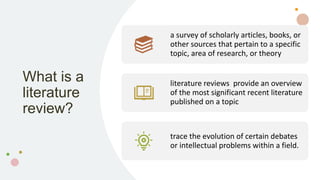
a survey of scholarly articles, books, or
other sources that pertain to a specific
topic, area of research, or theory
literature reviews provide an overview
of the most significant recent literature
published on a topic
trace the evolution of certain debates
or intellectual problems within a field.
Picking a Topic
Finding Relevant
Literature
JSTOR
Academic Search Complete,
Lexis/Nexis
EBSCO
And More!
Keywords and
phrases
• Searching with one or two phrases
surrounded by quotation marks will help to
limit the most relevant results, as only
articles that contain those two specific
phrases will be found.
Evaluating the
Literature
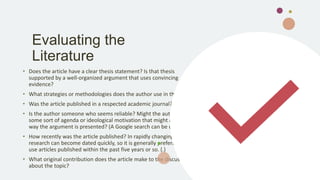
• Does the article have a clear thesis statement? Is that thesis
supported by a well-organized argument that uses convincing
evidence?
• What strategies or methodologies does the author use in the article?
• Was the article published in a respected academic journal?
• Is the author someone who seems reliable? Might the author have
some sort of agenda or ideological motivation that might affect the
way the argument is presented? (A Google search can be useful.)
• How recently was the article published? In rapidly changing fields,
research can become dated quickly, so it is generally preferable to
use articles published within the past five years or so. (.)
• What original contribution does the article make to the discussion
about the topic?
Organizing a
Literature
Review
Three parts
Introduction
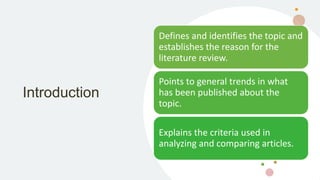
Defines and identifies the topic and
establishes the reason for the
literature review.
Points to general trends in what
has been published about the
topic.
Explains the criteria used in
analyzing and comparing articles.
Body of
the
Review
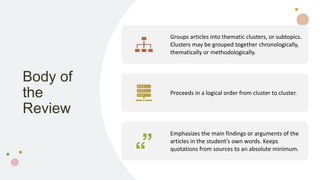
Groups articles into thematic clusters, or subtopics.
Clusters may be grouped together chronologically,
thematically or methodologically.
Proceeds in a logical order from cluster to cluster.
Emphasizes the main findings or arguments of the
articles in the student’s own words. Keeps
quotations from sources to an absolute minimum.
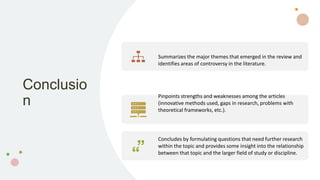
Conclusio
n
Summarizes the major themes that emerged in the review and
identifies areas of controversy in the literature.
Pinpoints strengths and weaknesses among the articles
(innovative methods used, gaps in research, problems with
theoretical frameworks, etc.).
Concludes by formulating questions that need further research
within the topic and provides some insight into the relationship
between that topic and the larger field of study or discipline.
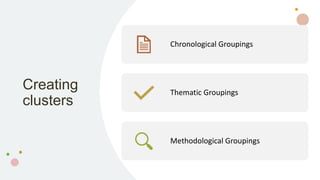
Creating
clusters
Chronological Groupings
Thematic Groupings
Methodological Groupings
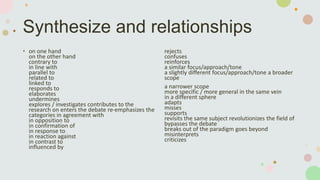
Synthesize and relationships
• on one hand
on the other hand
contrary to
in line with
parallel to
related to
linked to
responds to
elaborates
undermines
explores / investigates contributes to the
research on enters the debate re-emphasizes the
categories in agreement with
in opposition to
in confirmation of
in response to
in reaction against
in contrast to
influenced by
rejects
confuses
reinforces
a similar focus/approach/tone
a slightly different focus/approach/tone a broader
scope
a narrower scope
more specific / more general in the same vein
in a different sphere
adapts
misses
supports
revisits the same subject revolutionizes the field of
bypasses the debate
breaks out of the paradigm goes beyond
misinterprets
criticizes

Presentation2student.pptx

  • 1.
  • 2.
    What is a literature review? asurvey of scholarly articles, books, or other sources that pertain to a specific topic, area of research, or theory literature reviews provide an overview of the most significant recent literature published on a topic trace the evolution of certain debates or intellectual problems within a field.
  • 3.
  • 4.
    Finding Relevant Literature JSTOR Academic SearchComplete, Lexis/Nexis EBSCO And More!
  • 5.
    Keywords and phrases • Searchingwith one or two phrases surrounded by quotation marks will help to limit the most relevant results, as only articles that contain those two specific phrases will be found.
  • 6.
    Evaluating the Literature • Doesthe article have a clear thesis statement? Is that thesis supported by a well-organized argument that uses convincing evidence? • What strategies or methodologies does the author use in the article? • Was the article published in a respected academic journal? • Is the author someone who seems reliable? Might the author have some sort of agenda or ideological motivation that might affect the way the argument is presented? (A Google search can be useful.) • How recently was the article published? In rapidly changing fields, research can become dated quickly, so it is generally preferable to use articles published within the past five years or so. (.) • What original contribution does the article make to the discussion about the topic?
  • 7.
  • 8.
    Introduction Defines and identifiesthe topic and establishes the reason for the literature review. Points to general trends in what has been published about the topic. Explains the criteria used in analyzing and comparing articles.
  • 9.
    Body of the Review Groups articlesinto thematic clusters, or subtopics. Clusters may be grouped together chronologically, thematically or methodologically. Proceeds in a logical order from cluster to cluster. Emphasizes the main findings or arguments of the articles in the student’s own words. Keeps quotations from sources to an absolute minimum.
  • 10.
    Conclusio n Summarizes the majorthemes that emerged in the review and identifies areas of controversy in the literature. Pinpoints strengths and weaknesses among the articles (innovative methods used, gaps in research, problems with theoretical frameworks, etc.). Concludes by formulating questions that need further research within the topic and provides some insight into the relationship between that topic and the larger field of study or discipline.
  • 11.
  • 12.
    Synthesize and relationships •on one hand on the other hand contrary to in line with parallel to related to linked to responds to elaborates undermines explores / investigates contributes to the research on enters the debate re-emphasizes the categories in agreement with in opposition to in confirmation of in response to in reaction against in contrast to influenced by rejects confuses reinforces a similar focus/approach/tone a slightly different focus/approach/tone a broader scope a narrower scope more specific / more general in the same vein in a different sphere adapts misses supports revisits the same subject revolutionizes the field of bypasses the debate breaks out of the paradigm goes beyond misinterprets criticizes