Threshold Autoregressive (TAR) Models
• Movements between regimes governed by an observed variable.
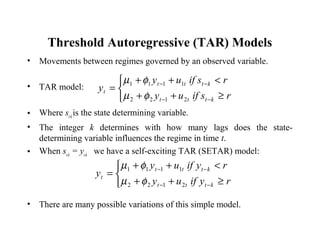
• TAR model:
• Where st-k
is the state determining variable.
• The integer k determines with how many lags does the state-
determining variable influences the regime in time t.
• When st-k
= yt-k
we have a self-exciting TAR (SETAR) model:
• There are many possible variations of this simple model.



≥++
<++
=
−−
−−
rsifuy
rsifuy
y
kttt
kttt
t
2122
1111
φµ
φµ



≥++
<++
=
−−
−−
ryifuy
ryifuy
y
kttt
kttt
t
2122
1111
φµ
φµ
Threshold Autoregressive (TAR) Models
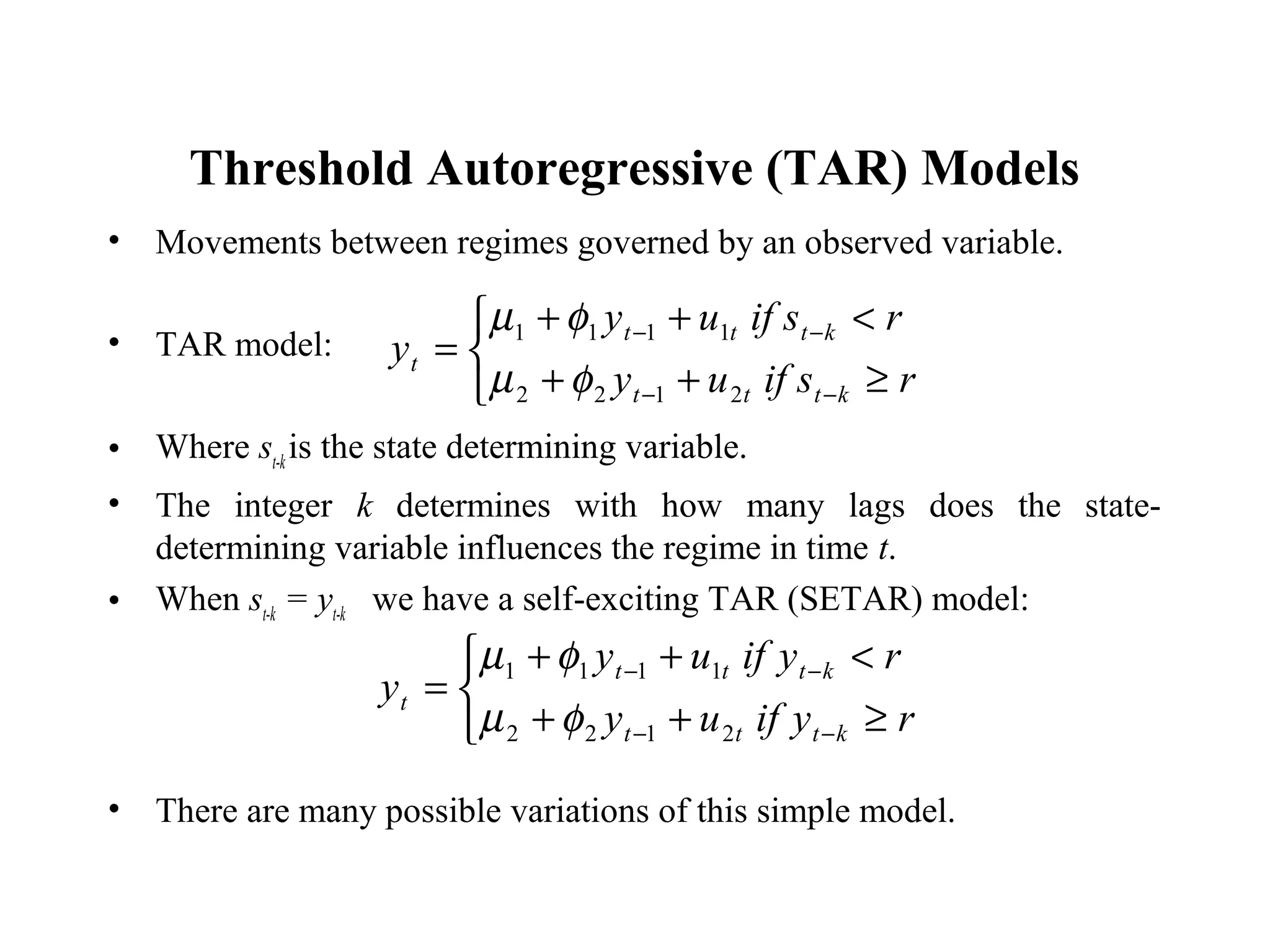
• Example: when st-k
= yt-k
we have a self-exciting TAR (SETAR) model:
• Consider k = 1. Parameters to be estimated:
µ1, µ2,σ1,σ2,
– r
• Estimation method: least squares with r estimated by a grid search.
• There are many possible variations of this simple model:
• Switching in only some of the parameters
• More than 2 regimes
• Different threshold variables
• Alternative dynamic specifications
Can use AIC or other information criteria to select models



≥++
<++
=
−−
−−
ryifuy
ryifuy
y
kttt
kttt
t
2122
1111
φµ
φµ
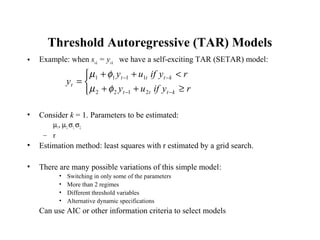
EXAMPLE: Threshold error correction (cointegration) model
2
4
6
8
10
12
14
16
18
1960 1965 1970 1975 1980 1985 1990
R3 R120
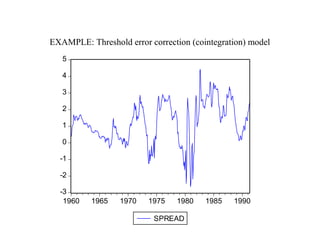
EXAMPLE: Threshold error correction (cointegration) model
-3
-2
-1
0
1
2
3
4
5
1960 1965 1970 1975 1980 1985 1990
SPREAD
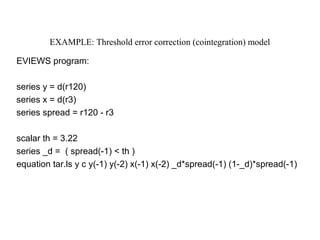
EXAMPLE: Threshold error correction (cointegration) model
EVIEWS program:
series y = d(r120)
series x = d(r3)
series spread = r120 - r3
scalar th = 3.22
series _d = ( spread(-1) < th )
equation tar.ls y c y(-1) y(-2) x(-1) x(-2) _d*spread(-1) (1-_d)*spread(-1)
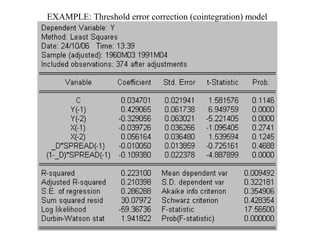
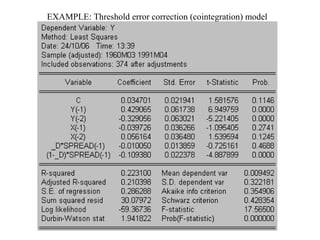
EXAMPLE: Threshold error correction (cointegration) model

Presentation_1375280857464

  • 1.
    Threshold Autoregressive (TAR)Models • Movements between regimes governed by an observed variable. • TAR model: • Where st-k is the state determining variable. • The integer k determines with how many lags does the state- determining variable influences the regime in time t. • When st-k = yt-k we have a self-exciting TAR (SETAR) model: • There are many possible variations of this simple model.    ≥++ <++ = −− −− rsifuy rsifuy y kttt kttt t 2122 1111 φµ φµ    ≥++ <++ = −− −− ryifuy ryifuy y kttt kttt t 2122 1111 φµ φµ
  • 2.
    Threshold Autoregressive (TAR)Models • Example: when st-k = yt-k we have a self-exciting TAR (SETAR) model: • Consider k = 1. Parameters to be estimated: µ1, µ2,σ1,σ2, – r • Estimation method: least squares with r estimated by a grid search. • There are many possible variations of this simple model: • Switching in only some of the parameters • More than 2 regimes • Different threshold variables • Alternative dynamic specifications Can use AIC or other information criteria to select models    ≥++ <++ = −− −− ryifuy ryifuy y kttt kttt t 2122 1111 φµ φµ
  • 3.
    EXAMPLE: Threshold errorcorrection (cointegration) model 2 4 6 8 10 12 14 16 18 1960 1965 1970 1975 1980 1985 1990 R3 R120
  • 4.
    EXAMPLE: Threshold errorcorrection (cointegration) model -3 -2 -1 0 1 2 3 4 5 1960 1965 1970 1975 1980 1985 1990 SPREAD
  • 5.
    EXAMPLE: Threshold errorcorrection (cointegration) model EVIEWS program: series y = d(r120) series x = d(r3) series spread = r120 - r3 scalar th = 3.22 series _d = ( spread(-1) < th ) equation tar.ls y c y(-1) y(-2) x(-1) x(-2) _d*spread(-1) (1-_d)*spread(-1)
  • 6.
    EXAMPLE: Threshold errorcorrection (cointegration) model
  • 7.
    EXAMPLE: Threshold errorcorrection (cointegration) model