Purpose of digital governor
• A digital governor is a control system used primarily in
hydropower turbines to:
• Maintain turbine speed at a desired set point despite load
variation
• Regulate power output to match grid demand
• Ensure system stability by responding rapidly to disturbances
• Optimize turbine efficiency by precise control of the wicket
gates or valves
• Reduce mechanical wear maintenance by replacing
mechanical linkages with electronic controls
• Enable remote monitoring and diagnosis via digital
communication interfaces
Components of digital governor
• Sensors
• Measure turbine speed ,load and other crtical parameters
• Often include speed sensors (tachometers) pressure sensors,and flow meters
• Controller unit (digital processor
• A microprocessor or PLC that excute the control algorithms
• Converts sensor inputs in to control signals for actuters
• Often programable for different operating modes
• Actaters /servomechanisms
• Hydraulic or electronic actuaters that adjust the position of the turbine gates /valves
• Receive controlsignal from the digital controller
• Human machine interface/HMI
• Display system status ,alrm,and allow s operator input
• Used for configrartion ,monitoring and manual overide
• Communication interfaces
• Connect the governor to plant control system like SCADA or DCS
• Enables dta exchange for monitoring and remote control
• Power supply
• Provide eelectrical power to sensors ccontrollrs and actuaters
Operation of digital governor
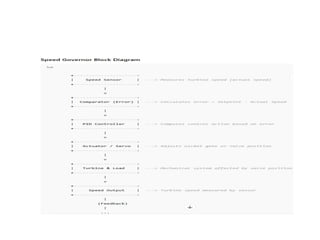
• The sensor measure the actual turbine speedand load
• The controllr compares the measured speed with the desired
speed setpoint
• Based on this error , the controller compares the required
adjustment using control algorithm (PID)
• The controller send signal to the actuator , which adjusts the
wickate gate or valve position
• This ajustment changes the water flow , which affects turbine
speed and power output
• The system continoisly monitors and adjusts to maintaine
stable operation under varieng load condition
Control mechanism
• Speed controller mode : maintain constant
turbine speed regardless of the load change
• Load contrl mode: regulate power output by
controlling turbine speed within limites
• Valve position control : direct control of wickate
gate to manage flow precisely
• Droop control : implement proportional speed
drop with increasing load to share load between
multiple turbines
What is PID controller
• PID stands for
• Proportional,integral-derivative , which are the three
control action combined to create a robust control loop
• Proportional (P): Reacts proportionally to the current
eror ( difference betewwn desired and actual turbine
speed )
• Intgral (I): Reacts to the accumulation of past errors ,
eliminating steady state ofset
• Derivative (D): react to the rate of change of the
error ,pridicting future treands and improving stability.
Role of PID IN Digital governor
• Error input :-the PID controller recieves the error signal
between the turbines actual and the target speed
• Control output: it compares the corrective action that
adjust the wickate gate or valve position via acctuateers
• Speed regulation : ensures turbine speed is maintained
pricisely even under changing load or water flow
• Load sharing :in multi-turbine plants PID helps
maintaine proper load sharing betewwn units
• Damping osillation :the derivative term helps reduce
osilation and stablize the system quikly
How PID works IN Digital Governor
• Proportional term(P)n provide
• Immediate response based on current error
• Large error-strong correction, but to high proportional gain can
cause oscillation
• Integral term(I): provides
• Sums past error over time to eliminate persistent deviations (steady
state error )
• Helps ensure the turbine speed exactly matches the set point
• Derivative term(D): provide
• Respond to how fast the error s changing , providing a predictive
control action
• Helps smooth out the response and avoid overshoot
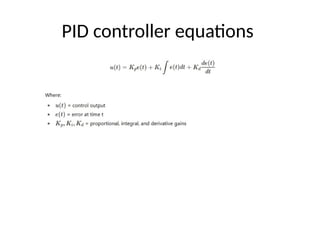
PID controller equations
Benefits of using PID digital governor
• Precise control
• Adaptability
• Stability
• Improved efficiency
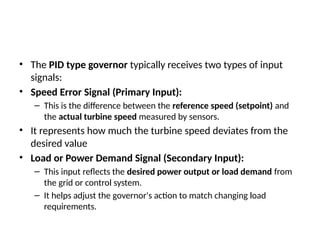
• The PID type governor typically receives two types of input
signals:
• Speed Error Signal (Primary Input):
– This is the difference between the reference speed (setpoint) and
the actual turbine speed measured by sensors.
• It represents how much the turbine speed deviates from the
desired value
• Load or Power Demand Signal (Secondary Input):
– This input reflects the desired power output or load demand from
the grid or control system.
– It helps adjust the governor's action to match changing load
requirements.
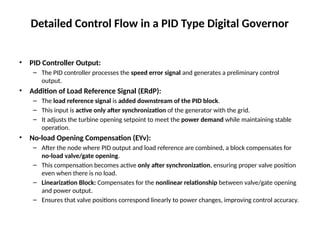
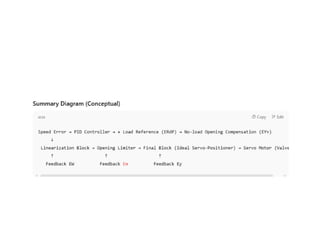
Detailed Control Flow in a PID Type Digital Governor
• PID Controller Output:
– The PID controller processes the speed error signal and generates a preliminary control
output.
• Addition of Load Reference Signal (ERdP):
– The load reference signal is added downstream of the PID block.
– This input is active only after synchronization of the generator with the grid.
– It adjusts the turbine opening setpoint to meet the power demand while maintaining stable
operation.
• No-load Opening Compensation (EYv):
– After the node where PID output and load reference are combined, a block compensates for
no-load valve/gate opening.
– This compensation becomes active only after synchronization, ensuring proper valve position
even when there is no load.
– Linearization Block: Compensates for the nonlinear relationship between valve/gate opening
and power output.
– Ensures that valve positions correspond linearly to power changes, improving control accuracy.
• Saturation Feedback Loops:
– The output of the linearization block goes through saturation limits to prevent over or
under-opening.
– Feedback signals control these saturations:
• EW: Feedback from the linearization block.
• Em: Feedback from the limitation block.
• Ey: Final setpoint feedback to the positioner.
• Opening Limiter Block:
– Placed after linearization.
– Ensures valve opening stays within mechanical and operational limits.
• Final Block (Ideal Servo-Positioner):
– Acts as an ideal servo-positioner sending the final valve opening setpoint to the servo
motors.
– Includes calibration of operating times for servo-motors (speed and response tuning).
– Ensures smooth, timely valve movements as commanded by the governor.
Presentation12E3RWDERFGDEFQGGFEWFW21S1.pptx

Presentation12E3RWDERFGDEFQGGFEWFW21S1.pptx

  • 2.
    Purpose of digitalgovernor • A digital governor is a control system used primarily in hydropower turbines to: • Maintain turbine speed at a desired set point despite load variation • Regulate power output to match grid demand • Ensure system stability by responding rapidly to disturbances • Optimize turbine efficiency by precise control of the wicket gates or valves • Reduce mechanical wear maintenance by replacing mechanical linkages with electronic controls • Enable remote monitoring and diagnosis via digital communication interfaces
  • 3.
    Components of digitalgovernor • Sensors • Measure turbine speed ,load and other crtical parameters • Often include speed sensors (tachometers) pressure sensors,and flow meters • Controller unit (digital processor • A microprocessor or PLC that excute the control algorithms • Converts sensor inputs in to control signals for actuters • Often programable for different operating modes • Actaters /servomechanisms • Hydraulic or electronic actuaters that adjust the position of the turbine gates /valves • Receive controlsignal from the digital controller • Human machine interface/HMI • Display system status ,alrm,and allow s operator input • Used for configrartion ,monitoring and manual overide • Communication interfaces • Connect the governor to plant control system like SCADA or DCS • Enables dta exchange for monitoring and remote control • Power supply • Provide eelectrical power to sensors ccontrollrs and actuaters
  • 4.
    Operation of digitalgovernor • The sensor measure the actual turbine speedand load • The controllr compares the measured speed with the desired speed setpoint • Based on this error , the controller compares the required adjustment using control algorithm (PID) • The controller send signal to the actuator , which adjusts the wickate gate or valve position • This ajustment changes the water flow , which affects turbine speed and power output • The system continoisly monitors and adjusts to maintaine stable operation under varieng load condition
  • 5.
    Control mechanism • Speedcontroller mode : maintain constant turbine speed regardless of the load change • Load contrl mode: regulate power output by controlling turbine speed within limites • Valve position control : direct control of wickate gate to manage flow precisely • Droop control : implement proportional speed drop with increasing load to share load between multiple turbines
  • 6.
    What is PIDcontroller • PID stands for • Proportional,integral-derivative , which are the three control action combined to create a robust control loop • Proportional (P): Reacts proportionally to the current eror ( difference betewwn desired and actual turbine speed ) • Intgral (I): Reacts to the accumulation of past errors , eliminating steady state ofset • Derivative (D): react to the rate of change of the error ,pridicting future treands and improving stability.
  • 7.
    Role of PIDIN Digital governor • Error input :-the PID controller recieves the error signal between the turbines actual and the target speed • Control output: it compares the corrective action that adjust the wickate gate or valve position via acctuateers • Speed regulation : ensures turbine speed is maintained pricisely even under changing load or water flow • Load sharing :in multi-turbine plants PID helps maintaine proper load sharing betewwn units • Damping osillation :the derivative term helps reduce osilation and stablize the system quikly
  • 8.
    How PID worksIN Digital Governor • Proportional term(P)n provide • Immediate response based on current error • Large error-strong correction, but to high proportional gain can cause oscillation • Integral term(I): provides • Sums past error over time to eliminate persistent deviations (steady state error ) • Helps ensure the turbine speed exactly matches the set point • Derivative term(D): provide • Respond to how fast the error s changing , providing a predictive control action • Helps smooth out the response and avoid overshoot
  • 9.
  • 10.
    Benefits of usingPID digital governor • Precise control • Adaptability • Stability • Improved efficiency
  • 12.
    • The PIDtype governor typically receives two types of input signals: • Speed Error Signal (Primary Input): – This is the difference between the reference speed (setpoint) and the actual turbine speed measured by sensors. • It represents how much the turbine speed deviates from the desired value • Load or Power Demand Signal (Secondary Input): – This input reflects the desired power output or load demand from the grid or control system. – It helps adjust the governor's action to match changing load requirements.
  • 13.
    Detailed Control Flowin a PID Type Digital Governor • PID Controller Output: – The PID controller processes the speed error signal and generates a preliminary control output. • Addition of Load Reference Signal (ERdP): – The load reference signal is added downstream of the PID block. – This input is active only after synchronization of the generator with the grid. – It adjusts the turbine opening setpoint to meet the power demand while maintaining stable operation. • No-load Opening Compensation (EYv): – After the node where PID output and load reference are combined, a block compensates for no-load valve/gate opening. – This compensation becomes active only after synchronization, ensuring proper valve position even when there is no load. – Linearization Block: Compensates for the nonlinear relationship between valve/gate opening and power output. – Ensures that valve positions correspond linearly to power changes, improving control accuracy.
  • 14.
    • Saturation FeedbackLoops: – The output of the linearization block goes through saturation limits to prevent over or under-opening. – Feedback signals control these saturations: • EW: Feedback from the linearization block. • Em: Feedback from the limitation block. • Ey: Final setpoint feedback to the positioner. • Opening Limiter Block: – Placed after linearization. – Ensures valve opening stays within mechanical and operational limits. • Final Block (Ideal Servo-Positioner): – Acts as an ideal servo-positioner sending the final valve opening setpoint to the servo motors. – Includes calibration of operating times for servo-motors (speed and response tuning). – Ensures smooth, timely valve movements as commanded by the governor.