Training Module: 400kV Switchyard
Operation, Maintenance, Testing,
and Protection
• Training Module: 400kV Switchyard Operation, Maintenance, Testing, and
Protection
• Presenter Name
• Date
Training Objectives
• Understand the structure and functions of 400kV switchyard components
• Learn safe and correct operation of 400kV equipment
• Know maintenance and testing protocols for 400kV systems
• Understand protection schemes at 400kV level
• Follow safety and documentation procedures
Overview of Electrical Power
System
• Generation → Transmission → Distribution
• 400kV role: Bulk power transmission
• Importance of switchyards in system reliability
Types of Switchyards
• Air Insulated Switchgear (AIS)
• Gas Insulated Switchgear (GIS)
• Hybrid Switchyards
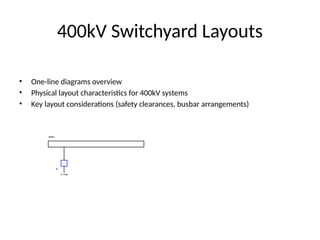
400kV Switchyard Layouts
• One-line diagrams overview
• Physical layout characteristics for 400kV systems
• Key layout considerations (safety clearances, busbar arrangements)
Major Components of 400kV
Switchyard
• Power Transformers (400/220kV, 315MVA+)
• Circuit Breakers (SF6 type, 400kV rated)
• Isolators/Disconnectors (motor-operated)
• Current Transformers (CTs) & Capacitor Voltage Transformers (CVTs)
• Lightning Arresters
• Busbars (quad moose or equivalent)
• Control & Relay Panels (numerical relays)
Practical Session
• Site visit or virtual tour of 400kV switchyard
• Study physical components and layout
• Q&A
Operational Philosophy
• Load flow management in 400kV transmission
• Synchronization of 400kV lines
Operating Procedures
• Circuit Breaker operation under 400kV protocols
• Isolator and Earth switch operation (motorized)
• Standard switching sequence for 400kV lines and transformers
Coordination with SLDC/RLDC &
SCADA
• Communication protocols for 400kV operations
• SCADA and remote control systems
Operational Hazards and
Mitigation
• Induction effects in 400kV lines
• Safety grounding and back-feed control
Practical Exercises
• Simulation of 400kV switching sequences
• SCADA demo (if available)
Maintenance Types Overview
• Preventive Maintenance in high-voltage environments
• Predictive Maintenance using DGA, IR, and thermography
Circuit Breaker Maintenance
• Contact wear analysis
• SF6 gas pressure checks
• Lubrication and mechanical inspection
Isolator Maintenance
• Motor operation check
• Alignment and lubrication
CTs and CVTs Maintenance
• Insulation resistance measurement
• Secondary circuit testing
Power Transformer Maintenance
• Dissolved Gas Analysis (DGA)
• Insulation testing
• Breakdown voltage (BDV) tests
Maintenance Tools and Record
Keeping
• Checklists
• Infrared cameras and gas analyzers
• Online monitoring systems
Practical Exercises
• DGA interpretation
• IR thermography practice
• Mock maintenance
Equipment Testing Overview
• Importance of testing in 400kV switchyards
• Test schedules and protocols
Circuit Breaker Testing
• Timing tests (primary injection)
• Contact resistance tests
Transformer Testing
• Turns ratio test
• Insulation resistance (IR) and Tan Delta tests
• Sweep Frequency Response Analysis (SFRA)
CT/PT Testing
• Ratio and polarity tests
• Insulation tests
Protection Principles
• Primary and backup protection concepts
• Zones of protection in EHV transmission
Protection Schemes at 400kV
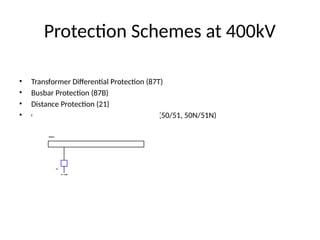
• Transformer Differential Protection (87T)
• Busbar Protection (87B)
• Distance Protection (21)
• Overcurrent and Earth Fault Protection (50/51, 50N/51N)
Relay Testing and Settings
• Secondary injection testing
• Distance relay zone settings and coordination
Practical Demonstrations
• Relay testing with Omicron kits or equivalent
• Setting configurations and simulations
Electrical Safety Practices
• PPE and Safety Gear for 400kV work
• Permit to Work (PTW) systems
• Lockout-Tagout (LOTO) procedures
• Safe earthing practices
Emergency Procedures
• Arc flash risk mitigation
• Oil fire and gas leak response protocols
Reporting and Documentation
• Daily logbooks
• Test and maintenance reports
• Disturbance and fault analysis reports
Assessment and Feedback
• Written test overview
• Practical demonstration assessment
• Participant feedback process
Closing and Certification
• Summary of key learning points
• Certification details
• Q&A and final remarks

400kV_Switchyard_Training_with_Diagrams.pptx

  • 1.
    Training Module: 400kVSwitchyard Operation, Maintenance, Testing, and Protection • Training Module: 400kV Switchyard Operation, Maintenance, Testing, and Protection • Presenter Name • Date
  • 2.
    Training Objectives • Understandthe structure and functions of 400kV switchyard components • Learn safe and correct operation of 400kV equipment • Know maintenance and testing protocols for 400kV systems • Understand protection schemes at 400kV level • Follow safety and documentation procedures
  • 3.
    Overview of ElectricalPower System • Generation → Transmission → Distribution • 400kV role: Bulk power transmission • Importance of switchyards in system reliability
  • 4.
    Types of Switchyards •Air Insulated Switchgear (AIS) • Gas Insulated Switchgear (GIS) • Hybrid Switchyards
  • 5.
    400kV Switchyard Layouts •One-line diagrams overview • Physical layout characteristics for 400kV systems • Key layout considerations (safety clearances, busbar arrangements)
  • 6.
    Major Components of400kV Switchyard • Power Transformers (400/220kV, 315MVA+) • Circuit Breakers (SF6 type, 400kV rated) • Isolators/Disconnectors (motor-operated) • Current Transformers (CTs) & Capacitor Voltage Transformers (CVTs) • Lightning Arresters • Busbars (quad moose or equivalent) • Control & Relay Panels (numerical relays)
  • 7.
    Practical Session • Sitevisit or virtual tour of 400kV switchyard • Study physical components and layout • Q&A
  • 8.
    Operational Philosophy • Loadflow management in 400kV transmission • Synchronization of 400kV lines
  • 9.
    Operating Procedures • CircuitBreaker operation under 400kV protocols • Isolator and Earth switch operation (motorized) • Standard switching sequence for 400kV lines and transformers
  • 10.
    Coordination with SLDC/RLDC& SCADA • Communication protocols for 400kV operations • SCADA and remote control systems
  • 11.
    Operational Hazards and Mitigation •Induction effects in 400kV lines • Safety grounding and back-feed control
  • 12.
    Practical Exercises • Simulationof 400kV switching sequences • SCADA demo (if available)
  • 13.
    Maintenance Types Overview •Preventive Maintenance in high-voltage environments • Predictive Maintenance using DGA, IR, and thermography
  • 14.
    Circuit Breaker Maintenance •Contact wear analysis • SF6 gas pressure checks • Lubrication and mechanical inspection
  • 15.
    Isolator Maintenance • Motoroperation check • Alignment and lubrication
  • 16.
    CTs and CVTsMaintenance • Insulation resistance measurement • Secondary circuit testing
  • 17.
    Power Transformer Maintenance •Dissolved Gas Analysis (DGA) • Insulation testing • Breakdown voltage (BDV) tests
  • 18.
    Maintenance Tools andRecord Keeping • Checklists • Infrared cameras and gas analyzers • Online monitoring systems
  • 19.
    Practical Exercises • DGAinterpretation • IR thermography practice • Mock maintenance
  • 20.
    Equipment Testing Overview •Importance of testing in 400kV switchyards • Test schedules and protocols
  • 21.
    Circuit Breaker Testing •Timing tests (primary injection) • Contact resistance tests
  • 22.
    Transformer Testing • Turnsratio test • Insulation resistance (IR) and Tan Delta tests • Sweep Frequency Response Analysis (SFRA)
  • 23.
    CT/PT Testing • Ratioand polarity tests • Insulation tests
  • 24.
    Protection Principles • Primaryand backup protection concepts • Zones of protection in EHV transmission
  • 25.
    Protection Schemes at400kV • Transformer Differential Protection (87T) • Busbar Protection (87B) • Distance Protection (21) • Overcurrent and Earth Fault Protection (50/51, 50N/51N)
  • 26.
    Relay Testing andSettings • Secondary injection testing • Distance relay zone settings and coordination
  • 27.
    Practical Demonstrations • Relaytesting with Omicron kits or equivalent • Setting configurations and simulations
  • 28.
    Electrical Safety Practices •PPE and Safety Gear for 400kV work • Permit to Work (PTW) systems • Lockout-Tagout (LOTO) procedures • Safe earthing practices
  • 29.
    Emergency Procedures • Arcflash risk mitigation • Oil fire and gas leak response protocols
  • 30.
    Reporting and Documentation •Daily logbooks • Test and maintenance reports • Disturbance and fault analysis reports
  • 31.
    Assessment and Feedback •Written test overview • Practical demonstration assessment • Participant feedback process
  • 32.
    Closing and Certification •Summary of key learning points • Certification details • Q&A and final remarks

Editor's Notes

  • #1 Expand on slide content as needed.
  • #2 Explain the importance of understanding the 400kV switchyard components and their role in reliable power transmission. Emphasize safety, operation, maintenance, testing, and protection.
  • #3 Briefly describe the flow of electrical power from generation through transmission to distribution. Highlight the 400kV level's role in bulk power transmission and the critical function of switchyards.
  • #4 Introduce Air Insulated Switchgear (AIS), Gas Insulated Switchgear (GIS), and Hybrid types. Discuss pros and cons briefly.
  • #5 Show one-line diagrams and physical layouts. Explain safety clearances and busbar arrangements.
  • #6 Discuss key equipment: transformers, breakers, isolators, CTs, CVTs, lightning arresters, busbars, and control panels.
  • #7 Encourage participants to observe real equipment and layouts during site visits or virtual tours.
  • #8 Explain how load flow is managed and how synchronization of lines at 400kV works.
  • #9 Explain standard procedures for breaker and isolator operation. Highlight importance of following sequences to maintain system stability.
  • #10 Explain communication protocols with control centers. Show how SCADA facilitates remote operation and monitoring.
  • #11 Discuss hazards such as induction effects and back-feed. Explain grounding and safety practices.
  • #12 Suggest simulation exercises and SCADA demonstrations for hands-on learning.
  • #13 Describe preventive and predictive maintenance. Introduce diagnostic tools like DGA and thermography.
  • #14 Explain SF6 breaker maintenance tasks including gas pressure checks and mechanical inspections.
  • #15 Explain motor operation checks and lubrication needs.
  • #16 Describe insulation resistance measurements and secondary testing.
  • #17 Detail dissolved gas analysis, insulation tests, and BDV tests.
  • #18 Discuss importance of checklists and modern tools like infrared cameras. Stress accurate record keeping.
  • #19 Suggest simulation exercises and SCADA demonstrations for hands-on learning.
  • #20 Explain the importance of regular testing and adherence to schedules.
  • #21 Describe timing and contact resistance tests.
  • #22 Explain turns ratio, IR, Tan Delta, and SFRA tests.
  • #23 Discuss ratio, polarity, and insulation tests.
  • #24 Explain primary and backup protection concepts. Define protection zones.
  • #25 Discuss transformer differential, busbar, distance, overcurrent, and earth fault protection.
  • #26 Describe secondary injection tests and relay coordination.
  • #27 Encourage use of relay test kits and simulation software.
  • #28 Stress the use of PPE, permit to work, LOTO, and safe earthing in 400kV environments.
  • #29 Explain arc flash risks and emergency response for fires and gas leaks.
  • #30 Emphasize importance of logs, test reports, and fault analysis documentation.
  • #31 Explain written and practical tests and how feedback improves training.
  • #32 Summarize key points, describe certification, and open for Q&A.