Aaliyah moon
8Th Grade

Three states of
matter
A. States of matter
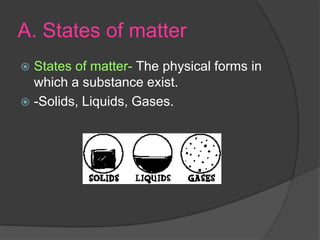
States of matter- The physical forms in
which a substance exist.
 -Solids, Liquids, Gases.

B. Solids
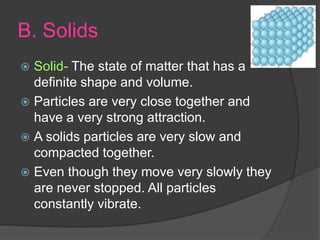
Solid- The state of matter that has a
definite shape and volume.
 Particles are very close together and
have a very strong attraction.
 A solids particles are very slow and
compacted together.
 Even though they move very slowly they
are never stopped. All particles
constantly vibrate.

B. Solids cont.
Ex.
- Desk
- Walls
- People
- Paper
- Cups

C. Liquids
Liquids- The state of matter that has a
definite volume but takes the same
shape of its container.
 These particles move just enough for
some particles to separate. They over
come the attraction.
 All liquids have surface tension.

C. Liquids cont.
Surface tension- A force that holds
together particles at the surface of a
liquid.
 The higher surface tension the more it
bubbles over.
 Viscosity- A liquids resistance to flow
 All liquids have viscosity.

C. Liquids cont.
Ex.
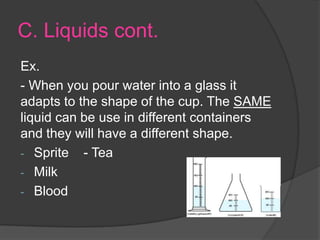
- When you pour water into a glass it
adapts to the shape of the cup. The SAME
liquid can be use in different containers
and they will have a different shape.
- Sprite - Tea
- Milk
- Blood
D. Gases
Gas- The state of matter that has no
definite shape or volume.
 These particles break free of their
attraction very easily because they
move so fast.
 Temperature can change the gases
volume.

D. Gases cont.
Ex.
- Farts
- Oxygen
- Hydrogen
- Smoke
- Helium

The helium
inside
1. Charles’s Law
Charles’s law states temperature
changes with volume.
 When the temperature goes down, the
volume goes down.
 When temperature goes up so does
volume.
Same balloon


Hot day

Cold day

Three States of Matter

  • 1.
  • 2.
    A. States ofmatter States of matter- The physical forms in which a substance exist.  -Solids, Liquids, Gases. 
  • 3.
    B. Solids Solid- Thestate of matter that has a definite shape and volume.  Particles are very close together and have a very strong attraction.  A solids particles are very slow and compacted together.  Even though they move very slowly they are never stopped. All particles constantly vibrate. 
  • 4.
    B. Solids cont. Ex. -Desk - Walls - People - Paper - Cups 
  • 5.
    C. Liquids Liquids- Thestate of matter that has a definite volume but takes the same shape of its container.  These particles move just enough for some particles to separate. They over come the attraction.  All liquids have surface tension. 
  • 6.
    C. Liquids cont. Surfacetension- A force that holds together particles at the surface of a liquid.  The higher surface tension the more it bubbles over.  Viscosity- A liquids resistance to flow  All liquids have viscosity. 
  • 7.
    C. Liquids cont. Ex. -When you pour water into a glass it adapts to the shape of the cup. The SAME liquid can be use in different containers and they will have a different shape. - Sprite - Tea - Milk - Blood
  • 8.
    D. Gases Gas- Thestate of matter that has no definite shape or volume.  These particles break free of their attraction very easily because they move so fast.  Temperature can change the gases volume. 
  • 9.
    D. Gases cont. Ex. -Farts - Oxygen - Hydrogen - Smoke - Helium The helium inside
  • 10.
    1. Charles’s Law Charles’slaw states temperature changes with volume.  When the temperature goes down, the volume goes down.  When temperature goes up so does volume. Same balloon  Hot day Cold day