Grammarsaurus
Word Class
Y5/ Y6
www.grammarsaurus.co.uk
A recap on earlier years’ word class learning for Year 5 and 6 classes
1
www.grammarsaurus.co.uk
What does word class mean?
Word class is a category of words, which are grouped
together due to similar form or function.
Time yourself and record how long it
takes you to complete.
We are going to look at the eight main word classes.
As a warm up, can you match the word class with its definition?
(Task one)
www.grammarsaurus.co.uk
1
2
Quickfire
Word class 1: Nouns
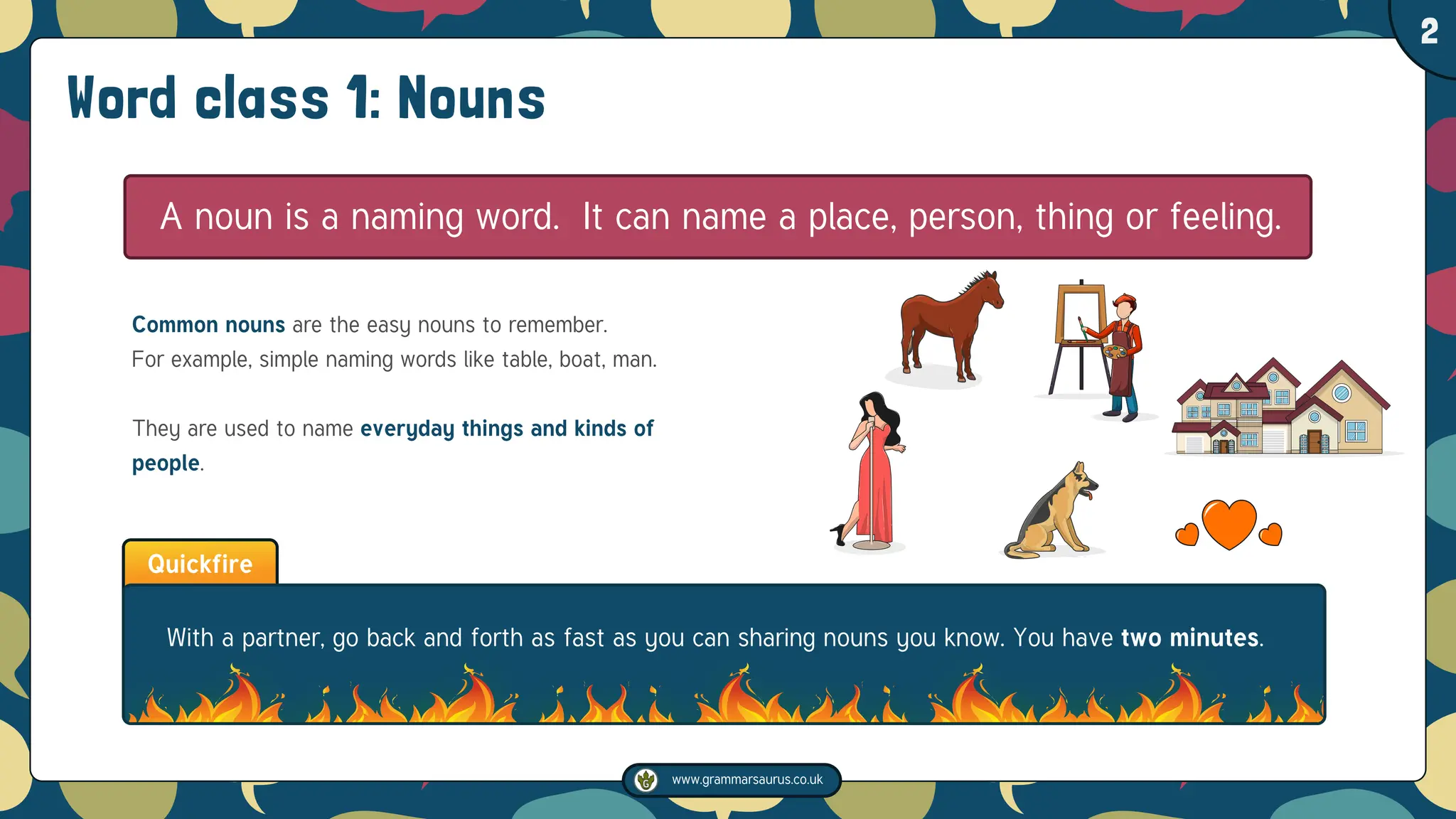
A noun is a naming word. It can name a place, person, thing or feeling.
Common nouns are the easy nouns to remember.
For example, simple naming words like table, boat, man.
They are used to name everyday things and kinds of
people.
With a partner, go back and forth as fast as you can sharing nouns you know. You have two minutes.
www.grammarsaurus.co.uk
1
3
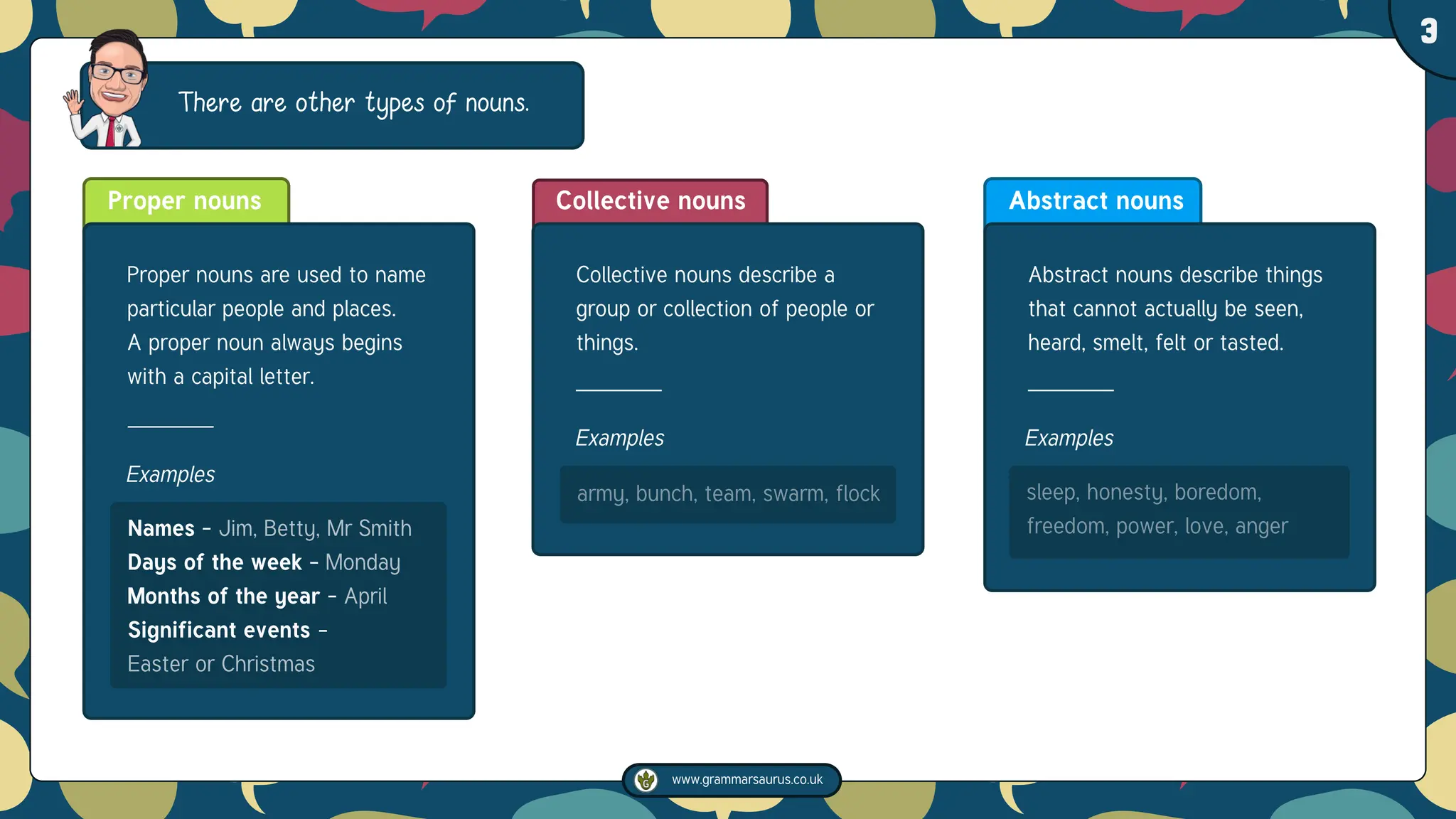
There are other types of nouns.
Proper nouns
Proper nouns are used to name
particular people and places.
A proper noun always begins
with a capital letter.
Collective nouns
Collective nouns describe a
group or collection of people or
things.
Abstract nouns
Abstract nouns describe things
that cannot actually be seen,
heard, smelt, felt or tasted.
Examples
Names - Jim, Betty, Mr Smith
Days of the week - Monday
Months of the year - April
Significant events –
Easter or Christmas
Examples
army, bunch, team, swarm, flock
Examples
sleep, honesty, boredom,
freedom, power, love, anger
www.grammarsaurus.co.uk
1
4
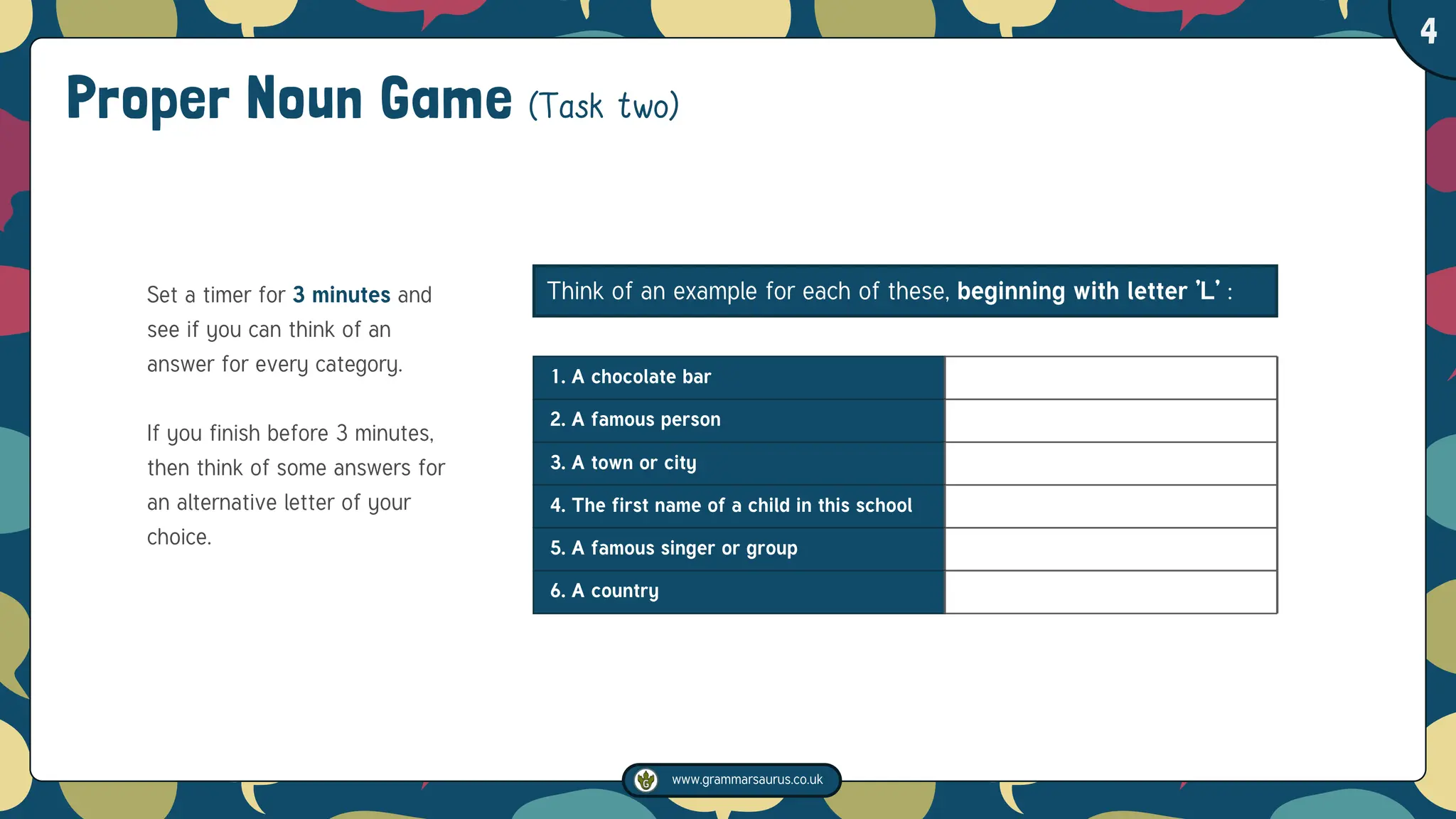
Proper Noun Game (Task two)
Set a timer for 3 minutes and
see if you can think of an
answer for every category.
If you finish before 3 minutes,
then think of some answers for
an alternative letter of your
choice.
Think of an example for each of these, beginning with letter ’L’ :
1. A chocolate bar
2. A famous person
3. A town or city
4. The first name of a child in this school
5. A famous singer or group
6. A country
www.grammarsaurus.co.uk
1
5
In your booklet, sort the different types of
nouns into the correct noun categories.
Challenge: Can you create your
own table with different nouns?
Noun Sorter (Task three)
www.grammarsaurus.co.uk
1
6
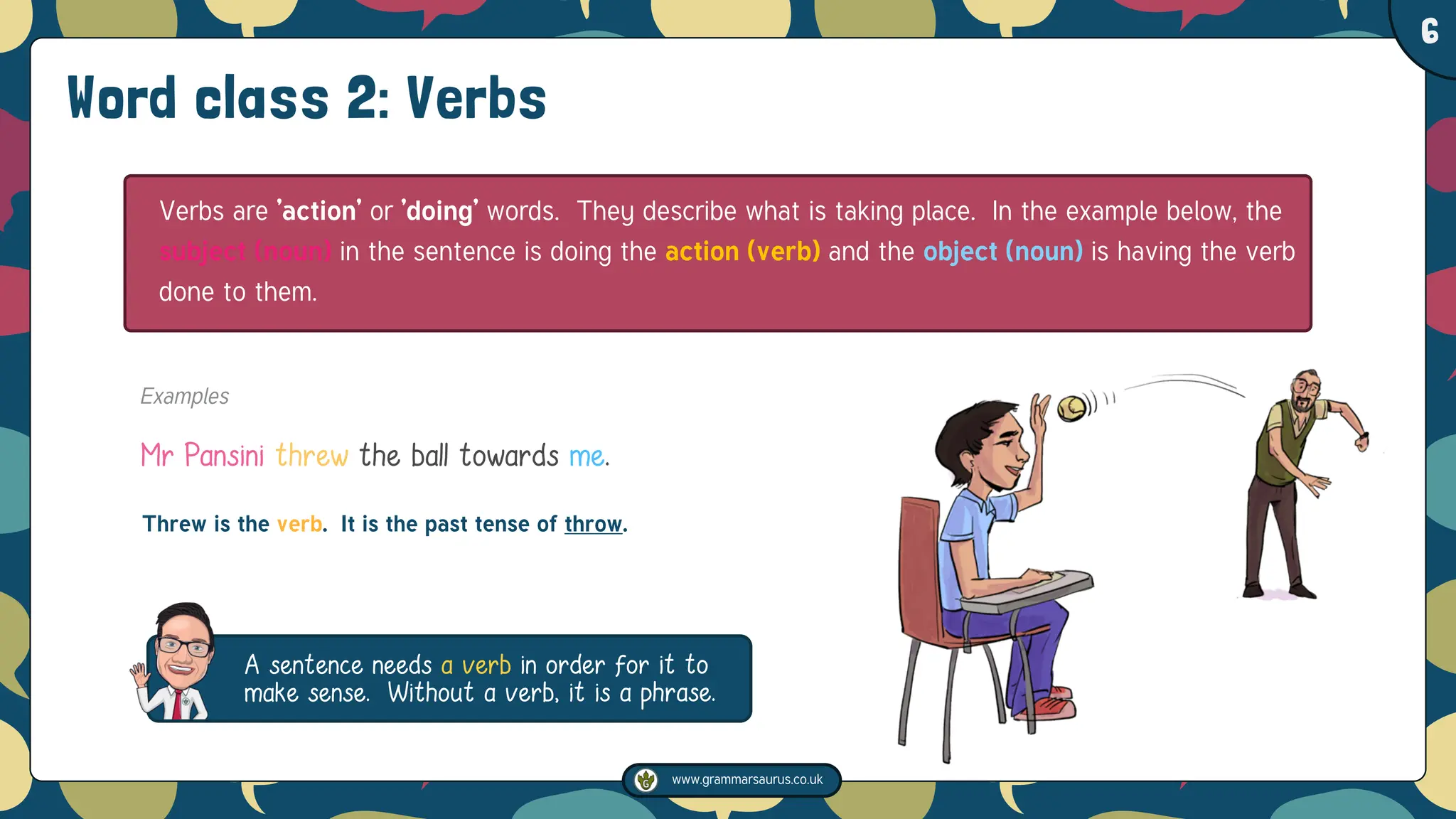
Word class 2: Verbs
Verbs are ’action’ or ’doing’ words. They describe what is taking place. In the example below, the
subject (noun) in the sentence is doing the action (verb) and the object (noun) is having the verb
done to them.
Examples
Mr Pansini threw the ball towards me.
Threw is the verb. It is the past tense of throw.
A sentence needs a verb in order for it to
make sense. Without a verb, it is a phrase.
www.grammarsaurus.co.uk
1
7
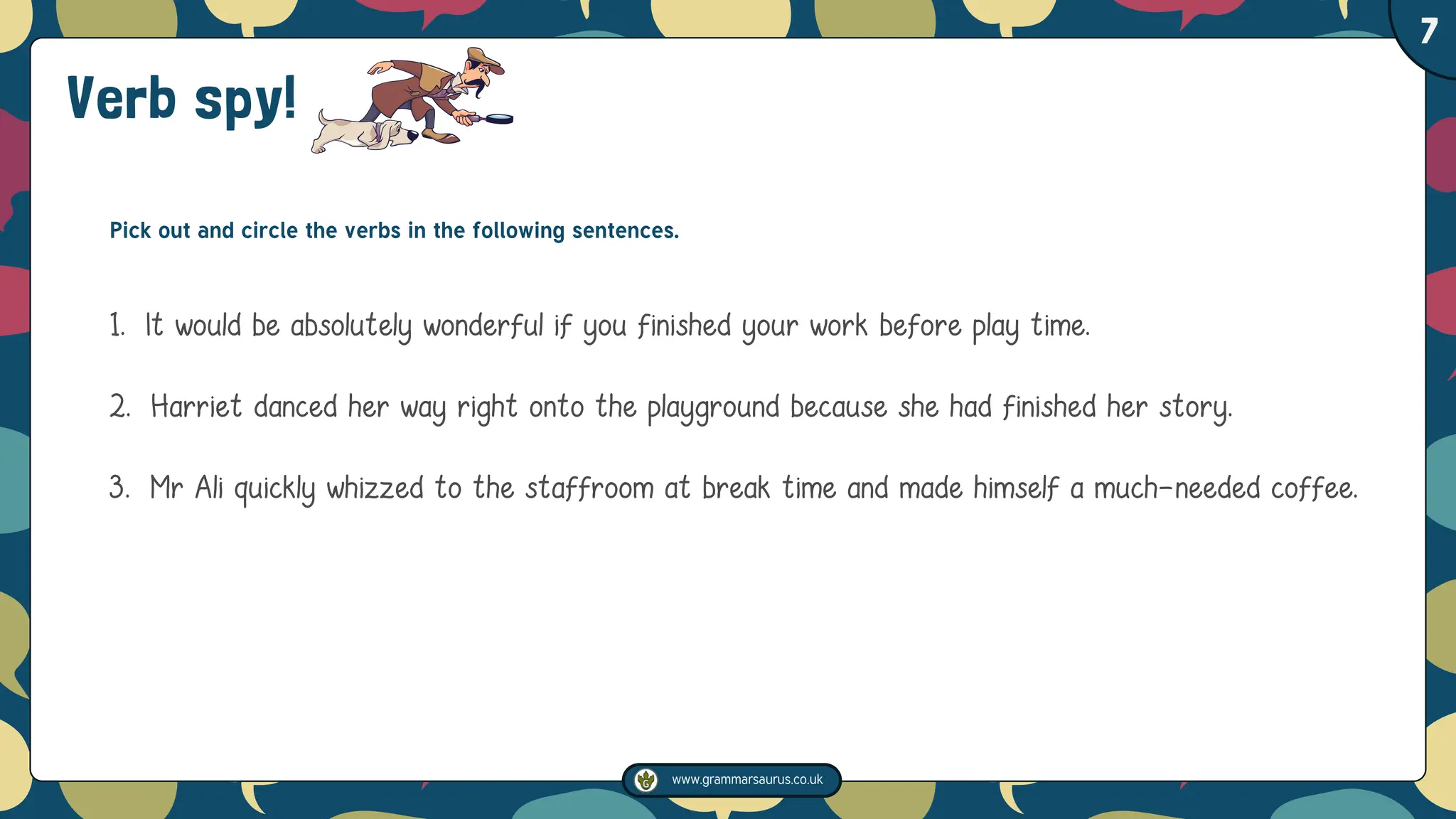
Verb spy!
Pick out and circle the verbs in the following sentences.
1. It would be absolutely wonderful if you finished your work before play time.
2. Harriet danced her way right onto the playground because she had finished her story.
3. Mr Ali quickly whizzed to the staffroom at break time and made himself a much-needed coffee.
www.grammarsaurus.co.uk
1
8
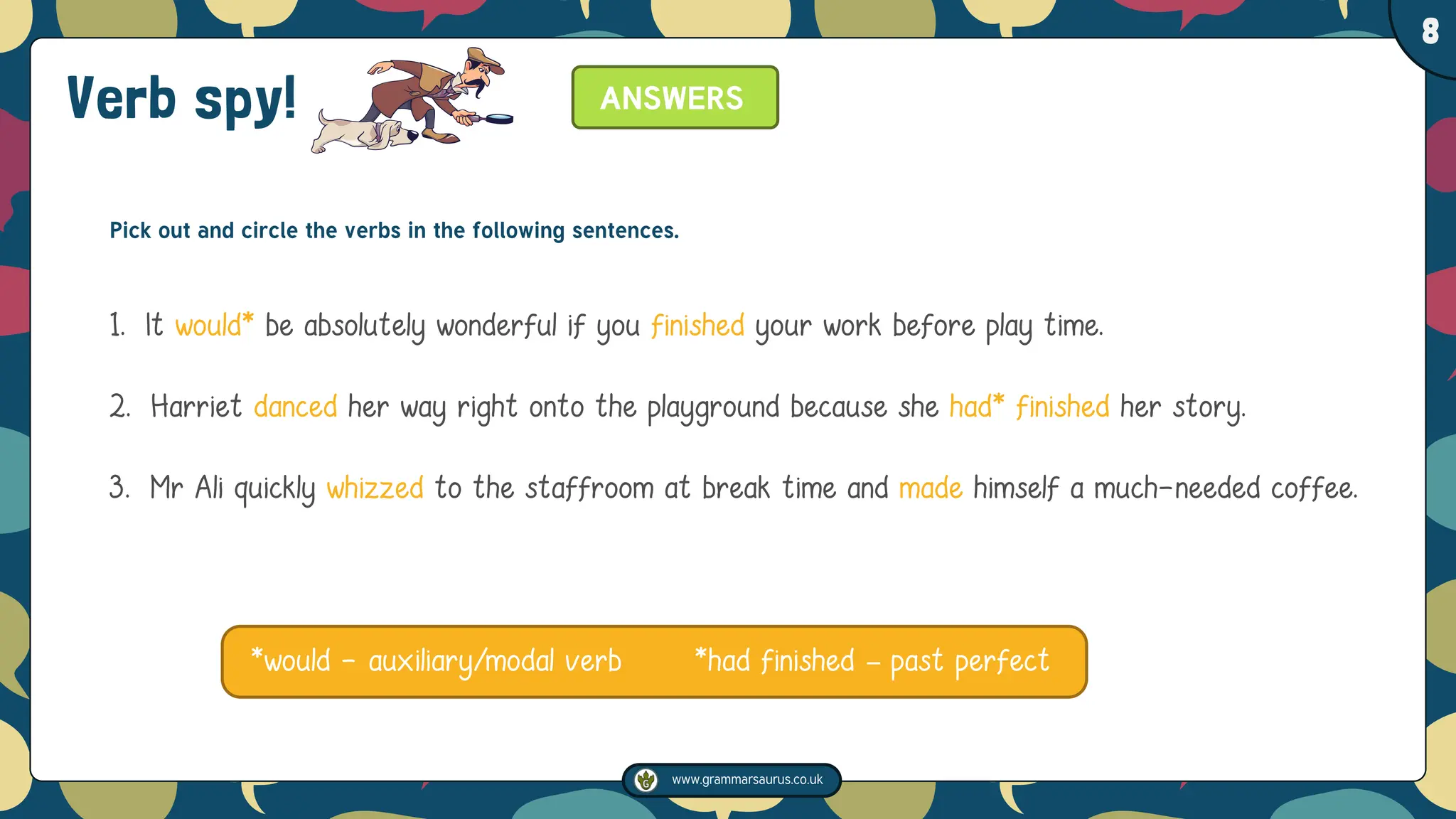
Pick out and circle the verbs in the following sentences.
1. It would* be absolutely wonderful if you finished your work before play time.
2. Harriet danced her way right onto the playground because she had* finished her story.
3. Mr Ali quickly whizzed to the staffroom at break time and made himself a much-needed coffee.
*would - auxiliary/modal verb *had finished – past perfect
ANSWERS
Verb spy!
www.grammarsaurus.co.uk
1
9
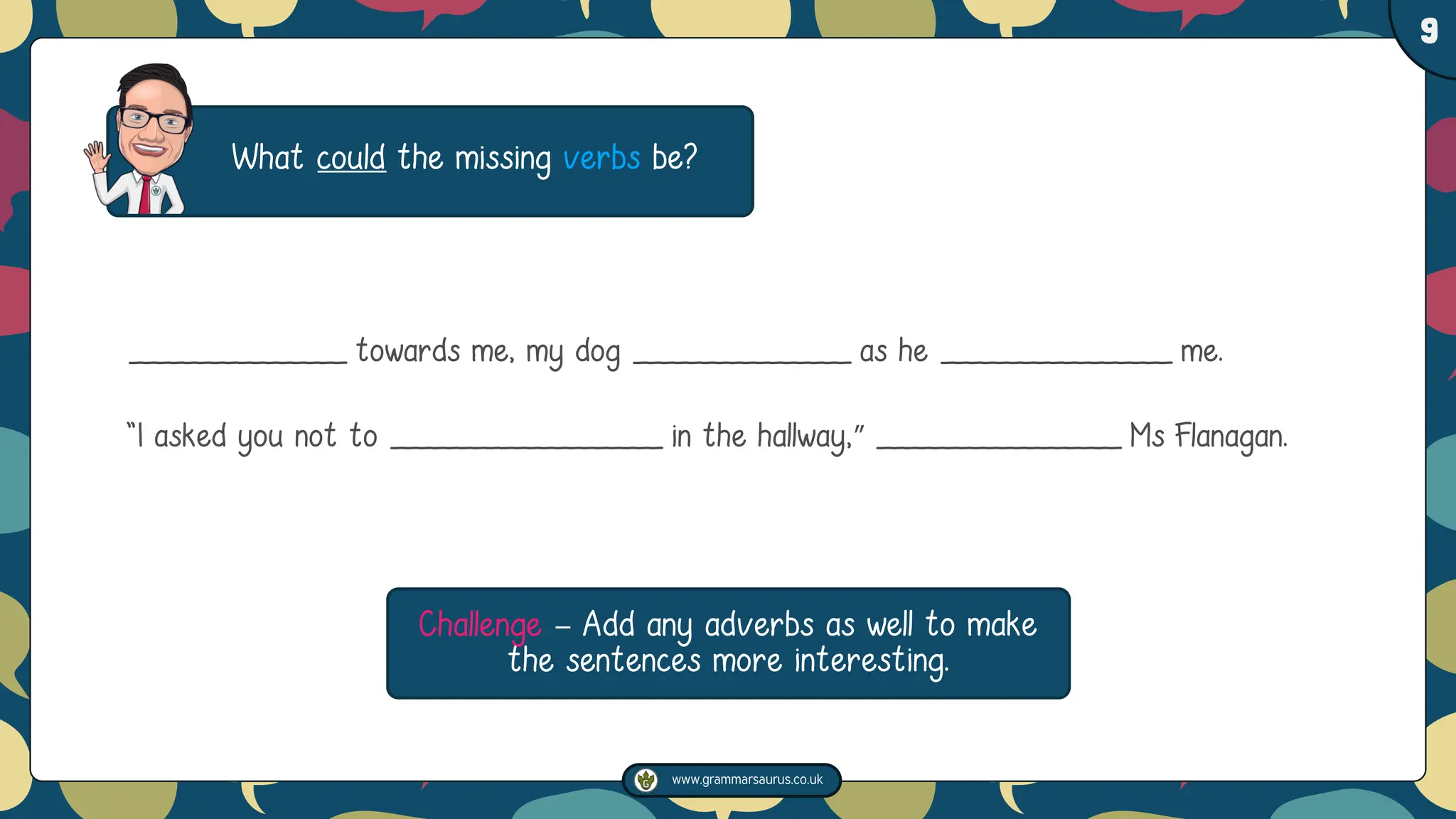
What could the missing verbs be?
Challenge – Add any adverbs as well to make
the sentences more interesting.
________________ towards me, my dog ________________ as he _________________ me.
"I asked you not to ____________________ in the hallway,” __________________ Ms Flanagan.
www.grammarsaurus.co.uk
1
10
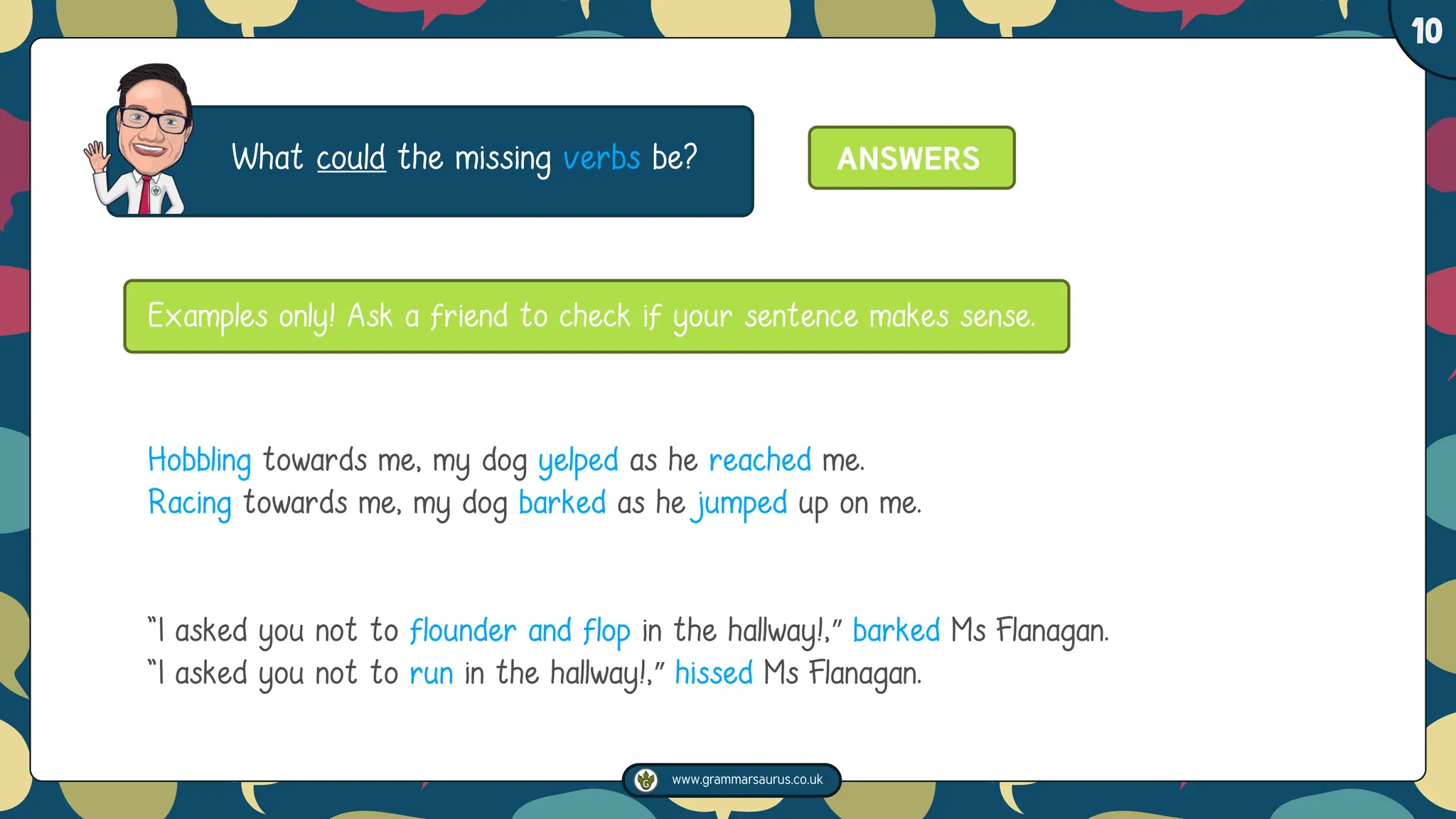
What could the missing verbs be?
Hobbling towards me, my dog yelped as he reached me.
Racing towards me, my dog barked as he jumped up on me.
"I asked you not to flounder and flop in the hallway!,” barked Ms Flanagan.
"I asked you not to run in the hallway!,” hissed Ms Flanagan.
Examples only! Ask a friend to check if your sentence makes sense.
ANSWERS
www.grammarsaurus.co.uk
1
11
Verb Upgrader! (Task four)
For this task, you need to look at the boring verbs written inside the stars
and find more exciting synonyms for that verb. Write as many as you can
around the stars.
Support – you can use a thesaurus if you need help.
Challenge – write alternative verbs in different tenses
too e.g. past and future tenses too.
www.grammarsaurus.co.uk
1
12
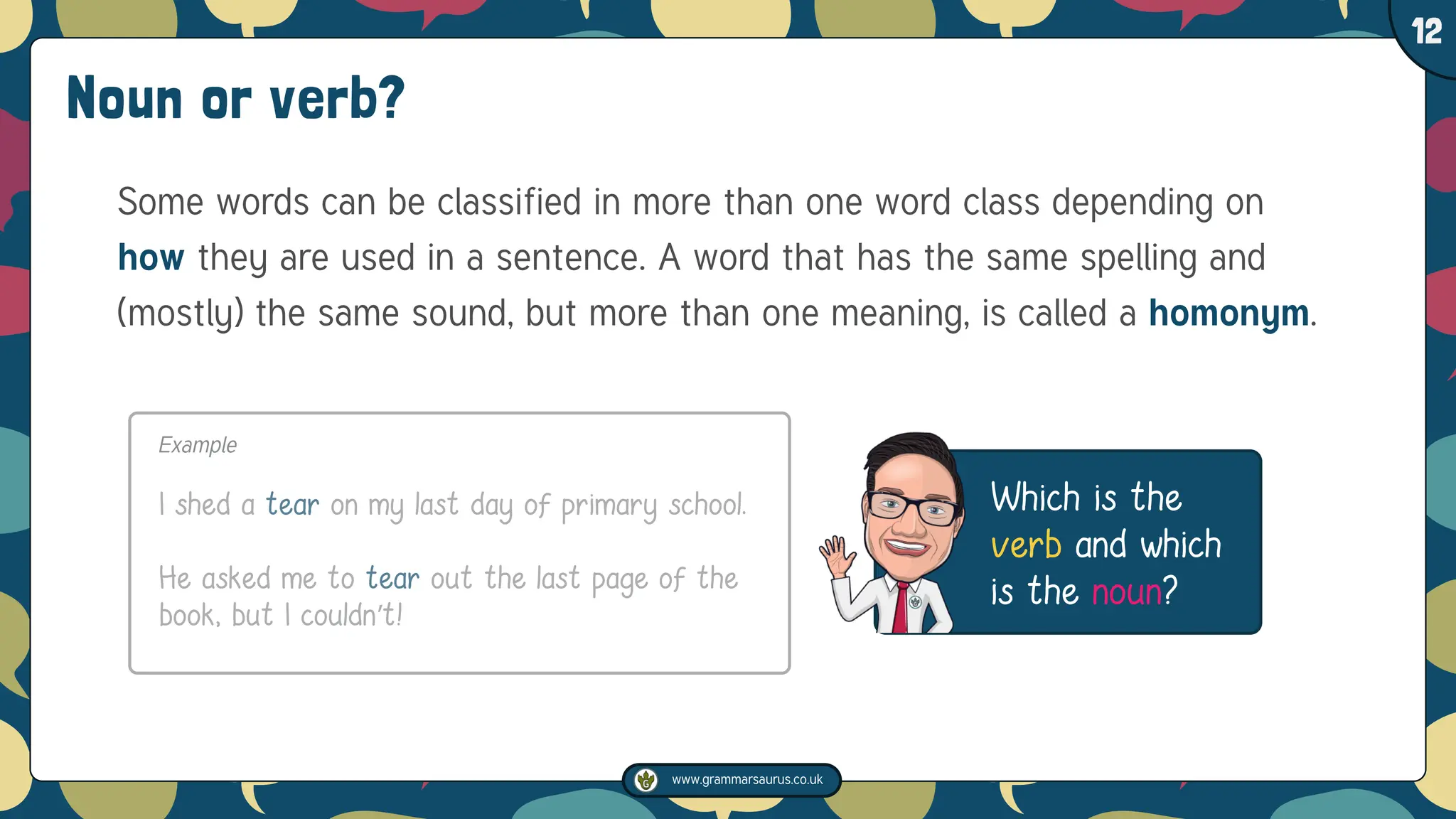
Which is the
verb and which
is the noun?
Noun or verb?
Some words can be classified in more than one word class depending on
how they are used in a sentence. A word that has the same spelling and
(mostly) the same sound, but more than one meaning, is called a homonym.
Example
I shed a tear on my last day of primary school.
He asked me to tear out the last page of the
book, but I couldn’t!
www.grammarsaurus.co.uk
1
13
Now, try the
questions on task
five in your booklet.
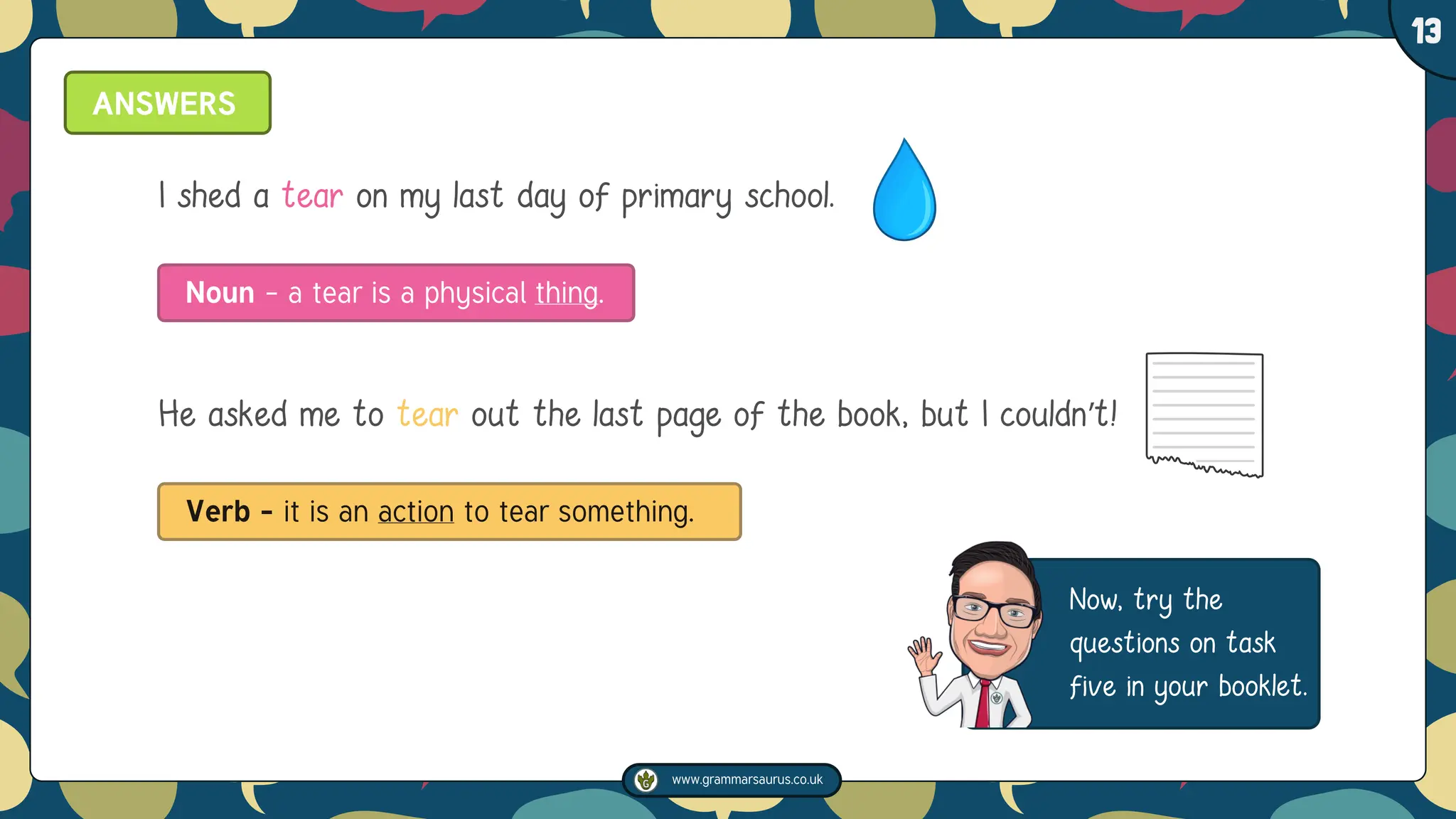
ANSWERS
I shed a tear on my last day of primary school.
Noun – a tear is a physical thing.
He asked me to tear out the last page of the book, but I couldn’t!
Verb – it is an action to tear something.
www.grammarsaurus.co.uk
1
14
You can use adjectives in pairs or lists for impact too.
You need to separate lists of adjectives with commas.
e.g. The dynamic, enchanting girl finally graced us with her presence.
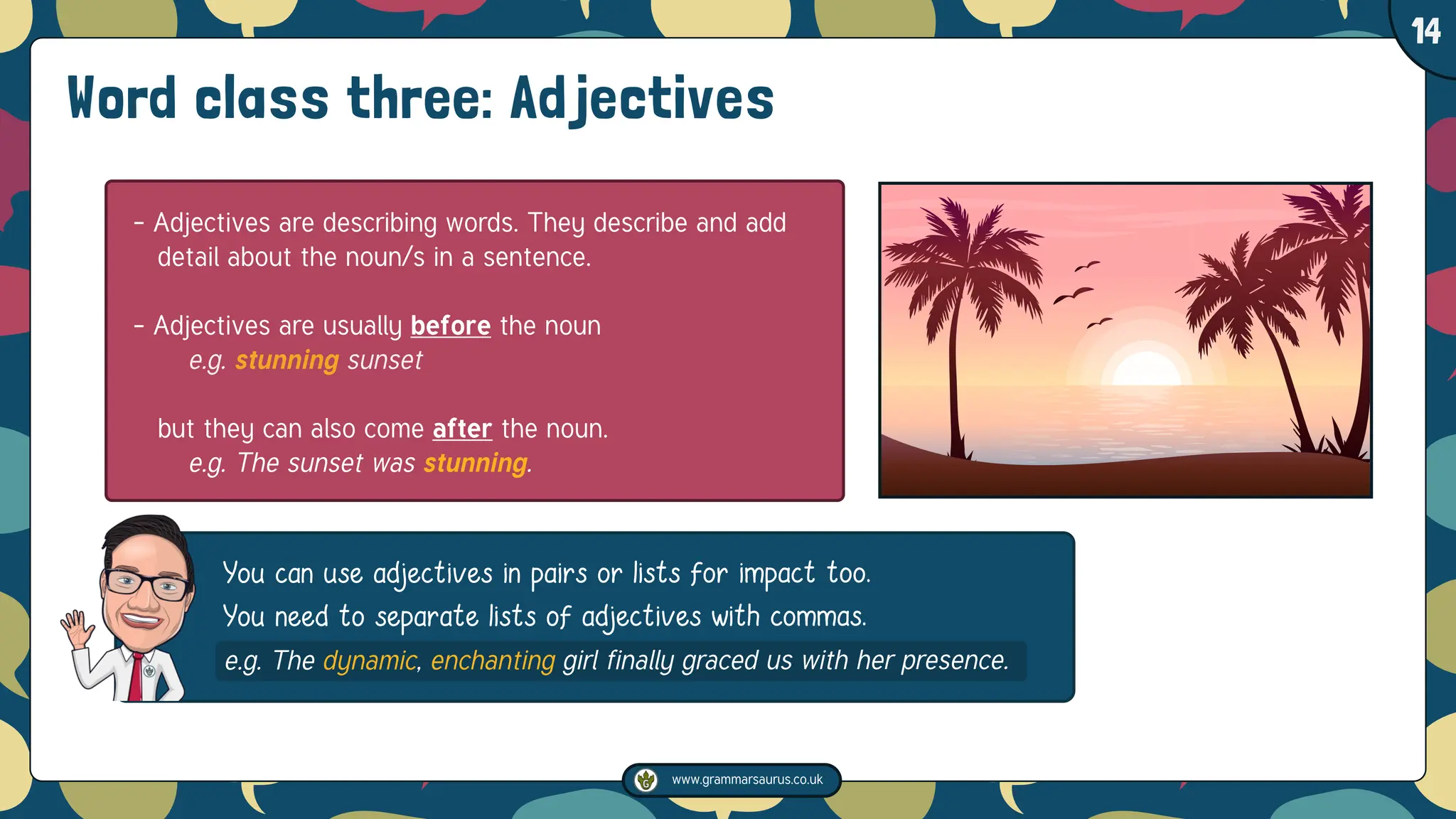
Word class three: Adjectives
- Adjectives are describing words. They describe and add
detail about the noun/s in a sentence.
- Adjectives are usually before the noun
e.g. stunning sunset
but they can also come after the noun.
e.g. The sunset was stunning.
www.grammarsaurus.co.uk
1
15
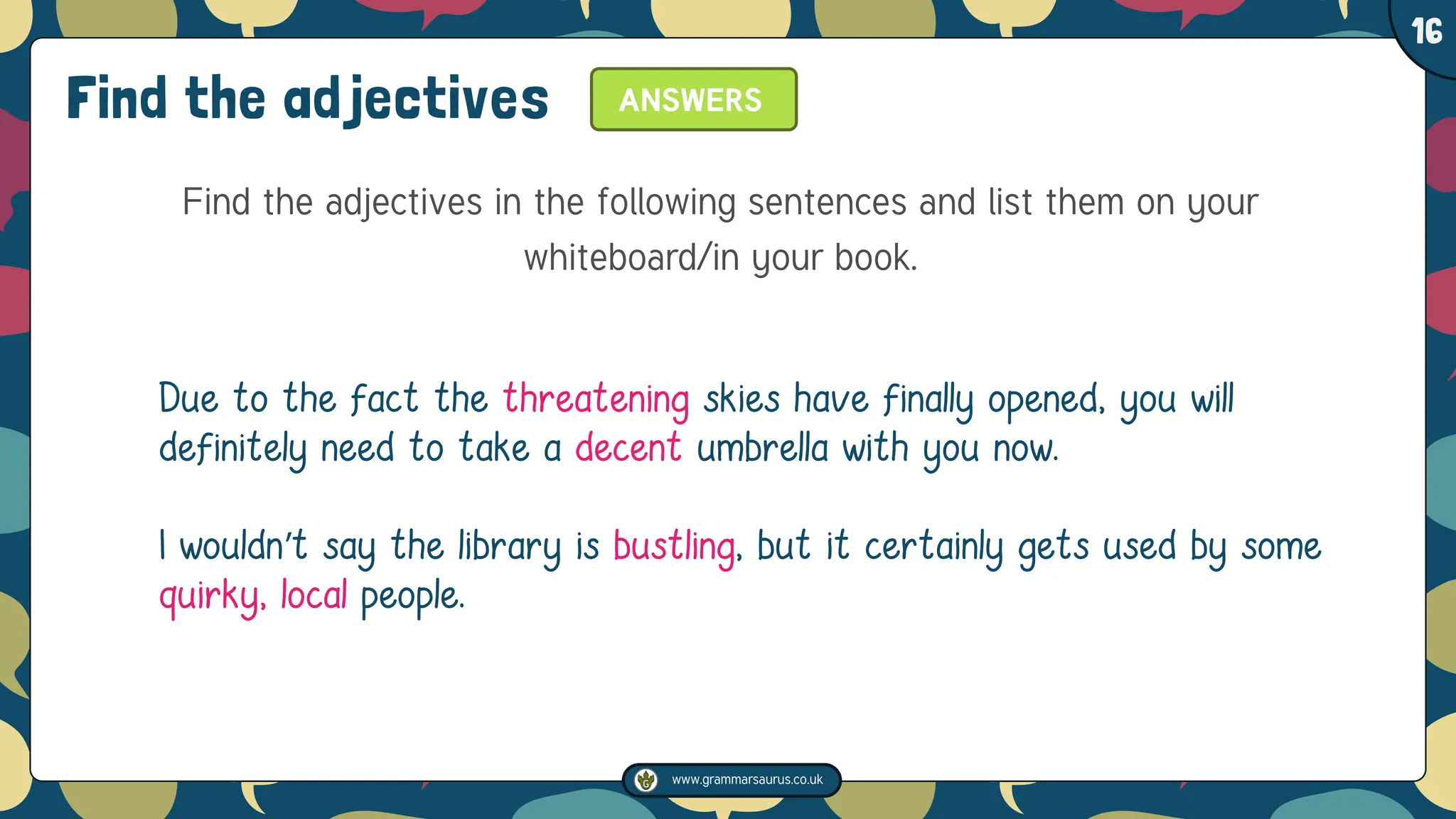
Find the adjectives
Find the adjectives in the following sentences and list them on your
whiteboard/in your book.
Due to the fact the threatening skies have finally opened, you will
definitely need to take a decent umbrella with you now.
I wouldn’t say the library is bustling, but it certainly gets used by some
quirky, local people.
www.grammarsaurus.co.uk
1
16
Find the adjectives
Find the adjectives in the following sentences and list them on your
whiteboard/in your book.
Due to the fact the threatening skies have finally opened, you will
definitely need to take a decent umbrella with you now.
I wouldn’t say the library is bustling, but it certainly gets used by some
quirky, local people.
ANSWERS
www.grammarsaurus.co.uk
1
17
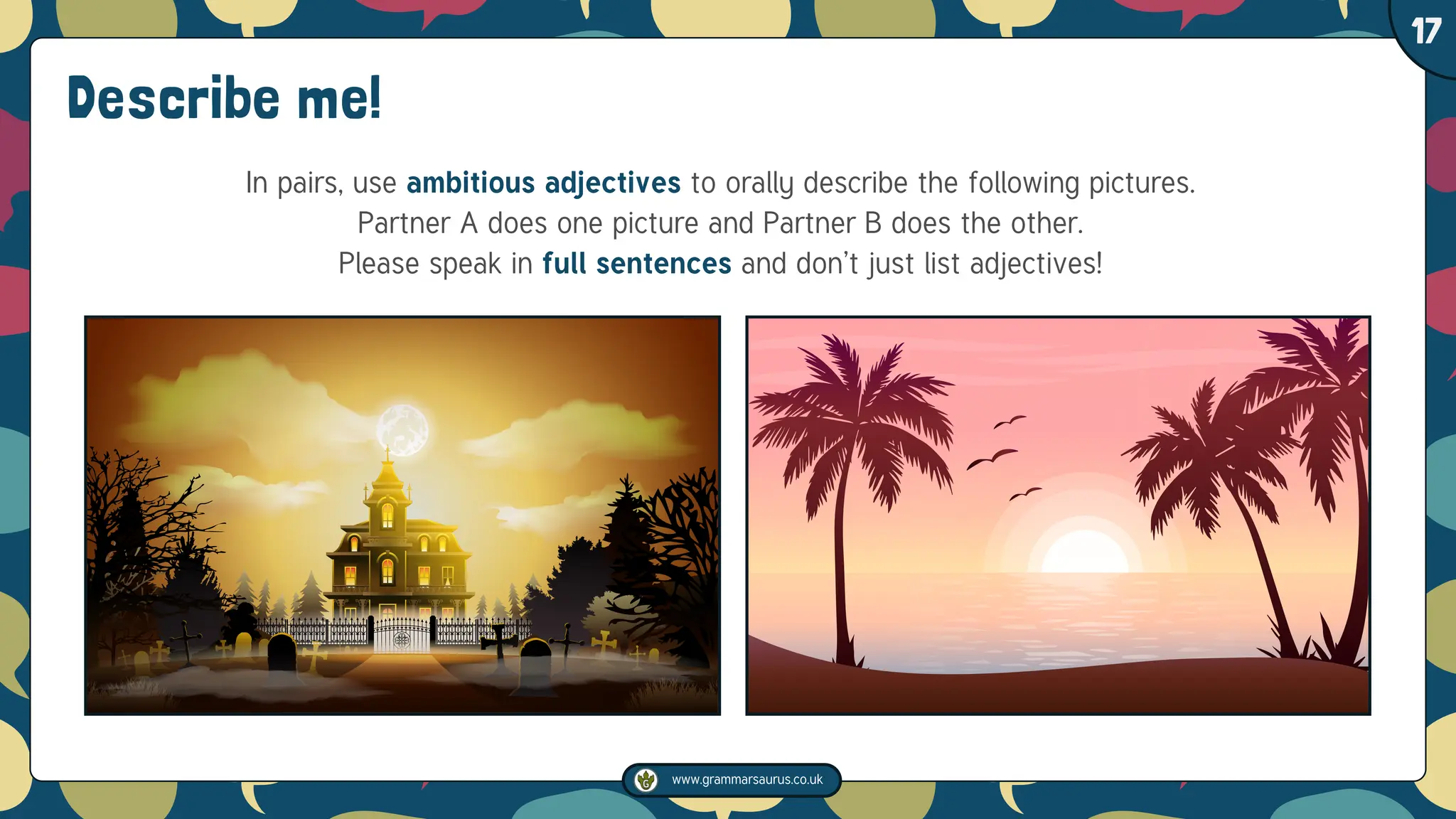
Describe me!
In pairs, use ambitious adjectives to orally describe the following pictures.
Partner A does one picture and Partner B does the other.
Please speak in full sentences and don’t just list adjectives!
www.grammarsaurus.co.uk
1
18
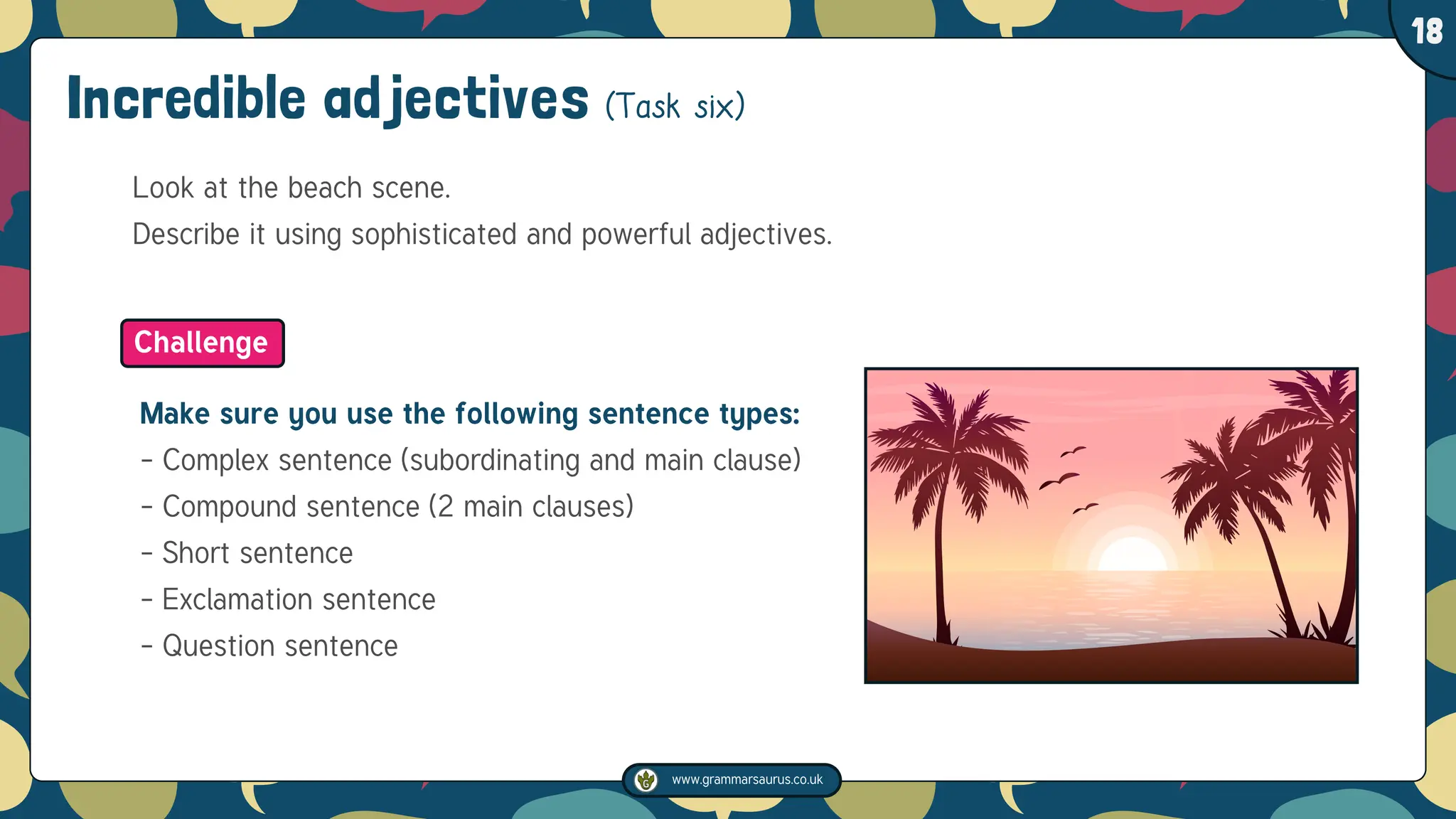
Incredible adjectives (Task six)
Look at the beach scene.
Describe it using sophisticated and powerful adjectives.
Make sure you use the following sentence types:
- Complex sentence (subordinating and main clause)
- Compound sentence (2 main clauses)
- Short sentence
- Exclamation sentence
- Question sentence
Challenge
www.grammarsaurus.co.uk
1
19
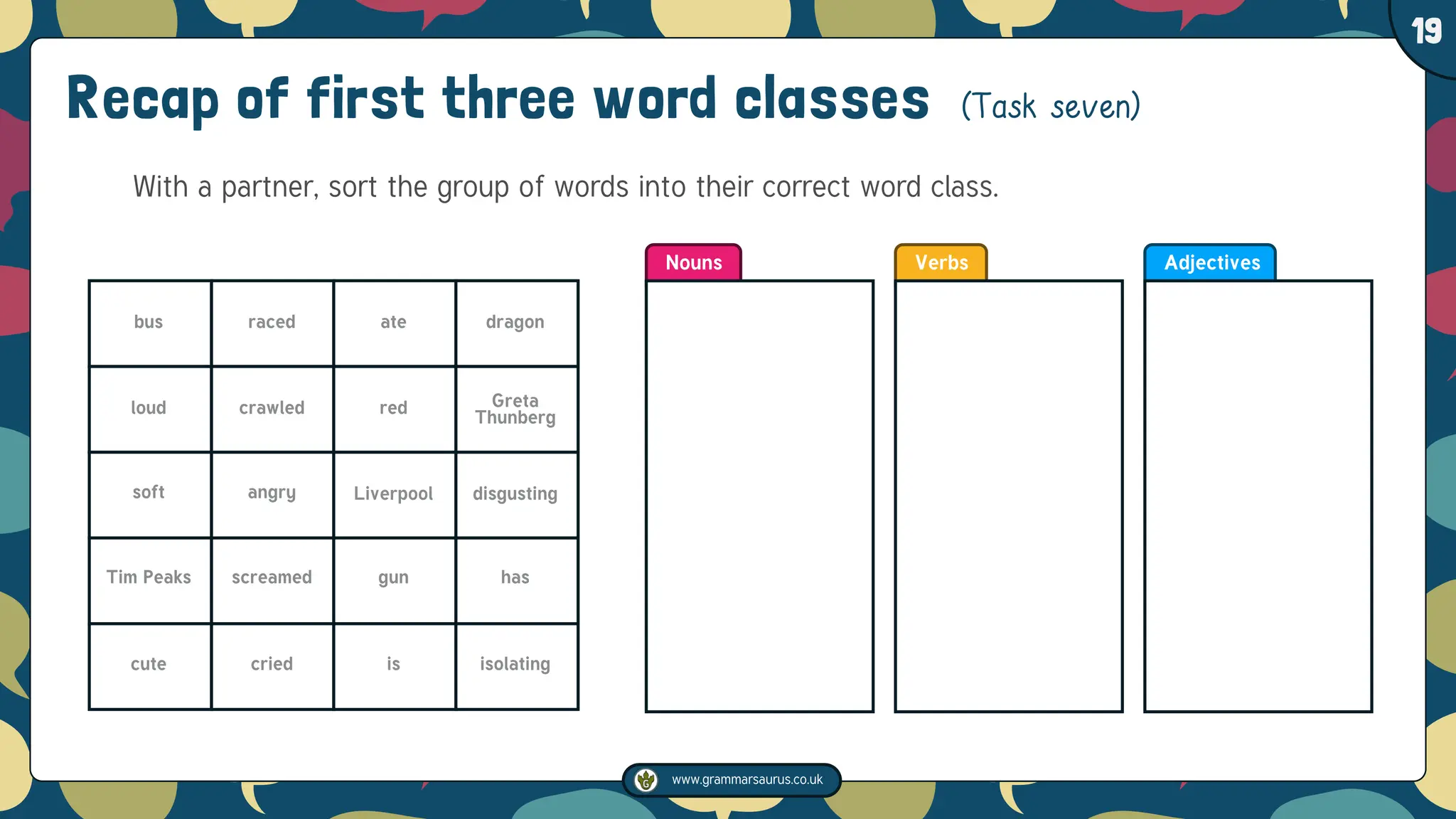
Recap of first three word classes (Task seven)
With a partner, sort the group of words into their correct word class.
Nouns Verbs Adjectives
bus raced ate dragon
loud crawled red Greta
Thunberg
soft angry Liverpool disgusting
Tim Peaks screamed gun has
cute cried is isolating
www.grammarsaurus.co.uk
1
20
Word class four: Adverbs
You know a word is an adverb because it ends in –ly.
True False
or
www.grammarsaurus.co.uk
1
21
False
- Many adverbs do end with the suffix -ly, since adding ’ly’ is a way to turn an adjective into an
adverb. For instance, the adjective "bold" transforms into the adverb "boldly" by adding -ly to
the end.
- While not a hard and fast rule, spotting the -ly ending in a word is often a good indicator that
it is an adverb. However, there are many exceptions to the rule.
- Many adverbs end in -ly, but not all of them do. Common adverbs that don’t end in -ly
include words like fast, slow and very. These words can also be used as adjectives, so it is
important to analyse their function within a sentence.
www.grammarsaurus.co.uk
1
22
Adverbs
An adverb tells you more about the verb by describing it or modifying it - it ’adds’ to the verb.
It nearly always answers the questions: How? When? Where? How often? How much?
Many of the adverbs which tell us how end in –ly and come from adjectives.
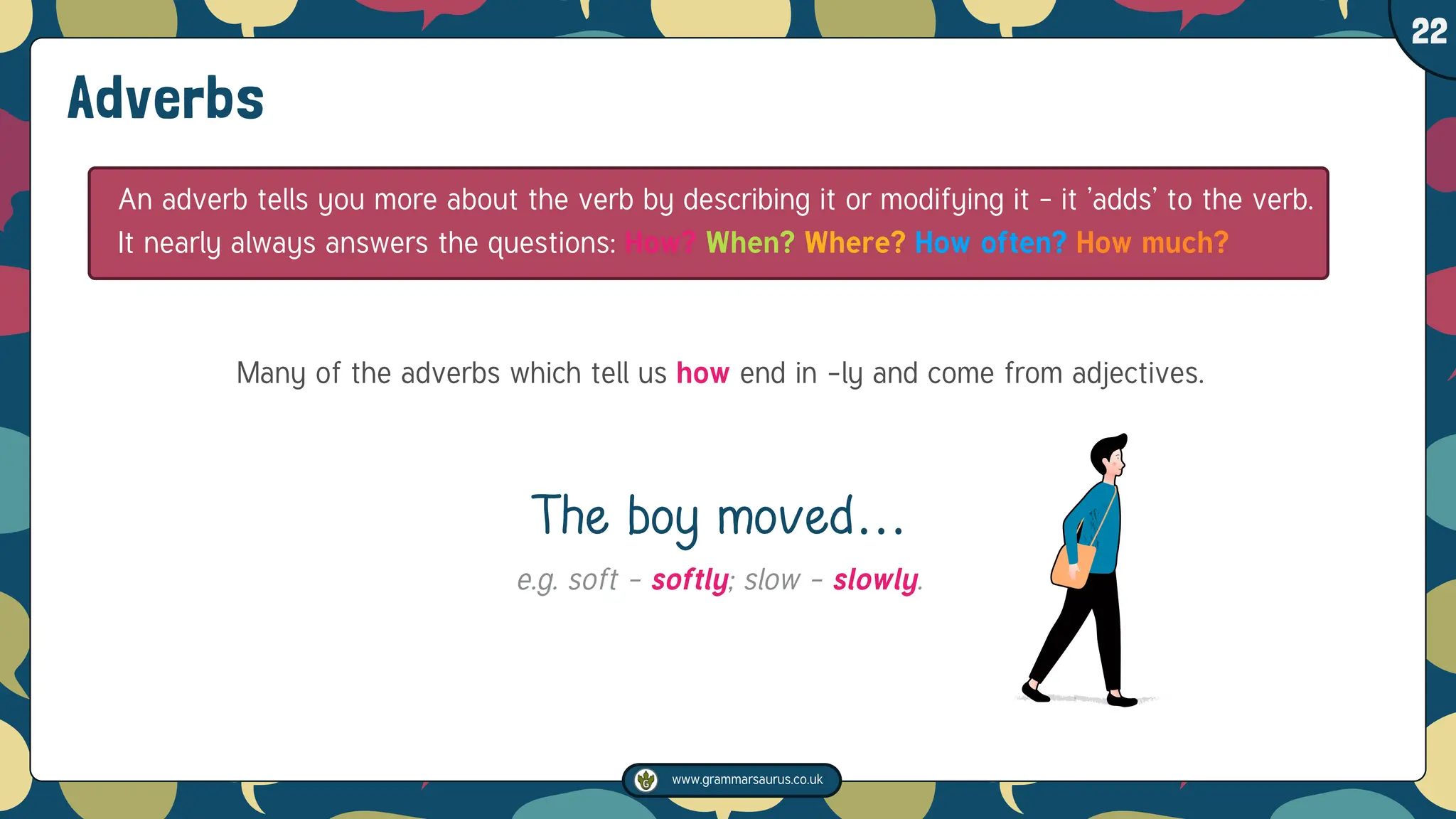
The boy moved…
e.g. soft – softly; slow – slowly.
www.grammarsaurus.co.uk
1
23
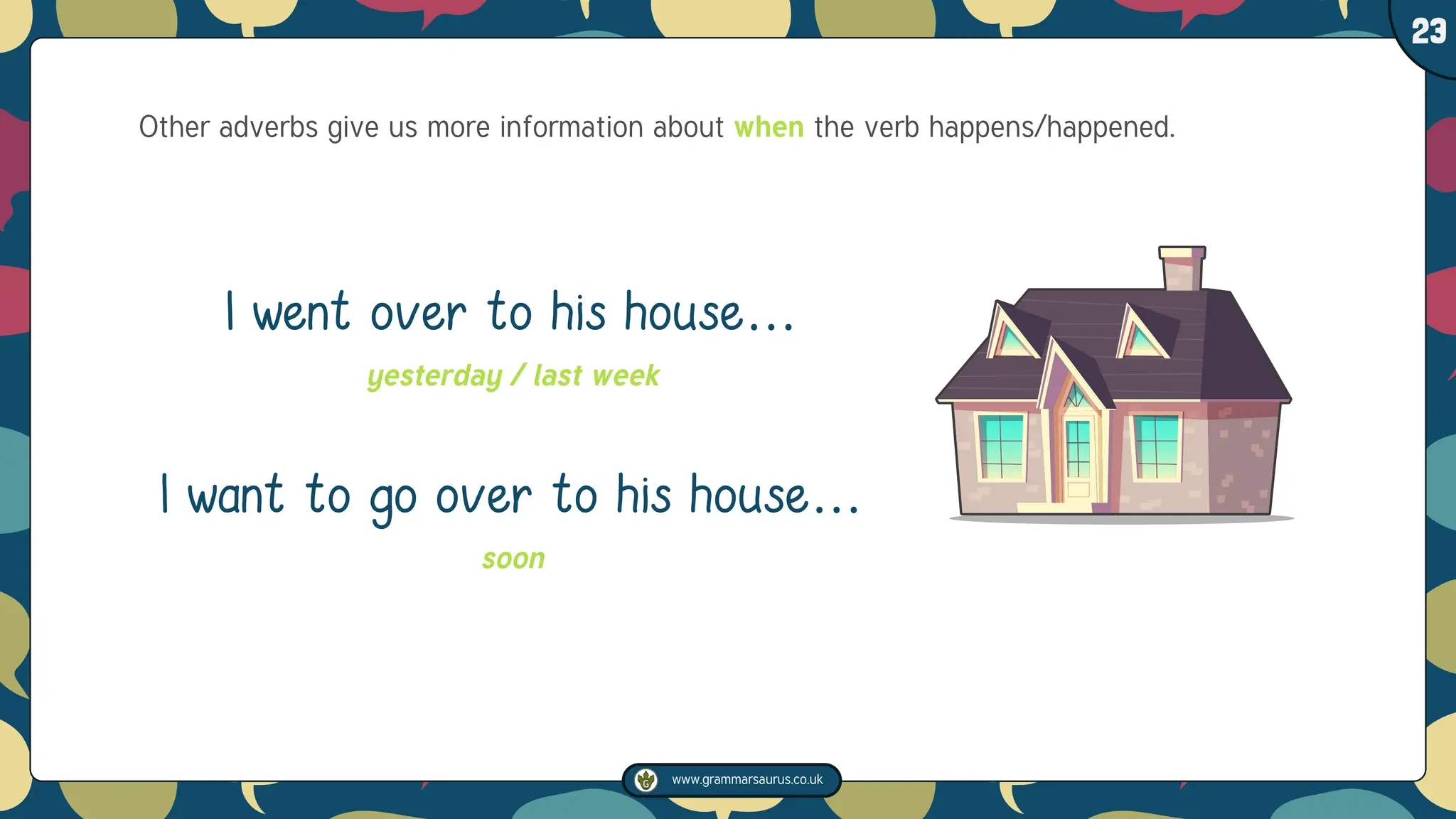
Other adverbs give us more information about when the verb happens/happened.
I went over to his house…
yesterday / last week
I want to go over to his house…
soon
www.grammarsaurus.co.uk
1
24
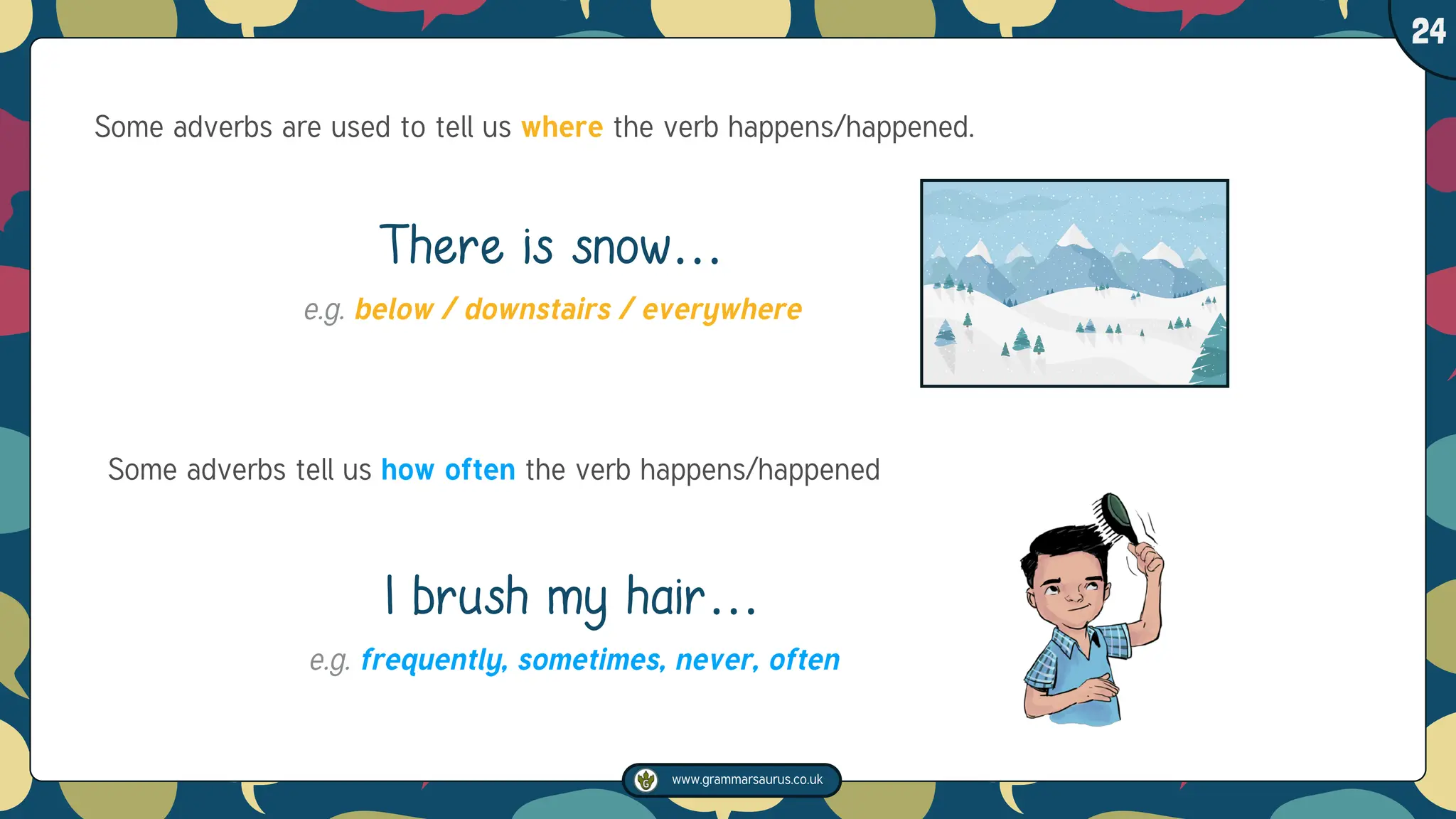
Some adverbs are used to tell us where the verb happens/happened.
There is snow…
e.g. below / downstairs / everywhere
Some adverbs tell us how often the verb happens/happened
I brush my hair…
e.g. frequently, sometimes, never, often
www.grammarsaurus.co.uk
1
25
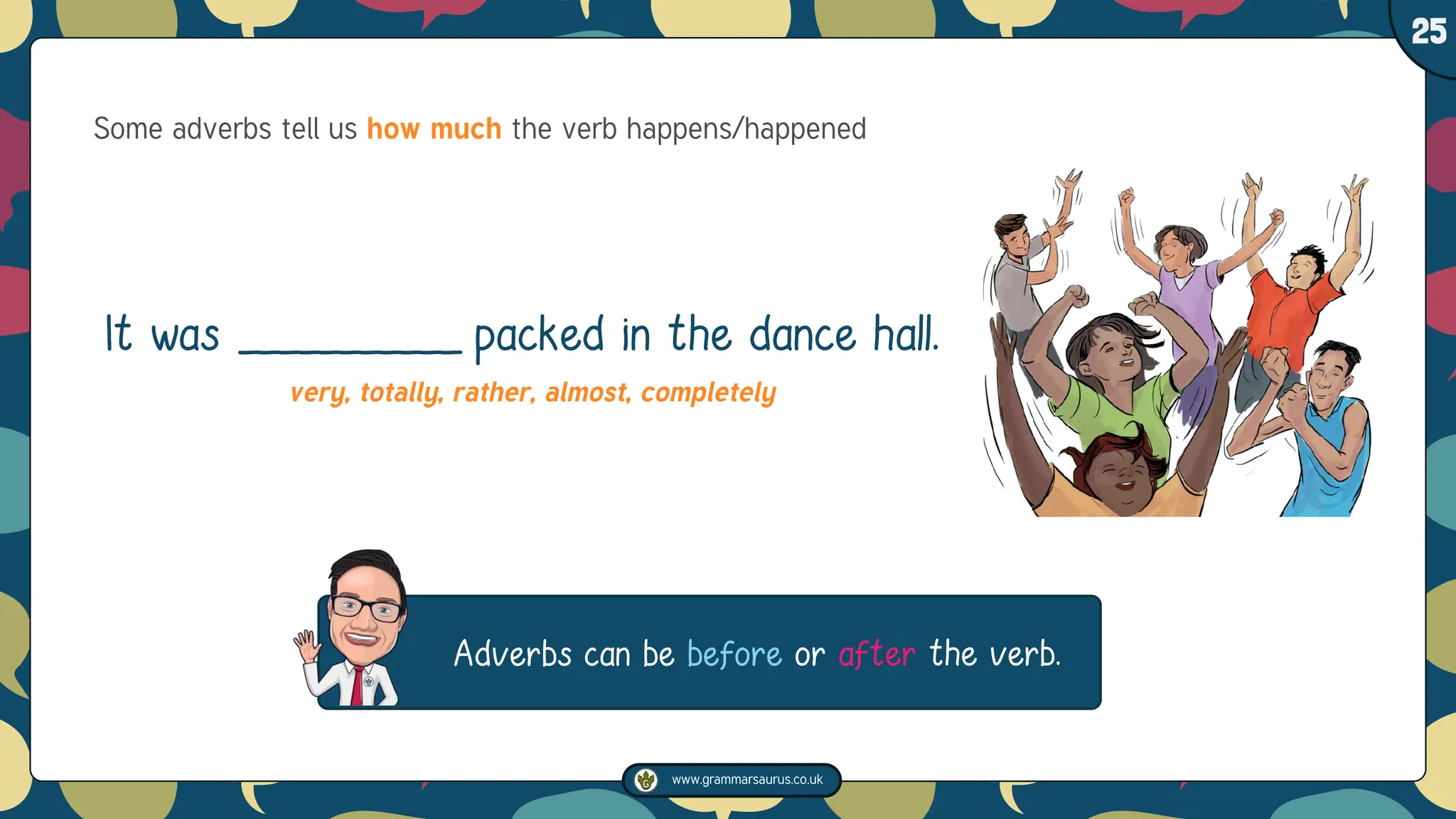
Some adverbs tell us how much the verb happens/happened
It was ___________ packed in the dance hall.
very, totally, rather, almost, completely
Adverbs can be before or after the verb.
www.grammarsaurus.co.uk
1
26
Adverbs (Task eight)
Fill in the blanks in the sentences in the revision booklet.
Then, identify and circle the adverbs in the sentences. Look carefully…
Challenge: Create your own adverb
word bank under the following headings.
When? Where? How? How often? How much?
www.grammarsaurus.co.uk
1
27
Word class five: Pronouns
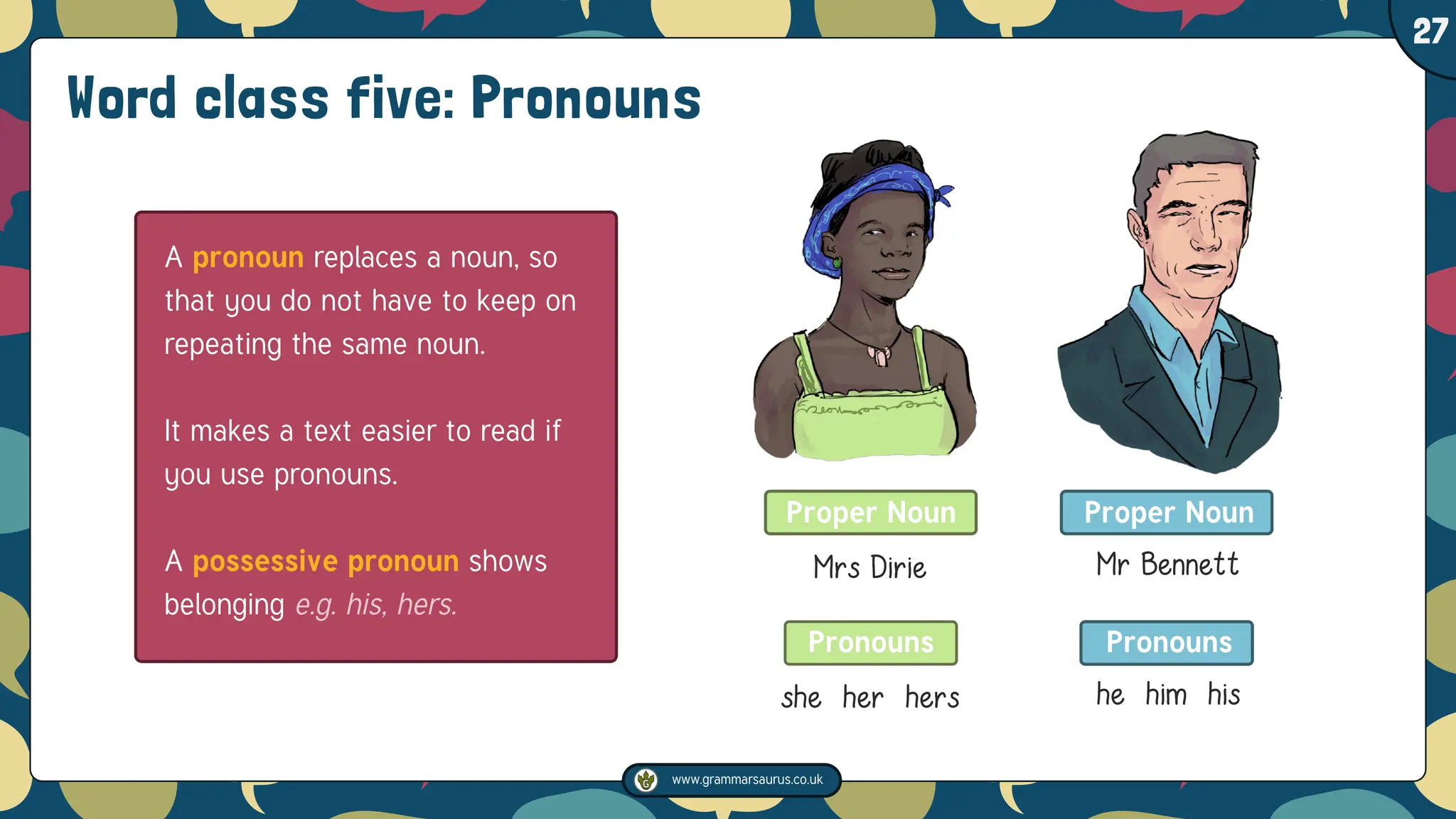
A pronoun replaces a noun, so
that you do not have to keep on
repeating the same noun.
It makes a text easier to read if
you use pronouns.
A possessive pronoun shows
belonging e.g. his, hers.
Proper Noun
Mrs Dirie
Pronouns
she her hers
Proper Noun
Mr Bennett
Pronouns
he him his
www.grammarsaurus.co.uk
1
28
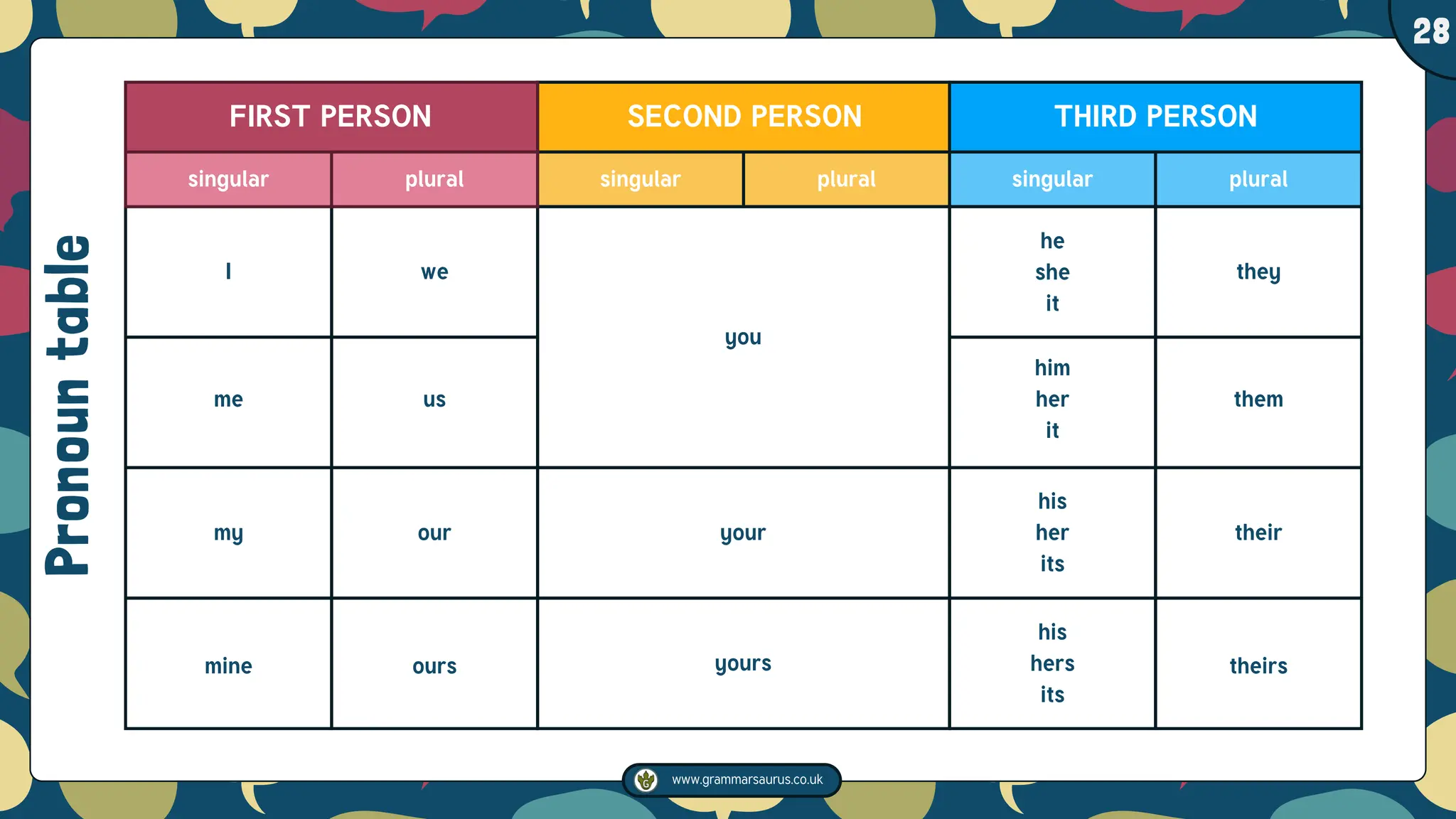
Pronoun
table
I
me
my
mine
we
us
our
ours
he
she
it
him
her
it
his
her
its
his
hers
its
you
your
yours
they
them
their
theirs
singular plural singular plural
SECOND PERSON THIRD PERSON
FIRST PERSON
singular plural
www.grammarsaurus.co.uk
1
29
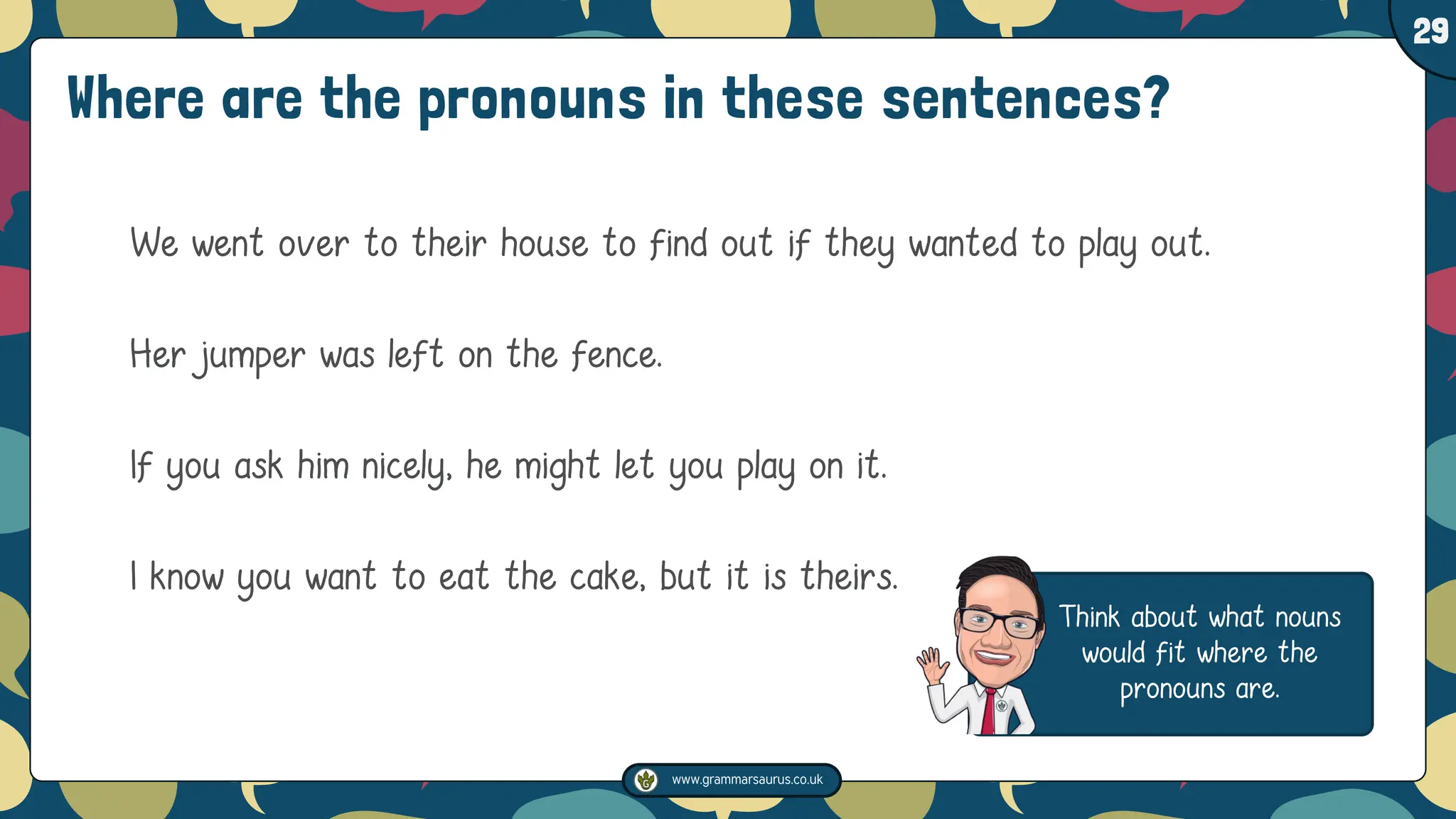
Where are the pronouns in these sentences?
We went over to their house to find out if they wanted to play out.
Her jumper was left on the fence.
If you ask him nicely, he might let you play on it.
I know you want to eat the cake, but it is theirs.
Think about what nouns
would fit where the
pronouns are.
www.grammarsaurus.co.uk
1
29
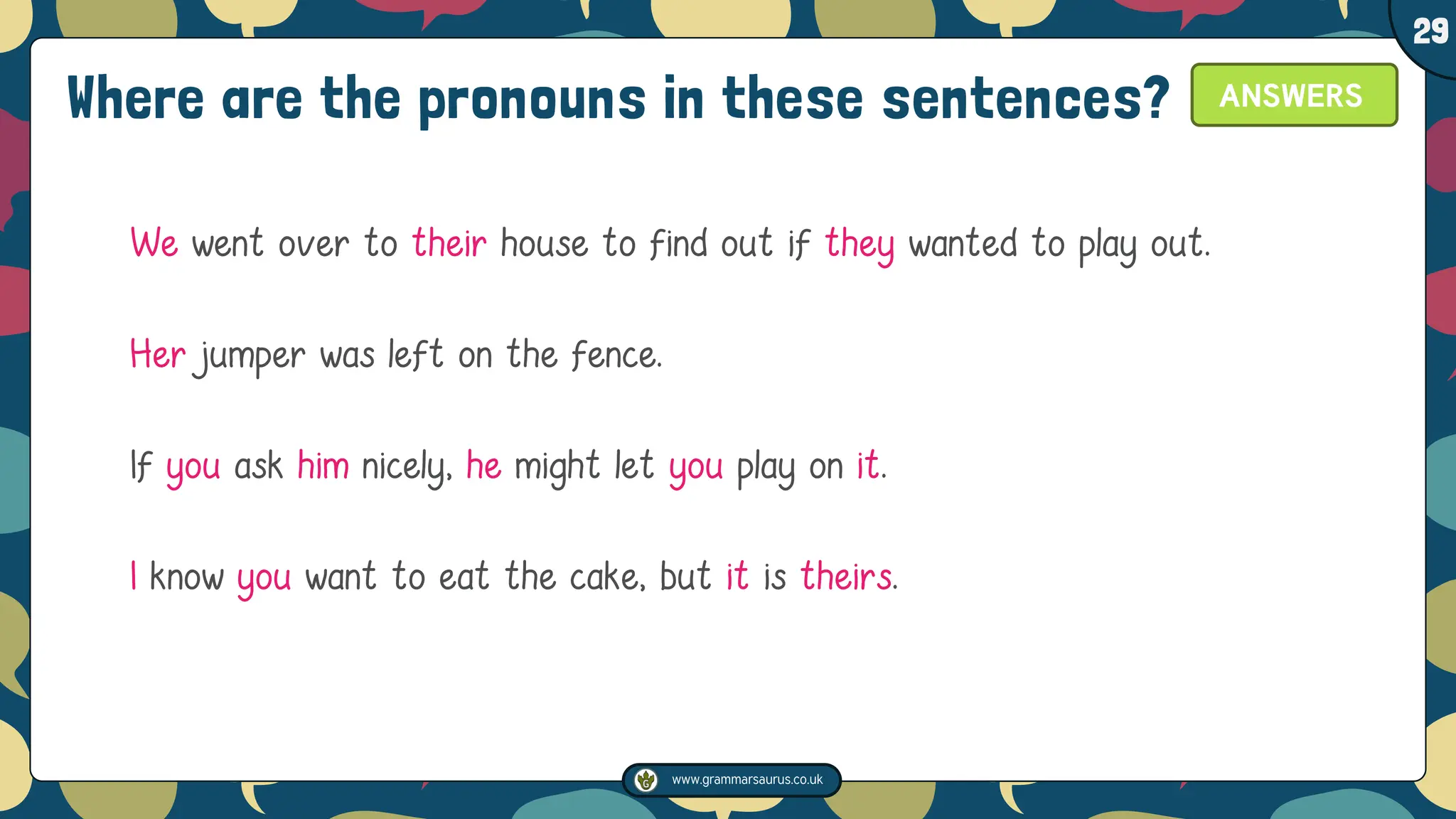
Where are the pronouns in these sentences?
We went over to their house to find out if they wanted to play out.
Her jumper was left on the fence.
If you ask him nicely, he might let you play on it.
I know you want to eat the cake, but it is theirs.
ANSWERS
www.grammarsaurus.co.uk
1
31
Task nine
Complete the pronoun
tasks in your booklet.
www.grammarsaurus.co.uk
1
32
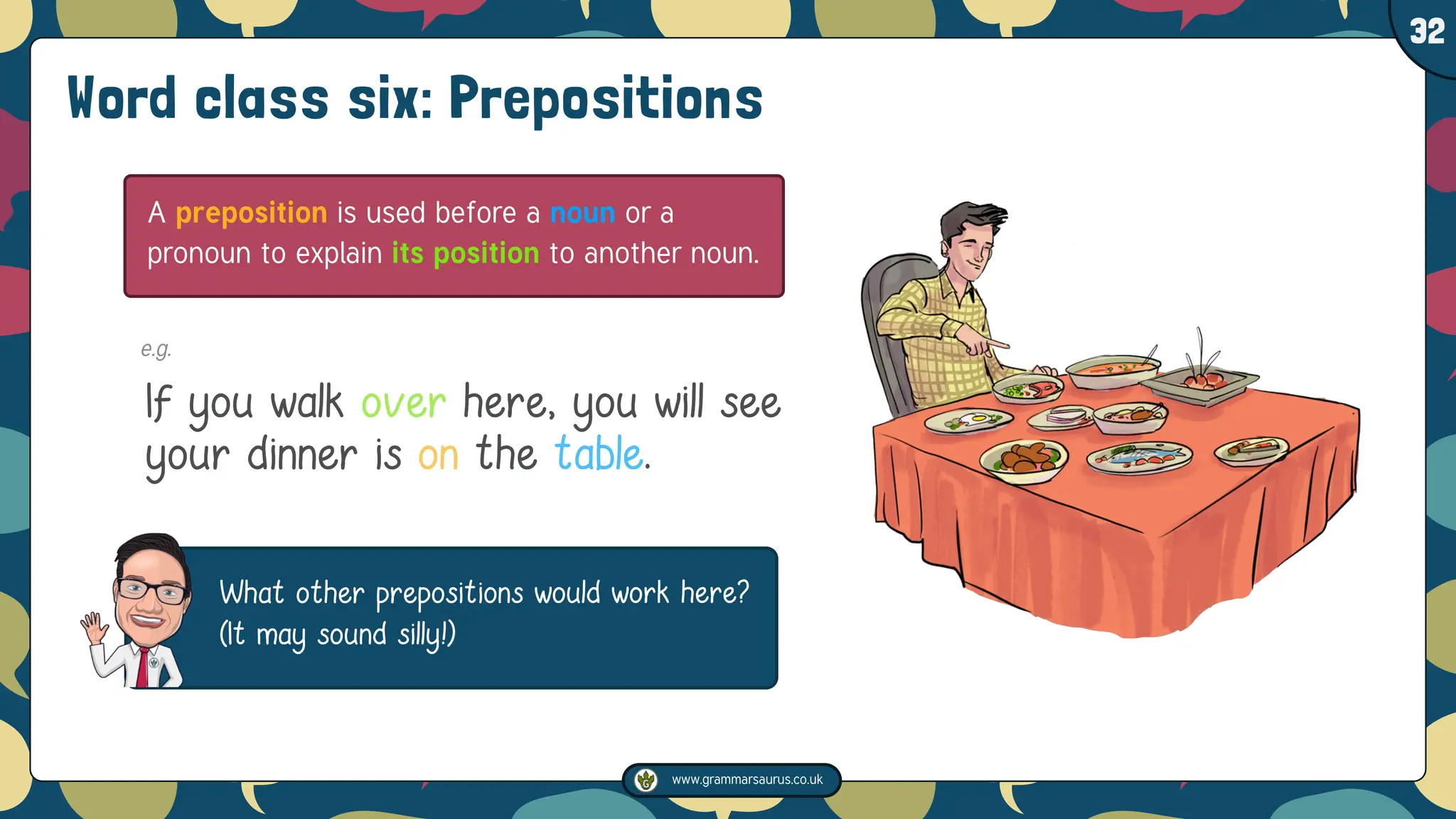
What other prepositions would work here?
(It may sound silly!)
Word class six: Prepositions
A preposition is used before a noun or a
pronoun to explain its position to another noun.
e.g.
If you walk over here, you will see
your dinner is on the table.
www.grammarsaurus.co.uk
1
33
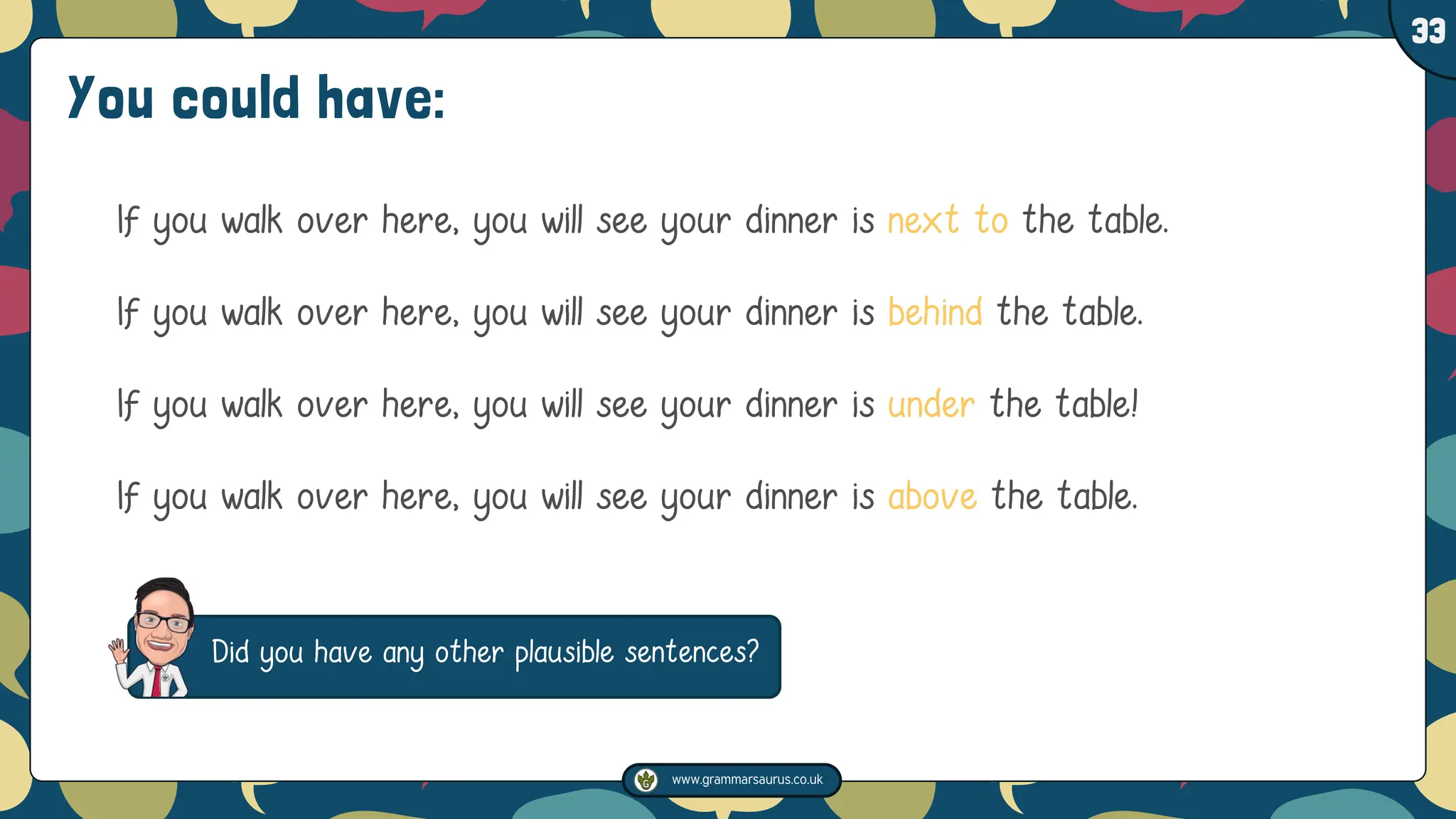
You could have:
If you walk over here, you will see your dinner is next to the table.
If you walk over here, you will see your dinner is behind the table.
If you walk over here, you will see your dinner is under the table!
If you walk over here, you will see your dinner is above the table.
Did you have any other plausible sentences?
www.grammarsaurus.co.uk
1
34
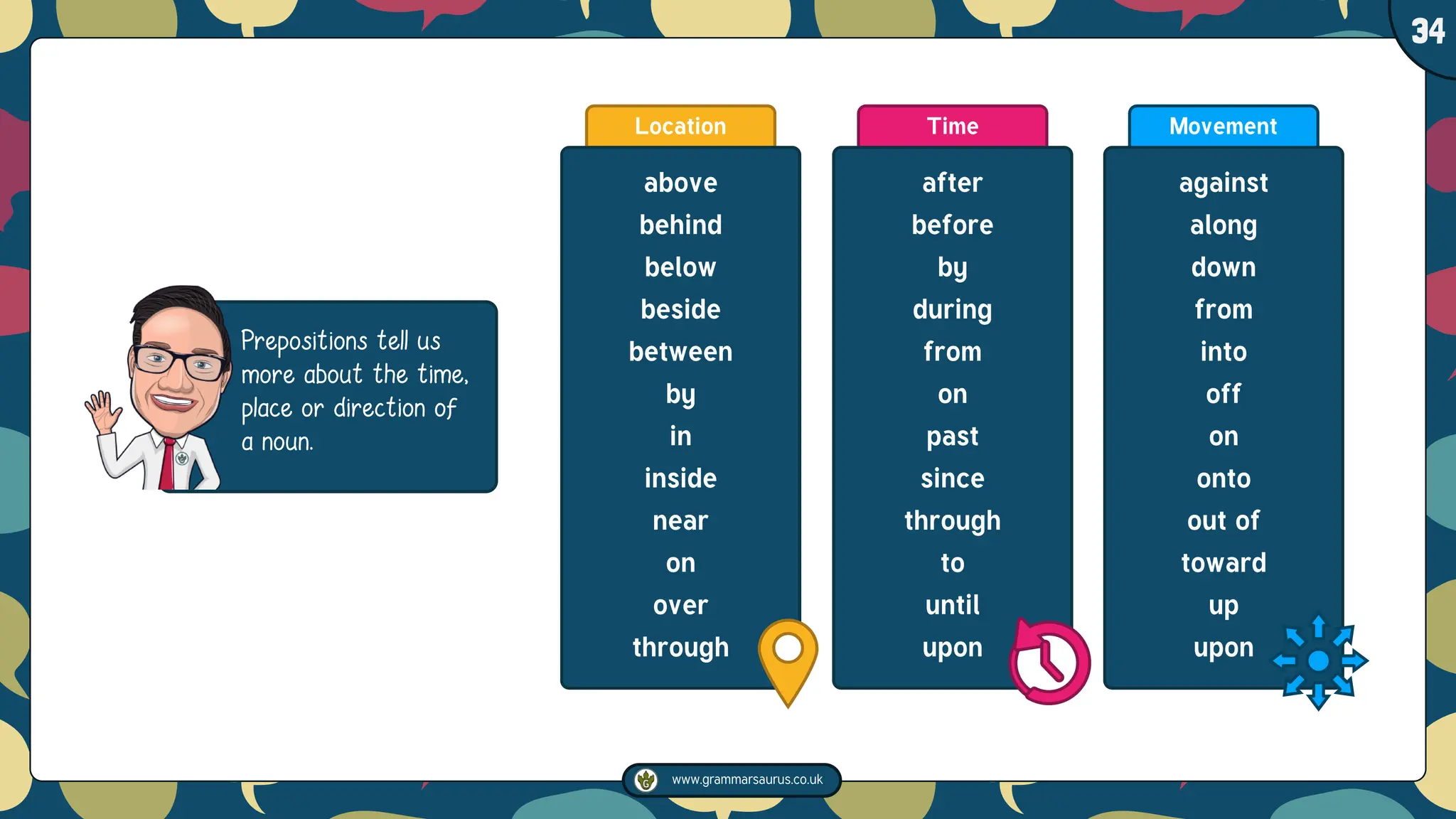
Prepositions tell us
more about the time,
place or direction of
a noun.
Location
above
behind
below
beside
between
by
in
inside
near
on
over
through
Time
after
before
by
during
from
on
past
since
through
to
until
upon
Movement
against
along
down
from
into
off
on
onto
out of
toward
up
upon
www.grammarsaurus.co.uk
1
35
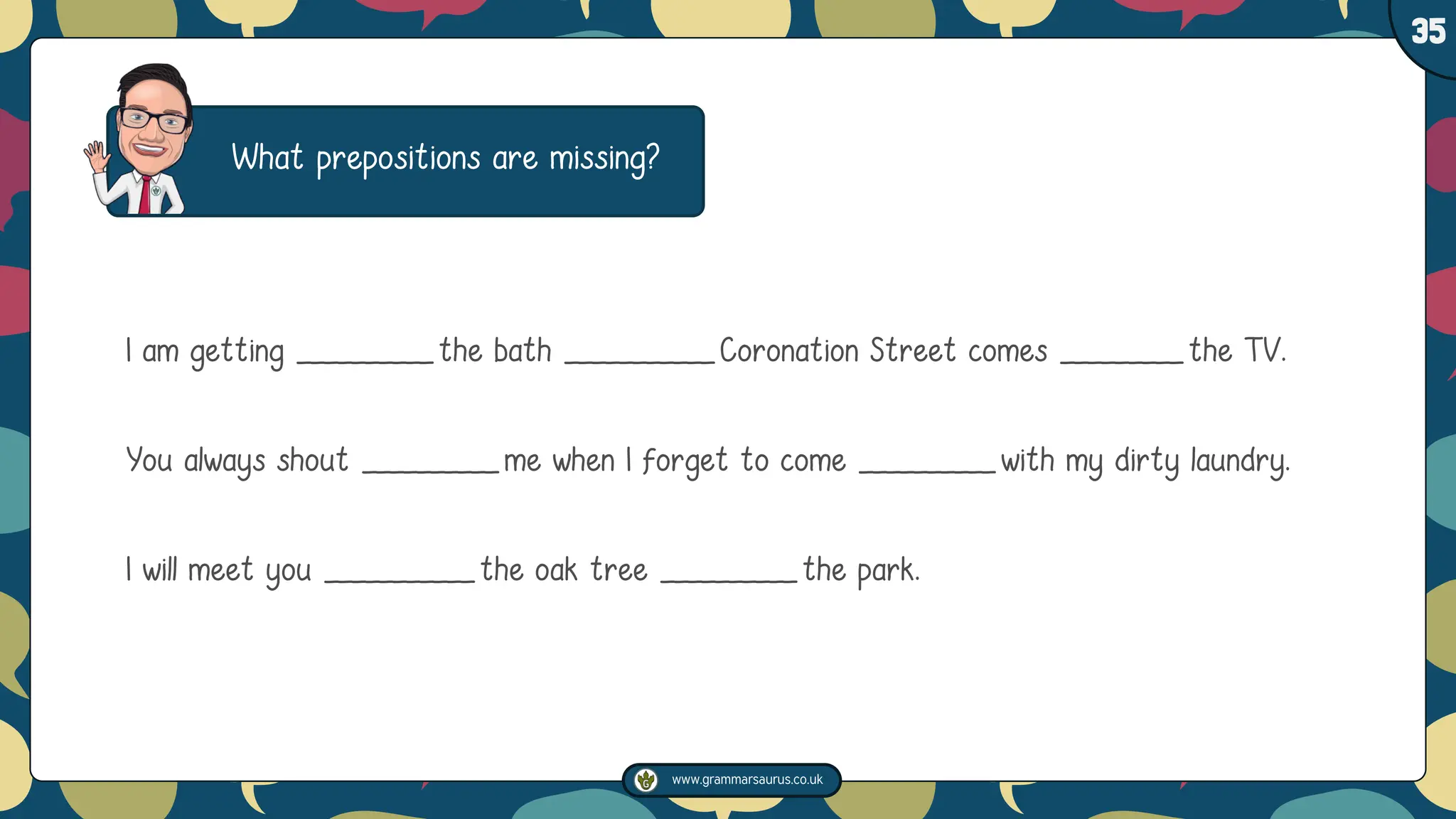
What prepositions are missing?
I am getting __________the bath ___________Coronation Street comes _________the TV.
You always shout __________me when I forget to come __________with my dirty laundry.
I will meet you ___________the oak tree __________the park.
www.grammarsaurus.co.uk
1
36
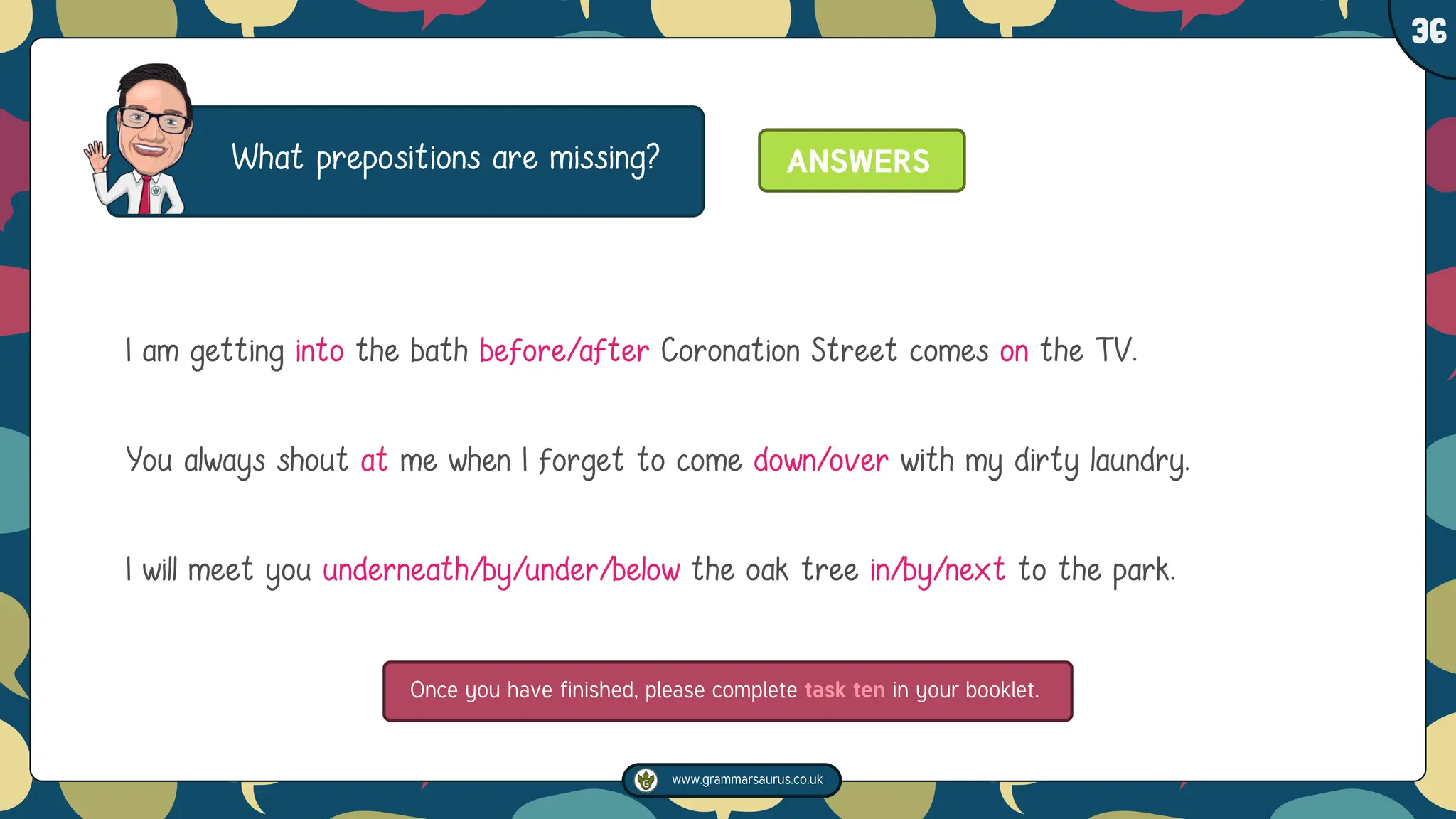
What prepositions are missing?
I am getting into the bath before/after Coronation Street comes on the TV.
You always shout at me when I forget to come down/over with my dirty laundry.
I will meet you underneath/by/under/below the oak tree in/by/next to the park.
ANSWERS
Once you have finished, please complete task ten in your booklet.
www.grammarsaurus.co.uk
1
37
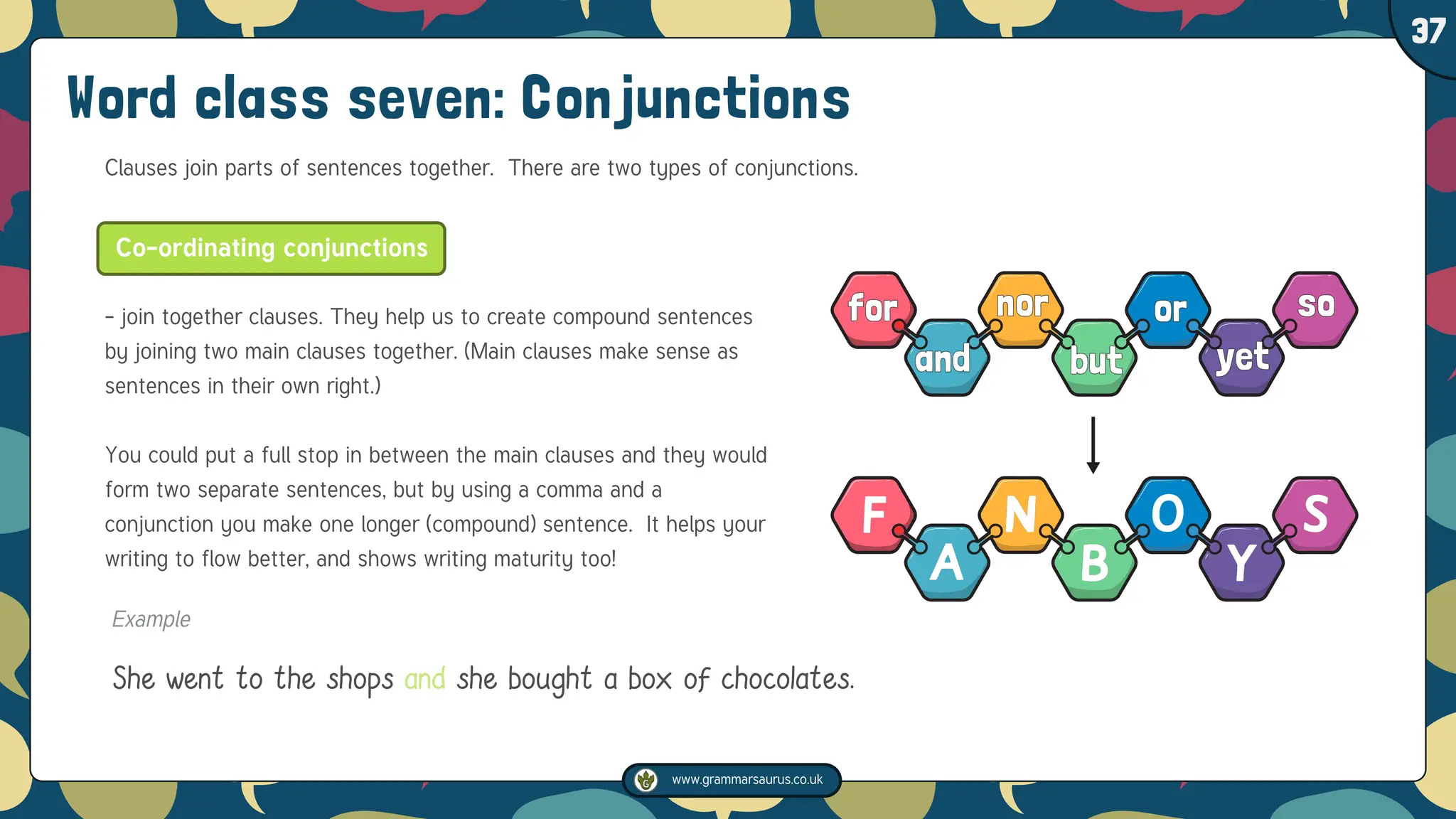
Word class seven: Conjunctions
Clauses join parts of sentences together. There are two types of conjunctions.
- join together clauses. They help us to create compound sentences
by joining two main clauses together. (Main clauses make sense as
sentences in their own right.)
You could put a full stop in between the main clauses and they would
form two separate sentences, but by using a comma and a
conjunction you make one longer (compound) sentence. It helps your
writing to flow better, and shows writing maturity too!
Co-ordinating conjunctions
Example
She went to the shops and she bought a box of chocolates.
www.grammarsaurus.co.uk
1
38
Subordinating conjunctions link a main (independent) clause
with a subordinate (dependent) clause (a clause which does
not make sense on its own).
If a sentence starts with a subordinate clause, it needs a
comma after the subordinate clause and before the main
clause. If the subordinate clause is in the middle of the
sentence, it does not need a comma to separate the
clauses.
Subordinating conjunctions
Examples
When we got home, we were hungry.
We were hungry because we hadn’t eaten all day.
In case I forget to tell you later on, there will be no football
on this Tuesday.
www.grammarsaurus.co.uk
1
39
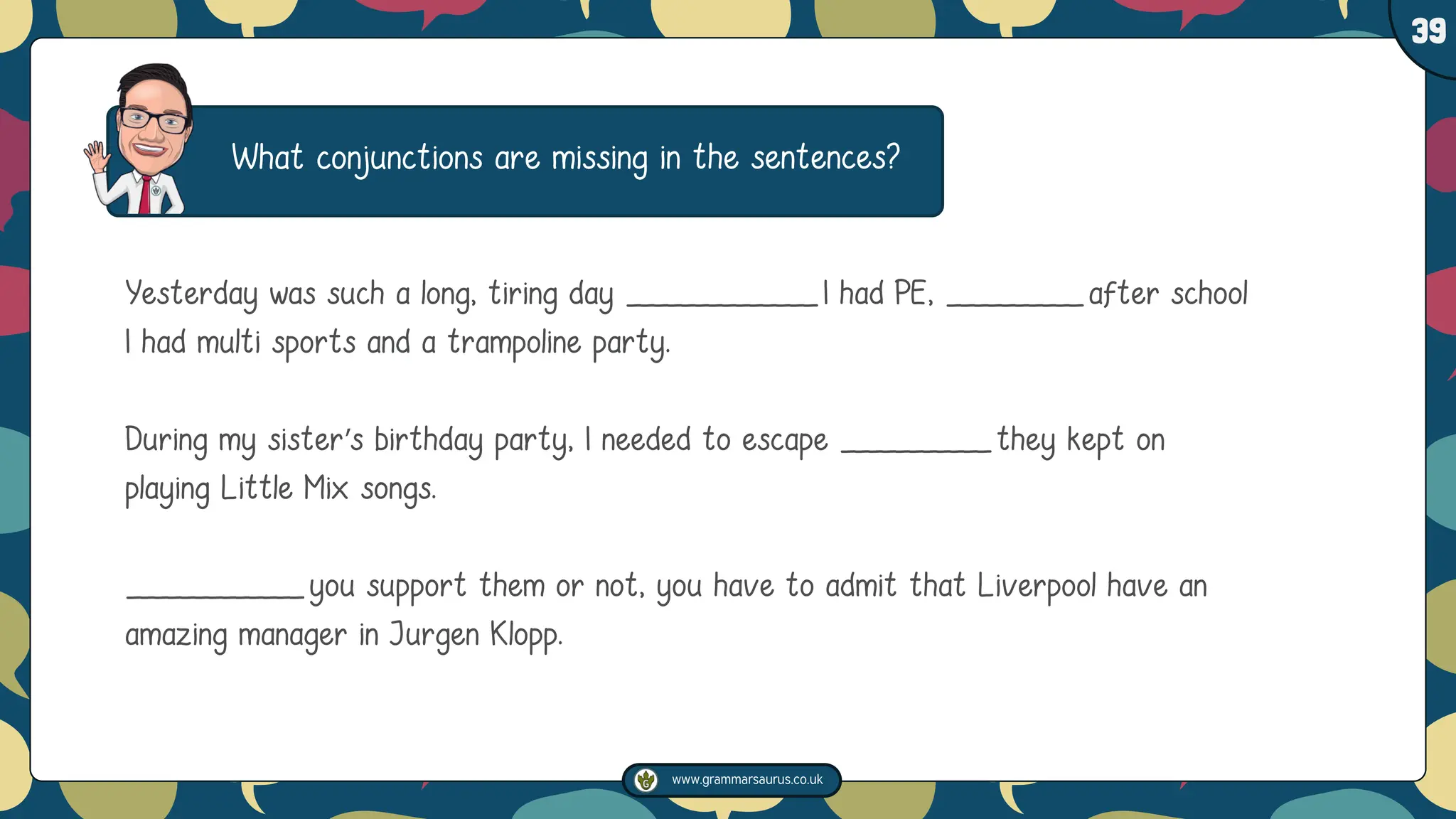
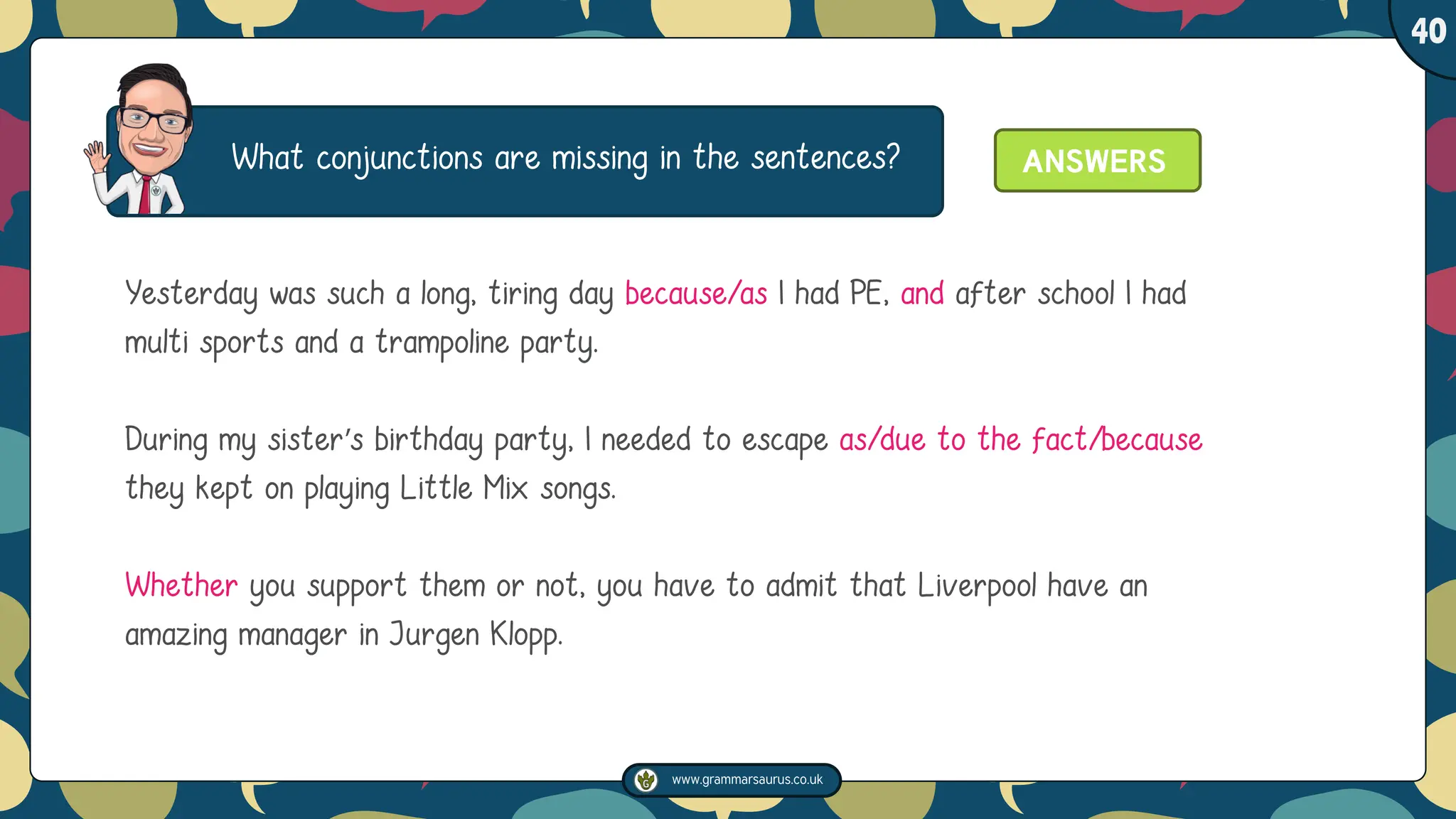
What conjunctions are missing in the sentences?
Yesterday was such a long, tiring day ______________I had PE, __________after school
I had multi sports and a trampoline party.
During my sister’s birthday party, I needed to escape ___________they kept on
playing Little Mix songs.
_____________you support them or not, you have to admit that Liverpool have an
amazing manager in Jurgen Klopp.
www.grammarsaurus.co.uk
1
40
What conjunctions are missing in the sentences?
Yesterday was such a long, tiring day because/as I had PE, and after school I had
multi sports and a trampoline party.
During my sister’s birthday party, I needed to escape as/due to the fact/because
they kept on playing Little Mix songs.
Whether you support them or not, you have to admit that Liverpool have an
amazing manager in Jurgen Klopp.
ANSWERS
www.grammarsaurus.co.uk
1
41
Task eleven
In your booklet, try to remember what conjunctions make up the acronyms
FANBOYS and AWHITEBUS. Sneak a look at the previous slide if you
need to!
Complete the following two tasks:
- Add in the missing conjunctions.
- Complete the tick boxes.
www.grammarsaurus.co.uk
1
42
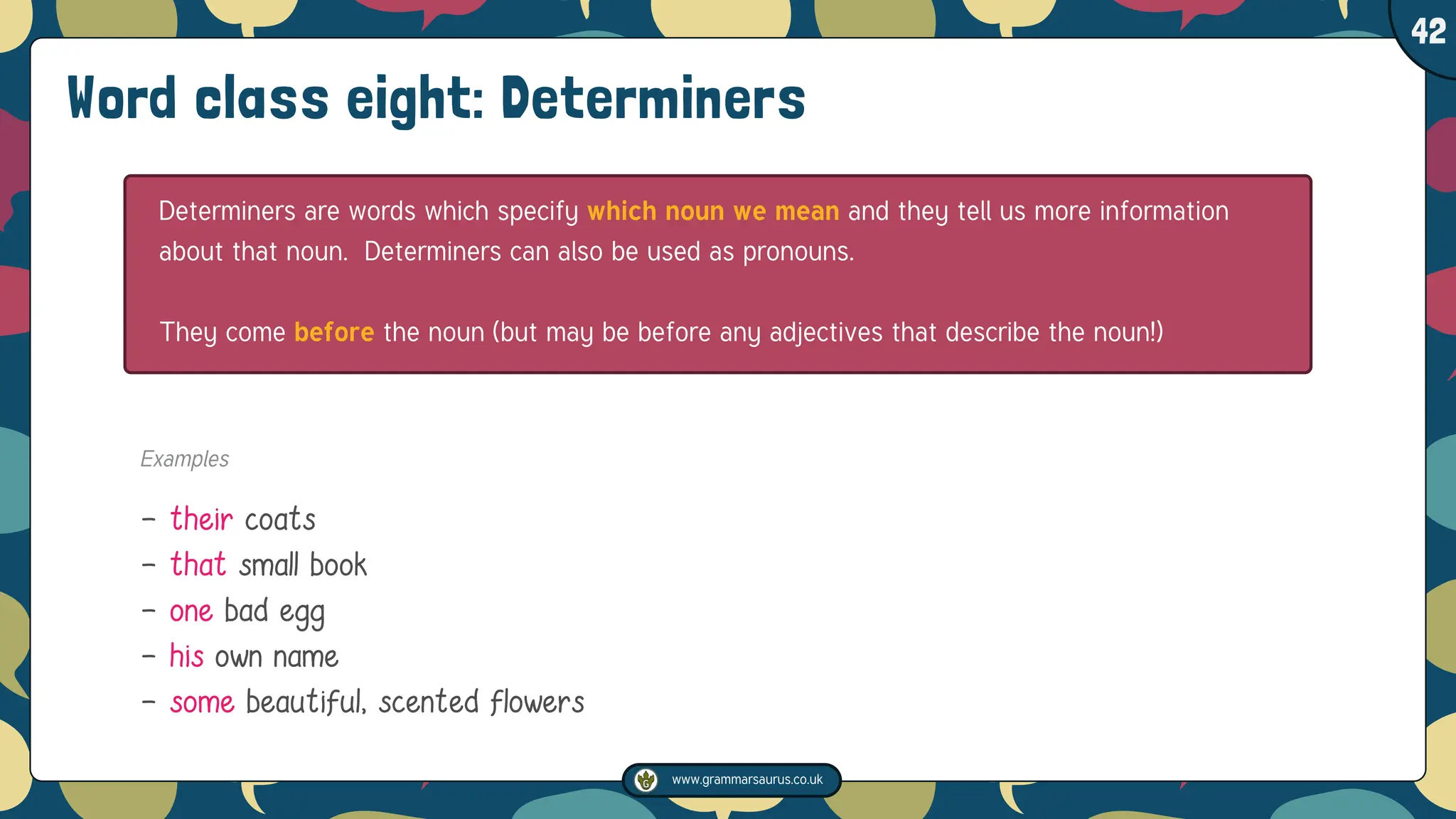
Word class eight: Determiners
Determiners are words which specify which noun we mean and they tell us more information
about that noun. Determiners can also be used as pronouns.
They come before the noun (but may be before any adjectives that describe the noun!)
Examples
- their coats
- that small book
- one bad egg
- his own name
- some beautiful, scented flowers
www.grammarsaurus.co.uk
1
43
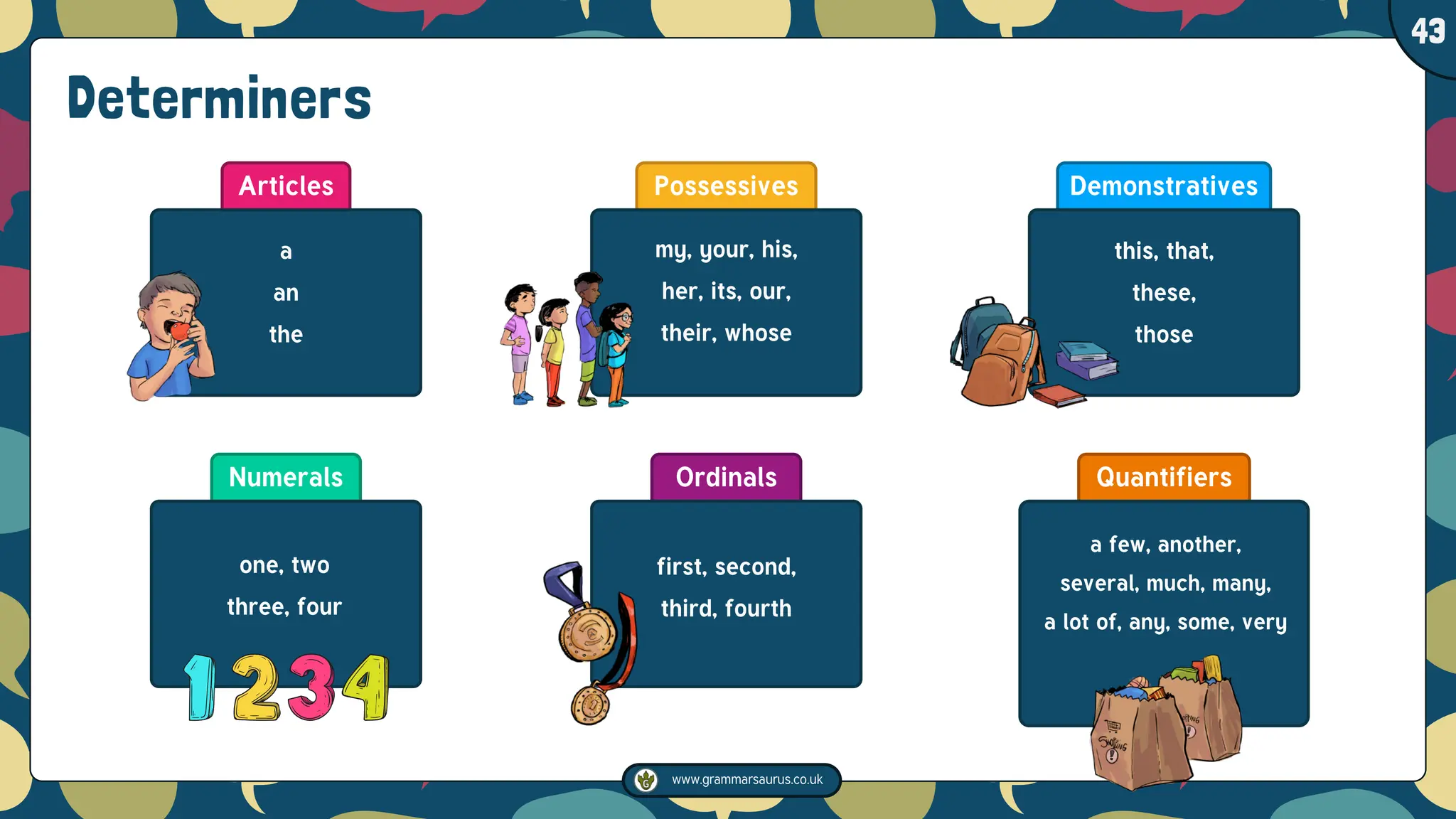
Determiners
Articles
a
an
the
Possessives
my, your, his,
her, its, our,
their, whose
Demonstratives
this, that,
these,
those
Numerals
one, two
three, four
Ordinals
first, second,
third, fourth
Quantifiers
a few, another,
several, much, many,
a lot of, any, some, very
www.grammarsaurus.co.uk
1
44
Spot the determiners
We are going to their house.
I need you to go and order seventeen cupcakes for the party.
Jacob got the first place medal.
There is a lot of unnecessary talk going on in this classroom!
www.grammarsaurus.co.uk
1
45
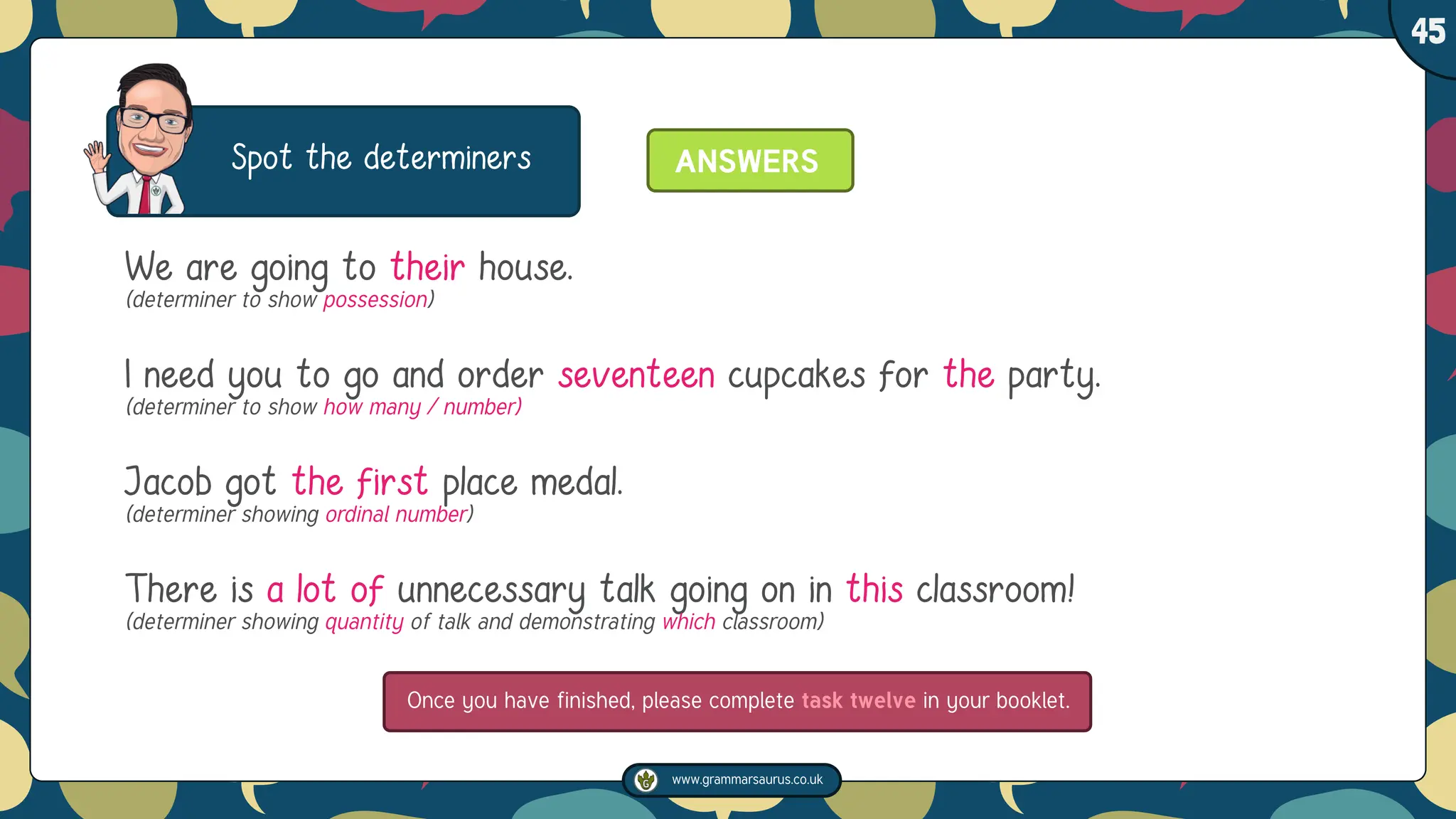
Spot the determiners ANSWERS
Once you have finished, please complete task twelve in your booklet.
We are going to their house.
(determiner to show possession)
I need you to go and order seventeen cupcakes for the party.
(determiner to show how many / number)
Jacob got the first place medal.
(determiner showing ordinal number)
There is a lot of unnecessary talk going on in this classroom!
(determiner showing quantity of talk and demonstrating which classroom)
www.grammarsaurus.co.uk
1
46
We have reminded ourselves about the
eight main word classes. ��
Now, let’s see if you can identify them
when used in a sentence. ��
www.grammarsaurus.co.uk
1
47
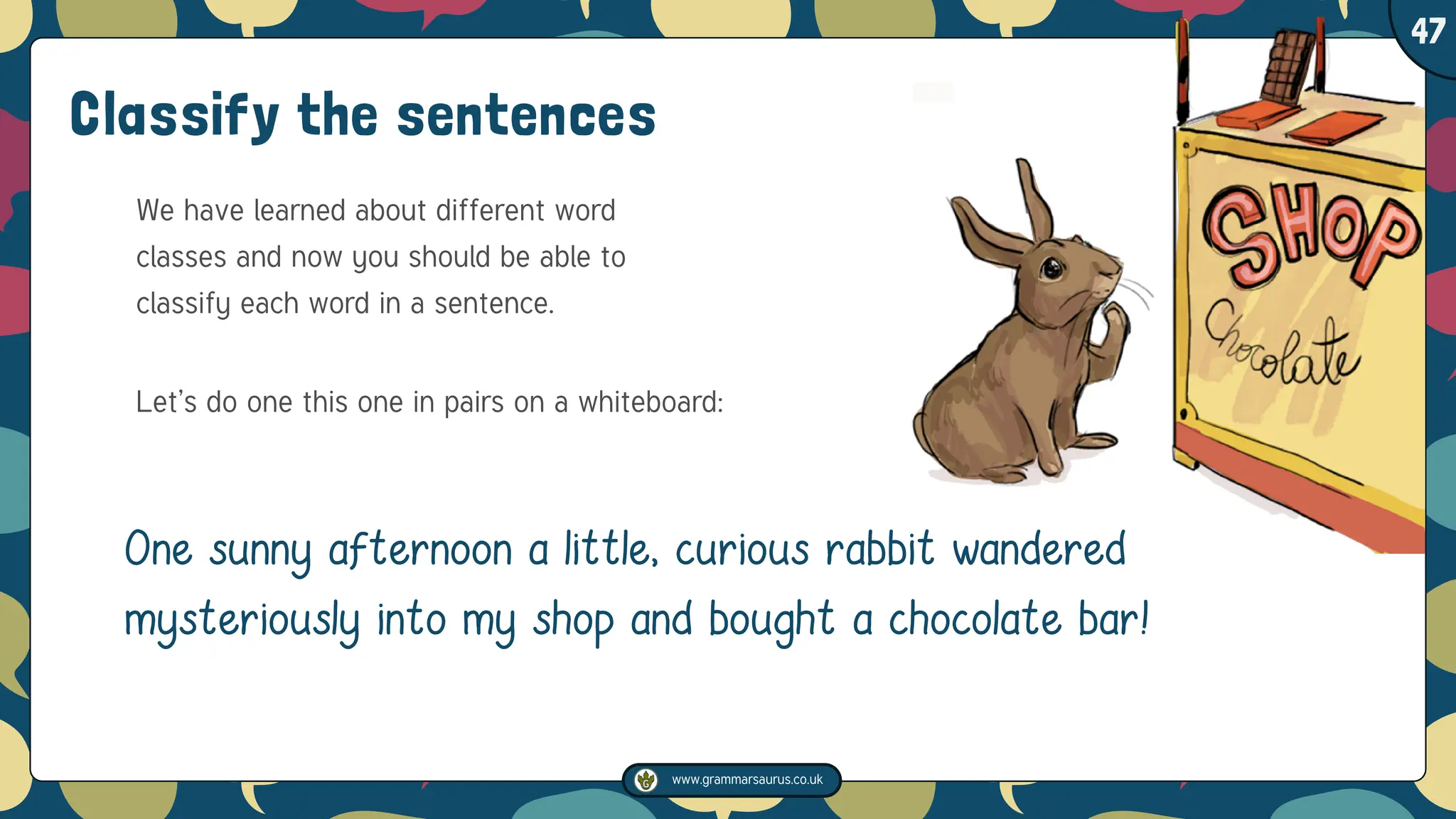
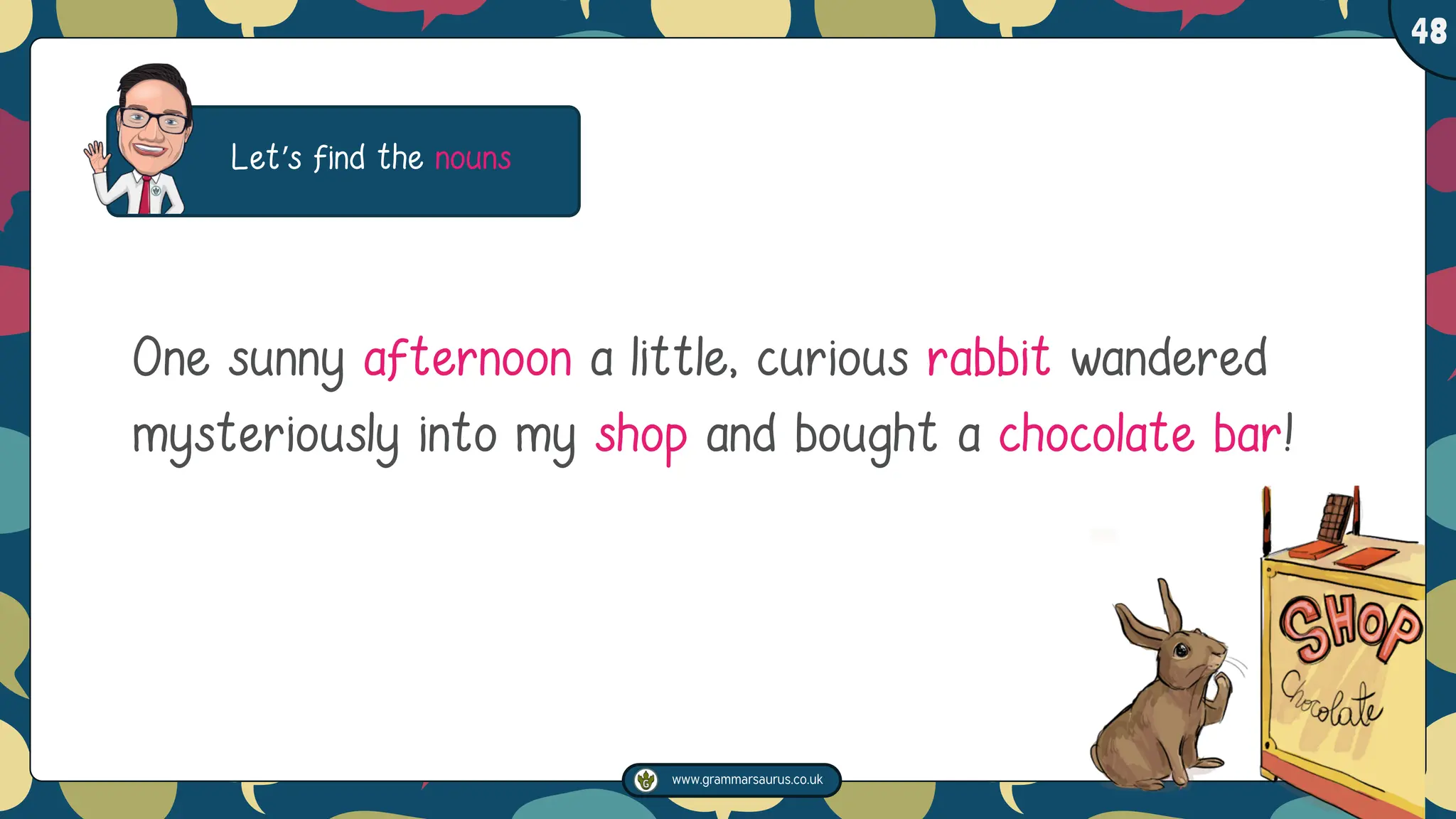
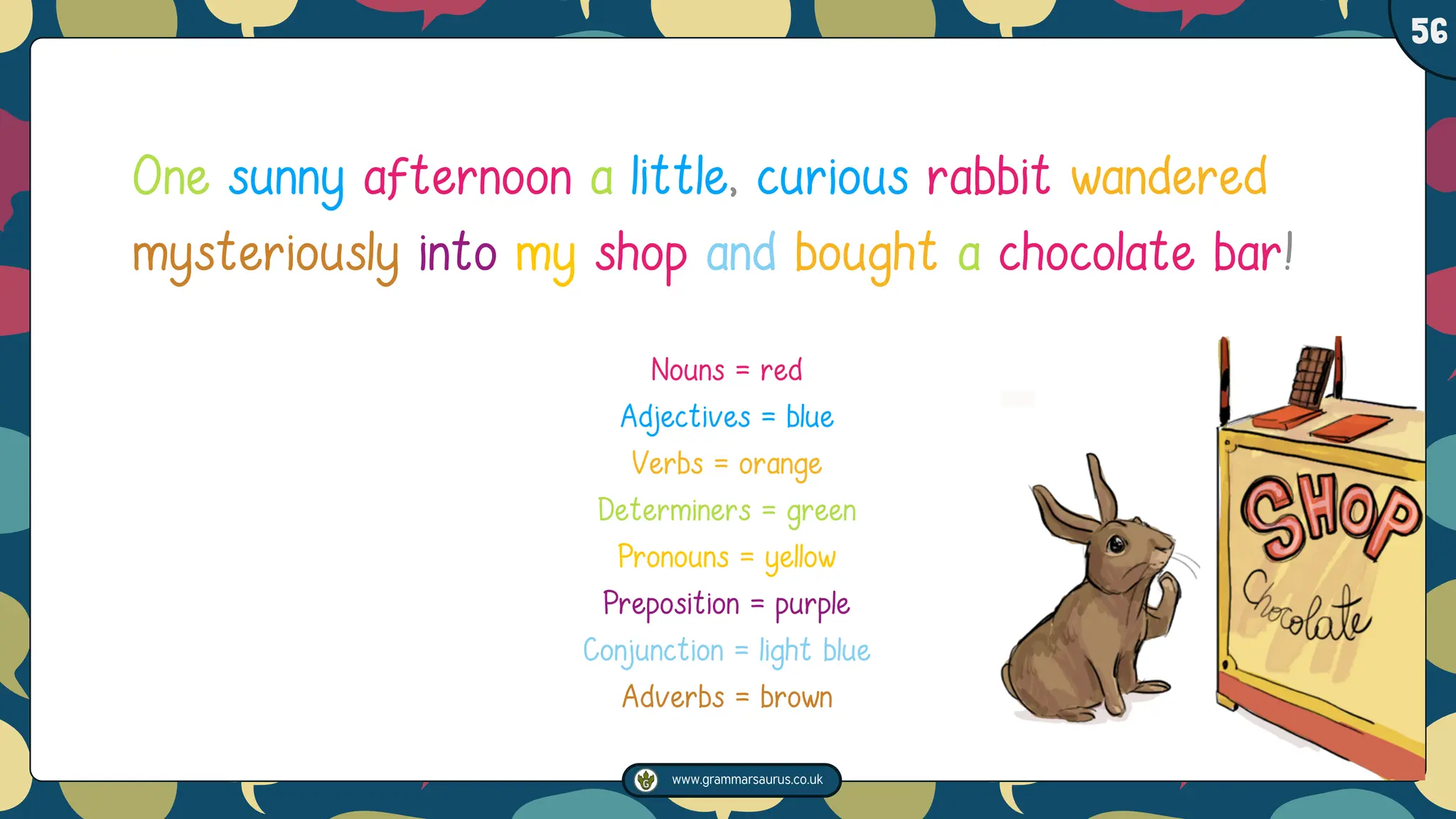
One sunny afternoon a little, curious rabbit wandered
mysteriously into my shop and bought a chocolate bar!
Classify the sentences
We have learned about different word
classes and now you should be able to
classify each word in a sentence.
Let’s do one this one in pairs on a whiteboard:
www.grammarsaurus.co.uk
1
48
Let’s find the nouns
One sunny afternoon a little, curious rabbit wandered
mysteriously into my shop and bought a chocolate bar!
www.grammarsaurus.co.uk
1
49
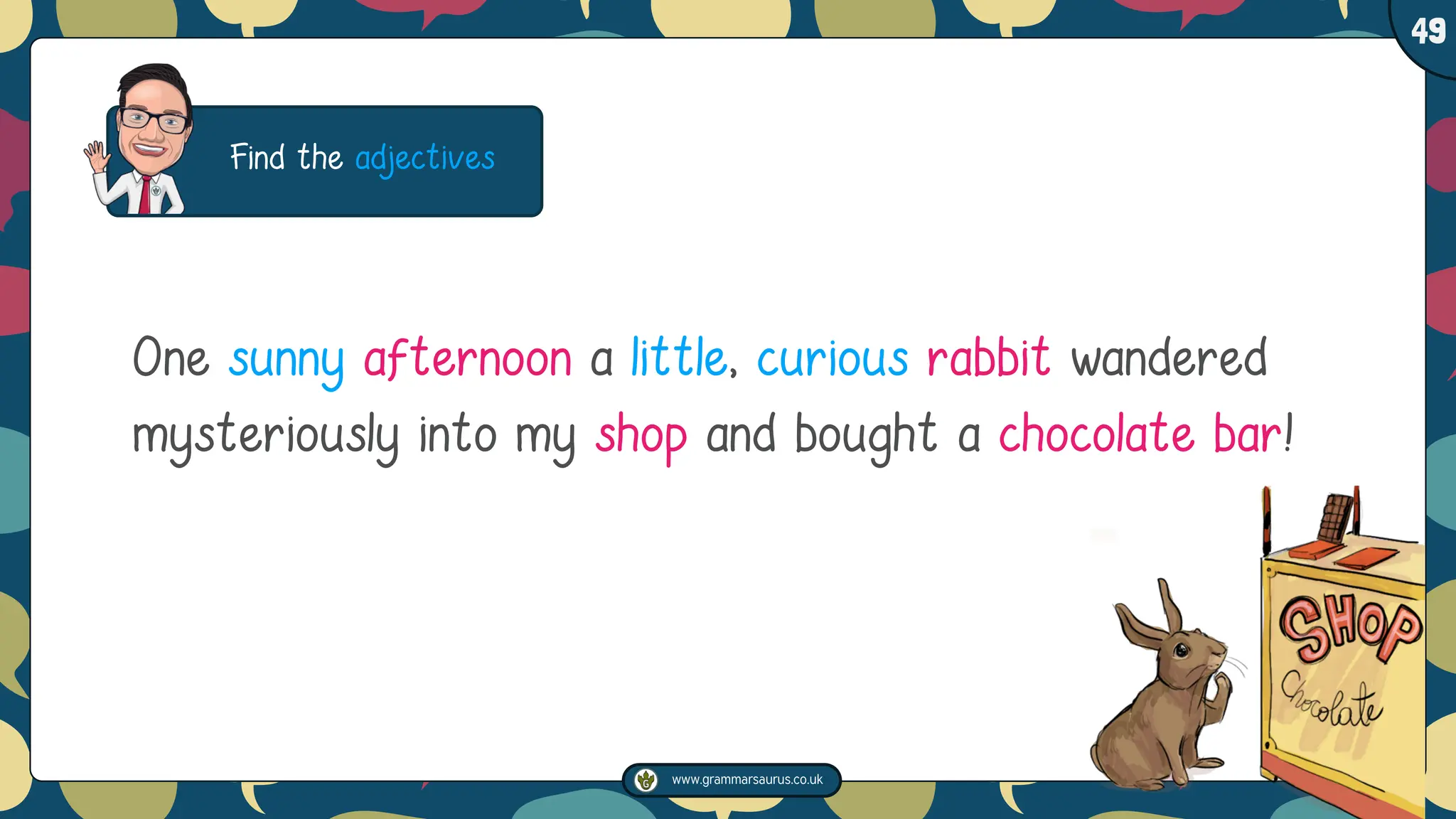
Find the adjectives
One sunny afternoon a little, curious rabbit wandered
mysteriously into my shop and bought a chocolate bar!
www.grammarsaurus.co.uk
1
50
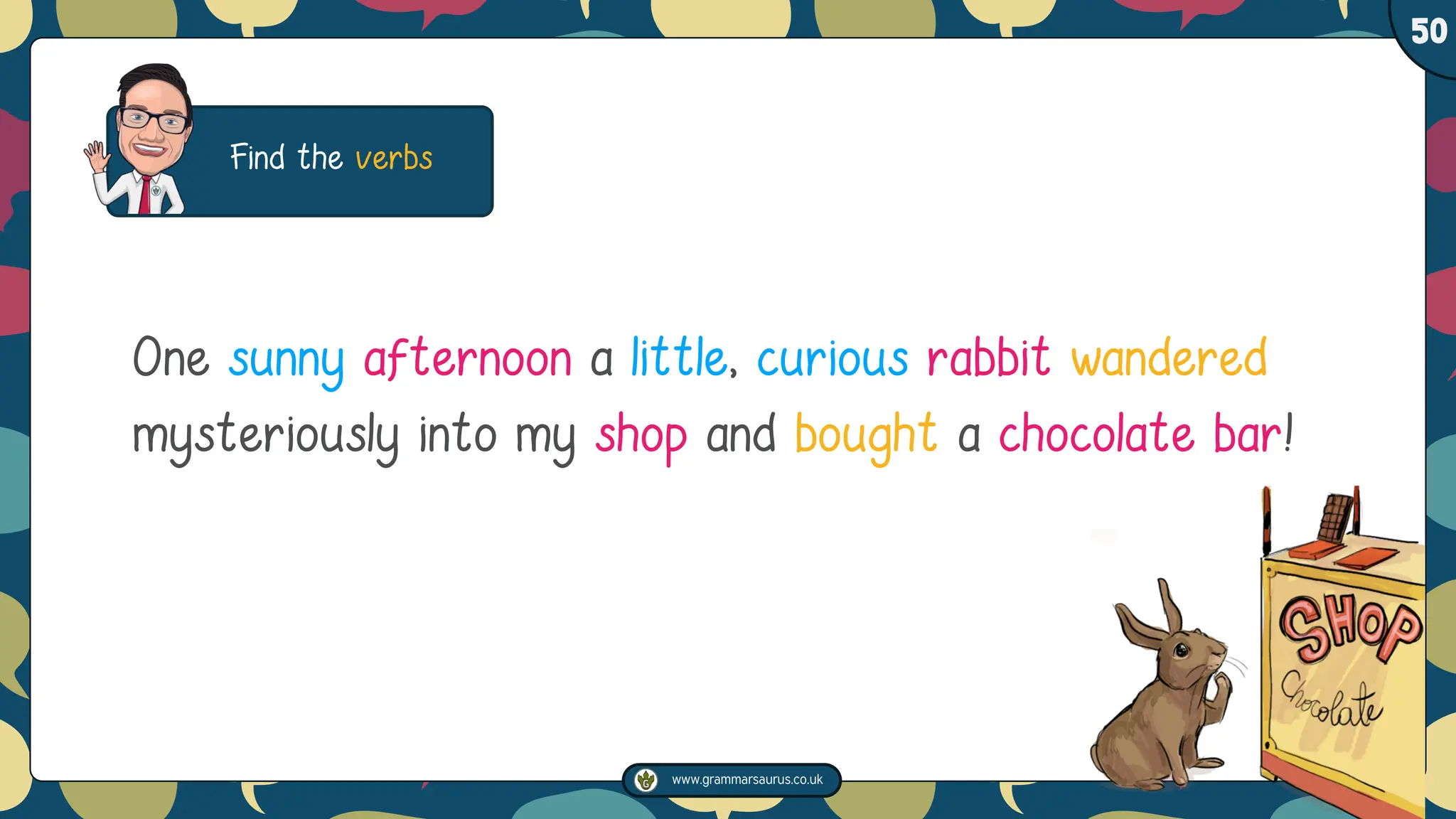
Find the verbs
One sunny afternoon a little, curious rabbit wandered
mysteriously into my shop and bought a chocolate bar!
www.grammarsaurus.co.uk
1
51
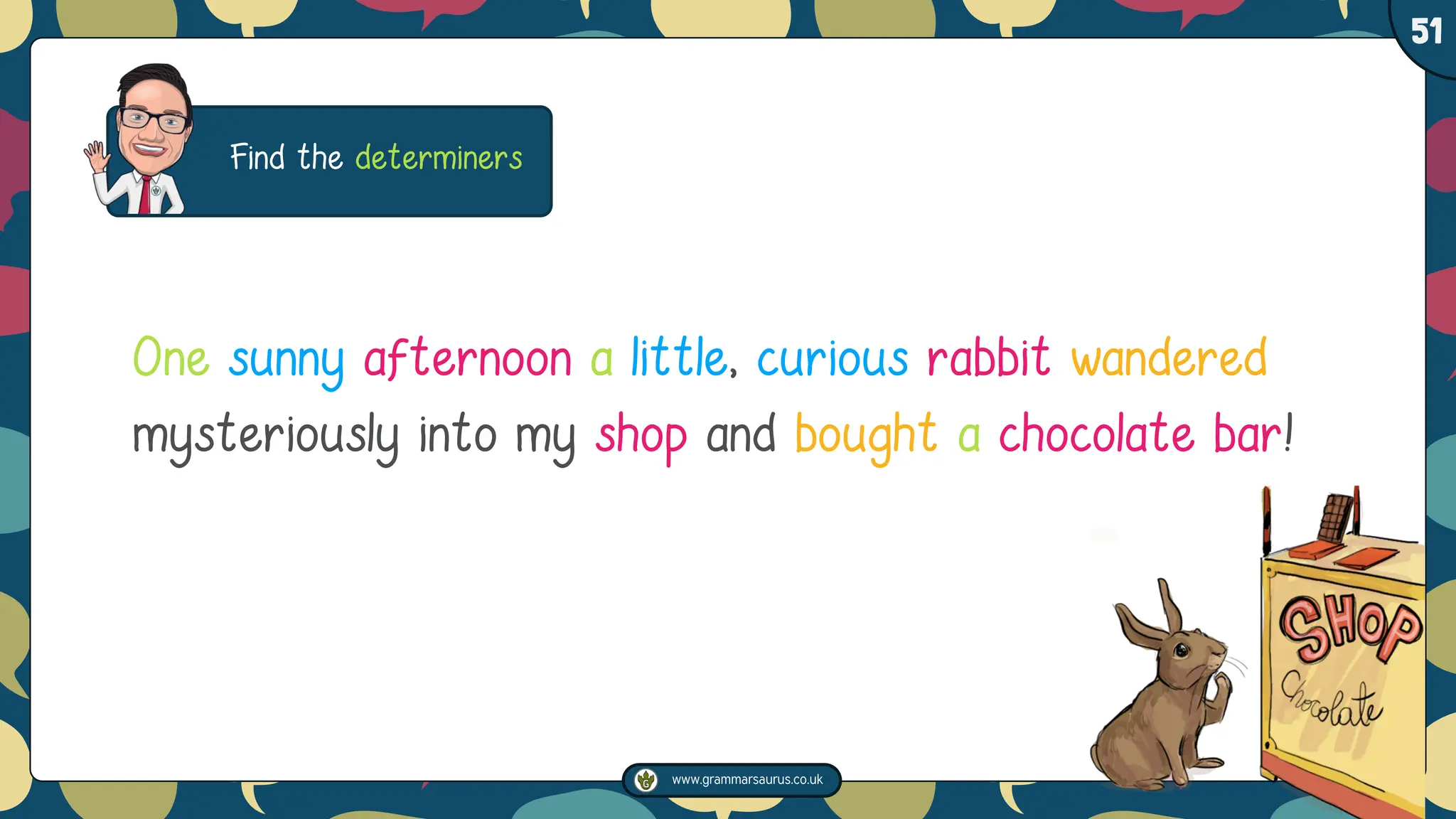
Find the determiners
One sunny afternoon a little, curious rabbit wandered
mysteriously into my shop and bought a chocolate bar!
www.grammarsaurus.co.uk
1
52
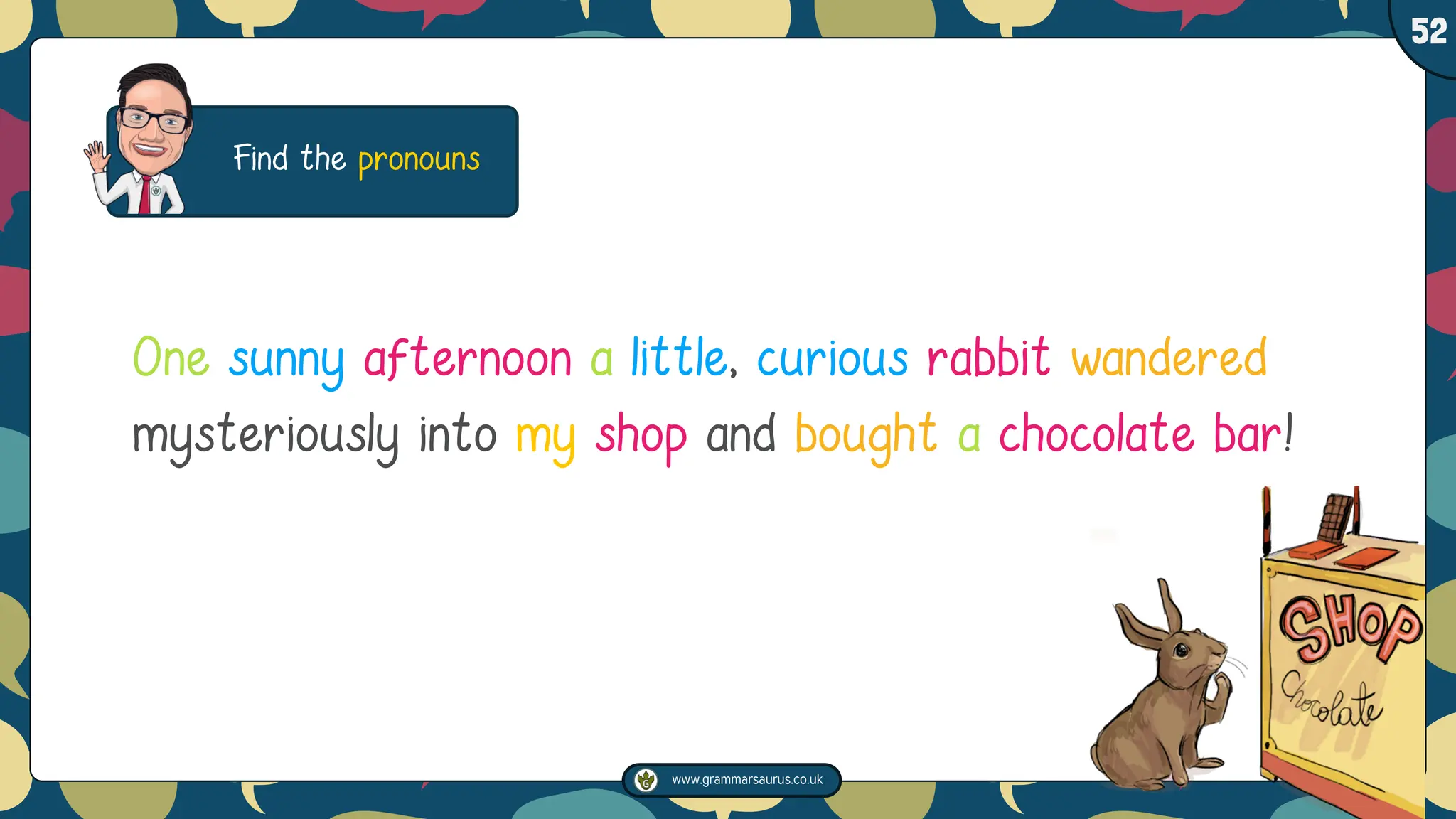
Find the pronouns
One sunny afternoon a little, curious rabbit wandered
mysteriously into my shop and bought a chocolate bar!
www.grammarsaurus.co.uk
1
53
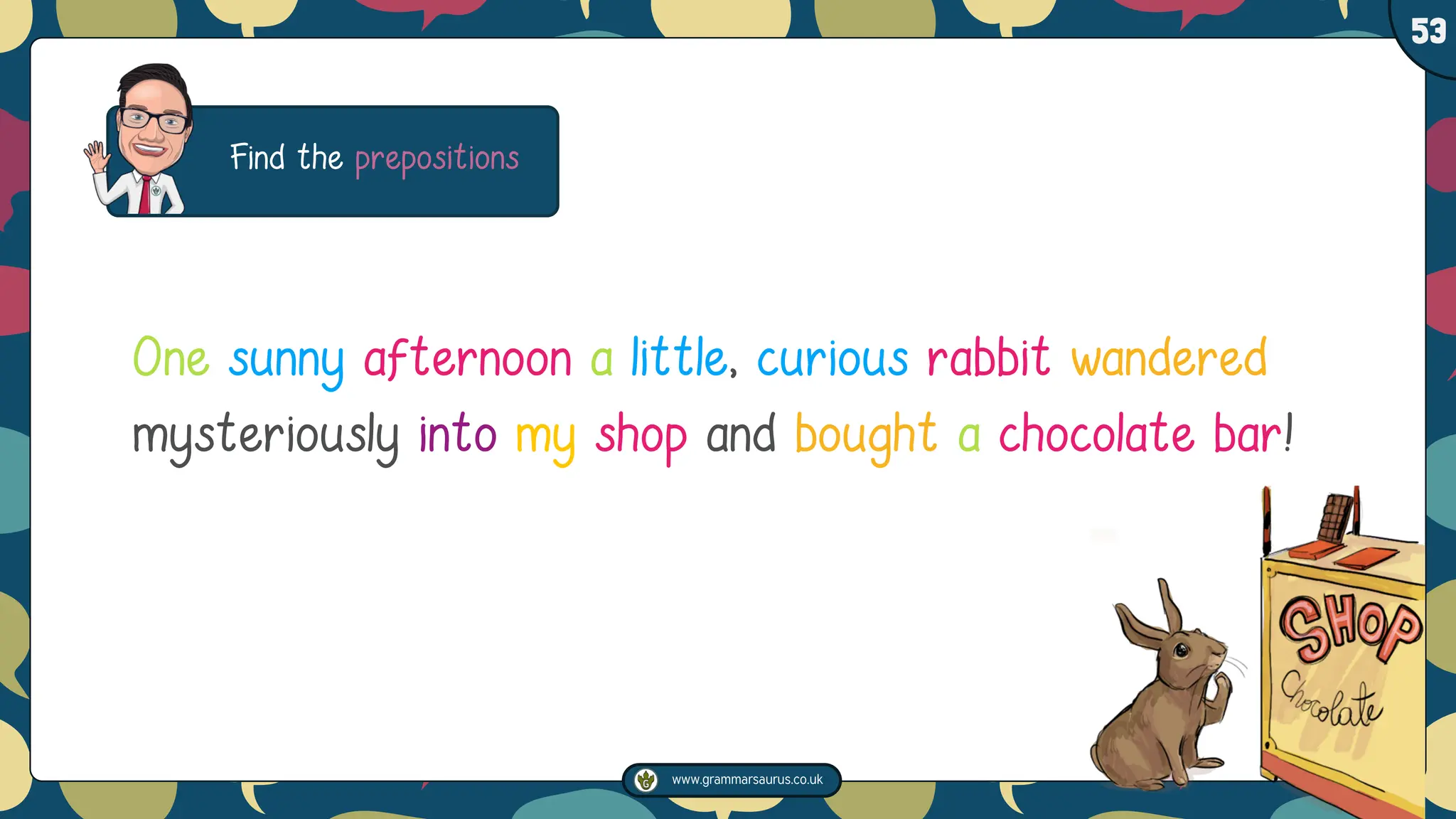
Find the prepositions
One sunny afternoon a little, curious rabbit wandered
mysteriously into my shop and bought a chocolate bar!
www.grammarsaurus.co.uk
1
54
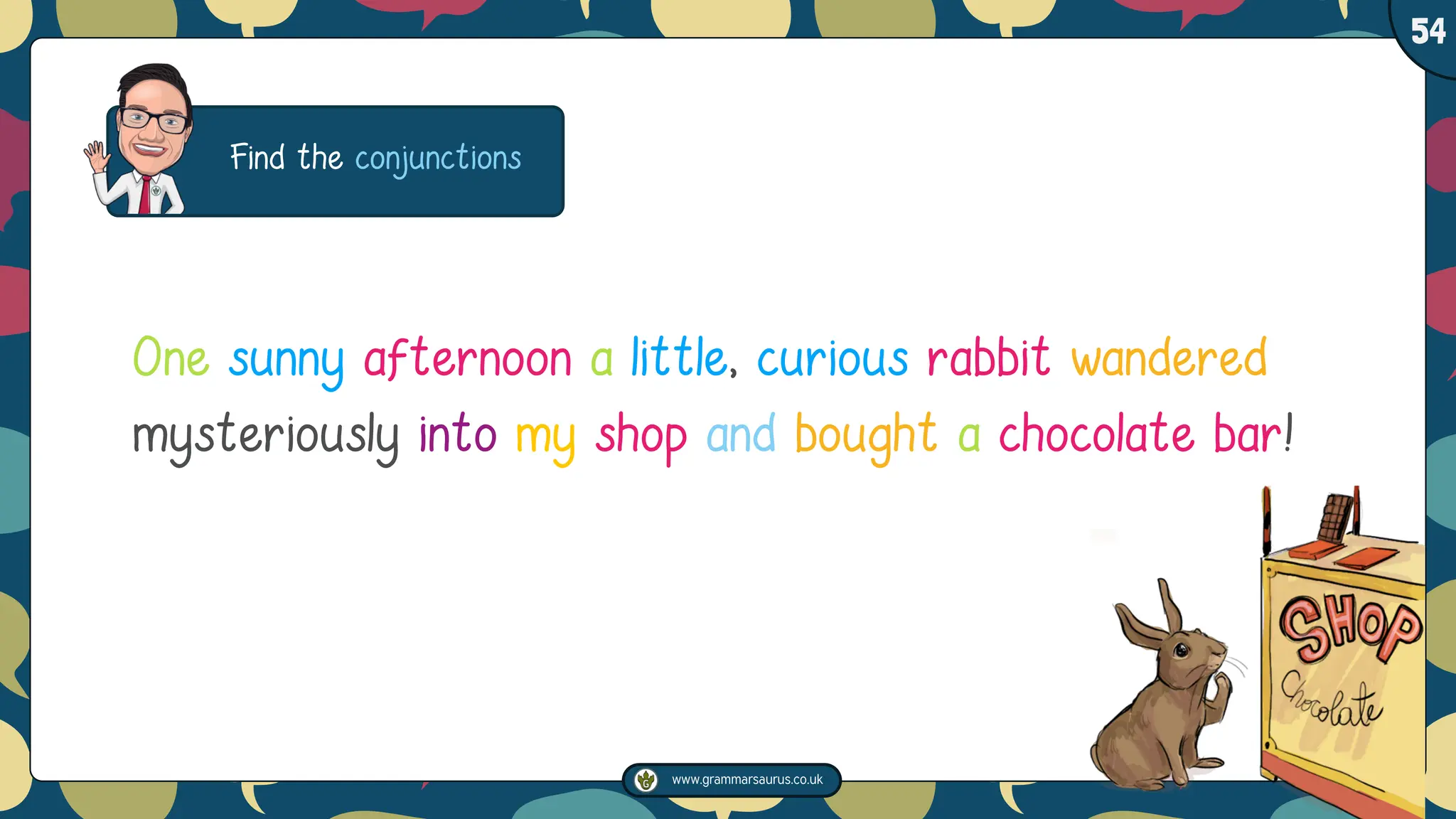
Find the conjunctions
One sunny afternoon a little, curious rabbit wandered
mysteriously into my shop and bought a chocolate bar!
www.grammarsaurus.co.uk
1
55
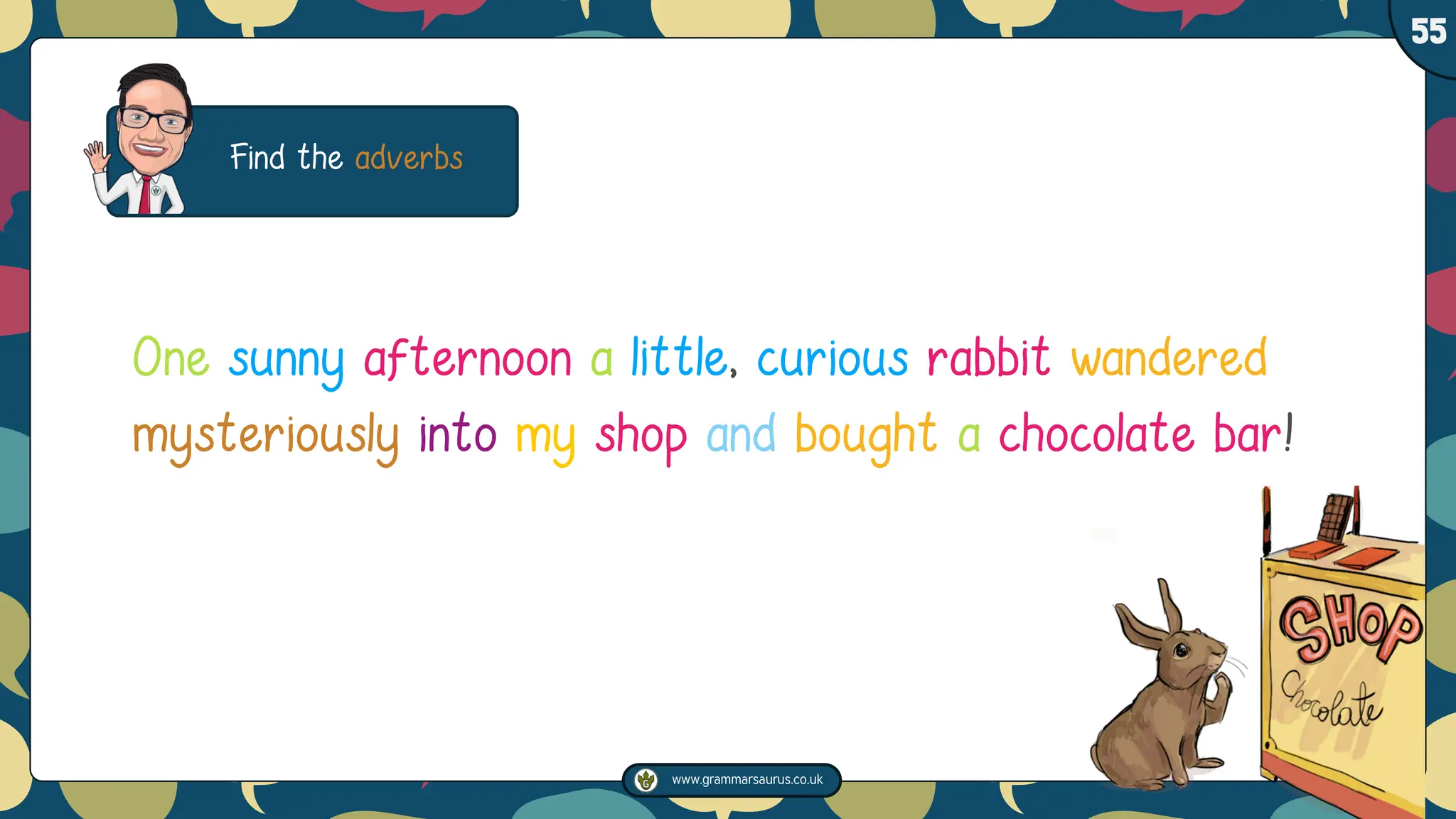
Find the adverbs
One sunny afternoon a little, curious rabbit wandered
mysteriously into my shop and bought a chocolate bar!
www.grammarsaurus.co.uk
1
56
One sunny afternoon a little, curious rabbit wandered
mysteriously into my shop and bought a chocolate bar!
Nouns = red
Adjectives = blue
Verbs = orange
Determiners = green
Pronouns = yellow
Preposition = purple
Conjunction = light blue
Adverbs = brown
www.grammarsaurus.co.uk
1
57
Now, try the sentences in your booklet.
(Task thirteen)
www.grammarsaurus.co.uk
1
58
Congratulations! ��
You have now recapped on word class.��
In your booklet, repeat the same
matching exercise that we started this
unit with. ��
How much faster and more accurate are
you this time?��

PRESENTATION-Word-Class-Revision slide share

  • 1.
    Grammarsaurus Word Class Y5/ Y6 www.grammarsaurus.co.uk Arecap on earlier years’ word class learning for Year 5 and 6 classes
  • 2.
    1 www.grammarsaurus.co.uk What does wordclass mean? Word class is a category of words, which are grouped together due to similar form or function. Time yourself and record how long it takes you to complete. We are going to look at the eight main word classes. As a warm up, can you match the word class with its definition? (Task one)
  • 3.
    www.grammarsaurus.co.uk 1 2 Quickfire Word class 1:Nouns A noun is a naming word. It can name a place, person, thing or feeling. Common nouns are the easy nouns to remember. For example, simple naming words like table, boat, man. They are used to name everyday things and kinds of people. With a partner, go back and forth as fast as you can sharing nouns you know. You have two minutes.
  • 4.
    www.grammarsaurus.co.uk 1 3 There are othertypes of nouns. Proper nouns Proper nouns are used to name particular people and places. A proper noun always begins with a capital letter. Collective nouns Collective nouns describe a group or collection of people or things. Abstract nouns Abstract nouns describe things that cannot actually be seen, heard, smelt, felt or tasted. Examples Names - Jim, Betty, Mr Smith Days of the week - Monday Months of the year - April Significant events – Easter or Christmas Examples army, bunch, team, swarm, flock Examples sleep, honesty, boredom, freedom, power, love, anger
  • 5.
    www.grammarsaurus.co.uk 1 4 Proper Noun Game(Task two) Set a timer for 3 minutes and see if you can think of an answer for every category. If you finish before 3 minutes, then think of some answers for an alternative letter of your choice. Think of an example for each of these, beginning with letter ’L’ : 1. A chocolate bar 2. A famous person 3. A town or city 4. The first name of a child in this school 5. A famous singer or group 6. A country
  • 6.
    www.grammarsaurus.co.uk 1 5 In your booklet,sort the different types of nouns into the correct noun categories. Challenge: Can you create your own table with different nouns? Noun Sorter (Task three)
  • 7.
    www.grammarsaurus.co.uk 1 6 Word class 2:Verbs Verbs are ’action’ or ’doing’ words. They describe what is taking place. In the example below, the subject (noun) in the sentence is doing the action (verb) and the object (noun) is having the verb done to them. Examples Mr Pansini threw the ball towards me. Threw is the verb. It is the past tense of throw. A sentence needs a verb in order for it to make sense. Without a verb, it is a phrase.
  • 8.
    www.grammarsaurus.co.uk 1 7 Verb spy! Pick outand circle the verbs in the following sentences. 1. It would be absolutely wonderful if you finished your work before play time. 2. Harriet danced her way right onto the playground because she had finished her story. 3. Mr Ali quickly whizzed to the staffroom at break time and made himself a much-needed coffee.
  • 9.
    www.grammarsaurus.co.uk 1 8 Pick out andcircle the verbs in the following sentences. 1. It would* be absolutely wonderful if you finished your work before play time. 2. Harriet danced her way right onto the playground because she had* finished her story. 3. Mr Ali quickly whizzed to the staffroom at break time and made himself a much-needed coffee. *would - auxiliary/modal verb *had finished – past perfect ANSWERS Verb spy!
  • 10.
    www.grammarsaurus.co.uk 1 9 What could themissing verbs be? Challenge – Add any adverbs as well to make the sentences more interesting. ________________ towards me, my dog ________________ as he _________________ me. "I asked you not to ____________________ in the hallway,” __________________ Ms Flanagan.
  • 11.
    www.grammarsaurus.co.uk 1 10 What could themissing verbs be? Hobbling towards me, my dog yelped as he reached me. Racing towards me, my dog barked as he jumped up on me. "I asked you not to flounder and flop in the hallway!,” barked Ms Flanagan. "I asked you not to run in the hallway!,” hissed Ms Flanagan. Examples only! Ask a friend to check if your sentence makes sense. ANSWERS
  • 12.
    www.grammarsaurus.co.uk 1 11 Verb Upgrader! (Taskfour) For this task, you need to look at the boring verbs written inside the stars and find more exciting synonyms for that verb. Write as many as you can around the stars. Support – you can use a thesaurus if you need help. Challenge – write alternative verbs in different tenses too e.g. past and future tenses too.
  • 13.
    www.grammarsaurus.co.uk 1 12 Which is the verband which is the noun? Noun or verb? Some words can be classified in more than one word class depending on how they are used in a sentence. A word that has the same spelling and (mostly) the same sound, but more than one meaning, is called a homonym. Example I shed a tear on my last day of primary school. He asked me to tear out the last page of the book, but I couldn’t!
  • 14.
    www.grammarsaurus.co.uk 1 13 Now, try the questionson task five in your booklet. ANSWERS I shed a tear on my last day of primary school. Noun – a tear is a physical thing. He asked me to tear out the last page of the book, but I couldn’t! Verb – it is an action to tear something.
  • 15.
    www.grammarsaurus.co.uk 1 14 You can useadjectives in pairs or lists for impact too. You need to separate lists of adjectives with commas. e.g. The dynamic, enchanting girl finally graced us with her presence. Word class three: Adjectives - Adjectives are describing words. They describe and add detail about the noun/s in a sentence. - Adjectives are usually before the noun e.g. stunning sunset but they can also come after the noun. e.g. The sunset was stunning.
  • 16.
    www.grammarsaurus.co.uk 1 15 Find the adjectives Findthe adjectives in the following sentences and list them on your whiteboard/in your book. Due to the fact the threatening skies have finally opened, you will definitely need to take a decent umbrella with you now. I wouldn’t say the library is bustling, but it certainly gets used by some quirky, local people.
  • 17.
    www.grammarsaurus.co.uk 1 16 Find the adjectives Findthe adjectives in the following sentences and list them on your whiteboard/in your book. Due to the fact the threatening skies have finally opened, you will definitely need to take a decent umbrella with you now. I wouldn’t say the library is bustling, but it certainly gets used by some quirky, local people. ANSWERS
  • 18.
    www.grammarsaurus.co.uk 1 17 Describe me! In pairs,use ambitious adjectives to orally describe the following pictures. Partner A does one picture and Partner B does the other. Please speak in full sentences and don’t just list adjectives!
  • 19.
    www.grammarsaurus.co.uk 1 18 Incredible adjectives (Tasksix) Look at the beach scene. Describe it using sophisticated and powerful adjectives. Make sure you use the following sentence types: - Complex sentence (subordinating and main clause) - Compound sentence (2 main clauses) - Short sentence - Exclamation sentence - Question sentence Challenge
  • 20.
    www.grammarsaurus.co.uk 1 19 Recap of firstthree word classes (Task seven) With a partner, sort the group of words into their correct word class. Nouns Verbs Adjectives bus raced ate dragon loud crawled red Greta Thunberg soft angry Liverpool disgusting Tim Peaks screamed gun has cute cried is isolating
  • 21.
    www.grammarsaurus.co.uk 1 20 Word class four:Adverbs You know a word is an adverb because it ends in –ly. True False or
  • 22.
    www.grammarsaurus.co.uk 1 21 False - Many adverbsdo end with the suffix -ly, since adding ’ly’ is a way to turn an adjective into an adverb. For instance, the adjective "bold" transforms into the adverb "boldly" by adding -ly to the end. - While not a hard and fast rule, spotting the -ly ending in a word is often a good indicator that it is an adverb. However, there are many exceptions to the rule. - Many adverbs end in -ly, but not all of them do. Common adverbs that don’t end in -ly include words like fast, slow and very. These words can also be used as adjectives, so it is important to analyse their function within a sentence.
  • 23.
    www.grammarsaurus.co.uk 1 22 Adverbs An adverb tellsyou more about the verb by describing it or modifying it - it ’adds’ to the verb. It nearly always answers the questions: How? When? Where? How often? How much? Many of the adverbs which tell us how end in –ly and come from adjectives. The boy moved… e.g. soft – softly; slow – slowly.
  • 24.
    www.grammarsaurus.co.uk 1 23 Other adverbs giveus more information about when the verb happens/happened. I went over to his house… yesterday / last week I want to go over to his house… soon
  • 25.
    www.grammarsaurus.co.uk 1 24 Some adverbs areused to tell us where the verb happens/happened. There is snow… e.g. below / downstairs / everywhere Some adverbs tell us how often the verb happens/happened I brush my hair… e.g. frequently, sometimes, never, often
  • 26.
    www.grammarsaurus.co.uk 1 25 Some adverbs tellus how much the verb happens/happened It was ___________ packed in the dance hall. very, totally, rather, almost, completely Adverbs can be before or after the verb.
  • 27.
    www.grammarsaurus.co.uk 1 26 Adverbs (Task eight) Fillin the blanks in the sentences in the revision booklet. Then, identify and circle the adverbs in the sentences. Look carefully… Challenge: Create your own adverb word bank under the following headings. When? Where? How? How often? How much?
  • 28.
    www.grammarsaurus.co.uk 1 27 Word class five:Pronouns A pronoun replaces a noun, so that you do not have to keep on repeating the same noun. It makes a text easier to read if you use pronouns. A possessive pronoun shows belonging e.g. his, hers. Proper Noun Mrs Dirie Pronouns she her hers Proper Noun Mr Bennett Pronouns he him his
  • 29.
  • 30.
    www.grammarsaurus.co.uk 1 29 Where are thepronouns in these sentences? We went over to their house to find out if they wanted to play out. Her jumper was left on the fence. If you ask him nicely, he might let you play on it. I know you want to eat the cake, but it is theirs. Think about what nouns would fit where the pronouns are.
  • 31.
    www.grammarsaurus.co.uk 1 29 Where are thepronouns in these sentences? We went over to their house to find out if they wanted to play out. Her jumper was left on the fence. If you ask him nicely, he might let you play on it. I know you want to eat the cake, but it is theirs. ANSWERS
  • 32.
  • 33.
    www.grammarsaurus.co.uk 1 32 What other prepositionswould work here? (It may sound silly!) Word class six: Prepositions A preposition is used before a noun or a pronoun to explain its position to another noun. e.g. If you walk over here, you will see your dinner is on the table.
  • 34.
    www.grammarsaurus.co.uk 1 33 You could have: Ifyou walk over here, you will see your dinner is next to the table. If you walk over here, you will see your dinner is behind the table. If you walk over here, you will see your dinner is under the table! If you walk over here, you will see your dinner is above the table. Did you have any other plausible sentences?
  • 35.
    www.grammarsaurus.co.uk 1 34 Prepositions tell us moreabout the time, place or direction of a noun. Location above behind below beside between by in inside near on over through Time after before by during from on past since through to until upon Movement against along down from into off on onto out of toward up upon
  • 36.
    www.grammarsaurus.co.uk 1 35 What prepositions aremissing? I am getting __________the bath ___________Coronation Street comes _________the TV. You always shout __________me when I forget to come __________with my dirty laundry. I will meet you ___________the oak tree __________the park.
  • 37.
    www.grammarsaurus.co.uk 1 36 What prepositions aremissing? I am getting into the bath before/after Coronation Street comes on the TV. You always shout at me when I forget to come down/over with my dirty laundry. I will meet you underneath/by/under/below the oak tree in/by/next to the park. ANSWERS Once you have finished, please complete task ten in your booklet.
  • 38.
    www.grammarsaurus.co.uk 1 37 Word class seven:Conjunctions Clauses join parts of sentences together. There are two types of conjunctions. - join together clauses. They help us to create compound sentences by joining two main clauses together. (Main clauses make sense as sentences in their own right.) You could put a full stop in between the main clauses and they would form two separate sentences, but by using a comma and a conjunction you make one longer (compound) sentence. It helps your writing to flow better, and shows writing maturity too! Co-ordinating conjunctions Example She went to the shops and she bought a box of chocolates.
  • 39.
    www.grammarsaurus.co.uk 1 38 Subordinating conjunctions linka main (independent) clause with a subordinate (dependent) clause (a clause which does not make sense on its own). If a sentence starts with a subordinate clause, it needs a comma after the subordinate clause and before the main clause. If the subordinate clause is in the middle of the sentence, it does not need a comma to separate the clauses. Subordinating conjunctions Examples When we got home, we were hungry. We were hungry because we hadn’t eaten all day. In case I forget to tell you later on, there will be no football on this Tuesday.
  • 40.
    www.grammarsaurus.co.uk 1 39 What conjunctions aremissing in the sentences? Yesterday was such a long, tiring day ______________I had PE, __________after school I had multi sports and a trampoline party. During my sister’s birthday party, I needed to escape ___________they kept on playing Little Mix songs. _____________you support them or not, you have to admit that Liverpool have an amazing manager in Jurgen Klopp.
  • 41.
    www.grammarsaurus.co.uk 1 40 What conjunctions aremissing in the sentences? Yesterday was such a long, tiring day because/as I had PE, and after school I had multi sports and a trampoline party. During my sister’s birthday party, I needed to escape as/due to the fact/because they kept on playing Little Mix songs. Whether you support them or not, you have to admit that Liverpool have an amazing manager in Jurgen Klopp. ANSWERS
  • 42.
    www.grammarsaurus.co.uk 1 41 Task eleven In yourbooklet, try to remember what conjunctions make up the acronyms FANBOYS and AWHITEBUS. Sneak a look at the previous slide if you need to! Complete the following two tasks: - Add in the missing conjunctions. - Complete the tick boxes.
  • 43.
    www.grammarsaurus.co.uk 1 42 Word class eight:Determiners Determiners are words which specify which noun we mean and they tell us more information about that noun. Determiners can also be used as pronouns. They come before the noun (but may be before any adjectives that describe the noun!) Examples - their coats - that small book - one bad egg - his own name - some beautiful, scented flowers
  • 44.
    www.grammarsaurus.co.uk 1 43 Determiners Articles a an the Possessives my, your, his, her,its, our, their, whose Demonstratives this, that, these, those Numerals one, two three, four Ordinals first, second, third, fourth Quantifiers a few, another, several, much, many, a lot of, any, some, very
  • 45.
    www.grammarsaurus.co.uk 1 44 Spot the determiners Weare going to their house. I need you to go and order seventeen cupcakes for the party. Jacob got the first place medal. There is a lot of unnecessary talk going on in this classroom!
  • 46.
    www.grammarsaurus.co.uk 1 45 Spot the determinersANSWERS Once you have finished, please complete task twelve in your booklet. We are going to their house. (determiner to show possession) I need you to go and order seventeen cupcakes for the party. (determiner to show how many / number) Jacob got the first place medal. (determiner showing ordinal number) There is a lot of unnecessary talk going on in this classroom! (determiner showing quantity of talk and demonstrating which classroom)
  • 47.
    www.grammarsaurus.co.uk 1 46 We have remindedourselves about the eight main word classes. �� Now, let’s see if you can identify them when used in a sentence. ��
  • 48.
    www.grammarsaurus.co.uk 1 47 One sunny afternoona little, curious rabbit wandered mysteriously into my shop and bought a chocolate bar! Classify the sentences We have learned about different word classes and now you should be able to classify each word in a sentence. Let’s do one this one in pairs on a whiteboard:
  • 49.
    www.grammarsaurus.co.uk 1 48 Let’s find thenouns One sunny afternoon a little, curious rabbit wandered mysteriously into my shop and bought a chocolate bar!
  • 50.
    www.grammarsaurus.co.uk 1 49 Find the adjectives Onesunny afternoon a little, curious rabbit wandered mysteriously into my shop and bought a chocolate bar!
  • 51.
    www.grammarsaurus.co.uk 1 50 Find the verbs Onesunny afternoon a little, curious rabbit wandered mysteriously into my shop and bought a chocolate bar!
  • 52.
    www.grammarsaurus.co.uk 1 51 Find the determiners Onesunny afternoon a little, curious rabbit wandered mysteriously into my shop and bought a chocolate bar!
  • 53.
    www.grammarsaurus.co.uk 1 52 Find the pronouns Onesunny afternoon a little, curious rabbit wandered mysteriously into my shop and bought a chocolate bar!
  • 54.
    www.grammarsaurus.co.uk 1 53 Find the prepositions Onesunny afternoon a little, curious rabbit wandered mysteriously into my shop and bought a chocolate bar!
  • 55.
    www.grammarsaurus.co.uk 1 54 Find the conjunctions Onesunny afternoon a little, curious rabbit wandered mysteriously into my shop and bought a chocolate bar!
  • 56.
    www.grammarsaurus.co.uk 1 55 Find the adverbs Onesunny afternoon a little, curious rabbit wandered mysteriously into my shop and bought a chocolate bar!
  • 57.
    www.grammarsaurus.co.uk 1 56 One sunny afternoona little, curious rabbit wandered mysteriously into my shop and bought a chocolate bar! Nouns = red Adjectives = blue Verbs = orange Determiners = green Pronouns = yellow Preposition = purple Conjunction = light blue Adverbs = brown
  • 58.
    www.grammarsaurus.co.uk 1 57 Now, try thesentences in your booklet. (Task thirteen)
  • 59.
    www.grammarsaurus.co.uk 1 58 Congratulations! �� You havenow recapped on word class.�� In your booklet, repeat the same matching exercise that we started this unit with. �� How much faster and more accurate are you this time?��