Basic Grammar
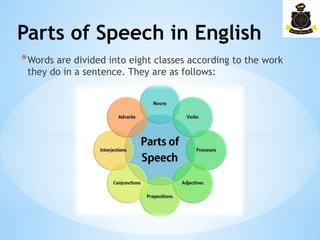
Parts of Speech in English
*Words are divided into eight classes according to the work
they do in a sentence. They are as follows:
Nouns:­
A noun is “naming word”. It names somebody or something.
Rahul took the dog to park.
The car makes a lot of noise.
Look at the example above. A noun is the name of a person
(Rahul), animal (dog), place (park),
thing (car) or idea (noise).
Kinds of Nouns
­
Nouns may be divided into (a) common nouns and (b) proper nouns.
Common nouns are the names given in common to all persons, places
or things of the same class.
For example, bank, shop, market, etc.
Collective noun : Common nouns include another class known as
collective nouns. A collective noun names a group of people, animals
or things regarded as a whole., e.g., batch, company, university,
crowd, flock, etc.
Proper nouns are the names of particular persons, places or things.
For example, India, Larsen and Turbo, Delhi, January, etc.
Activity 1­
Read the following sentences and identify the type
of noun used.
1. Kolkata is the capital of West Bengal.
2. The Royal Bengal Tiger is found in the Sunderbans.
3. The jury gave a unanimous verdict.
4. Laughter is good for health.
5. The crowd is very big.
6. The elephant is an intelligent animal.
7. The Ganges is a sacred river.
8. The bravery of the soldier saved the day.
9. I bought furniture for my new house.
10. King Solomon was very wise.
Activity 1­
Answers::
1. Kolkata, West Bengal – Proper Noun
2. Royal Bengal Tiger, Sunderbans – Proper Noun
3. Jury – Collective Noun, Verdict – Abstract Noun.
4. Laughter, health – Abstract Noun
5. Crowd – Collective Noun
6. Elephant, Animal – Common noun
7. Ganges – Proper Noun, river – Common Noun
8. Bravery – Abstract Noun, Soldier, Day – Common
Noun
9. Furniture, house – Common Noun
10.King Solomon – Proper Noun
Pronouns
­
Pronouns are used in place of nouns. Pronouns may be Personal and
Relative.
Personal Pronouns : To represent person or things., e.g., I, we, you,
she, he, it him, us, them, etc.
Relative Pronouns : The most common relative pronouns are whom,
which and that.
A relative pronoun acts as a pronoun and as a conjunction at the same
time.
This is the boy who save my life.
Possessive Pronouns : These show possession, e.g., mine, ours, yours
their, its and hers
Activity 2­
Read the following sentences and use the
appropriate pronouns.
1. Murat is a good boy. __ always listens to__
teacher.
2. Amit and Sumit are twin brothers. ___ take the
same bag to school.
3. Milly and I are very good friends. ___ have
known each other since childhood.
4. The mangoes are very sour. Where did you buy
___?
5. I love watching Tom and Jerry. __ reminds me
of my childhood days.
Activity 2­
Answers::
1. He, his
2. They
3. We
4. Them
5. It
Adjectives
­
A word used to describe or point out, a person, animal, place or thing
which the noun names, or to tell the number and quantity, is called an
Adjective.
Rani is a clever girl (Girl of what kind?)
He gave me six books (How many book?)
Two or more words can be joined with a hyphen to form a compound
Adjective, e.g., government- financed project
Activity 3­
Read the given sentences below and circle the
adjectives.
1. The homeless beggar hasn’t eaten in days.
2. The fox is a sly animal.
3. Mary had a little lamb.
4. The selfish giant didn’t allow the children to
enter his garden.
5. The foolish dog barked at its reflection and lost
its food.
Activity 3­
Answers::
1. Homeless
2. Sly
3. Little
4. Selfish
5. Foolish
Verbs
­
A verb is a word that tells or asserts something about a person or
thing. Verb comes from Latin Verbum, meaning a word. It is so called
because it is the most important word in the sentence.
A verb may tell us :
1. What a person or thing does; as
Rohit runs.
The bell rings.
2. What is done to a person or thing; as
Ram is beaten.
The door is broken.
Activity 4­
Read the following sentences and select the
correct form of the verb given in brackets.
1. Rita ___ a mile every day. (run/runs)
2. The dogs ___ all night. (barks/bark)
3. The cat ___ the snake. (catch/caught)
4. We ___ in the park in the evenings.
(play/plays)
5. Mia __ school yesterday. (went/go)
Activity 4­
Answers::
1. Runs
2. Bark
3. Caught
4. Play
5. Went
Adverb
­
While Adjectives qualify or add to the meaning of nouns, adverbs
modify the meaning not only of verbs, but also of adjectives,
prepositions, conjunctions, etc.
The following sentences illustrate the varied use of adverbs:
1. Small investors find it very difficult to invest wisely.
(The first adverb very modifies the adjective difficult, and the second
adverb wisely modifies the verb invest).
2. The CEO is an exceptionally sharp manager.
(The adverb exceptionally modifies the adjective sharp).
3. The cash counter is right behind you.
(The adverb right modifies the prepositions behind).
Activity 5
Read the sentences given below and underline the
adverbs:
1. The boy is too careless.
2. The winds are very strong.
3. The baby slept soundly.
4. The soldiers fought the war valiantly.
5. Joey always tries his best.
Activity 5­
Answers::
1. Too
2. Very
3. Soundly
4. Valiantly
5. Always
Preposition
­
A Preposition, by definition is placed before a noun or its equivalent in
order to show its relationship in terms of time, place, etc.:
The space above the room houses the conference facility.
(The preposition above explains the relationship between the room
and the conference facility).
There are hardly any rules governing the use of prepositions, some
people feel that it is inelegant to put them at the end of a sentence
since they are basically used as link-words. However, as Fowler points
out, “Almost all ourgreat writers have allowed themselves to end a
sentence or a clause with a preposition.” The thumb-rule is that the
sentence should read well.
Preposition
­
*It is largely the usage that determines the choice of a preposition.
Americans tend to drop them but it is largely colloquial. A wrong
preposition certainly changes the intended meaning. Therefore, we
have to learn the use of prepositions carefully. All standard
dictionaries list the root word along with different prepositions or
adverbial phrases and also show the difference in meaning.
*For example:
The root word get conveys italicised meanings when used with:
…about, move or spread
…across, be understood
…ahead, make progress
…along, manage
…at, gain access to
…away, escape
Activity 6
Fill in the blanks with appropriate prepositions::
1. This shop doesn’t have the toys I was looking
__. (up/for)
2. The teacher divided the sweets ___ all the
children. (between/among)
3. Bruce did not fare well __ his examination.
(in/at)
4. The dog is grateful __ its owner. (to/for)
5. My brother’s anniversary is __ 5th November.
(on/in)
Activity 6­
Answers::
1. For
2. Among
3. In
4. To
5. On
Conjunction
­
Conjunctions join words or even sentences conveying related ideas.
Two commonly used conjunctions are:
•and
•but.
We received your letter and telegram but regret our inability to
attend the meeting.
Conjunctions may also be used in pairs, e.g. neither-nor, either-or, not
only-but also, both-and, whether or etc.
Such conjunctions are known as Correlative Conjunctions
Activity 7
Fill in the blanks with appropriate
conjunctions::
1. Sruthi ____ I visited Gokarna last weekend.
2. Do you have a rough notebook ___ at least a
rough sheet of paper?
3. I did not go to work today ____ I was not
keeping well.
4. She did not like the food, ____ she ate it.
5. I will be leaving tomorrow ___ I am trying to
finish all the pending assignments.
Activity 7
Answers::
1. And
2. Or
3. Because
4. Yet
5. So
Interjection
­
Interjections are words which are used in a sentence to express strong
emotion or feeling. They may not form a part of its grammatical
structure.
Some of the common interjections are: Hi !,Alas !, Oh !, etc.
Activity 8
Fill in the blanks with appropriate
interjections::
1. ______We won the match.
2. ______That really hurt badly.
3. ______That is a beautiful dress indeed.
4. ______That was unexpected.
5. _____That guy is unbelievably huge.
Activity 8
Answers::
1. Hurray!
2. Ouch!
3. Wow!
4. Oh my God!
5. Whoa!
Articles
­
The words a or an and the are called Articles. They come before
nouns. A or an is called the Indefinite Article, because it usually leaves
indefinite the person or thing spoken of; as,
A doctor; that is, any doctor.
The is called the Definite Article because it normally points out some
particular person or thing; as,
He saw the doctor; meaning some particular doctor.
The indefinite article is used before singular countable nouns, e.g.,A
car, an apple, a table.
The definite article is used before singular countable nouns, plural
countable nouns and uncountable nouns,e.g., The pen, the pens, the
milk, the idea.
Articles
­
The article ‘an’ is used when the noun to which it is attached begins
with a vowel sound (a, e, i, o
and u). It is the vowel sound and not the vowels that determines the
use of ‘a’ or ‘an’. Vowels with
consonant sound take ‘a’ and not ‘an’. For example,
Bring me an apple
He walks like an Egyptian.
She has planted a eucalyptus tree.
He is an honest man.
He has joined a union.
I have lost a one-rupee note.
Activity 9
Fill in the blanks with appropriate articles
Use ‘an’, ‘a’ or ‘the’ appropriately in the
sentences given below.
1. Sheldon is ___ honest man.
2. King Arthur was ___ just king.
3. ____ lion let go of ___ mouse.
4. I have fixed ___ appointment with ___ doctor.
5. Will you take ___ picture of us?
Activity 9
Answers::
An
A
The, The
An, The
A
Usage
­
Usage implies the manner in which the native speakers of a language
use it. The “body of conventions governing the use of a language
especially those aspects not governed by grammatical rules”,
“habitual or customary use”often lays down new standards of
acceptance.
For example, ‘It is me’ is generally accepted on grounds of usage even
though ‘It is I’ is considered grammatically correct.
Usage may be learnt by reading standard texts and listening to
educated speakers of a language
Tenses
­
In Grammar – a set of forms taken by a verb to indicate the time (and
sometimes the continuance or completeness) of the action in relation
to the time of the utterance”; is the meaning that the Concise Oxford
Dictionary assigns to the word ‘Tense’. The word tense comes from
Latin word tempus, meaning time.
Tenses
­
Read the following sentences.
1. I write this letter to my mother
2. I wrote the letter yesterday.
3. I shall write another letter tomorrow.
In sentence 1, the verb write refers to present time. Hence a verb
that refers to present time is said
to be in the Present Tense.
In sentence 2, the verb wrote refers to past time. Hence it is said to
be in Past Tense.
In sentence 3, the verb shall write refers to future time. Therefore, it
is said to be in the Future Tense.
Tenses
­
Read these sentences :
1. I read a book. (simple present)
2. I am reading a book. (Present continuous)
3. I have read a book. (Present Perfect)
4. I have been reading a book. (Present Perfect Continuous)
Tenses
­
The verbs in all of these sentences refer to the present time, and are
therefore said to be in the present tense.
In sentence 1, however, the verb shows that the action is mentioned
simply, without anything being said about the completeness or
incompleteness of the action.
In sentence 2, the verb shows that the action is mentioned as
incomplete or continuous, that is, as still going on.
In sentence 3, the verb shows that the action is mentioned as finished,
complete or perfect, at the time of speaking.
The tense of the verb in sentence 4 is said to be Present Perfect
Continuous, because the verb shows that the action is going on
continuously, and not completed at this present moment.
Thus we see that the tense of a verb shows not only the time of an
action or event, but also the state of an action referred to
Tenses
­
Just as Present Tense has four forms, the Past Tense also has the
following four forms :
1. I jumped from the window. (Simple Past)
2. I was jumping from the window. (Past Continuous)
3. I had jumped from the window. (Past Perfect)
4. I had been jumping from the window. (Past Perfect continuous)
Similarly, the Future Tense has the following four forms :
1. I shall/will jump (Simple Future)
2. I shall/will be jumping. (Future Continuous)
3. I shall/will have jumped. (Future Perfect)
4. I shall/will have been jumping. (Future Perfect Continuous)
Hence, we may define Tense as that form of a verb which shows the
time and the state of an action or event.
Activity 10
Go through the sentences provided below and identify the
type of tenses:
1. Damon drinks coffee every morning.
2. The boy got up late and missed the bus.
3. My mother goes to pray in the temple.
4. The team is playing very well.
5. The school will be closed for winter break.
6. Leonard graduated from college last year.
7. The baby has eaten all the chips.
8. Have you read Pride and Prejudice?
9. The train has just left the station.
10.The sick child has been sleeping for three hours.
Activity 10
Answers::
1. Simple Present Tense
2. Simple Past Tense
3. Simple Present Tense
4. Present Continuous Tense
5. Simple Future Tense
6. Simple Past Tense
7. Present Perfect Tense
8. Present Perfect Tense
9. Present Perfect Tense
10.Present Perfect Continuous Tense
Sentence Construction
­
Various Purposes of a Sentence
A group of words, which makes complete sense, is called a sentence.
Grammar also lays down rules for arranging words in a certain order to
form meaningful sentences.
Sentences may be formed to:
• Make a statement : The government has decided to disinvest its
stake in Air-India.
• Pose a question : Would this step enable them to turn this PSU
around?
• Give a command : Bring about a change of ownership.
• Make an exclamation: What a way to bridge the fiscal deficit!
Sentence Construction
­
A sentence consists of two parts:
Subject : The part which names the person or thing we are speaking
about is called the subject of the sentence.
Predicate : The part which tells something about the subject is called
predicate.
A Phrase is a group of words, which neither has a finite verb nor makes
any sense by itself
Sentence Construction
­
Depending on its place in the sentence, it may be a:
• Noun
• Adjectival or
• Adverbial Phrase.
Examine the following pair of sentences.
(i) Raj is a wealthy man.
(ii) Raj is a man of great wealth.
In the first sentence the word wealthy described the noun Raj.
In the second sentence of great wealth also tells us what sort of man
Raj is. It qualifies the noun just as an Adjective does. Hence, it is
called an Adjective Phrase.
Adverb Phrases
­
Just as the work of an Adjective is often done by a group of words
called an Adjective Phrase, so the work of an Adverb is often done by
a group of words. Examine the following pair of sentences.
(i) He answered rudely. (How?)
(ii) He answered in a very rude manner. (How?)
Since the phrase very rude manner does the work of an Adverb, it is
called an Adverb Trial Phrase.
Noun Phrase
­
Noun Phrase
A Noun Phrase is a group of words that does the work of a Noun. For
example,
(i) My demat account has been closed.
(ii) To win a prize is my ambition.
In the above sentences italicized phrases are noun phrases because
they are doing the work of a noun
Types of Sentences
­
The basic knowledge of grammar helps us understand different
sentence structures or patterns so
that we can communicate in a clear, concise and correct manner.
A group of words that form a part of a sentence, and has a subject and
a predicate of its own, is called a clause.
The clause that makes good sense by itself, and hence could stand by
itself, as a separate sentence is called a Principal or Main Clause.
A clause which cannot stand by itself and makes good sense but not
complete sense are called a Dependent or Subordinate Clause.
A sentence which has only one finite verb and one independent clause
is called Simple sentence.
For example,
This courage won him honour.
Types of Sentences
­
A compound sentence is made up of two or more independent clauses.
For example, Night come
on and rain fell heavily and we all got very wet.
A complex sentence has an independent clause and atleast one
dependent clause.
For example,
The human brain never stops working until you stand up to speak in
public.
Sentence Construction
­
Sentences can be constructed using different structures or patterns.
The simplest sentence may have:
– a noun or a pronoun in the beginning,
– a verb in the middle,
– another noun or its equivalent in the end.
For example
The budget affects the stock market.
This sentence structure may also be shown as:
Subject + verb + object
Sentence Construction
­
The structure of an imperative sentence is different. Here the subject
is understood.
For example,
Mail this letter, is the shorter form of (You) mail this letter.
It is important to use varying sentences structures in your writing so
that the interest of the reader is not lost.
For example,
Mail this letter, is the shorter form of (You) mail this letter.
It is important to use varying sentences structures in your writing so
that the interest of the reader is not lost.
Sentence Construction
­
Sentence Construction is based on the kind of writing in question.
Sentences are also constructed on the basis of complexity of writing.
Loose sentences are suited to simple style of letter writing and are
closer to the spoken form. They begin with the main statement and
develop it to its logical conclusion.
For example
The Reserve Bank of India intervened in the forex market as there
were strong rumours about an intense speculative activity caused by
the spurt in imports.
Sentence Construction
­
Periodic Sentences are decorous and emphatic but more difficult to
write. The order is reversed and the main statement is made at the
end.
For example
As there were strong rumours about an intense speculative activity
caused by the spurt in imports, the Reserve Bank of India intervened
in the forex market
Sentence Construction on
the basis of Length
The length of a sentence is also an important factor in sentence
construction.
Shorter Sentences are easier to write as well as understand. But a
long sequence of short sentences may not make a very pleasant
reading:
Thank you for the order. The goods will be sent soon. The duplicate
copy of bill is enclosed. The payment must be made early.
Sentence Construction on
the basis of Length
­
Longer Sentences are prone to grammatical errors and need careful
thought and planning.
Such efforts at constructing marathon sentences should be avoided.
It may be a good idea to mix the shorter and longer sentences to
sustain the interest of the reader.
For example
The conference opens on the tenth of June in Simla. More than two
hundred company secretaries
will take part. The purpose is to deliberate on the merits of the new
Companies Act, 2013 and
propose amendments. The discussions are likely to go on for three
days
Paragraph Construction
­
The construction of a paragraph is equally important. If a good
sentence should focus on a single thought, a good paragraph should
restrict itself to a single topic or idea. The topic sentence of a
paragraph sums up its central idea and develops it further. It is usually
in the beginning or the end of the sentence; though, in some cases, it
can be written somewhere in the middle too. Shorter paragraphs
should be preferred because they enable the reader to follow the
writer’s plan.
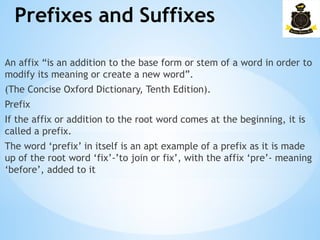
Prefixes and Suffixes
­
An affix “is an addition to the base form or stem of a word in order to
modify its meaning or create a new word”.
(The Concise Oxford Dictionary, Tenth Edition).
Prefix
If the affix or addition to the root word comes at the beginning, it is
called a prefix.
The word ‘prefix’ in itself is an apt example of a prefix as it is made
up of the root word ‘fix’-’to join or fix’, with the affix ‘pre’- meaning
‘before’, added to it
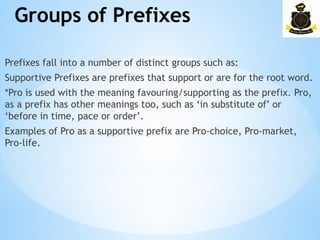
Groups of Prefixes
­
Prefixes fall into a number of distinct groups such as:
Supportive Prefixes are prefixes that support or are for the root word.
*Pro is used with the meaning favouring/supporting as the prefix. Pro,
as a prefix has other meanings too, such as ‘in substitute of’ or
‘before in time, pace or order’.
Examples of Pro as a supportive prefix are Pro-choice, Pro-market,
Pro-life.
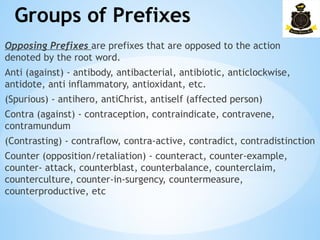
Groups of Prefixes
­
Opposing Prefixes are prefixes that are opposed to the action
denoted by the root word.
Anti (against) - antibody, antibacterial, antibiotic, anticlockwise,
antidote, anti inflammatory, antioxidant, etc.
(Spurious) - antihero, antiChrist, antiself (affected person)
Contra (against) - contraception, contraindicate, contravene,
contramundum
(Contrasting) - contraflow, contra-active, contradict, contradistinction
Counter (opposition/retaliation) - counteract, counter-example,
counter- attack, counterblast, counterbalance, counterclaim,
counterculture, counter-in-surgency, countermeasure,
counterproductive, etc
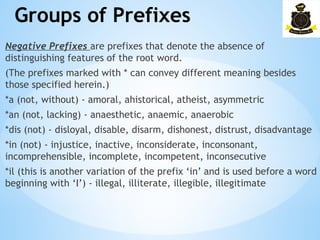
Groups of Prefixes
­
Negative Prefixes are prefixes that denote the absence of
distinguishing features of the root word.
(The prefixes marked with * can convey different meaning besides
those specified herein.)
*a (not, without) - amoral, ahistorical, atheist, asymmetric
*an (not, lacking) - anaesthetic, anaemic, anaerobic
*dis (not) - disloyal, disable, disarm, dishonest, distrust, disadvantage
*in (not) - injustice, inactive, inconsiderate, inconsonant,
incomprehensible, incomplete, incompetent, inconsecutive
*il (this is another variation of the prefix ‘in’ and is used before a word
beginning with ‘I’) - illegal, illiterate, illegible, illegitimate
Groups of Prefixes
­
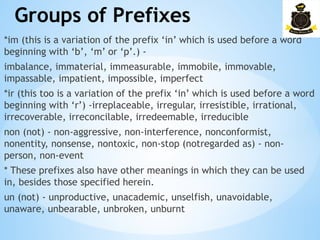
*im (this is a variation of the prefix ‘in’ which is used before a word
beginning with ‘b’, ‘m’ or ‘p’.) -
imbalance, immaterial, immeasurable, immobile, immovable,
impassable, impatient, impossible, imperfect
*ir (this too is a variation of the prefix ‘in’ which is used before a word
beginning with ‘r’) -irreplaceable, irregular, irresistible, irrational,
irrecoverable, irreconcilable, irredeemable, irreducible
non (not) - non-aggressive, non-interference, nonconformist,
nonentity, nonsense, nontoxic, non-stop (notregarded as) - non-
person, non-event
* These prefixes also have other meanings in which they can be used
in, besides those specified herein.
un (not) - unproductive, unacademic, unselfish, unavoidable,
unaware, unbearable, unbroken, unburnt
Groups of Prefixes
­
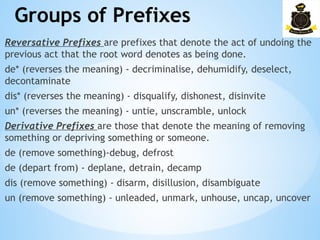
Reversative Prefixes are prefixes that denote the act of undoing the
previous act that the root word denotes as being done.
de* (reverses the meaning) - decriminalise, dehumidify, deselect,
decontaminate
dis* (reverses the meaning) - disqualify, dishonest, disinvite
un* (reverses the meaning) - untie, unscramble, unlock
Derivative Prefixes are those that denote the meaning of removing
something or depriving something or someone.
de (remove something)-debug, defrost
de (depart from) - deplane, detrain, decamp
dis (remove something) - disarm, disillusion, disambiguate
un (remove something) - unleaded, unmark, unhouse, uncap, uncover
Groups of Prefixes
­
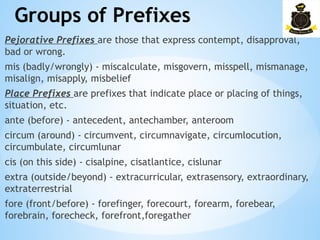
Pejorative Prefixes are those that express contempt, disapproval,
bad or wrong.
mis (badly/wrongly) - miscalculate, misgovern, misspell, mismanage,
misalign, misapply, misbelief
Place Prefixes are prefixes that indicate place or placing of things,
situation, etc.
ante (before) - antecedent, antechamber, anteroom
circum (around) - circumvent, circumnavigate, circumlocution,
circumbulate, circumlunar
cis (on this side) - cisalpine, cisatlantice, cislunar
extra (outside/beyond) - extracurricular, extrasensory, extraordinary,
extraterrestrial
fore (front/before) - forefinger, forecourt, forearm, forebear,
forebrain, forecheck, forefront,foregather
Groups of Prefixes
­
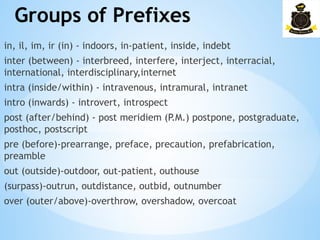
in, il, im, ir (in) - indoors, in-patient, inside, indebt
inter (between) - interbreed, interfere, interject, interracial,
international, interdisciplinary,internet
intra (inside/within) - intravenous, intramural, intranet
intro (inwards) - introvert, introspect
post (after/behind) - post meridiem (P.M.) postpone, postgraduate,
posthoc, postscript
pre (before)-prearrange, preface, precaution, prefabrication,
preamble
out (outside)-outdoor, out-patient, outhouse
(surpass)-outrun, outdistance, outbid, outnumber
over (outer/above)-overthrow, overshadow, overcoat
Groups of Prefixes
­
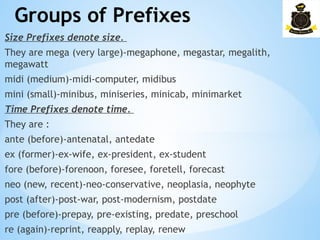
Size Prefixes denote size.
They are mega (very large)-megaphone, megastar, megalith,
megawatt
midi (medium)-midi-computer, midibus
mini (small)-minibus, miniseries, minicab, minimarket
Time Prefixes denote time.
They are :
ante (before)-antenatal, antedate
ex (former)-ex-wife, ex-president, ex-student
fore (before)-forenoon, foresee, foretell, forecast
neo (new, recent)-neo-conservative, neoplasia, neophyte
post (after)-post-war, post-modernism, postdate
pre (before)-prepay, pre-existing, predate, preschool
re (again)-reprint, reapply, replay, renew
Groups of Prefixes
­
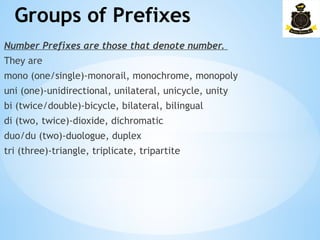
Number Prefixes are those that denote number.
They are
mono (one/single)-monorail, monochrome, monopoly
uni (one)-unidirectional, unilateral, unicycle, unity
bi (twice/double)-bicycle, bilateral, bilingual
di (two, twice)-dioxide, dichromatic
duo/du (two)-duologue, duplex
tri (three)-triangle, triplicate, tripartite
Groups of Prefixes
­
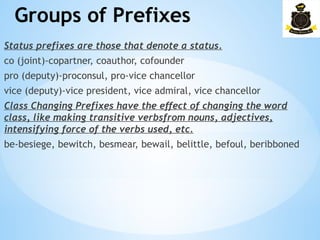
Status prefixes are those that denote a status.
co (joint)-copartner, coauthor, cofounder
pro (deputy)-proconsul, pro-vice chancellor
vice (deputy)-vice president, vice admiral, vice chancellor
Class Changing Prefixes have the effect of changing the word
class, like making transitive verbsfrom nouns, adjectives,
intensifying force of the verbs used, etc.
be-besiege, bewitch, besmear, bewail, belittle, befoul, beribboned
Groups of Prefixes
­
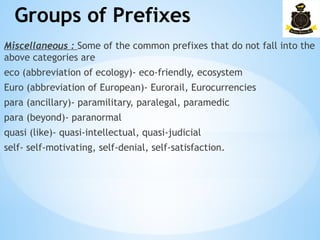
Miscellaneous : Some of the common prefixes that do not fall into the
above categories are
eco (abbreviation of ecology)- eco-friendly, ecosystem
Euro (abbreviation of European)- Eurorail, Eurocurrencies
para (ancillary)- paramilitary, paralegal, paramedic
para (beyond)- paranormal
quasi (like)- quasi-intellectual, quasi-judicial
self- self-motivating, self-denial, self-satisfaction.
Suffix
­
It is a morpheme (minimal meaningful language unit) added at the end
of a word to form a derivative. In other words an addition to the end
of a word to form a derivative of the root word is a suffix.
Groups of Suffix : Suffixes fall into the following categories:
– Noun Suffixes – Adjective Suffixes
– Verb Suffixes – Adverb Suffixes
Noun Suffixes are as follows:
acity (indicates a quality and state of being)-audacity, capacity
ant (denoting attribution of an action or state)-appellant, informant,
arrogant, (denoting an
agent)-deodorant, oxidant
al (verbal action)-betrayal, dismissal, deferra
Suffix
­
Verb Suffixes are as follows:
fy/ify (indicates or becoming)-beautify, purify, gratify, electrify,
pacify, personify
ise, ize (quality, state or function)-capitalize, modernise, popularise,
terrorise, expertise
Adjective Suffixes - Some of them are as follows:
able/ible (inclined to, capable of, causing)-audible, uncountable,
readable, reliable, terrible,
peaceable, profitable
al/ial (kind of)-tidal, accidental managerial, musical
ed (having, affected by)-cultured, heavy handed, talented
Suffix
­
Adverb Suffixes : Some of them are as follows:
ly (forms adverbs from adjectives)-amiably, candidly, surprisingly,
greatly
wise (of manner or respect or direction)-clockwise, notewise, taxwise,
anticlockwise.
Punctuations
The marks, such as full stop, comma, inverted commas, hypen and
brackets are used in writing to separate sentences and their elements
and to clarify meaning, are called punctuation marks.
The importance of punctuation in writing can be compared to the
importance of pause, intonation and emphasis used in the spoken
word.
Therefore, one can state that the chief purpose of using punctuation
is to make the meaning of a written passage clear. The punctuation
marks remove ambiguities, if any
Prescriptive grammar
­
Prescriptive grammar describes when people focus on talking about
how a language should or ought to be used. One way to remember this
association is to think of going to a doctor’s office. When a doctor
gives you a prescription for medication, it often includes directions
about how you should take your medication as well as what you should
not do when taking your medication. In a similar way, a prescriptive
grammar tells you how you should speak, and what type of language to
avoid. This is commonly found in English classes as well as other
language classes, where the aim is to teach people how to use
language in a very particular (typically described as ‘proper’ or
‘correct’) way.
Descriptive grammar
­
Descriptive grammar, on the other hand, focuses on describing the
language as it is used, not saying how it should be used. For example,
think about a prescriptive rule like Don’t split infinitives. A descriptive
grammarian would see a sentence like “To boldly go where no man has
gone before” and would try to describe how the mental grammar can
cause that ordering of words, rather than saying that the surface form
is faulty due to prescriptive rules (which would require the sentence
“To go boldly where no man has gone before”). Linguistics takes this
approach to language.
Prescriptive vs descriptive
grammar
­
A key contrast is to be found between these two approaches. A
descriptive grammarian would say that a sentence is “grammatical” if
a native speaker of the language would produce that sentence in
speaking. The descriptive grammarian would then try to describe how
that sentence is produced through theorizing about the mental
processes that lead up to the surface form. A prescriptive
grammarian, on the other hand, would say that something is
grammatical only if the surface form conforms to a set of rules that
the grammarian believes should be followed in order for a certain
grammar style is achieved. (Note that I have tried to emphasize that
the descriptive grammarian hears a form and tries to describe the
mental processes underneath the produced (spoken) form, while a
prescriptive grammarian does not hypothesize about the mental
grammar at all, but is merely concerned with ‘editing’ the surface
form.)
Thank you

Basic Grammar for students and its importance in hotels

  • 1.
  • 2.
    Parts of Speechin English *Words are divided into eight classes according to the work they do in a sentence. They are as follows:
  • 3.
    Nouns:­ A noun is“naming word”. It names somebody or something. Rahul took the dog to park. The car makes a lot of noise. Look at the example above. A noun is the name of a person (Rahul), animal (dog), place (park), thing (car) or idea (noise).
  • 4.
    Kinds of Nouns ­ Nounsmay be divided into (a) common nouns and (b) proper nouns. Common nouns are the names given in common to all persons, places or things of the same class. For example, bank, shop, market, etc. Collective noun : Common nouns include another class known as collective nouns. A collective noun names a group of people, animals or things regarded as a whole., e.g., batch, company, university, crowd, flock, etc. Proper nouns are the names of particular persons, places or things. For example, India, Larsen and Turbo, Delhi, January, etc.
  • 5.
    Activity 1­ Read thefollowing sentences and identify the type of noun used. 1. Kolkata is the capital of West Bengal. 2. The Royal Bengal Tiger is found in the Sunderbans. 3. The jury gave a unanimous verdict. 4. Laughter is good for health. 5. The crowd is very big. 6. The elephant is an intelligent animal. 7. The Ganges is a sacred river. 8. The bravery of the soldier saved the day. 9. I bought furniture for my new house. 10. King Solomon was very wise.
  • 6.
    Activity 1­ Answers:: 1. Kolkata,West Bengal – Proper Noun 2. Royal Bengal Tiger, Sunderbans – Proper Noun 3. Jury – Collective Noun, Verdict – Abstract Noun. 4. Laughter, health – Abstract Noun 5. Crowd – Collective Noun 6. Elephant, Animal – Common noun 7. Ganges – Proper Noun, river – Common Noun 8. Bravery – Abstract Noun, Soldier, Day – Common Noun 9. Furniture, house – Common Noun 10.King Solomon – Proper Noun
  • 7.
    Pronouns ­ Pronouns are usedin place of nouns. Pronouns may be Personal and Relative. Personal Pronouns : To represent person or things., e.g., I, we, you, she, he, it him, us, them, etc. Relative Pronouns : The most common relative pronouns are whom, which and that. A relative pronoun acts as a pronoun and as a conjunction at the same time. This is the boy who save my life. Possessive Pronouns : These show possession, e.g., mine, ours, yours their, its and hers
  • 8.
    Activity 2­ Read thefollowing sentences and use the appropriate pronouns. 1. Murat is a good boy. __ always listens to__ teacher. 2. Amit and Sumit are twin brothers. ___ take the same bag to school. 3. Milly and I are very good friends. ___ have known each other since childhood. 4. The mangoes are very sour. Where did you buy ___? 5. I love watching Tom and Jerry. __ reminds me of my childhood days.
  • 9.
    Activity 2­ Answers:: 1. He,his 2. They 3. We 4. Them 5. It
  • 10.
    Adjectives ­ A word usedto describe or point out, a person, animal, place or thing which the noun names, or to tell the number and quantity, is called an Adjective. Rani is a clever girl (Girl of what kind?) He gave me six books (How many book?) Two or more words can be joined with a hyphen to form a compound Adjective, e.g., government- financed project
  • 11.
    Activity 3­ Read thegiven sentences below and circle the adjectives. 1. The homeless beggar hasn’t eaten in days. 2. The fox is a sly animal. 3. Mary had a little lamb. 4. The selfish giant didn’t allow the children to enter his garden. 5. The foolish dog barked at its reflection and lost its food.
  • 12.
    Activity 3­ Answers:: 1. Homeless 2.Sly 3. Little 4. Selfish 5. Foolish
  • 13.
    Verbs ­ A verb isa word that tells or asserts something about a person or thing. Verb comes from Latin Verbum, meaning a word. It is so called because it is the most important word in the sentence. A verb may tell us : 1. What a person or thing does; as Rohit runs. The bell rings. 2. What is done to a person or thing; as Ram is beaten. The door is broken.
  • 14.
    Activity 4­ Read thefollowing sentences and select the correct form of the verb given in brackets. 1. Rita ___ a mile every day. (run/runs) 2. The dogs ___ all night. (barks/bark) 3. The cat ___ the snake. (catch/caught) 4. We ___ in the park in the evenings. (play/plays) 5. Mia __ school yesterday. (went/go)
  • 15.
    Activity 4­ Answers:: 1. Runs 2.Bark 3. Caught 4. Play 5. Went
  • 16.
    Adverb ­ While Adjectives qualifyor add to the meaning of nouns, adverbs modify the meaning not only of verbs, but also of adjectives, prepositions, conjunctions, etc. The following sentences illustrate the varied use of adverbs: 1. Small investors find it very difficult to invest wisely. (The first adverb very modifies the adjective difficult, and the second adverb wisely modifies the verb invest). 2. The CEO is an exceptionally sharp manager. (The adverb exceptionally modifies the adjective sharp). 3. The cash counter is right behind you. (The adverb right modifies the prepositions behind).
  • 17.
    Activity 5 Read thesentences given below and underline the adverbs: 1. The boy is too careless. 2. The winds are very strong. 3. The baby slept soundly. 4. The soldiers fought the war valiantly. 5. Joey always tries his best.
  • 18.
    Activity 5­ Answers:: 1. Too 2.Very 3. Soundly 4. Valiantly 5. Always
  • 19.
    Preposition ­ A Preposition, bydefinition is placed before a noun or its equivalent in order to show its relationship in terms of time, place, etc.: The space above the room houses the conference facility. (The preposition above explains the relationship between the room and the conference facility). There are hardly any rules governing the use of prepositions, some people feel that it is inelegant to put them at the end of a sentence since they are basically used as link-words. However, as Fowler points out, “Almost all ourgreat writers have allowed themselves to end a sentence or a clause with a preposition.” The thumb-rule is that the sentence should read well.
  • 20.
    Preposition ­ *It is largelythe usage that determines the choice of a preposition. Americans tend to drop them but it is largely colloquial. A wrong preposition certainly changes the intended meaning. Therefore, we have to learn the use of prepositions carefully. All standard dictionaries list the root word along with different prepositions or adverbial phrases and also show the difference in meaning. *For example: The root word get conveys italicised meanings when used with: …about, move or spread …across, be understood …ahead, make progress …along, manage …at, gain access to …away, escape
  • 21.
    Activity 6 Fill inthe blanks with appropriate prepositions:: 1. This shop doesn’t have the toys I was looking __. (up/for) 2. The teacher divided the sweets ___ all the children. (between/among) 3. Bruce did not fare well __ his examination. (in/at) 4. The dog is grateful __ its owner. (to/for) 5. My brother’s anniversary is __ 5th November. (on/in)
  • 22.
    Activity 6­ Answers:: 1. For 2.Among 3. In 4. To 5. On
  • 23.
    Conjunction ­ Conjunctions join wordsor even sentences conveying related ideas. Two commonly used conjunctions are: •and •but. We received your letter and telegram but regret our inability to attend the meeting. Conjunctions may also be used in pairs, e.g. neither-nor, either-or, not only-but also, both-and, whether or etc. Such conjunctions are known as Correlative Conjunctions
  • 24.
    Activity 7 Fill inthe blanks with appropriate conjunctions:: 1. Sruthi ____ I visited Gokarna last weekend. 2. Do you have a rough notebook ___ at least a rough sheet of paper? 3. I did not go to work today ____ I was not keeping well. 4. She did not like the food, ____ she ate it. 5. I will be leaving tomorrow ___ I am trying to finish all the pending assignments.
  • 25.
    Activity 7 Answers:: 1. And 2.Or 3. Because 4. Yet 5. So
  • 26.
    Interjection ­ Interjections are wordswhich are used in a sentence to express strong emotion or feeling. They may not form a part of its grammatical structure. Some of the common interjections are: Hi !,Alas !, Oh !, etc.
  • 27.
    Activity 8 Fill inthe blanks with appropriate interjections:: 1. ______We won the match. 2. ______That really hurt badly. 3. ______That is a beautiful dress indeed. 4. ______That was unexpected. 5. _____That guy is unbelievably huge.
  • 28.
    Activity 8 Answers:: 1. Hurray! 2.Ouch! 3. Wow! 4. Oh my God! 5. Whoa!
  • 29.
    Articles ­ The words aor an and the are called Articles. They come before nouns. A or an is called the Indefinite Article, because it usually leaves indefinite the person or thing spoken of; as, A doctor; that is, any doctor. The is called the Definite Article because it normally points out some particular person or thing; as, He saw the doctor; meaning some particular doctor. The indefinite article is used before singular countable nouns, e.g.,A car, an apple, a table. The definite article is used before singular countable nouns, plural countable nouns and uncountable nouns,e.g., The pen, the pens, the milk, the idea.
  • 30.
    Articles ­ The article ‘an’is used when the noun to which it is attached begins with a vowel sound (a, e, i, o and u). It is the vowel sound and not the vowels that determines the use of ‘a’ or ‘an’. Vowels with consonant sound take ‘a’ and not ‘an’. For example, Bring me an apple He walks like an Egyptian. She has planted a eucalyptus tree. He is an honest man. He has joined a union. I have lost a one-rupee note.
  • 31.
    Activity 9 Fill inthe blanks with appropriate articles Use ‘an’, ‘a’ or ‘the’ appropriately in the sentences given below. 1. Sheldon is ___ honest man. 2. King Arthur was ___ just king. 3. ____ lion let go of ___ mouse. 4. I have fixed ___ appointment with ___ doctor. 5. Will you take ___ picture of us?
  • 32.
  • 33.
    Usage ­ Usage implies themanner in which the native speakers of a language use it. The “body of conventions governing the use of a language especially those aspects not governed by grammatical rules”, “habitual or customary use”often lays down new standards of acceptance. For example, ‘It is me’ is generally accepted on grounds of usage even though ‘It is I’ is considered grammatically correct. Usage may be learnt by reading standard texts and listening to educated speakers of a language
  • 34.
    Tenses ­ In Grammar –a set of forms taken by a verb to indicate the time (and sometimes the continuance or completeness) of the action in relation to the time of the utterance”; is the meaning that the Concise Oxford Dictionary assigns to the word ‘Tense’. The word tense comes from Latin word tempus, meaning time.
  • 35.
    Tenses ­ Read the followingsentences. 1. I write this letter to my mother 2. I wrote the letter yesterday. 3. I shall write another letter tomorrow. In sentence 1, the verb write refers to present time. Hence a verb that refers to present time is said to be in the Present Tense. In sentence 2, the verb wrote refers to past time. Hence it is said to be in Past Tense. In sentence 3, the verb shall write refers to future time. Therefore, it is said to be in the Future Tense.
  • 36.
    Tenses ­ Read these sentences: 1. I read a book. (simple present) 2. I am reading a book. (Present continuous) 3. I have read a book. (Present Perfect) 4. I have been reading a book. (Present Perfect Continuous)
  • 37.
    Tenses ­ The verbs inall of these sentences refer to the present time, and are therefore said to be in the present tense. In sentence 1, however, the verb shows that the action is mentioned simply, without anything being said about the completeness or incompleteness of the action. In sentence 2, the verb shows that the action is mentioned as incomplete or continuous, that is, as still going on. In sentence 3, the verb shows that the action is mentioned as finished, complete or perfect, at the time of speaking. The tense of the verb in sentence 4 is said to be Present Perfect Continuous, because the verb shows that the action is going on continuously, and not completed at this present moment. Thus we see that the tense of a verb shows not only the time of an action or event, but also the state of an action referred to
  • 38.
    Tenses ­ Just as PresentTense has four forms, the Past Tense also has the following four forms : 1. I jumped from the window. (Simple Past) 2. I was jumping from the window. (Past Continuous) 3. I had jumped from the window. (Past Perfect) 4. I had been jumping from the window. (Past Perfect continuous) Similarly, the Future Tense has the following four forms : 1. I shall/will jump (Simple Future) 2. I shall/will be jumping. (Future Continuous) 3. I shall/will have jumped. (Future Perfect) 4. I shall/will have been jumping. (Future Perfect Continuous) Hence, we may define Tense as that form of a verb which shows the time and the state of an action or event.
  • 39.
    Activity 10 Go throughthe sentences provided below and identify the type of tenses: 1. Damon drinks coffee every morning. 2. The boy got up late and missed the bus. 3. My mother goes to pray in the temple. 4. The team is playing very well. 5. The school will be closed for winter break. 6. Leonard graduated from college last year. 7. The baby has eaten all the chips. 8. Have you read Pride and Prejudice? 9. The train has just left the station. 10.The sick child has been sleeping for three hours.
  • 40.
    Activity 10 Answers:: 1. SimplePresent Tense 2. Simple Past Tense 3. Simple Present Tense 4. Present Continuous Tense 5. Simple Future Tense 6. Simple Past Tense 7. Present Perfect Tense 8. Present Perfect Tense 9. Present Perfect Tense 10.Present Perfect Continuous Tense
  • 41.
    Sentence Construction ­ Various Purposesof a Sentence A group of words, which makes complete sense, is called a sentence. Grammar also lays down rules for arranging words in a certain order to form meaningful sentences. Sentences may be formed to: • Make a statement : The government has decided to disinvest its stake in Air-India. • Pose a question : Would this step enable them to turn this PSU around? • Give a command : Bring about a change of ownership. • Make an exclamation: What a way to bridge the fiscal deficit!
  • 42.
    Sentence Construction ­ A sentenceconsists of two parts: Subject : The part which names the person or thing we are speaking about is called the subject of the sentence. Predicate : The part which tells something about the subject is called predicate. A Phrase is a group of words, which neither has a finite verb nor makes any sense by itself
  • 43.
    Sentence Construction ­ Depending onits place in the sentence, it may be a: • Noun • Adjectival or • Adverbial Phrase. Examine the following pair of sentences. (i) Raj is a wealthy man. (ii) Raj is a man of great wealth. In the first sentence the word wealthy described the noun Raj. In the second sentence of great wealth also tells us what sort of man Raj is. It qualifies the noun just as an Adjective does. Hence, it is called an Adjective Phrase.
  • 44.
    Adverb Phrases ­ Just asthe work of an Adjective is often done by a group of words called an Adjective Phrase, so the work of an Adverb is often done by a group of words. Examine the following pair of sentences. (i) He answered rudely. (How?) (ii) He answered in a very rude manner. (How?) Since the phrase very rude manner does the work of an Adverb, it is called an Adverb Trial Phrase.
  • 45.
    Noun Phrase ­ Noun Phrase ANoun Phrase is a group of words that does the work of a Noun. For example, (i) My demat account has been closed. (ii) To win a prize is my ambition. In the above sentences italicized phrases are noun phrases because they are doing the work of a noun
  • 46.
    Types of Sentences ­ Thebasic knowledge of grammar helps us understand different sentence structures or patterns so that we can communicate in a clear, concise and correct manner. A group of words that form a part of a sentence, and has a subject and a predicate of its own, is called a clause. The clause that makes good sense by itself, and hence could stand by itself, as a separate sentence is called a Principal or Main Clause. A clause which cannot stand by itself and makes good sense but not complete sense are called a Dependent or Subordinate Clause. A sentence which has only one finite verb and one independent clause is called Simple sentence. For example, This courage won him honour.
  • 47.
    Types of Sentences ­ Acompound sentence is made up of two or more independent clauses. For example, Night come on and rain fell heavily and we all got very wet. A complex sentence has an independent clause and atleast one dependent clause. For example, The human brain never stops working until you stand up to speak in public.
  • 48.
    Sentence Construction ­ Sentences canbe constructed using different structures or patterns. The simplest sentence may have: – a noun or a pronoun in the beginning, – a verb in the middle, – another noun or its equivalent in the end. For example The budget affects the stock market. This sentence structure may also be shown as: Subject + verb + object
  • 49.
    Sentence Construction ­ The structureof an imperative sentence is different. Here the subject is understood. For example, Mail this letter, is the shorter form of (You) mail this letter. It is important to use varying sentences structures in your writing so that the interest of the reader is not lost. For example, Mail this letter, is the shorter form of (You) mail this letter. It is important to use varying sentences structures in your writing so that the interest of the reader is not lost.
  • 50.
    Sentence Construction ­ Sentence Constructionis based on the kind of writing in question. Sentences are also constructed on the basis of complexity of writing. Loose sentences are suited to simple style of letter writing and are closer to the spoken form. They begin with the main statement and develop it to its logical conclusion. For example The Reserve Bank of India intervened in the forex market as there were strong rumours about an intense speculative activity caused by the spurt in imports.
  • 51.
    Sentence Construction ­ Periodic Sentencesare decorous and emphatic but more difficult to write. The order is reversed and the main statement is made at the end. For example As there were strong rumours about an intense speculative activity caused by the spurt in imports, the Reserve Bank of India intervened in the forex market
  • 52.
    Sentence Construction on thebasis of Length The length of a sentence is also an important factor in sentence construction. Shorter Sentences are easier to write as well as understand. But a long sequence of short sentences may not make a very pleasant reading: Thank you for the order. The goods will be sent soon. The duplicate copy of bill is enclosed. The payment must be made early.
  • 53.
    Sentence Construction on thebasis of Length ­ Longer Sentences are prone to grammatical errors and need careful thought and planning. Such efforts at constructing marathon sentences should be avoided. It may be a good idea to mix the shorter and longer sentences to sustain the interest of the reader. For example The conference opens on the tenth of June in Simla. More than two hundred company secretaries will take part. The purpose is to deliberate on the merits of the new Companies Act, 2013 and propose amendments. The discussions are likely to go on for three days
  • 54.
    Paragraph Construction ­ The constructionof a paragraph is equally important. If a good sentence should focus on a single thought, a good paragraph should restrict itself to a single topic or idea. The topic sentence of a paragraph sums up its central idea and develops it further. It is usually in the beginning or the end of the sentence; though, in some cases, it can be written somewhere in the middle too. Shorter paragraphs should be preferred because they enable the reader to follow the writer’s plan.
  • 55.
    Prefixes and Suffixes ­ Anaffix “is an addition to the base form or stem of a word in order to modify its meaning or create a new word”. (The Concise Oxford Dictionary, Tenth Edition). Prefix If the affix or addition to the root word comes at the beginning, it is called a prefix. The word ‘prefix’ in itself is an apt example of a prefix as it is made up of the root word ‘fix’-’to join or fix’, with the affix ‘pre’- meaning ‘before’, added to it
  • 56.
    Groups of Prefixes ­ Prefixesfall into a number of distinct groups such as: Supportive Prefixes are prefixes that support or are for the root word. *Pro is used with the meaning favouring/supporting as the prefix. Pro, as a prefix has other meanings too, such as ‘in substitute of’ or ‘before in time, pace or order’. Examples of Pro as a supportive prefix are Pro-choice, Pro-market, Pro-life.
  • 57.
    Groups of Prefixes ­ OpposingPrefixes are prefixes that are opposed to the action denoted by the root word. Anti (against) - antibody, antibacterial, antibiotic, anticlockwise, antidote, anti inflammatory, antioxidant, etc. (Spurious) - antihero, antiChrist, antiself (affected person) Contra (against) - contraception, contraindicate, contravene, contramundum (Contrasting) - contraflow, contra-active, contradict, contradistinction Counter (opposition/retaliation) - counteract, counter-example, counter- attack, counterblast, counterbalance, counterclaim, counterculture, counter-in-surgency, countermeasure, counterproductive, etc
  • 58.
    Groups of Prefixes ­ NegativePrefixes are prefixes that denote the absence of distinguishing features of the root word. (The prefixes marked with * can convey different meaning besides those specified herein.) *a (not, without) - amoral, ahistorical, atheist, asymmetric *an (not, lacking) - anaesthetic, anaemic, anaerobic *dis (not) - disloyal, disable, disarm, dishonest, distrust, disadvantage *in (not) - injustice, inactive, inconsiderate, inconsonant, incomprehensible, incomplete, incompetent, inconsecutive *il (this is another variation of the prefix ‘in’ and is used before a word beginning with ‘I’) - illegal, illiterate, illegible, illegitimate
  • 59.
    Groups of Prefixes ­ *im(this is a variation of the prefix ‘in’ which is used before a word beginning with ‘b’, ‘m’ or ‘p’.) - imbalance, immaterial, immeasurable, immobile, immovable, impassable, impatient, impossible, imperfect *ir (this too is a variation of the prefix ‘in’ which is used before a word beginning with ‘r’) -irreplaceable, irregular, irresistible, irrational, irrecoverable, irreconcilable, irredeemable, irreducible non (not) - non-aggressive, non-interference, nonconformist, nonentity, nonsense, nontoxic, non-stop (notregarded as) - non- person, non-event * These prefixes also have other meanings in which they can be used in, besides those specified herein. un (not) - unproductive, unacademic, unselfish, unavoidable, unaware, unbearable, unbroken, unburnt
  • 60.
    Groups of Prefixes ­ ReversativePrefixes are prefixes that denote the act of undoing the previous act that the root word denotes as being done. de* (reverses the meaning) - decriminalise, dehumidify, deselect, decontaminate dis* (reverses the meaning) - disqualify, dishonest, disinvite un* (reverses the meaning) - untie, unscramble, unlock Derivative Prefixes are those that denote the meaning of removing something or depriving something or someone. de (remove something)-debug, defrost de (depart from) - deplane, detrain, decamp dis (remove something) - disarm, disillusion, disambiguate un (remove something) - unleaded, unmark, unhouse, uncap, uncover
  • 61.
    Groups of Prefixes ­ PejorativePrefixes are those that express contempt, disapproval, bad or wrong. mis (badly/wrongly) - miscalculate, misgovern, misspell, mismanage, misalign, misapply, misbelief Place Prefixes are prefixes that indicate place or placing of things, situation, etc. ante (before) - antecedent, antechamber, anteroom circum (around) - circumvent, circumnavigate, circumlocution, circumbulate, circumlunar cis (on this side) - cisalpine, cisatlantice, cislunar extra (outside/beyond) - extracurricular, extrasensory, extraordinary, extraterrestrial fore (front/before) - forefinger, forecourt, forearm, forebear, forebrain, forecheck, forefront,foregather
  • 62.
    Groups of Prefixes ­ in,il, im, ir (in) - indoors, in-patient, inside, indebt inter (between) - interbreed, interfere, interject, interracial, international, interdisciplinary,internet intra (inside/within) - intravenous, intramural, intranet intro (inwards) - introvert, introspect post (after/behind) - post meridiem (P.M.) postpone, postgraduate, posthoc, postscript pre (before)-prearrange, preface, precaution, prefabrication, preamble out (outside)-outdoor, out-patient, outhouse (surpass)-outrun, outdistance, outbid, outnumber over (outer/above)-overthrow, overshadow, overcoat
  • 63.
    Groups of Prefixes ­ SizePrefixes denote size. They are mega (very large)-megaphone, megastar, megalith, megawatt midi (medium)-midi-computer, midibus mini (small)-minibus, miniseries, minicab, minimarket Time Prefixes denote time. They are : ante (before)-antenatal, antedate ex (former)-ex-wife, ex-president, ex-student fore (before)-forenoon, foresee, foretell, forecast neo (new, recent)-neo-conservative, neoplasia, neophyte post (after)-post-war, post-modernism, postdate pre (before)-prepay, pre-existing, predate, preschool re (again)-reprint, reapply, replay, renew
  • 64.
    Groups of Prefixes ­ NumberPrefixes are those that denote number. They are mono (one/single)-monorail, monochrome, monopoly uni (one)-unidirectional, unilateral, unicycle, unity bi (twice/double)-bicycle, bilateral, bilingual di (two, twice)-dioxide, dichromatic duo/du (two)-duologue, duplex tri (three)-triangle, triplicate, tripartite
  • 65.
    Groups of Prefixes ­ Statusprefixes are those that denote a status. co (joint)-copartner, coauthor, cofounder pro (deputy)-proconsul, pro-vice chancellor vice (deputy)-vice president, vice admiral, vice chancellor Class Changing Prefixes have the effect of changing the word class, like making transitive verbsfrom nouns, adjectives, intensifying force of the verbs used, etc. be-besiege, bewitch, besmear, bewail, belittle, befoul, beribboned
  • 66.
    Groups of Prefixes ­ Miscellaneous: Some of the common prefixes that do not fall into the above categories are eco (abbreviation of ecology)- eco-friendly, ecosystem Euro (abbreviation of European)- Eurorail, Eurocurrencies para (ancillary)- paramilitary, paralegal, paramedic para (beyond)- paranormal quasi (like)- quasi-intellectual, quasi-judicial self- self-motivating, self-denial, self-satisfaction.
  • 67.
    Suffix ­ It is amorpheme (minimal meaningful language unit) added at the end of a word to form a derivative. In other words an addition to the end of a word to form a derivative of the root word is a suffix. Groups of Suffix : Suffixes fall into the following categories: – Noun Suffixes – Adjective Suffixes – Verb Suffixes – Adverb Suffixes Noun Suffixes are as follows: acity (indicates a quality and state of being)-audacity, capacity ant (denoting attribution of an action or state)-appellant, informant, arrogant, (denoting an agent)-deodorant, oxidant al (verbal action)-betrayal, dismissal, deferra
  • 68.
    Suffix ­ Verb Suffixes areas follows: fy/ify (indicates or becoming)-beautify, purify, gratify, electrify, pacify, personify ise, ize (quality, state or function)-capitalize, modernise, popularise, terrorise, expertise Adjective Suffixes - Some of them are as follows: able/ible (inclined to, capable of, causing)-audible, uncountable, readable, reliable, terrible, peaceable, profitable al/ial (kind of)-tidal, accidental managerial, musical ed (having, affected by)-cultured, heavy handed, talented
  • 69.
    Suffix ­ Adverb Suffixes :Some of them are as follows: ly (forms adverbs from adjectives)-amiably, candidly, surprisingly, greatly wise (of manner or respect or direction)-clockwise, notewise, taxwise, anticlockwise.
  • 70.
    Punctuations The marks, suchas full stop, comma, inverted commas, hypen and brackets are used in writing to separate sentences and their elements and to clarify meaning, are called punctuation marks. The importance of punctuation in writing can be compared to the importance of pause, intonation and emphasis used in the spoken word. Therefore, one can state that the chief purpose of using punctuation is to make the meaning of a written passage clear. The punctuation marks remove ambiguities, if any
  • 71.
    Prescriptive grammar ­ Prescriptive grammardescribes when people focus on talking about how a language should or ought to be used. One way to remember this association is to think of going to a doctor’s office. When a doctor gives you a prescription for medication, it often includes directions about how you should take your medication as well as what you should not do when taking your medication. In a similar way, a prescriptive grammar tells you how you should speak, and what type of language to avoid. This is commonly found in English classes as well as other language classes, where the aim is to teach people how to use language in a very particular (typically described as ‘proper’ or ‘correct’) way.
  • 72.
    Descriptive grammar ­ Descriptive grammar,on the other hand, focuses on describing the language as it is used, not saying how it should be used. For example, think about a prescriptive rule like Don’t split infinitives. A descriptive grammarian would see a sentence like “To boldly go where no man has gone before” and would try to describe how the mental grammar can cause that ordering of words, rather than saying that the surface form is faulty due to prescriptive rules (which would require the sentence “To go boldly where no man has gone before”). Linguistics takes this approach to language.
  • 73.
    Prescriptive vs descriptive grammar ­ Akey contrast is to be found between these two approaches. A descriptive grammarian would say that a sentence is “grammatical” if a native speaker of the language would produce that sentence in speaking. The descriptive grammarian would then try to describe how that sentence is produced through theorizing about the mental processes that lead up to the surface form. A prescriptive grammarian, on the other hand, would say that something is grammatical only if the surface form conforms to a set of rules that the grammarian believes should be followed in order for a certain grammar style is achieved. (Note that I have tried to emphasize that the descriptive grammarian hears a form and tries to describe the mental processes underneath the produced (spoken) form, while a prescriptive grammarian does not hypothesize about the mental grammar at all, but is merely concerned with ‘editing’ the surface form.)
  • 74.