intel.com/innovate
How to use this presentation
The following slides have been created by Intel for public use.
Share or use the presentation in its entirety or as individual slides, as desired.
TECHNOLOGY ACCESS
AND EMPOWERMENT
intel.com/innovate
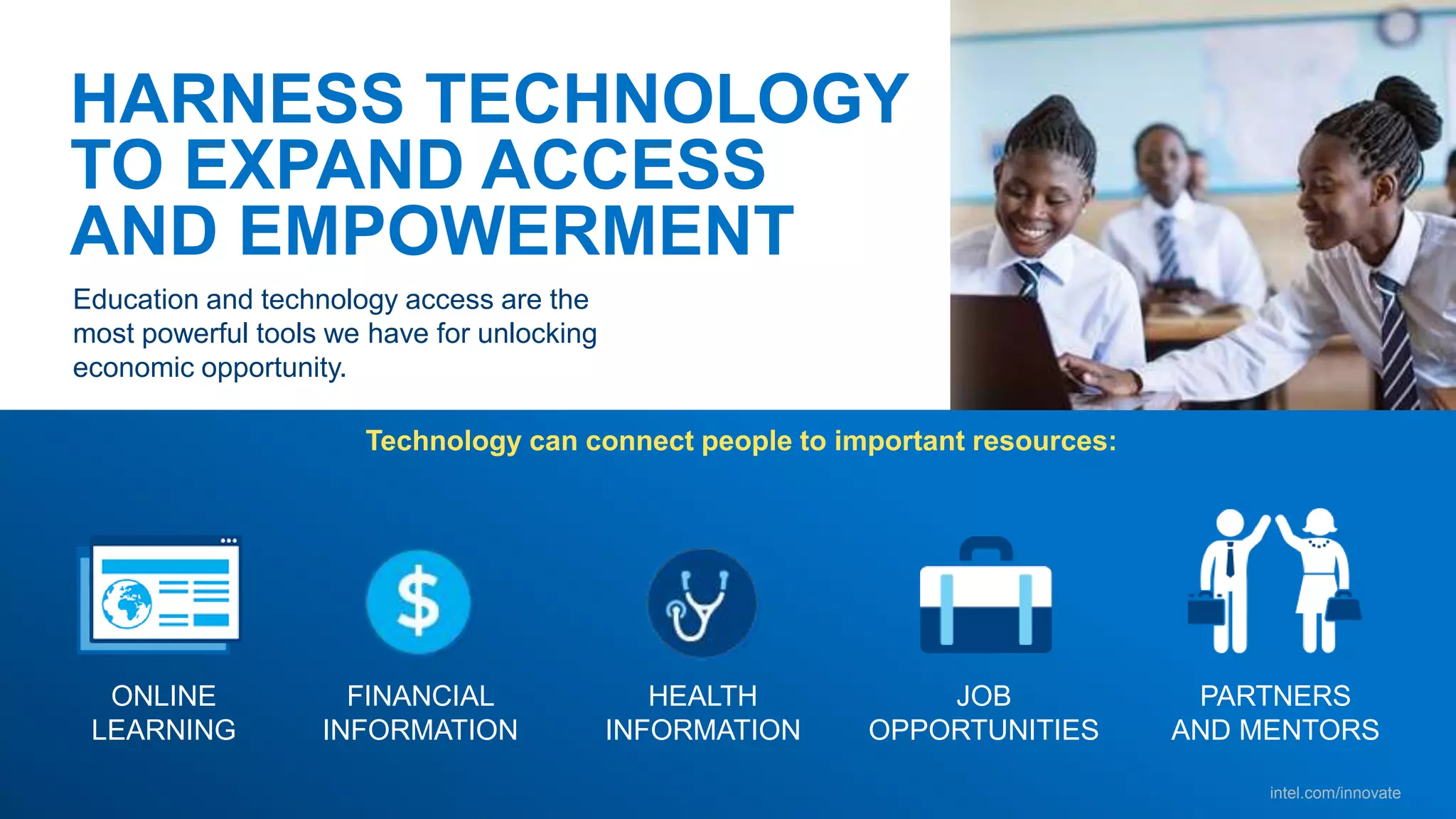
HARNESS TECHNOLOGY
TO EXPAND ACCESS
AND EMPOWERMENT
Technology can connect people to important resources:
Education and technology access are the
most powerful tools we have for unlocking
economic opportunity.
ONLINE
LEARNING
FINANCIAL
INFORMATION
HEALTH
INFORMATION
JOB
OPPORTUNITIES
PARTNERS
AND MENTORS
intel.com/innovate
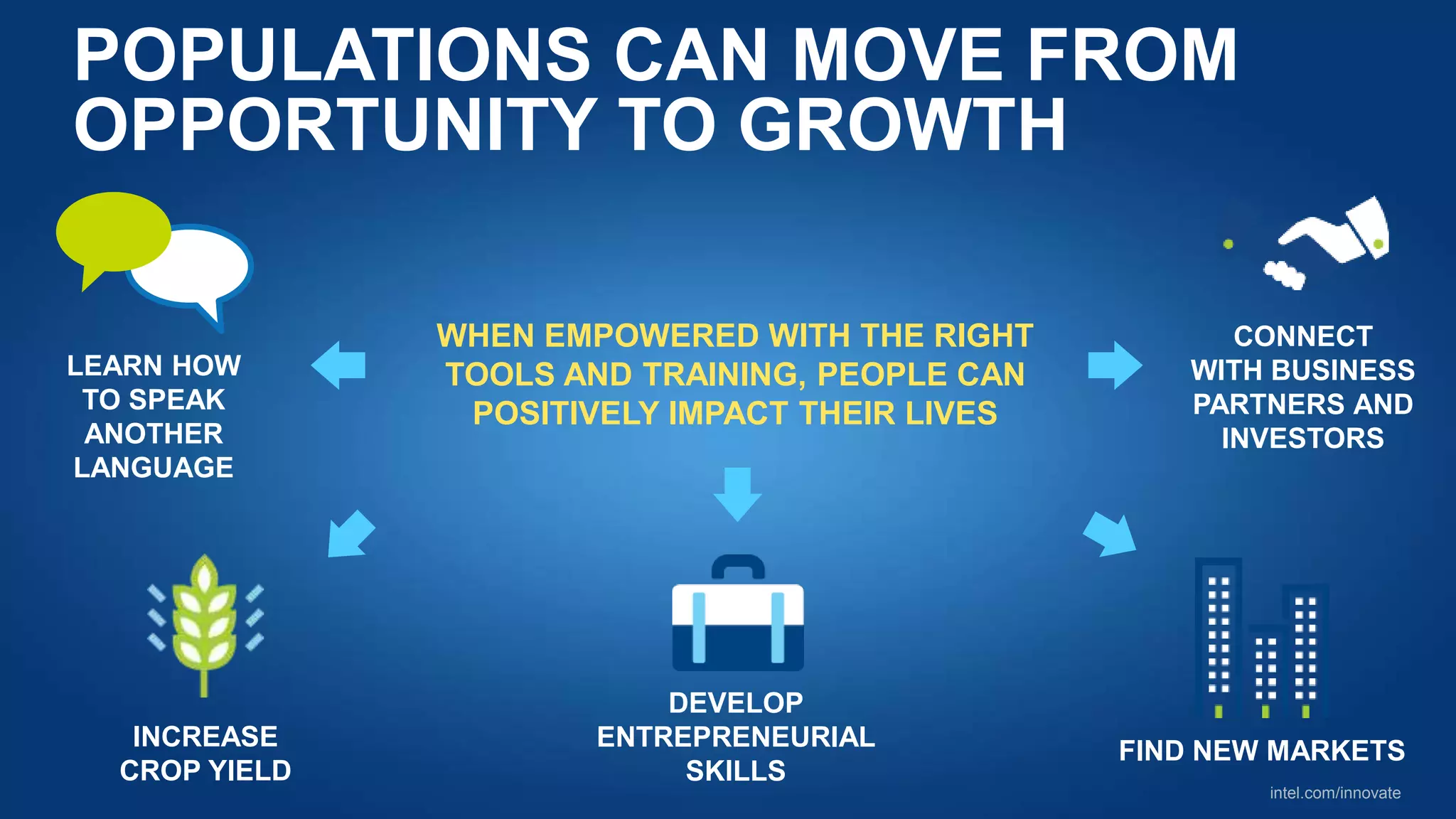
POPULATIONS CAN MOVE FROM
OPPORTUNITY TO GROWTH
WHEN EMPOWERED WITH THE RIGHT
TOOLS AND TRAINING, PEOPLE CAN
POSITIVELY IMPACT THEIR LIVES
DEVELOP
ENTREPRENEURIAL
SKILLS
FIND NEW MARKETS
CONNECT
WITH BUSINESS
PARTNERS AND
INVESTORS
LEARN HOW
TO SPEAK
ANOTHER
LANGUAGE
INCREASE
CROP YIELD
intel.com/innovate
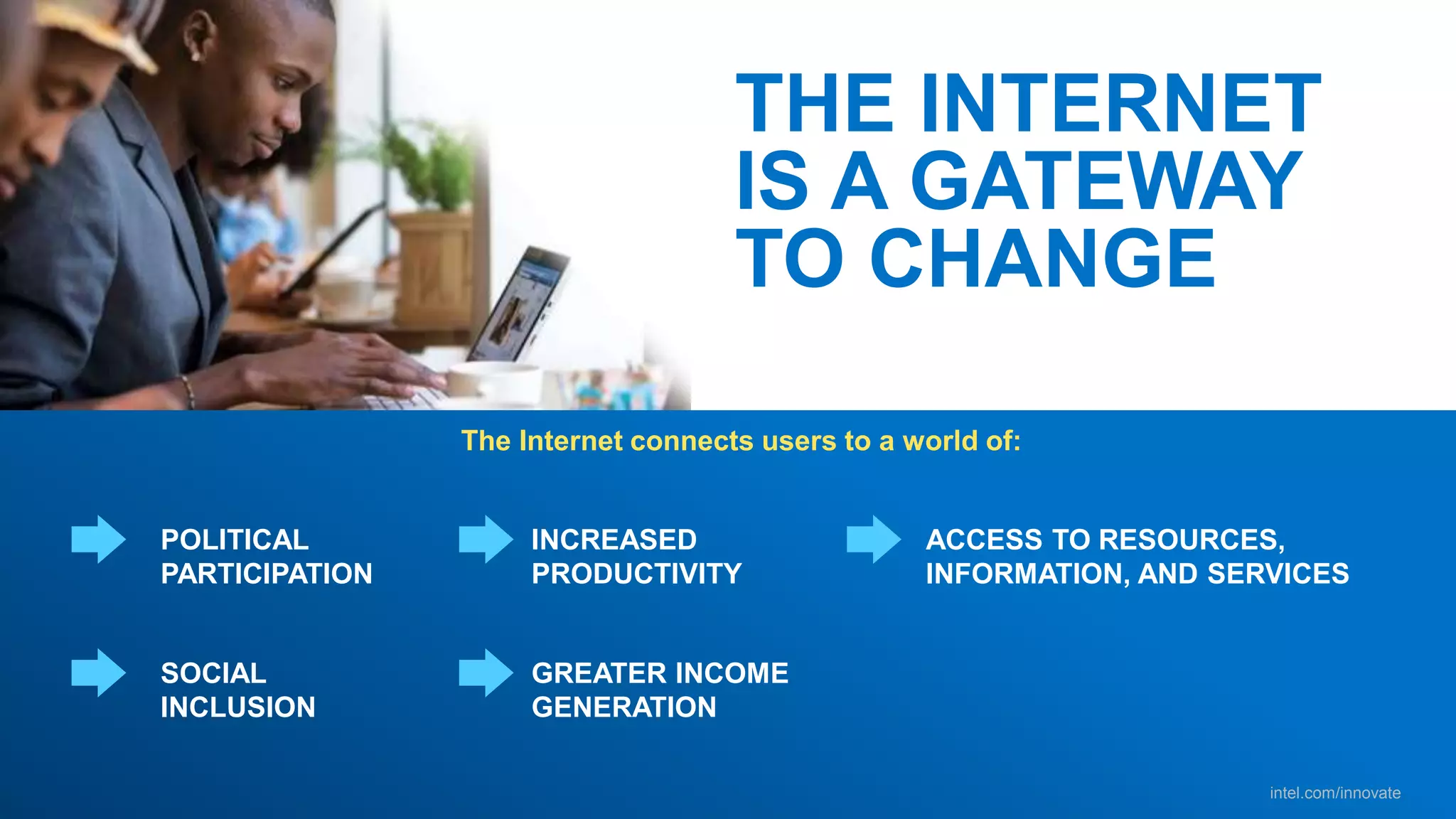
The Internet connects users to a world of:
THE INTERNET
IS A GATEWAY
TO CHANGE
POLITICAL
PARTICIPATION
INCREASED
PRODUCTIVITY
SOCIAL
INCLUSION
GREATER INCOME
GENERATION
ACCESS TO RESOURCES,
INFORMATION, AND SERVICES
intel.com/innovate
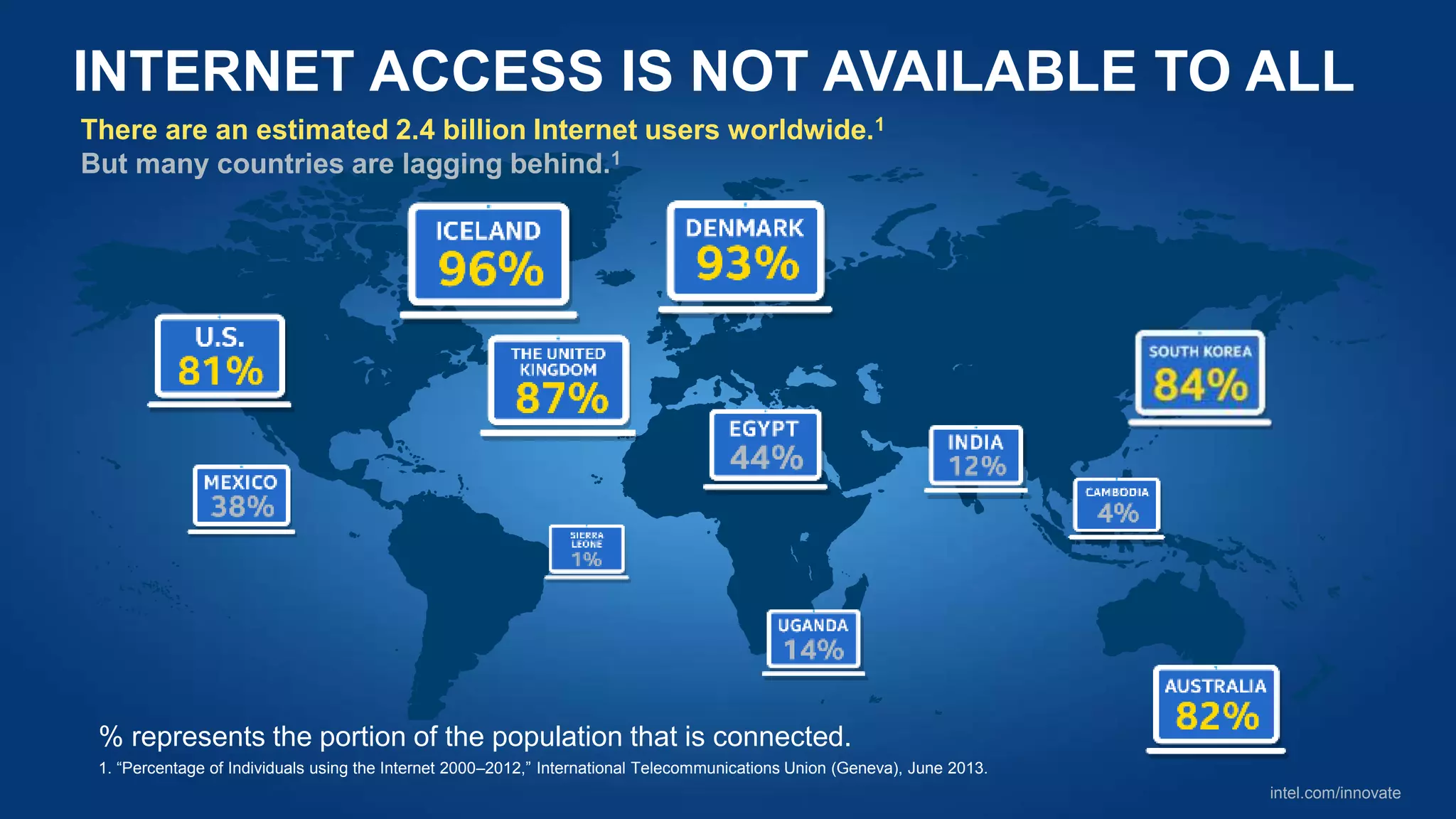
INTERNET ACCESS IS NOT AVAILABLE TO ALL
% represents the portion of the population that is connected.
1. “Percentage of Individuals using the Internet 2000–2012,” International Telecommunications Union (Geneva), June 2013.
There are an estimated 2.4 billion Internet users worldwide,
but many countries are lagging behind.1
ARGENTINA
55%
BRAZIL
49%
U.S.
81%
MEXICO
38%
ICELAND
96% THE UNITED
KINGDOM
87%
EGYPT
44%
UGANDA
14%
SOUTH
AFRICA
41%
DENMARK
93%
AUSTRALIA
82%
RUSSIA
53%
INDIA
12%
JAPAN
79%
SOUTH
KOREA
84%
SINGAPORE
74%
intel.com/innovate
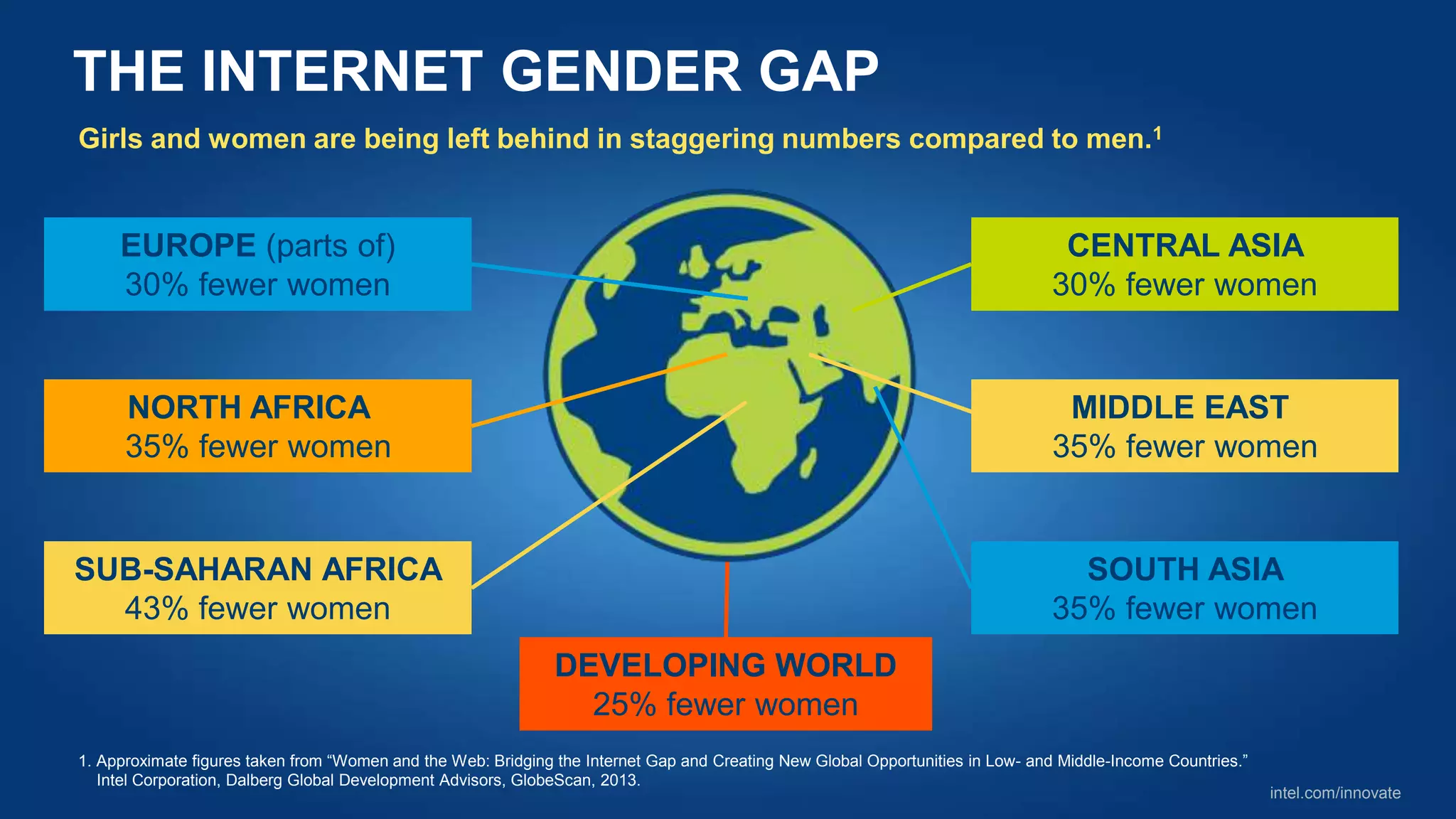
THE INTERNET GENDER GAP
EUROPE (parts of)
30% fewer women
DEVELOPING WORLD
25% fewer women
NORTH AFRICA
35% fewer women
SUB-SAHARAN AFRICA
43% fewer women
CENTRAL ASIA
30% fewer women
MIDDLE EAST
35% fewer women
SOUTH ASIA
35% fewer women
Girls and women are being left behind in staggering numbers compared to men.1
1. Approximate figures taken from “Women and the Web: Bridging the Internet Gap and Creating New Global Opportunities in Low- and Middle-Income Countries.”
Intel Corporation, Dalberg Global Development Advisors, GlobeScan, 2013.
intel.com/innovate
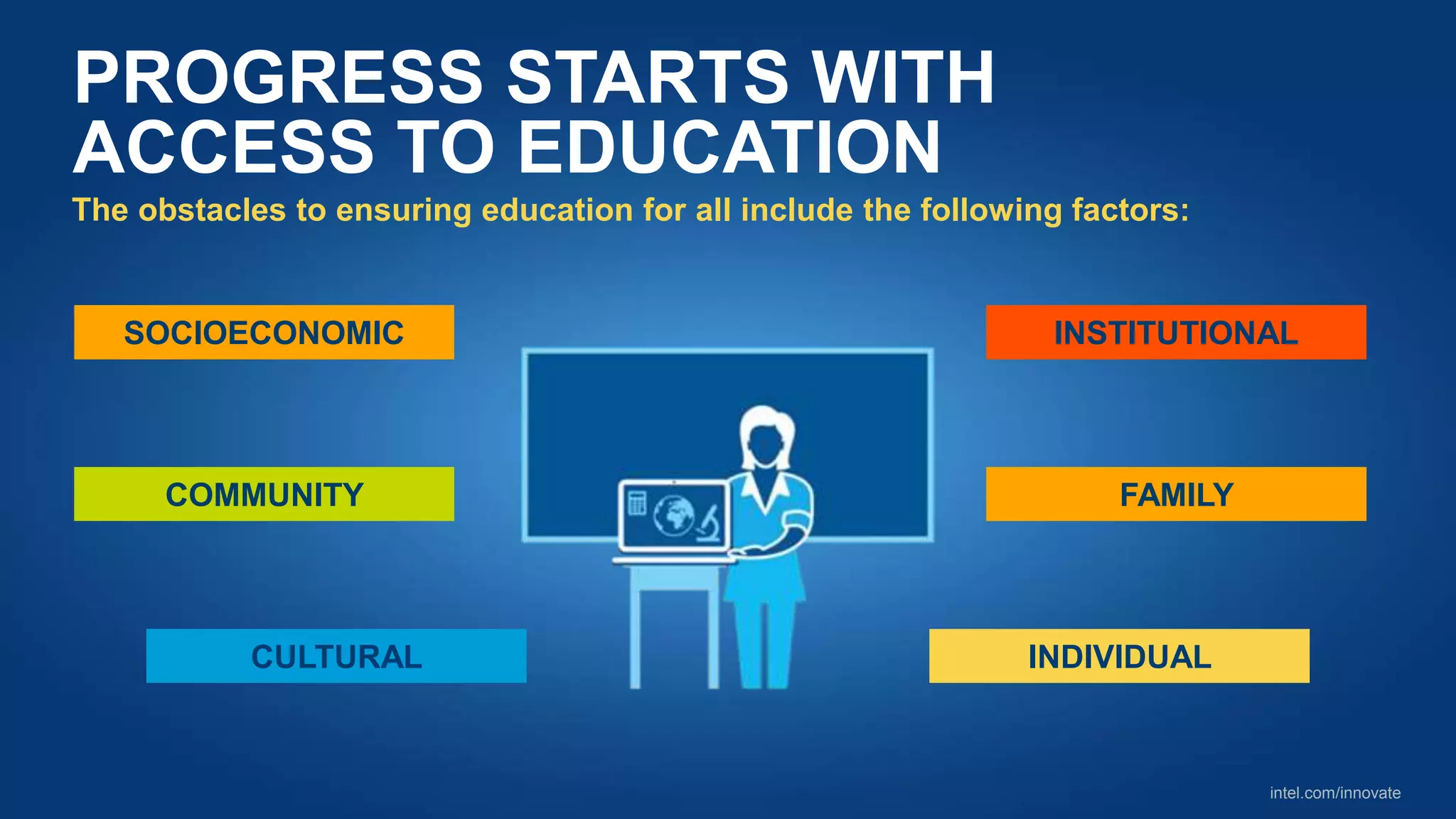
PROGRESS STARTS WITH
ACCESS TO EDUCATION
SOCIOECONOMIC
COMMUNITY
CULTURAL
INSTITUTIONAL
FAMILY
INDIVIDUAL
The obstacles to ensuring education for all include the following factors:
intel.com/innovate
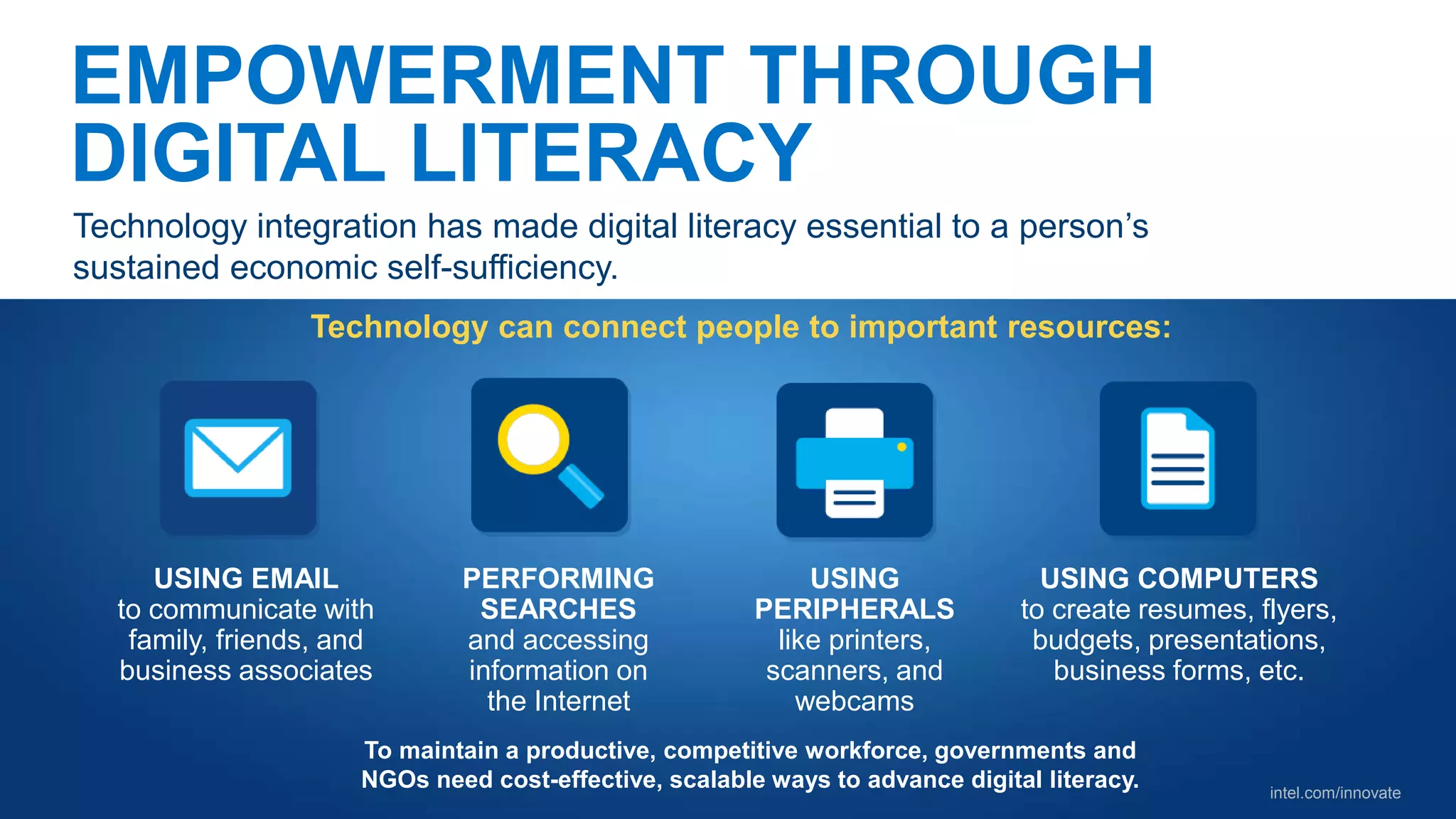
EMPOWERMENT THROUGH
DIGITAL LITERACY
Technology integration has made digital literacy essential to a person’s
sustained economic self-sufficiency.
Technology can connect people to important resources:
USING EMAIL
to communicate with
family, friends, and
business associates
PERFORMING
SEARCHES
and accessing
information on
the Internet
USING
PERIPHERALS
like printers,
scanners, and
webcams
USING COMPUTERS
to create resumes, flyers,
budgets, presentations,
business forms, etc.
To maintain a productive, competitive workforce, governments and
NGOs need cost-effective, scalable ways to advance digital literacy.
intel.com/innovate
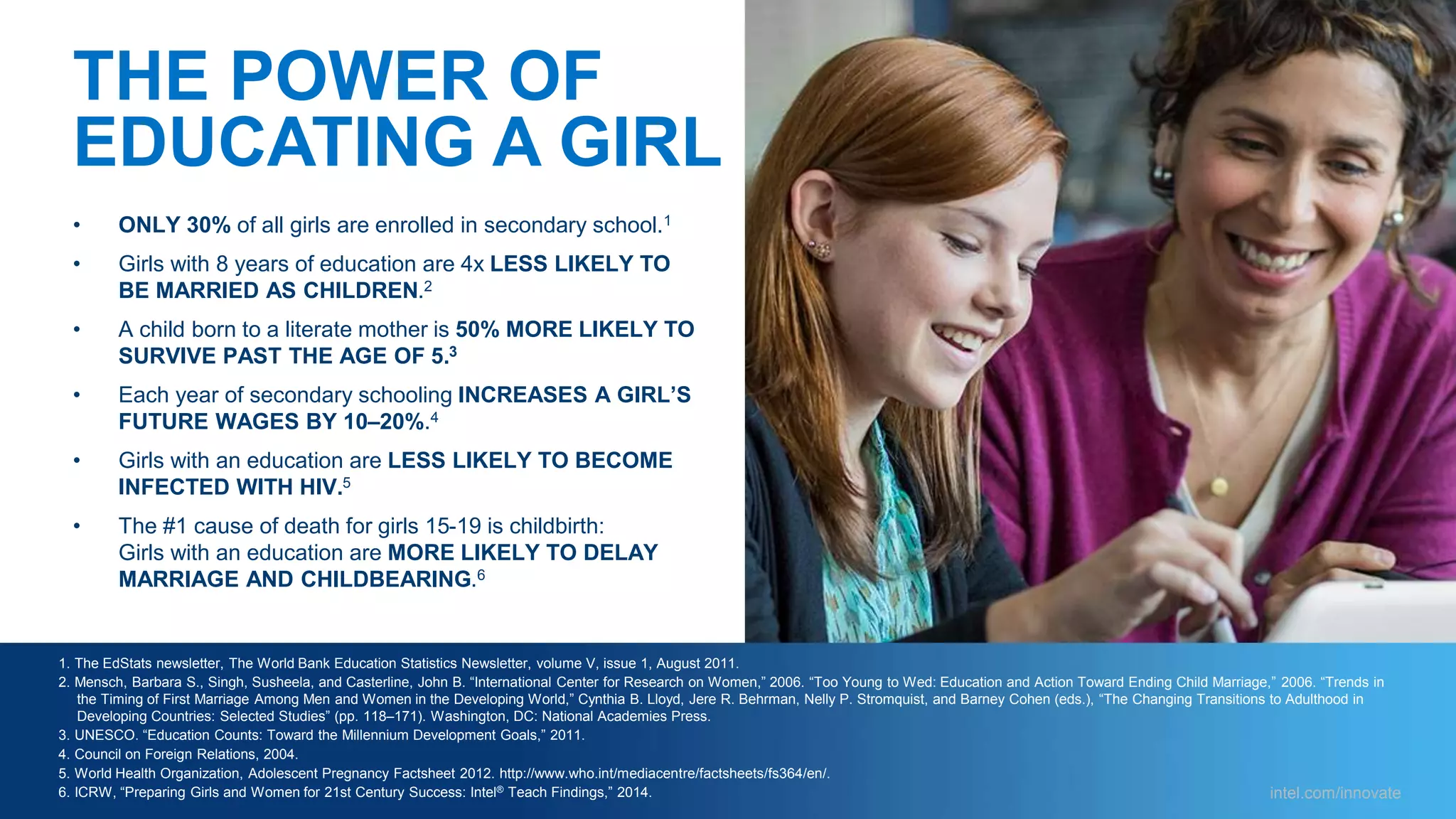
THE POWER OF
EDUCATING A GIRL
• ONLY 30% of all girls are enrolled in secondary school.1
• Girls with 8 years of education are 4x LESS LIKELY TO
BE MARRIED AS CHILDREN.2
• A child born to a literate mother is 50% MORE LIKELY TO
SURVIVE PAST THE AGE OF 5.3
• Each year of secondary schooling INCREASES A GIRL’S
FUTURE WAGES BY 10–20%.4
• Girls with an education are LESS LIKELY TO BECOME
INFECTED WITH HIV.5
• The #1 cause of death for girls 15-19 is childbirth:
Girls with an education are MORE LIKELY TO DELAY
MARRIAGE AND CHILDBEARING.6
1. The EdStats newsletter, The World Bank Education Statistics Newsletter, volume V, issue 1, August 2011.
2. Mensch, Barbara S., Singh, Susheela, and Casterline, John B. “International Center for Research on Women,” 2006. “Too Young to Wed: Education and Action Toward Ending Child Marriage,” 2006. “Trends in
the Timing of First Marriage Among Men and Women in the Developing World,” Cynthia B. Lloyd, Jere R. Behrman, Nelly P. Stromquist, and Barney Cohen (eds.), “The Changing Transitions to Adulthood in
Developing Countries: Selected Studies” (pp. 118–171). Washington, DC: National Academies Press.
3. UNESCO. “Education Counts: Toward the Millennium Development Goals,” 2011.
4. Council on Foreign Relations, 2004.
5. World Health Organization, Adolescent Pregnancy Factsheet 2012. http://www.who.int/mediacentre/factsheets/fs364/en/.
6. ICRW, “Preparing Girls and Women for 21st Century Success: Intel® Teach Findings,” 2014. intel.com/innovate
intel.com/innovate
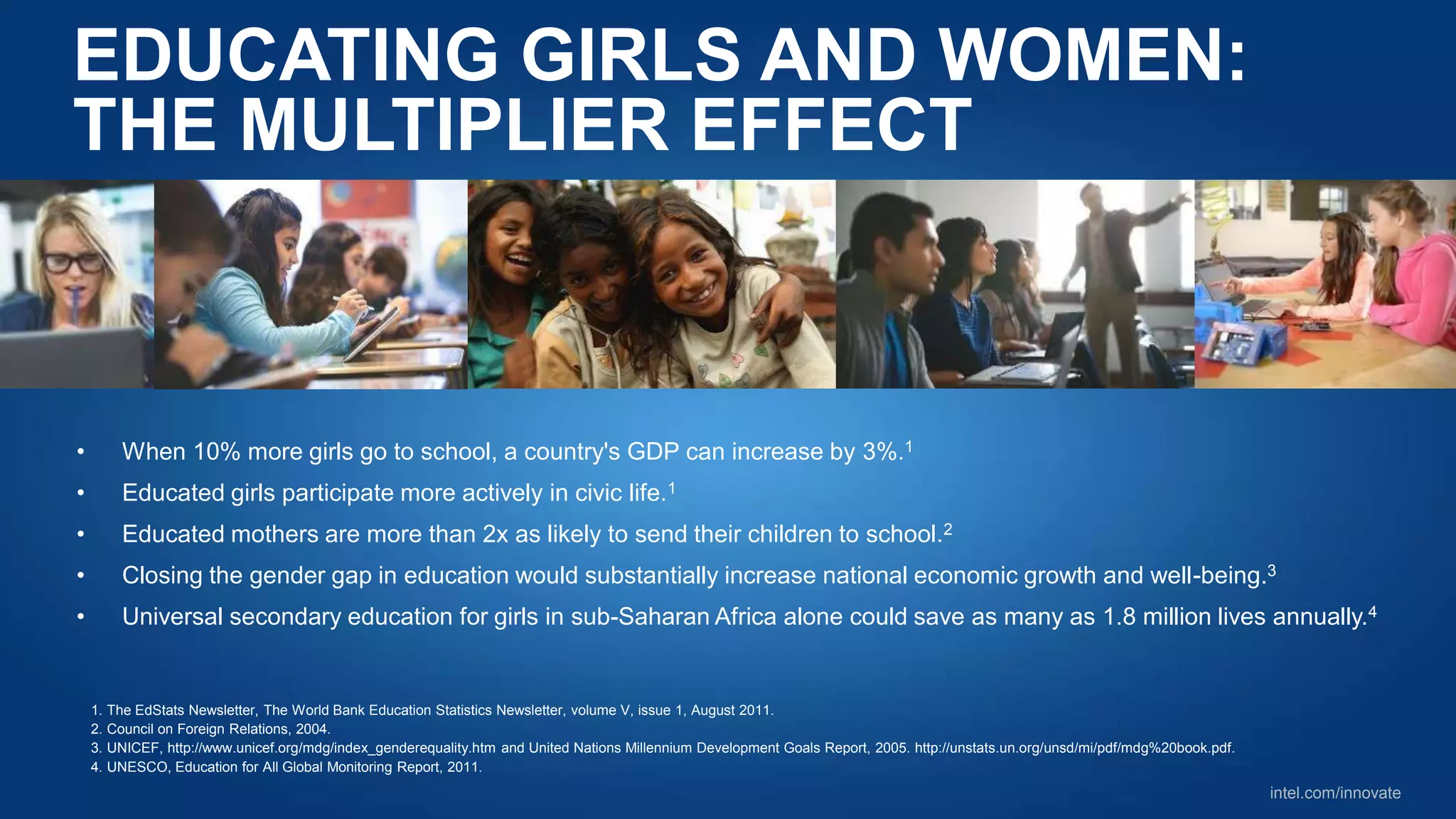
EDUCATING GIRLS AND WOMEN:
THE MULTIPLIER EFFECT
• When 10% more girls go to school, a country's GDP can increase by 3%.1
• Educated girls participate more actively in civic life.1
• Educated mothers are more than 2x as likely to send their children to school.2
• Closing the gender gap in education would substantially increase national economic growth and well-being.3
• Universal secondary education for girls in sub-Saharan Africa alone could save as many as 1.8 million lives annually.4
1. The EdStats Newsletter, The World Bank Education Statistics Newsletter, volume V, issue 1, August 2011.
2. Council on Foreign Relations, 2004.
3. UNICEF, http://www.unicef.org/mdg/index_genderequality.htm and United Nations Millennium Development Goals Report, 2005. http://unstats.un.org/unsd/mi/pdf/mdg%20book.pdf.
4. UNESCO, Education for All Global Monitoring Report, 2011.
intel.com/innovate
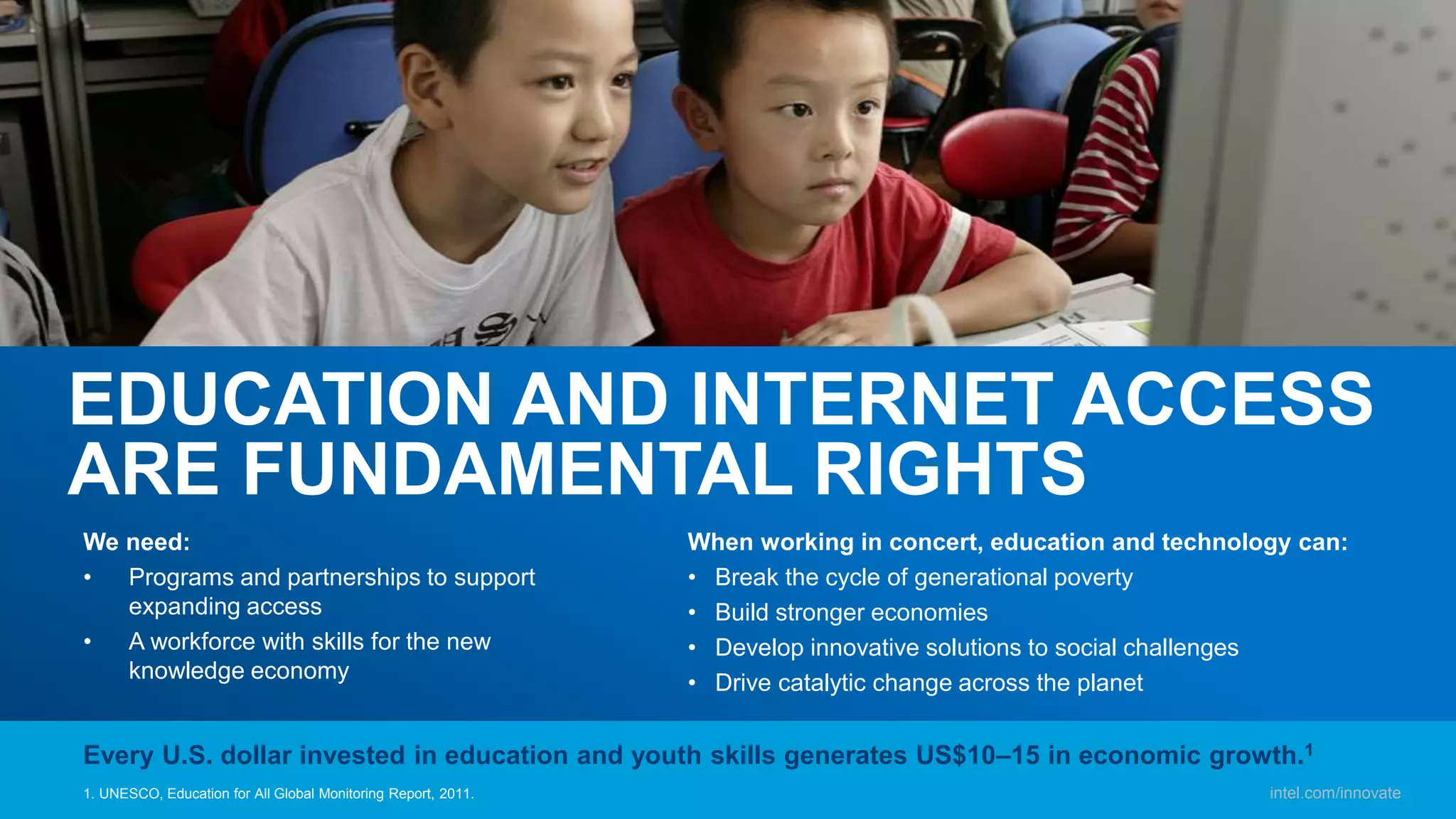
EDUCATION AND INTERNET ACCESS
ARE FUNDAMENTAL RIGHTS
We need:
• Programs and partnerships to support
expanding access
• A workforce with skills for the new
knowledge economy
When working in concert, education and technology can:
• Break the cycle of generational poverty
• Build stronger economies
• Develop innovative solutions to social challenges
• Drive catalytic change across the planet
1. UNESCO, Education for All Global Monitoring Report, 2011.
Every U.S. dollar invested in education and youth skills generates US$10–15 in economic growth.1
intel.com/innovate
INTEL IN ACTION
Learn more about Intel technology access
and empowerment programs:
Empowering Girls and Women
intel.com/women
Intel Computer Clubhouse Network
intel.com/content/www/us/en/education/
computer-clubhouse-network
Intel® Learn
intel.com/education/learn
Intel® Learn Easy Steps
intel.com/education/easysteps
Intel® She Will Connect
intel.com/women
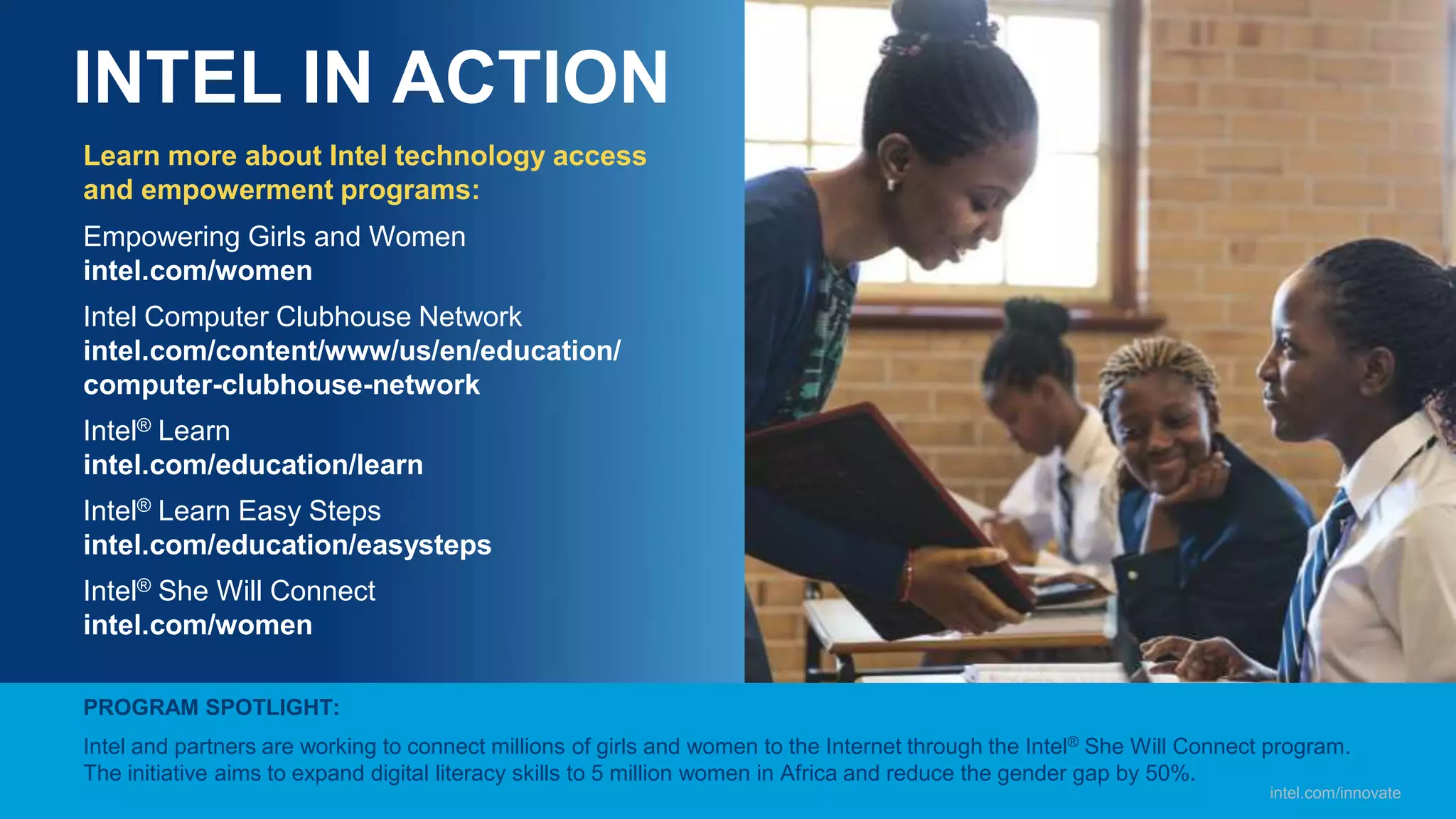
PROGRAM SPOTLIGHT:
Intel and partners are working to connect millions of girls and women to the Internet through the Intel® She Will Connect program.
The initiative aims to expand digital literacy skills to 5 million women in Africa and reduce the gender gap by 50%.
intel.com/innovate
intel.com/innovate
Learn more at:
intel.com/innovate/tech-access
Copyright © 2015, Intel Corporation. All rights reserved. Intel and the Intel logo are trademarks of Intel Corporation in the U.S. and/or other
countries. *Other names and brands may be claimed as the property of others. Programs of the Intel® Education initiative are funded by the
Intel Foundation and Intel Corporation.
1015/LDK/CMD/PPT

Presentation: Technology Access and Empowerment

  • 1.
    intel.com/innovate How to usethis presentation The following slides have been created by Intel for public use. Share or use the presentation in its entirety or as individual slides, as desired. TECHNOLOGY ACCESS AND EMPOWERMENT
  • 2.
    intel.com/innovate HARNESS TECHNOLOGY TO EXPANDACCESS AND EMPOWERMENT Technology can connect people to important resources: Education and technology access are the most powerful tools we have for unlocking economic opportunity. ONLINE LEARNING FINANCIAL INFORMATION HEALTH INFORMATION JOB OPPORTUNITIES PARTNERS AND MENTORS
  • 3.
    intel.com/innovate POPULATIONS CAN MOVEFROM OPPORTUNITY TO GROWTH WHEN EMPOWERED WITH THE RIGHT TOOLS AND TRAINING, PEOPLE CAN POSITIVELY IMPACT THEIR LIVES DEVELOP ENTREPRENEURIAL SKILLS FIND NEW MARKETS CONNECT WITH BUSINESS PARTNERS AND INVESTORS LEARN HOW TO SPEAK ANOTHER LANGUAGE INCREASE CROP YIELD
  • 4.
    intel.com/innovate The Internet connectsusers to a world of: THE INTERNET IS A GATEWAY TO CHANGE POLITICAL PARTICIPATION INCREASED PRODUCTIVITY SOCIAL INCLUSION GREATER INCOME GENERATION ACCESS TO RESOURCES, INFORMATION, AND SERVICES
  • 5.
    intel.com/innovate INTERNET ACCESS ISNOT AVAILABLE TO ALL % represents the portion of the population that is connected. 1. “Percentage of Individuals using the Internet 2000–2012,” International Telecommunications Union (Geneva), June 2013. There are an estimated 2.4 billion Internet users worldwide, but many countries are lagging behind.1 ARGENTINA 55% BRAZIL 49% U.S. 81% MEXICO 38% ICELAND 96% THE UNITED KINGDOM 87% EGYPT 44% UGANDA 14% SOUTH AFRICA 41% DENMARK 93% AUSTRALIA 82% RUSSIA 53% INDIA 12% JAPAN 79% SOUTH KOREA 84% SINGAPORE 74%
  • 6.
    intel.com/innovate THE INTERNET GENDERGAP EUROPE (parts of) 30% fewer women DEVELOPING WORLD 25% fewer women NORTH AFRICA 35% fewer women SUB-SAHARAN AFRICA 43% fewer women CENTRAL ASIA 30% fewer women MIDDLE EAST 35% fewer women SOUTH ASIA 35% fewer women Girls and women are being left behind in staggering numbers compared to men.1 1. Approximate figures taken from “Women and the Web: Bridging the Internet Gap and Creating New Global Opportunities in Low- and Middle-Income Countries.” Intel Corporation, Dalberg Global Development Advisors, GlobeScan, 2013.
  • 7.
    intel.com/innovate PROGRESS STARTS WITH ACCESSTO EDUCATION SOCIOECONOMIC COMMUNITY CULTURAL INSTITUTIONAL FAMILY INDIVIDUAL The obstacles to ensuring education for all include the following factors:
  • 8.
    intel.com/innovate EMPOWERMENT THROUGH DIGITAL LITERACY Technologyintegration has made digital literacy essential to a person’s sustained economic self-sufficiency. Technology can connect people to important resources: USING EMAIL to communicate with family, friends, and business associates PERFORMING SEARCHES and accessing information on the Internet USING PERIPHERALS like printers, scanners, and webcams USING COMPUTERS to create resumes, flyers, budgets, presentations, business forms, etc. To maintain a productive, competitive workforce, governments and NGOs need cost-effective, scalable ways to advance digital literacy.
  • 9.
    intel.com/innovate THE POWER OF EDUCATINGA GIRL • ONLY 30% of all girls are enrolled in secondary school.1 • Girls with 8 years of education are 4x LESS LIKELY TO BE MARRIED AS CHILDREN.2 • A child born to a literate mother is 50% MORE LIKELY TO SURVIVE PAST THE AGE OF 5.3 • Each year of secondary schooling INCREASES A GIRL’S FUTURE WAGES BY 10–20%.4 • Girls with an education are LESS LIKELY TO BECOME INFECTED WITH HIV.5 • The #1 cause of death for girls 15-19 is childbirth: Girls with an education are MORE LIKELY TO DELAY MARRIAGE AND CHILDBEARING.6 1. The EdStats newsletter, The World Bank Education Statistics Newsletter, volume V, issue 1, August 2011. 2. Mensch, Barbara S., Singh, Susheela, and Casterline, John B. “International Center for Research on Women,” 2006. “Too Young to Wed: Education and Action Toward Ending Child Marriage,” 2006. “Trends in the Timing of First Marriage Among Men and Women in the Developing World,” Cynthia B. Lloyd, Jere R. Behrman, Nelly P. Stromquist, and Barney Cohen (eds.), “The Changing Transitions to Adulthood in Developing Countries: Selected Studies” (pp. 118–171). Washington, DC: National Academies Press. 3. UNESCO. “Education Counts: Toward the Millennium Development Goals,” 2011. 4. Council on Foreign Relations, 2004. 5. World Health Organization, Adolescent Pregnancy Factsheet 2012. http://www.who.int/mediacentre/factsheets/fs364/en/. 6. ICRW, “Preparing Girls and Women for 21st Century Success: Intel® Teach Findings,” 2014. intel.com/innovate
  • 10.
    intel.com/innovate EDUCATING GIRLS ANDWOMEN: THE MULTIPLIER EFFECT • When 10% more girls go to school, a country's GDP can increase by 3%.1 • Educated girls participate more actively in civic life.1 • Educated mothers are more than 2x as likely to send their children to school.2 • Closing the gender gap in education would substantially increase national economic growth and well-being.3 • Universal secondary education for girls in sub-Saharan Africa alone could save as many as 1.8 million lives annually.4 1. The EdStats Newsletter, The World Bank Education Statistics Newsletter, volume V, issue 1, August 2011. 2. Council on Foreign Relations, 2004. 3. UNICEF, http://www.unicef.org/mdg/index_genderequality.htm and United Nations Millennium Development Goals Report, 2005. http://unstats.un.org/unsd/mi/pdf/mdg%20book.pdf. 4. UNESCO, Education for All Global Monitoring Report, 2011.
  • 11.
    intel.com/innovate EDUCATION AND INTERNETACCESS ARE FUNDAMENTAL RIGHTS We need: • Programs and partnerships to support expanding access • A workforce with skills for the new knowledge economy When working in concert, education and technology can: • Break the cycle of generational poverty • Build stronger economies • Develop innovative solutions to social challenges • Drive catalytic change across the planet 1. UNESCO, Education for All Global Monitoring Report, 2011. Every U.S. dollar invested in education and youth skills generates US$10–15 in economic growth.1 intel.com/innovate
  • 12.
    INTEL IN ACTION Learnmore about Intel technology access and empowerment programs: Empowering Girls and Women intel.com/women Intel Computer Clubhouse Network intel.com/content/www/us/en/education/ computer-clubhouse-network Intel® Learn intel.com/education/learn Intel® Learn Easy Steps intel.com/education/easysteps Intel® She Will Connect intel.com/women PROGRAM SPOTLIGHT: Intel and partners are working to connect millions of girls and women to the Internet through the Intel® She Will Connect program. The initiative aims to expand digital literacy skills to 5 million women in Africa and reduce the gender gap by 50%. intel.com/innovate
  • 13.
    intel.com/innovate Learn more at: intel.com/innovate/tech-access Copyright© 2015, Intel Corporation. All rights reserved. Intel and the Intel logo are trademarks of Intel Corporation in the U.S. and/or other countries. *Other names and brands may be claimed as the property of others. Programs of the Intel® Education initiative are funded by the Intel Foundation and Intel Corporation. 1015/LDK/CMD/PPT