PRESENTATION PROPOSAL - SAFETY AT LEVEL CROSSING.pptx
1.
Effect of RailwaySafety Education
and Innovation on Safety
Behaviour among Drivers at Level
Crossings in Tanzania
FACULTY OF LOGISTICS AND BUSINESS STUDIES
DEPARTMENT OF LOGISTICS AND TRANSPORT
STUDIES
2.
Background of theStudy
• Railway level crossings create serious potential conflict points for
collisions between road vehicles and trains. Safety at level crossings is
a worldwide issue, which increasingly has attracted the attention of
transport authorities, rail industry and the general public (Li-Sian Tey,
et al 2011).
3.
• The Ally'sStar bus, travelling from Dar es Salaam to Mwanza,
collided with a freight train at an intersection of the road and railway
on November 2023 in Singida region in Tanzania (Citizen, 2023).
• This accident killed 13 people instantly leaving the other 32 with
major injuries nearing permanent disabilities. In the light of increased
number of level crossing accidents, this study aims to examine the
prevalence of the problem and the effect of railway safety education
and innovation on safety behaviour among drivers at level crossings in
Tanzania.
4.
Statement of theproblem
• Although railway trespassing is risky and illegal, it is very common
and socially acceptable behaviour in many countries around the world.
In Tanzania, it is even difficult to define railway trespassing due to
little or no protection of many crossings. A good example is the
Tanzania Railway Corporation network (MGR) with a total number of
427 level crossings.
5.
• These crossingsare of different categories some of which the present the
highest danger. However, prevention activities are minimal, making them
vulnerable to road-train accidents.
• Thus, the proposed educational campaigns are aimed to unveil the risks that
drivers are exposed to level crossings and change their attitude towards safety
behaviour.
6.
RESEARCH OBJECTIVES
General Objective
•To assess the influence of education and innovation on safety behaviour among
drivers at level crossings in Tanzania.
Specific Objectives
a. To assess the public awareness on the safety at level crossings in Tanzania.
b. To assess the effect of railway safety training on safety behaviour among drivers
at level crossings in Tanzania
c. To examine the effect of innovation on safety behaviour among drivers at level
crossings in Tanzania
7.
LITERATURE REVIEW
• Railis one of the safest modes of transport all over the world. However, there are
safety concerns for road users as many of these railways pass through small and
large towns where it is common to find lots of rail crossing (Egaji et al., 2022).
• For instance in UK, around 5,600 crossings still exist on Britain’s railways even
after 1,250 having been closed since 2009. Seventy-five percent of those
remaining require the user to make the decision as to whether it is safe to cross.
There has thankfully been a 37% reduction in accident rates since 2009.
8.
Conceptual framework
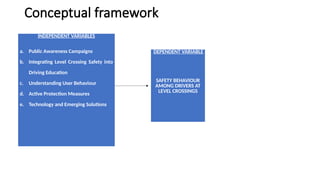
INDEPENDENT VARIABLES
a.Public Awareness Campaigns
b. Integrating Level Crossing Safety into
Driving Education
c. Understanding User Behaviour
d. Active Protection Measures
e. Technology and Emerging Solutions
DEPENDENT VARIABLE
SAFETY BEHAVIOUR
AMONG DRIVERS AT
LEVEL CROSSINGS
9.
Methodology
• The studyadopts a mixed research design where both quantitative and
qualitative designs are used.
• In the quantitative study, before-and-after control experimental design
will be used to evaluate the effect of railway safety education and
innovation on safety behaviour among drivers at level crossings
10.
Methods of DataCollection
• A survey questionnaire will be administered to a selected sample of drivers to
assess their attitude towards safety behaviour at level crossings.
• Moreover interviews, focus groups and observation methods will be used to
collect qualitative data. A consultation checklist will be used to guide
researchers on issues of discussion and observation.
11.
Study area, populationand sample size
• This study will be conducted in Tanzania and the study population will involve
drivers of long- distance passenger busses involved in level crossing at least
once in their routes.
• Bus drivers have been selected because they are most prone to rail accidents
given the nature of their services.
• Within the constraints of time and resources, on each railway line a limited
number of level crossings will be selected purposefully.
12.
• The selectionwill be based on the intensity of use by long distance
passenger buses. Thereafter, a two-stage sampling technique,
involving proportionate and simple random methods, will be used to
select respondents from each level crossing.
13.
Data analysis
• Inboth before and after intervention, quantitative data will be analysed
using partial least squares structural equation modelling (PLS-SEM)
method as implemented in smartPLS 3.
14.
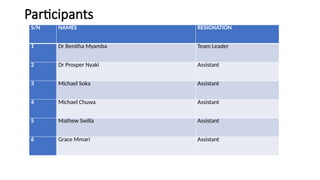
Participants
S/N NAMES RESIGNATION
1Dr Benitha Myamba Team Leader
2 Dr Prosper Nyaki Assistant
3 Michael Soka Assistant
4 Michael Chuwa Assistant
5 Mathew Swilla Assistant
6 Grace Mmari Assistant