International Research Journal of Engineering and Technology (IRJET) e-ISSN: 2395-0056
Volume: 06 Issue: 04 | Apr 2019 www.irjet.net p-ISSN: 2395-0072
© 2019, IRJET | Impact Factor value: 7.211 | ISO 9001:2008 Certified Journal | Page 4521
PEDESTRIAN RISK ANALYSIS AT UNCONTROLLED MIDBLOCK
Prof: Bybin Paul1, Mohamed Fayiz2, Naseef Ahamed V3, Sudharsana A4, Archana C5
1Assistant Professor, Dept. of Civil Engineering, Mar Athanasius College of Engineering, Kerala, India
2,3,4,5Student, Dept. of Civil Engineering, Mar Athanasius College of Engineering, Kerala, India
---------------------------------------------------------------------***----------------------------------------------------------------------
Abstract - Traffic controls andspaceallocationsaregenerally
biased towards vehicular trafficandpedestriansrequirements
are not given due consideration. One of the most hazardous
locations for a person to cross is at uncontrolled midblock. In
such locations, pedestrians need to search for adequate
vehicular gaps to cross safely. Pedestrian adopts a different
behaviour pattern than expected in this situation causing
confusion to fatal accidents during theendeavour. Objectiveof
this study is to find out whichever behavioural and
demographic factors influence the risk and adopt the safest
behaviours while crossing at midblock.
Key Words: Pedestrian risk analysis, Road crossing,waiting
time, Risk analysis, Interruption, Rolling gap.
1. INTRODUCTION
Transportation is defined as the transfer of person or goods
from one point to another by a medium which can be a
vehicle or a person. One of the most accessible modes of
transportation is road transportation. Once constructed for
the safe transport of pedestrians, it is currently fully
overtaken by vehicles.Consequently,thisputspedestriansin
a dangerous position of having given the least amount of
consideration during the design of roads.
Pedestrians either move along the road or across the road,
casually known as a road crossing, to get from A to B. The
latter movement is the problematic one, because of its
interference with ongoing traffic. It is also influenced by
several factors and conditions, accordingly, making it a
behavior having a high potential for accidents, as much as
driving.
One of the most hazardous locations for a person to cross is
at uncontrolled midblocks. Uncontrolled mid-block
pedestrian crossings aremarkedcrosswalksplacedbetween
intersections which are not controlled by any traffic police
personnel. The second Global Report on Road safety shared
that, globally, pedestrians constitute 22% of all road deaths
and in some countries; this proportion is as high as two
thirds. Moreover, millions of people are injured in traffic-
related crashes while walking, some of whom become
permanently disabled.
The data show that on an average day 1324 accidents occur
on Indian roads leading to the death of 349 people. This
means 55 accidents and 15 lives lost per hour. In other
words, a life lost every four minutes.
In Kerala; it was found that there is a 20% increase in road
accidents and injuries compared to the year 2015. Although
rash and drunk driving are the leading cause of these
fatalities and non-fatal injuries, lack of pedestrian
infrastructures and poor urban planning also puts
pedestrians at risk.
1.1 Need for Study
With a population of 601,574 as of 2011, the city of
Ernakulam has Kerala's second highest population density
parameter with 6340 people per km. As the population
increases, their need to commute to different locations have
increased many times. The accident rate in the city is
reportedly on the rise. Out of 2451 accident cases registered
in 2018 in the city, 140 caseswere fatal and around2451had
non-fatality injuries. The study aims to identify different
factors which may influencethebehaviourofpedestriansand
their risk and relations. By identifying these factors and
relations, safest behaviour traits that can be adopted during
crossing can be adopted.
1.2 Objectives
• To qualitatively and quantitatively assess the road
crossing conditions.
• To find the effect of gender, age, companions,
vehicles and other external factors on the road
crossing behavior.
• To give pointers to pedestrians and drivers on the
safest behaviors that could be adopted during the
midblock crossing.
2. LITERATURE REVIEW
Public transportation influences pedestriansafety.Crossings
located close to bus stops, or bus way systems, experience
higher pedestrian crash rates[1]. The speedofthepedestrian
was found to be influenced by the age and gender. Male
pedestriansmovefasterthanfemalepedestrians.Pedestrians
in the age group of 10–15 years had the highest speed, 82
m/min. The speed was reduced by about 85% when
pedestrians move with their baggage as friction increases
with weight[2].
Pedestrians preferred safe to short paths and they crossed
second half of the road with significantly higher speed. In
terms of safety, pedestrians who were middle aged; involved
in bigger groups, looked at vehicles more often before
crossing or interacted with buses rather than cars weresafer
International Research Journal of Engineering and Technology (IRJET) e-ISSN: 2395-0056
Volume: 06 Issue: 04 | Apr 2019 www.irjet.net p-ISSN: 2395-0072
© 2019, IRJET | Impact Factor value: 7.211 | ISO 9001:2008 Certified Journal | Page 4522
while those running were more dangerous [3]. 10.6% of
middle aged pedestrians are more likely to have irregular
crossing than youth and older pedestrians. It was also found
out that male pedestrians are 38.6% more likely to show
rolling gap behavior and 75.2% more likely to observe
running behavior. Analysis of behavior based on the size of
vehicles shows that pedestrians accepting gaps of buses are
likely to run in crossing at mid blocks
3. METHODOLOGY
Data for the study were collected in Ernakulam city during
the months ofFebruary and March of 2019. The videography
survey was done at morningand evening peakhoursfroman
elevated position at22selectedlocations.Therecordedvideo
was extracted using VLC Player with frame by frame
playback. In every 30 milliseconds, behaviors of the
pedestrian were analyzed manually.
The data includes different detailsaboutapedestrianand
the crossing behavior, including the age, gender, way of
crossing, vehicle gap acceptance, group effect etc.
Pedestrians were divided into four age groups based on
their visual appearance.
1. Child/Teen
2. Youth
3. Middle-aged
4. Elder
Other data extracted includes
1. Whether or not the pedestrian show running
behavior
2. Whether the pedestrian was in a group
3. The pattern of movement
4. Type of vehicles for which the pedestrians cross
5. Crossing time
6. Waiting time
7. Whetherornotthepedestriansfullycrossedthrough
the marked crosswalks.
The crossing speeds of the pedestrians were found out from
the road widthand the crossing timefrom the timeline of the
media player. Collected data is shown in Table-1.
OBSERVED DATA NUMBER OF PEDESTRIANS OBSERVED PERCENTAGE (%)
GENDER
1.Male
2.Female
1037
831
55.52
44.48
AGE GROUP
1.Child
2.Youth
3.Middle aged
4.Elder
303
859
616
191
15.4
43.6
31.4
9.7
BEHAVIOUR
1.Walk
2.Run
1553
315
83.1
16.9
GROUP OR NOT
1.Alone
2.Group
773
315
41.4
58.6
PATTERN OF MOVEMENT
1.Straight
2.Rolling
1424
444
76.2
23.8
INTERRUPTIONS IN CROSSING
1.Interrupted
2.Uninterrupted
426
1442
22.8
77.2
TYPE OF VEHICLE FOR WHICH
PEDESTRIANS CROSS
1. Car
2. Two Wheeler
3. Three Wheeler
4. Heavy Vehicles/ Bus
575
583
230
478
30.8
31.2
12.3
25.7
CROSSING IN ZEBRA
1.Yes
2.No
1185
683
63.4
36.6
International Research Journal of Engineering and Technology (IRJET) e-ISSN: 2395-0056
Volume: 06 Issue: 04 | Apr 2019 www.irjet.net p-ISSN: 2395-0072
© 2019, IRJET | Impact Factor value: 7.211 | ISO 9001:2008 Certified Journal | Page 4523
4. STATISTICAL ANALYSIS
To determine whether the pedestrian demographic factors
like age and gender, behavioral factors and vehicle factors
have any effect on the risk potential while crossing the road,
suitable statistical analysis tools are carried out.
The collected data contains categorical data as well as
numerical data. It is essential to select suitable methods for
the analysis of each type of data. One-way ANOVA is used to
compare between a categorical variable and a numerical
variable. Comparison between two categorical variables is
done by carrying out Chi-squared test. If any statistical
significance is established after carrying out the tests
between two variables, odd ratioiscalculatedtoquantifythe
relation. The odds ratio (OR) is the ratio of the odds of A in
the presence of B and the odds of A without the presence of
B. For example, if the possibilitiesthosepedestriansinGroup
A and Group B would run during crossing are ‘a’ and ‘b’
respectively, then the OR is given by,
OR = b(1-a)/a(1-b)
If the OR is greater than 1, then pedestrians in Group A are
more likely to run during crossing. If OR is equal to unity,
there are no difference between the two groups in terms of
the likelihood of showing running behavior while crossing.
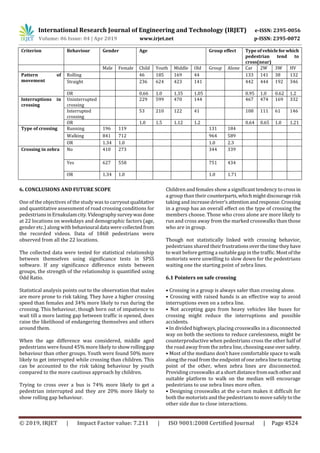
The results after analysis are shown in Table 2.
5. FACTORS AFFECTING CROSSING BEHAVIOUR
5.1 Gender
Statistical significance test show that males are 34% more
likely to run during crossing than female (p=.009). This
might be because of the risk taking behavior of the gender in
the prevailing culture. It was also found that males walk
slightly faster thantheirfemalecounterpartsduringcrossing
(p=.003). The mean crossing speed of males (ranging from
.42m/s to 3.67m/s) is 5% more than females (ranging from
.11m/s to 3.5m/s). The risk taking behavior of male
pedestrians is still more significant by the fact that they are
34% more likely to disregard the marked crosswalks. Males
are also less likely to cross as a group as opposed to female
pedestrians whose likelihood of crossing as groups is 1.77
times that of males.
5.2 Age difference
It was found that there exists no significant difference in
crossing speed between age groups as per the data from
ANOVA test (p=.191). However, middleagedpedestriansare
35% more likely to show rolling behavior that the youthand
45% more than other age groups (p=0.001). It was also
found out that youth are 50% more likely to get interrupted
while crossing than children or teens and 37% more likely
than other age groups (p=.032). Interestingly,Children/teen
were found to be 100% more likely cross in groups than any
other groups and 70% more likely than youth (p=.000). No
significant differences were found in running behavior and
preference to cross through markedcrosswalksbetween age
groups.
5.3 PLATOON SIZE
Crossing as a group is an evolved behavior to maximize
safety and attention from the motorists. This behavior
lessens the need for an individual to take more risks. This
would explain why those who cross alone are 130% more
likely to run across the road while crossing compared to
those cross as group. Those who cross alone are 71% more
likely to cross away from marked crosswalks too. There are
no significant difference in pattern of movement and
interruption during crossing and platoon size.
5.4 Vehicle Factor
The type of vehicle for which pedestrians tend to cross has
significant effect on interrupted crossing
(p=.000).Pedestrians are 20% more likely togetinterrupted
if they choose to cross a bus or heavy vehicle than a three
wheeler and 74% more likely than any other vehicles.
Pedestrians are also 20% more likely to show rolling
behavior when crossing for a bus (p=.013).
5.5 Other Factors
Though not a factor directly influencing the pedestrian
behaviour during the crossing, the time spent waiting for a
suitable gap between the ongoing traffic might have an
influence on the crossing behavior whichfollowsthe waiting
time period. It has been quantitatively measured. The mean
waiting time of a pedestrian in Ernakulam city is 21.5
seconds which is more than the time taken for the actual
crossing. Another surprising relation found out using the
statistical analysis is that those who cross through the
marked crosswalks are 50% more likely to get interrupted
by the vehicles than those who arenot.Thiscanbediscarded
as an anomaly observation. But, if we observe the behaviour
of motorists in a multiple lane straight highway, many are
unwilling to slow down for a pedestrian whethertheyare on
zebra line or not. This is evident from TABLE 1 that 36.6%of
the pedestrians chose not to cross through zebra lines.
International Research Journal of Engineering and Technology (IRJET) e-ISSN: 2395-0056
Volume: 06 Issue: 04 | Apr 2019 www.irjet.net p-ISSN: 2395-0072
© 2019, IRJET | Impact Factor value: 7.211 | ISO 9001:2008 Certified Journal | Page 4524
6. CONCLUSIONS AND FUTURE SCOPE
One of the objectives of the study was to carryoutqualitative
and quantitative assessment of road crossing conditions for
pedestriansinErnakulamcity.Videographysurveywasdone
at 22 locations on weekdays and demographic factors (age,
gender etc.) along with behavioural data werecollectedfrom
the recorded videos. Data of 1868 pedestrians were
observed from all the 22 locations.
The collected data were tested for statistical relationship
between themselves using significance tests in SPSS
software. If any significance difference exists between
groups, the strength of the relationship is quantified using
Odd Ratio.
Statistical analysis points out to the observation that males
are more prone to risk taking. They have a higher crossing
speed than females and 34% more likely to run during the
crossing. This behaviour, though born out of impatience to
wait till a more lasting gap between traffic is opened, does
raise the likelihood of endangering themselves and others
around them.
When the age difference was considered, middle aged
pedestrians were found 45% more likely to showrollinggap
behaviour than other groups. Youth were found 50% more
likely to get interrupted while crossing than children. This
can be accounted to the risk taking behaviour by youth
compared to the more cautious approach by children.
Trying to cross over a bus is 74% more likely to get a
pedestrian interrupted and they are 20% more likely to
show rolling gap behaviour.
Children and females show a significant tendency to crossin
a group than their counterparts,whichmightdiscourage risk
taking and increasedriver’s attentionandresponse.Crossing
in a group has an overall effect on the type of crossing the
members choose. Those who cross alone are more likely to
run and cross away from the marked crosswalks than those
who are in group.
Though not statistically linked with crossing behavior,
pedestrians shared theirfrustrationsoverthetimetheyhave
to wait before getting a suitable gap in the traffic. Mostofthe
motorists were unwilling to slow down for the pedestrians
waiting one the starting point of zebra lines.
6.1 Pointers on safe crossing
• Crossing in a group is always safer than crossing alone.
• Crossing with raised hands is an effective way to avoid
interruptions even on a zebra line.
• Not accepting gaps from heavy vehicles like buses for
crossing might reduce the interruptions and possible
accidents.
• In divided highways, placing crosswalks in a disconnected
way on both the sections to reduce carelessness, might be
counterproductive when pedestrians cross the other half of
the road away from the zebra line, choosing easeoversafety.
• Most of the medians don’t have comfortable space to walk
along the road from the endpoint ofonezebra linetostarting
point of the other, when zebra lines are disconnected.
Providing crosswalks ata shortdistancefromeachother and
suitable platform to walk on the median will encourage
pedestrians to use zebra lines more often.
• Designing crosswalks at the u-turn makes it difficult for
both the motorists and the pedestrians to move safely to the
other side due to close interactions.
Criterion Behaviour Gender Age Group effect Type of vehicleforwhich
pedestrian tend to
cross(near)
Male Female Child Youth Middle Old Group Alone Car 2W 3W HV
Pattern of
movement
Rolling 46 185 169 44 133 141 38 132
Straight 236 624 423 141 442 444 192 346
OR 0.66 1.0 1.35 1.05 0.95 1.0 0.62 1.2
Interruptions in
crossing
Uninterrupted
crossing
229 599 470 144 467 474 169 332
Interrupted
crossing
53 210 122 41 108 111 61 146
OR 1.0 1.5 1.12 1.2 0.64 0.65 1.0 1.21
Type of crossing Running 196 119 131 184
Walking 841 712 964 589
OR 1.34 1.0 1.0 2.3
Crossing in zebra No 410 273 344 339
Yes 627 558 751 434
OR 1.34 1.0 1.0 1.71
International Research Journal of Engineering and Technology (IRJET) e-ISSN: 2395-0056
Volume: 06 Issue: 04 | Apr 2019 www.irjet.net p-ISSN: 2395-0072
© 2019, IRJET | Impact Factor value: 7.211 | ISO 9001:2008 Certified Journal | Page 4525
REFERENCES
[1] Mara Chagas Diogenes and Luis Antonio Linda, 2010 -
Evaluation of pedestrian safety at midblock crossings.
[2] KotkarKishorLaxman, RajatRastogi,andSatish, 2010 -
Pedestrian Flow Characteristics in Mixed Traffic
Conditions.
[3] ZhuangX, 2011- Safety margin and perceived safety of
pedestrians at unmarked roadway.
[4] KodavantiVenkataRaghavendraRavishankar,ParvathyM
aheswari Nair, the 2017-pedestrian risk atuncontrolled
midblock and unsignalized intersections.

IRJET- Pedestrian Risk Analysis at Uncontrolled Midblock

  • 1.
    International Research Journalof Engineering and Technology (IRJET) e-ISSN: 2395-0056 Volume: 06 Issue: 04 | Apr 2019 www.irjet.net p-ISSN: 2395-0072 © 2019, IRJET | Impact Factor value: 7.211 | ISO 9001:2008 Certified Journal | Page 4521 PEDESTRIAN RISK ANALYSIS AT UNCONTROLLED MIDBLOCK Prof: Bybin Paul1, Mohamed Fayiz2, Naseef Ahamed V3, Sudharsana A4, Archana C5 1Assistant Professor, Dept. of Civil Engineering, Mar Athanasius College of Engineering, Kerala, India 2,3,4,5Student, Dept. of Civil Engineering, Mar Athanasius College of Engineering, Kerala, India ---------------------------------------------------------------------***---------------------------------------------------------------------- Abstract - Traffic controls andspaceallocationsaregenerally biased towards vehicular trafficandpedestriansrequirements are not given due consideration. One of the most hazardous locations for a person to cross is at uncontrolled midblock. In such locations, pedestrians need to search for adequate vehicular gaps to cross safely. Pedestrian adopts a different behaviour pattern than expected in this situation causing confusion to fatal accidents during theendeavour. Objectiveof this study is to find out whichever behavioural and demographic factors influence the risk and adopt the safest behaviours while crossing at midblock. Key Words: Pedestrian risk analysis, Road crossing,waiting time, Risk analysis, Interruption, Rolling gap. 1. INTRODUCTION Transportation is defined as the transfer of person or goods from one point to another by a medium which can be a vehicle or a person. One of the most accessible modes of transportation is road transportation. Once constructed for the safe transport of pedestrians, it is currently fully overtaken by vehicles.Consequently,thisputspedestriansin a dangerous position of having given the least amount of consideration during the design of roads. Pedestrians either move along the road or across the road, casually known as a road crossing, to get from A to B. The latter movement is the problematic one, because of its interference with ongoing traffic. It is also influenced by several factors and conditions, accordingly, making it a behavior having a high potential for accidents, as much as driving. One of the most hazardous locations for a person to cross is at uncontrolled midblocks. Uncontrolled mid-block pedestrian crossings aremarkedcrosswalksplacedbetween intersections which are not controlled by any traffic police personnel. The second Global Report on Road safety shared that, globally, pedestrians constitute 22% of all road deaths and in some countries; this proportion is as high as two thirds. Moreover, millions of people are injured in traffic- related crashes while walking, some of whom become permanently disabled. The data show that on an average day 1324 accidents occur on Indian roads leading to the death of 349 people. This means 55 accidents and 15 lives lost per hour. In other words, a life lost every four minutes. In Kerala; it was found that there is a 20% increase in road accidents and injuries compared to the year 2015. Although rash and drunk driving are the leading cause of these fatalities and non-fatal injuries, lack of pedestrian infrastructures and poor urban planning also puts pedestrians at risk. 1.1 Need for Study With a population of 601,574 as of 2011, the city of Ernakulam has Kerala's second highest population density parameter with 6340 people per km. As the population increases, their need to commute to different locations have increased many times. The accident rate in the city is reportedly on the rise. Out of 2451 accident cases registered in 2018 in the city, 140 caseswere fatal and around2451had non-fatality injuries. The study aims to identify different factors which may influencethebehaviourofpedestriansand their risk and relations. By identifying these factors and relations, safest behaviour traits that can be adopted during crossing can be adopted. 1.2 Objectives • To qualitatively and quantitatively assess the road crossing conditions. • To find the effect of gender, age, companions, vehicles and other external factors on the road crossing behavior. • To give pointers to pedestrians and drivers on the safest behaviors that could be adopted during the midblock crossing. 2. LITERATURE REVIEW Public transportation influences pedestriansafety.Crossings located close to bus stops, or bus way systems, experience higher pedestrian crash rates[1]. The speedofthepedestrian was found to be influenced by the age and gender. Male pedestriansmovefasterthanfemalepedestrians.Pedestrians in the age group of 10–15 years had the highest speed, 82 m/min. The speed was reduced by about 85% when pedestrians move with their baggage as friction increases with weight[2]. Pedestrians preferred safe to short paths and they crossed second half of the road with significantly higher speed. In terms of safety, pedestrians who were middle aged; involved in bigger groups, looked at vehicles more often before crossing or interacted with buses rather than cars weresafer
  • 2.
    International Research Journalof Engineering and Technology (IRJET) e-ISSN: 2395-0056 Volume: 06 Issue: 04 | Apr 2019 www.irjet.net p-ISSN: 2395-0072 © 2019, IRJET | Impact Factor value: 7.211 | ISO 9001:2008 Certified Journal | Page 4522 while those running were more dangerous [3]. 10.6% of middle aged pedestrians are more likely to have irregular crossing than youth and older pedestrians. It was also found out that male pedestrians are 38.6% more likely to show rolling gap behavior and 75.2% more likely to observe running behavior. Analysis of behavior based on the size of vehicles shows that pedestrians accepting gaps of buses are likely to run in crossing at mid blocks 3. METHODOLOGY Data for the study were collected in Ernakulam city during the months ofFebruary and March of 2019. The videography survey was done at morningand evening peakhoursfroman elevated position at22selectedlocations.Therecordedvideo was extracted using VLC Player with frame by frame playback. In every 30 milliseconds, behaviors of the pedestrian were analyzed manually. The data includes different detailsaboutapedestrianand the crossing behavior, including the age, gender, way of crossing, vehicle gap acceptance, group effect etc. Pedestrians were divided into four age groups based on their visual appearance. 1. Child/Teen 2. Youth 3. Middle-aged 4. Elder Other data extracted includes 1. Whether or not the pedestrian show running behavior 2. Whether the pedestrian was in a group 3. The pattern of movement 4. Type of vehicles for which the pedestrians cross 5. Crossing time 6. Waiting time 7. Whetherornotthepedestriansfullycrossedthrough the marked crosswalks. The crossing speeds of the pedestrians were found out from the road widthand the crossing timefrom the timeline of the media player. Collected data is shown in Table-1. OBSERVED DATA NUMBER OF PEDESTRIANS OBSERVED PERCENTAGE (%) GENDER 1.Male 2.Female 1037 831 55.52 44.48 AGE GROUP 1.Child 2.Youth 3.Middle aged 4.Elder 303 859 616 191 15.4 43.6 31.4 9.7 BEHAVIOUR 1.Walk 2.Run 1553 315 83.1 16.9 GROUP OR NOT 1.Alone 2.Group 773 315 41.4 58.6 PATTERN OF MOVEMENT 1.Straight 2.Rolling 1424 444 76.2 23.8 INTERRUPTIONS IN CROSSING 1.Interrupted 2.Uninterrupted 426 1442 22.8 77.2 TYPE OF VEHICLE FOR WHICH PEDESTRIANS CROSS 1. Car 2. Two Wheeler 3. Three Wheeler 4. Heavy Vehicles/ Bus 575 583 230 478 30.8 31.2 12.3 25.7 CROSSING IN ZEBRA 1.Yes 2.No 1185 683 63.4 36.6
  • 3.
    International Research Journalof Engineering and Technology (IRJET) e-ISSN: 2395-0056 Volume: 06 Issue: 04 | Apr 2019 www.irjet.net p-ISSN: 2395-0072 © 2019, IRJET | Impact Factor value: 7.211 | ISO 9001:2008 Certified Journal | Page 4523 4. STATISTICAL ANALYSIS To determine whether the pedestrian demographic factors like age and gender, behavioral factors and vehicle factors have any effect on the risk potential while crossing the road, suitable statistical analysis tools are carried out. The collected data contains categorical data as well as numerical data. It is essential to select suitable methods for the analysis of each type of data. One-way ANOVA is used to compare between a categorical variable and a numerical variable. Comparison between two categorical variables is done by carrying out Chi-squared test. If any statistical significance is established after carrying out the tests between two variables, odd ratioiscalculatedtoquantifythe relation. The odds ratio (OR) is the ratio of the odds of A in the presence of B and the odds of A without the presence of B. For example, if the possibilitiesthosepedestriansinGroup A and Group B would run during crossing are ‘a’ and ‘b’ respectively, then the OR is given by, OR = b(1-a)/a(1-b) If the OR is greater than 1, then pedestrians in Group A are more likely to run during crossing. If OR is equal to unity, there are no difference between the two groups in terms of the likelihood of showing running behavior while crossing. The results after analysis are shown in Table 2. 5. FACTORS AFFECTING CROSSING BEHAVIOUR 5.1 Gender Statistical significance test show that males are 34% more likely to run during crossing than female (p=.009). This might be because of the risk taking behavior of the gender in the prevailing culture. It was also found that males walk slightly faster thantheirfemalecounterpartsduringcrossing (p=.003). The mean crossing speed of males (ranging from .42m/s to 3.67m/s) is 5% more than females (ranging from .11m/s to 3.5m/s). The risk taking behavior of male pedestrians is still more significant by the fact that they are 34% more likely to disregard the marked crosswalks. Males are also less likely to cross as a group as opposed to female pedestrians whose likelihood of crossing as groups is 1.77 times that of males. 5.2 Age difference It was found that there exists no significant difference in crossing speed between age groups as per the data from ANOVA test (p=.191). However, middleagedpedestriansare 35% more likely to show rolling behavior that the youthand 45% more than other age groups (p=0.001). It was also found out that youth are 50% more likely to get interrupted while crossing than children or teens and 37% more likely than other age groups (p=.032). Interestingly,Children/teen were found to be 100% more likely cross in groups than any other groups and 70% more likely than youth (p=.000). No significant differences were found in running behavior and preference to cross through markedcrosswalksbetween age groups. 5.3 PLATOON SIZE Crossing as a group is an evolved behavior to maximize safety and attention from the motorists. This behavior lessens the need for an individual to take more risks. This would explain why those who cross alone are 130% more likely to run across the road while crossing compared to those cross as group. Those who cross alone are 71% more likely to cross away from marked crosswalks too. There are no significant difference in pattern of movement and interruption during crossing and platoon size. 5.4 Vehicle Factor The type of vehicle for which pedestrians tend to cross has significant effect on interrupted crossing (p=.000).Pedestrians are 20% more likely togetinterrupted if they choose to cross a bus or heavy vehicle than a three wheeler and 74% more likely than any other vehicles. Pedestrians are also 20% more likely to show rolling behavior when crossing for a bus (p=.013). 5.5 Other Factors Though not a factor directly influencing the pedestrian behaviour during the crossing, the time spent waiting for a suitable gap between the ongoing traffic might have an influence on the crossing behavior whichfollowsthe waiting time period. It has been quantitatively measured. The mean waiting time of a pedestrian in Ernakulam city is 21.5 seconds which is more than the time taken for the actual crossing. Another surprising relation found out using the statistical analysis is that those who cross through the marked crosswalks are 50% more likely to get interrupted by the vehicles than those who arenot.Thiscanbediscarded as an anomaly observation. But, if we observe the behaviour of motorists in a multiple lane straight highway, many are unwilling to slow down for a pedestrian whethertheyare on zebra line or not. This is evident from TABLE 1 that 36.6%of the pedestrians chose not to cross through zebra lines.
  • 4.
    International Research Journalof Engineering and Technology (IRJET) e-ISSN: 2395-0056 Volume: 06 Issue: 04 | Apr 2019 www.irjet.net p-ISSN: 2395-0072 © 2019, IRJET | Impact Factor value: 7.211 | ISO 9001:2008 Certified Journal | Page 4524 6. CONCLUSIONS AND FUTURE SCOPE One of the objectives of the study was to carryoutqualitative and quantitative assessment of road crossing conditions for pedestriansinErnakulamcity.Videographysurveywasdone at 22 locations on weekdays and demographic factors (age, gender etc.) along with behavioural data werecollectedfrom the recorded videos. Data of 1868 pedestrians were observed from all the 22 locations. The collected data were tested for statistical relationship between themselves using significance tests in SPSS software. If any significance difference exists between groups, the strength of the relationship is quantified using Odd Ratio. Statistical analysis points out to the observation that males are more prone to risk taking. They have a higher crossing speed than females and 34% more likely to run during the crossing. This behaviour, though born out of impatience to wait till a more lasting gap between traffic is opened, does raise the likelihood of endangering themselves and others around them. When the age difference was considered, middle aged pedestrians were found 45% more likely to showrollinggap behaviour than other groups. Youth were found 50% more likely to get interrupted while crossing than children. This can be accounted to the risk taking behaviour by youth compared to the more cautious approach by children. Trying to cross over a bus is 74% more likely to get a pedestrian interrupted and they are 20% more likely to show rolling gap behaviour. Children and females show a significant tendency to crossin a group than their counterparts,whichmightdiscourage risk taking and increasedriver’s attentionandresponse.Crossing in a group has an overall effect on the type of crossing the members choose. Those who cross alone are more likely to run and cross away from the marked crosswalks than those who are in group. Though not statistically linked with crossing behavior, pedestrians shared theirfrustrationsoverthetimetheyhave to wait before getting a suitable gap in the traffic. Mostofthe motorists were unwilling to slow down for the pedestrians waiting one the starting point of zebra lines. 6.1 Pointers on safe crossing • Crossing in a group is always safer than crossing alone. • Crossing with raised hands is an effective way to avoid interruptions even on a zebra line. • Not accepting gaps from heavy vehicles like buses for crossing might reduce the interruptions and possible accidents. • In divided highways, placing crosswalks in a disconnected way on both the sections to reduce carelessness, might be counterproductive when pedestrians cross the other half of the road away from the zebra line, choosing easeoversafety. • Most of the medians don’t have comfortable space to walk along the road from the endpoint ofonezebra linetostarting point of the other, when zebra lines are disconnected. Providing crosswalks ata shortdistancefromeachother and suitable platform to walk on the median will encourage pedestrians to use zebra lines more often. • Designing crosswalks at the u-turn makes it difficult for both the motorists and the pedestrians to move safely to the other side due to close interactions. Criterion Behaviour Gender Age Group effect Type of vehicleforwhich pedestrian tend to cross(near) Male Female Child Youth Middle Old Group Alone Car 2W 3W HV Pattern of movement Rolling 46 185 169 44 133 141 38 132 Straight 236 624 423 141 442 444 192 346 OR 0.66 1.0 1.35 1.05 0.95 1.0 0.62 1.2 Interruptions in crossing Uninterrupted crossing 229 599 470 144 467 474 169 332 Interrupted crossing 53 210 122 41 108 111 61 146 OR 1.0 1.5 1.12 1.2 0.64 0.65 1.0 1.21 Type of crossing Running 196 119 131 184 Walking 841 712 964 589 OR 1.34 1.0 1.0 2.3 Crossing in zebra No 410 273 344 339 Yes 627 558 751 434 OR 1.34 1.0 1.0 1.71
  • 5.
    International Research Journalof Engineering and Technology (IRJET) e-ISSN: 2395-0056 Volume: 06 Issue: 04 | Apr 2019 www.irjet.net p-ISSN: 2395-0072 © 2019, IRJET | Impact Factor value: 7.211 | ISO 9001:2008 Certified Journal | Page 4525 REFERENCES [1] Mara Chagas Diogenes and Luis Antonio Linda, 2010 - Evaluation of pedestrian safety at midblock crossings. [2] KotkarKishorLaxman, RajatRastogi,andSatish, 2010 - Pedestrian Flow Characteristics in Mixed Traffic Conditions. [3] ZhuangX, 2011- Safety margin and perceived safety of pedestrians at unmarked roadway. [4] KodavantiVenkataRaghavendraRavishankar,ParvathyM aheswari Nair, the 2017-pedestrian risk atuncontrolled midblock and unsignalized intersections.