Characterization of Heavy Metal Resistant Phosphate Solubilizing Bacteria
Isolated from Nearby Contaminated Soil of Cement Industry
METHODOLOGY SEMINAR
PRESENTED BY : SAKIDAH MANZOOR
ENROLLMENT NO. : 21072119014
MSc. Microbiology, 4th Sem 2021
SUPERVISED BY
DR.ULFAT NAZIR
P.G Proramme In Microbiology
Centre Of Research For Development (CORD)
University Of Kashmir, Hazratbal, Srinagar,190006
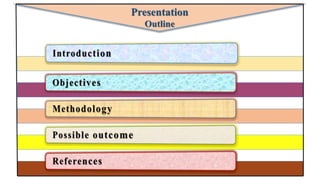
Presentation
Outline
INTRODUCTION
Phosphorus is one of the major essential macronutrient which is involved
in plant metabolism and is applied to soil in the form phosphate fertilizer
and large portion of soluble inorganic phosphate is immobilized rapidly
and become unavailable to plant (Motsim et., al 2019; Balemi et al., 2012;
Razaq et al., 2017; Sanz-Sáez et al.,2017; Malhotra et.,2018).
Phosphate Solubilizing Microorganisms(PSMs) are diverse group of
microorganisms including bacteria and fungi to convert insoluble form of
Phosphorus into soluble forms by a process called Phosphate
Solubilization (Leandro et al., 2023).
Important Genera of bacterial Phosphate Solubilizers include Bacillus,
Pseudomonas, Micrococcus and Flavobacterium, while fungal genera
include Aspergillus, Pencillium, Fusarium and Sclerotium (MS et al.,
2009; Seenivasagan et al., 2021).
INTRODUCTION (Cont.)
Phosphate-solubilizing bacteria play an essential role in P-cycling and
promoting plant growth. By using PSMs, they can reduce the need for
synthetic phosphorus fertilizers,which can be costly and have negative
environmental impacts when overused (Zhonghua et al., 2022).
The accumulation of heavy metals by agricultural activities in soil poses a
risk to the environmental and human health. In soil, heavy metals cause
toxicological effects on soil microbes, which may lead to a decrease in
their numbers and activities (DalCorso et al., 2013)
Environmental pollution by heavy metals has become a serious problem
in the world. The problem of heavy metals pollution is becoming more
and more serious with increasing industrialization and disturbance of
natural biogeochemical cycles (Khan et al., 2010).
INTRODUCTION (Cont.)
Cement factories are known to emit a variety of pollutants, including
particulate matter, gases, and various heavy metals. Cement dust can
indeed contain heavy metals, including Cr, Ni, Co, Pb and Hg which are
known to be harmful to the biotic environment (Akpambang et al.,
2022).
Heavy metals cannot be degraded, biological processes can still be used
for remediation and management of heavy metal-contaminated sites
through various techniques via Biosorption, Phytoremediation,
Biostimulation, Bioaugmentation (Lebeau et al., 2008).
Microorganisms like Heavy Metal Resistant PSBs have evolved different
strategies and mechanisms to survive in heavy metal-contaminated
environments. Heavy Metal Resistant PSB includes, Pseudomonas spp.,
Bacillus spp., Enterobacter spp., Arthrobacter spp., Stenotrophomonas
maltophilia, Acinetobacter spp. (Fakhar et al., 2022).
INTRODUCTION (Cont.)
Phosphate-solubilizing bacteria (PSB) do not directly degrade heavy
metals but mitigate the adverse effects of heavy metal toxicity, enhancing
plant growth and health through several mechanisms Phytostimulation,
Enhancing Metal Tolerance, Inducing Metal Sequestration,
Bioremediation and Improving Soil Structure (Mohamed et al., 2017).
The Heavy metal resistance of these bacteria may vary depending on the
specific heavy metal and its concentration in the environment.
Additionally, the efficiency of these bacteria in phosphate solubilization
and heavy metal resistance can be influenced by soil pH, temperature, and
other environmental factors (Paul et al., 2015).
However, it's essential to carefully select and evaluate the most suitable
strains for specific soil conditions and targeted heavy metal contaminants
to ensure successful applications (Priya et al., 2023).
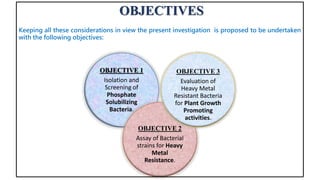
OBJECTIVES
OBJECTIVE 1
Isolation and
Screening of
Phosphate
Solubilizing
Bacteria.
OBJECTIVE 2
Assay of Bacterial
strains for Heavy
Metal
Resistance.
OBJECTIVE 3
Evaluation of
Heavy Metal
Resistant Bacteria
for Plant Growth
Promoting
activities.
Keeping all these considerations in view the present investigation is proposed to be undertaken
with the following objectives:
METHODOLOGY
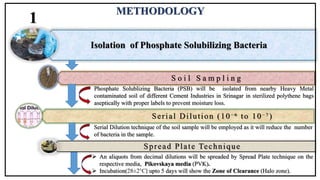
Isolation of Phosphate Solubilizing Bacteria
S o i l S a m p l i n g
Serial Dilution (10⁻⁶ to 10⁻⁷)
Spread Plate Technique
Phosphate Solublizing Bacteria (PSB) will be isolated from nearby Heavy Metal
contaminated soil of different Cement Industries in Srinagar in sterilized polythene bags
aseptically with proper labels to prevent moisture loss.
Serial Dilution technique of the soil sample will be employed as it will reduce the number
of bacteria in the sample.
 An aliquots from decimal dilutions will be spreaded by Spread Plate technique on the
respective media, Pikovskaya media (PVK).
 Incubation(28±2°C) upto 5 days will show the Zone of Clearance (Halo zone).
1
METHODOLOGY (Cont.)
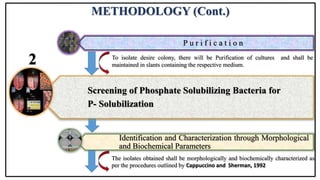
P u r i f i c a t i o n
Screening of Phosphate Solubilizing Bacteria for
P- Solubilization
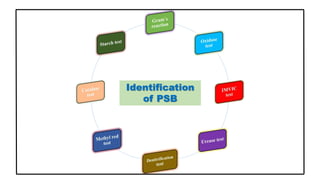
Identification and Characterization through Morphological
and Biochemical Parameters
To isolate desire colony, there will be Purification of cultures and shall be
maintained in slants containing the respective medium.
2
The isolates obtained shall be morphologically and biochemically characterized as
per the procedures outlined by Cappuccino and Sherman, 1992
Identification
of PSB
METHODOLOGY (Cont.)
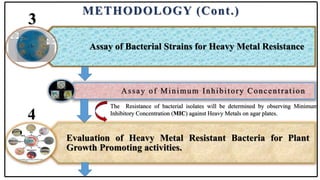
Assay of Bacterial Strains for Heavy Metal Resistance
Assay of Minimum Inhibitory Concentration
3
The Resistance of bacterial isolates will be determined by observing Minimum
Inhibitory Concentration (MIC) against Heavy Metals on agar plates.
Evaluation of Heavy Metal Resistant Bacteria for Plant
Growth Promoting activities.
4
METHODOLOGY (Cont.)
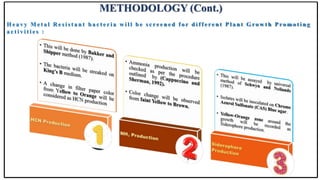
H e a v y M e t a l R e s i s t a n t b a c t e r i a w i l l b e s c re e n e d f o r d i f f e re n t P l a n t G ro w t h P ro m o t i n g
a c t i v i t i e s :
POSSIBLE OUTCOME
I will be expected to isolate Phosphate Solubilizing Bacteria.
I will be expected to isolate Heavy Metal Resistant Phosphate Solubilizing
Bacteria.
Evaluating the Heavy Metal Resistant Bacteria for Plant Growth Promoting
Bacteria activities.
REFERENCES
 Akpambang, V. O. E., Ebuzeme, G. C., & Akinola, J. O. (2022). Heavy metal contamination of topsoil around a cement factory–A case
study of Obajana Cement Plc. Environmental Pollutants and Bioavailability, 34(1), 12-20.
 Ali, H., Khan, E., & Sajad, M. A. (2013). Phytoremediation of heavy metals—concepts and applications. Chemosphere, 91(7), 869-881.
 Ahemad, M. (2015). Phosphate-solubilizing bacteria-assisted phytoremediation of metalliferous soils: a review. 3 Biotech, 5(2), 111-121.
 Balemi, T., & Negisho, K. (2012). Management of soil phosphorus and plant adaptation mechanisms to phosphorus stress for sustainable
crop production: a review. Journal of soil science and plant nutrition, 12(3), 547-562.
 Chen, Y. P., Rekha, P. D., Arun, A. B., Shen, F. T., Lai, W. A., & Young, C. C. (2006). Phosphate solubilizing bacteria from subtropical
soil and their tricalcium phosphate solubilizing abilities. Applied soil ecology, 34(1), 33-41.
 Fakhar, A., Gul, B., Gurmani, A. R., Khan, S. M., Ali, S., Sultan, T., ... & Rizwan, M. (2022). Heavy metal remediation and resistance
mechanism of Aeromonas, Bacillus, and Pseudomonas: A review. Critical Reviews in Environmental Science and
Technology, 52(11), 1868-1914.
 Hu, X., & Chen, H. Phosphorus solubilizing microorganism: a green measure to effectively control and regulate heavy metal pollution in
agricultural soils. Frontiers in Microbiology, 14, 1193670.
 Kalayu, G. (2019). Phosphate solubilizing microorganisms: promising approach as biofertilizers. International Journal of
Agronomy, 2019, 1-7.
 Khan, M. S., Zaidi, A., & Wani, P. A. (2009). Role of phosphate solubilizing microorganisms in sustainable agriculture-a
review. Sustainable agriculture, 551-570.
 Marzban, A., Ebrahimipour, G., Karkhane, M., & Teymouri, M. (2016). Metal resistant and phosphate solubilizing bacterium improves
maize (Zea mays) growth and mitigates metal accumulation in plant. Biocatalysis and Agricultural Biotechnology, 8, 13-17.
 Malhotra, H., Vandana, Sharma, S., & Pandey, R. (2018). Phosphorus nutrition: plant growth in response to deficiency and excess. Plant
nutrients and abiotic stress tolerance, 171-190.
 Mohamed, H. M., & Almaroai, Y. A. (2017). Effect of phosphate solubilizing bacteria on the uptake of heavy metals by corn plants in a
long-term sewage wastewater treated soil. International journal of environmental science and development, 8(5), 366.
 Paul, D., & Sinha, S. N. (2015). Isolation and characterization of a phosphate solubilizing heavy metal tolerant bacterium from River Ganga,
West Bengal, India. Songklanakarin Journal of Science & Technology, 37(6).
 Priya, A. K., Muruganandam, M., Ali, S. S., & Kornaros, M. (2023). Clean-Up of Heavy Metals from Contaminated Soil by
Phytoremediation: A Multidisciplinary and Eco-Friendly Approach. Toxics, 11(5), 422.
 Razaq, M., Zhang, P., Shen, H. L., & Salahuddin. (2017). Influence of nitrogen and phosphorous on the growth and root morphology of Acer
mono. PloS one, 12(2), e0171321.
 Silva, L. I. D., Pereira, M. C., Carvalho, A. M. X. D., Buttrós, V. H., Pasqual, M., & Dória, J. (2023). Phosphorus-Solubilizing
Microorganisms: A Key to Sustainable Agriculture. Agriculture, 13(2), 462.
 Solgi, E., Esmaili-Sari, A., Riyahi-Bakhtiari, A., & Hadipour, M. (2012). Soil contamination of metals in the three industrial estates, Arak,
Iran. Bulletin of environmental contamination and toxicology, 88, 634-638.
 Sanz‐Sáez, Á., Koester, R. P., Rosenthal, D. M., Montes, C. M., Ort, D. R., & Ainsworth, E. A. (2017). Leaf and canopy scale drivers of
genotypic variation in soybean response to elevated carbon dioxide concentration. Global Change Biology, 23(9), 3908-3920.
 Seenivasagan, R., & Babalola, O. O. (2021). Utilization of microbial consortia as biofertilizers and biopesticides for the production of
feasible agricultural product. Biology, 10(11), 1111.
 Wang, Z., Zhang, H., Liu, L., Li, S., Xie, J., Xue, X., & Jiang, Y. (2022). Screening of phosphate-solubilizing bacteria and their abilities of
phosphorus solubilization and wheat growth promotion. BMC microbiology, 22(1), 296.
PRESENTATION PROJECT.pptx presentation u

PRESENTATION PROJECT.pptx presentation u

  • 1.
    Characterization of HeavyMetal Resistant Phosphate Solubilizing Bacteria Isolated from Nearby Contaminated Soil of Cement Industry METHODOLOGY SEMINAR PRESENTED BY : SAKIDAH MANZOOR ENROLLMENT NO. : 21072119014 MSc. Microbiology, 4th Sem 2021 SUPERVISED BY DR.ULFAT NAZIR P.G Proramme In Microbiology Centre Of Research For Development (CORD) University Of Kashmir, Hazratbal, Srinagar,190006
  • 3.
  • 4.
    INTRODUCTION Phosphorus is oneof the major essential macronutrient which is involved in plant metabolism and is applied to soil in the form phosphate fertilizer and large portion of soluble inorganic phosphate is immobilized rapidly and become unavailable to plant (Motsim et., al 2019; Balemi et al., 2012; Razaq et al., 2017; Sanz-Sáez et al.,2017; Malhotra et.,2018). Phosphate Solubilizing Microorganisms(PSMs) are diverse group of microorganisms including bacteria and fungi to convert insoluble form of Phosphorus into soluble forms by a process called Phosphate Solubilization (Leandro et al., 2023). Important Genera of bacterial Phosphate Solubilizers include Bacillus, Pseudomonas, Micrococcus and Flavobacterium, while fungal genera include Aspergillus, Pencillium, Fusarium and Sclerotium (MS et al., 2009; Seenivasagan et al., 2021).
  • 5.
    INTRODUCTION (Cont.) Phosphate-solubilizing bacteriaplay an essential role in P-cycling and promoting plant growth. By using PSMs, they can reduce the need for synthetic phosphorus fertilizers,which can be costly and have negative environmental impacts when overused (Zhonghua et al., 2022). The accumulation of heavy metals by agricultural activities in soil poses a risk to the environmental and human health. In soil, heavy metals cause toxicological effects on soil microbes, which may lead to a decrease in their numbers and activities (DalCorso et al., 2013) Environmental pollution by heavy metals has become a serious problem in the world. The problem of heavy metals pollution is becoming more and more serious with increasing industrialization and disturbance of natural biogeochemical cycles (Khan et al., 2010).
  • 6.
    INTRODUCTION (Cont.) Cement factoriesare known to emit a variety of pollutants, including particulate matter, gases, and various heavy metals. Cement dust can indeed contain heavy metals, including Cr, Ni, Co, Pb and Hg which are known to be harmful to the biotic environment (Akpambang et al., 2022). Heavy metals cannot be degraded, biological processes can still be used for remediation and management of heavy metal-contaminated sites through various techniques via Biosorption, Phytoremediation, Biostimulation, Bioaugmentation (Lebeau et al., 2008). Microorganisms like Heavy Metal Resistant PSBs have evolved different strategies and mechanisms to survive in heavy metal-contaminated environments. Heavy Metal Resistant PSB includes, Pseudomonas spp., Bacillus spp., Enterobacter spp., Arthrobacter spp., Stenotrophomonas maltophilia, Acinetobacter spp. (Fakhar et al., 2022).
  • 7.
    INTRODUCTION (Cont.) Phosphate-solubilizing bacteria(PSB) do not directly degrade heavy metals but mitigate the adverse effects of heavy metal toxicity, enhancing plant growth and health through several mechanisms Phytostimulation, Enhancing Metal Tolerance, Inducing Metal Sequestration, Bioremediation and Improving Soil Structure (Mohamed et al., 2017). The Heavy metal resistance of these bacteria may vary depending on the specific heavy metal and its concentration in the environment. Additionally, the efficiency of these bacteria in phosphate solubilization and heavy metal resistance can be influenced by soil pH, temperature, and other environmental factors (Paul et al., 2015). However, it's essential to carefully select and evaluate the most suitable strains for specific soil conditions and targeted heavy metal contaminants to ensure successful applications (Priya et al., 2023).
  • 8.
    OBJECTIVES OBJECTIVE 1 Isolation and Screeningof Phosphate Solubilizing Bacteria. OBJECTIVE 2 Assay of Bacterial strains for Heavy Metal Resistance. OBJECTIVE 3 Evaluation of Heavy Metal Resistant Bacteria for Plant Growth Promoting activities. Keeping all these considerations in view the present investigation is proposed to be undertaken with the following objectives:
  • 9.
    METHODOLOGY Isolation of PhosphateSolubilizing Bacteria S o i l S a m p l i n g Serial Dilution (10⁻⁶ to 10⁻⁷) Spread Plate Technique Phosphate Solublizing Bacteria (PSB) will be isolated from nearby Heavy Metal contaminated soil of different Cement Industries in Srinagar in sterilized polythene bags aseptically with proper labels to prevent moisture loss. Serial Dilution technique of the soil sample will be employed as it will reduce the number of bacteria in the sample.  An aliquots from decimal dilutions will be spreaded by Spread Plate technique on the respective media, Pikovskaya media (PVK).  Incubation(28±2°C) upto 5 days will show the Zone of Clearance (Halo zone). 1
  • 10.
    METHODOLOGY (Cont.) P ur i f i c a t i o n Screening of Phosphate Solubilizing Bacteria for P- Solubilization Identification and Characterization through Morphological and Biochemical Parameters To isolate desire colony, there will be Purification of cultures and shall be maintained in slants containing the respective medium. 2 The isolates obtained shall be morphologically and biochemically characterized as per the procedures outlined by Cappuccino and Sherman, 1992
  • 11.
  • 12.
    METHODOLOGY (Cont.) Assay ofBacterial Strains for Heavy Metal Resistance Assay of Minimum Inhibitory Concentration 3 The Resistance of bacterial isolates will be determined by observing Minimum Inhibitory Concentration (MIC) against Heavy Metals on agar plates. Evaluation of Heavy Metal Resistant Bacteria for Plant Growth Promoting activities. 4
  • 13.
    METHODOLOGY (Cont.) H ea v y M e t a l R e s i s t a n t b a c t e r i a w i l l b e s c re e n e d f o r d i f f e re n t P l a n t G ro w t h P ro m o t i n g a c t i v i t i e s :
  • 14.
    POSSIBLE OUTCOME I willbe expected to isolate Phosphate Solubilizing Bacteria. I will be expected to isolate Heavy Metal Resistant Phosphate Solubilizing Bacteria. Evaluating the Heavy Metal Resistant Bacteria for Plant Growth Promoting Bacteria activities.
  • 15.
    REFERENCES  Akpambang, V.O. E., Ebuzeme, G. C., & Akinola, J. O. (2022). Heavy metal contamination of topsoil around a cement factory–A case study of Obajana Cement Plc. Environmental Pollutants and Bioavailability, 34(1), 12-20.  Ali, H., Khan, E., & Sajad, M. A. (2013). Phytoremediation of heavy metals—concepts and applications. Chemosphere, 91(7), 869-881.  Ahemad, M. (2015). Phosphate-solubilizing bacteria-assisted phytoremediation of metalliferous soils: a review. 3 Biotech, 5(2), 111-121.  Balemi, T., & Negisho, K. (2012). Management of soil phosphorus and plant adaptation mechanisms to phosphorus stress for sustainable crop production: a review. Journal of soil science and plant nutrition, 12(3), 547-562.  Chen, Y. P., Rekha, P. D., Arun, A. B., Shen, F. T., Lai, W. A., & Young, C. C. (2006). Phosphate solubilizing bacteria from subtropical soil and their tricalcium phosphate solubilizing abilities. Applied soil ecology, 34(1), 33-41.  Fakhar, A., Gul, B., Gurmani, A. R., Khan, S. M., Ali, S., Sultan, T., ... & Rizwan, M. (2022). Heavy metal remediation and resistance mechanism of Aeromonas, Bacillus, and Pseudomonas: A review. Critical Reviews in Environmental Science and Technology, 52(11), 1868-1914.  Hu, X., & Chen, H. Phosphorus solubilizing microorganism: a green measure to effectively control and regulate heavy metal pollution in agricultural soils. Frontiers in Microbiology, 14, 1193670.  Kalayu, G. (2019). Phosphate solubilizing microorganisms: promising approach as biofertilizers. International Journal of Agronomy, 2019, 1-7.  Khan, M. S., Zaidi, A., & Wani, P. A. (2009). Role of phosphate solubilizing microorganisms in sustainable agriculture-a review. Sustainable agriculture, 551-570.  Marzban, A., Ebrahimipour, G., Karkhane, M., & Teymouri, M. (2016). Metal resistant and phosphate solubilizing bacterium improves maize (Zea mays) growth and mitigates metal accumulation in plant. Biocatalysis and Agricultural Biotechnology, 8, 13-17.
  • 16.
     Malhotra, H.,Vandana, Sharma, S., & Pandey, R. (2018). Phosphorus nutrition: plant growth in response to deficiency and excess. Plant nutrients and abiotic stress tolerance, 171-190.  Mohamed, H. M., & Almaroai, Y. A. (2017). Effect of phosphate solubilizing bacteria on the uptake of heavy metals by corn plants in a long-term sewage wastewater treated soil. International journal of environmental science and development, 8(5), 366.  Paul, D., & Sinha, S. N. (2015). Isolation and characterization of a phosphate solubilizing heavy metal tolerant bacterium from River Ganga, West Bengal, India. Songklanakarin Journal of Science & Technology, 37(6).  Priya, A. K., Muruganandam, M., Ali, S. S., & Kornaros, M. (2023). Clean-Up of Heavy Metals from Contaminated Soil by Phytoremediation: A Multidisciplinary and Eco-Friendly Approach. Toxics, 11(5), 422.  Razaq, M., Zhang, P., Shen, H. L., & Salahuddin. (2017). Influence of nitrogen and phosphorous on the growth and root morphology of Acer mono. PloS one, 12(2), e0171321.  Silva, L. I. D., Pereira, M. C., Carvalho, A. M. X. D., Buttrós, V. H., Pasqual, M., & Dória, J. (2023). Phosphorus-Solubilizing Microorganisms: A Key to Sustainable Agriculture. Agriculture, 13(2), 462.  Solgi, E., Esmaili-Sari, A., Riyahi-Bakhtiari, A., & Hadipour, M. (2012). Soil contamination of metals in the three industrial estates, Arak, Iran. Bulletin of environmental contamination and toxicology, 88, 634-638.  Sanz‐Sáez, Á., Koester, R. P., Rosenthal, D. M., Montes, C. M., Ort, D. R., & Ainsworth, E. A. (2017). Leaf and canopy scale drivers of genotypic variation in soybean response to elevated carbon dioxide concentration. Global Change Biology, 23(9), 3908-3920.  Seenivasagan, R., & Babalola, O. O. (2021). Utilization of microbial consortia as biofertilizers and biopesticides for the production of feasible agricultural product. Biology, 10(11), 1111.  Wang, Z., Zhang, H., Liu, L., Li, S., Xie, J., Xue, X., & Jiang, Y. (2022). Screening of phosphate-solubilizing bacteria and their abilities of phosphorus solubilization and wheat growth promotion. BMC microbiology, 22(1), 296.