Department of English
M.K.B.U
Name :- Alisha Vaghasiya
M.A.
Sem :- 3
Email ID :-
alishapatel610@gmail.com
Year :- 2019 -2020
Paper :- 9 (The Modernist Literature)
Topic :- Stream of Consciousness To
the lighthouse
To the lighthouse
by – Virginia Woolf
Written. :- 1926, London
Published :- 1927
Literary period :- Modern
Style :- Stream of Consciousness
Three part of the Novel
1)The window
2)Time passes
3)The Lighthouse
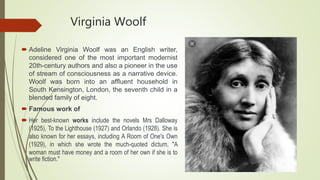
Virginia Woolf
 Adeline Virginia Woolf was an English writer,
considered one of the most important modernist
20th-century authors and also a pioneer in the use
of stream of consciousness as a narrative device.
Woolf was born into an affluent household in
South Kensington, London, the seventh child in a
blended family of eight.
 Famous work of
 Her best-known works include the novels Mrs Dalloway
(1925), To the Lighthouse (1927) and Orlando (1928). She is
also known for her essays, including A Room of One's Own
(1929), in which she wrote the much-quoted dictum, "A
woman must have money and a room of her own if she is to
write fiction."
Character name of
Ramsay Family
Mr. Ramsay Mrs. Ramsay
Both of Children name
Andrew Jasper. Roger
Prue. Rose. Nancy
Cam. James
Relative Name of
Charles Tansley
Lily Briscoe
William Bankes
Paul Rayley
Minta Doyle
Definition
Stream of consciousness is a literary technique
was pioneered by Dorothy Richardson, Virginia
Woolf, and James Joyce, Stream Of Consciousness is
characterized by a flow of thoughts and images,
which may not always appear to have a coherent
structure or cohesion. The plot line may weave in
out of time. And place, carrying the reader thought
the life span of a character or further along a
to incorporate the lives of characters from other
Writer name :-
James Joyce :- Ulysses (1882 – 1941)
Dorothy Richardson :- Pilgrimage ( 1873 -
1956
Virginia Woolf :- Mrs Dallowy & To the
lighthouse
Henry James :- Portrait of a Lady
william Faulkner :- The sound and the fury
(1897 - 1962
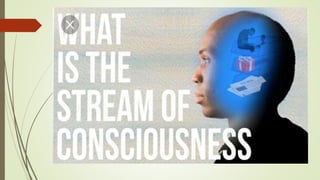
Stream of consciousness
It’s very challenging consept in literature
. The first was written by William James in his
book The Principales of the psychology ( 1890)
The stream of consciousness is the flow of
thought in the conscious mind. Research studies have
shown that we only experience on mental event at
William James, often considered to be the father of
American psychology first coined the phrase “ stream of
consciousness”.
Explanation
Here again the parentheses act as signals of perspective.
They are the demarcation lines between omniscient
narration and interior monologue.
With the help of brackets Woolf makes an easy ans clear
transition between the two. And this is one of the
indications of her sophisticated in artistry
A continuous flow of ideas, thought and feeling, as thy are
experienced by a person a style of writing that expresses
this without using the usual methods of description and
conversation.
To the lighthouse In Stream of
Consciousness
 Rejection of Traditional technique
 The role of the central Intelligence
 James Hafley
 It’s Advat
 Selection and organisations of material
 Suspense and curiosity
 The skilful exposition
 The Patten conversation and Reaction
 The time scheme
 Third person Narration
Suspense and Curiosity
Original text
“Other aspects of Mrs. Woolf ‘s technique of narration may now be noted. To
the lighthouse begins by taking us into the middle of a scene ; Mrs , Ramsay
opening remarks is the answer to an unstated questions which we have to
supply by picking up clues from what follows , The readers Nature curiosity
thus becomes involved we wonder who these becomes involved we wonder
who these people are, what they are talking about and so on. As we read on ,
promoted by this desire to know we begin to recognise apattern in the
narrative at the same time as we assimilate names , facts, statemei in direct
speech separated by longer description of the characters reactions and
thoughts in indirect speech”
Conclusion
 In short analysing stream of consciousness technique we can
find that indirect interior monologue makes Woolf express the
characters inner world in such great coherence and surface
unity she uses it with great skill .
 In to the lighthouse Virginia Woolf succeed in producing a
much subtle effect though the use of this technique
 This novel contains a great deal of straight, conversational
narration and description, but the interior monologue is used
often enough to give the novel it’s special characters of
seeming to be always within the consciousness of the chief
charactery .
Presentation Paper 9

Presentation Paper 9

  • 1.
    Department of English M.K.B.U Name:- Alisha Vaghasiya M.A. Sem :- 3 Email ID :- alishapatel610@gmail.com Year :- 2019 -2020 Paper :- 9 (The Modernist Literature) Topic :- Stream of Consciousness To the lighthouse
  • 2.
    To the lighthouse by– Virginia Woolf Written. :- 1926, London Published :- 1927 Literary period :- Modern Style :- Stream of Consciousness Three part of the Novel 1)The window 2)Time passes 3)The Lighthouse
  • 3.
    Virginia Woolf  AdelineVirginia Woolf was an English writer, considered one of the most important modernist 20th-century authors and also a pioneer in the use of stream of consciousness as a narrative device. Woolf was born into an affluent household in South Kensington, London, the seventh child in a blended family of eight.  Famous work of  Her best-known works include the novels Mrs Dalloway (1925), To the Lighthouse (1927) and Orlando (1928). She is also known for her essays, including A Room of One's Own (1929), in which she wrote the much-quoted dictum, "A woman must have money and a room of her own if she is to write fiction."
  • 4.
    Character name of RamsayFamily Mr. Ramsay Mrs. Ramsay Both of Children name Andrew Jasper. Roger Prue. Rose. Nancy Cam. James Relative Name of Charles Tansley Lily Briscoe William Bankes Paul Rayley Minta Doyle
  • 6.
    Definition Stream of consciousnessis a literary technique was pioneered by Dorothy Richardson, Virginia Woolf, and James Joyce, Stream Of Consciousness is characterized by a flow of thoughts and images, which may not always appear to have a coherent structure or cohesion. The plot line may weave in out of time. And place, carrying the reader thought the life span of a character or further along a to incorporate the lives of characters from other
  • 7.
    Writer name :- JamesJoyce :- Ulysses (1882 – 1941) Dorothy Richardson :- Pilgrimage ( 1873 - 1956 Virginia Woolf :- Mrs Dallowy & To the lighthouse Henry James :- Portrait of a Lady william Faulkner :- The sound and the fury (1897 - 1962
  • 8.
    Stream of consciousness It’svery challenging consept in literature . The first was written by William James in his book The Principales of the psychology ( 1890) The stream of consciousness is the flow of thought in the conscious mind. Research studies have shown that we only experience on mental event at William James, often considered to be the father of American psychology first coined the phrase “ stream of consciousness”.
  • 9.
    Explanation Here again theparentheses act as signals of perspective. They are the demarcation lines between omniscient narration and interior monologue. With the help of brackets Woolf makes an easy ans clear transition between the two. And this is one of the indications of her sophisticated in artistry A continuous flow of ideas, thought and feeling, as thy are experienced by a person a style of writing that expresses this without using the usual methods of description and conversation.
  • 10.
    To the lighthouseIn Stream of Consciousness  Rejection of Traditional technique  The role of the central Intelligence  James Hafley  It’s Advat  Selection and organisations of material  Suspense and curiosity  The skilful exposition  The Patten conversation and Reaction  The time scheme  Third person Narration
  • 11.
    Suspense and Curiosity Originaltext “Other aspects of Mrs. Woolf ‘s technique of narration may now be noted. To the lighthouse begins by taking us into the middle of a scene ; Mrs , Ramsay opening remarks is the answer to an unstated questions which we have to supply by picking up clues from what follows , The readers Nature curiosity thus becomes involved we wonder who these becomes involved we wonder who these people are, what they are talking about and so on. As we read on , promoted by this desire to know we begin to recognise apattern in the narrative at the same time as we assimilate names , facts, statemei in direct speech separated by longer description of the characters reactions and thoughts in indirect speech”
  • 12.
    Conclusion  In shortanalysing stream of consciousness technique we can find that indirect interior monologue makes Woolf express the characters inner world in such great coherence and surface unity she uses it with great skill .  In to the lighthouse Virginia Woolf succeed in producing a much subtle effect though the use of this technique  This novel contains a great deal of straight, conversational narration and description, but the interior monologue is used often enough to give the novel it’s special characters of seeming to be always within the consciousness of the chief charactery .