More Related Content

PPTX

PPTX
smokingcessationslides for symposium.pptx 
PDF
Brief Counseling for tobacco use Cessation 
PPTX
Role of Family Physicians in Smoking Cessation 
PPTX

PPTX
Steps of Smoking Cessation Badr Bin Himd.pptx 
PDF
COPD Lecture 8 Tobacoo cessation 
PPTX
Tobacco screening by healthcare professionals Similar to Κάπνισμα κακό στην υγεία εργασία για φιλοσοφία

PPTX
Tobacco screening by healthcare professionals 
PDF
Clinical review supporting smoking cessationqqqqqqq11111 
PPT
Smoking cessation complete guideline .ppt 
PDF
SMOKING CESSATION _ CODP 8 
PPTX
Tobacco Cessation Treatment for Doctors and Nurses 
PPTX
Management of Tobacco Use 
PPT

PPT

PPT

PDF
Improving smoking cessation approaches at the individual level 
PPT

PPTX

PPT

PPTX

PDF
Improving smoking cessation approaches at the individual level 
PDF
Tob control 2012-aveyard-252-7 
PPTX
P07 ASSISomarwarymbshhsvshshsvhsvsusvwyT.pptx 
PPTX

PPS
Updates On Smoking Cessation 
PDF
4. Smoking Cessation lecture.pdfjjhhjhjj Recently uploaded

PDF
Danielle Oliveira New Jersey - A Lifelong Learner 
PPTX
Audio Video Analysis in Digital Forensics 
PDF
Top property lawyer law firm in pune. Propdox specializes in property dispute... 
PDF
gazette_sgi_rules_260210_163157-2.pdf Gaz 
PPTX
Constitutional Law Doctrines-by Judge Nazmul Hasan.pptx 
PDF
Company Constitution vs Shareholders’ Agreement :What’s the Difference (and H... 
PDF
A brief introduction of the Rulebooks platform 
PDF
VIETNAM - NAVIGATING VIETNAM'S WIND POWER MARKET: LESSONS FROM THE PNE AG CAS... 
PDF
VIETNAM - STRUCTURING REAL ESTATE INVESTMENT TRUSTS (REITS) IN VIETNAM: LEGAL... 
PDF
"We’re Better Together," Message Guide for Building Public Support for Immigr... 
PDF
How can I create a new user for the Rulebooks platform? 
PDF
Manual for users with VIEW rights in Rulebooks Κάπνισμα κακό στην υγεία εργασία για φιλοσοφία
- 1.
- 2.
Page 2 -© IPCRG 2007
Page 2 - © IPCRG 2007
Page 2 - © IPCRG 2007
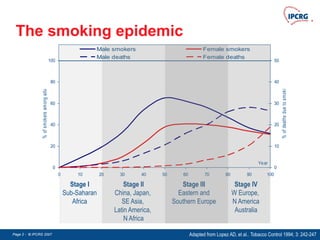
The smoking epidemic
0
20
40
60
80
100
0 10 20 30 40 50 60 70 80 90 100
Year
%
of
smokers
among
adults
0
10
20
30
40
50
%
of
deaths
due
to
smoking
Male smokers Female smokers
Male deaths Female deaths
Stage I
Sub-Saharan
Africa
Stage II
China, Japan,
SE Asia,
Latin America,
N Africa
Stage III
Eastern and
Southern Europe
Stage IV
W Europe,
N America
Australia
Adapted from Lopez AD, et al.. Tobacco Control 1994; 3: 242-247
- 3.
Page 3 -© IPCRG 2007
Page 3 - © IPCRG 2007
Page 3 - © IPCRG 2007
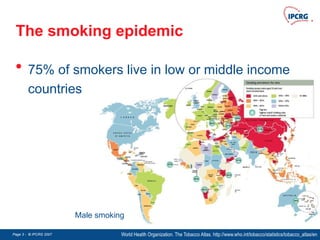
The smoking epidemic
• 75% of smokers live in low or middle income
countries
World Health Organization. The Tobacco Atlas. http://www.who.int/tobacco/statistics/tobacco_atlas/en
Male smoking
- 4.
Page 4 -© IPCRG 2007
Page 4 - © IPCRG 2007
Page 4 - © IPCRG 2007
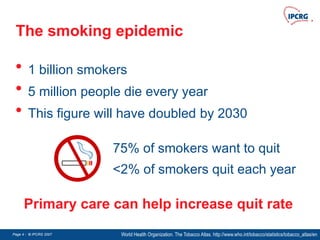
The smoking epidemic
• 1 billion smokers
• 5 million people die every year
• This figure will have doubled by 2030
World Health Organization. The Tobacco Atlas. http://www.who.int/tobacco/statistics/tobacco_atlas/en
75% of smokers want to quit
<2% of smokers quit each year
Primary care can help increase quit rate
- 5.
Page 5 -© IPCRG 2007
Page 5 - © IPCRG 2007
Page 5 - © IPCRG 2007
The smoking epidemic
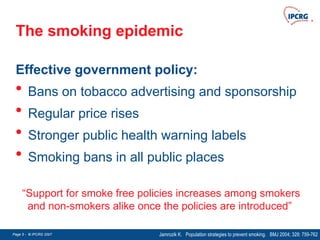
Effective government policy:
• Bans on tobacco advertising and sponsorship
• Regular price rises
• Stronger public health warning labels
• Smoking bans in all public places
Jamrozik K. Population strategies to prevent smoking. BMJ 2004; 328: 759-762
“Support for smoke free policies increases among smokers
and non-smokers alike once the policies are introduced”
- 6.
Page 6 -© IPCRG 2007
Page 6 - © IPCRG 2007
Page 6 - © IPCRG 2007
The smoking epidemic
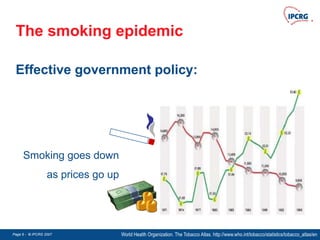
Effective government policy:
World Health Organization. The Tobacco Atlas. http://www.who.int/tobacco/statistics/tobacco_atlas/en
Smoking goes down
as prices go up
- 7.
Page 7 -© IPCRG 2007
Page 7 - © IPCRG 2007
Page 7 - © IPCRG 2007
The smoking epidemic
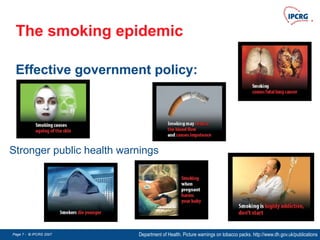
Effective government policy:
Department of Health. Picture warnings on tobacco packs. http://www.dh.gov.uk/publications
Stronger public health warnings
- 8.
Page 8 -© IPCRG 2007
Page 8 - © IPCRG 2007
Page 8 - © IPCRG 2007
Quitlines
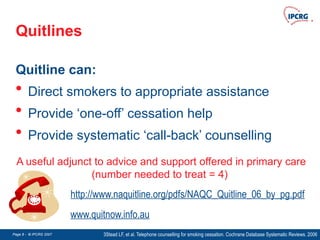
Quitline can:
• Direct smokers to appropriate assistance
• Provide ‘one-off’ cessation help
• Provide systematic ‘call-back’ counselling
3Stead LF, et al. Telephone counselling for smoking cessation. Cochrane Database Systematic Reviews. 2006
A useful adjunct to advice and support offered in primary care
(number needed to treat = 4)
http://www.naquitline.org/pdfs/NAQC_Quitline_06_by_pg.pdf
www.quitnow.info.au
- 9.
Page 9 -© IPCRG 2007
Page 9 - © IPCRG 2007
Page 9 - © IPCRG 2007
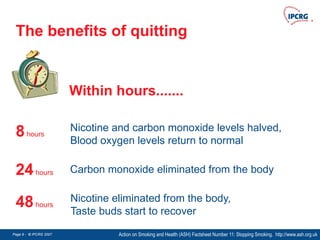
The benefits of quitting
Action on Smoking and Health (ASH) Factsheet Number 11: Stopping Smoking. http://www.ash.org.uk
8hours
Nicotine and carbon monoxide levels halved,
Blood oxygen levels return to normal
24hours Carbon monoxide eliminated from the body
48hours
Nicotine eliminated from the body,
Taste buds start to recover
Within hours.......
- 10.
Page 10 -© IPCRG 2007
Page 10 - © IPCRG 2007
Page 10 - © IPCRG 2007
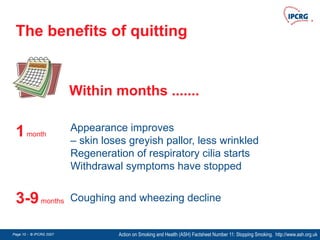
The benefits of quitting
Action on Smoking and Health (ASH) Factsheet Number 11: Stopping Smoking. http://www.ash.org.uk
1month
Appearance improves
– skin loses greyish pallor, less wrinkled
Regeneration of respiratory cilia starts
Withdrawal symptoms have stopped
3-9months Coughing and wheezing decline
Within months .......
- 11.
Page 11 -© IPCRG 2007
Page 11 - © IPCRG 2007
Page 11 - © IPCRG 2007
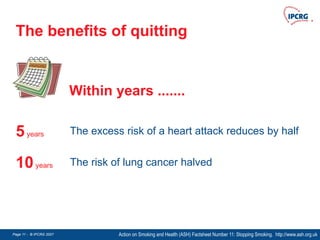
The benefits of quitting
Action on Smoking and Health (ASH) Factsheet Number 11: Stopping Smoking. http://www.ash.org.uk
5years The excess risk of a heart attack reduces by half
10years The risk of lung cancer halved
Within years .......
- 12.
Page 12 -© IPCRG 2007
Page 12 - © IPCRG 2007
Page 12 - © IPCRG 2007
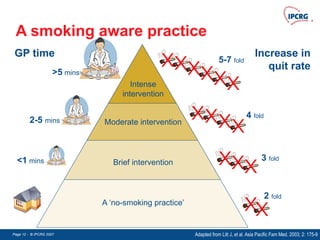
A smoking aware practice
Adapted from Litt J, et al. Asia Pacific Fam Med. 2003; 2: 175-9
Increase in
quit rate
GP time
A ‘no-smoking practice’
Brief intervention
Moderate intervention
Intense
intervention
>5 mins
<1 mins
2-5 mins
2 fold
3 fold
4 fold
5-7 fold
- 13.
Page 13 -© IPCRG 2007
Page 13 - © IPCRG 2007
Page 13 - © IPCRG 2007
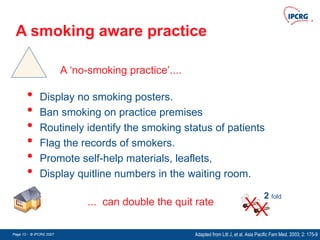
A smoking aware practice
Adapted from Litt J, et al. Asia Pacific Fam Med. 2003; 2: 175-9
A ‘no-smoking practice’....
2 fold
• Display no smoking posters.
• Ban smoking on practice premises
• Routinely identify the smoking status of patients
• Flag the records of smokers.
• Promote self-help materials, leaflets,
• Display quitline numbers in the waiting room.
... can double the quit rate
- 14.
Page 14 -© IPCRG 2007
Page 14 - © IPCRG 2007
Page 14 - © IPCRG 2007
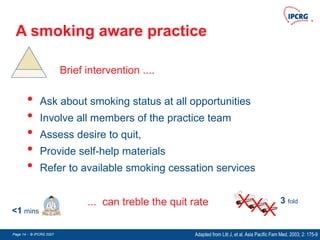
3 fold
A smoking aware practice
Adapted from Litt J, et al. Asia Pacific Fam Med. 2003; 2: 175-9
<1 mins
Brief intervention ....
... can treble the quit rate
• Ask about smoking status at all opportunities
• Involve all members of the practice team
• Assess desire to quit,
• Provide self-help materials
• Refer to available smoking cessation services
- 15.
Page 15 -© IPCRG 2007
Page 15 - © IPCRG 2007
Page 15 - © IPCRG 2007
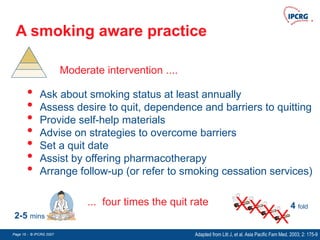
4 fold
A smoking aware practice
Adapted from Litt J, et al. Asia Pacific Fam Med. 2003; 2: 175-9
2-5 mins
Moderate intervention ....
... four times the quit rate
• Ask about smoking status at least annually
• Assess desire to quit, dependence and barriers to quitting
• Provide self-help materials
• Advise on strategies to overcome barriers
• Set a quit date
• Assist by offering pharmacotherapy
• Arrange follow-up (or refer to smoking cessation services)
- 16.
Page 16 -© IPCRG 2007
Page 16 - © IPCRG 2007
Page 16 - © IPCRG 2007
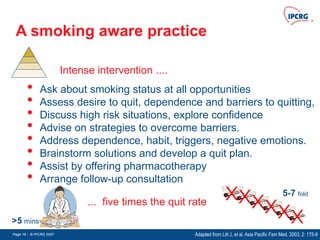
A smoking aware practice
Adapted from Litt J, et al. Asia Pacific Fam Med. 2003; 2: 175-9
>5 mins
5-7 fold
Intense intervention ....
... five times the quit rate
• Ask about smoking status at all opportunities
• Assess desire to quit, dependence and barriers to quitting,
• Discuss high risk situations, explore confidence
• Advise on strategies to overcome barriers.
• Address dependence, habit, triggers, negative emotions.
• Brainstorm solutions and develop a quit plan.
• Assist by offering pharmacotherapy
• Arrange follow-up consultation
- 17.
Page 17 -© IPCRG 2007
Page 17 - © IPCRG 2007
Page 17 - © IPCRG 2007
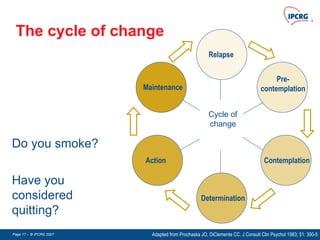
The cycle of change
Cycle of
change
Pre-
contemplation
Contemplation
Determination
Action
Maintenance
Relapse
Have you
considered
quitting?
Do you smoke?
Adapted from Prochaska JO, DiClemente CC. J Consult Clin Psychol 1983; 51: 390-5
- 18.
Page 18 -© IPCRG 2007
Page 18 - © IPCRG 2007
Page 18 - © IPCRG 2007
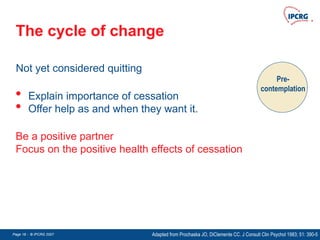
The cycle of change
Pre-
contemplation
Be a positive partner
Focus on the positive health effects of cessation
Not yet considered quitting
• Explain importance of cessation
• Offer help as and when they want it.
Adapted from Prochaska JO, DiClemente CC. J Consult Clin Psychol 1983; 51: 390-5
- 19.
Page 19 -© IPCRG 2007
Page 19 - © IPCRG 2007
Page 19 - © IPCRG 2007
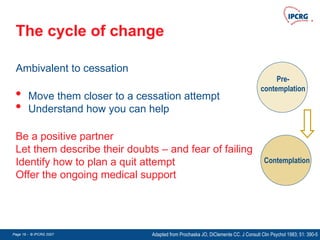
The cycle of change
Pre-
contemplation
Contemplation
Be a positive partner
Let them describe their doubts – and fear of failing
Identify how to plan a quit attempt
Offer the ongoing medical support
Ambivalent to cessation
• Move them closer to a cessation attempt
• Understand how you can help
Adapted from Prochaska JO, DiClemente CC. J Consult Clin Psychol 1983; 51: 390-5
- 20.
Page 20 -© IPCRG 2007
Page 20 - © IPCRG 2007
Page 20 - © IPCRG 2007
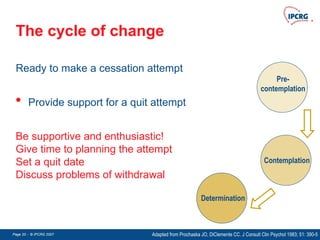
The cycle of change
Pre-
contemplation
Contemplation
Determination
Be supportive and enthusiastic!
Give time to planning the attempt
Set a quit date
Discuss problems of withdrawal
Ready to make a cessation attempt
• Provide support for a quit attempt
Adapted from Prochaska JO, DiClemente CC. J Consult Clin Psychol 1983; 51: 390-5
- 21.
Page 21 -© IPCRG 2007
Page 21 - © IPCRG 2007
Page 21 - © IPCRG 2007
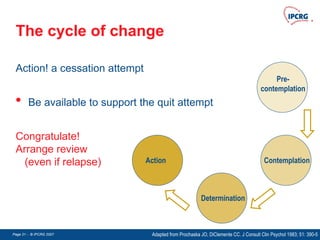
The cycle of change
Pre-
contemplation
Contemplation
Determination
Action
Congratulate!
Arrange review
(even if relapse)
Action! a cessation attempt
• Be available to support the quit attempt
Adapted from Prochaska JO, DiClemente CC. J Consult Clin Psychol 1983; 51: 390-5
- 22.
Page 22 -© IPCRG 2007
Page 22 - © IPCRG 2007
Page 22 - © IPCRG 2007
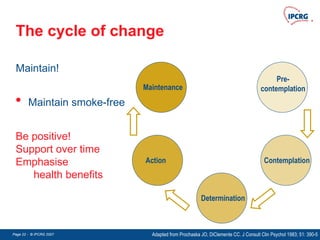
The cycle of change
Pre-
contemplation
Contemplation
Determination
Action
Maintenance
Be positive!
Support over time
Emphasise
health benefits
Maintain!
• Maintain smoke-free
Adapted from Prochaska JO, DiClemente CC. J Consult Clin Psychol 1983; 51: 390-5
- 23.
Page 23 -© IPCRG 2007
Page 23 - © IPCRG 2007
Page 23 - © IPCRG 2007
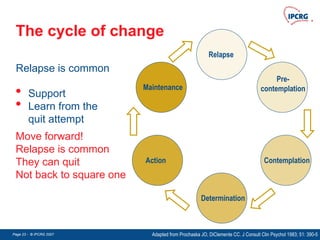
The cycle of change
Pre-
contemplation
Contemplation
Determination
Action
Maintenance
Relapse
Move forward!
Relapse is common
They can quit
Not back to square one
Relapse is common
• Support
• Learn from the
quit attempt
Adapted from Prochaska JO, DiClemente CC. J Consult Clin Psychol 1983; 51: 390-5
- 24.
Page 24 -© IPCRG 2007
Page 24 - © IPCRG 2007
Page 24 - © IPCRG 2007
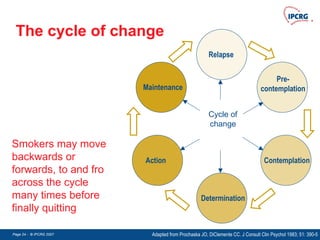
The cycle of change
Pre-
contemplation
Contemplation
Determination
Action
Maintenance
Relapse
Smokers may move
backwards or
forwards, to and fro
across the cycle
many times before
finally quitting
Cycle of
change
Adapted from Prochaska JO, DiClemente CC. J Consult Clin Psychol 1983; 51: 390-5
- 25.
Page 25 -© IPCRG 2007
Page 25 - © IPCRG 2007
Page 25 - © IPCRG 2007
Motivational interviewing
Fiore MC, et al. Treating tobacco use and dependence: US Department of Health and Human Services, 2000
Key principles
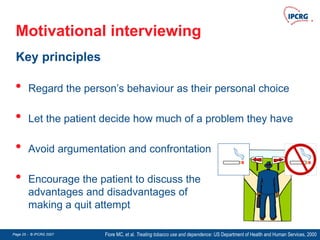
• Regard the person’s behaviour as their personal choice
• Encourage the patient to discuss the
advantages and disadvantages of
making a quit attempt
• Let the patient decide how much of a problem they have
• Avoid argumentation and confrontation
- 26.
Page 26 -© IPCRG 2007
Page 26 - © IPCRG 2007
Page 26 - © IPCRG 2007
Motivational tension
Aveyard, P, et al. Managing smoking cessation. BMJ 2007;335:37-41
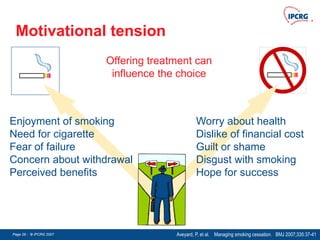
Worry about health
Dislike of financial cost
Guilt or shame
Disgust with smoking
Hope for success
Enjoyment of smoking
Need for cigarette
Fear of failure
Concern about withdrawal
Perceived benefits
Offering treatment can
influence the choice
- 27.
Page 27 -© IPCRG 2007
Page 27 - © IPCRG 2007
Page 27 - © IPCRG 2007
The 5 ‘A’s
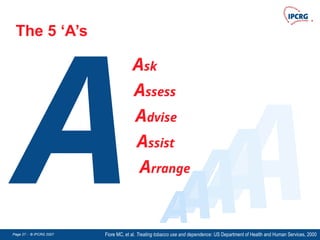
A
Ask
Assess
Advise
Assist
Arrange
Fiore MC, et al. Treating tobacco use and dependence: US Department of Health and Human Services, 2000
A
A
A
A
A
- 28.
Page 28 -© IPCRG 2007
Page 28 - © IPCRG 2007
Page 28 - © IPCRG 2007
The 5 ‘A’s
ASK about smoking status
Fiore MC, et al. Treating tobacco use and dependence: US Department of Health and Human Services, 2000
A
A
A
A
A
• How do you feel about your smoking?
• Have you thought about quitting?
• What would be the hardest thing about quitting?
• Are you ready to quit now?
• Have you tried to quit before?
• What helped when you quit before?
• What led to any relapse?
• What challenges do you see in succeeding in giving up
smoking?
- 29.
Page 29 -© IPCRG 2007
Page 29 - © IPCRG 2007
Page 29 - © IPCRG 2007
The 5 ‘A’s
ASSESS motivation and nicotine dependence
Fiore MC, et al. Treating tobacco use and dependence: US Department of Health and Human Services, 2000
A
A
A
A
A
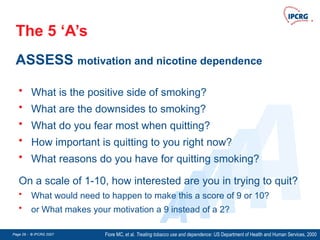
• What is the positive side of smoking?
• What are the downsides to smoking?
• What do you fear most when quitting?
• How important is quitting to you right now?
• What reasons do you have for quitting smoking?
On a scale of 1-10, how interested are you in trying to quit?
• What would need to happen to make this a score of 9 or 10?
• or What makes your motivation a 9 instead of a 2?
- 30.
Page 30 -© IPCRG 2007
Page 30 - © IPCRG 2007
Page 30 - © IPCRG 2007
The 5 ‘A’s
ASSESS motivation and nicotine dependence
Fiore MC, et al. Treating tobacco use and dependence: US Department of Health and Human Services, 2000
A
A
A
A
A
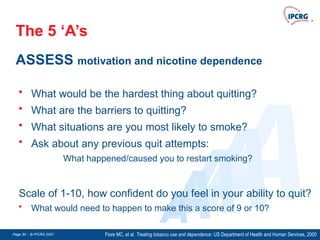
• What would be the hardest thing about quitting?
• What are the barriers to quitting?
• What situations are you most likely to smoke?
• Ask about any previous quit attempts:
What happened/caused you to restart smoking?
Scale of 1-10, how confident do you feel in your ability to quit?
• What would need to happen to make this a score of 9 or 10?
- 31.
Page 31 -© IPCRG 2007
Page 31 - © IPCRG 2007
Page 31 - © IPCRG 2007
The 5 ‘A’s
ASSESS motivation and nicotine dependence
Fiore MC, et al. Treating tobacco use and dependence: US Department of Health and Human Services, 2000
A
A
A
A
A
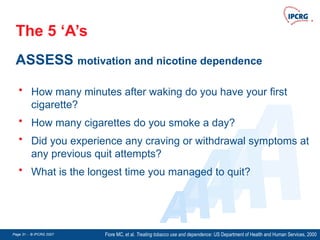
• How many minutes after waking do you have your first
cigarette?
• How many cigarettes do you smoke a day?
• Did you experience any craving or withdrawal symptoms at
any previous quit attempts?
• What is the longest time you managed to quit?
- 32.
Page 32 -© IPCRG 2007
Page 32 - © IPCRG 2007
Page 32 - © IPCRG 2007
The 5 ‘A’s
ADVISE on coping strategies
Fiore MC, et al. Treating tobacco use and dependence: US Department of Health and Human Services, 2000
A
A
A
A
A
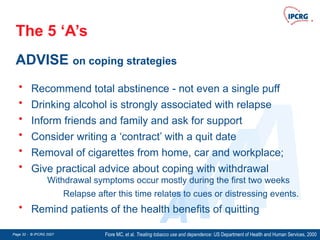
• Recommend total abstinence - not even a single puff
• Drinking alcohol is strongly associated with relapse
• Inform friends and family and ask for support
• Consider writing a ‘contract’ with a quit date
• Removal of cigarettes from home, car and workplace;
• Give practical advice about coping with withdrawal
Withdrawal symptoms occur mostly during the first two weeks
Relapse after this time relates to cues or distressing events.
• Remind patients of the health benefits of quitting
- 33.
Page 33 -© IPCRG 2007
Page 33 - © IPCRG 2007
Page 33 - © IPCRG 2007
The 5 ‘A’s
ASSIST the quit attempt
Fiore MC, et al. Treating tobacco use and dependence: US Department of Health and Human Services, 2000
A
A
A
A
A
• Provide assistance in developing a quit plan;
• Help a patient to set a quit date;
• Offer self-help material;
• Explore potential barriers and difficulties
• Review the need for pharmacotherapy.
• Refer to a quitline and/or an active call back programme
- 34.
Page 34 -© IPCRG 2007
Page 34 - © IPCRG 2007
Page 34 - © IPCRG 2007
The 5 ‘A’s
ARRANGE follow up
Fiore MC, et al. Treating tobacco use and dependence: US Department of Health and Human Services, 2000
A
A
A
A
A
• Offer a follow up appointment within 7 days
• Affirm success when you next see the patient
• Reinforce successful quitting: positive feedback helps
sustain smoking cessation.
• Don’t talk about ‘failure’, ‘relapse’ is very common
• Help the patient work out ‘what went wrong this time’ and
how they prevent a relapse next time.
- 35.
Page 35 -© IPCRG 2007
Page 35 - © IPCRG 2007
Page 35 - © IPCRG 2007
D
D
D
D
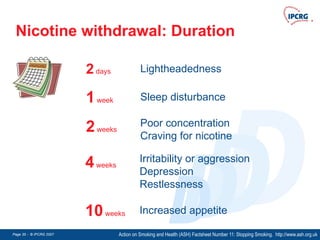
Nicotine withdrawal: Duration
Action on Smoking and Health (ASH) Factsheet Number 11: Stopping Smoking. http://www.ash.org.uk
1week Sleep disturbance
2weeks
Poor concentration
Craving for nicotine
4weeks
Irritability or aggression
Depression
Restlessness
2days Lightheadedness
10weeks Increased appetite
- 36.
Page 36 -© IPCRG 2007
Page 36 - © IPCRG 2007
Page 36 - © IPCRG 2007
D
D
D
D
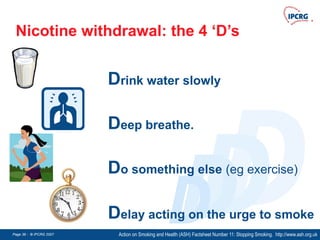
Nicotine withdrawal: the 4 ‘D’s
Action on Smoking and Health (ASH) Factsheet Number 11: Stopping Smoking. http://www.ash.org.uk
Delay acting on the urge to smoke
Drink water slowly
Deep breathe.
Do something else (eg exercise)
- 37.
Page 37 -© IPCRG 2007
Page 37 - © IPCRG 2007
Page 37 - © IPCRG 2007
Pharmacotherapy
Pharmacotherapy + behavioural counselling
improves long-term quit rates
Aveyard P, West R. Managing smoking cessation. BMJ 2007;335;37-41
Smokers of 10 or more cigarettes a day
who are ready to stop should be
encouraged to use pharmacologial
support as a cessation aid
- 38.
Page 38 -© IPCRG 2007
Page 38 - © IPCRG 2007
Page 38 - © IPCRG 2007
Nicotine replacement
• Begin NRT on the quit date, (apply patches the night before)
• Use a dose that controls the withdrawal symptoms
• NRT provides levels of nicotine well below smoking
• Prescribe in blocks of two weeks
• Arrange follow up to provide support
• Use a full dose for 6 to 8 weeks then stop
or reduce the dose gradually over 4 weeks.
Silagy C, et al. Nicotine replacement therapy for smoking cessation. Cochrane Database Systematic Reviews 2004
NRT increases the odds of quitting about 1.5 to 2 fold
- 39.
Page 39 -© IPCRG 2007
Page 39 - © IPCRG 2007
Page 39 - © IPCRG 2007
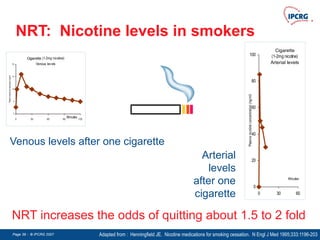
NRT: Nicotine levels in smokers
Adapted from : Henningfield JE. Nicotine medications for smoking cessation. N Engl J Med 1995;333:1196-203
NRT increases the odds of quitting about 1.5 to 2 fold
Cigarette (1-2mg nicotine)
Venous levels
0
5
10
15
20
0 30 60 90 120
Minutes
Plasma
nicotine
concentration
(ng/ml)
Cigarette
(1-2mg nicotine)
Arterial levels
0
20
40
60
80
100
0 30 60
Minutes
Plasma
nicotine
concentration
(ng/ml)
Venous levels after one cigarette
Arterial
levels
after one
cigarette
- 40.
Page 40 -© IPCRG 2007
Page 40 - © IPCRG 2007
Page 40 - © IPCRG 2007
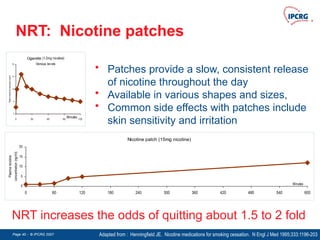
NRT: Nicotine patches
Adapted from : Henningfield JE. Nicotine medications for smoking cessation. N Engl J Med 1995;333:1196-203
NRT increases the odds of quitting about 1.5 to 2 fold
Nicotine patch (15mg nicotine)
0
5
10
15
20
0 60 120 180 240 300 360 420 480 540 600
Minutes
Plasma
nicotine
concentration
(ng/ml)
• Patches provide a slow, consistent release
of nicotine throughout the day
• Available in various shapes and sizes,
• Common side effects with patches include
skin sensitivity and irritation
Cigarette (1-2mg nicotine)
Venous levels
0
5
10
15
20
0 30 60 90 120
Minutes
Plasma
nicotine
concentration
(ng/ml)
- 41.
Page 41 -© IPCRG 2007
Page 41 - © IPCRG 2007
Page 41 - © IPCRG 2007
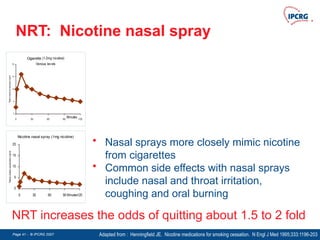
NRT: Nicotine nasal spray
Adapted from : Henningfield JE. Nicotine medications for smoking cessation. N Engl J Med 1995;333:1196-203
NRT increases the odds of quitting about 1.5 to 2 fold
Nicotine nasal spray (1mg nicotine)
0
5
10
15
20
0 30 60 90 120
Minutes
Plasma
nicotine
concentration
(ng/ml)
• Nasal sprays more closely mimic nicotine
from cigarettes
• Common side effects with nasal sprays
include nasal and throat irritation,
coughing and oral burning
Cigarette (1-2mg nicotine)
Venous levels
0
5
10
15
20
0 30 60 90 120
Minutes
Plasma
nicotine
concentration
(ng/ml)
- 42.
Page 42 -© IPCRG 2007
Page 42 - © IPCRG 2007
Page 42 - © IPCRG 2007
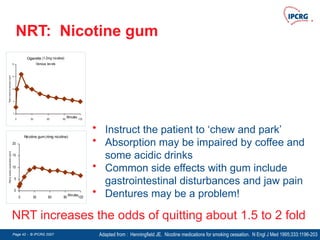
NRT: Nicotine gum
Adapted from : Henningfield JE. Nicotine medications for smoking cessation. N Engl J Med 1995;333:1196-203
NRT increases the odds of quitting about 1.5 to 2 fold
Nicotine gum (4mg nicotine)
0
5
10
15
20
0 30 60 90 120
Minutes
Plasma
nicotine
concentration
(ng/ml)
• Instruct the patient to ‘chew and park’
• Absorption may be impaired by coffee and
some acidic drinks
• Common side effects with gum include
gastrointestinal disturbances and jaw pain
• Dentures may be a problem!
Cigarette (1-2mg nicotine)
Venous levels
0
5
10
15
20
0 30 60 90 120
Minutes
Plasma
nicotine
concentration
(ng/ml)
- 43.
Page 43 -© IPCRG 2007
Page 43 - © IPCRG 2007
Page 43 - © IPCRG 2007
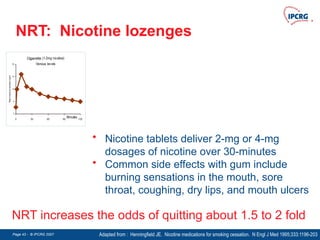
NRT: Nicotine lozenges
Adapted from : Henningfield JE. Nicotine medications for smoking cessation. N Engl J Med 1995;333:1196-203
NRT increases the odds of quitting about 1.5 to 2 fold
• Nicotine tablets deliver 2-mg or 4-mg
dosages of nicotine over 30-minutes
• Common side effects with gum include
burning sensations in the mouth, sore
throat, coughing, dry lips, and mouth ulcers
Cigarette (1-2mg nicotine)
Venous levels
0
5
10
15
20
0 30 60 90 120
Minutes
Plasma
nicotine
concentration
(ng/ml)
- 44.
Page 44 -© IPCRG 2007
Page 44 - © IPCRG 2007
Page 44 - © IPCRG 2007
Bupropion
• Begin bupropion a week before the quit date
• Normal dose 150mg bd, (reduce in elderly, liver/renal disease)
• Contra-indicated in patients with epilepsy, anorexia
nervosa, bulimia, bipolar disorder or severe liver disease.
• The most common side effects are insomnia (up to 30%),
dry mouth (10-15%), headache (10%), nausea (10%),
constipation (10%), and agitation (5-10%)
• Interaction with antidepressants, antipsychotics and anti-
arrhythmics
Hughes J, et al. Antidepressants for smoking cessation. Cochrane Database Systematic Reviews 2007
Bupropion increases the odds of quitting about 2 fold
- 45.
Page 45 -© IPCRG 2007
Page 45 - © IPCRG 2007
Page 45 - © IPCRG 2007
Nortryptiline
• Tri-cyclic antidepressant
• Not licensed for smoking cessation
• Low cost
• Side-effects include sedation, dry mouth, light-
headedness, cardiac arrhythmia
• Contra-indicated after recent myocardial infarction
Hughes J, et al. Antidepressants for smoking cessation. Cochrane Database Systematic Reviews 2007
Nortryptiline increases the odds of quitting about 2 fold
- 46.
Page 46 -© IPCRG 2007
Page 46 - © IPCRG 2007
Page 46 - © IPCRG 2007
Varenicline
• Begin varenicline a week before the quit date, increasing
dose gradually.
• Alleviates withdrawal symptoms, reduces urge to smoke
• Common side effects include: nausea (30%), insomnia,
(14%), abnormal dreams (13%), headache (13%),
constipation (9%), gas (6%) and vomiting (5%).
• Contra-indicated in pregnancy
• New drug
Cahill K, et al. Nicotine receptor partial agonists for smoking cessation. Cochrane Database Syst Rev 2007
Varenicline increases the odds of quitting about 2.5 fold
- 47.
Page 47 -© IPCRG 2007
Page 47 - © IPCRG 2007
Page 47 - © IPCRG 2007
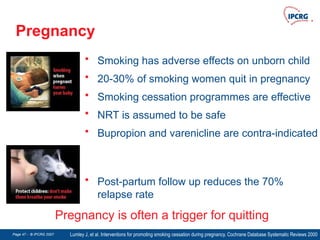
Pregnancy
• Smoking has adverse effects on unborn child
• 20-30% of smoking women quit in pregnancy
• Smoking cessation programmes are effective
• NRT is assumed to be safe
• Bupropion and varenicline are contra-indicated
Lumley J, et al. Interventions for promoting smoking cessation during pregnancy. Cochrane Database Systematic Reviews 2000
Pregnancy is often a trigger for quitting
• Post-partum follow up reduces the 70%
relapse rate
- 48.
Page 48 -© IPCRG 2007
Page 48 - © IPCRG 2007
Page 48 - © IPCRG 2007
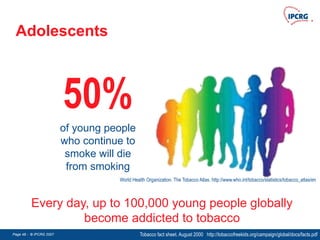
Adolescents
Tobacco fact sheet. August 2000 http://tobaccofreekids.org/campaign/global/docs/facts.pdf
Every day, up to 100,000 young people globally
become addicted to tobacco
50%
of young people
who continue to
smoke will die
from smoking
World Health Organization. The Tobacco Atlas. http://www.who.int/tobacco/statistics/tobacco_atlas/en
- 49.
Page 49 -© IPCRG 2007
Page 49 - © IPCRG 2007
Page 49 - © IPCRG 2007
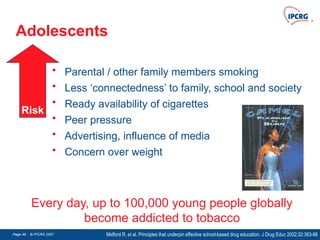
Adolescents
Midford R, et al. Principles that underpin effective school-based drug education. J Drug Educ 2002;32:363-86
Every day, up to 100,000 young people globally
become addicted to tobacco
• Parental / other family members smoking
• Less ‘connectedness’ to family, school and society
• Ready availability of cigarettes
• Peer pressure
• Advertising, influence of media
• Concern over weight
Risk
- 50.
Page 50 -© IPCRG 2007
Page 50 - © IPCRG 2007
Page 50 - © IPCRG 2007
Adolescents
Midford R, et al. Principles that underpin effective school-based drug education. J Drug Educ 2002;32:363-86
Every day, up to 100,000 young people globally
become addicted to tobacco
• School-based policies around smoking education
• Good social support
• Higher levels of physical activity
Risk
- 51.
Page 51 -© IPCRG 2007
Page 51 - © IPCRG 2007
Page 51 - © IPCRG 2007
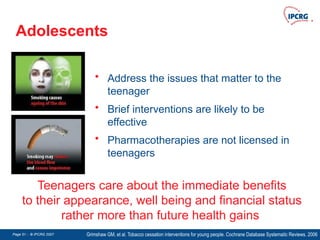
Adolescents
Grimshaw GM, et al. Tobacco cessation interventions for young people. Cochrane Database Systematic Reviews. 2006
Teenagers care about the immediate benefits
to their appearance, well being and financial status
rather more than future health gains
• Address the issues that matter to the
teenager
• Brief interventions are likely to be
effective
• Pharmacotherapies are not licensed in
teenagers
- 52.
Page 52 -© IPCRG 2007
Page 52 - © IPCRG 2007
Page 52 - © IPCRG 2007
Mental health
McNeil A. Smoking and mental health - a review of the literature Smoke Free London Programme: London, 2001
People with mental health problems are more likely to
smoke than those without mental illness
• Psychotic disorders are associated with three times the
risk being a heavy smokers (35% vs 9%)
• Smoking may alleviate symptoms of psychosis
• Smoking and depression are related
• The antidepressants, bupropion and nortriptyline are
effective in assisting smoking cessation
• Bupropion interacts with other antidepressants