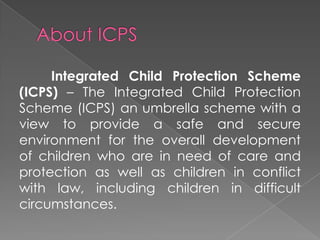

Integrated Child Protection Scheme
(ICPS) – The Integrated Child Protection
Scheme (ICPS) an umbrella scheme with a
view to provide a safe and secure
environment for the overall development
of children who are in need of care and
protection as well as children in conflict
with law, including children in difficult
circumstances.
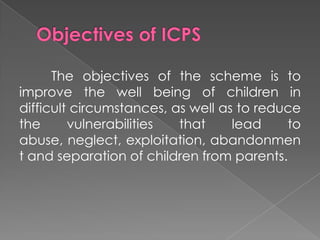
The objectives of the scheme is to
improve the well being of children in
difficult circumstances, as well as to reduce
the      vulnerabilities  that     lead    to
abuse, neglect, exploitation, abandonmen
t and separation of children from parents.
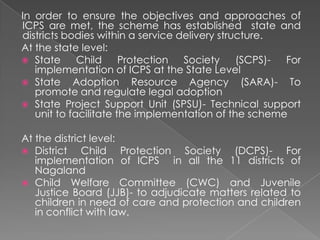
In order to ensure the objectives and approaches of
ICPS are met, the scheme has established state and
districts bodies within a service delivery structure.
At the state level:
 State      Child     Protection  Society     (SCPS)- For
   implementation of ICPS at the State Level
 State Adoption Resource Agency (SARA)- To
   promote and regulate legal adoption
 State Project Support Unit (SPSU)- Technical support
   unit to facilitate the implementation of the scheme

At the district level:
 District    Child Protection Society (DCPS)- For
   implementation of ICPS in all the 11 districts of
   Nagaland
 Child Welfare Committee (CWC) and Juvenile
   Justice Board (JJB)- to adjudicate matters related to
   children in need of care and protection and children
   in conflict with law.
Trafficking of human beings, especially of
women and children, is an organized crime that
violates basic human rights. Trafficking is defined as
any              activity         leading            to
recruitment, transportation, harboring or receipt of
persons, by means of threat or use of force or a
position of vulnerability. Human trafficking has been
identified as the third largest source of profit for
organized crime, following arms and drug
trafficking, generating billions of dollars annually at
the global level. Trafficking takes places for various
purposes such as labour, prostitution, organ
trade, drug couriers, arms smuggling etc.
However, these cannot be seen in isolation as they
have a crosscutting nexus and linkage, which
compounds the constraints faced in tackling the
problem.
The common understanding of the
methods used for trafficking is compulsion,
duping, luring, abducting, kidnapping etc.
However,     in   most    cases      particularly
Nagaland, it is the social and economic
constraints of the victims that make them
most vulnerable. With growing globalization
and liberalization, the possibilities and
potential for trafficking have also grown.
People tend to migrate in search of better
Opportunities. Though this is a positive trend, it
has also led to the emergence of other
complex issues such as smuggling of people
across borders and unsafe Migration by
deceitful touts and agents.
   The number of trafficked children is difficult
    to determine due to the secrecy in the
    nature of the crime. studies by the Ministry
    of Women and Child Development
    (MWCD) estimates that there are about
    three million prostitutes in the country, of
    which an estimated 40 percent are
    children, as there is a growing demand for
    very young girls to be inducted into
    prostitution on account of customer
    preferences.
 Over the years, Nagaland has become
  a source, destination and transit region
  for human trafficking. Cross-border
  trafficking also takes place, especially
  from      Myanmar       and    Bangladesh.
  Interstate    trafficking   from   Assam,
  Arunachal Pradesh and some from
  Meghalaya.
 Poverty force parents in the Naga-
  dominated areas of Myanmar to send
  their children to Nagaland in the hope
  that they would get education but most
  children land up as domestic help.
 It has been reported that there were over
  500 children working in Kohima alone. The
  traffickers, who convince parents of better
  education for their children, get anything
  between Rs 5,000 to Rs 20,000 for a child.
 The       Eastern     Nagaland         People’s
  Organizations      (ENPO)      reports    child
  trafficking from Nagaland backward
  districts had turned quite serious because of
  the poverty. According to report from the
  ENPO,       there    were     around      3,000
  children, mostly girls, working as domestic
  helps in and around Kohima. About 1,000 of
  them are from Mon district alone.
   Many children are trafficked for purposes of
    cheap labour and commercial sexual
    exploitation. The destinations are usually New
    Delhi, Mumbai, Pune, Goa and Kolkata and
    extend as far as Thailand and Singapore and
    Middle East countries.
   These children are sent with a promise for
    better life, better education and proper care.
   Ironically, most of the reported case of
    trafficking case has been done through the
    church or people posing to be missionaries. In
    most cases the local pastors were duped and
    fallen prey to some deceitful person who was
    posing as Christian missionaries.
   In 2009, 29(twenty nine) children (all from
    Peren District) were rescued from
    Andhra Pradesh from a home. These
    children       went    through       many
    physical, social, emotional and mental
    trauma. These children were rescued
    and repatriated to Nagaland. At
    present, the SCPS Nagaland is keeping
    close check on these children in co-
    ordination       with      the      District
    Administration,        Police,          Civil
    Societies, Village Council and schools.
   In 2011, 6 Naga children from Peren District
    were         rescued          from       Hope
    Home, Kolkata, West Bengal. Out of these
    children, one child was only 2 years old and
    was given up by her mother as she could
    not afford to keep her. SCPS Nagaland
    coordinated with childline Kolkata. The
    officials of SCPS and the State Juvenile
    Police units went and rescued the children
    and repatriated back to their families. The
    DCPO, Peren along with the counselors and
    the Legal Officers are in constant touch
    with these families and children. We are
    also in the process of providing sponsorships
    and foster care to some of these children.
    SCPS is also trying to initiate legal adoption
    so these that these children can be placed
    in a safe home.
   Just yesterday, Rajasthan police rescued 49
    children, including 27 girls of northeast
    region, aged between 4 and 14, from an
    illegal orphanage in Jaipur and arrested
    one person in connection with the
    case. The children were kept confined in
    shelter homes which were not registered
    with government agencies. A man claiming
    to be a pastor was arrested by police,
    officials said. Police detained a man
    identified as Jacob John, who claims to be
    a pastor, the officer added. John said the
    children came from poor families across the
    country. Among them were children from
    Punjab, Assam, Manipur, Nagaland and
    Chhattisgarh.
These are the various Acts, Codes and
Sections that we apply in dealing with various
trafficking cases:
   The Immoral Traffic (Prevention) Act, 1956 (ITPA)
   The Indian Penal Code (Sec 339, 340, 372, 373)
   Juvenile Justice (Care and Protection of
    Children) Act, 2000 (JJA)
   Child Labour (Prohibition & Regulation) Act
   The Bonded Labour System (Abolition)
    Act, 1976
The State Child Protection Society has built strong
linkages and partnerships with various stakeholders
including civil society, NGOs, and other states, in all its
endeavors to build an integrated response to prevent
and combat trafficking in children
  All children below the age of 18 years from Eastern
    Nagaland are to register from Eastern Nagaland
    People Organisation (ENPO) at Kohima and Dimapur.
  Sponsorships and Foster Care - SCPS has been
    providing sponsorships and foster care to families
    who are not financially stable for preventive and Re-
    habilitative purposes.
One of the challenges faced in the
rehabilitation and re-integration of the
victims is that of providing them with
sustainable livelihood options. In order to
help children emerging from Institutions to
restart a new life in mainstream
society, there are various after-care
programs where they are given Vocational
Trainings.
 Child Line Services – Child Line, the toll-free
  number 1098, is a 24-hour telephone service run
  under the aegis of MWCD, available to all
  children in distress or to adults on behalf of
  children in distress. One of The basic objectives of
  Child Line is To respond to the emergency needs
  of the children in difficulty and provide referral
  services.
 Track The Child – Child Tracking System: It is a
  web-enabled Child Protection Management
  information System on all children accessing
  services to track missing children has been
  introduced in Nagaland in collaboration with
  the NIC.
   Advocacy and awareness of all sections of society. Special
    efforts are on to sensitize the church, civil bodies and law
    enforcement agencies
   To call upon all concerned, including police, prosecutors and
    the judiciary, to undertake concerted action in law
    enforcement so that offenders are punished quickly, certainly
    and severely and in a time-bound manner;
   To identify vulnerable areas, including the study of migration
    and trafficking trends and patterns;
   To identify inter-State and intra-State source, transit and
    destination;
   To prevent brokers and intermediaries from indulging in
    trafficking for forced labour and other forms of illegal
    purposes, including, specifically, domestic child labour;
   To build a coalition of media partners and Organisations to
    advocate for the prevention of trafficking.
Presentation on scps

Presentation on scps

  • 2.
    Integrated Child ProtectionScheme (ICPS) – The Integrated Child Protection Scheme (ICPS) an umbrella scheme with a view to provide a safe and secure environment for the overall development of children who are in need of care and protection as well as children in conflict with law, including children in difficult circumstances.
  • 3.
    The objectives ofthe scheme is to improve the well being of children in difficult circumstances, as well as to reduce the vulnerabilities that lead to abuse, neglect, exploitation, abandonmen t and separation of children from parents.
  • 4.
    In order toensure the objectives and approaches of ICPS are met, the scheme has established state and districts bodies within a service delivery structure. At the state level:  State Child Protection Society (SCPS)- For implementation of ICPS at the State Level  State Adoption Resource Agency (SARA)- To promote and regulate legal adoption  State Project Support Unit (SPSU)- Technical support unit to facilitate the implementation of the scheme At the district level:  District Child Protection Society (DCPS)- For implementation of ICPS in all the 11 districts of Nagaland  Child Welfare Committee (CWC) and Juvenile Justice Board (JJB)- to adjudicate matters related to children in need of care and protection and children in conflict with law.
  • 5.
    Trafficking of humanbeings, especially of women and children, is an organized crime that violates basic human rights. Trafficking is defined as any activity leading to recruitment, transportation, harboring or receipt of persons, by means of threat or use of force or a position of vulnerability. Human trafficking has been identified as the third largest source of profit for organized crime, following arms and drug trafficking, generating billions of dollars annually at the global level. Trafficking takes places for various purposes such as labour, prostitution, organ trade, drug couriers, arms smuggling etc. However, these cannot be seen in isolation as they have a crosscutting nexus and linkage, which compounds the constraints faced in tackling the problem.
  • 6.
    The common understandingof the methods used for trafficking is compulsion, duping, luring, abducting, kidnapping etc. However, in most cases particularly Nagaland, it is the social and economic constraints of the victims that make them most vulnerable. With growing globalization and liberalization, the possibilities and potential for trafficking have also grown. People tend to migrate in search of better Opportunities. Though this is a positive trend, it has also led to the emergence of other complex issues such as smuggling of people across borders and unsafe Migration by deceitful touts and agents.
  • 7.
    The number of trafficked children is difficult to determine due to the secrecy in the nature of the crime. studies by the Ministry of Women and Child Development (MWCD) estimates that there are about three million prostitutes in the country, of which an estimated 40 percent are children, as there is a growing demand for very young girls to be inducted into prostitution on account of customer preferences.
  • 8.
     Over theyears, Nagaland has become a source, destination and transit region for human trafficking. Cross-border trafficking also takes place, especially from Myanmar and Bangladesh. Interstate trafficking from Assam, Arunachal Pradesh and some from Meghalaya.  Poverty force parents in the Naga- dominated areas of Myanmar to send their children to Nagaland in the hope that they would get education but most children land up as domestic help.
  • 9.
     It hasbeen reported that there were over 500 children working in Kohima alone. The traffickers, who convince parents of better education for their children, get anything between Rs 5,000 to Rs 20,000 for a child.  The Eastern Nagaland People’s Organizations (ENPO) reports child trafficking from Nagaland backward districts had turned quite serious because of the poverty. According to report from the ENPO, there were around 3,000 children, mostly girls, working as domestic helps in and around Kohima. About 1,000 of them are from Mon district alone.
  • 10.
    Many children are trafficked for purposes of cheap labour and commercial sexual exploitation. The destinations are usually New Delhi, Mumbai, Pune, Goa and Kolkata and extend as far as Thailand and Singapore and Middle East countries.  These children are sent with a promise for better life, better education and proper care.  Ironically, most of the reported case of trafficking case has been done through the church or people posing to be missionaries. In most cases the local pastors were duped and fallen prey to some deceitful person who was posing as Christian missionaries.
  • 11.
    In 2009, 29(twenty nine) children (all from Peren District) were rescued from Andhra Pradesh from a home. These children went through many physical, social, emotional and mental trauma. These children were rescued and repatriated to Nagaland. At present, the SCPS Nagaland is keeping close check on these children in co- ordination with the District Administration, Police, Civil Societies, Village Council and schools.
  • 12.
    In 2011, 6 Naga children from Peren District were rescued from Hope Home, Kolkata, West Bengal. Out of these children, one child was only 2 years old and was given up by her mother as she could not afford to keep her. SCPS Nagaland coordinated with childline Kolkata. The officials of SCPS and the State Juvenile Police units went and rescued the children and repatriated back to their families. The DCPO, Peren along with the counselors and the Legal Officers are in constant touch with these families and children. We are also in the process of providing sponsorships and foster care to some of these children. SCPS is also trying to initiate legal adoption so these that these children can be placed in a safe home.
  • 13.
    Just yesterday, Rajasthan police rescued 49 children, including 27 girls of northeast region, aged between 4 and 14, from an illegal orphanage in Jaipur and arrested one person in connection with the case. The children were kept confined in shelter homes which were not registered with government agencies. A man claiming to be a pastor was arrested by police, officials said. Police detained a man identified as Jacob John, who claims to be a pastor, the officer added. John said the children came from poor families across the country. Among them were children from Punjab, Assam, Manipur, Nagaland and Chhattisgarh.
  • 14.
    These are thevarious Acts, Codes and Sections that we apply in dealing with various trafficking cases:  The Immoral Traffic (Prevention) Act, 1956 (ITPA)  The Indian Penal Code (Sec 339, 340, 372, 373)  Juvenile Justice (Care and Protection of Children) Act, 2000 (JJA)  Child Labour (Prohibition & Regulation) Act  The Bonded Labour System (Abolition) Act, 1976
  • 15.
    The State ChildProtection Society has built strong linkages and partnerships with various stakeholders including civil society, NGOs, and other states, in all its endeavors to build an integrated response to prevent and combat trafficking in children  All children below the age of 18 years from Eastern Nagaland are to register from Eastern Nagaland People Organisation (ENPO) at Kohima and Dimapur.  Sponsorships and Foster Care - SCPS has been providing sponsorships and foster care to families who are not financially stable for preventive and Re- habilitative purposes.
  • 16.
    One of thechallenges faced in the rehabilitation and re-integration of the victims is that of providing them with sustainable livelihood options. In order to help children emerging from Institutions to restart a new life in mainstream society, there are various after-care programs where they are given Vocational Trainings.
  • 17.
     Child LineServices – Child Line, the toll-free number 1098, is a 24-hour telephone service run under the aegis of MWCD, available to all children in distress or to adults on behalf of children in distress. One of The basic objectives of Child Line is To respond to the emergency needs of the children in difficulty and provide referral services.  Track The Child – Child Tracking System: It is a web-enabled Child Protection Management information System on all children accessing services to track missing children has been introduced in Nagaland in collaboration with the NIC.
  • 18.
    Advocacy and awareness of all sections of society. Special efforts are on to sensitize the church, civil bodies and law enforcement agencies  To call upon all concerned, including police, prosecutors and the judiciary, to undertake concerted action in law enforcement so that offenders are punished quickly, certainly and severely and in a time-bound manner;  To identify vulnerable areas, including the study of migration and trafficking trends and patterns;  To identify inter-State and intra-State source, transit and destination;  To prevent brokers and intermediaries from indulging in trafficking for forced labour and other forms of illegal purposes, including, specifically, domestic child labour;  To build a coalition of media partners and Organisations to advocate for the prevention of trafficking.