Introduction
• Moniezia belongs to family Anopocephalidae. M. sp. Cause disease called
Moniziasis.
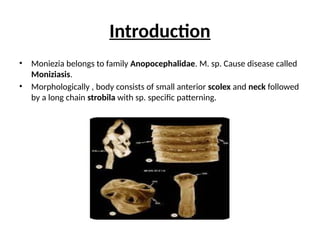
• Morphologically , body consists of small anterior scolex and neck followed
by a long chain strobila with sp. specific patterning.
12 species identified in domestic & wild
ruminants
• M. expensa and M. benedeni are the most common ruminant
tapeworm world wide.
Length
• Upto 10 meters, absence of hooks and
rostellum.
Eggs
• Dropped from GIT of host along with gravid
proglottids
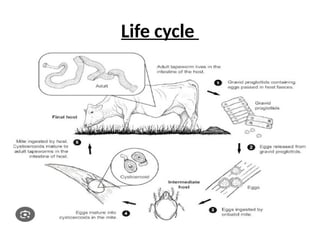
Life cycle
GC-MS
Gas Chromatography interfaced to Mass Spectrometer
Gc-Mass that may clarify the
processes of parasite life cycle,
helminthes infection and host-
parasite interaction, providing
targets to further interference for
parasite control or even infection
treatment.
SAMPLE COLLECTION
• Sheep intestinal organs were collected from
slaughter house Bassrah (Nov 2020-April 2021).
• Disections done from the start of the rectum to
farthest limit of the stomach to search parasite.
• OUTCOMES OF SEARCH:
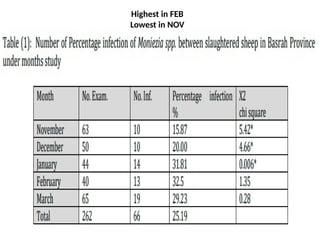
• 262 ruminants were examined out of which 66
were infected.
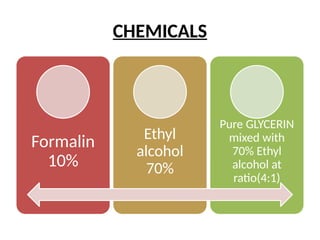
CHEMICALS
Formalin
10%
Ethyl
alcohol
70%
Pure GLYCERIN
mixed with
70% Ethyl
alcohol at
ratio(4:1)
STAINING WORMS
Three isolated parasites were
stained with ACETOCARMIN STAIN,
others with KUJRAT stain and
some with NATURAL HONEY,
where tapeworms divided into
head and other segments.
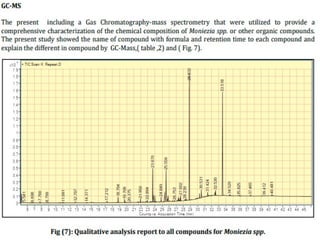
GC-MS STUDY
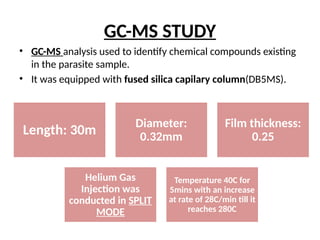
• GC-MS analysis used to identify chemical compounds existing
in the parasite sample.
• It was equipped with fused silica capilary column(DB5MS).
Length: 30m
Diameter:
0.32mm
Film thickness:
0.25
Helium Gas
Injection was
conducted in SPLIT
MODE
Temperature 40C for
5mins with an increase
at rate of 28C/min till it
reaches 280C
RESULTS
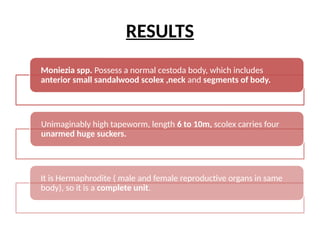
Moniezia spp. Possess a normal cestoda body, which includes
anterior small sandalwood scolex ,neck and segments of body.
Unimaginably high tapeworm, length 6 to 10m, scolex carries four
unarmed huge suckers.
It is Hermaphrodite ( male and female reproductive organs in same
body), so it is a complete unit.
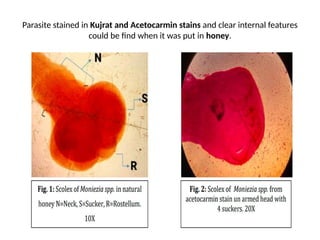
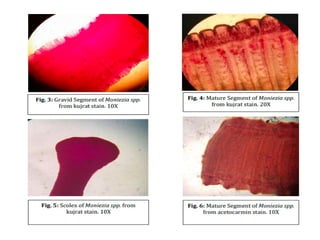
Parasite stained in Kujrat and Acetocarmin stains and clear internal features
could be find when it was put in honey.
Highest in FEB
Lowest in NOV
Discussion
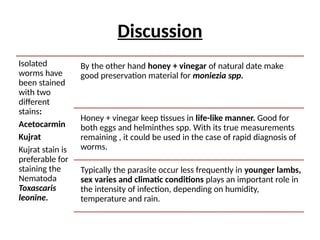
Isolated
worms have
been stained
with two
different
stains:
Acetocarmin
Kujrat
Kujrat stain is
preferable for
staining the
Nematoda
Toxascaris
leonine.
By the other hand honey + vinegar of natural date make
good preservation material for moniezia spp.
Honey + vinegar keep tissues in life-like manner. Good for
both eggs and helminthes spp. With its true measurements
remaining , it could be used in the case of rapid diagnosis of
worms.
Typically the parasite occur less frequently in younger lambs,
sex varies and climatic conditions plays an important role in
the intensity of infection, depending on humidity,
temperature and rain.
Discussion
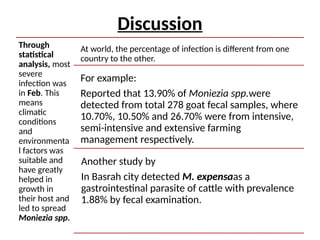
Through
statistical
analysis, most
severe
infection was
in Feb. This
means
climatic
conditions
and
environmenta
l factors was
suitable and
have greatly
helped in
growth in
their host and
led to spread
Moniezia spp.
At world, the percentage of infection is different from one
country to the other.
For example:
Reported that 13.90% of Moniezia spp.were
detected from total 278 goat fecal samples, where
10.70%, 10.50% and 26.70% were from intensive,
semi-intensive and extensive farming
management respectively.
Another study by
In Basrah city detected M. expensaas a
gastrointestinal parasite of cattle with prevalence
1.88% by fecal examination.

Presentation On Research in Medical Science

  • 2.
    Introduction • Moniezia belongsto family Anopocephalidae. M. sp. Cause disease called Moniziasis. • Morphologically , body consists of small anterior scolex and neck followed by a long chain strobila with sp. specific patterning.
  • 3.
    12 species identifiedin domestic & wild ruminants • M. expensa and M. benedeni are the most common ruminant tapeworm world wide. Length • Upto 10 meters, absence of hooks and rostellum. Eggs • Dropped from GIT of host along with gravid proglottids
  • 4.
  • 5.
    GC-MS Gas Chromatography interfacedto Mass Spectrometer Gc-Mass that may clarify the processes of parasite life cycle, helminthes infection and host- parasite interaction, providing targets to further interference for parasite control or even infection treatment.
  • 6.
    SAMPLE COLLECTION • Sheepintestinal organs were collected from slaughter house Bassrah (Nov 2020-April 2021). • Disections done from the start of the rectum to farthest limit of the stomach to search parasite. • OUTCOMES OF SEARCH: • 262 ruminants were examined out of which 66 were infected.
  • 7.
  • 8.
    STAINING WORMS Three isolatedparasites were stained with ACETOCARMIN STAIN, others with KUJRAT stain and some with NATURAL HONEY, where tapeworms divided into head and other segments.
  • 9.
    GC-MS STUDY • GC-MSanalysis used to identify chemical compounds existing in the parasite sample. • It was equipped with fused silica capilary column(DB5MS). Length: 30m Diameter: 0.32mm Film thickness: 0.25 Helium Gas Injection was conducted in SPLIT MODE Temperature 40C for 5mins with an increase at rate of 28C/min till it reaches 280C
  • 10.
    RESULTS Moniezia spp. Possessa normal cestoda body, which includes anterior small sandalwood scolex ,neck and segments of body. Unimaginably high tapeworm, length 6 to 10m, scolex carries four unarmed huge suckers. It is Hermaphrodite ( male and female reproductive organs in same body), so it is a complete unit.
  • 11.
    Parasite stained inKujrat and Acetocarmin stains and clear internal features could be find when it was put in honey.
  • 13.
  • 15.
    Discussion Isolated worms have been stained withtwo different stains: Acetocarmin Kujrat Kujrat stain is preferable for staining the Nematoda Toxascaris leonine. By the other hand honey + vinegar of natural date make good preservation material for moniezia spp. Honey + vinegar keep tissues in life-like manner. Good for both eggs and helminthes spp. With its true measurements remaining , it could be used in the case of rapid diagnosis of worms. Typically the parasite occur less frequently in younger lambs, sex varies and climatic conditions plays an important role in the intensity of infection, depending on humidity, temperature and rain.
  • 16.
    Discussion Through statistical analysis, most severe infection was inFeb. This means climatic conditions and environmenta l factors was suitable and have greatly helped in growth in their host and led to spread Moniezia spp. At world, the percentage of infection is different from one country to the other. For example: Reported that 13.90% of Moniezia spp.were detected from total 278 goat fecal samples, where 10.70%, 10.50% and 26.70% were from intensive, semi-intensive and extensive farming management respectively. Another study by In Basrah city detected M. expensaas a gastrointestinal parasite of cattle with prevalence 1.88% by fecal examination.