Porosity in Welds
Porosity in Welds
Porosity simply put, signifies gas pocket(s) that form into the welded
metal.
Normally porosity can be easily detected with the naked eye in the
holes. However, testing devices like X-Rays are used in the case of
welds.
Porosity in Welds
Porosity simply put, signifies gas pocket(s) that form into the welded
metal.
Normally porosity can be easily detected with the naked eye in the
holes. However, testing devices like X-Rays are used in the case of
welds.
Porosity in Welds
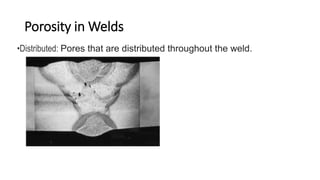
•Distributed: Pores that are distributed throughout the weld.
Porosity in Welds
•surface breaking pores: Pores that break the surface.
Porosity in Welds
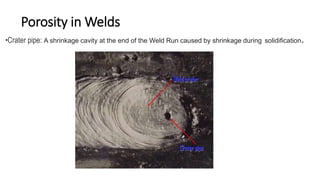
•Crater pipe: A shrinkage cavity at the end of the Weld Run caused by shrinkage during solidification.
Porosity in Welds
•Wormholes: Elongated pores that show up resembling a herringbone
pattern on the radiograph
1
2
Porosity in Welds
How to solve Porosity Problems
• Remove any surface contamination, in particular, oil, grease, rust, and
residue from NDT operations
• Remove any surface coatings from the joint area to expose bright material
• Check the primer thickness is below the manufacturer’s maximum
• Avoid a joint geometry that creates a cavity
• Use run-off tag to enable the welding arc to be extinguished outside the
welded joint
• Grind out the weld run stop crater before continuing with the next electrode
or depositing the subsequent weld run
Welder technique
• Progressively reduce the welding current to reduce the weld pool size (use
slope-down or crater fill functions)
• Add filler (tig) to compensate for the weld pool shrinkage
Porosity in Welds
Air entrainment
•Seal any air leak
•Avoid weld pool turbulence
•Use filler with an adequate level of deoxidants
•Reduce the excessively high gas flow
Hydrogen
•Dry the electrode and flux
•Clean and degrease the workpiece surface
Surface coatings
•Clean the joint edges immediately before welding
•Check that the weldable primer is below the recommended
maximum thickness.

Presentation on Porosity.pptx

  • 1.
  • 2.
    Porosity in Welds Porositysimply put, signifies gas pocket(s) that form into the welded metal. Normally porosity can be easily detected with the naked eye in the holes. However, testing devices like X-Rays are used in the case of welds.
  • 3.
    Porosity in Welds Porositysimply put, signifies gas pocket(s) that form into the welded metal. Normally porosity can be easily detected with the naked eye in the holes. However, testing devices like X-Rays are used in the case of welds.
  • 4.
    Porosity in Welds •Distributed:Pores that are distributed throughout the weld.
  • 5.
    Porosity in Welds •surfacebreaking pores: Pores that break the surface.
  • 6.
    Porosity in Welds •Craterpipe: A shrinkage cavity at the end of the Weld Run caused by shrinkage during solidification.
  • 7.
    Porosity in Welds •Wormholes:Elongated pores that show up resembling a herringbone pattern on the radiograph 1 2
  • 8.
    Porosity in Welds Howto solve Porosity Problems • Remove any surface contamination, in particular, oil, grease, rust, and residue from NDT operations • Remove any surface coatings from the joint area to expose bright material • Check the primer thickness is below the manufacturer’s maximum • Avoid a joint geometry that creates a cavity • Use run-off tag to enable the welding arc to be extinguished outside the welded joint • Grind out the weld run stop crater before continuing with the next electrode or depositing the subsequent weld run Welder technique • Progressively reduce the welding current to reduce the weld pool size (use slope-down or crater fill functions) • Add filler (tig) to compensate for the weld pool shrinkage
  • 9.
    Porosity in Welds Airentrainment •Seal any air leak •Avoid weld pool turbulence •Use filler with an adequate level of deoxidants •Reduce the excessively high gas flow Hydrogen •Dry the electrode and flux •Clean and degrease the workpiece surface Surface coatings •Clean the joint edges immediately before welding •Check that the weldable primer is below the recommended maximum thickness.