Facebook Presentation
By :
NP3
Nazish
Parth
Prabha
Prerna
What is Facebook?
•
•
•
•
•
•
•

A portal for social networking
Interact with friends
Share photos and/or videos
Community organizing
Email and instant messaging
Various forms of interpersonal communication
Operated and privately owned by Facebook, Inc.
Who Created Facebook?
• Mark Zuckerberg created Facebook while
at Harvard University in February 2004
with roommate Dustin Moskovitz and
fellow Computer Science major Chris
Hughes.
• Initially created for college students
• Then moved to include high school
students
• Now open to anyone over the age of 13
History
• Facebook was developed in February
2004 with the name of “THE FACEBOOK”.
owned and operated by Facebook, Inc. As
of May 2012, Facebook has over 900
million active users, more than half of
them using Facebook on a mobile device.
Users must register before using the site
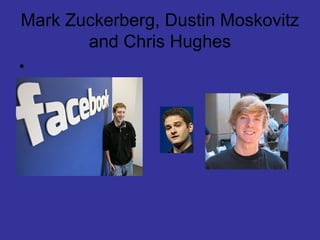
Mark Zuckerberg, Dustin Moskovitz
and Chris Hughes
•
Earnings
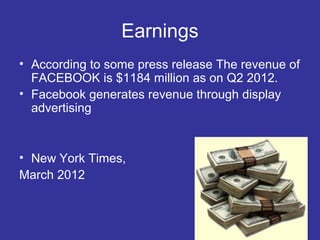
• According to some press release The revenue of
FACEBOOK is $1184 million as on Q2 2012.
• Facebook generates revenue through display
advertising

• New York Times,
March 2012
Features
•
•
•
•
•
•
•
•

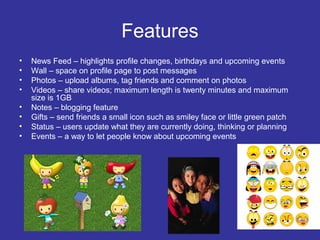
News Feed – highlights profile changes, birthdays and upcoming events
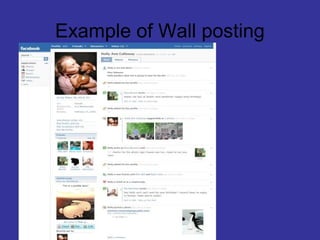
Wall – space on profile page to post messages
Photos – upload albums, tag friends and comment on photos
Videos – share videos; maximum length is twenty minutes and maximum
size is 1GB
Notes – blogging feature
Gifts – send friends a small icon such as smiley face or little green patch
Status – users update what they are currently doing, thinking or planning
Events – a way to let people know about upcoming events
Example of Wall posting
Pros
•
•
•
•
•
•
•

Keep in touch with friends and family
Share photos and videos
Connect with classmates
Stay informed on community events
Select your own level of privacy
Ability to reject friend requests
A tool to be used in teaching students cyber
ethics
Cons
• Information and pictures may be used
against a person
• Sexual predators
• Cyber bullying
• Students under 18 providing too much
information (full name, address,
birthday, school, etc.)
Facebook’s Statement of Rights
and Responsibility
• “WE DO NOT GUARANTEE THAT FACEBOOK WILL
BE SAFE OR SECURE. FACEBOOK IS NOT
RESPONSIBLE FOR THE ACTIONS OR CONTENT OF
THIRD PARTIES, AND YOU RELEASE US, OUR
DIRECTORS, OFFICERS, EMPLOYEES, AND AGENTS
FROM ANY CLAIMS AND DAMAGES, KNOWN AND
UNKNOWN, ARISING OUT OF OR IN ANY WAY
CONNECTED WITH ANY CLAIM YOU HAVE AGAINST
ANY SUCH THIRD PARTIES.”
• What does this mean? Let’s translate…
How can Teachers and Parents
Help?
•
•
•
•
•

Talk to our students
Discuss online safety
Check privacy settings
Explain ethical behavior and cyber bullying
Share how certain pictures and words can
damage a persons future
• Keep computers in an openly accessible room in
the house
• Ask questions
How to select privacy settings on
your Facebook account
•
•
•
•
•
•
•
•
•

Privacy
Profile
Control who can see your profile and personal information.
Search
Control who can search for you, and how you can be contacted.
News Feed and Wall
Control what Recent Activity is visible on your profile and in your friends' home pages.
Applications
Control what information is available to applications you use on Facebook.

•
•

Block People
If you block someone, they will not be able to find you in a Facebook search, see your
profile, or interact with you through Facebook channels (such as Wall posts, Poke,
etc.). Any Facebook ties you currently have with a person you block will be broken
(for example, friendship connections, Relationship Status, etc.). Note that blocking
someone may not prevent all communications and interactions in third-party
applications, and does not extend to elsewhere on the Internet.
Person

•
Here to stay?
• “Cool only lasts for so long, but being
useful is something that applies to
everyone.”
• -- Christopher Cox, Director of Product,
Facebook Inc.
Presentation on facebook

Presentation on facebook

  • 1.
  • 2.
    What is Facebook? • • • • • • • Aportal for social networking Interact with friends Share photos and/or videos Community organizing Email and instant messaging Various forms of interpersonal communication Operated and privately owned by Facebook, Inc.
  • 3.
    Who Created Facebook? •Mark Zuckerberg created Facebook while at Harvard University in February 2004 with roommate Dustin Moskovitz and fellow Computer Science major Chris Hughes. • Initially created for college students • Then moved to include high school students • Now open to anyone over the age of 13
  • 4.
    History • Facebook wasdeveloped in February 2004 with the name of “THE FACEBOOK”. owned and operated by Facebook, Inc. As of May 2012, Facebook has over 900 million active users, more than half of them using Facebook on a mobile device. Users must register before using the site
  • 5.
    Mark Zuckerberg, DustinMoskovitz and Chris Hughes •
  • 6.
    Earnings • According tosome press release The revenue of FACEBOOK is $1184 million as on Q2 2012. • Facebook generates revenue through display advertising • New York Times, March 2012
  • 7.
    Features • • • • • • • • News Feed –highlights profile changes, birthdays and upcoming events Wall – space on profile page to post messages Photos – upload albums, tag friends and comment on photos Videos – share videos; maximum length is twenty minutes and maximum size is 1GB Notes – blogging feature Gifts – send friends a small icon such as smiley face or little green patch Status – users update what they are currently doing, thinking or planning Events – a way to let people know about upcoming events
  • 8.
  • 9.
    Pros • • • • • • • Keep in touchwith friends and family Share photos and videos Connect with classmates Stay informed on community events Select your own level of privacy Ability to reject friend requests A tool to be used in teaching students cyber ethics
  • 10.
    Cons • Information andpictures may be used against a person • Sexual predators • Cyber bullying • Students under 18 providing too much information (full name, address, birthday, school, etc.)
  • 11.
    Facebook’s Statement ofRights and Responsibility • “WE DO NOT GUARANTEE THAT FACEBOOK WILL BE SAFE OR SECURE. FACEBOOK IS NOT RESPONSIBLE FOR THE ACTIONS OR CONTENT OF THIRD PARTIES, AND YOU RELEASE US, OUR DIRECTORS, OFFICERS, EMPLOYEES, AND AGENTS FROM ANY CLAIMS AND DAMAGES, KNOWN AND UNKNOWN, ARISING OUT OF OR IN ANY WAY CONNECTED WITH ANY CLAIM YOU HAVE AGAINST ANY SUCH THIRD PARTIES.” • What does this mean? Let’s translate…
  • 12.
    How can Teachersand Parents Help? • • • • • Talk to our students Discuss online safety Check privacy settings Explain ethical behavior and cyber bullying Share how certain pictures and words can damage a persons future • Keep computers in an openly accessible room in the house • Ask questions
  • 13.
    How to selectprivacy settings on your Facebook account • • • • • • • • • Privacy Profile Control who can see your profile and personal information. Search Control who can search for you, and how you can be contacted. News Feed and Wall Control what Recent Activity is visible on your profile and in your friends' home pages. Applications Control what information is available to applications you use on Facebook. • • Block People If you block someone, they will not be able to find you in a Facebook search, see your profile, or interact with you through Facebook channels (such as Wall posts, Poke, etc.). Any Facebook ties you currently have with a person you block will be broken (for example, friendship connections, Relationship Status, etc.). Note that blocking someone may not prevent all communications and interactions in third-party applications, and does not extend to elsewhere on the Internet. Person •
  • 14.
    Here to stay? •“Cool only lasts for so long, but being useful is something that applies to everyone.” • -- Christopher Cox, Director of Product, Facebook Inc.