MOTIVATION
SUBJECT: ORGANIZATIONAL BEHAVIOUR
TEACHER: HAMEED AKHTAR
REPORT ON MOTIVATION
MUHAMMAD FARAZ ALI
SAHRAN MINHAS
KHIZER NADEEM
What is Motivation?
 Motivation originates from a Latin word “Movere”, which means to move.
 It creates a reflection that keeps us working and helping us to achieve our goals.
 It is basically an act or process that gives a person a reason to do something in a
particular way.
 Employee motivation generates effort towards work related activities.
Forward Digital Consultancy
 It is a company that motivates other companies which create TVC’s.
 They help materialize the ideas into great projects.
 They design, develop and advertise for the companies to give a good startup.
Company’s main focus
It’s main focus is on:
 Analytics
 Strategy
 Sales
 Mobile and web designing
 User experience
 Photography
They have covered 25 clients, 55 videos and 3500 leads.
Motivational Theories
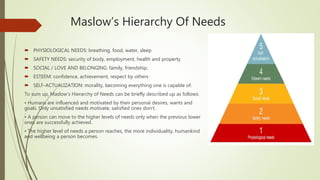
Maslow’s Hierarchy Of Needs
 PHYSIOLOGICAL NEEDS: breathing, food, water, sleep
 SAFETY NEEDS: security of body, employment, health and property
 SOCIAL / LOVE AND BELONGING: family, friendship,
 ESTEEM: confidence, achievement, respect by others
 SELF-ACTUALIZATION: morality, becoming everything one is capable of.
To sum up, Maslow’s Hierarchy of Needs can be briefly described up as follows:
• Humans are influenced and motivated by their personal desires, wants and
goals. Only unsatisfied needs motivate, satisfied ones don’t.
• A person can move to the higher levels of needs only when the previous lower
ones are successfully achieved.
• The higher level of needs a person reaches, the more individuality, humankind
and wellbeing a person becomes.
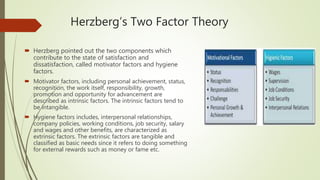
Herzberg’s Two Factor Theory
 Herzberg pointed out the two components which
contribute to the state of satisfaction and
dissatisfaction, called motivator factors and hygiene
factors.
 Motivator factors, including personal achievement, status,
recognition, the work itself, responsibility, growth,
promotion and opportunity for advancement are
described as intrinsic factors. The intrinsic factors tend to
be intangible.
 Hygiene factors includes, interpersonal relationships,
company policies, working conditions, job security, salary
and wages and other benefits, are characterized as
extrinsic factors. The extrinsic factors are tangible and
classified as basic needs since it refers to doing something
for external rewards such as money or fame etc.
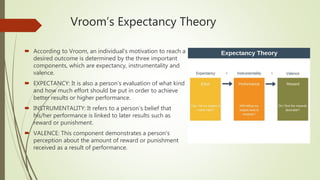
Vroom’s Expectancy Theory
 According to Vroom, an individual’s motivation to reach a
desired outcome is determined by the three important
components, which are expectancy, instrumentality and
valence.
 EXPECTANCY: It is also a person’s evaluation of what kind
and how much effort should be put in order to achieve
better results or higher performance.
 INSTRUMENTALITY: It refers to a person’s belief that
his/her performance is linked to later results such as
reward or punishment.
 VALENCE: This component demonstrates a person’s
perception about the amount of reward or punishment
received as a result of performance.
SURVEY
 We took 40 people from forward digital consultancy to interview them on different
question on motivation.
 The people were cooperative and answered us as we asked them.
 The study is exploratory and descriptive in nature.
 We make our questions from internet, the theories we have defined above and
from other course books.
 Employees have to rate our question as strongly agree, agree, uncertain, disagree
and strongly disagree.
LIMITATIONS OF STUDY
 Time constraint was one of the
limitations during the data
collection.
 Responses received were not free
from respondent biases because
of their apprehension that it might
affect their career.
SURVEY QUESTIONS
1. Are you happy with your present salary and increment?.
2. Does financially related reward system effect employ motivation?.
3. Is employ motivation is effected by working condition?.
4. Does welfare facilities effect motivation of employees?.
5. Does motivation is effected by superior peers and subordinates are good?.
6. Is it important for supervisors to take interest in your problem to motivate you?.
7. Does enjoy setting and achieving challenging goal motivates you?.
8. Do recognition and praised for your good performance motivates you to work?.
9. Clear and effective system of performance appraisal & career development motivates you?.
10. right opportunities in this organization for my personal growth and promotion motivates employees?.
11. If organization helps me in all possible. Does it motivates you to work?.
12. If you are getting maximum pleasure from your work does it effect your motivation level?.
13. Added authority and responsibility to present job will be more interesting and rewarding. Does this motivates you?.
14. If your job content and responsibilities are appropriate for you. Does this effects your motivation level?.
15. Appropriate work is given to me according to my skill and potential. Does this motivates you?.
16. Leadership also influences the level of motivation. Do agree with this statement?.
SUGGESTION AND RECOMMENDATIONS
 In the forward digital consultancy employees feel that the salary structure is very good but give
amount is not satisfactory. 55%of the employees are satisfied by their salary and increment,
financial reward. As it is very low rate
 The higher number of employees (85%) has given strongly agree. It means in forward digital
consultancy the belongingness of employees are very good. They have a good relationship with
everyone.
 65% of employees are satisfied with recognition programs and performance appraisal system. But
35%of the employee is still feeling that the performance appraisal system and recognition
programmer are not proper. Hence HR department should know why the employees are not
satisfied with the performance appraisal system and which type of recognition program they want
in future.
 The higher numbers of employees have given positive response but still there is scope for
improvement.
 The HR department should make the job more challenging. Exciting and meaningful by the factor
like goal setting. Creative work. Job rotation. Skill diversity.
presentation on employee motivation

presentation on employee motivation

  • 1.
    MOTIVATION SUBJECT: ORGANIZATIONAL BEHAVIOUR TEACHER:HAMEED AKHTAR REPORT ON MOTIVATION MUHAMMAD FARAZ ALI SAHRAN MINHAS KHIZER NADEEM
  • 2.
    What is Motivation? Motivation originates from a Latin word “Movere”, which means to move.  It creates a reflection that keeps us working and helping us to achieve our goals.  It is basically an act or process that gives a person a reason to do something in a particular way.  Employee motivation generates effort towards work related activities.
  • 3.
    Forward Digital Consultancy It is a company that motivates other companies which create TVC’s.  They help materialize the ideas into great projects.  They design, develop and advertise for the companies to give a good startup.
  • 4.
    Company’s main focus It’smain focus is on:  Analytics  Strategy  Sales  Mobile and web designing  User experience  Photography They have covered 25 clients, 55 videos and 3500 leads.
  • 5.
  • 6.
    Maslow’s Hierarchy OfNeeds  PHYSIOLOGICAL NEEDS: breathing, food, water, sleep  SAFETY NEEDS: security of body, employment, health and property  SOCIAL / LOVE AND BELONGING: family, friendship,  ESTEEM: confidence, achievement, respect by others  SELF-ACTUALIZATION: morality, becoming everything one is capable of. To sum up, Maslow’s Hierarchy of Needs can be briefly described up as follows: • Humans are influenced and motivated by their personal desires, wants and goals. Only unsatisfied needs motivate, satisfied ones don’t. • A person can move to the higher levels of needs only when the previous lower ones are successfully achieved. • The higher level of needs a person reaches, the more individuality, humankind and wellbeing a person becomes.
  • 7.
    Herzberg’s Two FactorTheory  Herzberg pointed out the two components which contribute to the state of satisfaction and dissatisfaction, called motivator factors and hygiene factors.  Motivator factors, including personal achievement, status, recognition, the work itself, responsibility, growth, promotion and opportunity for advancement are described as intrinsic factors. The intrinsic factors tend to be intangible.  Hygiene factors includes, interpersonal relationships, company policies, working conditions, job security, salary and wages and other benefits, are characterized as extrinsic factors. The extrinsic factors are tangible and classified as basic needs since it refers to doing something for external rewards such as money or fame etc.
  • 8.
    Vroom’s Expectancy Theory According to Vroom, an individual’s motivation to reach a desired outcome is determined by the three important components, which are expectancy, instrumentality and valence.  EXPECTANCY: It is also a person’s evaluation of what kind and how much effort should be put in order to achieve better results or higher performance.  INSTRUMENTALITY: It refers to a person’s belief that his/her performance is linked to later results such as reward or punishment.  VALENCE: This component demonstrates a person’s perception about the amount of reward or punishment received as a result of performance.
  • 9.
    SURVEY  We took40 people from forward digital consultancy to interview them on different question on motivation.  The people were cooperative and answered us as we asked them.  The study is exploratory and descriptive in nature.  We make our questions from internet, the theories we have defined above and from other course books.  Employees have to rate our question as strongly agree, agree, uncertain, disagree and strongly disagree.
  • 10.
    LIMITATIONS OF STUDY Time constraint was one of the limitations during the data collection.  Responses received were not free from respondent biases because of their apprehension that it might affect their career.
  • 11.
    SURVEY QUESTIONS 1. Areyou happy with your present salary and increment?. 2. Does financially related reward system effect employ motivation?. 3. Is employ motivation is effected by working condition?. 4. Does welfare facilities effect motivation of employees?. 5. Does motivation is effected by superior peers and subordinates are good?. 6. Is it important for supervisors to take interest in your problem to motivate you?. 7. Does enjoy setting and achieving challenging goal motivates you?. 8. Do recognition and praised for your good performance motivates you to work?. 9. Clear and effective system of performance appraisal & career development motivates you?. 10. right opportunities in this organization for my personal growth and promotion motivates employees?. 11. If organization helps me in all possible. Does it motivates you to work?. 12. If you are getting maximum pleasure from your work does it effect your motivation level?. 13. Added authority and responsibility to present job will be more interesting and rewarding. Does this motivates you?. 14. If your job content and responsibilities are appropriate for you. Does this effects your motivation level?. 15. Appropriate work is given to me according to my skill and potential. Does this motivates you?. 16. Leadership also influences the level of motivation. Do agree with this statement?.
  • 12.
    SUGGESTION AND RECOMMENDATIONS In the forward digital consultancy employees feel that the salary structure is very good but give amount is not satisfactory. 55%of the employees are satisfied by their salary and increment, financial reward. As it is very low rate  The higher number of employees (85%) has given strongly agree. It means in forward digital consultancy the belongingness of employees are very good. They have a good relationship with everyone.  65% of employees are satisfied with recognition programs and performance appraisal system. But 35%of the employee is still feeling that the performance appraisal system and recognition programmer are not proper. Hence HR department should know why the employees are not satisfied with the performance appraisal system and which type of recognition program they want in future.  The higher numbers of employees have given positive response but still there is scope for improvement.  The HR department should make the job more challenging. Exciting and meaningful by the factor like goal setting. Creative work. Job rotation. Skill diversity.