
Fundamentals and Analysis
Takowa Rahman
Lecturer,
Department of CSE
• Jannatul ferdous khondoker 232-15-937
• Md Arafat Hossain 232-15-948
• Mahadi Islam 232-15-934
• Shuvo karmaker 232-15-947
• Md Saifuddin Shovon 232-15-956
• Ohm’s Law
• Kirchhoff's Laws KVL & KCL
• Current Divider Rule (CDR)
• Voltage Divider Rule (VDR)
• Application and Examples
An electrical circuit is a closed loop enabling
the flow of electric current, crucial for powering everyday
devices and advancing technology.
Understanding circuits is essential for
• problem-solving
• engineering applications
• safety
• Everyday Applications
• Engineering Foundation
4
Ohm's Law states that the current flowing through a conductor is directly
proportional to the voltage across it, with resistance as the constant factor
(V = I * R).
It's a fundamental principle in electrical circuits, relating voltage, current,
and resistance.
Next Arafat
5
Kirchhoff's Voltage Law (KVL) states that the total voltage in
a closed loop is equal to the sum of individual voltage drops.
6
Kirchhoff's Current Law (KCL) asserts that the total current
entering a junction is equal to the total current leaving, ensuring
conservation of electric charge.
Next Mahadi
7
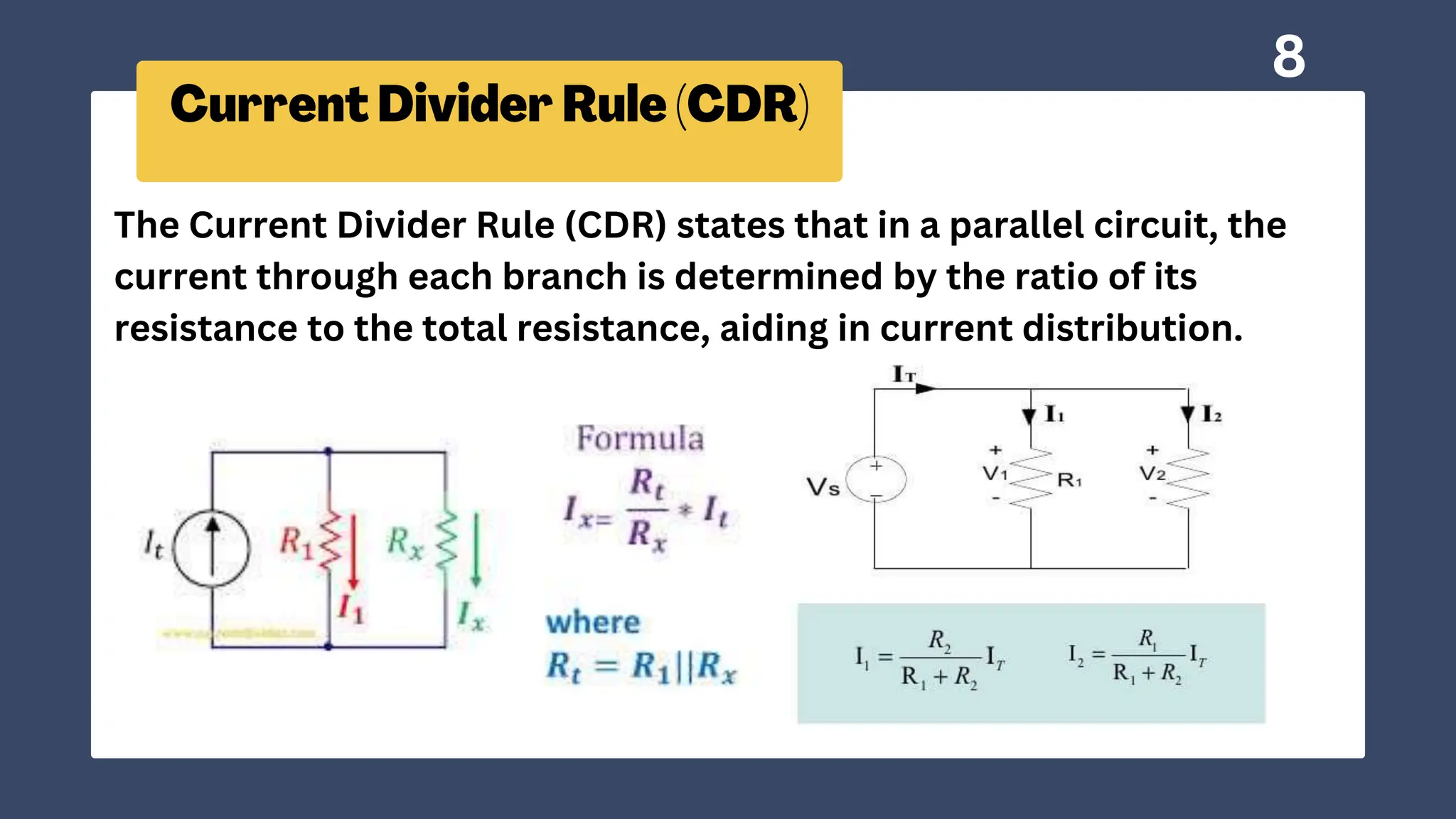
The Current Divider Rule (CDR) states that in a parallel circuit, the
current through each branch is determined by the ratio of its
resistance to the total resistance, aiding in current distribution.
8
Next Shuvo
9
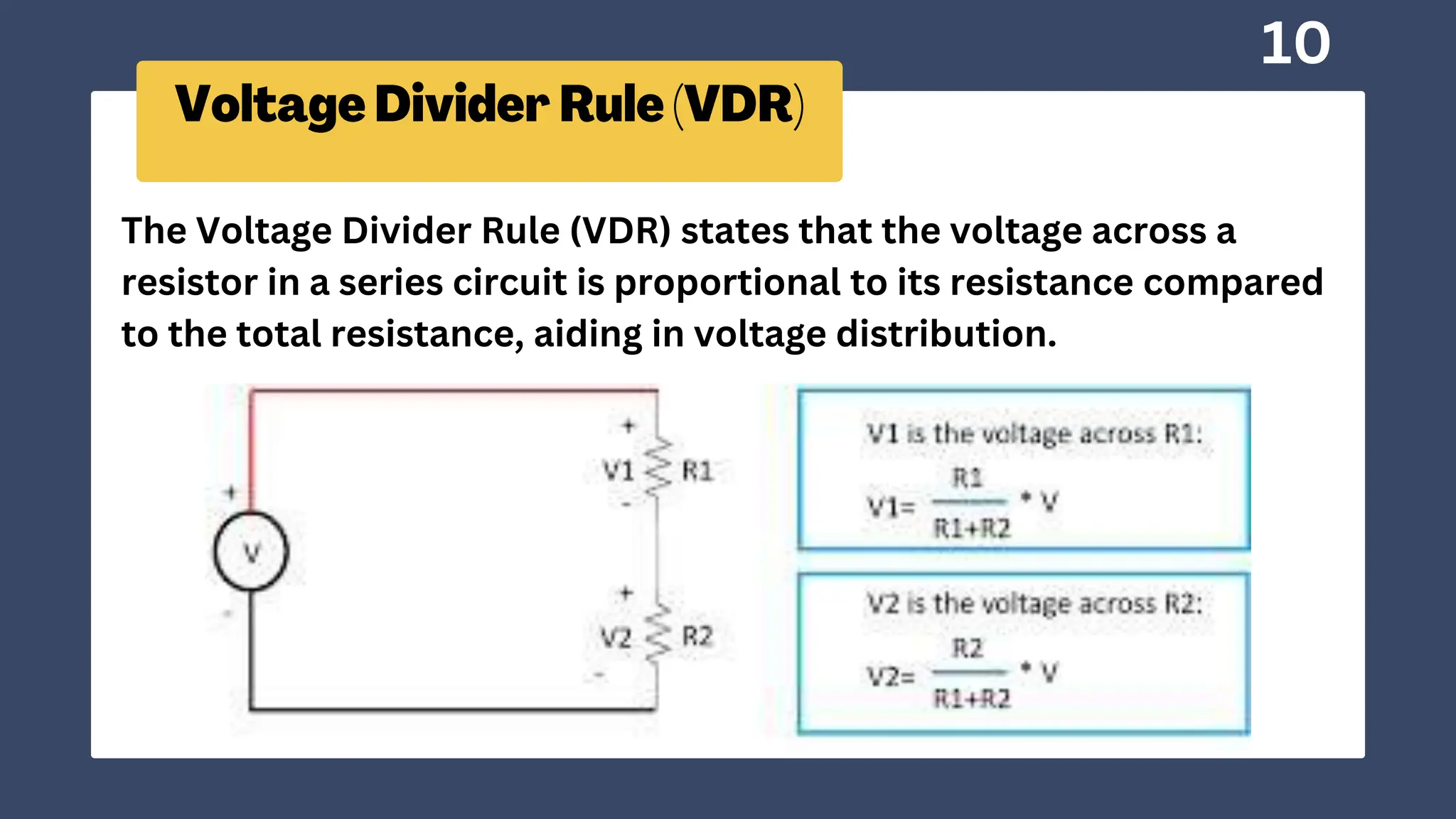
The Voltage Divider Rule (VDR) states that the voltage across a
resistor in a series circuit is proportional to its resistance compared
to the total resistance, aiding in voltage distribution.
10
Next Shovon
11
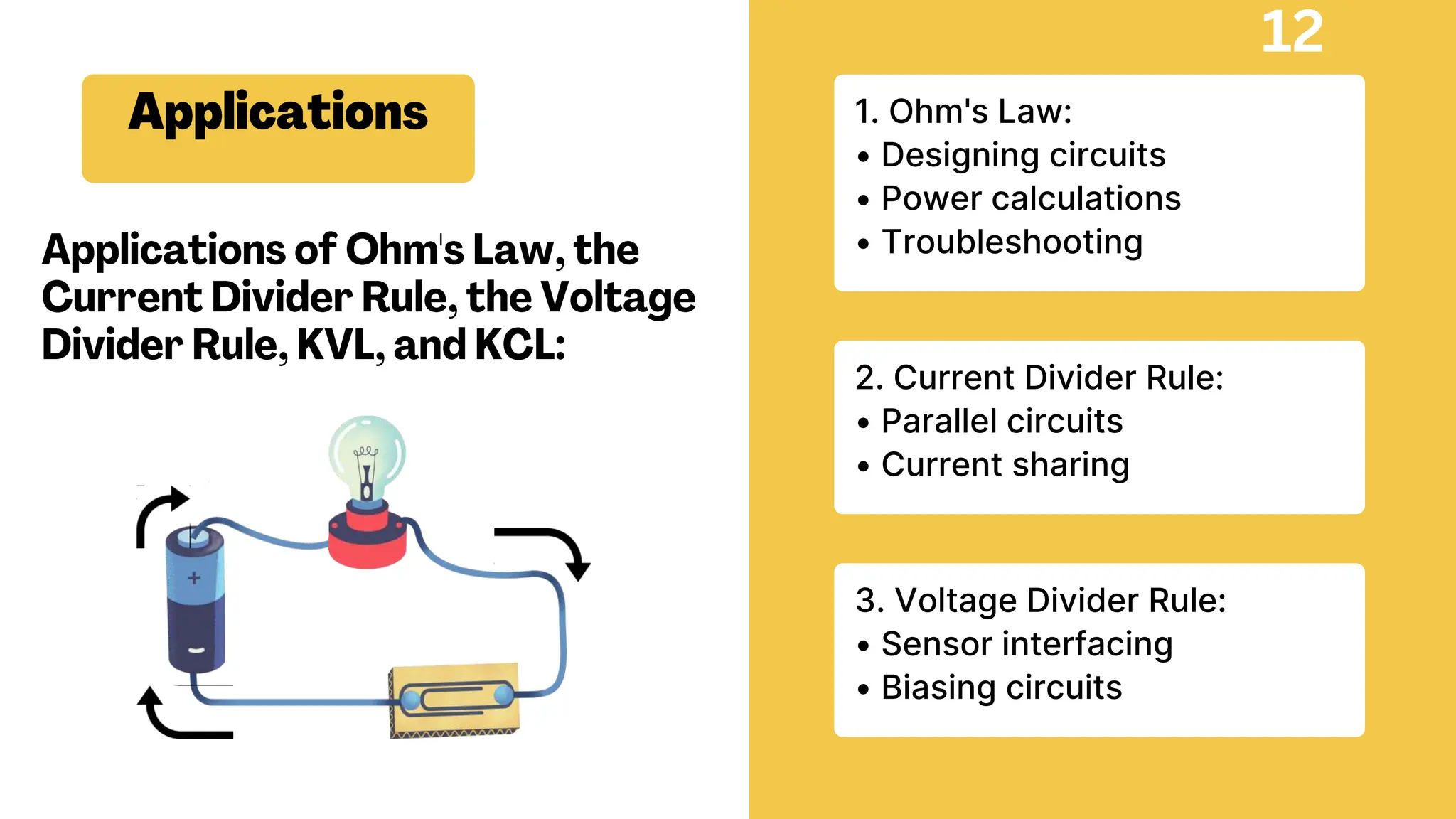
3. Voltage Divider Rule:
• Sensor interfacing
• Biasing circuits
1. Ohm's Law:
• Designing circuits
• Power calculations
• Troubleshooting
2. Current Divider Rule:
• Parallel circuits
• Current sharing
12
4. Kirchhoff's Voltage Law
(KVL):
• Loop analysis
• Mesh analysis
5. Kirchhoff's Current Law
(KCL):
• Node analysis
• Current conservation
13
Overall, these principles serve as
fundamental tools for electrical
engineers in designing, analyzing,
and troubleshooting circuits across
various applications, from electronic
devices to power systems.
14
WITH THE HELP OF YOUR TEACHER OR CARER,
TEST WHETHER YOUR SUGGESTIONS AND
DRAWINGS WILL MAKE THE BULB LIGHT USING
ACTUAL BATTERIES, A SMALL LIGHTBULB, AND
WIRES.
Q & A Session

Presentation on Electrical Circuit fundamental and Analysis || Electrical Circuit DIU

  • 1.
  • 2.
    Takowa Rahman Lecturer, Department ofCSE • Jannatul ferdous khondoker 232-15-937 • Md Arafat Hossain 232-15-948 • Mahadi Islam 232-15-934 • Shuvo karmaker 232-15-947 • Md Saifuddin Shovon 232-15-956
  • 3.
    • Ohm’s Law •Kirchhoff's Laws KVL & KCL • Current Divider Rule (CDR) • Voltage Divider Rule (VDR) • Application and Examples
  • 4.
    An electrical circuitis a closed loop enabling the flow of electric current, crucial for powering everyday devices and advancing technology. Understanding circuits is essential for • problem-solving • engineering applications • safety • Everyday Applications • Engineering Foundation 4
  • 5.
    Ohm's Law statesthat the current flowing through a conductor is directly proportional to the voltage across it, with resistance as the constant factor (V = I * R). It's a fundamental principle in electrical circuits, relating voltage, current, and resistance. Next Arafat 5
  • 6.
    Kirchhoff's Voltage Law(KVL) states that the total voltage in a closed loop is equal to the sum of individual voltage drops. 6
  • 7.
    Kirchhoff's Current Law(KCL) asserts that the total current entering a junction is equal to the total current leaving, ensuring conservation of electric charge. Next Mahadi 7
  • 8.
    The Current DividerRule (CDR) states that in a parallel circuit, the current through each branch is determined by the ratio of its resistance to the total resistance, aiding in current distribution. 8
  • 9.
  • 10.
    The Voltage DividerRule (VDR) states that the voltage across a resistor in a series circuit is proportional to its resistance compared to the total resistance, aiding in voltage distribution. 10
  • 11.
  • 12.
    3. Voltage DividerRule: • Sensor interfacing • Biasing circuits 1. Ohm's Law: • Designing circuits • Power calculations • Troubleshooting 2. Current Divider Rule: • Parallel circuits • Current sharing 12
  • 13.
    4. Kirchhoff's VoltageLaw (KVL): • Loop analysis • Mesh analysis 5. Kirchhoff's Current Law (KCL): • Node analysis • Current conservation 13
  • 14.
    Overall, these principlesserve as fundamental tools for electrical engineers in designing, analyzing, and troubleshooting circuits across various applications, from electronic devices to power systems. 14
  • 15.
    WITH THE HELPOF YOUR TEACHER OR CARER, TEST WHETHER YOUR SUGGESTIONS AND DRAWINGS WILL MAKE THE BULB LIGHT USING ACTUAL BATTERIES, A SMALL LIGHTBULB, AND WIRES. Q & A Session