WEBINAR:
BEYOND BUZZWORDS
What you need to know to develop your
packaging sustainability strategy
Today’s Presenter
Dr. Gerald Rebitzer
Director Sustainability
Amcor Flexibles
2
3
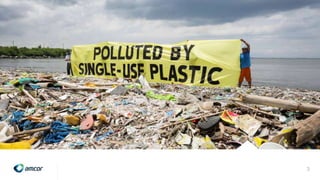
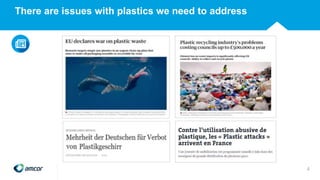
There are issues with plastics we need to address
4
MYTH 1: “BANNING THE USE OF
PLASTICS IN PACKAGING IS THE
BEST SOLUTION FOR THE
ENVIRONMENT”
5
+5-6 C
nightmare
+2 C
“safe” limit
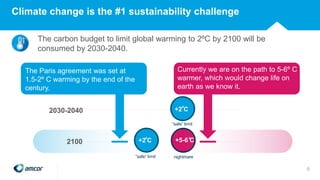
Climate change is the #1 sustainability challenge
6
The carbon budget to limit global warming to 2ºC by 2100 will be
consumed by 2030-2040.
2100
2030-2040 +2 C
“safe” limit
The Paris agreement was set at
1.5-2º C warming by the end of the
century.
Currently we are on the path to 5-6º C
warmer, which would change life on
earth as we know it.
°
°°
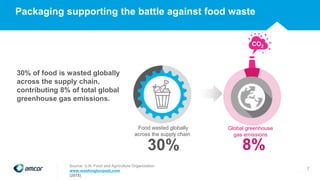
Packaging supporting the battle against food waste
Source: U.N. Food and Agriculture Organization
www.washingtonpost.com
(2018)
30%
CO2
8%
Food wasted globally
across the supply chain
Global greenhouse
gas emissions
7
30% of food is wasted globally
across the supply chain,
contributing 8% of total global
greenhouse gas emissions.
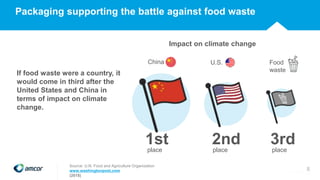
Packaging supporting the battle against food waste
8
1st 2nd 3rd
Source: U.N. Food and Agriculture Organization
www.washingtonpost.com
(2018)
U.S.China Food
waste
If food waste were a country, it
would come in third after the
United States and China in
terms of impact on climate
change.
Impact on climate change
place place place
Energy
supply
26%
Transport
13%Industry
19%
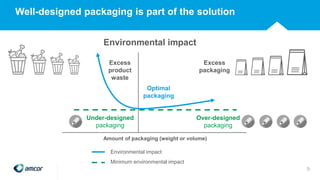
Environmental impact
Excess
product
waste
Optimal
packaging
Excess
packaging
Over-designed
packaging
Under-designed
packaging
Amount of packaging (weight or volume)
Environmental impact
Minimum environmental impact
Well-designed packaging is part of the solution
9
10
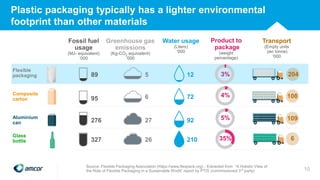
Fossil fuel
usage
(MJ- equivalent)
‘000
Greenhouse gas
emissions
(Kg-CO2 equivalent)
‘000
Water usage
(Liters)
‘000
Product to
package
(weight
percentage)
Transport
(Empty units
per tonne)
‘000
89 5 12 3% 204
95 6 72 4% 108
276 27 92 5% 109
327 26 210 35% 6
Flexible
packaging
Composite
carton
Aluminium
can
Glass
bottle
Plastic packaging typically has a lighter environmental
footprint than other materials
Source: Flexible Packaging Association (https://www.flexpack.org) - Extracted from “A Holistic View of
the Role of Flexible Packaging in a Sustainable World” report by PTIS (commissioned 3rd party) 10
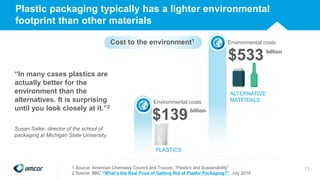
Plastic packaging typically has a lighter environmental
footprint than other materials
$139billion
$533
Environmental costs
billion
Environmental costs
PLASTICS
ALTERNATIVE
MATERIALS
11
Cost to the environment1
“In many cases plastics are
actually better for the
environment than the
alternatives. It is surprising
until you look closely at it.”2
Susan Selke: director of the school of
packaging at Michigan State University.
1 Source: American Chemistry Council and Trucost, “Plastics and Sustainability”
2 Source: BBC “What’s the Real Price of Getting Rid of Plastic Packaging?” July 2018
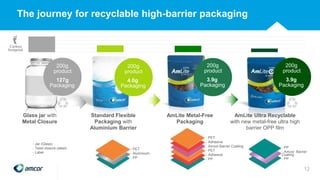
200g
product
127g
Packaging
200g
product
4.0g
Packaging
200g
product
3.9g
Packaging
200g
product
3.9g
Packaging
Glass jar with
Metal Closure
Standard Flexible
Packaging with
Aluminium Barrier
AmLite Metal-Free
Packaging
AmLite Ultra Recyclable
with new metal-free ultra high
barrier OPP film
- Jar (Glass)
- Twist closure (steel)
- Label
The journey for recyclable high-barrier packaging
12
- PP
- Amcor Barrier
Coating
- PP
- PET
- Adhesive
- Amcor Barrier Coating
- PET
- Adhesive
- PP
- PET
- Aluminium
- PP
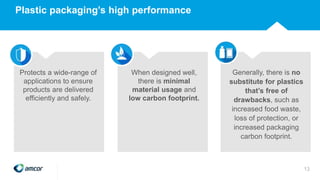
When designed well,
there is minimal
material usage and
low carbon footprint.
Generally, there is no
substitute for plastics
that’s free of
drawbacks, such as
increased food waste,
loss of protection, or
increased packaging
carbon footprint.
Protects a wide-range of
applications to ensure
products are delivered
efficiently and safely.
Plastic packaging’s high performance
13
MYTH 2: “IT’S HARD TO MAKE
PACKAGING MORE SUSTAINABLE
WITHOUT MAKING A DRAMATIC
SHIFT”
14
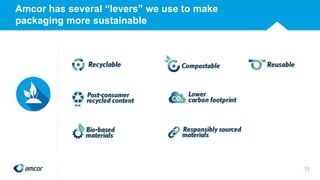
Amcor has several “levers” we use to make
packaging more sustainable
15
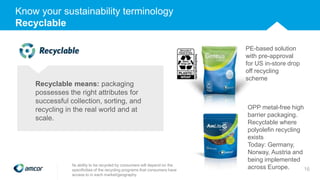
Recyclable means: packaging
possesses the right attributes for
successful collection, sorting, and
recycling in the real world and at
scale.
Its ability to be recycled by consumers will depend on the
specificities of the recycling programs that consumers have
access to in each market/geography.
PE-based solution
with pre-approval
for US in-store drop
off recycling
scheme
OPP metal-free high
barrier packaging.
Recyclable where
polyolefin recycling
exists
Today: Germany,
Norway, Austria and
being implemented
across Europe.
Know your sustainability terminology
Recyclable
16
*Based on the draft EMF Project Barrier guidelines, December 2018. Exceptions can be granted based on
certified recycling tests (e.g. cyclos HTP)
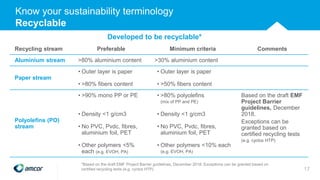
Recycling stream
Developed to be recyclable*
CommentsPreferable Minimum criteria
Aluminium stream >80% aluminium content >30% aluminium content
Paper stream
• Outer layer is paper
• >80% fibers content
• Outer layer is paper
• >50% fibers content
Polyolefins (PO)
stream
• >90% mono PP or PE
• Density <1 g/cm3
• No PVC, Pvdc, fibres,
aluminium foil, PET
• Other polymers <5%
each (e.g. EVOH, PA)
• >80% polyolefins
(mix of PP and PE)
• Density <1 g/cm3
• No PVC, Pvdc, fibres,
aluminium foil, PET
• Other polymers <10% each
(e.g. EVOH, PA)
Based on the draft EMF
Project Barrier
guidelines, December
2018.
Exceptions can be
granted based on
certified recycling tests
(e.g. cyclos HTP)
17
Know your sustainability terminology
Recyclable
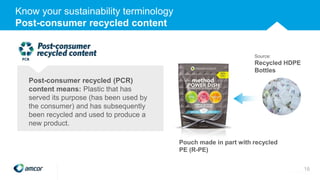
Post-consumer recycled (PCR)
content means: Plastic that has
served its purpose (has been used by
the consumer) and has subsequently
been recycled and used to produce a
new product.
Source:
Recycled HDPE
Bottles
Pouch made in part with recycled
PE (R-PE)
18
Know your sustainability terminology
Post-consumer recycled content
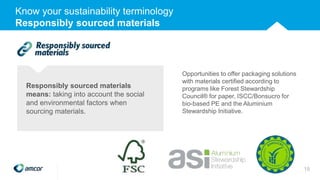
Responsibly sourced materials
means: taking into account the social
and environmental factors when
sourcing materials.
Opportunities to offer packaging solutions
with materials certified according to
programs like Forest Stewardship
Council® for paper, ISCC/Bonsucro for
bio-based PE and the Aluminium
Stewardship Initiative.
19
Know your sustainability terminology
Responsibly sourced materials
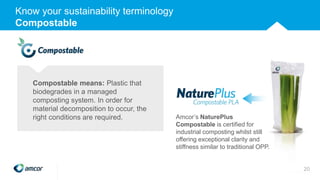
Compostable means: Plastic that
biodegrades in a managed
composting system. In order for
material decomposition to occur, the
right conditions are required. Amcor’s NaturePlus
Compostable is certified for
industrial composting whilst still
offering exceptional clarity and
stiffness similar to traditional OPP.
Know your sustainability terminology
Compostable
20
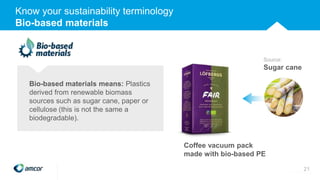
Bio-based materials means: Plastics
derived from renewable biomass
sources such as sugar cane, paper or
cellulose (this is not the same a
biodegradable).
Source:
Sugar cane
Coffee vacuum pack
made with bio-based PE
21
Know your sustainability terminology
Bio-based materials
22
Know your sustainability terminology
Reusable
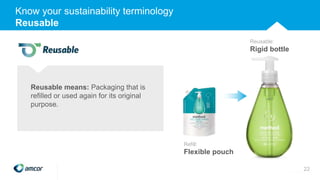
Reusable means: Packaging that is
refilled or used again for its original
purpose.
Refill:
Flexible pouch
Reusable:
Rigid bottle
How to measure and weigh the different options:
Lower carbon footprint and lifecycle impacts
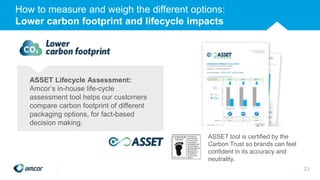
ASSET Lifecycle Assessment:
Amcor’s in-house life-cycle
assessment tool helps our customers
compare carbon footprint of different
packaging options, for fact-based
decision making.
ASSET tool is certified by the
Carbon Trust so brands can feel
confident in its accuracy and
neutrality.
23
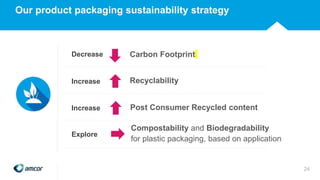
Carbon FootprintDecrease
RecyclabilityIncrease
Post Consumer Recycled contentIncrease
Explore
Compostability and Biodegradability
for plastic packaging, based on application
Our product packaging sustainability strategy
24
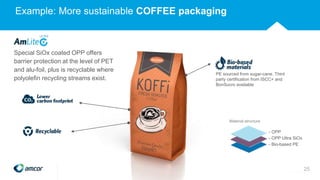
Example: More sustainable COFFEE packaging
PE sourced from sugar-cane. Third
party certification from ISCC+ and
BonSucro available
25
Special SiOx coated OPP offers
barrier protection at the level of PET
and alu-foil, plus is recyclable where
polyolefin recycling streams exist.
- OPP
- OPP Ultra SiOx
- Bio-based PE
Material structure
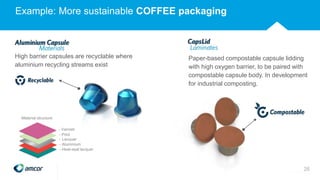
Example: More sustainable COFFEE packaging
26
- Aluminium
- Heat-seal lacquer
- Print
- Lacquer
- Varnish
Material structure
High barrier capsules are recyclable where
aluminium recycling streams exist
Paper-based compostable capsule lidding
with high oxygen barrier, to be paired with
compostable capsule body. In development
for industrial composting.
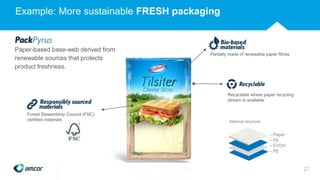
Example: More sustainable FRESH packaging
Paper-based base-web derived from
renewable sources that protects
product freshness.
Recyclable where paper recycling
stream is available
– Paper
– PE
– EVOH
– PE
Partially made of renewable paper fibres
Forest Stewardship Council (FSC)
certified materials Material structure
27
Example: More Sustainable SNACKS packaging
28
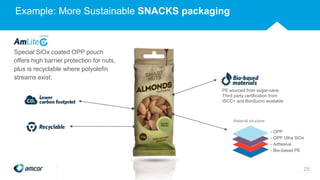
Special SiOx coated OPP pouch
offers high barrier protection for nuts,
plus is recyclable where polyolefin
streams exist.
PE sourced from sugar-cane.
Third party certification from
ISCC+ and BonSucro available
- OPP
- OPP Ultra SiOx
- Adhesive
- Bio-based PE
Material structure
Example: More Sustainable SNACKS packaging
29
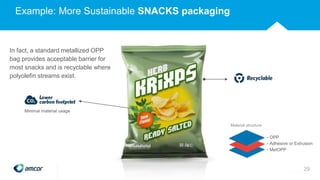
Material structure
- OPP
- Adhesive or Extrusion
- MetOPP
In fact, a standard metallized OPP
bag provides acceptable barrier for
most snacks and is recyclable where
polyolefin streams exist.
Minimal material usage
MYTH 3: “SUSTAINABLE
PACKAGING LEGISLATION IS TOO
FAR AWAY TO ACT NOW”
30
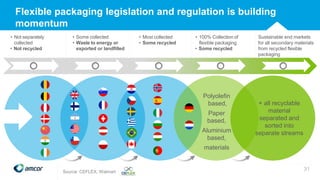
Flexible packaging legislation and regulation is building
momentum
• Not separately
collected
• Not recycled
• Some collected
• Waste to energy or
exported or landfilled
• Most collected
• Some recycled
• 100% Collection of
flexible packaging
• Some recycled
Sustainable end markets
for all secondary materials
from recycled flexible
packaging
31Source: CEFLEX, Walmart
Polyolefin
based,
Paper
based,
Aluminium
based,
materials
+ all recyclable
material
separated and
sorted into
separate streams
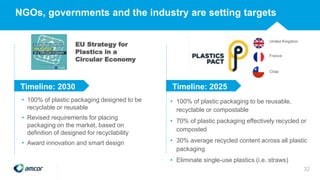
• 100% of plastic packaging to be reusable,
recyclable or compostable
• 70% of plastic packaging effectively recycled or
composted
• 30% average recycled content across all plastic
packaging
• Eliminate single-use plastics (i.e. straws)
EU Strategy for
Plastics in a
Circular Economy
• 100% of plastic packaging designed to be
recyclable or reusable
• Revised requirements for placing
packaging on the market, based on
definition of designed for recyclability
• Award innovation and smart design
Timeline: 2025Timeline: 2030
NGOs, governments and the industry are setting targets
32
United Kingdom
France
Chile
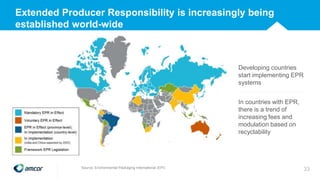
Extended Producer Responsibility is increasingly being
established world-wide
33
Developing countries
start implementing EPR
systems
In countries with EPR,
there is a trend of
increasing fees and
modulation based on
recyclability
Source: Environmental Packaging International (EPI)
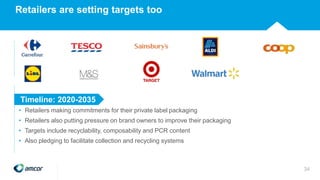
• Retailers making commitments for their private label packaging
• Retailers also putting pressure on brand owners to improve their packaging
• Targets include recyclability, composability and PCR content
• Also pledging to facilitate collection and recycling systems
Timeline: 2020-2035
Retailers are setting targets too
34
The whole value chain is committing
35
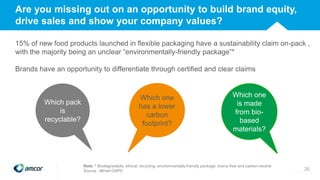
Are you missing out on an opportunity to build brand equity,
drive sales and show your company values?
15% of new food products launched in flexible packaging have a sustainability claim on-pack ,
with the majority being an unclear “environmentally-friendly package”*
Brands have an opportunity to differentiate through certified and clear claims
Note: * Biodegradable, ethical, recycling, environmentally friendly package, toxins-free and carbon-neutral
Source : Mintel GNPD
Which pack
is
recyclable?
Which one
has a lower
carbon
footprint?
Which one
is made
from bio-
based
materials?
36
MYTH 4: “IT’S NOT POSSIBLE TO
CONVEY CREDIBLE SUSTAINABILITY
MESSAGES TO CONSUMERS”
37
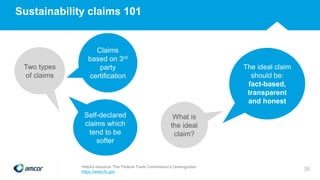
Sustainability claims 101
Two types
of claims
Claims
based on 3rd
party
certification
What is
the ideal
claim?
The ideal claim
should be:
fact-based,
transparent
and honest
38
Helpful resource: The Federal Trade Commission's Greenguides
https://www.ftc.gov
Self-declared
claims which
tend to be
softer
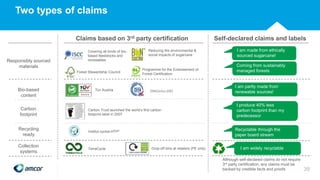
Two types of claims
Claims based on 3rd party certification Self-declared claims and labels
Responsibly sourced
materials
Recycling
ready
Carbon
footprint
Tüv Austria DINCertco (DE)
Forest Stewardship Council
Programme for the Endorsement of
Forest Certification
Institut cyclos-HTP2
Covering all kinds of bio-
based feedstocks and
renewables
Reducing the environmental &
social impacts of sugarcane
Bio-based
content
Carbon Trust launched the world’s first carbon
footprint label in 2007
Collection
systems
TerraCycle Drop-off bins at retailers (PE only)
I am made from ethically
sourced sugarcane!
Coming from sustainably
managed forests
I am partly made from
renewable sources!
I produce 40% less
carbon footprint than my
predecessor
Recyclable through the
paper board stream
Although self-declared claims do not require
3rd party certification, any claims must be
backed by credible facts and proofs 39
I am widely recyclable
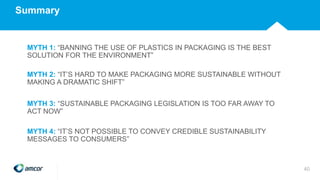
MYTH 4: “IT’S NOT POSSIBLE TO CONVEY CREDIBLE SUSTAINABILITY
MESSAGES TO CONSUMERS”
MYTH 3: “SUSTAINABLE PACKAGING LEGISLATION IS TOO FAR AWAY TO
ACT NOW”
MYTH 2: “IT’S HARD TO MAKE PACKAGING MORE SUSTAINABLE WITHOUT
MAKING A DRAMATIC SHIFT”
MYTH 1: “BANNING THE USE OF PLASTICS IN PACKAGING IS THE BEST
SOLUTION FOR THE ENVIRONMENT”
Summary
40
Gerald Rebitzer
May 28, 2019
www.linkedin.com/in/gerald-rebitzer-sustainability

Amcor: packaging sustainability webinar, May 28th 2019

  • 1.
    WEBINAR: BEYOND BUZZWORDS What youneed to know to develop your packaging sustainability strategy
  • 2.
    Today’s Presenter Dr. GeraldRebitzer Director Sustainability Amcor Flexibles 2
  • 3.
  • 4.
    There are issueswith plastics we need to address 4
  • 5.
    MYTH 1: “BANNINGTHE USE OF PLASTICS IN PACKAGING IS THE BEST SOLUTION FOR THE ENVIRONMENT” 5
  • 6.
    +5-6 C nightmare +2 C “safe”limit Climate change is the #1 sustainability challenge 6 The carbon budget to limit global warming to 2ºC by 2100 will be consumed by 2030-2040. 2100 2030-2040 +2 C “safe” limit The Paris agreement was set at 1.5-2º C warming by the end of the century. Currently we are on the path to 5-6º C warmer, which would change life on earth as we know it. ° °°
  • 7.
    Packaging supporting thebattle against food waste Source: U.N. Food and Agriculture Organization www.washingtonpost.com (2018) 30% CO2 8% Food wasted globally across the supply chain Global greenhouse gas emissions 7 30% of food is wasted globally across the supply chain, contributing 8% of total global greenhouse gas emissions.
  • 8.
    Packaging supporting thebattle against food waste 8 1st 2nd 3rd Source: U.N. Food and Agriculture Organization www.washingtonpost.com (2018) U.S.China Food waste If food waste were a country, it would come in third after the United States and China in terms of impact on climate change. Impact on climate change place place place
  • 9.
    Energy supply 26% Transport 13%Industry 19% Environmental impact Excess product waste Optimal packaging Excess packaging Over-designed packaging Under-designed packaging Amount ofpackaging (weight or volume) Environmental impact Minimum environmental impact Well-designed packaging is part of the solution 9
  • 10.
    10 Fossil fuel usage (MJ- equivalent) ‘000 Greenhousegas emissions (Kg-CO2 equivalent) ‘000 Water usage (Liters) ‘000 Product to package (weight percentage) Transport (Empty units per tonne) ‘000 89 5 12 3% 204 95 6 72 4% 108 276 27 92 5% 109 327 26 210 35% 6 Flexible packaging Composite carton Aluminium can Glass bottle Plastic packaging typically has a lighter environmental footprint than other materials Source: Flexible Packaging Association (https://www.flexpack.org) - Extracted from “A Holistic View of the Role of Flexible Packaging in a Sustainable World” report by PTIS (commissioned 3rd party) 10
  • 11.
    Plastic packaging typicallyhas a lighter environmental footprint than other materials $139billion $533 Environmental costs billion Environmental costs PLASTICS ALTERNATIVE MATERIALS 11 Cost to the environment1 “In many cases plastics are actually better for the environment than the alternatives. It is surprising until you look closely at it.”2 Susan Selke: director of the school of packaging at Michigan State University. 1 Source: American Chemistry Council and Trucost, “Plastics and Sustainability” 2 Source: BBC “What’s the Real Price of Getting Rid of Plastic Packaging?” July 2018
  • 12.
    200g product 127g Packaging 200g product 4.0g Packaging 200g product 3.9g Packaging 200g product 3.9g Packaging Glass jar with MetalClosure Standard Flexible Packaging with Aluminium Barrier AmLite Metal-Free Packaging AmLite Ultra Recyclable with new metal-free ultra high barrier OPP film - Jar (Glass) - Twist closure (steel) - Label The journey for recyclable high-barrier packaging 12 - PP - Amcor Barrier Coating - PP - PET - Adhesive - Amcor Barrier Coating - PET - Adhesive - PP - PET - Aluminium - PP
  • 13.
    When designed well, thereis minimal material usage and low carbon footprint. Generally, there is no substitute for plastics that’s free of drawbacks, such as increased food waste, loss of protection, or increased packaging carbon footprint. Protects a wide-range of applications to ensure products are delivered efficiently and safely. Plastic packaging’s high performance 13
  • 14.
    MYTH 2: “IT’SHARD TO MAKE PACKAGING MORE SUSTAINABLE WITHOUT MAKING A DRAMATIC SHIFT” 14
  • 15.
    Amcor has several“levers” we use to make packaging more sustainable 15
  • 16.
    Recyclable means: packaging possessesthe right attributes for successful collection, sorting, and recycling in the real world and at scale. Its ability to be recycled by consumers will depend on the specificities of the recycling programs that consumers have access to in each market/geography. PE-based solution with pre-approval for US in-store drop off recycling scheme OPP metal-free high barrier packaging. Recyclable where polyolefin recycling exists Today: Germany, Norway, Austria and being implemented across Europe. Know your sustainability terminology Recyclable 16
  • 17.
    *Based on thedraft EMF Project Barrier guidelines, December 2018. Exceptions can be granted based on certified recycling tests (e.g. cyclos HTP) Recycling stream Developed to be recyclable* CommentsPreferable Minimum criteria Aluminium stream >80% aluminium content >30% aluminium content Paper stream • Outer layer is paper • >80% fibers content • Outer layer is paper • >50% fibers content Polyolefins (PO) stream • >90% mono PP or PE • Density <1 g/cm3 • No PVC, Pvdc, fibres, aluminium foil, PET • Other polymers <5% each (e.g. EVOH, PA) • >80% polyolefins (mix of PP and PE) • Density <1 g/cm3 • No PVC, Pvdc, fibres, aluminium foil, PET • Other polymers <10% each (e.g. EVOH, PA) Based on the draft EMF Project Barrier guidelines, December 2018. Exceptions can be granted based on certified recycling tests (e.g. cyclos HTP) 17 Know your sustainability terminology Recyclable
  • 18.
    Post-consumer recycled (PCR) contentmeans: Plastic that has served its purpose (has been used by the consumer) and has subsequently been recycled and used to produce a new product. Source: Recycled HDPE Bottles Pouch made in part with recycled PE (R-PE) 18 Know your sustainability terminology Post-consumer recycled content
  • 19.
    Responsibly sourced materials means:taking into account the social and environmental factors when sourcing materials. Opportunities to offer packaging solutions with materials certified according to programs like Forest Stewardship Council® for paper, ISCC/Bonsucro for bio-based PE and the Aluminium Stewardship Initiative. 19 Know your sustainability terminology Responsibly sourced materials
  • 20.
    Compostable means: Plasticthat biodegrades in a managed composting system. In order for material decomposition to occur, the right conditions are required. Amcor’s NaturePlus Compostable is certified for industrial composting whilst still offering exceptional clarity and stiffness similar to traditional OPP. Know your sustainability terminology Compostable 20
  • 21.
    Bio-based materials means:Plastics derived from renewable biomass sources such as sugar cane, paper or cellulose (this is not the same a biodegradable). Source: Sugar cane Coffee vacuum pack made with bio-based PE 21 Know your sustainability terminology Bio-based materials
  • 22.
    22 Know your sustainabilityterminology Reusable Reusable means: Packaging that is refilled or used again for its original purpose. Refill: Flexible pouch Reusable: Rigid bottle
  • 23.
    How to measureand weigh the different options: Lower carbon footprint and lifecycle impacts ASSET Lifecycle Assessment: Amcor’s in-house life-cycle assessment tool helps our customers compare carbon footprint of different packaging options, for fact-based decision making. ASSET tool is certified by the Carbon Trust so brands can feel confident in its accuracy and neutrality. 23
  • 24.
    Carbon FootprintDecrease RecyclabilityIncrease Post ConsumerRecycled contentIncrease Explore Compostability and Biodegradability for plastic packaging, based on application Our product packaging sustainability strategy 24
  • 25.
    Example: More sustainableCOFFEE packaging PE sourced from sugar-cane. Third party certification from ISCC+ and BonSucro available 25 Special SiOx coated OPP offers barrier protection at the level of PET and alu-foil, plus is recyclable where polyolefin recycling streams exist. - OPP - OPP Ultra SiOx - Bio-based PE Material structure
  • 26.
    Example: More sustainableCOFFEE packaging 26 - Aluminium - Heat-seal lacquer - Print - Lacquer - Varnish Material structure High barrier capsules are recyclable where aluminium recycling streams exist Paper-based compostable capsule lidding with high oxygen barrier, to be paired with compostable capsule body. In development for industrial composting.
  • 27.
    Example: More sustainableFRESH packaging Paper-based base-web derived from renewable sources that protects product freshness. Recyclable where paper recycling stream is available – Paper – PE – EVOH – PE Partially made of renewable paper fibres Forest Stewardship Council (FSC) certified materials Material structure 27
  • 28.
    Example: More SustainableSNACKS packaging 28 Special SiOx coated OPP pouch offers high barrier protection for nuts, plus is recyclable where polyolefin streams exist. PE sourced from sugar-cane. Third party certification from ISCC+ and BonSucro available - OPP - OPP Ultra SiOx - Adhesive - Bio-based PE Material structure
  • 29.
    Example: More SustainableSNACKS packaging 29 Material structure - OPP - Adhesive or Extrusion - MetOPP In fact, a standard metallized OPP bag provides acceptable barrier for most snacks and is recyclable where polyolefin streams exist. Minimal material usage
  • 30.
    MYTH 3: “SUSTAINABLE PACKAGINGLEGISLATION IS TOO FAR AWAY TO ACT NOW” 30
  • 31.
    Flexible packaging legislationand regulation is building momentum • Not separately collected • Not recycled • Some collected • Waste to energy or exported or landfilled • Most collected • Some recycled • 100% Collection of flexible packaging • Some recycled Sustainable end markets for all secondary materials from recycled flexible packaging 31Source: CEFLEX, Walmart Polyolefin based, Paper based, Aluminium based, materials + all recyclable material separated and sorted into separate streams
  • 32.
    • 100% ofplastic packaging to be reusable, recyclable or compostable • 70% of plastic packaging effectively recycled or composted • 30% average recycled content across all plastic packaging • Eliminate single-use plastics (i.e. straws) EU Strategy for Plastics in a Circular Economy • 100% of plastic packaging designed to be recyclable or reusable • Revised requirements for placing packaging on the market, based on definition of designed for recyclability • Award innovation and smart design Timeline: 2025Timeline: 2030 NGOs, governments and the industry are setting targets 32 United Kingdom France Chile
  • 33.
    Extended Producer Responsibilityis increasingly being established world-wide 33 Developing countries start implementing EPR systems In countries with EPR, there is a trend of increasing fees and modulation based on recyclability Source: Environmental Packaging International (EPI)
  • 34.
    • Retailers makingcommitments for their private label packaging • Retailers also putting pressure on brand owners to improve their packaging • Targets include recyclability, composability and PCR content • Also pledging to facilitate collection and recycling systems Timeline: 2020-2035 Retailers are setting targets too 34
  • 35.
    The whole valuechain is committing 35
  • 36.
    Are you missingout on an opportunity to build brand equity, drive sales and show your company values? 15% of new food products launched in flexible packaging have a sustainability claim on-pack , with the majority being an unclear “environmentally-friendly package”* Brands have an opportunity to differentiate through certified and clear claims Note: * Biodegradable, ethical, recycling, environmentally friendly package, toxins-free and carbon-neutral Source : Mintel GNPD Which pack is recyclable? Which one has a lower carbon footprint? Which one is made from bio- based materials? 36
  • 37.
    MYTH 4: “IT’SNOT POSSIBLE TO CONVEY CREDIBLE SUSTAINABILITY MESSAGES TO CONSUMERS” 37
  • 38.
    Sustainability claims 101 Twotypes of claims Claims based on 3rd party certification What is the ideal claim? The ideal claim should be: fact-based, transparent and honest 38 Helpful resource: The Federal Trade Commission's Greenguides https://www.ftc.gov Self-declared claims which tend to be softer
  • 39.
    Two types ofclaims Claims based on 3rd party certification Self-declared claims and labels Responsibly sourced materials Recycling ready Carbon footprint Tüv Austria DINCertco (DE) Forest Stewardship Council Programme for the Endorsement of Forest Certification Institut cyclos-HTP2 Covering all kinds of bio- based feedstocks and renewables Reducing the environmental & social impacts of sugarcane Bio-based content Carbon Trust launched the world’s first carbon footprint label in 2007 Collection systems TerraCycle Drop-off bins at retailers (PE only) I am made from ethically sourced sugarcane! Coming from sustainably managed forests I am partly made from renewable sources! I produce 40% less carbon footprint than my predecessor Recyclable through the paper board stream Although self-declared claims do not require 3rd party certification, any claims must be backed by credible facts and proofs 39 I am widely recyclable
  • 40.
    MYTH 4: “IT’SNOT POSSIBLE TO CONVEY CREDIBLE SUSTAINABILITY MESSAGES TO CONSUMERS” MYTH 3: “SUSTAINABLE PACKAGING LEGISLATION IS TOO FAR AWAY TO ACT NOW” MYTH 2: “IT’S HARD TO MAKE PACKAGING MORE SUSTAINABLE WITHOUT MAKING A DRAMATIC SHIFT” MYTH 1: “BANNING THE USE OF PLASTICS IN PACKAGING IS THE BEST SOLUTION FOR THE ENVIRONMENT” Summary 40
  • 41.
    Gerald Rebitzer May 28,2019 www.linkedin.com/in/gerald-rebitzer-sustainability

Editor's Notes

  • #4 We know there is a challenge. (Show our understanding and build credibility with the audience – we are not going to tell them there is no issue – which is what they may expect from a packaging expert)
  • #6 However, even though there is an issue that needs to be understand and solved – banning the use of plastics in packaging is not the best solution for the environment…
  • #7 Climate change is still the #1 sustainability challenge. THE CARBON BUDGET TO LIMIT GLOBAL WARMING TO 2°C WILL BE CONSUMED BY 2030-2040. Paris climate agreement 1.5 -2 degrees warming but we are on the path to 5-6 by 2100, in our children’s or grandchildren’s lifetime. Before 2050 we need to be at net zero Global greenhouse gases. Cannot loose sight of issues like carbon footprint and food waste.
  • #8 Food waste is a large contributor to the climate change battle.
  • #11 - The chart figures are based on a Single Serve Juice Packaging Comparison Summary. - The Flexible Packaging Association is the U.S. association of the manufacturers of flexible packaging; and, material or equipment suppliers to the industry PTIS, LLC is a leading business and technology management company focused on Creating Value Through Packaging© and helping clients throughout the packaging value chain develop long term packaging strategies and programs. When we look at all the environmental impacts of different types of packaging, plastic packaging actually has a lower carbon footprint than cartons, aluminium cans or glass bottles. This is in large part because it’s extremely lightweight and resource efficient. On average, high barrier flexibles packaging only weighs 3% of the total packaged product – it excels at the “Reduce” part of the 3 Rs (Reduce, Reuse, Recycle).
  • #13 The evolution from glass to flexible packaging in practice. Key message: carbon footprint reduction + recyclability + barrier protection
  • #15 But how do you make that shift? How do brands choose the right packaging for their products? Can more sustainable packaging be easily achieved? The short answer is yes… Note: there is perception in the audience that switching to more sustainable materials requires big changes mechanically and technically. These slides need to address this misconception.
  • #16 More sustainable packaging is more than recycling. At Amcor we use 7 levers to assess how we can make packaging more sustainable. And these are levers you can also use to assess your packaging choices as you develop your strategy.
  • #17 Amcor experts can support you in navigating the complexity of recycling - across various streams and also across different markets.
  • #18 Global relevance
  • #19 Established in PET beverage bottles. Now being expanded into flexibles. Today mainly used in flexibles for non-food applications. Work to bring it safely to food applications as well.
  • #20 Amcor can support in the certification process. Every step in the value change needs to be certified. ASI we have 2 sites being certified, and customer needs to get their site certified. There’s some on-boarding cost up front. FSC for example is very well established with clear processes.
  • #21 This is one that risks being a buzzword as it requires specific collection and conditions to be composted – otherwise it’s just waste. There are certifications for compostable – home and industrial. Check study on compostable grocery shopping bags. It does make sense for certain applications where organic waste is composted with the packaging (i.e. fresh product or coffee capsules). Explain difference between compostable and biodegradable here or on the next slide.
  • #22 Be careful with terminology: Bio-based is not the same as biodegrable. Bio-based is…. Talk about reduced CFP.
  • #24 A way to measure the true cost in context of material sourcing, recycling, climate change, etc.
  • #26 Let’s see these levers in practice showing you how they can be applied to real products. Make the point on one of these product slides that switching to a recyclable laminate is a relatively easy and quick switch for brands which doesn’t need to impact their production processes. Amcor experts can provide more insights and specific guidance.
  • #33 The UK Plastic Pact: Trailblazing, collaborative initiative, delivered by WRAP (Waste & Resources Action Programme, a registered charity) that will create a circular economy for plastics
  • #37 This slide is key for refuting this myth. The legislation is coming, the regulation will arrive but even if that feels far off, the key driver now is consumer demand. Consumers are aware of the challenges with ocean plastics and plastics pollution. They are choosing brands which address this challenge. Your brand has the opportunity to differentiate now.
  • #40 Amcor can support you in navigating these on-pack claims and how to apply for the relevant 3rd party certifications.