DOCTRINE OF 
SEVERABILITY 
KUNAL BASU
WHAT DOES SEVERABILITY 
MEAN? 
Latin Origin: Salvatorious 
estrange, separate, isolate or segregate 
Legal dictionaries: “...that which is capable 
of being separated from other things to 
which it is joined and maintaining 
nonetheless a complete and independent 
existence.”
WHAT DOES SEVERABILITY 
MEAN? 
CONSTITUTIONAL MEANING 
If an offending and inappropriate provision 
of statutory legislation can be separated 
from that portion of the statute which is 
deemed to be of a valid and constitutional 
nature, then only that part which is 
offending and repugnant shall be declared 
as being void, and not the entire statute 
itself.
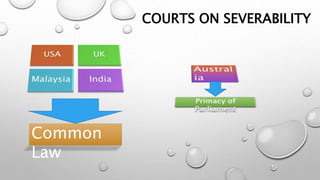
COURTS ON SEVERABILITY 
Common 
Law
DOCTRINE OF SEVERABILITY IN THE 
Originates in the UcKase of Nordfelt v. 
Maxim Nordfelt Guns and Ammunition 
Company Ltd(1894) 
Principle of restrictive trade practices 
utilized as against the concept of fair 
competition 
First recorded case in English history ever 
known to apply this judicial doctrine to a 
case
DOCTRINE OF SEVERABILITY IN 
USA 
Applied in the case of United States v. Reese(1876) & Reiterated in 
Champlin Refining Co. v. Corp. Comm. of Oklahoma(1932) 
The concept of successful separation of the void & statutory 
legislation from the invalid part without causing the latter(void 
statute)from being dependent on the former(valid statute) 
Ayotte v. Planned Parenthood of N. New Eng: The court laid down 
three principles of severability, “first, we try not to nullify more of a 
legislature's work than is necessary . . . . second . . . we restrain 
ourselves from rewriting state law to conform it to constitutional 
requirements even as we strive to salvage it. Third . . . a court cannot 
use its remedial powers to circumvent the intent of the legislature.”
DOCTRINE OF SEVERABILITY IN 
AUSTRALIA 
Doctrine written into law under S. 15A of the Acts Interpretation 
Act 1901 limits jurisdiction of courts 
Limitation-I: If there are a number of possible ways of reading 
down a provision of general application, it will not be so read 
down unless the Parliament indicates which supporting heads of 
legislative power it is relying on 
Limitation-II: A provision of general application will not be read 
down unless Parliament indicates an intention that the provision 
is to have a distributive operation 
Test of reasonability such as restriction(s) on trade
DOCTRINE OF SEVERABILITY IN INDIA-I 
Art. 13 (1) All laws in force in the territory of India immediately before 
the commencement of this Constitution, in so far as they are 
inconsistent with the provisions of this Part, shall, to the extent of such 
inconsistency, be void. 
Art. 13(2): The State shall not make any law, which takes away or 
abridges the rights conferred by this Part and any law made in 
contravention of this clause shall, to the extent of the contravention, be 
void. 
Art. 13(3)(b): Includes ‘laws passed or made by a legislature or other 
competent authority in the territory of India before the commencement 
of the constitution not previously repealed including customs and 
usages and also the laws passed by the British Parliament and applicable 
to India like the Fugitive Offenders’ Act 1881.
DOCTRINE OF SEVERABILITY IN INDIA-II 
RMDC V. UNION OF INDIA 
Intention of the legislature will determine whether the valid part of a 
statute is severable from the invalid parts 
If the valid and invalid provisions are so inextricably mixed up that they 
cannot be separated from another, then the invalidity of a portion must 
result in the invalidity of the Act in its entirety. 
On the other hand, if they are so distinct and separate that after striking 
out what is invalid what remains is itself a complete code independent of 
the rest, then it will be upheld notwithstanding that the rest had become 
unenforceable.
DOCTRINE OF SEVERABILITY IN INDIA-III 
R.M.D. Chamarbaugwalla v. The Union of India 
Courts would be reluctant to declare a law invalid or ultra 
vires on account of unconstitutionality. 
Courts would accept an interpretation, which would be in 
favor of constitutionality rather than the one which would 
render the law unconstitutional……. 
The court can resort to reading down a law in order to save it 
from being rendered unconstitutional. But while doing so, it 
cannot change the essence of the law and create a new law 
which in its opinion is more desirable.
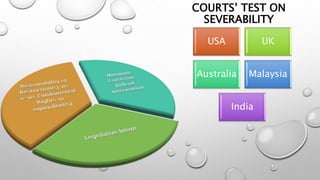
COURTS’ TEST ON 
SEVERABILITY 
USA UK 
Australia Malaysia 
India
SOME IMPORTANT CASES 
CITED 
Nordenfelt v. Maxim Nordenfelt Guns and Ammunition 
Company Ltd 
United States v. Reese 
Champlin Refining Co. v. Corp. Commission of Oklahoma Ayotte v. Planned Parenthood of N. New Eng. 
Cardegna. V Buckeye Check Cashing Free Enterprise Fund v. Public Co. Accounting 
Oversight Board 
The King v. Poole; Ex Parte Henry Adamson v New South Wales Rugby League Ltd 
Lloyd’s Ships Holdings Pty Ltd v Davros Pty Ltd Malaysian Bar & Anr. V. Government of Malaysia 
Datuk Haji Harun bin Idris v Public Prosecutor Poindexter v Greenhow 
Pannalal Binjraj v Union of India Shankri Prasad v Union of Ind 
Sajjan Singh v State of Rajasthan L.C. Golaknath v State of Punjab 
Kesavananda Bharati v State of Kerala AK Gopalan v State of Madras 
RMDC v Union of India Keshavan Madhava Menon v. The State of Bombay 
Bhikaji Narain Dhakras and Others v. The State Of Madhya 
Deep Chand v State of UP 
Pradesh and Anr 
Mahendralal Jaini v State State of Gujarat v Shri Ambica Mills 
Romesh Thapar v. State of Madras DS Nakara v. Union of India 
State of Bombay v. F.N. Balsara R.M.D. Chamarbaugwalla v. The Union of India
THANK YOU 
Johann Christiaan Kriegler* 
If the good is not dependent on the bad and can be separated from 
it, one gives effect to the good that remains after the separation if 
it still gives effect to the main objective 
* Former Constitutional Court and Appeal Court judge from South Africa

Presentation on Doctrine of Severability

  • 1.
  • 2.
    WHAT DOES SEVERABILITY MEAN? Latin Origin: Salvatorious estrange, separate, isolate or segregate Legal dictionaries: “...that which is capable of being separated from other things to which it is joined and maintaining nonetheless a complete and independent existence.”
  • 3.
    WHAT DOES SEVERABILITY MEAN? CONSTITUTIONAL MEANING If an offending and inappropriate provision of statutory legislation can be separated from that portion of the statute which is deemed to be of a valid and constitutional nature, then only that part which is offending and repugnant shall be declared as being void, and not the entire statute itself.
  • 4.
  • 5.
    DOCTRINE OF SEVERABILITYIN THE Originates in the UcKase of Nordfelt v. Maxim Nordfelt Guns and Ammunition Company Ltd(1894) Principle of restrictive trade practices utilized as against the concept of fair competition First recorded case in English history ever known to apply this judicial doctrine to a case
  • 6.
    DOCTRINE OF SEVERABILITYIN USA Applied in the case of United States v. Reese(1876) & Reiterated in Champlin Refining Co. v. Corp. Comm. of Oklahoma(1932) The concept of successful separation of the void & statutory legislation from the invalid part without causing the latter(void statute)from being dependent on the former(valid statute) Ayotte v. Planned Parenthood of N. New Eng: The court laid down three principles of severability, “first, we try not to nullify more of a legislature's work than is necessary . . . . second . . . we restrain ourselves from rewriting state law to conform it to constitutional requirements even as we strive to salvage it. Third . . . a court cannot use its remedial powers to circumvent the intent of the legislature.”
  • 7.
    DOCTRINE OF SEVERABILITYIN AUSTRALIA Doctrine written into law under S. 15A of the Acts Interpretation Act 1901 limits jurisdiction of courts Limitation-I: If there are a number of possible ways of reading down a provision of general application, it will not be so read down unless the Parliament indicates which supporting heads of legislative power it is relying on Limitation-II: A provision of general application will not be read down unless Parliament indicates an intention that the provision is to have a distributive operation Test of reasonability such as restriction(s) on trade
  • 8.
    DOCTRINE OF SEVERABILITYIN INDIA-I Art. 13 (1) All laws in force in the territory of India immediately before the commencement of this Constitution, in so far as they are inconsistent with the provisions of this Part, shall, to the extent of such inconsistency, be void. Art. 13(2): The State shall not make any law, which takes away or abridges the rights conferred by this Part and any law made in contravention of this clause shall, to the extent of the contravention, be void. Art. 13(3)(b): Includes ‘laws passed or made by a legislature or other competent authority in the territory of India before the commencement of the constitution not previously repealed including customs and usages and also the laws passed by the British Parliament and applicable to India like the Fugitive Offenders’ Act 1881.
  • 9.
    DOCTRINE OF SEVERABILITYIN INDIA-II RMDC V. UNION OF INDIA Intention of the legislature will determine whether the valid part of a statute is severable from the invalid parts If the valid and invalid provisions are so inextricably mixed up that they cannot be separated from another, then the invalidity of a portion must result in the invalidity of the Act in its entirety. On the other hand, if they are so distinct and separate that after striking out what is invalid what remains is itself a complete code independent of the rest, then it will be upheld notwithstanding that the rest had become unenforceable.
  • 10.
    DOCTRINE OF SEVERABILITYIN INDIA-III R.M.D. Chamarbaugwalla v. The Union of India Courts would be reluctant to declare a law invalid or ultra vires on account of unconstitutionality. Courts would accept an interpretation, which would be in favor of constitutionality rather than the one which would render the law unconstitutional……. The court can resort to reading down a law in order to save it from being rendered unconstitutional. But while doing so, it cannot change the essence of the law and create a new law which in its opinion is more desirable.
  • 11.
    COURTS’ TEST ON SEVERABILITY USA UK Australia Malaysia India
  • 12.
    SOME IMPORTANT CASES CITED Nordenfelt v. Maxim Nordenfelt Guns and Ammunition Company Ltd United States v. Reese Champlin Refining Co. v. Corp. Commission of Oklahoma Ayotte v. Planned Parenthood of N. New Eng. Cardegna. V Buckeye Check Cashing Free Enterprise Fund v. Public Co. Accounting Oversight Board The King v. Poole; Ex Parte Henry Adamson v New South Wales Rugby League Ltd Lloyd’s Ships Holdings Pty Ltd v Davros Pty Ltd Malaysian Bar & Anr. V. Government of Malaysia Datuk Haji Harun bin Idris v Public Prosecutor Poindexter v Greenhow Pannalal Binjraj v Union of India Shankri Prasad v Union of Ind Sajjan Singh v State of Rajasthan L.C. Golaknath v State of Punjab Kesavananda Bharati v State of Kerala AK Gopalan v State of Madras RMDC v Union of India Keshavan Madhava Menon v. The State of Bombay Bhikaji Narain Dhakras and Others v. The State Of Madhya Deep Chand v State of UP Pradesh and Anr Mahendralal Jaini v State State of Gujarat v Shri Ambica Mills Romesh Thapar v. State of Madras DS Nakara v. Union of India State of Bombay v. F.N. Balsara R.M.D. Chamarbaugwalla v. The Union of India
  • 13.
    THANK YOU JohannChristiaan Kriegler* If the good is not dependent on the bad and can be separated from it, one gives effect to the good that remains after the separation if it still gives effect to the main objective * Former Constitutional Court and Appeal Court judge from South Africa

Editor's Notes

  • #6 1 1894 AC 535
  • #7 2 United States vs. Reese (1876) 3. Champlin Refining Co. vs. Corporation Commission of Oklahoma(1932)
  • #8 2 United States vs. Reese (1876) 3. Champlin Refining Co. vs. Corporation Commission of Oklahoma(1932)
  • #9 2 United States vs. Reese (1876) 3. Champlin Refining Co. vs. Corporation Commission of Oklahoma(1932)
  • #10 2 United States vs. Reese (1876) 3. Champlin Refining Co. vs. Corporation Commission of Oklahoma(1932)
  • #11 2 United States vs. Reese (1876) 3. Champlin Refining Co. vs. Corporation Commission of Oklahoma(1932)