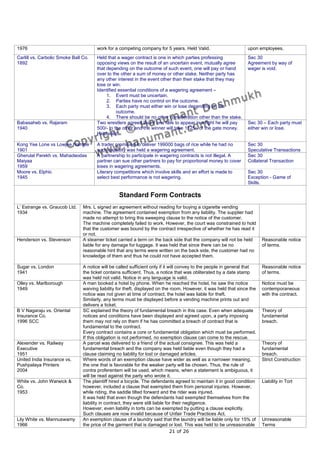
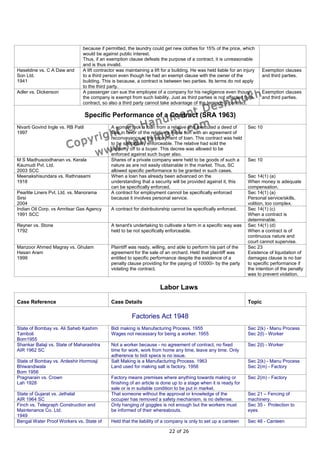
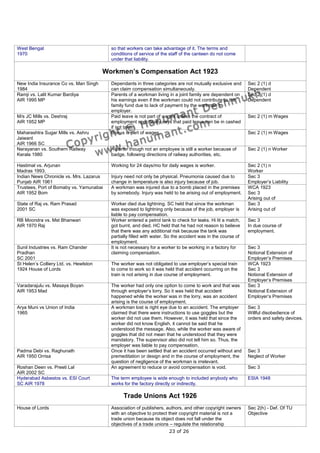
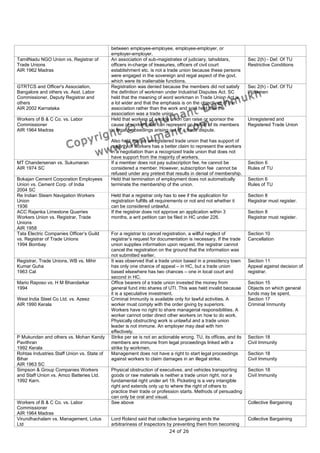
Case List For LLB 1st Semester

                                                                Constitutional Law

Case Reference                         Case Details                                                                Topic


                                      Fundamental Rights and Judicial Review

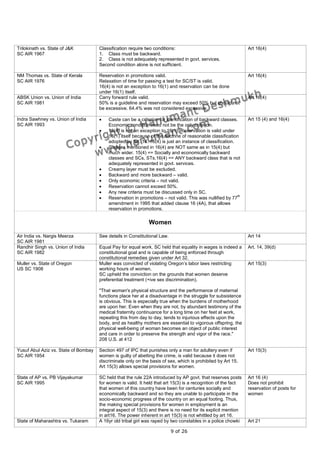
P D Shamdasani vs. Central Bank        Bank confiscated property on loan default. SC held that fundamental         Fundamental rights are
of India                               rights are available against the state and not against private              against State.
SC AIR 1952                            individuals because there already are enough safeguards under
                                       ordinary laws for such disputes.
Rajasthan Electricity Board vs.        Definition of State is not narrow. It includes all such entities that are   Art 12
Mohan Lal                              constituted by the State. Electricity Board and a University are States.    What is State.
SC AIR 1967                            Overruled Univ. of Madras vs. Santa Bai.

Sukhdev vs. Bhagatram                  ONGC, LIC, Industrial Finance Corp. are all states because the rules
SC AIR 1975                            and regulations made by them have the force of law.
Marbury vs. Madison                    US SC held that the judiciary has the power to review actions of the        Art 13
US SC 1800                             legislature. The concept of Judicial Review started from here.              Judicial Review
L Chandra Kumar vs. Union of           The power of judicial review of legislative action as vested in SC by art   Art 13
India                                  32 and in HC by art 226 is a basic feature of the constitution and
SC AIR 1997                            cannot be curtailed even by constitutional amendment.
AK Gopalan vs. State of Madras         Only Section 14 of Preventive Detention Act 1950 was held                   Art 13
SC AIR 1950                            unconstitutional. Whole act except this section is valid.                   Doctrine of Severability.
                                       In Romesh Thaper vs. State of Madras, SC held that only if the
                                       unconstitutional portions cannot be removed then the whole act will be
                                       utra vires and thus unconstitutional.
Bhikaji vs. State of MP                Govt. of Central Province monopolized motor transport by an act. SC         Art 13
SC AIR 1954                            held that the pre-constitutional law that violates fundamental rights is    Doctrine of Eclipse
                                       not void ab initio. It is merely eclipsed. When Art 19 was amended to
                                       allow state to monopolize any business, the said act became
                                       constitutional again.
Deep Chand vs. State of UP             Doctrine of Eclipse does not apply to Post-Constitutional law because       Art 13
SC AIR 1959                            such a law is void ab initio.                                               Doctrine of Eclipse
State of Gujarat vs. Ambica Mills      Overruled Deep Chand’s case and held that Doctrine of Eclipse is            Art 13
SC AIR 1974                            applicable to non-citizens.                                                 Doctrine of Eclipse
                  rd
Dulare Lodh vs. 3 Additional           Held that Doctrine of Eclipse to post-constitutional law is applicable to   Art 13
District Judge                         citizens as well.                                                           Doctrine of Eclipse
SC AIR 1984
Basheshar Nath vs. Income Tax          The appellant had reached a settlement with IT dept. to pay 3 lac per       Art 13
Commissioner                           month for taxes that he owed under IT act. However, later that act was      Doctrine of Waiver
SC AIR 1959                            determined to be unconstitutional. So he challenged the settlement. IT
                                       dept argued that he had waived his right by reaching a settlement.
                                       SC held that, unlike USA, Indian constitution does not follow Doctrine
                                       of Waiver. Fundamental rights are an obligation imposed upon the
                                       state by the constitution. It is the court’s duty to enforce them.
Keshavanand Bharti vs. State of        SC held that constitutional amendments do not fall under “laws” as          Art 13
Kerala                                 meant in art 13. It held that “Law” in art 13 means rules and               Meaning of “law”.
SC AIR 1973                            regulations made under ordinary legislative powers and not
                                       amendments made under constitutional powers. Thus, Constitution
                                           th                                              th
                                       (24 Amendment Act) Act 1971 by which the 4 clause was added to
                                       art 13 was valid. Art 13(4) says, “Nothing in this article shall apply to
                                       any amendment of the constitution made under art 368.”

                                  Equality and Classification (See Compensatory Discrimination)


                                        Protection of Life and Personal Liberty
A K Gopalan vs. State of Madras        A communist leader was detained under Preventive Detention Act,             Art 14/19/21
SC AIR 1950                            1950.
                                       1. Fundamental Rights are not absolute.
                                       2. Rights in Part III are mutually exclusive and that liberty in Art 19

                                                                            1 of 26
and 21 are different things. (Overruled in Menaka Gandhi)
                                   3.        Held that “law” means state made law and not jus naturale
                                             (principles of natural justice).
                                   4.        Rejected that “procedure established by law” is same as “due
                                             process of law” of the US constitution.
                                   5.        Held that 21 protects against loss of personal physical liberty and
                                             19 deals with unreasonable restrictions on specific freedoms.

Kharak Singh vs. State of UP       UP Police performed domiciliary visits to make sure that he was at                Art 21
SC AIR 1963                        home in the nights. This was challenged. SC held the following.
                                   1. Personal liberty is not confined only to bodily restraint or
                                       confinement in prisons but includes all those things through which
                                       life is enjoyed.
                                   2. Personal Liberty means much more that mere animal existence.
                                   3. Art 19 gives some of the freedoms required to enjoy personal
                                       liberty, while art 21 constitutes the rest.
                                   4. Since there was no law which could justify domiciliary visits, they
                                       were held to be an unauthorized intrusion into a person’s life and
                                       were held to be in violation of art 21.
Satwant Singh vs. Asst. Passport   Right to travel abroad.                                                           Art 21
Officer
SC AIR 1967
Govind vs. State of MP             Domiciliary visits were held valid because there was a law and so had             Art 21
SC AIR 1975                        the force of law.
Menaka Gandhi vs. Union of India   Passport was confiscated without providing any reason.                            Art 14, 21.
SC AIR 1978
                                   Prior to this case, Art 21 guaranteed protection against arbitrary action
                                   only of executive and not from legislative action. After this case:

                                   A person can be deprived of life and personal liberty only if
                                       1. There is a law.
                                       2. The law must provide a procedure.
                                       3. The procedure is just, fair, and reasonable.
                                       4. The procedure must satisfy Art 14.

                                   Important Points

                                             1.   Fundamental rights represent the values cherished by people
                                                  since Vedic ages and are calculated to provide dignity to
                                                  human beings and to create conditions that enable a human
                                                  being to develop his personality to fullest extent. (J Bhagvati)
                                             2.   Provisions of Part III should be given widest possible
                                                  interpretation.
                                             3.   Rights in Part III are not mutually exclusive but form a single
                                                  scheme.
                                             4.   Laws under Art 21 must satisfy the test of reasonability under
                                                  Art 14 and also stand the test of Art 19.
                                             5.   SC has accepted that “law” should be reasonable law and not
                                                  just an enacted law. To be fair and just, it should follow the
                                                  principles of natural justice. Thus, even if “due process of
                                                  law” is not explicitly mentioned, the effect is same.

                                   Although Art 21 uses negative words, it has a positive dimension as
                                   well. Thus, it does not just mean right to mere existence but a right to
                                   live with human dignity.

                                   Compensation for violation of Art 21.
                                        th
                                   44 amendment, Emergency, and Art 21. Art 21 cannot be suspended
                                   on presidential order under art 359.
MH Hoskot vs. State of Mah.        Right to free legal aid.                                                          Art 21
SC AIR 1978
Hussainara Khatun vs. State of     Right to speedy trial.                                                            Art 21
Bihar
SC AIR 1979
Olga Tellis vs. BMC                Right to livelihood.                                                              Art 21
(Pavement Dweller’s case)
SC AIR 1986
Paramand Katara vs. U of I         Right to health and medical assistance.                                           Art 21
SC AIR 1989
                                                                             2 of 26
Subhas Kumar vs. State of Bih       Right to pollution free air and water.                                      Art 21
SC AIR 1991
Mohini Jain vs. State of Kar.       Right to education                                                          Art 21
(Capitation fee case)
SC AIR 1992
Chameli Singh vs. State of UP       Right to shelter.                                                           Art 21
SC AIR 1996
PUCL vs. Union of India             Right to privacy.                                                           Art 21
(Telephone Tapping case)
SC AIR 1997
Murli Deora vs. Union of India      Ban on smoking in public places.                                            Art 21
SC AIR 2002
re Noise Pollution                  Right to freedom from noise.                                                Art 21
SC AIR 2005

                                         Freedom of Speech and Expression
Romesh Thaper vs. State of          Romesh Thaper was the publisher of Cross Roads, a left leaning              Art 19 (1) (a)
Madras                              paper, critical of Govt. State of Madras banned its entry and circulation   Art 19 (2)
SC AIR 1959                         in Madras on the grounds of public safety.                                  Freedom of Speech and
                                    SC held freedom of circulation is covered under freedom of speech           Expression
                                    and that public safety is out of scope of Art 19 (2).
                                                                 st
                                    After this, in Constitution 1 Amendment, Art 19 (2) was amended to
                                    include public order, security of state, incitement of offence as grounds
                                    for restricting the freedom of speech and expression.

Prabhu Dutt vs. U of I              People have right to know news and functioning of the govt.                 Art 19 (1)
SC AIR 1982
Association for Democratic          People have right to know about the assets, liabilities, wealth,            Art 19 (1)
Reforms vs. U of I                  education of the candidate before voting.
SC AIR 2002
LIC vs. Manubhai D Shah             Manubhai wrote an article in LIC's magazine about the problems with         Art 19 (1)
AIR SC 1992                         LIC that affected policy holders.
                                    LIC published a response to that but did not give a chance to publish a
                                    rejoinder. SC held that LIC being a State as per Art 12, must publish
                                    his response. It also held that it does not mean every body has a right
                                    to publish in a magazine and this right should be determined on a
                                    case by case basis.
Tata Press Ltd. vs. MTNL            Commercial adverts are protected under freedom of speech.                   Art 19(1)
SC SCC 1995
Ministry of I& B vs. CAB            SC has held that one has the right to publicize his expression as well.     Art 19(1)
SC AIR 1995                         A game of cricket is an expression and the organizers have a right to
                                    propagate it every where in the world. So Doordarshan must provide
                                    its up linking facilities to CAB for transmitting the signals out of
                                    country. Art 19 (2) does not allow restrictions on 19 (1) (a) on the
                                    grounds of creating monopoly of the govt.

CPI (M) vs. Bharat Kumar            Bundhs are illegal.                                                         Art 19 (1)
SC AIR 1998
Ranjit Udeshi vs. State of Mah.     Bookseller banned for selling obscene books.                                Art 19 (1)
SC AIR 1965
Hamdard Dawakhana vs. U of I        Obnoxious and Fraudulent advertising is not protected.                      Art 19 (1)
SC AIR 1960

                                               Secularism/Minority Rights
SR Bommai vs. Union of India        SC held that secularism is a basic feature of the constitution. Indian      Art 25-28
SC AIR 1994                         secularism is different from American secularism.

Santosh Kumar vs. Ministry of HRD   Teaching of Sanskrit language is not anti-secular because it is the
SC AIR 1995                         mother of all Aryan languages.
Church of God vs. KKRMC Welfare     Noise pollution in the name of religion not allowed.
assoc.
SC AIR 1999
Aruna Roy vs. Union of India        Study based on all religions in school is not anti-secular. Must keeps
SC AIR 2002                         ”sarva dhrama samabhav” and not “sarva dharma abhav”.
Rev Stainislaus vs. State of MP     Forcible conversions not allowed.
SC AIR 1977

                                                                         3 of 26
Javed vs. State of Haryana          Two children norm not a violation of art 25.
SC AIR 2003
Md Hanif Quareshi vs. State of      Ban on cow slaughter does not violate art 25 because cow slaughter is
Bihar                               not an essential part of Islam.
SC AIR 1958
Ashutosh Lahiri vs. State of WB     Exemption on cow slaughter on Bakarid day invalid because it is not
SC AIR 1995                         an essential to the religion.
State of Bombay vs. Varasu          An act that banned bigamy held valid because bigamy is not an
Bapamali                            essential part of Hinduism.
SC AIR 1953
DAV College, Jullundher vs. State   Guru Nanak Univ directed the state to make provision for study and          Art 28.
of Punjab                           research on life and teachings of Guru Nanak. This was challenge on
SC AIR 1971                         the ground that it violates Art 28.
                                    SC held that it did not violate because the study was only academic
                                    and did not amount to religious instruction or promotion of any religion.

St. Xavier’s College vs. State of   Relation between Art 29(1) and 30(1). SC held the following four            Art 29, 30
Gujarat                             distinctions:
SC AIR 1974                          29(1)                             30(1)
                                     Gives right to all citizens       Gives right to minorities to
                                     having a distinct language,       establish and administer
                                     script, or culture, to preserve   educational institutions.
                                     the same.
                                     Provides right to all citizens.   Provides right to minorities.
                                     Deals only with language, script, Deals with language and
                                     and culture.                      religion.
                                     Concerned with right to           Gives right to establish and
                                     conserve language, script, and    manage educational institutions
                                     culture.                          of their choice to minorities.
                                     Does not necessarily mean         Deals only with establishment
                                     educational institutes.           and administration of
                                                                       educational institutions.

                                    In this landmark case, some sections of Gujarat Univ. Act imposed
                                    several restrictions that affected its managerial rights on the college.

                                    SC held that provisions that effectively take control of the
                                    management of an educational institution are not applicable to
                                    minority institutions.

                                                             Judiciary

Union of India vs. Sankalchand      Sankalchand Seth was transferred from one HC to another without             Art 222
Sheth                               CJ’s approval, under art 222, which says, “(1) The President may,           Independence of the
SC 1977                             after consultation with the Chief Justice of India, transfer a Judge from   Judiciary
                                    one High Court to any other High Court.”
                                    In this case, SC held that consultation does not mean that the advise
                                    of the constitutional functionaries is binding on the President and that
                                    a Judge can be transferred without his consent.
S P Gupta vs. Union of India        SC unanimously with the meaning of the term “consultation” as               Art 124(2)
(Judges Transfer Case – I)          determined in Sankalchand’s case and held that only ground on which         Independence of the
AIR SC 1982                         the decision of the govt. regarding appointment and transfer of a           Judiciary
                                    Judge can be challenged is that if it is based on mala fide or irrelevant
                                    consideration.
                                    This hugely affected the independence of the judiciary because the
                                    control over appointed of the judges went completely to the executive
                                    branch.
SC Advocate on Record Assoc. vs.    Overruled SP Gupta case and held the following:                             Art 124(2)
Union of India                      Judges of SC and HCs must be appointed in consultation with CJI.            Independence of the
SCC 1993                            The consultation must be effective. The opinion of CJI has primacy.         Judiciary
                                    The CJI must be appointed on the basis of seniority
re Presidential Reference 1999      The President requested the opinion of the SC when the CJI gave his         Art 124(2)
                                    recommendation without consulting other judges of the SC.                   Independence of the
                                    SC held that recommendation given without consulting other judges is        Judiciary
                                    not binding on the President.
V Ramaswamy’s Impeachment           V Ramaswamy was in financial irregularities.                                Art 124(4)
1990                                Proceedings were started but did not succeed because congress               Removal of a Judge of
                                    abstained from voting.                                                      SC or HC

                                                                         4 of 26
C Ravi Chandran Iyer vs. A M         Bar Assoc. tried to pressurize the judge to resign for alleged financial    Art 124(4)
Bhattacharjee                        misbehavior. SC held that any such coercion is invalid, affects the         Removal of a Judge of
SCC 1995                             independence of the judiciary and amounts to contempt court. Only           SC or HC
                                     procedure to remove a judge is given in 124(4) and (5).
                                     It further held that if the misconduct of a judge falls short of
                                     impeachment, an action could be taken in-house within the judiciary.
                                     Further, only the CJI, being the first among the judges can be the
                                     prime mover of such an action.
Delhi Judicial Services Assoc. vs.   5 policemen were held guilty of criminal contempt of court for              Art 129
State of Gujarat                     harassing and handcuffing the Chief Judicial Magistrate in Nadiad,          Court of Record
SCC 1991                             Gujarat.
                                     SC held that it has power to punish for contempt of itself as well as
                                     any subordinate court under art 129.
Ayodhya Case                         UP CM Kalyan Singh was convicted of contempt of court for failing to        Art 129
Mohd. Aslam vs. Union of India       keep his promise of not letting any construction on disputed land.          Court of Record
SCC 1994

State of Karnataka vs. Union of      Center appointed a commission of inquiry under Commissions of               Art 131
India                                Inquiry Act 1952 to investigate the charges of corruption, nepotism,        Original Jurisdiction of
SCJ 1978                             etc. against the CM of Karnataka. State of Karnataka filed a suite in       SC
                                     SC under original jurisdiction charging that Center does not have the
                                     power to appoint such a commission because it is in the sphere of
                                     State legislative and executive powers and that it violates the federal
                                     character of the constitution.
                                     Center contended that since the commission is against the CM
                                     personally and not against the State of Kar, the suit cannot be brought
                                     under Art 131, which prohibits personal suites.
                                     SC held that the suit is maintainable because the State acts through
                                     its ministers and any action against the ministers affects the State. So
                                     State has sufficient interest in the case to file the suite.
                                     It further held that the commission does not violate the federal
                                     character of the center-state relations.
Union of India vs. State of Raj.     SC held that State’s suit against Union of India to recover damages         Art 131
SCC 1984                             under railways act 1890 is not a dispute falling under 131 and              Original Jurisdiction of
                                     therefore not maintainable. Such ordinary commercial disputes are not       SC
                                     under SC’s jurisdiction.
Krishnaswamy vs. Gov. General-in-    If there is difference of opinion among HCs and there is no direct          Art 132
Council                              decision of SC on that point, it is a substantial question of law to        Appellate Juris – Const
AIR 1947                             permit appeal in SC.
Madan Gopal vs. State of Orrisa      The pecuniary(monetory) value of the subject matter of the case is of       Art 132
AIR 1956                             no importance. There may be matters which cannot be measured in             Appellate Juris – Civil
                                     terms of money but the decision may still have far reaching impact.
Kiranmal vs. Dynanoba                High Court dismissed the appeal by one word order “Dismissal”. SC           Art 132
AIR 1983                             held that to be invalid and remitted to HC for disposal on merits.          Appellate Juris – Civil
Siddheshwar Ganguly vs. State of     In case SC has given guidelines to be followed by HC to give                Art 134
W.B.                                 certificates. HC cannot issue a certificate under 134-A on mere             Appellate Juris – Crim.
AIR 1958                             question of fact. The case must involve a substantial question of law.
Ramakant Rai vs. Madan Rai           Private party can file appeal under Art 136 challenging acquittal. SC       Art 136
AIR 2004                             cannot refrain from doing its duty just because a private party and not     Special Leave to Appeal
                                     the state has not appealed against the acquittal by HC.
Pritam Singh vs. State               SC explained how the discretionary power under Art 136 will be used         Art 136
AIR 1950                             by SC in this case:                                                         Special Leave to Appeal
                                     Since the power is exceptional and very wide, it must be used
                                     sparingly and in exceptional circumstances. Beyond this it is not
                                     possible to fetter the exercise of this power by any set formula or rule.
Union Carbide Corp. vs. Union of     SC held that under Art 136, the court has inherent power to transfer        Art 136
India                                the cases from District court of Bhopal and dispose of the same. SC         Special Leave to Appeal
SCC 1991                             has wide powers under 142 and the court can do so if it is necessary
                                     to do complete justice.
Union of India vs. Shiromani         SC may transfer the case from one HC to another if it feels that the        Art 139 A
Gurudwara Prabandhak Committee       case cannot be dealt with fairly in one HC due to exceptional
SCC 1986                             circumstances.
Bengal Immunity Co. vs. State of     SC held that there is nothing in the constitution that prevents SC from     Art 141
Bihar                                departing from its previous decision. If SC finds that a previous           Decision of SC is binding
AIR 1955                             judgment made a erroneous, it should admit it and not to perpetuate it.     on all courts.
re Kerala Education Bill             SC interpreted the word "may" in clause 1 as it is not bound to give its    Art 143
1953                                 opinion. If it has a good reason, it may refuse to express its opinion.     Advisory Juris
re Special Courts Bill               SC held that opinions given by it under this jurisdiction are binding on    Art 143
1979                                 all courts in the country.                                                  Advisory Juris

                                                                         5 of 26
re Cauvery Disputes Tribunal         SC held that the ordinance passed by the State of Kar. to not follow         Art 143
                                     the order of the tribunal to release water to TN, is unconstitutional.       Advisory Juris
Ayodhya Dispute and advisory         SC refused to express its opinion on whether a temple existed on the         Art 143
opinion                              disputed location because it was superfluous, unnecessary, and               Advisory Juris
1994                                 favors a particular religion.
L Chandra Kumar vs. Unon of India    Power of HC over legislative action is basic feature of the constitution     Art 226
SC AIR 1997                          and cannot be curtailed by constitutional amendment.                         Writ Juris. of HC.
ABSK Sangh(Rly) vs. Union of         Unregistered union has a right to file a writ petition for a public          Art 226
India                                grievance.                                                                   Locus Standi
AIR 1991
Chairman, Rlwy Board vs.             An advocate of Calcutta HC has sufficient interest in demanding              Art 226
Chandrima Das                        compensation for Bangladeshi woman raped in a railway station,               Locus Standi
AIR 2000                             which is a public place, by railway employees.
Basappa vs. Nagappa                  SC held that scope of 226 is very wide and can be used to remedy             Art 226
AIR SC 1954                          injustice wherever it is found.                                              Scope
Union of India vs. RK Sharma         Proceedings under sec 18 of Indian Army Act cannot be arbitrary and          Art 226
AIR 2001                             can come under judicial review.                                              Scope
Mohan Pandey Vs. Usha Rani           Private commercial disputes do not fall under 226 if they do not allege      Art 226
Rajgaria                             violation of statutory rights by statutory authorities.                      Scope
SCC 1992
Election Commision vs. Venkata       Madras HC cannot issue writ against ECI because ECI is based in              Art 226
Rao                                  New Delhi, which is out of jurisdiction of Madras HC.                        Territorial Scope
                                              th
AIR 1975                             Later 15 amendment 1963 amended 226 to allow HC to issue writs
                                     against central agencies if the cause of action, whole or in part, lies is
                                     that HC’s jurisdiction.
ONGC vs. Utpal Kumar Basu            Petition did not disclose that whole or part of cause of action lies in      Art 226
SCC 1994                             Calcutta HC jurisdiction so HC cannot issue writ against ONGC.               Territorial Scope
Vellaswamy vs. IG Police Madras      HC dismissed the petition citing that alternate remedy is available          Art 226
AIR 1982                             under police rules of Madras.                                                Discretionary Remedy
                                     SC held that the remedy was not sufficient and HC should not have
                                     dismissed the petition.

                                           Amendment of the Constitution
                                      st
Shankari Prasad vs. Union of India   1 amendment that inserted of Art 31-A and 31-B by was challenged.            Art 368/13
AIR 1951                             SC held that “Law” in Art 13 refers to ordinary law made under               Amendment of the
                                     legislative power and does not include amendment of the constitution.        constitution
                                     Art 368 gives complete power to the parliament to amend the
                                     constitution including fundamental rights.
                                        th
Sajjan Singh vs. State of Raj.       17 amendment was challenged. SC followed the judgment in                     Art 368/13
AIR 1965                             Shankari Prasad case and held that “amendment of the constitution”           Amendment of the
                                     means amendment of all the provisions of the constitution.                   constitution
                                        th                                                       th
Golak Nath vs. State of Pun.         17 amendment that inserted certain state acts in the 9 schedule              Art 368/13
AIR 1971                             was again challenged.                                                        Amendment of the
                                     SC overruled the previous judgment and held that the parliament does         constitution
                                     not have the power amend part III so as to take away fundamental
                                     rights. It held that art 368 merely describes the procedure of
                                     amendment and the actual power of amendment comes from art 245
                                     and entry 97 of List 1. “Amendment” is a “law” with in art 13 (1).
Keshavanand Bharati vs. Union of     In order to overcome difficulties posed by SC decision in Golak Nath         Art 368/13
                                                                                    th
India                                case, parliament added clause 13(3) by 24 amendment, which says              Amendment of the
AIR 1973                             that art 13 will not apply to any amendments made under art 368.             constitution
                                     Further, it added a new clause to art 368 saying nothing in art 13 shall
                                     apply to amendment made under this article.
                                     In this case, this amendment was challenged.
                                     SC overruled Golak Nath case and held the following –
                                     •     “Law” in art 13 means ordinary law made under legislative power.
                                              th
                                           24 amendment is only clarifying that point and so it valid.
                                     •     Parliament has wide power of amending the constitution but it is
                                           not unlimited.
                                     •     The usage of the word “amendment” in the constitution means
                                           that the basic framework of the constitution must survive after the
                                           amendment. It does not allow destruction of the basic structure of
                                           the constitution.
                                     •     Power to amend the constitution does not including abrogating
                                           the constitution.
                                     •     C J Sikri said that basic features of the constitution include –
                                                 o Supremacy of the judiciary
                                                 o Republic and democratic character
                                                                          6 of 26
o    Secular character
                                               o    Division of powers among judiciary, legislative, executive
                                               o    Federal character of the constitution

                                                             Emergency
Minerva Mills vs. Union of India     Proclamation of emergency by the president falls under judicial                  Art 352
AIR 1980                             preview. However, court's power is limited only to examining whether
                                     the limitations conferred by the constitution have been observed or
                                     not. It can check if the satisfaction of the president is valid or not. If the
                                     satisfaction is based on mala-fide or absurd or irrelevant grounds, it is
                                     no satisfaction at all.
State of Raj. vs. Union of India     Dissolution of 9 state assemblies in 1977 was held valid. SC held that           Art 356
AIR 1977                             it is a political decision and rests with the executive. Satisfaction of the
                                     president can be reviewed by the court.
S R Bommai vs. Union of India        Secularism is a basic feature and a govt. may be dismissed on this               Art 356
AIR 1994                             ground. It gave detailed guidelines on invocation of art 356.
Makhan Singh vs. State of Punjab     In this case SC identified the difference between art 358 and art 359.           Art 358/359
AIR 1964                                Art 358                               Art 359
                                        Freedoms given by art 19 are          Fundamental rights are not
                                        suspended.                            suspended. Only that courts
                                                                              cannot be moved to enforce
                                                                              fundamental rights.
                                        Any actions done or omitted to        Any action done by the
                                        be done cannot be challenged          legislature or executive can be
                                        even after emergency.                 challenged after the suspension
                                                                              is over.
                                        Art 19 is suspended for the           Right to move courts is
                                        period of emergency.                  suspended for the period of
                                                                              emergency or until the
                                                                              proclamation of the president to
                                                                              remove suspension.
                                        Effective all over the country.       May be confined to an area.
MM Pathak vs. Union of India         LIC entered into a settlement with its employee before emergency.                Art 359
AIR 1978                             During emergency this settlement was scrapped by a law. This was
                                     defended on the ground that since fundamental rights were
                                     suspended during emergency it cannot be challenged on the ground
                                     that it violates fundamental rights in the courts.
                                     SC held that rights given under art 14 to 19 are not suspended under
                                     emergency. Only their operation is suspended. Therefore as soon as
                                     emergency ends, those rights are revived again. Also, liabilities
                                     incurred before emergency cannot be quashed by a law made in
                                     emergency. They are revived after emergency.

                                                      Compensatory Discrimination

Case Reference                        Case Details                                                                    Topic


                                                    Equality/Classification

Plessy vs. Ferguson                   1892 Homer Plessy vs. State of Louisiana – Judgment by Justice                  Equality
US SC 1896                            Ferguson held that separate railway cars for blacks and whites                  Separate but equal.
                                      satisfies the principle of equality.
                                      1896 US SC upheld the decision and thus the doctrine of “Separate
                                      but equal” came into existence. Dissenter was Justice John Harlan.

Lindsley vs. National Carbolic Gas    Meaning of Equal Protection of Laws : State can classify. Equal laws            Equality
Company                               for equal circumstances.
US SC 1911
Brown vs. Board of Education, City    Cannot have separate schools for blacks and white because it                    Equality
of Topeka, Kansas.                    violates equality.                                                              Separate can never be
US SC 1954                                                                                                            equal.
Charanjit Lal vs. Union of India      Mismanagement in Sholapur Spinning and weaving company.                         Art 14
SC AIR 1951                           State can do reasonable classification.                                         Doctrine of reasonable
                                      One individual can be treated as a class.                                       classification.


                                                                            7 of 26
Anwar Ali Sarkar vs. State of WB      SC held that since there was no clear guideline for which cases will      Art 14
SC AIR 1952                           be referred to the special court, it violated art 14. The object of the
                                      act “to provide speedier trial to certain cases” is too vague for
                                      intelligible classification.
Kathi Ranning vs. State of            SC held that since there were proper guidelines for determining           Art 14
Saurashtra                            which cases should be referred to the special court, it does not
SC AIR 1952                           violate art 14.
EP Royappa vs. State of TN            New Concept of equality: Lack of arbitrariness. J Bhagwati -              Art 14
SC AIR 1974                           “Equality is a dynamic concept with many aspects and dimensions           Lack of arbitrariness.
                                      and it cannot be cribbed, cabined, or confined with traditional and
                                      doctrinaire limits….Equality and arbitrariness are sworn enemies.”
Randhir Singh vs. Union of India      Held that unequal scales of pay based on irrational classification        Art 14, 16, 39
SC AIR 1982                           invalid. Equal pay for equal work has since become a fundamental
                                      right.
Air India vs. Nargis Meerza           An airhostess would be retired upon: 35 yrs of age, marriage if           Art 14
SC AIR 1981                           within first 4 yrs of service, or first pregnancy, whichever occurs
                                      earlier. MD has the discretionary power to allow service.
                                      SC held that the clause of first pregnancy was totally unreasonable
                                      because it force the AH to not have children at all. Discretionary
                                      powers to the MD also violate art 14.
D S Nakara vs. Union of India         J Desai assimilated the doctrines of classification and doctrine of       Art 14
SC AIR 1983                           arbitrariness.
                                      SC struck down rule 34 of Central services pension rule 1972 on the
                                      ground that classification made by it between pensioners retiring
                                      before and after a certain date is arbitrary and so violates art 14.
Krishna Singh vs. State of Raj.       SC held that separate rules for land revenue for Marwar region is         Art 14
SC AIR 1955                           valid.                                                                    Basis of Classification
                                                                                                                Geographical
Sagir Ahmed vs. State of UP           Creating a monopoly in favor of State is valid because State as a         Art 14
SC AIR 1955                           person is a class in itself which is different from other person.         Basis of Classification
                                                                                                                In favor of State
Venkateshwara Theaters vs. State      Tax slabs were created for different kinds of theaters such as air-       Art 14
of AP                                 conditioned, air-cooled, ordinary. SC held this classification to be      Basis of Classification
SC AIR 1993                           valid.                                                                    Taxation
Anwar Ali Sarkar’s case and s         (see above.)                                                              Art 14
Kathi Ranning’ case                                                                                             Basis of Classification
                                                                                                                Special Courts & Special
                                                                                                                Procedures
Nayansukh Das vs. State of UP         Separate Electoral rolls based on religion was held invalid.              Art 15(1)
SC AIR 1953
State of Rajasthan vs. Pratap Singh   Additional taxes for police protection for everybody in a colony          Art 15(1)
SC AIR 1960                           except Muslims and Harijans was held invalid.
DP Joshi vs. State of MP              Place of residence valid ground for classification. Not prohibited by     Art 15(1)
SC AIR 1960                           15(1). College charged capitation fee from non-mp students.

Sanjeev Coke Mfg. Co. vs. Bharat      “Where art 31C come in, art 14 goes out.”                                 Art 14, Art 31C, Art 39
Cooking Coal Ltd.                     Laws made by state to implement Directive Principles in 39(b) and
SCC 1983                              (c) cannot be challenged on the grounds that they violate art 14.

BALCO Employees Union vs. Union       No judicial review of the economic policy of the govt. SC held that       Art 14
of India                              divestment in public sector units is a decision based on complex
SC AIR 2002                           economic factors and courts have refrained to comment on such
                                      economic matters.

                                                           Reservation

Champakam Dorairajan vs. State of     Prompted the addition of 15(4) that allows state to make special          Art 15(4)
Madras                                provisions for SCs, STs and other backward classes.
SC AIR 1951
Balaji vs. State of Mysore            Reservation cannot exceed 50%. Caste should not be the only               Art 15(4)
SC AIR 1963                           criterion.
                                      Classification of backward and more backward is invalid.
                                      Art 16(4) is an exception to Art 16(1).
                                      Classes mentioned in 16(4) are same as in 15(4).
State of MP vs. Nivedita Jain         Complete relaxation of qualifying marks for SCs/STs for admission         Art 15(4)
SC AIR 1981                           to medical courses is valid and does not violate either Article 14,
                                      15(1), 15(2), or 15 (4).
Devdasan vs. Union of India           Carry forward rule invalid.                                               Art 16(4)
SC AIR 1964
                                                                         8 of 26
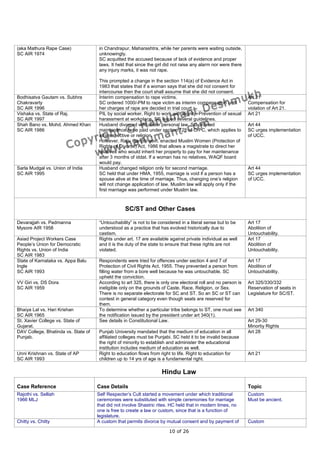
Trilokinath vs. State of J&K          Classification require two conditions:                                    Art 16(4)
SC AIR 1967                           1. Class must be backward.
                                      2. Class is not adequately represented in govt. services.
                                      Second condition alone is not sufficient.

NM Thomas vs. State of Kerala         Reservation in promotions valid.                                          Art 16(4)
SC AIR 1976                           Relaxation of time for passing a test for SC/ST is valid.
                                      16(4) is not an exception to 16(1) and reservation can be done
                                      under 16(1) itself.
ABSK Union vs. Union of India         Carry forward rule valid.                                                 Art 16(4)
SC AIR 1981                           50% is a guideline and reservation may exceed 50% but should not
                                      be excessive. 64.4% was not considered excessive.

Indra Sawhney vs. Union of India      •   Caste can be a criterion for identification of backward classes.      Art 15 (4) and 16(4)
SC AIR 1993                               Economic condition need not be the only criterion.
                                      •   16(4) is not an exception to 16(1). Reservation is valid under
                                          16(1) itself because of the doctrine of reasonable classification
                                          adopted by Art. 14. 16(4) is just an instance of classification.
                                      •   Classes mentioned in 16(4) are NOT same as in 15(4) but
                                          much wider. 15(4) == Socially and economically backward
                                          classes and SCs, STs.16(4) == ANY backward class that is not
                                          adequately represented in govt. services.
                                      •   Creamy layer must be excluded.
                                      •   Backward and more backward – valid.
                                      •   Only economic criteria – not valid.
                                      •   Reservation cannot exceed 50%.
                                      •   Any new criteria must be discussed only in SC.
                                      •
                                                                                                           th
                                          Reservation in promotions – not valid. This was nullified by 77
                                          amendment in 1995 that added clause 16 (4A), that allows
                                          reservation in promotions.

                                                              Women

Air India vs. Nargis Meerza           See details in Constitutional Law.                                        Art 14
SC AIR 1981
Randhir Singh vs. Union of India      Equal Pay for equal work. SC held that equality in wages is indeed a      Art. 14, 39(d)
SC AIR 1982                           constitutional goal and is capable of being enforced through
                                      constitutional remedies given under Art 32.
Muller vs. State of Oregon            Muller was convicted of violating Oregon’s labor laws restricting         Art 15(3)
US SC 1908                            working hours of women.
                                      SC upheld the conviction on the grounds that women deserve
                                      preferential treatment (+ive sex discrimination).

                                      "That woman's physical structure and the performance of maternal
                                      functions place her at a disadvantage in the struggle for subsistence
                                      is obvious. This is especially true when the burdens of motherhood
                                      are upon her. Even when they are not, by abundant testimony of the
                                      medical fraternity continuance for a long time on her feet at work,
                                      repeating this from day to day, tends to injurious effects upon the
                                      body, and as healthy mothers are essential to vigorous offspring, the
                                      physical well-being of woman becomes an object of public interest
                                      and care in order to preserve the strength and vigor of the race."
                                      208 U.S. at 412

Yusuf Abul Aziz vs. State of Bombay   Section 497 of IPC that punishes only a man for adultery even if          Art 15(3)
SC AIR 1954                           women is guilty of abetting the crime, is valid because it does not
                                      discriminate only on the basis of sex, which is prohibited by Art 15.
                                      Art 15(3) allows special provisions for women.

State of AP vs. PB Vijayakumar        SC held that the rule 22A introduced by AP govt. that reserves posts      Art 16 (4)
SC AIR 1995                           for women is valid. It held that art 15(3) is a recognition of the fact   Does not prohibit
                                      that women of this country have been for centuries socially and           reservation of posts for
                                      economically backward and so they are unable to participate in the        women
                                      socio-economic progress of the country on an equal footing. Thus,
                                      the making special provisions for women in employment is an
                                      integral aspect of 15(3) and there is no need for its explicit mention
                                      in art16. The power inherent in art 15(3) is not whittled by art 16.
State of Maharashtra vs. Tukaram      A 16yr old tribal girl was raped by two constables in a police chowki     Art 21

                                                                           9 of 26
(aka Mathura Rape Case)               in Chandrapur, Maharashtra, while her parents were waiting outside,
SC AIR 1974                           unknowingly.
                                      SC acquitted the accused because of lack of evidence and proper
                                      laws. It held that since the girl did not raise any alarm nor were there
                                      any injury marks, it was not rape.

                                      This prompted a change in the section 114(a) of Evidence Act in
                                      1983 that states that if a woman says that she did not consent for
                                      intercourse then the court shall assume that she did not consent.
Bodhisatva Gautam vs. Subhra          Interim compensation to rape victims.                                      Art 21
Chakravarty                           SC ordered 1000/-PM to rape victim as interim compensation until           Compensation for
SC AIR 1996                           her charges of rape are decided in trial court.                            violation of Art 21.
Vishaka vs. State of Raj.             PIL by social worker. Right to work with dignity. Prevention of sexual     Art 21
SC AIR 1997                           harassment at workplace. SC issued several guidelines.
Shah Bano vs. Mohd. Ahmed Khan        Husband divorced wife under personal law. SC ordered                       Art 44
SC AIR 1986                           maintenance to be paid under section 125 of CrPC, which applies to         SC urges implementation
                                      all irrespective or religion.                                              of UCC.
                                      However, Rajiv Gandhi govt. enacted Muslim Women (Protection of
                                      Rights of Divorce) Act, 1986 that allows a magistrate to direct her
                                      relatives who would inherit her property to pay for her maintenance
                                      after 3 months of iddat. If a woman has no relatives, WAQF board
                                      would pay.
Sarla Mudgal vs. Union of India       Husband changed religion only for second marriage.                         Art 44
SC AIR 1995                           SC held that under HMA, 1955, marriage is void if a person has a           SC urges implementation
                                      spouse alive at the time of marriage. Thus, changing one’s religion        of UCC.
                                      will not change application of law. Muslim law will apply only if the
                                      first marriage was performed under Muslim law.


                                                   SC/ST and Other Cases

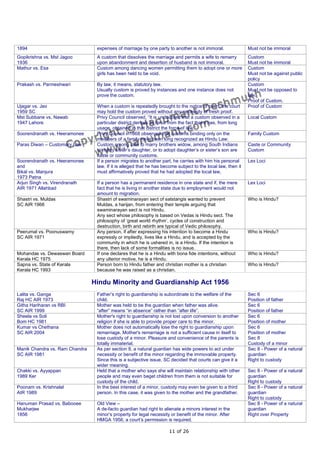
Devarajjah vs. Padmanna               “Untouchability” is not to be considered in a literal sense but to be      Art 17
Mysore AIR 1958                       understood as a practice that has evolved historically due to              Abolition of
                                      castism.                                                                   Untouchability.
Asiad Project Workers Case            Rights under art. 17 are available against private individual as well      Art 17
People’s Union for Democratic         and it is the duty of the state to ensure that these rights are not        Abolition of
Rights vs. Union of India             violated.                                                                  Untouchability.
SC AIR 1983
State of Karnataka vs. Appa Balu      Respondents were tried for offences under section 4 and 7 of               Art 17
Ingle                                 Protection of Civil Rights Act, 1955. They prevented a person from         Abolition of
SC AIR 1993                           filling water from a bore well because he was untouchable. SC              Untouchability.
                                      upheld the conviction.
VV Giri vs. DS Dora                   According to art 325, there is only one electoral roll and no person is    Art 325/330/332
SC AIR 1959                           ineligible only on the grounds of Caste, Race, Religion, or Sex.           Reservation of seats in
                                      There is no separate electorate for SC and ST. So an SC or ST can          Legislature for SC/ST.
                                      contest in general category even though seats are reserved for
                                      them.
Bhaiya Lal vs. Hari Krishan           To determine whether a particular tribe belongs to ST, one must see        Art 340
SC AIR 1965                           the notification issued by the president under art 340(1).
St. Xavier College vs. State of       See details in Constitutional Law.                                         Art 29-30
Gujarat.                                                                                                         Minortiy Rights
DAV College, Bhatinda vs. State of    Punjab University mandated that the medium of education in all             Art 28
Punjab.                               affiliated colleges must be Punjabi. SC held it to be invalid because
                                      the right of minority to establish and administer the educational
                                      institution includes medium of education as well.
Unni Krishnan vs. State of AP         Right to education flows from right to life. Right to education for        Art 21
SC AIR 1993                           children up to 14 yrs of age is a fundamental right.

                                                                     Hindu Law

Case Reference                       Case Details                                                                Topic
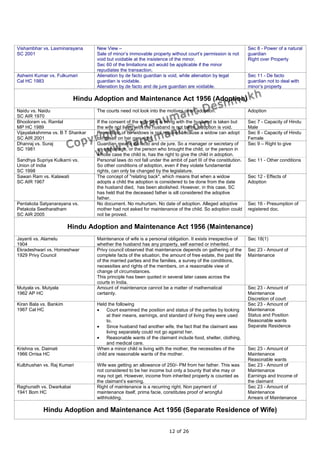
Rajothi vs. Selliah                  Self Respecter’s Cult started a movement under which traditional            Custom
1966 MLJ                             ceremonies were substituted with simple ceremonies for marriage             Must be ancient.
                                     that did not involve Shastric rites. HC held that in modern times, no
                                     one is free to create a law or custom, since that is a function of
                                     legislature.
Chitty vs. Chitty                    A custom that permits divorce by mutual consent and by payment of           Custom

                                                                         10 of 26
1894                             expenses of marriage by one party to another is not immoral.                 Must not be immoral
Gopikrishna vs. Mst Jagoo        A custom that dissolves the marriage and permits a wife to remarry           Custom
1936                             upon abandonment and desertion of husband is not immoral.                    Must not be immoral
Mathur vs. Esa                   Custom among dancing women permitting them to adopt one or more              Custom
                                 girls has been held to be void.                                              Must not be against public
                                                                                                              policy
Prakash vs. Parmeshwari          By law, it means, statutory law.                                             Custom
                                 Usually custom is proved by instances and one instance does not              Must not be opposed to
                                 prove the custom.                                                            law.
                                                                                                              Proof of Custom.
Ujagar vs. Jeo                   When a custom is repeatedly brought to the notice of court, the court        Proof of Custom
1959 SC                          may hold the custom proved without any necessity of fresh proof.
Mst Subbane vs. Nawab            Privy Council observed, “It is undoubted that a custom observed in a         Local Custom
1947 Lahore                      particular district derives its force from the fact that it has, from long
                                 usage, obtained in that district the force of law.”
Soorendranath vs. Heeramonee     Privy Council in1868 observed that customs binding only on the               Family Custom
                                 members of a family have been long recognized as Hindu Law.
Paras Diwan – Customary Law      Custom among Jats to marry brothers widow, among South Indians               Caste or Community
                                 to marry sister’s daughter, or to adopt daughter’s or sister’s son are       Custom
                                 caste or community customs.
Soorendranath vs. Heeramonee     If a person migrates to another part, he carries with him his personal       Lex Loci
and                              law. If it is alleged that he has become subject to the local law, then it
Bikal vs. Manjura                must affirmatively proved that he had adopted the local law,
1973 Patna
Arjun Singh vs. Virendranath     If a person has a permanent residence in one state and if, the mere          Lex Loci
AIR 1971 Allahbad                fact that he is living in another state due to employment would not
                                 amount to migration.
Shastri vs. Muldas               Shastri of swaminarayan sect of satstangis wanted to prevent                 Who is Hindu?
SC AIR 1966                      Muldas, a harijan, from entering their temple arguing that
                                 swaminarayan sect is not Hindu.
                                 Any sect whose philosophy is based on Vedas is Hindu sect. The
                                 philosophy of ‘great world rhythm’, cycles of construction and
                                 destruction, birth and rebirth are typical of Vedic philosophy.
Peerumal vs. Poonuswamy          Any person, if after expressing his intention to become a Hindu              Who is Hindu?
SC AIR 1971                      expressly or impliedly, lives like a Hindu, and is accepted by the
                                 community in which he is ushered in, is a Hindu. If the intention is
                                 there, then lack of some formalities is no issue.
Mohandas vs. Dewaswan Board      If one declares that he is a Hindu with bona fide intentions, without        Who is Hindu?
Kerala HC 1975                   any ulterior motive, he is a Hindu.
Sapna vs. State of Kerala        Person born to Hindu father and christian mother is a christian              Who is Hindu?
Kerala HC 1993                   because he was raised as a christian.

                                Hindu Minority and Guardianship Act 1956
Lalita vs. Ganga                 Father’s right to guardianship is subordinate to the welfare of the          Sec 6
Raj HC AIR 1973                  child.                                                                       Position of father
Githa Hariharan vs RBI           Mother was held to be the guardian when father was alive.                    Sec 6
SC AIR 1999                      “after” means “in absence” rather than “after life”.                         Position of father
Sheela vs Soli                   Mother's right to guardianship is not lost upon conversion to another        Sec 6
Bom HC 1981                      religion if she is able to provide proper care to the minor.                 Position of mother
Kumar vs Chethana                Mother does not automatically lose the right to guardianship upon            Sec 6
SC AIR 2004                      remarriage. Mother's remarriage is not a sufficient cause in itself to       Position of mother
                                 lose custody of a minor. Pleasure and convenience of the parents is          Sec 8
                                 totally immaterial.                                                          Custody of a minor
Manik Chandra vs. Ram Chandra    As per section 8, a natural guardian has wide powers to act under            Sec 8 - Power of a natural
SC AIR 1981                      necessity or benefit of the minor regarding the immovable property.          guardian
                                 Since this is a subjective issue, SC decided that courts can give it a       Right to custody
                                 wider meaning.
Chakki vs. Ayyappan              Held that a mother who says she will maintain relationship with other        Sec 8 - Power of a natural
1989 Ker                         people and may even beget children from them is not suitable for             guardian
                                 custody of the child.                                                        Right to custody
Poonam vs. Krishnalal            In the best interest of a minor, custody may even be given to a third        Sec 8 - Power of a natural
AIR 1989                         person. In this case, it was given to the mother and the grandfather.        guardian
                                                                                                              Right to custody
Hanuman Prasad vs. Babooee       Old View –                                                                   Sec 8 - Power of a natural
Mukharjee                        A de-facto guardian had right to alienate a minors interest in the           guardian
1856                             minor’s property for legal necessity or benefit of the minor. After          Right over Property
                                 HMGA 1956, a court’s permission is required.

                                                                      11 of 26
Vishambhar vs. Laxminarayana     New View –                                                                   Sec 8 - Power of a natural
SC 2001                          Sale of minor’s immovable property without court’s permission is not         guardian
                                 void but voidable at the insistence of the minor.                            Right over Property
                                 Sec 60 of the limitations act would be applicable if the minor
                                 repudiates the transaction.
Ashwini Kumar vs. Fulkumari      Alienation by de facto guardian is void, while alienation by legal           Sec 11 - De facto
Cal HC 1983                      guardian is voidable.                                                        guardian not to deal with
                                 Alienation by de facto and de jure guardian are voidable.                    minor’s property

                          Hindu Adoption and Maintenance Act 1956 (Adoption)
Naidu vs. Naidu                  The courts need not look into the motives of an adoption.                    Adoption
SC AIR 1970
Bhooloram vs. Ramlal             If the consent of the wife who is living with the husband is taken but       Sec 7 - Capacity of Hindu
MP HC 1989                       the wife not living with the husband is not taken, adoption is void.         Male
Vijayalakshmma vs. B T Shankar   Permission of co-widows is not required because a widow can adopt            Sec 8 - Capacity of Hindu
SC AIR 2001                      to herself on her own right.                                                 Female
Dhanraj vs. Suraj                Guardian means de facto and de jure. So a manager or secretary of            Sec 9 – Right to give
SC 1981                          an orphanage, or the person who brought the child, or the person in
                                 whose case the child is, has the right to give the child in adoption.
Sandhya Supriya Kulkarni vs.     Personal laws do not fall under the ambit of part III of the constitution.   Sec 11 - Other conditions
Union of India                   So other conditions of adoption, even if they violate fundamental
SC 1998                          rights, can only be changed by the legislature.
Sawan Ram vs. Kalawati           The concept of "relating back", which means that when a widow                Sec 12 - Effects of
SC AIR 1967                      adopts a child the adoption is considered to be done from the date           Adoption
                                 the husband died, has been abolished. However, in this case, SC
                                 has held that the deceased father is sill considered the adoptive
                                 father.
Pentakota Satyanarayana vs.      No document. No muhurtam. No date of adoption. Alleged adoptive              Sec 16 - Presumption of
Petakota Seetharatham            mother had not asked for maintenance of the child. So adoption could         registered doc.
SC AIR 2005                      not be proved.

                        Hindu Adoption and Maintenance Act 1956 (Maintenance)
Jayanti vs. Alamelu              Maintenance of wife is a personal obligation. It exists irrespective of      Sec 18(1)
1904                             whether the husband has any property, self earned or inherited.
Ekradeshwari vs. Homeshwar       Privy council observed that maintenance depends on gathering of the          Sec 23 - Amount of
1929 Privy Council               complete facts of the situation, the amount of free estate, the past life    Maintenance
                                 of the married parties and the families, a survey of the conditions,
                                 necessities and rights of the members, on a reasonable view of
                                 change of circumstances.
                                 This principle has been quoted in several later cases across the
                                 courts in India.
Mutyala vs. Mutyala              Amount of maintenance cannot be a matter of mathematical                     Sec 23 - Amount of
1962 AP HC                       certainty.                                                                   Maintenance
                                                                                                              Discretion of court
Kiran Bala vs. Bankim            Held the following                                                           Sec 23 - Amount of
1967 Cal HC                      •    Court examined the position and status of the parties by looking        Maintenance
                                      at their means, earnings, and standard of living they were used         Status and Position
                                      to.                                                                     Reasonable wants
                                 •    Since husband had another wife, the fact that the claimant was          Separate Residence
                                      living separately could not go against her.
                                 •    Reasonable wants of the claimant include food, shelter, clothing,
                                      and medical care.
Krishna vs. Daimati              When a minor child is living with the mother, the necessities of the         Sec 23 - Amount of
1966 Orrisa HC                   child are reasonable wants of the mother.                                    Maintenance
                                                                                                              Reasonable wants
Kulbhushan vs. Raj Kumari        Wife was getting an allowance of 250/- PM from her father. This was          Sec 23 - Amount of
                                 not considered to be her income but only a bounty that she may or            Maintenance
                                 may not get. However, income from inherited property is counted as           Earnings and Income of
                                 the claimant’s earning.                                                      the claimant
Raghunath vs. Dwarkabai          Right of maintenance is a recurring right. Non payment of                    Sec 23 - Amount of
1941 Bom HC                      maintenance itself, prima facie, constitutes proof of wrongful               Maintenance
                                 withholding.                                                                 Arrears of Maintenance

            Hindu Adoption and Maintenance Act 1956 (Separate Residence of Wife)


                                                                     12 of 26
Meera vs. Sukumar           Willful neglect amounts to desertion and so wife is entitled to             HAMA
1994 Madras HC              separate residence and maintenance.                                         Sec 18(2)
Ram Devi vs. Raja Ram       Husband resented the presence of his wife, made her feel unwanted.          HAMA
1963 Allahbad HC            This was held to be cruelty.                                                Sec 18(2)
Kalawati vs. Ratan          It is not necessary that the second wife is living in the same house.       HAMA
1960 Allahbad HC            To claim separate residence, only this required is that there is a          Sec 18(2)
                            second wife alive.
Rajathi vs. Ganesan         Keeping or living with a concubine is extreme form of adultery. It is a     HAMA
1999 SC                     valid ground for separate residence and maintenance.                        Sec 18(2)
Kesharbai vs. Haribhan      All the grounds on which a court may deny husband’s request of              HAMA
1974 Mah. HC                restitution of conjugal rights, are valid ground for separate residence     Sec 18(2)
                            and maintenance.
Laxmi vs. Maheshwar         If husband does not obey the order of restitution of conjugal rights, he    HAMA
1985 Orrisa HC              is liable to pay for separate maintenance.                                  Sec 18(2)
Sobha vs. Bhim              Merely the habit of drinking is not a sufficient ground for separate        HAMA
1975 Orrisa HC              residence.                                                                  Sec 18(2)
Dattu vs. Tarabai           Merely cohabiting does not by itself terminate the order of separate        HAMA
1985 Bombay HC              residence passed under section 18(2). If the cause for the order still      Sec 18(3)
                            exists, the order stands.                                                   When a wife is not
                                                                                                        eligible.

                                        Hindu Marriage Act 1955
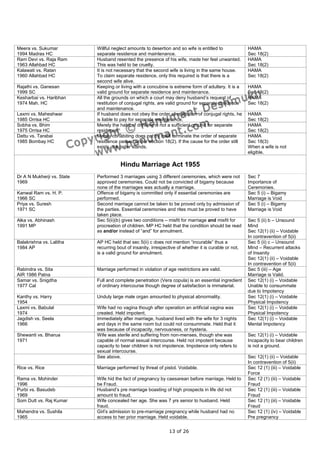
Dr A N Mukherji vs. State   Performed 3 marriages using 3 different ceremonies, which were not          Sec 7
1969                        approved ceremonies. Could not be convicted of bigamy because               Importance of
                            none of the marriages was actually a marriage.                              Ceremonies.
Kanwal Ram vs. H. P.        Offence of bigamy is committed only if essential ceremonies are             Sec 5 (i) – Bigamy
1966 SC                     performed.                                                                  Marriage is Void
Priya vs. Suresh            Second marriage cannot be taken to be proved only by admission of           Sec 5 (i) – Bigamy
1971 SC                     the parties. Essential ceremonies and rites must be proved to have          Marriage is Void
                            taken place.
Alka vs. Abhinash           Sec 5(ii)(b) gives two conditions – misfit for marriage and misfit for      Sec 5 (ii) b – Unsound
1991 MP                     procreation of children. MP HC held that the condition should be read       Mind
                            as and/or instead of “and” for annulment.                                   Sec 12(1) (ii) – Voidable
                                                                                                        In contravention of 5(ii)
Balakrishna vs. Lalitha     AP HC held that sec 5(ii) c does not mention “incurable” thus a             Sec 5 (ii) c – Unsound
1984 AP                     recurring bout of insanity, irrespective of whether it is curable or not,   Mind – Recurrent attacks
                            is a valid ground for annulment.                                            of Insanity
                                                                                                        Sec 12(1) (ii) – Voidable
                                                                                                        In contravention of 5(ii)
Rabindra vs. Sita           Marriage performed in violation of age restrictions are valid.              Sec 5 (iii) – Age
AIR 1986 Patna                                                                                          Marriage is Valid.
Samar vs. Snigdha           Full and complete penetration (Vera copula) is an essential ingredient      Sec 12(1) (i) – Voidable
1977 Cal                    of ordinary intercourse though degree of satisfaction is immaterial.        Unable to consummate
                                                                                                        due to Impotency
Kanthy vs. Harry            Unduly large male organ amounted to physical abnormality.                   Sec 12(1) (i) – Voidable
1954                                                                                                    Physical Impotency
Laxmi vs. Babulal           Wife had no vagina though after operation an artificial vagina was          Sec 12(1) (i) – Voidable
1974                        created. Held impotent.                                                     Physical Impotency
Jagdish vs. Seela           Immediately after marriage, husband lived with the wife for 3 nights        Sec 12(1) (i) – Voidable
1966                        and days in the same room but could not consummate. Held that it            Mental Impotency
                            was because of incapacity, nervousness, or hysteria.
Shewanti vs. Bharua         Wife was sterile and suffering from non-menses, though she was              Sec 12(1) (i) – Voidable
1971                        capable of normal sexual intercourse. Held not impotent because             Incapacity to bear children
                            capacity to bear children is not impotence. Impotence only refers to        is not a ground.
                            sexual intercourse.
                            See above.                                                                  Sec 12(1) (ii) – Voidable
                                                                                                        In contravention of 5(ii)
Rice vs. Rice               Marriage performed by threat of pistol. Voidable.                           Sec 12 (1) (iii) – Voidable
                                                                                                        Force
Rama vs. Mohinder           Wife hid the fact of pregnancy by caesarean before marriage. Held to        Sec 12 (1) (iii) – Voidable
1996                        be Fraud.                                                                   Fraud
Purbi vs. Basudeb           Husband’s pre marriage boasting of high prospects in life did not           Sec 12 (1) (iii) – Voidable
1969                        amount to fraud.                                                            Fraud
Som Dutt vs. Raj Kumar      Wife concealed her age. She was 7 yrs senior to husband. Held               Sec 12 (1) (iii) – Voidable
                            fraud.                                                                      Fraud
Mahendra vs. Sushila        Girl’s admission to pre-marriage pregnancy while husband had no             Sec 12 (1) (iv) – Voidable
1965                        access to her prior marriage. Held voidable.                                Pre pregnancy


                                                                 13 of 26
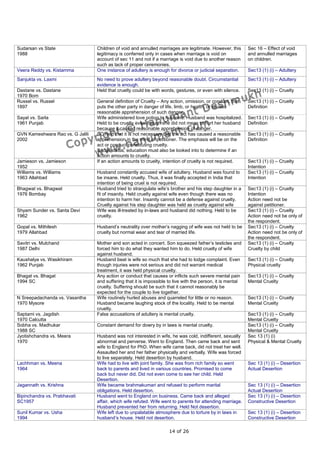
Sudarsan vs State                 Children of void and annulled marriages are legitimate. However, this       Sec 16 – Effect of void
1988                              legitimacy is conferred only in cases when marriage is void on              and annulled marriages
                                  account of sec 11 and not if a marriage is void due to another reason       on children.
                                  such as lack of proper ceremonies.
Veera Reddy vs. Kistamma          One instance of adultery is enough for divorce or judicial separation.      Sec13 (1) (i) – Adultery
Sanjukta vs. Laxmi                No need to prove adultery beyond reasonable doubt. Circumstantial           Sec13 (1) (i) – Adultery
                                  evidence is enough.
Dastane vs. Dastane               Held that cruelty could be with words, gestures, or even with silence.      Sec13 (1) (i) – Cruelty
1970 Bom
Russel vs. Russel                 General definition of Cruelty – Any action, omission, or conduct, that      Sec13 (1) (i) – Cruelty
1897                              puts the other party in danger of life, limb, or health, or causes          Definition
                                  reasonable apprehension of such danger.
Sayal vs. Sarla                   Wife administered love potion to husband. Husband was hospitalized.         Sec13 (1) (i) – Cruelty
1961 Punjab                       Held to be cruelty even though she did not mean to hurt her husband         Definition
                                  because it caused reasonable apprehension of danger.
GVN Kameshwara Rao vs. G Jalili   SC held that it is not necessary that the act has caused a reasonable       Sec13 (1) (i) – Cruelty
2002                              apprehension in the mind of petitioner. The emphasis will be on the         Definition
                                  act or conduct constituting cruelty.
                                  Social status, education must also be looked into to determine if an
                                  action amounts to cruelty.
Jamieson vs. Jamieson             If an action amounts to cruelty, intention of cruelty is not required.      Sec13 (1) (i) – Cruelty
1952                                                                                                          Intention
Williams vs. Williams             Husband constantly accused wife of adultery. Husband was found to           Sec13 (1) (i) – Cruelty
1963 Allahbad                     be insane. Held cruelty. Thus, it was finally accepted in India that        Intention
                                  intention of being cruel is not required.
Bhagwat vs. Bhagwat               Husband tried to strangulate wife’s brother and his step daughter in a      Sec13 (1) (i) – Cruelty
1976 Bombay                       fit of insanity. Held cruelty against wife even though there was no         Intention
                                  intention to harm her. Insanity cannot be a defense against cruelty.        Action need not be
                                  Cruelty against his step daughter was held as cruelty against wife          against petitioner.
Shyam Sunder vs. Santa Devi       Wife was ill-treated by in-laws and husband did nothing. Held to be         Sec13 (1) (i) – Cruelty
1962                              cruelty.                                                                    Action need not be only of
                                                                                                              the respondent.
Gopal vs. Mithilesh               Husband’s neutrality over mother’s nagging of wife was not held to be       Sec13 (1) (i) – Cruelty
1979 Allahbad                     cruelty but normal wear and tear of married life.                           Action need not be only of
                                                                                                              the respondent.
Savitri vs. Mulchand              Mother and son acted in concert. Son squeezed father’s testicles and        Sec13 (1) (i) – Cruelty
1987 Delhi                        forced him to do what they wanted him to do. Held cruelty of wife           Cruelty by child
                                  against husband.
Kaushalya vs. Wasikhiram          Husband beat is wife so much that she had to lodge complaint. Even          Sec13 (1) (i) – Cruelty
1962 Punjab                       though injuries were not serious and did not warrant medical                Physical cruelty
                                  treatment, it was held physical cruelty.
Bhagat vs. Bhagat                 Any action or conduct that causes or inflicts such severe mental pain       Sec13 (1) (i) – Cruelty
1994 SC                           and suffering that it is impossible to live with the person, it is mental   Mental Cruelty
                                  cruelty. Suffering should be such that it cannot reasonably be
                                  expected for the couple to live together.
N Sreepadachanda vs. Vasantha     Wife routinely hurled abuses and quarreled for little or no reason.         Sec13 (1) (i) – Cruelty
1970 Mysore                       Husband became laughing stock of the locality. Held to be mental            Mental Cruelty
                                  cruelty.
Saptami vs. Jagdish               False accusations of adultery is mental cruelty.                            Sec13 (1) (i) – Cruelty
1970 Calcutta                                                                                                 Mental Cruelty
Sobha vs. Madhukar                Constant demand for dowry by in laws is mental cruelty.                     Sec13 (1) (i) – Cruelty
1988 SC                                                                                                       Mental Cruelty
Jyotishchandra vs. Meera          Husband was not interested in wife, he was cold, indifferent, sexually      Sec 13 (1) (i)
1970                              abnormal and perverse. Went to England. Then came back and sent             Physical & Mental Cruelty
                                  wife to England for PhD. When wife came back, did not treat her well.
                                  Assaulted her and her father physically and verbally. Wife was forced
                                  to live separately. Held desertion by husband.
Lachhman vs. Meena                Wife had to live with joint family. She was from rich family so went        Sec 13 (1) (i) – Desertion
1964                              back to parents and lived in various countries. Promised to come            Actual Desertion
                                  back but never did. Did not even come to see her child. Held
                                  Desertion.
Jagannath vs. Krishna             Wife became brahmakumari and refused to perform marital                     Sec 13 (1) (i) – Desertion
                                  obligations. Held desertion.                                                Actual Desertion
Bipinchandra vs. Prabhavati       Husband went to England on business. Came back and alleged                  Sec 13 (1) (i) – Desertion
SC1957                            affair, which wife refuted. Wife went to parents for attending marriage.    Constructive Desertion
                                  Husband prevented her from returning. Held Not desertion.
Sunil Kumar vs. Usha              Wife left due to unpalatable atmosphere due to torture by in laws in        Sec 13 (1) (i) – Desertion
1994                              husband’s house. Held not desertion.                                        Constructive Desertion

                                                                      14 of 26
Jyotishchandra vs. Meera            See above.                                                                Sec 13 (1) (i) – Desertion
1970                                                                                                          Constructive Desertion.
Balihar vs Dhir Das                 Refusing to perform basic marital obligations such as denial of           Sec 13 (1) (i) – Desertion
1979                                company or intercourse or denial to provide maintenance is willful        Willful Neglect
                                    neglect.
Chandra vs. Saroj                   Forced Brahman wife to eat meat and drink alcohol. Wife left. Held        Sec 13 (1) (i) – Desertion
1975                                not desertion because she had reasonable cause.                           Reasonability
Bhagwati vs. Sadhu Ram              Wife was living separately on the account of a maintenance                Sec 13 (1) (i) – Desertion
1961                                agreement with husband. Held not desertion because she was living         Desertion by consent.
                                    separately by consent of husband.

                                                              Law of Contracts

Case Reference                      Case Details                                                              Topic
Balfour vs. Balfour                 Husband promised to pay wife a weekly stipend. It was held not            Intention to Contract
1919                                binding because there was no intention to contract.
Rose and Frank Co. vs. J R          An elaborate agreement was drawn up between an American and an            Intention to Contract
Crompton                            English firm. It specified that this agreement is not meant to create
1923                                any legal obligations. The agreement was terminated by one party.
                                    The other party sued. Held that there was no intention to contract as
                                    specified in the agreement.

                     Communication of Proposal, Acceptance, and their Revocation

Haji Mohd Ishaq vs. Mohd Iqbal      Goods were dispatch by the plaintiff through a go-between man and         Sec 3 – Comm. Accpt. &
1978                                the defendants also paid part of the cost.                                Revocation of Proposals
                                    They were held to be liable for paying the balance because they           Sec 9 - Promises can be
                                    accepted the offer by their actions.                                      express or implied.
                                                                                                              Communication of
                                                                                                              proposal and acceptance
                                                                                                              can be through actions.
Lalman vs. Gauridatta               A businessman’s child was lost and he sent his assistant to search        Sec 4 – Communication of
1913                                for him. After the assistant was gone, the businessman made a public      proposal is complete
                                    offer that whoever brings his child would get a reward. After that the    when it comes to the
                                    assistant brought the child and claimed the reward.                       knowledge of the person
                                    It was held that since the assistant did not know about the offer, he     to whom it is made.
                                    could not have accepted it and thus he was not eligible for the
                                    reward.
Adams vs. Lindsell                  Defendants sent an offer to sell wool by post. The plaintiff received     Sec 4 - Communication of
                                                   th
1818                                the offer on 5 and mailed an acceptance, which was received by the        acceptance is complete
                                                      th
                                    defendants on 9 . However, the defendants had already sold the            when it is put in
                                               th
                                    wool on 8 upon not receiving the acceptance.                              transmission so as to be
                                    It was held that the contract came into existence as soon as the          out of power of the
                                    acceptor mails the acceptance, and not when the offerer receives the      acceptor.
                                    acceptance. Otherwise, it will cause an infinite loop (ad infinitum) of
                                    acceptance and confirmation.
Henthorn vs. Fraser                 An offer to sell a property was made to a person, who lived in another    Sec 5 – A Proposal can
1862                                town. He posted an acceptance at 3.50 PM. However, the offerer had        be revoked anytime
                                    already mailed a revocation of the offer at 1PM, which reached the        before communication of
                                    person at 5.30PM. Held that revocation was ineffective because the        its acceptance is complete
                                    acceptance was already done against the offerer.                          against the promisor.
Union of India vs Bhimsen Walaiti   Defendant won an auction for a liquor shop and paid 1/6 of the cost       Sec 5 – An acceptance
Ram                                 upfront. However, the bid was supposed to be finalized by the             can be revoked anytime
SCC 1969                            financial commissioner, which he had not done. Meanwhile, the             before its communication
                                    defendant failed to pay the remaining amount and the commissioner         is complete against the
                                    ordered a re-auction. In the re-auction, less money was realized and      acceptor.
                                    the plaintiff sued to recover the shortfall.
                                    Held that since the commissioner had not given is final approval for
                                    the bid, the communication of acceptance was not complete against
                                    the defendant, thus the defendant was free to revoke his proposal.
                                    1. By communication of notice of revocation.                              Sec 6 – Revocation how
                                    2. By lapse of time (or lapse of reasonable time if not time is           made.
                                         specified in the proposal.)
                                    3. By failure to perform a condition precedent.
                                    4. By death or insanity of the proposer, if the fact of his death or
                                         insanity comes to the knowledge of the acceptor before
                                         acceptance.

                                                                       15 of 26
Bhagvandas Goverdhandas Kedia        A mere mental decision of the acceptance is not enough. It must be           Section 2 (b)
vs Girdharilal Pursottamdas          reflected through an act such as through speech, letter, etc.                When the party to whom
SC AIR 1966                                                                                                       offer is made, signifies his
                                                                                                                  assent thereto, he accepts
                                                                                                                  the offer.
Powel vs Lee                         A member of the appointment committee, in his personal capacity,             Section 2 (b)
1908                                 informed that the plaintiff was appointed. However, later, the
                                     committee changed its decision.
                                     It was held that since no acceptance was given by the authorized
                                     person, there was no contract.

Felthouse vs. Bindley                The owner of the horse did not communicate his acceptance of his             Section 2 (b)
1863                                 uncle’s offer but only to his auctioneer, who mistakenly sold the horse
                                     to someone else.
                                     It was held that since the acceptance was not given to the promisor,
                                     there was no contract.

Hyde vs. Wrench                      An offer to sell a farm for $1000 was rejected by plaintiff who offered      Sec 7 – In order to convert
1840                                 $950 for it. This was turned down by the offerer. Plaintiff then agreed      a proposal into promise,
                                     to pay $1000.                                                                the acceptance must be
                                     It was held that the defendant was not bound by any such                     absolute and unqualified
                                     acceptance.                                                                  …
State of Bihar vs. Bengal C&P        When an order for goods is sent, the mailing of goods itself is              Sec 7 - … and be
Works                                considered the acceptance of proposal. No further communication of           expressed in some usual
SC AIR 1954                          acceptance is required.                                                      and reasonable manner…

Elliason vs Henshaw                  The plaintiff sent the acceptance by mail instead of through the             Sec 7 – Manner of
1819                                 wagon that brought the offer, as prescribed by the offerer. The claim        acceptance.
                                     was rejected because acceptance must be in prescribed manner.

                                     Situation is different in India. Sec 7 says - If the proposal prescribes
                                     a manner of acceptance, and if the acceptance is not made in that
                                     manner, proposer may insists that his proposal shall be acceptance
                                     in the prescribed manner, but if he fails to do so, he accepts the
                                     acceptance.
Carlill vs. Carbolic Smoke Ball Co   See Below                                                                    Sec 8 – Performance of
                                     Offer was accepted by performing conditions given in the                     the conditions of a
                                     advertisement.                                                               proposal or the
                                                                                                                  acceptance of any
                                                                                                                  consideration for a
                                                                                                                  reciprocal promise, is an
                                                                                                                  acceptance of the
                                                                                                                  proposal.
Harvey vs. Facie                     Plaintiff telegraphed, “will you sell bumper hall pen?” Telegraph            Offer and Invitation for
1893                                 lowest price.” Defendants telegraphed back with “Lowest price #900”          offer
                                     but then refused to sell it at that price.
                                     Defendants were not held liable because just by quoting the price
                                     they had not made any offer.
Pharmaceutical Soc. Of GB vs.        Display of goods is merely an invitation to proposals even if it is a self   Offer and Invitation for
Boots Cash Chemists Ltd.             service shop.                                                                offer
1952
M C Pherson vs. Appanna              Proposal to buy property at 6000/- was replied with, " won't accept          Offer and Invitation for
1951                                 less than 10000". This was not considered a proposal but an                  offer
                                     invitation to proposal.
Carlill vs. Carbolic Smoke Ball      The company advertised that it will pay $100 to anyone who uses              General Offer
Company                              their product and still caught influenza and that they have deposited
1893                                 $1000 in the bank for this purpose. The plaintiff claimed the offer. The
                                     company’s grounds were:
                                          •    The offer was not for any one in particular.
                                          •    There was no intention to contract.

                                     Their arguments were rejected because a general offer could be
                                     accepted by anybody and $1000 deposit implied that they had
                                     intention to contract.

                                                 Competency to Contract
Mohoribibee vs. Dharmodas Ghosh      Contract with a minor is void ab initio.                                     Section 11
Privy Council 1903                   Minor mortgaged his house and received some money in advance.                Competent to Contract -

                                                                         16 of 26
Later, the minor applied to cancel the contract because he was               Minority
                                    minor. The money lender only asked for returning the advance under
                                    section 64 or 65 of contract act. But was denied because these
                                    sections apply only for voidable contract. Here, there was no contract
                                    at all. A relief under sec 41 of Specific relief act could be granted only
                                    if justice required it. Here, since money lender knew about the age,
                                    justice did not require it.
Mir Sarvarjan vs. Fakhruddin        A contract to purchase a property was done on behalf for minor by            Section 11
Mohd. Chaudhary                     the guardian. It was held that the minor cannot sue to recover
1912                                possession.
Srikakulam Subramanyam vs.          Sale of inherited property of a minor to pay off inherited debts by the      Section 11
Kurra Subha Rao                     guardian was held valid.
1949
Jennings vs. Rundall                Minor hired a horse for short distance but rode it for long distance.        Section 11 – No liability in
1799                                The horse was injured. Minor was not held liable.                            tort or in contract arising
                                                                                                                 out of a contract.
Hari Mohan vs. Dulu Mia             Minor was not held liable in tort for money lent on bond.                    Section 11
1934 Calcutta
Burnard vs. Haggis                  Minor borrowed a horse and gave it to a friend who jumped it. Horse          Section 11
1863                                died. Minor was held liable in tort because there was no contract.
Leslie vs. Sheill                   Money Lenders could not recover 400 pounds lent to a minor, who              Section 11
                                    took it by misrepresenting his age.                                          Doctrine of Restitution
                                    This was followed in Mohoribibee case.
Ulfat Rai vs. Gauri Shankar         A minor can sue to recover possession of a house for which he had            Section 11
1911                                already paid.                                                                Beneficial Contracts
Raj Rani vs. Prem Adib              Film producer entered into a contract with the father of a girl to give      Section 11
1949                                the girl a role in his movie. Later on he refused. It was held that either   Beneficial Contracts
                                    minor nor her father could sue because the minor could not be forced
                                    to give consideration and the father had not given any consideration
                                    for the promise.
Inder Singh vs. Parmeshwardhari     A land worth 25000Rs was sold for only 7000Rs. Mother claimed that           Section 12
Singh                               the son was an idiot and did not understand the implications. The            Competent to Contract-
Patna HC 1957                       sale was held void.                                                          Unsoundness of mind.


                       Coercion, Undue Influence, Fraud, Misrepresentation, Mistake
Chikham Amiraju vs. Chikham         A Hindu threatened to commit suicide to induce his wife and son to           Sec 15 – Coercion
Seshamma                            sign release of property document in favor of his brother.
Madras HC 1912
Askari Mirza vs. Bibi Jai Kishori   Threatening a criminal prosecution is not coercion per se. But               Sec 15 – Coercion
1912                                threatening to file a false charge is coercion.
Astley vs. Reynolds                 A person pledged his plate for $10 but when he went to take it back,         Sec 15 – Coercion
1721                                the lender asked for $10 more for interest. He paid but later on sue to      Detention of property.
                                    recover $10. Held coercion.
Andhra Sugar vs. State of AP        A sugar factory was bound to receive sugarcane offered by a farmer.          Sec 15 – Coercion
1968                                Held not coercion.
                                    Statutory requirement is not coercion.
Mannu Singh vs. Umadat Pandey       Devotee gave up all his property to his guru.                                Sec 16 – Undue Influence
Allahbad HC 1890                                                                                                 Ability to dominate will.
Williams vs. Baylex                 Father was afraid of bank manager filing charges against son. So he          Sec 16 – Undue Influence
1866                                mortgaged his house on unfavorable terms.                                    Parties on unequal
                                    Held undue influence.                                                        footing.
Ranee Annapurni vs. Swaminatha      A poor widow desperately needed money to fight case for                      Sec 16 – Undue Influence
1910                                maintenance. Moneylender gave money on 100% interest rate. Held              Mental Distress.
                                    undue influence.
Lancashire Loans Ltd. vs. Black     A daughter gave a surety for a loan taken by mother. Held that a             Sec 16 – Undue Influence
1934                                daughter may not be independent and may be under the influence of            Presumption of undue
                                    the mother.                                                                  influence.
Wajid Khan vs. Ewaz Ali Khan        An illiterate woman conferred upon her manager a big pecuniary               Sec 16 – Undue Influence
1891                                benefit for very less valuable consideration under the guise of a trust.     Unconscionable Bargain
Lloyd’s Bank vs. Bundy              A farmer pledged his only farmhouse to secure loan for his                   Sec 16 – Undue Influence
                                    businessman son. Later bank tried to take possession of the house.           Inequality in Bargaining
                                    Held that the contract may have been influenced by undue influence.          Power
Ismail vs. Amir Bibi                For a contract with a pardanasheen woman to be deemed induced by             Sec 16 – Undue Influence
1902                                undue influence, the woman should be completely secluded from the            Contract with
                                    society. A lady who stood as witness, put tenants, collected rents in        pardanasheen woman
                                    respect of her house, was held not a pardanasheen woman.


                                                                        17 of 26
Derry vs. Peek                        Company’s prospectus said that they had been authorized by a               Sec 17 - Fraud
1889                                  special act of parliament to run steam trams. However, the                 Suggestion of a Fact.
                                      permission was subject to approval of Board of Trade, which was not
                                      mentioned. The permission was later denied and the company wound           Intention is required.
                                      up.
                                      Since they honestly believed that once parliament gave consent, the
                                      board of trade would give the permission too, they were not held to
                                      be liable for fraud.

B R Chaudahry vs. IOC                 A dealer concealed previous employment with govt to get dealership.        Sec 17 – Fraud
SC 2004                               Held fraud.                                                                Act. Concealment
Sri Krishan vs. Univ of Kurukshetra   Student did not disclose that he was short of attendance. He was not       Sec 17 - Fraud
SC AIR 1976                           held liable because it was the duty of the university to scrutinize the    Passive Concealment
                                      forms and ask for more information if in doubt.

                                      Mere silence is not fraud.
DDA vs. Skipper Construction Co.      A builder got deposits from more number of people that there were          Sec 17 – Fraud
SC 2000                               flats. He knew that he couldn’t fulfill the promise of giving a flat to    Making a promise without
                                      everyone. Held as fraud and was ordered to pay deposit back with           intention to perform.
                                      interest.
Ningawwa vs. Byrappa                  Husband got his illiterate wife to sign papers by telling her that he      Sec 17 – Fraud
1968                                  was mortgaging two of her lands but in reality he mortgaged four.          Any act fitted to deceive.
                                      Was held as fraud.
Oceanic Steam Navigation vs.          Ship was claimed to be of 2800 tonnage, but turned out to be more          Sec 18 – Misrep.
Soonderdas Dharmasey.                 than 3000 tonnage.                                                         Unwarranted Statements
Bom HC 1980.
Thake vs. Maurice                     Failed vasectomy, wife became pregnant. Was not informed of the            Sec 18 - Misrep.
1986                                  risk of failure.                                                           Breach of duty

Farrand vs. Lazarus                   Dealer did not disclose true mileage of the car and put a disclaimer       Sec 18 –
2002                                  that odometer could be incorrect. In reality, odometer was very            Misrepresentation
                                      wrong, and thus disclaimer was a grossly misleading.                       Inducing mistake about
                                                                                                                 subject matter
R vs. Kylsant                         Company prospectus said that company was regularly paying                  Sec 18 – Misrep.
1932                                  dividends, which implied that is was making profit. However, it did not    Suppression of material &
                                      say that company was making losses and dividends were being paid           vital facts
                                      from war time accumulated profits.
Bisset vs. Wilkinson                  Seller of the land expressed an opinion that the land was good for         Sec 18 – Misrep.
1927                                  200 sheep. But it turned out that the land was not suitable for sheep      Expressing opinion.
                                      farming at all. Held not misrepresentation.
Cundy vs. Lindsay                     Plaintiffs received an order from a fraudulent man named Blenkarn. A       Sec 20 – Mistake
1878                                  reputed firm by the name of Blankiron also existed nearby. The             What constitutes Essential
                                      plaintiff supplied the goods on the name of Blankiron to the address       Fact? Identity of the
                                      mentioned on the order, which were received by Blenkarn. Blenkarn          parties.
                                      then sold the goods to the defendants. Plaintiff sued the defendants.
                                      It was held that the plaintiffs never indented to contract with Blankarn   Mistake of Identity caused
                                      and thus, there was no contract between the plaintiff and Blankarn.        by Fraud.
                                      Thus, Blankarn did not own the title to the goods and had no right to
                                      sell them to the defendants. Defendants were thus liable to pay the
                                      value of the goods to plaintiffs.
Said vs. Butt                         Tickets to a show were bought by a person for his friend. However,         Sec 20 – Mistake
1920                                  later the manager did not allow the friend to enter the theater. Held      Identity of the parties.
                                      valid because there was no contract between the theater manager
                                      and the friend.
Raffles vs. Witchelhaus               Plaintiff and Defendants had different ships having same name              Sec 20 – Mistake
1864                                  “Peerless” in mind while entering the contract. Held that there was no     Identity/nature of subject
                                      consensus ad idem and therefore no valid contract.                         matter.
                                                                                                                 Different subject matters
                                                                                                                 in mind.
Smith vs. Hughes                      A person wanted to buy old oats for his horse. Seller showed the oats      Sec 20 – Mistake
1871                                  but said nothing about the age. Buyer accepted the sample and              Identity/nature of subject
                                      ordered. Later on the buyer refused the order saying that the oats         matter.
                                      were new.                                                                  Quality of the subject
                                      Held the buyer liable.                                                     matter.
Sarat Chandra vs. Kanailal            A gift deed was signed under the impression that it was only a power       Sec 20 – Mistake
AIR 1929                              of attorney. Held that the agreement is void.                              Nature of promise.

                                                          Consideration

                                                                          18 of 26
Koteswar Vittal Kamath vs. K          Sale of liquor without license is void. Money paid is not recoverable.      Sec 23 - Unlawful
Rangappa Baliga                                                                                                   Consideration
1969 SC                                                                                                           Prohibited by law
Mannalal Khetan vs. Kedar Nath        If the intention of the law is to forbid something in public interest, an   Sec 23 - Unlawful
Khetan                                agreement that contravenes it, is void. However, if the intention is to     Consideration
1977 SC                               merely regulate something, the contract may not be void even if the         Prohibited by law
                                      parties have to pay a penalty.
Fateh Singh vs. Sanwal Singh          An accused was required to put a surety of 5000/- for good behavior.        Sec 23 - Unlawful
1878                                  He deposited the money with defendant and asked the defendant to            Consideration
                                      become surety. After the period of surety, the accused sued to              Defeats provision of law
                                      recover the deposit. Agreement was held void.
Regazzoni vs. K C Sethia              Two parties made an agreement that one will supply jute to another          Sec 23 - Unlawful
1956 SC                               in an African country so that it can then be resold in another country      Consideration
                                      to which export of jute bags was prohibited. One party sued the other       Defeats provision of law
                                      for breach of contract. Held Void.
Scott vs. Brown Doering McNab         A trader asked the broker to purchase a stock of a company at a             Sec 23 - Unlawful
and Co                                premium to create an impression in people that the company was              Consideration
1891                                  worth paying a premium. Later he discovered that the broker sold his        Fraudulent
                                      own shares to him. The trader sued to revert the transaction. Held
                                      void because it was done to defraud people.
Ram Sarup vs. Bansi Mandar            An agreement said that a person would work for another person for           Sec 23 - Unlawful
1915                                  two years for borrowing 100/-. In case of default, he was to pay an         Consideration
                                      exorbitant interest and principal at once. This was held                    Injurious to person
                                      indistinguishable from bonded labor and this was injurious to person.
                                      Held void.
Allice Marry Hill vs. William Clark   Adultery involving a married person is not only immoral but illegal and     Sec 23 - Unlawful
1905                                  any contract or promise related to that cannot be enforced.                 Consideration
                                                                                                                  Immoral
Ratanchand Hirachand vs. Askar        J Reddy of AP HC observed, "The twin touchstones of public policy           Sec 23 - Unlawful
Navaz Jung                            are advancement of public good and prevention of public mischief            Consideration
1976                                  and these are to be decided by the judges not as a men of legal             Against public policy.
                                      learning but as experienced and enlightened members of the
                                      society."
Debi Radha Rani vs. Ram Dass          Forbearance to sue is a valid consideration.                                Sec 25
1941
Ramchandra Chintaman vs. Kalu         A lawyer was promised additional sum if he won the case. The                Sec 25
Raju                                  promise was held non binding because he was under contractual               Performance of
1877                                  obligation to do his best to win the case.                                  contractual obligation is
                                                                                                                  no consideration.
Shadwell vs. Shadwell                 An uncle was held to be liable to pay annuity that he had promised to       Sec 25
1860                                  his nephew upon the nephew’s marriage to a girl.                            Contractual obligation to
                                                                                                                  third party is valid
                                                                                                                  consideration.
Rajlukhy Dabee vs. Bhootnath          Husband agreed to pay wife for maintenance and separate                     Sec 25 (1) – Love and
Mookherji                             residence. The agreement noted that there were quarrels among               Affection.
1900                                  them. Court found no “love and affection” between them and held the
                                      agreement void for want of consideration.
Bhiwa vs. Shivram                     A brother gave half of his property by an agreement in writing. Court       Sec 25 (1) – Love and
1899                                  observed that he did this to be a able be reconcile with his brother.       Affection.
                                      there was natural love and affection so the contract is valid.
                                      Covered by section 25(2) – if it is a Promise to compensate, wholly or      Sec 25 (2) - Past
                                      in part, a person who has voluntarily done something for the                voluntary service = Past
                                      promisor, or something which the promisor was legally compellable to        Consideration.
                                      do, such a contract is not void for want of consideration.
Sindha Sri Ganpatsingji vs.           Every act done at request implies a promise to pay. Thus, services          Sec 25 (2) - Past service
Abraham                               rendered to a minor, which were continued after his majority upon his       at Request = Past
1896                                  request, were held valid consideration for his promise to pay.              Consideration.

                                      In English law, as held in the case of Limpleigh vs. Braithwaite, a past
                                      service done at request is a valid consideration but promise to pay for
                                      a past service that was done when no promise existed, is void for
                                      want of consideration. This is opposed to sec 25(2).
Haigh vs. Brooks                      A promise to pay some bills if the promisee handed over a document,         Sec 25 – Consideration
1839                                  which turned out to be worthless, was held valid. It is not for the court   must be of some value …
                                      to decide whether the value of the consideration is sufficient for the
                                      promise, but only that the consideration is of some value.
                                      Explanation to Sec 25 says that A sells a house worth 1000 to B for         Sec 25 - …but may not be
                                      10. A’s consent was freely obtained. This is valid contract. However,       adequate.
                                      lack of adequate consideration may be a ground for determining
                                      whether the consent was free or not.
                                                                          19 of 26
De La Bere vs. Pearson            Newspaper offered financial advice. A person followed it and lost           Sec 25 - …but may not be
1908                              money. Held that there was sufficient consideration for the offer of        adequate.
                                  advice.
Durga Prasad vs. Baldeo           Plaintiff built shops on the desire of the collector. Defendant,            Sec 2(d), 25
1880                              shopkeepers, promised to pay a percentage of sales. Their promise
                                  was held without consideration and thus non-binding.
Kedar Nath vs. Gauri Mohd.        Defendant pledged 100Rs for the construction of town hall. Plaintiff        Sec 2(d), 25
1886                              started construction. Defendant was held liable to pay.
Tweddle vs. Atkinson              G and plaintiff’s father had agreed to pay a sum of money to plaintiff      Sec 2(d), 25
1861                              upon plaintiff’s marriage to G’s daughter. G failed to pay. Plaintiff
                                  sued. G was held NOT liable.

                                  British law on Privity of consideration and Privity of Contract:
                                        1. Consideration must move from promisee to promisor.
                                        2. Only a party to a contract can sue for execution.
Chinnaya vs. Ramaya               An old lady gifted her property to her daughter. The daughter had           Sec 25
1882                              promised to pay an annuity to the plaintiff, who was the sister of the      Privity of consideration.
                                  old lady. The daughter was held liable to pay.
                                  Consideration can be given by any body.
M C Chacko vs. State Bank of      SC followed the principle in Tweddle and Atkinson and held that             Sec 25
Travancore                        since SBT was not a party to the contract between the father and the        Privity of Contract
1969 SCC                          son, it could not sue for its performance.
Khwaja Mohd. Khan vs. Hussaini    Privy council observed that due to the cultural aspect in communities       Sec 25
Begum                             of India, it would amount to injustice if the common law doctrine was       Exception to Privity of
1910                              applied to agreements and arrangement of marriage and family                Contract
                                  matters.                                                                    Trust or Charge
                                  A beneficiary of a trust created by an agreement has the right to sue
                                  for its performance.
Rana Uma Nath Bakhs Singh vs.     Father gave the property to the son with a promise that son will give       Sec 25
Jung Bahadur                      one village and annuity to another illegitimate son.                        Exception to Privity of
1938                              Illegitimate son sued and succeeded.                                        Contract
                                                                                                              Trust or Charge
Daropti vs. Jaspat Rai            Husband promised to father that he will pay for separate residence of       Sec 25
1905                              daughter. Daughter sued and won.                                            Exception to Privity of
                                                                                                              Contract
                                                                                                              Marriage, Partition, or
                                                                                                              family matters.
Devraj Urs vs. Ram Krishnaiya     When by the terms of a contract a payment is to be made by a party          Sec 25
AIR 1952                          to a third person and the party acknowledges this to the third person,      Exception to Privity of
                                  a liability is incurred towards the party to pay.                           Contract
                                                                                                              Acknowledgement or
                                                                                                              Estoppel

                                  Void Agreements – Trade and Wagering
Mahbub Chander vs. Raj Koomar     Two shopkeepers had shops in same locality. One agreed to pay the           Sec 27
1874                              second one to close his shop. The second shopkeeper closed the              Agreement in Restraint of
                                  shop but the first shopkeeper refused to pay, Agreement was held            Trade, void.
                                  void.
Nordenfelt vs. Maxim Nordenfelt   Inventor sold the goodwill of a gun company to a buyer. The                 Sec 27
Gun Co.                           agreement was –                                                             Agreement in Restraint of
1894                              1. Seller will not practice the same trade for 25                           Trade, void.
                                  2. Seller will not do any business that will compete with the
                                       business carried on by the buyer at that time.
                                  It was held that the first part is valid because it is reasonable but the
                                  second part is invalid because it is unreasonable restriction on trade.
Mohd. Isack vs. Daddapaneni       Agreement was that one person would pay another to not respond to           Sec 27
1946                              a tender floated by postal service. The person got the contract as a        Collusion between bidders
                                  result and refused to pay. Held Valid.                                      and tenderers is valid.
Vidya Wati vs. Hans Raj           Lessor can put restriction on what kind of business or trade can be         Sec 27
1993                              done on his property. This is not held to be a restriction but an           Right of a lessor.
                                  opening for a specific business.
Korus Mfg. Vs. Koluk Mfg.         Two companies entered into an agreement to not employ any person            Sec 27
1959                              who has worked in each other’s companies in past 5 years. Held              Trade Combinations.
                                  invalid. Trade combinations are permitted to regulate business such
                                  as hours of opening or closing that marginally infringe upon trade but
                                  they cannot put restrictions on employment in the guise of regulation.
Niranjan Sankar Golkari vs.       A foreign company collaborated with Indian company on the condition         Sec 27
Century Spinning and Mfg. Co.     that its trade secrets will be protected. An employee was restricted to     Trade Secrets – Restraint

                                                                      20 of 26
1976                                   work for a competing company for 5 years. Held Valid.                      upon employees.
Carlill vs. Carbolic Smoke Ball Co.    Held that a wager contract is one in which parties professing              Sec 30
1892                                   opposing views on the result of an uncertain event, mutually agree         Agreement by way of
                                       that depending on the outcome of such event, one will pay or hand          wager is void.
                                       over to the other a sum of money or other stake. Neither party has
                                       any other interest in the event other than their stake that they may
                                       lose or win.
                                       Identified essential conditions of a wagering agreement –
                                            1. Event must be uncertain.
                                            2. Parties have no control on the outcome.
                                            3. Each party must either win or lose depending on the
                                                 outcome.
                                            4. There should be no other consideration other than the stake.
Babasaheb vs. Rajaram                  Two wrestlers agreed that if one fails to appear in a fight he will pay    Sec 30 – Each party must
1940                                   500/- to the other and the winner will take 1125/- of the gate money.      either win or lose.
                                       Held valid.

Kong Yee Lone vs Lowjee Namjee         A trader promising to deliver 199000 bags of rice while he had no          Sec 30
1901                                   such capacity was held a wagering agreement.                               Speculative Transactions
Gherulal Parekh vs. Mahadeodas         A partnership to participate in wagering contracts is not illegal. A       Sec 30
Maiyaa                                 partner can sue other partners to pay for proportional money to cover      Collateral Transaction
1959                                   loses in wagering agreements.
Moore vs. Elphic                       Literary competitions which involve skills and an effort is made to        Sec 30
1945                                   select best performance is not wagering.                                   Exception - Game of
                                                                                                                  Skills.

                                                  Standard Form Contracts
L’ Estrange vs. Graucob Ltd.    Mrs. L signed an agreement without reading for buying a cigarette vending
1934                            machine. The agreement contained exemption from any liability. The supplier had
                                made no attempt to bring this sweeping clause to the notice of the customer.
                                The machine completely failed to work. However, the court was constrained to hold
                                that the customer was bound by the contract irrespective of whether he has read it
                                or not.
Henderson vs. Stevenson         A steamer ticket carried a term on the back side that the company will not be held        Reasonable notice
                                liable for any damage for luggage. It was held that since there can be no                 of terms.
                                reasonable hint that any terms were written on the back side, the customer had no
                                knowledge of them and thus he could not have accepted them.

Sugar vs. London                A notice will be called sufficient only if it will convey to the people in general that   Reasonable notice
1941                            the ticket contains sufficient. Thus, a notice that was obliterated by a date stamp       of terms.
                                was held not valid. Notice in any language is valid.
Olley vs. Marlborough           A man booked a hotel by phone. When he reached the hotel, he saw the notice               Notice must be
1949                            waiving liability for theft, displayed on the room. However, it was held that since the   contemporaneous
                                notice was not given at time of contract, the hotel was liable for theft.                 with the contract.
                                Similarly, any terms must be displayed before a vending machine prints out and
                                delivers a ticket.
B V Nagaraju vs. Oriental       SC explained the theory of fundamental breach in this case. Even when adequate            Theory of
Insurance Co.                   notices and conditions have been displayed and agreed upon, a party imposing              fundamental
1996 SCC                        them may not rely on them if he has committed a breach of contract that is                breach.
                                fundamental to the contract.
                                Every contract contains a core or fundamental obligation which must be performed.
                                If this obligation is not performed, no exemption clause can come to the rescue.
Alexender vs. Railway           A parcel was delivered to a friend of the actual consignee. This was held a               Theory of
Executive                       fundamental breach and the company was held liable even though they had a                 fundamental
1951                            clause claiming no liability for lost or damaged articles.                                breach.
United India Insurance vs.      Where words of an exemption clause have wider as well as a narrower meaning,              Strict Construction
Pushpalaya Printers             the one that is favorable for the weaker party will be chosen. Thus, the rule of
2004                            contra proferentem will be used, which means, when a statement is ambiguous, it
                                will be read against the party who wrote it.
White vs. John Warwick &        The plaintiff hired a bicycle. The defendants agreed to maintain it in good condition     Liability in Tort
Co.                             however, included a clause that exempted them from personal injuries. However,
1953                            while riding, the saddle tilted forward and the rider was injured.
                                It was held that even though the defendants had exempted themselves from the
                                liability in contract, they were still liable for their negligence.
                                However, even liability in torts can be exempted by putting a clause explicitly.
                                Such clauses are now invalid because of Unfair Trade Practices Act.
Lily White vs. Mannuswamy       An exemption clause of a laundry said that the laundry will be liable only for 15% of     Unreasonable
1966                            the price of the garment that is damaged or lost. This was held to be unreasonable        Terms
                                                                                21 of 26
because if permitted, the laundry could get new clothes for 15% of the price, which
                                would be against public interest.
                                Thus, if an exemption clause defeats the purpose of a contract, it is unreasonable
                                and is thus invalid.
Haseldine vs. C A Daw and       A lift contractor was maintaining a lift for a building. He was held liable for an injury    Exemption clauses
Son Ltd.                        to a third person even though he had an exempt clause with the owner of the                  and third parties.
1941                            building. This is because, a contract is between two parties. Its terms do not apply
                                to the third party.
Adler vs. Dickenson             A passenger can sue the employee of a company for his negligence even though                 Exemption clauses
                                the company is exempt from such liability. Just as third parties is not affected by a        and third parties.
                                contract, so also a third party cannot take advantage of the terms in a contract.

                                    Specific Performance of a Contract (SRA 1963)
Nivarti Govind Ingle vs. RB Patil             A woman took a loan from a relative and executed a deed of             Sec 10
1997                                          sale in favor of the relative's minor son with an agreement of
                                              reconveyance at the repayment of loan. This contract was held
                                              to be specifically enforceable. The relative had sold the
                                              property off to a buyer. This decree was allowed to be
                                              enforced against such buyer also.
M S Madhusoodhanan vs. Kerala                 Shares of a private company were held to be goods of such a            Sec 10
Kaumudi Pvt. Ltd.                             nature as are not easily obtainable in the market. Thus, SC
2003 SCC                                      allowed specific performance to be granted in such cases.
Meenakshisundara vs. Rathnasami               When a loan has already been advanced on the                           Sec 14(1) (a)
1918                                          understanding that a security will be provided against it, this        When money is adequate
                                              can be specifically enforced.                                          compensation.
Pearlite Liners Pvt. Ltd. vs. Manorama        A contract for employment cannot be specifically enforced              Sec 14(1) (a)
Sirsi                                         because it involves personal service.                                  Personal service/skills,
2004                                                                                                                 volition, too complex.
Indian Oil Corp. vs Amritsar Gas Agency       A contract for distributorship cannot be specifically enforced.        Sec 14(1) (c)
1991 SCC                                                                                                             When a contract is
                                                                                                                     determinable.
Reyner vs. Stone                              A tenant's undertaking to cultivate a farm in a specific way was       Sec 14(1) (d)
1792                                          held to be not specifically enforceable.                               When a contract is of
                                                                                                                     continuous nature and
                                                                                                                     court cannot supervise.
Manzoor Ahmed Magray vs. Ghulam               Plaintiff was ready, willing, and able to perform his part of the      Sec 23
Hasan Aram                                    agreement for the sale of an orchard. Held that plaintiff was          Existence of liquidation of
1999                                          entitled to specific performance despite the existence of a            damages clause is no bar
                                              penalty clause providing for the paying of 10000/- by the party        to specific performance if
                                              violating the contract.                                                the intention of the penalty
                                                                                                                     was to prevent violation.

                                                                       Labor Laws

Case Reference                                Case Details                                                           Topic

                                                         Factories Act 1948
State of Bombay vs. Ali Saheb Kashim          Bidi making is Manufacturing Process. 1955                             Sec 2(k) - Manu Process
Tamboli                                       Wages not necessary for being a worker. 1955                           Sec 2(l) - Worker
Bom1955
Shankar Balaji vs. State of Maharashtra       Not a worker because - no agreement of contract, no fixed              Sec 2(l) - Worker
AIR 1962 SC                                   time for work, work from home any time, leave any time. Only
                                              adherence to bidi specs is no issue.
State of Bombay vs. Ardeshir Hormosji         Salt Making is a Manufacturing Process. 1963                           Sec 2(k) - Manu Process
Bhiwandiwala                                  Land used for making salt is factory. 1956                             Sec 2(m) - Factory
Bom 1956
Pragnarain vs. Crown                          Factory means premises where anything towards making or                Sec 2(m) - Factory
Lah 1928                                      finishing of an article is done up to a stage when it is ready for
                                              sale or is in suitable condition to be put in market.
State of Gujarat vs. Jethalal                 That someone without the approval or knowledge of the                  Sec 21 – Fencing of
AIR 1964 SC                                   occupier has removed a safety mechanism, is no defense.                machinery.
Finch vs. Telegraph Construction and          Only hanging of goggles is not enough but the workers must             Sec 35 - Protection to
Maintenance Co. Ltd.                          be informed of their whereabouts.                                      eyes
1949
Bengal Water Proof Workers vs. State of       Held that the liability of a company is only to set up a canteen       Sec 46 - Canteen

                                                                            22 of 26
West Bengal                               so that workers can take advantage of it. The terms and
1970                                      conditions of service of the staff of the canteen do not come
                                          under that liability.

                                        Workmen’s Compensation Act 1923
New India Insurance Co vs. Man Singh      Dependants in three categories are not mutually exclusive and       Sec 2 (1) d
1984                                      can claim compensation simultaneously.                              Dependent
Ramji vs. Lalit Kumar Bardiya             Parents of a workman living in a joint family are dependent on      Sec 2 (1) d
AIR 1995 MP                               his earnings even if the workman could not contribute to the        Dependent
                                          family fund due to lack of payment by the workman’s
                                          employer.
M/s JC Mills vs. Deshraj                  Paid leave is not part of wages unless the contract of              Sec 2 (1) m Wages
AIR 1952 MP                               employment specifically says that paid leave can be in cashed
                                          if not taken.
Maharashtra Sugar Mills vs. Ashru         Bonus is part of wages.                                             Sec 2 (1) m Wages
Jaiwant
AIR 1966 SC
Narayanan vs. Southern Railway            A porter though not an employee is still a worker because of        Sec 2 (1) n Worker
Kerala 1980                               badge, following directions of railway authorities, etc.

Hastimal vs. Arjunan                      Working for 24 days/mo for daily wages is worker.                   Sec 2 (1) n
Madras 1993.                                                                                                  Worker
Indian News Chronicle vs. Mrs. Lazarus    Injury need not only be physical. Pneumonia caused due to           Sec 3
Punjab AIR 1961                           change in temperature is also injury because of job.                Employer’s Liability
Trustees, Port of Bomaby vs. Yamunabai    A workman was injured due to a bomb placed in the premises          WCA 1923
AIR 1952 Bom                              by somebody. Injury was held to be arising out of employment.       Sec 3
                                                                                                              Arising out of
State of Raj vs. Ram Prasad               Worker died due lightning. SC held that since the workman           Sec 3
2001 SC                                   was exposed to lightning only because of the job, employer is       Arising out of
                                          liable to pay compensation.
RB Moondra vs. Mst Bhanwari               Worker entered a petrol tank to check for leaks. Hi lit a match,    Sec 3
AIR 1970 Raj                              got burnt, and died. HC held that he had not reason to believe      In due course of
                                          that there was any additional risk because the tank was             employment.
                                          partially filled with water. So the accident was in the course of
                                          employment.
Sunil Industries vs. Ram Chander          It is not necessary for a worker to be working in a factory for     Sec 3
Pradhan                                   claiming compensation.                                              Notional Extension of
SC 2001                                                                                                       Employer’s Premises
St Helen’s Colliery Ltd. vs. Hewlston     The worker was not obligated to use employer’s special train        WCA 1923
1924 House of Lords                       to come to work so it was held that accident occurring on the       Sec 3
                                          train is not arising in due course of employment.                   Notional Extension of
                                                                                                              Employer’s Premises
Varadarajulu vs. Masaya Boyan             The worker had only one option to come to work and that was         Sec 3
AIR 1953 Mad                              through employer’s lorry. So it was held that accident              Notional Extension of
                                          happened while the worker was in the lorry, was an accident         Employer’s Premises
                                          arising is the course of employment.
Arya Muni vs Union of India               A workman lost is right eye due to an accident. The employer        Sec 3
1965                                      claimed that there were instructions to use goggles but the         Willful disobedience of
                                          worker did not use them. However, it was held that since the        orders and safety devices.
                                          worker did not know English, it cannot be said that he
                                          understood the message. Also, while the worker was aware of
                                          goggles that did not mean that he understood that they were
                                          mandatory. The supervisor also did not tell him so. Thus, the
                                          employer was liable to pay compensation.
Padma Debi vs. Raghunath                  Once it has been settled that an accident occurred without and      Sec 3
AIR 1950 Orrisa                           premeditation or design and in the course of employment, the        Neglect of Worker
                                          question of negligence of the workman is irrelevant.
Roshan Deen vs. Preeti Lal                An agreement to reduce or avoid compensation is void.               Sec 3
AIR 2002 SC
Hyderabad Asbestos vs. ESI Court          The term employee is wide enough to included anybody who            ESIA 1948
SC AIR 1978                               works for the factory directly or indirectly.

                                                Trade Unions Act 1926
House of Lords                            Association of publishers, authors, and other copyright owners      Sec 2(h) - Def. Of TU
                                          with an objective to protect their copyright material is not a      Objective
                                          trade union because its object does not fall under the
                                          objectives of a trade unions – regulate the relationship
                                                                       23 of 26
between employee-employee, employee-employer, or
                                             employer-employer.
TamilNadu NGO Union vs. Registrar of         An association of sub-magistrates of judiciary, tahsildars,          Sec 2(h) - Def. Of TU
Trade Unions                                 officers in-charge of treasuries, officers of civil court            Restrictive Conditions
AIR 1962 Madras                              establishment etc. is not a trade union because these persons
                                             were engaged in the sovereign and regal aspect of the govt.
                                             which were its inalienable functions.
GTRTCS and Officer's Association,            Registration was denied because the members did not satisfy          Sec 2(h) - Def. Of TU
Bangalore and others vs. Asst. Labor         the definition of workmen under Industrial Disputes Act. SC          Workmen
Commissioner, Deputy Registrar and           held that the meaning of word workman in Trade Union Act is
others                                       a lot wider and that the emphasis is on the objectives of the
AIR 2002 Karnataka                           association rather than the work and so it held that the
                                             association was a trade union.
Workers of B & C Co. vs. Labor               Held that workers of a trade union can raise or sponsor the          Unregistered and
Commissioner                                 cause of workers and can represent on behalf of its members          Registered Trade Union
AIR 1964 Madras                              in legal proceedings arising out of a trade dispute.

                                             Also held that an unregistered trade union that has support of
                                             majority of workers has a better claim to represent the workers
                                             in a negotiation than a recognized trade union that does not
                                             have support from the majority of workers.
MT Chandersenan vs. Sukumaran                If a member does not pay subscription fee, he cannot be              Section 6
AIR 1974 SC                                  considered a member. However, subscription fee cannot be             Rules of TU
                                             refused under any pretext that results in denial of membership.
Bokajan Cement Corporation Employees         Held that termination of employment does not automatically           Section 6
Union vs. Cement Corp. of India              terminate the membership of the union.                               Rules of TU
2004 SC
Re Indian Steam Navigation Workers           Held that a registrar only has to see if the application for         Section 8
Union                                        registration fulfills all requirements or not and not whether it     Registrar must register.
1936                                         can be considered unlawful.
ACC Rajanka Limestone Quarries               If the registrar does not approve an application within 3            Section 8
Workers Union vs. Registrar, Trade           months, a writ petition can be filed in HC under 226.                Registrar must register.
Unions
AIR 1958
Tata Electric Companies Officer’s Guild      For a registrar to cancel registration, a willful neglect of         Section 10
vs. Registrar of Trade Unions                registrar’s request for documentation is necessary. If the trade     Cancellation
1994 Bombay                                  union supplies information upon request, the registrar cannot
                                             cancel the registration on the ground that the information was
                                             not submitted earlier.
Registrar, Trade Unions, WB vs. Mihir        It was observed that a trade union based in a presidency town        Section 11
Kumar Guha                                   has only one chance of appeal – in HC, but a trade union             Appeal against decision of
1963 Cal                                     based elsewhere has two chances – one in local court and             registrar.
                                             second in HC.
Mario Raposo vs. H M Bhandarkar              Office bearers of a trade union invested the money from              Section 15
1994                                         general fund into shares of UTI. This was held invalid because       Objects on which general
                                             it is a speculative investment.                                      funds may be spent.
West India Steel Co Ltd. vs. Azeez           Criminal Immunity is available only for lawful activities. A         Section 17
AIR 1990 Kerala                              worker must comply with the order giving by superiors.               Criminal Immunity
                                             Workers have no right to share managerial responsibilities. A
                                             worker cannot order direct other workers on how to do work.
                                             Physically obstructing work is unlawful and a trade union
                                             leader is not immune. An employer may deal with him
                                             effectively.
P Mukundan and others vs. Mohan Kandy        Strike per se is not an actionable wrong. TU, its offices, and its   Section 18
Pavithran                                    members are immune from legal proceedings linked with a              Civil Immunity
1992 Kerala                                  strike by workmen.
Rohtas Industries Staff Union vs. State of   Management does not have a right to start legal proceedings          Section 18
Bihar                                        against workers to claim damages in an illegal strike.               Civil Immunity
AIR 1963 SC
Simpson & Group Companies Workers            Physical obstruction of executives, and vehicles transporting        Section 18
and Staff Union vs. Amco Batteries Ltd.      goods or raw materials is neither a trade union right, nor a         Civil Immunity
1992 Karn.                                   fundamental right under art 19. Picketing is a very intangible
                                             right and extends only up to where the right of others to
                                             practice their trade or profession starts. Methods of persuading
                                             can only be oral and visual.
Workers of B & C Co. vs. Labor               See above                                                            Collective Bargaining
Commissioner
AIR 1964 Madras
Virundhachalam vs. Management, Lotus         Lord Roland said that collective bargaining ends the                 Collective Bargaining
Ltd                                          arbitrariness of Inspectors by preventing them from becoming
                                                                           24 of 26
legal kings.


                                            Industrial Disputes Act 1947
D C & G Mills vs. Shambhu Nath             Due to reorganization a worker was relocated to another              Section 2(oo)
                                           department instead of retrenchment. Due to lack of                   Retrenchment
                                           performance, he was further moved to another department.
                                           However, the worker refused and asked for one more chance.
                                           He was removed from the rolls. Held that it was retrenchment.
Morindo Coop Sugar Mills vs. Ram Kishen    Cessation of work due to seasonal nature of a factory is not         Section 2(oo)
                                           retrenchment.                                                        Retrenchment
Santosh Gupta vs. SBI                      A worker was not given confirmation due to lack of                   Section 2(oo)
                                           performance after the probation period. Held retrenchment.           Retrenchment
Punjab Nation Bank vs. Virender Singh      SC held that once an employee avails any benefit of VRS such         Section 2(oo)
Goel                                       as withdrawing VRS payment, he cannot retract.                       Retrenchment
Lalit Mohan Puri vs. Pure Drinks           An employee refused to submit before an ESI doctor to prove          Section 2(oo)
                                           ill health. He was fired. SC held that ill health is not only        Retrenchment
                                           physical but includes mental also. Further held that merely
                                           refusing to get checked by a medical practitioner is not a valid
                                           ground for removal. Held retrenchment.
Dilip Hanuman Shirke vs. Zilla Parishad    Sub clause bb that says that removal due to non-renewal of a         Section 2(oo)
Yavatmal                                   contract is not retrenchment, must be interpreted restrictively.     Retrenchment
                                           The period of contract must be deducted from the nature of the
                                           post and the work and not only from the employment letter
                                           otherwise the employers will abuse it.
Central India Spinning Weaving &           Held that the words, “failure, refusal, or inability” means that     Section 2(kkk)
Manufacturing Co vs. Labor Court, Mah.     the lack of work is due to reasons beyond employer’s contract        Lay-off
                                           and have nothing to do with any action or inaction on the part
                                           of the workman.
Workmen of Itakhoolie Tea Estate vs.       In a lockout, it is the employer who asks the workmen to keep        Section 2(l)
Management                                 away from work and so the workmen are not obligated to show          Lock-out
                                           up for work.
Patiala Cement Co vs. Certain Workers      Cessation of work for even half an hour is Strike.                   Section 2(q)
1955                                                                                                            Strike
Ram Sarup vs. Rex                          Mere absence of work is not enough. A concerted refusal of           Section 2(q)
1949                                       work is a must for Strike.                                           Strike
Indian Iron and Steel Co vs. Its Workers   Mere cessation of work is not strike unless it is shown that it is   Section 2(q)
                                           due to an industrial demand.                                         Strike
State of Bombay vs. Bombay Hospital        Any activity systematically or habitually undertaken for the         Section 2(j)
Mazdoor Sabha                              production or distribution of goods or for rendering of material     Industry
                                           service to the community at large or a part of such community,
                                           with the help of employees is Industry.
Bangalore Water Suppy & Sewage vs. A       Triple Test –
Rajappa                                         1. Systematic activity
                                                2. organized by the cooperation of employers and
                                                     employees.
                                                3. for the production or distribution of goods or services
                                                     calculated to satisfy human wishes and wants
                                           Other observations –
                                           •    Spiritual and religion services such as making prasad.
                                           •    Absence of profit motive or gainful business is irrelevant.
                                           •    Presence of trade or business is important even if
                                                philanthropy is animating the undertaking.
                                           •    True test is the function and the focus is on the nature of
                                                the activity and the relationship between employer and
                                                employees.

                                           Overrules Sufdarjung Hospital case and rehabilitated Bombay
                                           Hospital Mazdoor Sabha case. Thus, Hospital is an industry.

                                           Dominant Nature Test – If an activity involves multiple
                                           processes, the predominate activity and the integration of the
                                           departments needs to be checked.
D N Banerjee vs. P N Mukherjee             Municipal corporation is an Industry.
Brahmo Samaj Educational Society vs.       Whether an educational institute is an industry or not depends
WB College Employees Association           on evidence of every case. If the focus is on profit and quality
                                           of individual teachers is not important, it is an industry.

                                                                        25 of 26
Several cases   Universities, Clubs, Lawyer’s Office, Indian Standards Institute
                are all Industry.


                                            26 of 26

Case list-sem-1

  • 1.
    Case List ForLLB 1st Semester Constitutional Law Case Reference Case Details Topic Fundamental Rights and Judicial Review P D Shamdasani vs. Central Bank Bank confiscated property on loan default. SC held that fundamental Fundamental rights are of India rights are available against the state and not against private against State. SC AIR 1952 individuals because there already are enough safeguards under ordinary laws for such disputes. Rajasthan Electricity Board vs. Definition of State is not narrow. It includes all such entities that are Art 12 Mohan Lal constituted by the State. Electricity Board and a University are States. What is State. SC AIR 1967 Overruled Univ. of Madras vs. Santa Bai. Sukhdev vs. Bhagatram ONGC, LIC, Industrial Finance Corp. are all states because the rules SC AIR 1975 and regulations made by them have the force of law. Marbury vs. Madison US SC held that the judiciary has the power to review actions of the Art 13 US SC 1800 legislature. The concept of Judicial Review started from here. Judicial Review L Chandra Kumar vs. Union of The power of judicial review of legislative action as vested in SC by art Art 13 India 32 and in HC by art 226 is a basic feature of the constitution and SC AIR 1997 cannot be curtailed even by constitutional amendment. AK Gopalan vs. State of Madras Only Section 14 of Preventive Detention Act 1950 was held Art 13 SC AIR 1950 unconstitutional. Whole act except this section is valid. Doctrine of Severability. In Romesh Thaper vs. State of Madras, SC held that only if the unconstitutional portions cannot be removed then the whole act will be utra vires and thus unconstitutional. Bhikaji vs. State of MP Govt. of Central Province monopolized motor transport by an act. SC Art 13 SC AIR 1954 held that the pre-constitutional law that violates fundamental rights is Doctrine of Eclipse not void ab initio. It is merely eclipsed. When Art 19 was amended to allow state to monopolize any business, the said act became constitutional again. Deep Chand vs. State of UP Doctrine of Eclipse does not apply to Post-Constitutional law because Art 13 SC AIR 1959 such a law is void ab initio. Doctrine of Eclipse State of Gujarat vs. Ambica Mills Overruled Deep Chand’s case and held that Doctrine of Eclipse is Art 13 SC AIR 1974 applicable to non-citizens. Doctrine of Eclipse rd Dulare Lodh vs. 3 Additional Held that Doctrine of Eclipse to post-constitutional law is applicable to Art 13 District Judge citizens as well. Doctrine of Eclipse SC AIR 1984 Basheshar Nath vs. Income Tax The appellant had reached a settlement with IT dept. to pay 3 lac per Art 13 Commissioner month for taxes that he owed under IT act. However, later that act was Doctrine of Waiver SC AIR 1959 determined to be unconstitutional. So he challenged the settlement. IT dept argued that he had waived his right by reaching a settlement. SC held that, unlike USA, Indian constitution does not follow Doctrine of Waiver. Fundamental rights are an obligation imposed upon the state by the constitution. It is the court’s duty to enforce them. Keshavanand Bharti vs. State of SC held that constitutional amendments do not fall under “laws” as Art 13 Kerala meant in art 13. It held that “Law” in art 13 means rules and Meaning of “law”. SC AIR 1973 regulations made under ordinary legislative powers and not amendments made under constitutional powers. Thus, Constitution th th (24 Amendment Act) Act 1971 by which the 4 clause was added to art 13 was valid. Art 13(4) says, “Nothing in this article shall apply to any amendment of the constitution made under art 368.” Equality and Classification (See Compensatory Discrimination) Protection of Life and Personal Liberty A K Gopalan vs. State of Madras A communist leader was detained under Preventive Detention Act, Art 14/19/21 SC AIR 1950 1950. 1. Fundamental Rights are not absolute. 2. Rights in Part III are mutually exclusive and that liberty in Art 19 1 of 26
  • 2.
    and 21 aredifferent things. (Overruled in Menaka Gandhi) 3. Held that “law” means state made law and not jus naturale (principles of natural justice). 4. Rejected that “procedure established by law” is same as “due process of law” of the US constitution. 5. Held that 21 protects against loss of personal physical liberty and 19 deals with unreasonable restrictions on specific freedoms. Kharak Singh vs. State of UP UP Police performed domiciliary visits to make sure that he was at Art 21 SC AIR 1963 home in the nights. This was challenged. SC held the following. 1. Personal liberty is not confined only to bodily restraint or confinement in prisons but includes all those things through which life is enjoyed. 2. Personal Liberty means much more that mere animal existence. 3. Art 19 gives some of the freedoms required to enjoy personal liberty, while art 21 constitutes the rest. 4. Since there was no law which could justify domiciliary visits, they were held to be an unauthorized intrusion into a person’s life and were held to be in violation of art 21. Satwant Singh vs. Asst. Passport Right to travel abroad. Art 21 Officer SC AIR 1967 Govind vs. State of MP Domiciliary visits were held valid because there was a law and so had Art 21 SC AIR 1975 the force of law. Menaka Gandhi vs. Union of India Passport was confiscated without providing any reason. Art 14, 21. SC AIR 1978 Prior to this case, Art 21 guaranteed protection against arbitrary action only of executive and not from legislative action. After this case: A person can be deprived of life and personal liberty only if 1. There is a law. 2. The law must provide a procedure. 3. The procedure is just, fair, and reasonable. 4. The procedure must satisfy Art 14. Important Points 1. Fundamental rights represent the values cherished by people since Vedic ages and are calculated to provide dignity to human beings and to create conditions that enable a human being to develop his personality to fullest extent. (J Bhagvati) 2. Provisions of Part III should be given widest possible interpretation. 3. Rights in Part III are not mutually exclusive but form a single scheme. 4. Laws under Art 21 must satisfy the test of reasonability under Art 14 and also stand the test of Art 19. 5. SC has accepted that “law” should be reasonable law and not just an enacted law. To be fair and just, it should follow the principles of natural justice. Thus, even if “due process of law” is not explicitly mentioned, the effect is same. Although Art 21 uses negative words, it has a positive dimension as well. Thus, it does not just mean right to mere existence but a right to live with human dignity. Compensation for violation of Art 21. th 44 amendment, Emergency, and Art 21. Art 21 cannot be suspended on presidential order under art 359. MH Hoskot vs. State of Mah. Right to free legal aid. Art 21 SC AIR 1978 Hussainara Khatun vs. State of Right to speedy trial. Art 21 Bihar SC AIR 1979 Olga Tellis vs. BMC Right to livelihood. Art 21 (Pavement Dweller’s case) SC AIR 1986 Paramand Katara vs. U of I Right to health and medical assistance. Art 21 SC AIR 1989 2 of 26
  • 3.
    Subhas Kumar vs.State of Bih Right to pollution free air and water. Art 21 SC AIR 1991 Mohini Jain vs. State of Kar. Right to education Art 21 (Capitation fee case) SC AIR 1992 Chameli Singh vs. State of UP Right to shelter. Art 21 SC AIR 1996 PUCL vs. Union of India Right to privacy. Art 21 (Telephone Tapping case) SC AIR 1997 Murli Deora vs. Union of India Ban on smoking in public places. Art 21 SC AIR 2002 re Noise Pollution Right to freedom from noise. Art 21 SC AIR 2005 Freedom of Speech and Expression Romesh Thaper vs. State of Romesh Thaper was the publisher of Cross Roads, a left leaning Art 19 (1) (a) Madras paper, critical of Govt. State of Madras banned its entry and circulation Art 19 (2) SC AIR 1959 in Madras on the grounds of public safety. Freedom of Speech and SC held freedom of circulation is covered under freedom of speech Expression and that public safety is out of scope of Art 19 (2). st After this, in Constitution 1 Amendment, Art 19 (2) was amended to include public order, security of state, incitement of offence as grounds for restricting the freedom of speech and expression. Prabhu Dutt vs. U of I People have right to know news and functioning of the govt. Art 19 (1) SC AIR 1982 Association for Democratic People have right to know about the assets, liabilities, wealth, Art 19 (1) Reforms vs. U of I education of the candidate before voting. SC AIR 2002 LIC vs. Manubhai D Shah Manubhai wrote an article in LIC's magazine about the problems with Art 19 (1) AIR SC 1992 LIC that affected policy holders. LIC published a response to that but did not give a chance to publish a rejoinder. SC held that LIC being a State as per Art 12, must publish his response. It also held that it does not mean every body has a right to publish in a magazine and this right should be determined on a case by case basis. Tata Press Ltd. vs. MTNL Commercial adverts are protected under freedom of speech. Art 19(1) SC SCC 1995 Ministry of I& B vs. CAB SC has held that one has the right to publicize his expression as well. Art 19(1) SC AIR 1995 A game of cricket is an expression and the organizers have a right to propagate it every where in the world. So Doordarshan must provide its up linking facilities to CAB for transmitting the signals out of country. Art 19 (2) does not allow restrictions on 19 (1) (a) on the grounds of creating monopoly of the govt. CPI (M) vs. Bharat Kumar Bundhs are illegal. Art 19 (1) SC AIR 1998 Ranjit Udeshi vs. State of Mah. Bookseller banned for selling obscene books. Art 19 (1) SC AIR 1965 Hamdard Dawakhana vs. U of I Obnoxious and Fraudulent advertising is not protected. Art 19 (1) SC AIR 1960 Secularism/Minority Rights SR Bommai vs. Union of India SC held that secularism is a basic feature of the constitution. Indian Art 25-28 SC AIR 1994 secularism is different from American secularism. Santosh Kumar vs. Ministry of HRD Teaching of Sanskrit language is not anti-secular because it is the SC AIR 1995 mother of all Aryan languages. Church of God vs. KKRMC Welfare Noise pollution in the name of religion not allowed. assoc. SC AIR 1999 Aruna Roy vs. Union of India Study based on all religions in school is not anti-secular. Must keeps SC AIR 2002 ”sarva dhrama samabhav” and not “sarva dharma abhav”. Rev Stainislaus vs. State of MP Forcible conversions not allowed. SC AIR 1977 3 of 26
  • 4.
    Javed vs. Stateof Haryana Two children norm not a violation of art 25. SC AIR 2003 Md Hanif Quareshi vs. State of Ban on cow slaughter does not violate art 25 because cow slaughter is Bihar not an essential part of Islam. SC AIR 1958 Ashutosh Lahiri vs. State of WB Exemption on cow slaughter on Bakarid day invalid because it is not SC AIR 1995 an essential to the religion. State of Bombay vs. Varasu An act that banned bigamy held valid because bigamy is not an Bapamali essential part of Hinduism. SC AIR 1953 DAV College, Jullundher vs. State Guru Nanak Univ directed the state to make provision for study and Art 28. of Punjab research on life and teachings of Guru Nanak. This was challenge on SC AIR 1971 the ground that it violates Art 28. SC held that it did not violate because the study was only academic and did not amount to religious instruction or promotion of any religion. St. Xavier’s College vs. State of Relation between Art 29(1) and 30(1). SC held the following four Art 29, 30 Gujarat distinctions: SC AIR 1974 29(1) 30(1) Gives right to all citizens Gives right to minorities to having a distinct language, establish and administer script, or culture, to preserve educational institutions. the same. Provides right to all citizens. Provides right to minorities. Deals only with language, script, Deals with language and and culture. religion. Concerned with right to Gives right to establish and conserve language, script, and manage educational institutions culture. of their choice to minorities. Does not necessarily mean Deals only with establishment educational institutes. and administration of educational institutions. In this landmark case, some sections of Gujarat Univ. Act imposed several restrictions that affected its managerial rights on the college. SC held that provisions that effectively take control of the management of an educational institution are not applicable to minority institutions. Judiciary Union of India vs. Sankalchand Sankalchand Seth was transferred from one HC to another without Art 222 Sheth CJ’s approval, under art 222, which says, “(1) The President may, Independence of the SC 1977 after consultation with the Chief Justice of India, transfer a Judge from Judiciary one High Court to any other High Court.” In this case, SC held that consultation does not mean that the advise of the constitutional functionaries is binding on the President and that a Judge can be transferred without his consent. S P Gupta vs. Union of India SC unanimously with the meaning of the term “consultation” as Art 124(2) (Judges Transfer Case – I) determined in Sankalchand’s case and held that only ground on which Independence of the AIR SC 1982 the decision of the govt. regarding appointment and transfer of a Judiciary Judge can be challenged is that if it is based on mala fide or irrelevant consideration. This hugely affected the independence of the judiciary because the control over appointed of the judges went completely to the executive branch. SC Advocate on Record Assoc. vs. Overruled SP Gupta case and held the following: Art 124(2) Union of India Judges of SC and HCs must be appointed in consultation with CJI. Independence of the SCC 1993 The consultation must be effective. The opinion of CJI has primacy. Judiciary The CJI must be appointed on the basis of seniority re Presidential Reference 1999 The President requested the opinion of the SC when the CJI gave his Art 124(2) recommendation without consulting other judges of the SC. Independence of the SC held that recommendation given without consulting other judges is Judiciary not binding on the President. V Ramaswamy’s Impeachment V Ramaswamy was in financial irregularities. Art 124(4) 1990 Proceedings were started but did not succeed because congress Removal of a Judge of abstained from voting. SC or HC 4 of 26
  • 5.
    C Ravi ChandranIyer vs. A M Bar Assoc. tried to pressurize the judge to resign for alleged financial Art 124(4) Bhattacharjee misbehavior. SC held that any such coercion is invalid, affects the Removal of a Judge of SCC 1995 independence of the judiciary and amounts to contempt court. Only SC or HC procedure to remove a judge is given in 124(4) and (5). It further held that if the misconduct of a judge falls short of impeachment, an action could be taken in-house within the judiciary. Further, only the CJI, being the first among the judges can be the prime mover of such an action. Delhi Judicial Services Assoc. vs. 5 policemen were held guilty of criminal contempt of court for Art 129 State of Gujarat harassing and handcuffing the Chief Judicial Magistrate in Nadiad, Court of Record SCC 1991 Gujarat. SC held that it has power to punish for contempt of itself as well as any subordinate court under art 129. Ayodhya Case UP CM Kalyan Singh was convicted of contempt of court for failing to Art 129 Mohd. Aslam vs. Union of India keep his promise of not letting any construction on disputed land. Court of Record SCC 1994 State of Karnataka vs. Union of Center appointed a commission of inquiry under Commissions of Art 131 India Inquiry Act 1952 to investigate the charges of corruption, nepotism, Original Jurisdiction of SCJ 1978 etc. against the CM of Karnataka. State of Karnataka filed a suite in SC SC under original jurisdiction charging that Center does not have the power to appoint such a commission because it is in the sphere of State legislative and executive powers and that it violates the federal character of the constitution. Center contended that since the commission is against the CM personally and not against the State of Kar, the suit cannot be brought under Art 131, which prohibits personal suites. SC held that the suit is maintainable because the State acts through its ministers and any action against the ministers affects the State. So State has sufficient interest in the case to file the suite. It further held that the commission does not violate the federal character of the center-state relations. Union of India vs. State of Raj. SC held that State’s suit against Union of India to recover damages Art 131 SCC 1984 under railways act 1890 is not a dispute falling under 131 and Original Jurisdiction of therefore not maintainable. Such ordinary commercial disputes are not SC under SC’s jurisdiction. Krishnaswamy vs. Gov. General-in- If there is difference of opinion among HCs and there is no direct Art 132 Council decision of SC on that point, it is a substantial question of law to Appellate Juris – Const AIR 1947 permit appeal in SC. Madan Gopal vs. State of Orrisa The pecuniary(monetory) value of the subject matter of the case is of Art 132 AIR 1956 no importance. There may be matters which cannot be measured in Appellate Juris – Civil terms of money but the decision may still have far reaching impact. Kiranmal vs. Dynanoba High Court dismissed the appeal by one word order “Dismissal”. SC Art 132 AIR 1983 held that to be invalid and remitted to HC for disposal on merits. Appellate Juris – Civil Siddheshwar Ganguly vs. State of In case SC has given guidelines to be followed by HC to give Art 134 W.B. certificates. HC cannot issue a certificate under 134-A on mere Appellate Juris – Crim. AIR 1958 question of fact. The case must involve a substantial question of law. Ramakant Rai vs. Madan Rai Private party can file appeal under Art 136 challenging acquittal. SC Art 136 AIR 2004 cannot refrain from doing its duty just because a private party and not Special Leave to Appeal the state has not appealed against the acquittal by HC. Pritam Singh vs. State SC explained how the discretionary power under Art 136 will be used Art 136 AIR 1950 by SC in this case: Special Leave to Appeal Since the power is exceptional and very wide, it must be used sparingly and in exceptional circumstances. Beyond this it is not possible to fetter the exercise of this power by any set formula or rule. Union Carbide Corp. vs. Union of SC held that under Art 136, the court has inherent power to transfer Art 136 India the cases from District court of Bhopal and dispose of the same. SC Special Leave to Appeal SCC 1991 has wide powers under 142 and the court can do so if it is necessary to do complete justice. Union of India vs. Shiromani SC may transfer the case from one HC to another if it feels that the Art 139 A Gurudwara Prabandhak Committee case cannot be dealt with fairly in one HC due to exceptional SCC 1986 circumstances. Bengal Immunity Co. vs. State of SC held that there is nothing in the constitution that prevents SC from Art 141 Bihar departing from its previous decision. If SC finds that a previous Decision of SC is binding AIR 1955 judgment made a erroneous, it should admit it and not to perpetuate it. on all courts. re Kerala Education Bill SC interpreted the word "may" in clause 1 as it is not bound to give its Art 143 1953 opinion. If it has a good reason, it may refuse to express its opinion. Advisory Juris re Special Courts Bill SC held that opinions given by it under this jurisdiction are binding on Art 143 1979 all courts in the country. Advisory Juris 5 of 26
  • 6.
    re Cauvery DisputesTribunal SC held that the ordinance passed by the State of Kar. to not follow Art 143 the order of the tribunal to release water to TN, is unconstitutional. Advisory Juris Ayodhya Dispute and advisory SC refused to express its opinion on whether a temple existed on the Art 143 opinion disputed location because it was superfluous, unnecessary, and Advisory Juris 1994 favors a particular religion. L Chandra Kumar vs. Unon of India Power of HC over legislative action is basic feature of the constitution Art 226 SC AIR 1997 and cannot be curtailed by constitutional amendment. Writ Juris. of HC. ABSK Sangh(Rly) vs. Union of Unregistered union has a right to file a writ petition for a public Art 226 India grievance. Locus Standi AIR 1991 Chairman, Rlwy Board vs. An advocate of Calcutta HC has sufficient interest in demanding Art 226 Chandrima Das compensation for Bangladeshi woman raped in a railway station, Locus Standi AIR 2000 which is a public place, by railway employees. Basappa vs. Nagappa SC held that scope of 226 is very wide and can be used to remedy Art 226 AIR SC 1954 injustice wherever it is found. Scope Union of India vs. RK Sharma Proceedings under sec 18 of Indian Army Act cannot be arbitrary and Art 226 AIR 2001 can come under judicial review. Scope Mohan Pandey Vs. Usha Rani Private commercial disputes do not fall under 226 if they do not allege Art 226 Rajgaria violation of statutory rights by statutory authorities. Scope SCC 1992 Election Commision vs. Venkata Madras HC cannot issue writ against ECI because ECI is based in Art 226 Rao New Delhi, which is out of jurisdiction of Madras HC. Territorial Scope th AIR 1975 Later 15 amendment 1963 amended 226 to allow HC to issue writs against central agencies if the cause of action, whole or in part, lies is that HC’s jurisdiction. ONGC vs. Utpal Kumar Basu Petition did not disclose that whole or part of cause of action lies in Art 226 SCC 1994 Calcutta HC jurisdiction so HC cannot issue writ against ONGC. Territorial Scope Vellaswamy vs. IG Police Madras HC dismissed the petition citing that alternate remedy is available Art 226 AIR 1982 under police rules of Madras. Discretionary Remedy SC held that the remedy was not sufficient and HC should not have dismissed the petition. Amendment of the Constitution st Shankari Prasad vs. Union of India 1 amendment that inserted of Art 31-A and 31-B by was challenged. Art 368/13 AIR 1951 SC held that “Law” in Art 13 refers to ordinary law made under Amendment of the legislative power and does not include amendment of the constitution. constitution Art 368 gives complete power to the parliament to amend the constitution including fundamental rights. th Sajjan Singh vs. State of Raj. 17 amendment was challenged. SC followed the judgment in Art 368/13 AIR 1965 Shankari Prasad case and held that “amendment of the constitution” Amendment of the means amendment of all the provisions of the constitution. constitution th th Golak Nath vs. State of Pun. 17 amendment that inserted certain state acts in the 9 schedule Art 368/13 AIR 1971 was again challenged. Amendment of the SC overruled the previous judgment and held that the parliament does constitution not have the power amend part III so as to take away fundamental rights. It held that art 368 merely describes the procedure of amendment and the actual power of amendment comes from art 245 and entry 97 of List 1. “Amendment” is a “law” with in art 13 (1). Keshavanand Bharati vs. Union of In order to overcome difficulties posed by SC decision in Golak Nath Art 368/13 th India case, parliament added clause 13(3) by 24 amendment, which says Amendment of the AIR 1973 that art 13 will not apply to any amendments made under art 368. constitution Further, it added a new clause to art 368 saying nothing in art 13 shall apply to amendment made under this article. In this case, this amendment was challenged. SC overruled Golak Nath case and held the following – • “Law” in art 13 means ordinary law made under legislative power. th 24 amendment is only clarifying that point and so it valid. • Parliament has wide power of amending the constitution but it is not unlimited. • The usage of the word “amendment” in the constitution means that the basic framework of the constitution must survive after the amendment. It does not allow destruction of the basic structure of the constitution. • Power to amend the constitution does not including abrogating the constitution. • C J Sikri said that basic features of the constitution include – o Supremacy of the judiciary o Republic and democratic character 6 of 26
  • 7.
    o Secular character o Division of powers among judiciary, legislative, executive o Federal character of the constitution Emergency Minerva Mills vs. Union of India Proclamation of emergency by the president falls under judicial Art 352 AIR 1980 preview. However, court's power is limited only to examining whether the limitations conferred by the constitution have been observed or not. It can check if the satisfaction of the president is valid or not. If the satisfaction is based on mala-fide or absurd or irrelevant grounds, it is no satisfaction at all. State of Raj. vs. Union of India Dissolution of 9 state assemblies in 1977 was held valid. SC held that Art 356 AIR 1977 it is a political decision and rests with the executive. Satisfaction of the president can be reviewed by the court. S R Bommai vs. Union of India Secularism is a basic feature and a govt. may be dismissed on this Art 356 AIR 1994 ground. It gave detailed guidelines on invocation of art 356. Makhan Singh vs. State of Punjab In this case SC identified the difference between art 358 and art 359. Art 358/359 AIR 1964 Art 358 Art 359 Freedoms given by art 19 are Fundamental rights are not suspended. suspended. Only that courts cannot be moved to enforce fundamental rights. Any actions done or omitted to Any action done by the be done cannot be challenged legislature or executive can be even after emergency. challenged after the suspension is over. Art 19 is suspended for the Right to move courts is period of emergency. suspended for the period of emergency or until the proclamation of the president to remove suspension. Effective all over the country. May be confined to an area. MM Pathak vs. Union of India LIC entered into a settlement with its employee before emergency. Art 359 AIR 1978 During emergency this settlement was scrapped by a law. This was defended on the ground that since fundamental rights were suspended during emergency it cannot be challenged on the ground that it violates fundamental rights in the courts. SC held that rights given under art 14 to 19 are not suspended under emergency. Only their operation is suspended. Therefore as soon as emergency ends, those rights are revived again. Also, liabilities incurred before emergency cannot be quashed by a law made in emergency. They are revived after emergency. Compensatory Discrimination Case Reference Case Details Topic Equality/Classification Plessy vs. Ferguson 1892 Homer Plessy vs. State of Louisiana – Judgment by Justice Equality US SC 1896 Ferguson held that separate railway cars for blacks and whites Separate but equal. satisfies the principle of equality. 1896 US SC upheld the decision and thus the doctrine of “Separate but equal” came into existence. Dissenter was Justice John Harlan. Lindsley vs. National Carbolic Gas Meaning of Equal Protection of Laws : State can classify. Equal laws Equality Company for equal circumstances. US SC 1911 Brown vs. Board of Education, City Cannot have separate schools for blacks and white because it Equality of Topeka, Kansas. violates equality. Separate can never be US SC 1954 equal. Charanjit Lal vs. Union of India Mismanagement in Sholapur Spinning and weaving company. Art 14 SC AIR 1951 State can do reasonable classification. Doctrine of reasonable One individual can be treated as a class. classification. 7 of 26
  • 8.
    Anwar Ali Sarkarvs. State of WB SC held that since there was no clear guideline for which cases will Art 14 SC AIR 1952 be referred to the special court, it violated art 14. The object of the act “to provide speedier trial to certain cases” is too vague for intelligible classification. Kathi Ranning vs. State of SC held that since there were proper guidelines for determining Art 14 Saurashtra which cases should be referred to the special court, it does not SC AIR 1952 violate art 14. EP Royappa vs. State of TN New Concept of equality: Lack of arbitrariness. J Bhagwati - Art 14 SC AIR 1974 “Equality is a dynamic concept with many aspects and dimensions Lack of arbitrariness. and it cannot be cribbed, cabined, or confined with traditional and doctrinaire limits….Equality and arbitrariness are sworn enemies.” Randhir Singh vs. Union of India Held that unequal scales of pay based on irrational classification Art 14, 16, 39 SC AIR 1982 invalid. Equal pay for equal work has since become a fundamental right. Air India vs. Nargis Meerza An airhostess would be retired upon: 35 yrs of age, marriage if Art 14 SC AIR 1981 within first 4 yrs of service, or first pregnancy, whichever occurs earlier. MD has the discretionary power to allow service. SC held that the clause of first pregnancy was totally unreasonable because it force the AH to not have children at all. Discretionary powers to the MD also violate art 14. D S Nakara vs. Union of India J Desai assimilated the doctrines of classification and doctrine of Art 14 SC AIR 1983 arbitrariness. SC struck down rule 34 of Central services pension rule 1972 on the ground that classification made by it between pensioners retiring before and after a certain date is arbitrary and so violates art 14. Krishna Singh vs. State of Raj. SC held that separate rules for land revenue for Marwar region is Art 14 SC AIR 1955 valid. Basis of Classification Geographical Sagir Ahmed vs. State of UP Creating a monopoly in favor of State is valid because State as a Art 14 SC AIR 1955 person is a class in itself which is different from other person. Basis of Classification In favor of State Venkateshwara Theaters vs. State Tax slabs were created for different kinds of theaters such as air- Art 14 of AP conditioned, air-cooled, ordinary. SC held this classification to be Basis of Classification SC AIR 1993 valid. Taxation Anwar Ali Sarkar’s case and s (see above.) Art 14 Kathi Ranning’ case Basis of Classification Special Courts & Special Procedures Nayansukh Das vs. State of UP Separate Electoral rolls based on religion was held invalid. Art 15(1) SC AIR 1953 State of Rajasthan vs. Pratap Singh Additional taxes for police protection for everybody in a colony Art 15(1) SC AIR 1960 except Muslims and Harijans was held invalid. DP Joshi vs. State of MP Place of residence valid ground for classification. Not prohibited by Art 15(1) SC AIR 1960 15(1). College charged capitation fee from non-mp students. Sanjeev Coke Mfg. Co. vs. Bharat “Where art 31C come in, art 14 goes out.” Art 14, Art 31C, Art 39 Cooking Coal Ltd. Laws made by state to implement Directive Principles in 39(b) and SCC 1983 (c) cannot be challenged on the grounds that they violate art 14. BALCO Employees Union vs. Union No judicial review of the economic policy of the govt. SC held that Art 14 of India divestment in public sector units is a decision based on complex SC AIR 2002 economic factors and courts have refrained to comment on such economic matters. Reservation Champakam Dorairajan vs. State of Prompted the addition of 15(4) that allows state to make special Art 15(4) Madras provisions for SCs, STs and other backward classes. SC AIR 1951 Balaji vs. State of Mysore Reservation cannot exceed 50%. Caste should not be the only Art 15(4) SC AIR 1963 criterion. Classification of backward and more backward is invalid. Art 16(4) is an exception to Art 16(1). Classes mentioned in 16(4) are same as in 15(4). State of MP vs. Nivedita Jain Complete relaxation of qualifying marks for SCs/STs for admission Art 15(4) SC AIR 1981 to medical courses is valid and does not violate either Article 14, 15(1), 15(2), or 15 (4). Devdasan vs. Union of India Carry forward rule invalid. Art 16(4) SC AIR 1964 8 of 26
  • 9.
    Trilokinath vs. Stateof J&K Classification require two conditions: Art 16(4) SC AIR 1967 1. Class must be backward. 2. Class is not adequately represented in govt. services. Second condition alone is not sufficient. NM Thomas vs. State of Kerala Reservation in promotions valid. Art 16(4) SC AIR 1976 Relaxation of time for passing a test for SC/ST is valid. 16(4) is not an exception to 16(1) and reservation can be done under 16(1) itself. ABSK Union vs. Union of India Carry forward rule valid. Art 16(4) SC AIR 1981 50% is a guideline and reservation may exceed 50% but should not be excessive. 64.4% was not considered excessive. Indra Sawhney vs. Union of India • Caste can be a criterion for identification of backward classes. Art 15 (4) and 16(4) SC AIR 1993 Economic condition need not be the only criterion. • 16(4) is not an exception to 16(1). Reservation is valid under 16(1) itself because of the doctrine of reasonable classification adopted by Art. 14. 16(4) is just an instance of classification. • Classes mentioned in 16(4) are NOT same as in 15(4) but much wider. 15(4) == Socially and economically backward classes and SCs, STs.16(4) == ANY backward class that is not adequately represented in govt. services. • Creamy layer must be excluded. • Backward and more backward – valid. • Only economic criteria – not valid. • Reservation cannot exceed 50%. • Any new criteria must be discussed only in SC. • th Reservation in promotions – not valid. This was nullified by 77 amendment in 1995 that added clause 16 (4A), that allows reservation in promotions. Women Air India vs. Nargis Meerza See details in Constitutional Law. Art 14 SC AIR 1981 Randhir Singh vs. Union of India Equal Pay for equal work. SC held that equality in wages is indeed a Art. 14, 39(d) SC AIR 1982 constitutional goal and is capable of being enforced through constitutional remedies given under Art 32. Muller vs. State of Oregon Muller was convicted of violating Oregon’s labor laws restricting Art 15(3) US SC 1908 working hours of women. SC upheld the conviction on the grounds that women deserve preferential treatment (+ive sex discrimination). "That woman's physical structure and the performance of maternal functions place her at a disadvantage in the struggle for subsistence is obvious. This is especially true when the burdens of motherhood are upon her. Even when they are not, by abundant testimony of the medical fraternity continuance for a long time on her feet at work, repeating this from day to day, tends to injurious effects upon the body, and as healthy mothers are essential to vigorous offspring, the physical well-being of woman becomes an object of public interest and care in order to preserve the strength and vigor of the race." 208 U.S. at 412 Yusuf Abul Aziz vs. State of Bombay Section 497 of IPC that punishes only a man for adultery even if Art 15(3) SC AIR 1954 women is guilty of abetting the crime, is valid because it does not discriminate only on the basis of sex, which is prohibited by Art 15. Art 15(3) allows special provisions for women. State of AP vs. PB Vijayakumar SC held that the rule 22A introduced by AP govt. that reserves posts Art 16 (4) SC AIR 1995 for women is valid. It held that art 15(3) is a recognition of the fact Does not prohibit that women of this country have been for centuries socially and reservation of posts for economically backward and so they are unable to participate in the women socio-economic progress of the country on an equal footing. Thus, the making special provisions for women in employment is an integral aspect of 15(3) and there is no need for its explicit mention in art16. The power inherent in art 15(3) is not whittled by art 16. State of Maharashtra vs. Tukaram A 16yr old tribal girl was raped by two constables in a police chowki Art 21 9 of 26
  • 10.
    (aka Mathura RapeCase) in Chandrapur, Maharashtra, while her parents were waiting outside, SC AIR 1974 unknowingly. SC acquitted the accused because of lack of evidence and proper laws. It held that since the girl did not raise any alarm nor were there any injury marks, it was not rape. This prompted a change in the section 114(a) of Evidence Act in 1983 that states that if a woman says that she did not consent for intercourse then the court shall assume that she did not consent. Bodhisatva Gautam vs. Subhra Interim compensation to rape victims. Art 21 Chakravarty SC ordered 1000/-PM to rape victim as interim compensation until Compensation for SC AIR 1996 her charges of rape are decided in trial court. violation of Art 21. Vishaka vs. State of Raj. PIL by social worker. Right to work with dignity. Prevention of sexual Art 21 SC AIR 1997 harassment at workplace. SC issued several guidelines. Shah Bano vs. Mohd. Ahmed Khan Husband divorced wife under personal law. SC ordered Art 44 SC AIR 1986 maintenance to be paid under section 125 of CrPC, which applies to SC urges implementation all irrespective or religion. of UCC. However, Rajiv Gandhi govt. enacted Muslim Women (Protection of Rights of Divorce) Act, 1986 that allows a magistrate to direct her relatives who would inherit her property to pay for her maintenance after 3 months of iddat. If a woman has no relatives, WAQF board would pay. Sarla Mudgal vs. Union of India Husband changed religion only for second marriage. Art 44 SC AIR 1995 SC held that under HMA, 1955, marriage is void if a person has a SC urges implementation spouse alive at the time of marriage. Thus, changing one’s religion of UCC. will not change application of law. Muslim law will apply only if the first marriage was performed under Muslim law. SC/ST and Other Cases Devarajjah vs. Padmanna “Untouchability” is not to be considered in a literal sense but to be Art 17 Mysore AIR 1958 understood as a practice that has evolved historically due to Abolition of castism. Untouchability. Asiad Project Workers Case Rights under art. 17 are available against private individual as well Art 17 People’s Union for Democratic and it is the duty of the state to ensure that these rights are not Abolition of Rights vs. Union of India violated. Untouchability. SC AIR 1983 State of Karnataka vs. Appa Balu Respondents were tried for offences under section 4 and 7 of Art 17 Ingle Protection of Civil Rights Act, 1955. They prevented a person from Abolition of SC AIR 1993 filling water from a bore well because he was untouchable. SC Untouchability. upheld the conviction. VV Giri vs. DS Dora According to art 325, there is only one electoral roll and no person is Art 325/330/332 SC AIR 1959 ineligible only on the grounds of Caste, Race, Religion, or Sex. Reservation of seats in There is no separate electorate for SC and ST. So an SC or ST can Legislature for SC/ST. contest in general category even though seats are reserved for them. Bhaiya Lal vs. Hari Krishan To determine whether a particular tribe belongs to ST, one must see Art 340 SC AIR 1965 the notification issued by the president under art 340(1). St. Xavier College vs. State of See details in Constitutional Law. Art 29-30 Gujarat. Minortiy Rights DAV College, Bhatinda vs. State of Punjab University mandated that the medium of education in all Art 28 Punjab. affiliated colleges must be Punjabi. SC held it to be invalid because the right of minority to establish and administer the educational institution includes medium of education as well. Unni Krishnan vs. State of AP Right to education flows from right to life. Right to education for Art 21 SC AIR 1993 children up to 14 yrs of age is a fundamental right. Hindu Law Case Reference Case Details Topic Rajothi vs. Selliah Self Respecter’s Cult started a movement under which traditional Custom 1966 MLJ ceremonies were substituted with simple ceremonies for marriage Must be ancient. that did not involve Shastric rites. HC held that in modern times, no one is free to create a law or custom, since that is a function of legislature. Chitty vs. Chitty A custom that permits divorce by mutual consent and by payment of Custom 10 of 26
  • 11.
    1894 expenses of marriage by one party to another is not immoral. Must not be immoral Gopikrishna vs. Mst Jagoo A custom that dissolves the marriage and permits a wife to remarry Custom 1936 upon abandonment and desertion of husband is not immoral. Must not be immoral Mathur vs. Esa Custom among dancing women permitting them to adopt one or more Custom girls has been held to be void. Must not be against public policy Prakash vs. Parmeshwari By law, it means, statutory law. Custom Usually custom is proved by instances and one instance does not Must not be opposed to prove the custom. law. Proof of Custom. Ujagar vs. Jeo When a custom is repeatedly brought to the notice of court, the court Proof of Custom 1959 SC may hold the custom proved without any necessity of fresh proof. Mst Subbane vs. Nawab Privy Council observed, “It is undoubted that a custom observed in a Local Custom 1947 Lahore particular district derives its force from the fact that it has, from long usage, obtained in that district the force of law.” Soorendranath vs. Heeramonee Privy Council in1868 observed that customs binding only on the Family Custom members of a family have been long recognized as Hindu Law. Paras Diwan – Customary Law Custom among Jats to marry brothers widow, among South Indians Caste or Community to marry sister’s daughter, or to adopt daughter’s or sister’s son are Custom caste or community customs. Soorendranath vs. Heeramonee If a person migrates to another part, he carries with him his personal Lex Loci and law. If it is alleged that he has become subject to the local law, then it Bikal vs. Manjura must affirmatively proved that he had adopted the local law, 1973 Patna Arjun Singh vs. Virendranath If a person has a permanent residence in one state and if, the mere Lex Loci AIR 1971 Allahbad fact that he is living in another state due to employment would not amount to migration. Shastri vs. Muldas Shastri of swaminarayan sect of satstangis wanted to prevent Who is Hindu? SC AIR 1966 Muldas, a harijan, from entering their temple arguing that swaminarayan sect is not Hindu. Any sect whose philosophy is based on Vedas is Hindu sect. The philosophy of ‘great world rhythm’, cycles of construction and destruction, birth and rebirth are typical of Vedic philosophy. Peerumal vs. Poonuswamy Any person, if after expressing his intention to become a Hindu Who is Hindu? SC AIR 1971 expressly or impliedly, lives like a Hindu, and is accepted by the community in which he is ushered in, is a Hindu. If the intention is there, then lack of some formalities is no issue. Mohandas vs. Dewaswan Board If one declares that he is a Hindu with bona fide intentions, without Who is Hindu? Kerala HC 1975 any ulterior motive, he is a Hindu. Sapna vs. State of Kerala Person born to Hindu father and christian mother is a christian Who is Hindu? Kerala HC 1993 because he was raised as a christian. Hindu Minority and Guardianship Act 1956 Lalita vs. Ganga Father’s right to guardianship is subordinate to the welfare of the Sec 6 Raj HC AIR 1973 child. Position of father Githa Hariharan vs RBI Mother was held to be the guardian when father was alive. Sec 6 SC AIR 1999 “after” means “in absence” rather than “after life”. Position of father Sheela vs Soli Mother's right to guardianship is not lost upon conversion to another Sec 6 Bom HC 1981 religion if she is able to provide proper care to the minor. Position of mother Kumar vs Chethana Mother does not automatically lose the right to guardianship upon Sec 6 SC AIR 2004 remarriage. Mother's remarriage is not a sufficient cause in itself to Position of mother lose custody of a minor. Pleasure and convenience of the parents is Sec 8 totally immaterial. Custody of a minor Manik Chandra vs. Ram Chandra As per section 8, a natural guardian has wide powers to act under Sec 8 - Power of a natural SC AIR 1981 necessity or benefit of the minor regarding the immovable property. guardian Since this is a subjective issue, SC decided that courts can give it a Right to custody wider meaning. Chakki vs. Ayyappan Held that a mother who says she will maintain relationship with other Sec 8 - Power of a natural 1989 Ker people and may even beget children from them is not suitable for guardian custody of the child. Right to custody Poonam vs. Krishnalal In the best interest of a minor, custody may even be given to a third Sec 8 - Power of a natural AIR 1989 person. In this case, it was given to the mother and the grandfather. guardian Right to custody Hanuman Prasad vs. Babooee Old View – Sec 8 - Power of a natural Mukharjee A de-facto guardian had right to alienate a minors interest in the guardian 1856 minor’s property for legal necessity or benefit of the minor. After Right over Property HMGA 1956, a court’s permission is required. 11 of 26
  • 12.
    Vishambhar vs. Laxminarayana New View – Sec 8 - Power of a natural SC 2001 Sale of minor’s immovable property without court’s permission is not guardian void but voidable at the insistence of the minor. Right over Property Sec 60 of the limitations act would be applicable if the minor repudiates the transaction. Ashwini Kumar vs. Fulkumari Alienation by de facto guardian is void, while alienation by legal Sec 11 - De facto Cal HC 1983 guardian is voidable. guardian not to deal with Alienation by de facto and de jure guardian are voidable. minor’s property Hindu Adoption and Maintenance Act 1956 (Adoption) Naidu vs. Naidu The courts need not look into the motives of an adoption. Adoption SC AIR 1970 Bhooloram vs. Ramlal If the consent of the wife who is living with the husband is taken but Sec 7 - Capacity of Hindu MP HC 1989 the wife not living with the husband is not taken, adoption is void. Male Vijayalakshmma vs. B T Shankar Permission of co-widows is not required because a widow can adopt Sec 8 - Capacity of Hindu SC AIR 2001 to herself on her own right. Female Dhanraj vs. Suraj Guardian means de facto and de jure. So a manager or secretary of Sec 9 – Right to give SC 1981 an orphanage, or the person who brought the child, or the person in whose case the child is, has the right to give the child in adoption. Sandhya Supriya Kulkarni vs. Personal laws do not fall under the ambit of part III of the constitution. Sec 11 - Other conditions Union of India So other conditions of adoption, even if they violate fundamental SC 1998 rights, can only be changed by the legislature. Sawan Ram vs. Kalawati The concept of "relating back", which means that when a widow Sec 12 - Effects of SC AIR 1967 adopts a child the adoption is considered to be done from the date Adoption the husband died, has been abolished. However, in this case, SC has held that the deceased father is sill considered the adoptive father. Pentakota Satyanarayana vs. No document. No muhurtam. No date of adoption. Alleged adoptive Sec 16 - Presumption of Petakota Seetharatham mother had not asked for maintenance of the child. So adoption could registered doc. SC AIR 2005 not be proved. Hindu Adoption and Maintenance Act 1956 (Maintenance) Jayanti vs. Alamelu Maintenance of wife is a personal obligation. It exists irrespective of Sec 18(1) 1904 whether the husband has any property, self earned or inherited. Ekradeshwari vs. Homeshwar Privy council observed that maintenance depends on gathering of the Sec 23 - Amount of 1929 Privy Council complete facts of the situation, the amount of free estate, the past life Maintenance of the married parties and the families, a survey of the conditions, necessities and rights of the members, on a reasonable view of change of circumstances. This principle has been quoted in several later cases across the courts in India. Mutyala vs. Mutyala Amount of maintenance cannot be a matter of mathematical Sec 23 - Amount of 1962 AP HC certainty. Maintenance Discretion of court Kiran Bala vs. Bankim Held the following Sec 23 - Amount of 1967 Cal HC • Court examined the position and status of the parties by looking Maintenance at their means, earnings, and standard of living they were used Status and Position to. Reasonable wants • Since husband had another wife, the fact that the claimant was Separate Residence living separately could not go against her. • Reasonable wants of the claimant include food, shelter, clothing, and medical care. Krishna vs. Daimati When a minor child is living with the mother, the necessities of the Sec 23 - Amount of 1966 Orrisa HC child are reasonable wants of the mother. Maintenance Reasonable wants Kulbhushan vs. Raj Kumari Wife was getting an allowance of 250/- PM from her father. This was Sec 23 - Amount of not considered to be her income but only a bounty that she may or Maintenance may not get. However, income from inherited property is counted as Earnings and Income of the claimant’s earning. the claimant Raghunath vs. Dwarkabai Right of maintenance is a recurring right. Non payment of Sec 23 - Amount of 1941 Bom HC maintenance itself, prima facie, constitutes proof of wrongful Maintenance withholding. Arrears of Maintenance Hindu Adoption and Maintenance Act 1956 (Separate Residence of Wife) 12 of 26
  • 13.
    Meera vs. Sukumar Willful neglect amounts to desertion and so wife is entitled to HAMA 1994 Madras HC separate residence and maintenance. Sec 18(2) Ram Devi vs. Raja Ram Husband resented the presence of his wife, made her feel unwanted. HAMA 1963 Allahbad HC This was held to be cruelty. Sec 18(2) Kalawati vs. Ratan It is not necessary that the second wife is living in the same house. HAMA 1960 Allahbad HC To claim separate residence, only this required is that there is a Sec 18(2) second wife alive. Rajathi vs. Ganesan Keeping or living with a concubine is extreme form of adultery. It is a HAMA 1999 SC valid ground for separate residence and maintenance. Sec 18(2) Kesharbai vs. Haribhan All the grounds on which a court may deny husband’s request of HAMA 1974 Mah. HC restitution of conjugal rights, are valid ground for separate residence Sec 18(2) and maintenance. Laxmi vs. Maheshwar If husband does not obey the order of restitution of conjugal rights, he HAMA 1985 Orrisa HC is liable to pay for separate maintenance. Sec 18(2) Sobha vs. Bhim Merely the habit of drinking is not a sufficient ground for separate HAMA 1975 Orrisa HC residence. Sec 18(2) Dattu vs. Tarabai Merely cohabiting does not by itself terminate the order of separate HAMA 1985 Bombay HC residence passed under section 18(2). If the cause for the order still Sec 18(3) exists, the order stands. When a wife is not eligible. Hindu Marriage Act 1955 Dr A N Mukherji vs. State Performed 3 marriages using 3 different ceremonies, which were not Sec 7 1969 approved ceremonies. Could not be convicted of bigamy because Importance of none of the marriages was actually a marriage. Ceremonies. Kanwal Ram vs. H. P. Offence of bigamy is committed only if essential ceremonies are Sec 5 (i) – Bigamy 1966 SC performed. Marriage is Void Priya vs. Suresh Second marriage cannot be taken to be proved only by admission of Sec 5 (i) – Bigamy 1971 SC the parties. Essential ceremonies and rites must be proved to have Marriage is Void taken place. Alka vs. Abhinash Sec 5(ii)(b) gives two conditions – misfit for marriage and misfit for Sec 5 (ii) b – Unsound 1991 MP procreation of children. MP HC held that the condition should be read Mind as and/or instead of “and” for annulment. Sec 12(1) (ii) – Voidable In contravention of 5(ii) Balakrishna vs. Lalitha AP HC held that sec 5(ii) c does not mention “incurable” thus a Sec 5 (ii) c – Unsound 1984 AP recurring bout of insanity, irrespective of whether it is curable or not, Mind – Recurrent attacks is a valid ground for annulment. of Insanity Sec 12(1) (ii) – Voidable In contravention of 5(ii) Rabindra vs. Sita Marriage performed in violation of age restrictions are valid. Sec 5 (iii) – Age AIR 1986 Patna Marriage is Valid. Samar vs. Snigdha Full and complete penetration (Vera copula) is an essential ingredient Sec 12(1) (i) – Voidable 1977 Cal of ordinary intercourse though degree of satisfaction is immaterial. Unable to consummate due to Impotency Kanthy vs. Harry Unduly large male organ amounted to physical abnormality. Sec 12(1) (i) – Voidable 1954 Physical Impotency Laxmi vs. Babulal Wife had no vagina though after operation an artificial vagina was Sec 12(1) (i) – Voidable 1974 created. Held impotent. Physical Impotency Jagdish vs. Seela Immediately after marriage, husband lived with the wife for 3 nights Sec 12(1) (i) – Voidable 1966 and days in the same room but could not consummate. Held that it Mental Impotency was because of incapacity, nervousness, or hysteria. Shewanti vs. Bharua Wife was sterile and suffering from non-menses, though she was Sec 12(1) (i) – Voidable 1971 capable of normal sexual intercourse. Held not impotent because Incapacity to bear children capacity to bear children is not impotence. Impotence only refers to is not a ground. sexual intercourse. See above. Sec 12(1) (ii) – Voidable In contravention of 5(ii) Rice vs. Rice Marriage performed by threat of pistol. Voidable. Sec 12 (1) (iii) – Voidable Force Rama vs. Mohinder Wife hid the fact of pregnancy by caesarean before marriage. Held to Sec 12 (1) (iii) – Voidable 1996 be Fraud. Fraud Purbi vs. Basudeb Husband’s pre marriage boasting of high prospects in life did not Sec 12 (1) (iii) – Voidable 1969 amount to fraud. Fraud Som Dutt vs. Raj Kumar Wife concealed her age. She was 7 yrs senior to husband. Held Sec 12 (1) (iii) – Voidable fraud. Fraud Mahendra vs. Sushila Girl’s admission to pre-marriage pregnancy while husband had no Sec 12 (1) (iv) – Voidable 1965 access to her prior marriage. Held voidable. Pre pregnancy 13 of 26
  • 14.
    Sudarsan vs State Children of void and annulled marriages are legitimate. However, this Sec 16 – Effect of void 1988 legitimacy is conferred only in cases when marriage is void on and annulled marriages account of sec 11 and not if a marriage is void due to another reason on children. such as lack of proper ceremonies. Veera Reddy vs. Kistamma One instance of adultery is enough for divorce or judicial separation. Sec13 (1) (i) – Adultery Sanjukta vs. Laxmi No need to prove adultery beyond reasonable doubt. Circumstantial Sec13 (1) (i) – Adultery evidence is enough. Dastane vs. Dastane Held that cruelty could be with words, gestures, or even with silence. Sec13 (1) (i) – Cruelty 1970 Bom Russel vs. Russel General definition of Cruelty – Any action, omission, or conduct, that Sec13 (1) (i) – Cruelty 1897 puts the other party in danger of life, limb, or health, or causes Definition reasonable apprehension of such danger. Sayal vs. Sarla Wife administered love potion to husband. Husband was hospitalized. Sec13 (1) (i) – Cruelty 1961 Punjab Held to be cruelty even though she did not mean to hurt her husband Definition because it caused reasonable apprehension of danger. GVN Kameshwara Rao vs. G Jalili SC held that it is not necessary that the act has caused a reasonable Sec13 (1) (i) – Cruelty 2002 apprehension in the mind of petitioner. The emphasis will be on the Definition act or conduct constituting cruelty. Social status, education must also be looked into to determine if an action amounts to cruelty. Jamieson vs. Jamieson If an action amounts to cruelty, intention of cruelty is not required. Sec13 (1) (i) – Cruelty 1952 Intention Williams vs. Williams Husband constantly accused wife of adultery. Husband was found to Sec13 (1) (i) – Cruelty 1963 Allahbad be insane. Held cruelty. Thus, it was finally accepted in India that Intention intention of being cruel is not required. Bhagwat vs. Bhagwat Husband tried to strangulate wife’s brother and his step daughter in a Sec13 (1) (i) – Cruelty 1976 Bombay fit of insanity. Held cruelty against wife even though there was no Intention intention to harm her. Insanity cannot be a defense against cruelty. Action need not be Cruelty against his step daughter was held as cruelty against wife against petitioner. Shyam Sunder vs. Santa Devi Wife was ill-treated by in-laws and husband did nothing. Held to be Sec13 (1) (i) – Cruelty 1962 cruelty. Action need not be only of the respondent. Gopal vs. Mithilesh Husband’s neutrality over mother’s nagging of wife was not held to be Sec13 (1) (i) – Cruelty 1979 Allahbad cruelty but normal wear and tear of married life. Action need not be only of the respondent. Savitri vs. Mulchand Mother and son acted in concert. Son squeezed father’s testicles and Sec13 (1) (i) – Cruelty 1987 Delhi forced him to do what they wanted him to do. Held cruelty of wife Cruelty by child against husband. Kaushalya vs. Wasikhiram Husband beat is wife so much that she had to lodge complaint. Even Sec13 (1) (i) – Cruelty 1962 Punjab though injuries were not serious and did not warrant medical Physical cruelty treatment, it was held physical cruelty. Bhagat vs. Bhagat Any action or conduct that causes or inflicts such severe mental pain Sec13 (1) (i) – Cruelty 1994 SC and suffering that it is impossible to live with the person, it is mental Mental Cruelty cruelty. Suffering should be such that it cannot reasonably be expected for the couple to live together. N Sreepadachanda vs. Vasantha Wife routinely hurled abuses and quarreled for little or no reason. Sec13 (1) (i) – Cruelty 1970 Mysore Husband became laughing stock of the locality. Held to be mental Mental Cruelty cruelty. Saptami vs. Jagdish False accusations of adultery is mental cruelty. Sec13 (1) (i) – Cruelty 1970 Calcutta Mental Cruelty Sobha vs. Madhukar Constant demand for dowry by in laws is mental cruelty. Sec13 (1) (i) – Cruelty 1988 SC Mental Cruelty Jyotishchandra vs. Meera Husband was not interested in wife, he was cold, indifferent, sexually Sec 13 (1) (i) 1970 abnormal and perverse. Went to England. Then came back and sent Physical & Mental Cruelty wife to England for PhD. When wife came back, did not treat her well. Assaulted her and her father physically and verbally. Wife was forced to live separately. Held desertion by husband. Lachhman vs. Meena Wife had to live with joint family. She was from rich family so went Sec 13 (1) (i) – Desertion 1964 back to parents and lived in various countries. Promised to come Actual Desertion back but never did. Did not even come to see her child. Held Desertion. Jagannath vs. Krishna Wife became brahmakumari and refused to perform marital Sec 13 (1) (i) – Desertion obligations. Held desertion. Actual Desertion Bipinchandra vs. Prabhavati Husband went to England on business. Came back and alleged Sec 13 (1) (i) – Desertion SC1957 affair, which wife refuted. Wife went to parents for attending marriage. Constructive Desertion Husband prevented her from returning. Held Not desertion. Sunil Kumar vs. Usha Wife left due to unpalatable atmosphere due to torture by in laws in Sec 13 (1) (i) – Desertion 1994 husband’s house. Held not desertion. Constructive Desertion 14 of 26
  • 15.
    Jyotishchandra vs. Meera See above. Sec 13 (1) (i) – Desertion 1970 Constructive Desertion. Balihar vs Dhir Das Refusing to perform basic marital obligations such as denial of Sec 13 (1) (i) – Desertion 1979 company or intercourse or denial to provide maintenance is willful Willful Neglect neglect. Chandra vs. Saroj Forced Brahman wife to eat meat and drink alcohol. Wife left. Held Sec 13 (1) (i) – Desertion 1975 not desertion because she had reasonable cause. Reasonability Bhagwati vs. Sadhu Ram Wife was living separately on the account of a maintenance Sec 13 (1) (i) – Desertion 1961 agreement with husband. Held not desertion because she was living Desertion by consent. separately by consent of husband. Law of Contracts Case Reference Case Details Topic Balfour vs. Balfour Husband promised to pay wife a weekly stipend. It was held not Intention to Contract 1919 binding because there was no intention to contract. Rose and Frank Co. vs. J R An elaborate agreement was drawn up between an American and an Intention to Contract Crompton English firm. It specified that this agreement is not meant to create 1923 any legal obligations. The agreement was terminated by one party. The other party sued. Held that there was no intention to contract as specified in the agreement. Communication of Proposal, Acceptance, and their Revocation Haji Mohd Ishaq vs. Mohd Iqbal Goods were dispatch by the plaintiff through a go-between man and Sec 3 – Comm. Accpt. & 1978 the defendants also paid part of the cost. Revocation of Proposals They were held to be liable for paying the balance because they Sec 9 - Promises can be accepted the offer by their actions. express or implied. Communication of proposal and acceptance can be through actions. Lalman vs. Gauridatta A businessman’s child was lost and he sent his assistant to search Sec 4 – Communication of 1913 for him. After the assistant was gone, the businessman made a public proposal is complete offer that whoever brings his child would get a reward. After that the when it comes to the assistant brought the child and claimed the reward. knowledge of the person It was held that since the assistant did not know about the offer, he to whom it is made. could not have accepted it and thus he was not eligible for the reward. Adams vs. Lindsell Defendants sent an offer to sell wool by post. The plaintiff received Sec 4 - Communication of th 1818 the offer on 5 and mailed an acceptance, which was received by the acceptance is complete th defendants on 9 . However, the defendants had already sold the when it is put in th wool on 8 upon not receiving the acceptance. transmission so as to be It was held that the contract came into existence as soon as the out of power of the acceptor mails the acceptance, and not when the offerer receives the acceptor. acceptance. Otherwise, it will cause an infinite loop (ad infinitum) of acceptance and confirmation. Henthorn vs. Fraser An offer to sell a property was made to a person, who lived in another Sec 5 – A Proposal can 1862 town. He posted an acceptance at 3.50 PM. However, the offerer had be revoked anytime already mailed a revocation of the offer at 1PM, which reached the before communication of person at 5.30PM. Held that revocation was ineffective because the its acceptance is complete acceptance was already done against the offerer. against the promisor. Union of India vs Bhimsen Walaiti Defendant won an auction for a liquor shop and paid 1/6 of the cost Sec 5 – An acceptance Ram upfront. However, the bid was supposed to be finalized by the can be revoked anytime SCC 1969 financial commissioner, which he had not done. Meanwhile, the before its communication defendant failed to pay the remaining amount and the commissioner is complete against the ordered a re-auction. In the re-auction, less money was realized and acceptor. the plaintiff sued to recover the shortfall. Held that since the commissioner had not given is final approval for the bid, the communication of acceptance was not complete against the defendant, thus the defendant was free to revoke his proposal. 1. By communication of notice of revocation. Sec 6 – Revocation how 2. By lapse of time (or lapse of reasonable time if not time is made. specified in the proposal.) 3. By failure to perform a condition precedent. 4. By death or insanity of the proposer, if the fact of his death or insanity comes to the knowledge of the acceptor before acceptance. 15 of 26
  • 16.
    Bhagvandas Goverdhandas Kedia A mere mental decision of the acceptance is not enough. It must be Section 2 (b) vs Girdharilal Pursottamdas reflected through an act such as through speech, letter, etc. When the party to whom SC AIR 1966 offer is made, signifies his assent thereto, he accepts the offer. Powel vs Lee A member of the appointment committee, in his personal capacity, Section 2 (b) 1908 informed that the plaintiff was appointed. However, later, the committee changed its decision. It was held that since no acceptance was given by the authorized person, there was no contract. Felthouse vs. Bindley The owner of the horse did not communicate his acceptance of his Section 2 (b) 1863 uncle’s offer but only to his auctioneer, who mistakenly sold the horse to someone else. It was held that since the acceptance was not given to the promisor, there was no contract. Hyde vs. Wrench An offer to sell a farm for $1000 was rejected by plaintiff who offered Sec 7 – In order to convert 1840 $950 for it. This was turned down by the offerer. Plaintiff then agreed a proposal into promise, to pay $1000. the acceptance must be It was held that the defendant was not bound by any such absolute and unqualified acceptance. … State of Bihar vs. Bengal C&P When an order for goods is sent, the mailing of goods itself is Sec 7 - … and be Works considered the acceptance of proposal. No further communication of expressed in some usual SC AIR 1954 acceptance is required. and reasonable manner… Elliason vs Henshaw The plaintiff sent the acceptance by mail instead of through the Sec 7 – Manner of 1819 wagon that brought the offer, as prescribed by the offerer. The claim acceptance. was rejected because acceptance must be in prescribed manner. Situation is different in India. Sec 7 says - If the proposal prescribes a manner of acceptance, and if the acceptance is not made in that manner, proposer may insists that his proposal shall be acceptance in the prescribed manner, but if he fails to do so, he accepts the acceptance. Carlill vs. Carbolic Smoke Ball Co See Below Sec 8 – Performance of Offer was accepted by performing conditions given in the the conditions of a advertisement. proposal or the acceptance of any consideration for a reciprocal promise, is an acceptance of the proposal. Harvey vs. Facie Plaintiff telegraphed, “will you sell bumper hall pen?” Telegraph Offer and Invitation for 1893 lowest price.” Defendants telegraphed back with “Lowest price #900” offer but then refused to sell it at that price. Defendants were not held liable because just by quoting the price they had not made any offer. Pharmaceutical Soc. Of GB vs. Display of goods is merely an invitation to proposals even if it is a self Offer and Invitation for Boots Cash Chemists Ltd. service shop. offer 1952 M C Pherson vs. Appanna Proposal to buy property at 6000/- was replied with, " won't accept Offer and Invitation for 1951 less than 10000". This was not considered a proposal but an offer invitation to proposal. Carlill vs. Carbolic Smoke Ball The company advertised that it will pay $100 to anyone who uses General Offer Company their product and still caught influenza and that they have deposited 1893 $1000 in the bank for this purpose. The plaintiff claimed the offer. The company’s grounds were: • The offer was not for any one in particular. • There was no intention to contract. Their arguments were rejected because a general offer could be accepted by anybody and $1000 deposit implied that they had intention to contract. Competency to Contract Mohoribibee vs. Dharmodas Ghosh Contract with a minor is void ab initio. Section 11 Privy Council 1903 Minor mortgaged his house and received some money in advance. Competent to Contract - 16 of 26
  • 17.
    Later, the minorapplied to cancel the contract because he was Minority minor. The money lender only asked for returning the advance under section 64 or 65 of contract act. But was denied because these sections apply only for voidable contract. Here, there was no contract at all. A relief under sec 41 of Specific relief act could be granted only if justice required it. Here, since money lender knew about the age, justice did not require it. Mir Sarvarjan vs. Fakhruddin A contract to purchase a property was done on behalf for minor by Section 11 Mohd. Chaudhary the guardian. It was held that the minor cannot sue to recover 1912 possession. Srikakulam Subramanyam vs. Sale of inherited property of a minor to pay off inherited debts by the Section 11 Kurra Subha Rao guardian was held valid. 1949 Jennings vs. Rundall Minor hired a horse for short distance but rode it for long distance. Section 11 – No liability in 1799 The horse was injured. Minor was not held liable. tort or in contract arising out of a contract. Hari Mohan vs. Dulu Mia Minor was not held liable in tort for money lent on bond. Section 11 1934 Calcutta Burnard vs. Haggis Minor borrowed a horse and gave it to a friend who jumped it. Horse Section 11 1863 died. Minor was held liable in tort because there was no contract. Leslie vs. Sheill Money Lenders could not recover 400 pounds lent to a minor, who Section 11 took it by misrepresenting his age. Doctrine of Restitution This was followed in Mohoribibee case. Ulfat Rai vs. Gauri Shankar A minor can sue to recover possession of a house for which he had Section 11 1911 already paid. Beneficial Contracts Raj Rani vs. Prem Adib Film producer entered into a contract with the father of a girl to give Section 11 1949 the girl a role in his movie. Later on he refused. It was held that either Beneficial Contracts minor nor her father could sue because the minor could not be forced to give consideration and the father had not given any consideration for the promise. Inder Singh vs. Parmeshwardhari A land worth 25000Rs was sold for only 7000Rs. Mother claimed that Section 12 Singh the son was an idiot and did not understand the implications. The Competent to Contract- Patna HC 1957 sale was held void. Unsoundness of mind. Coercion, Undue Influence, Fraud, Misrepresentation, Mistake Chikham Amiraju vs. Chikham A Hindu threatened to commit suicide to induce his wife and son to Sec 15 – Coercion Seshamma sign release of property document in favor of his brother. Madras HC 1912 Askari Mirza vs. Bibi Jai Kishori Threatening a criminal prosecution is not coercion per se. But Sec 15 – Coercion 1912 threatening to file a false charge is coercion. Astley vs. Reynolds A person pledged his plate for $10 but when he went to take it back, Sec 15 – Coercion 1721 the lender asked for $10 more for interest. He paid but later on sue to Detention of property. recover $10. Held coercion. Andhra Sugar vs. State of AP A sugar factory was bound to receive sugarcane offered by a farmer. Sec 15 – Coercion 1968 Held not coercion. Statutory requirement is not coercion. Mannu Singh vs. Umadat Pandey Devotee gave up all his property to his guru. Sec 16 – Undue Influence Allahbad HC 1890 Ability to dominate will. Williams vs. Baylex Father was afraid of bank manager filing charges against son. So he Sec 16 – Undue Influence 1866 mortgaged his house on unfavorable terms. Parties on unequal Held undue influence. footing. Ranee Annapurni vs. Swaminatha A poor widow desperately needed money to fight case for Sec 16 – Undue Influence 1910 maintenance. Moneylender gave money on 100% interest rate. Held Mental Distress. undue influence. Lancashire Loans Ltd. vs. Black A daughter gave a surety for a loan taken by mother. Held that a Sec 16 – Undue Influence 1934 daughter may not be independent and may be under the influence of Presumption of undue the mother. influence. Wajid Khan vs. Ewaz Ali Khan An illiterate woman conferred upon her manager a big pecuniary Sec 16 – Undue Influence 1891 benefit for very less valuable consideration under the guise of a trust. Unconscionable Bargain Lloyd’s Bank vs. Bundy A farmer pledged his only farmhouse to secure loan for his Sec 16 – Undue Influence businessman son. Later bank tried to take possession of the house. Inequality in Bargaining Held that the contract may have been influenced by undue influence. Power Ismail vs. Amir Bibi For a contract with a pardanasheen woman to be deemed induced by Sec 16 – Undue Influence 1902 undue influence, the woman should be completely secluded from the Contract with society. A lady who stood as witness, put tenants, collected rents in pardanasheen woman respect of her house, was held not a pardanasheen woman. 17 of 26
  • 18.
    Derry vs. Peek Company’s prospectus said that they had been authorized by a Sec 17 - Fraud 1889 special act of parliament to run steam trams. However, the Suggestion of a Fact. permission was subject to approval of Board of Trade, which was not mentioned. The permission was later denied and the company wound Intention is required. up. Since they honestly believed that once parliament gave consent, the board of trade would give the permission too, they were not held to be liable for fraud. B R Chaudahry vs. IOC A dealer concealed previous employment with govt to get dealership. Sec 17 – Fraud SC 2004 Held fraud. Act. Concealment Sri Krishan vs. Univ of Kurukshetra Student did not disclose that he was short of attendance. He was not Sec 17 - Fraud SC AIR 1976 held liable because it was the duty of the university to scrutinize the Passive Concealment forms and ask for more information if in doubt. Mere silence is not fraud. DDA vs. Skipper Construction Co. A builder got deposits from more number of people that there were Sec 17 – Fraud SC 2000 flats. He knew that he couldn’t fulfill the promise of giving a flat to Making a promise without everyone. Held as fraud and was ordered to pay deposit back with intention to perform. interest. Ningawwa vs. Byrappa Husband got his illiterate wife to sign papers by telling her that he Sec 17 – Fraud 1968 was mortgaging two of her lands but in reality he mortgaged four. Any act fitted to deceive. Was held as fraud. Oceanic Steam Navigation vs. Ship was claimed to be of 2800 tonnage, but turned out to be more Sec 18 – Misrep. Soonderdas Dharmasey. than 3000 tonnage. Unwarranted Statements Bom HC 1980. Thake vs. Maurice Failed vasectomy, wife became pregnant. Was not informed of the Sec 18 - Misrep. 1986 risk of failure. Breach of duty Farrand vs. Lazarus Dealer did not disclose true mileage of the car and put a disclaimer Sec 18 – 2002 that odometer could be incorrect. In reality, odometer was very Misrepresentation wrong, and thus disclaimer was a grossly misleading. Inducing mistake about subject matter R vs. Kylsant Company prospectus said that company was regularly paying Sec 18 – Misrep. 1932 dividends, which implied that is was making profit. However, it did not Suppression of material & say that company was making losses and dividends were being paid vital facts from war time accumulated profits. Bisset vs. Wilkinson Seller of the land expressed an opinion that the land was good for Sec 18 – Misrep. 1927 200 sheep. But it turned out that the land was not suitable for sheep Expressing opinion. farming at all. Held not misrepresentation. Cundy vs. Lindsay Plaintiffs received an order from a fraudulent man named Blenkarn. A Sec 20 – Mistake 1878 reputed firm by the name of Blankiron also existed nearby. The What constitutes Essential plaintiff supplied the goods on the name of Blankiron to the address Fact? Identity of the mentioned on the order, which were received by Blenkarn. Blenkarn parties. then sold the goods to the defendants. Plaintiff sued the defendants. It was held that the plaintiffs never indented to contract with Blankarn Mistake of Identity caused and thus, there was no contract between the plaintiff and Blankarn. by Fraud. Thus, Blankarn did not own the title to the goods and had no right to sell them to the defendants. Defendants were thus liable to pay the value of the goods to plaintiffs. Said vs. Butt Tickets to a show were bought by a person for his friend. However, Sec 20 – Mistake 1920 later the manager did not allow the friend to enter the theater. Held Identity of the parties. valid because there was no contract between the theater manager and the friend. Raffles vs. Witchelhaus Plaintiff and Defendants had different ships having same name Sec 20 – Mistake 1864 “Peerless” in mind while entering the contract. Held that there was no Identity/nature of subject consensus ad idem and therefore no valid contract. matter. Different subject matters in mind. Smith vs. Hughes A person wanted to buy old oats for his horse. Seller showed the oats Sec 20 – Mistake 1871 but said nothing about the age. Buyer accepted the sample and Identity/nature of subject ordered. Later on the buyer refused the order saying that the oats matter. were new. Quality of the subject Held the buyer liable. matter. Sarat Chandra vs. Kanailal A gift deed was signed under the impression that it was only a power Sec 20 – Mistake AIR 1929 of attorney. Held that the agreement is void. Nature of promise. Consideration 18 of 26
  • 19.
    Koteswar Vittal Kamathvs. K Sale of liquor without license is void. Money paid is not recoverable. Sec 23 - Unlawful Rangappa Baliga Consideration 1969 SC Prohibited by law Mannalal Khetan vs. Kedar Nath If the intention of the law is to forbid something in public interest, an Sec 23 - Unlawful Khetan agreement that contravenes it, is void. However, if the intention is to Consideration 1977 SC merely regulate something, the contract may not be void even if the Prohibited by law parties have to pay a penalty. Fateh Singh vs. Sanwal Singh An accused was required to put a surety of 5000/- for good behavior. Sec 23 - Unlawful 1878 He deposited the money with defendant and asked the defendant to Consideration become surety. After the period of surety, the accused sued to Defeats provision of law recover the deposit. Agreement was held void. Regazzoni vs. K C Sethia Two parties made an agreement that one will supply jute to another Sec 23 - Unlawful 1956 SC in an African country so that it can then be resold in another country Consideration to which export of jute bags was prohibited. One party sued the other Defeats provision of law for breach of contract. Held Void. Scott vs. Brown Doering McNab A trader asked the broker to purchase a stock of a company at a Sec 23 - Unlawful and Co premium to create an impression in people that the company was Consideration 1891 worth paying a premium. Later he discovered that the broker sold his Fraudulent own shares to him. The trader sued to revert the transaction. Held void because it was done to defraud people. Ram Sarup vs. Bansi Mandar An agreement said that a person would work for another person for Sec 23 - Unlawful 1915 two years for borrowing 100/-. In case of default, he was to pay an Consideration exorbitant interest and principal at once. This was held Injurious to person indistinguishable from bonded labor and this was injurious to person. Held void. Allice Marry Hill vs. William Clark Adultery involving a married person is not only immoral but illegal and Sec 23 - Unlawful 1905 any contract or promise related to that cannot be enforced. Consideration Immoral Ratanchand Hirachand vs. Askar J Reddy of AP HC observed, "The twin touchstones of public policy Sec 23 - Unlawful Navaz Jung are advancement of public good and prevention of public mischief Consideration 1976 and these are to be decided by the judges not as a men of legal Against public policy. learning but as experienced and enlightened members of the society." Debi Radha Rani vs. Ram Dass Forbearance to sue is a valid consideration. Sec 25 1941 Ramchandra Chintaman vs. Kalu A lawyer was promised additional sum if he won the case. The Sec 25 Raju promise was held non binding because he was under contractual Performance of 1877 obligation to do his best to win the case. contractual obligation is no consideration. Shadwell vs. Shadwell An uncle was held to be liable to pay annuity that he had promised to Sec 25 1860 his nephew upon the nephew’s marriage to a girl. Contractual obligation to third party is valid consideration. Rajlukhy Dabee vs. Bhootnath Husband agreed to pay wife for maintenance and separate Sec 25 (1) – Love and Mookherji residence. The agreement noted that there were quarrels among Affection. 1900 them. Court found no “love and affection” between them and held the agreement void for want of consideration. Bhiwa vs. Shivram A brother gave half of his property by an agreement in writing. Court Sec 25 (1) – Love and 1899 observed that he did this to be a able be reconcile with his brother. Affection. there was natural love and affection so the contract is valid. Covered by section 25(2) – if it is a Promise to compensate, wholly or Sec 25 (2) - Past in part, a person who has voluntarily done something for the voluntary service = Past promisor, or something which the promisor was legally compellable to Consideration. do, such a contract is not void for want of consideration. Sindha Sri Ganpatsingji vs. Every act done at request implies a promise to pay. Thus, services Sec 25 (2) - Past service Abraham rendered to a minor, which were continued after his majority upon his at Request = Past 1896 request, were held valid consideration for his promise to pay. Consideration. In English law, as held in the case of Limpleigh vs. Braithwaite, a past service done at request is a valid consideration but promise to pay for a past service that was done when no promise existed, is void for want of consideration. This is opposed to sec 25(2). Haigh vs. Brooks A promise to pay some bills if the promisee handed over a document, Sec 25 – Consideration 1839 which turned out to be worthless, was held valid. It is not for the court must be of some value … to decide whether the value of the consideration is sufficient for the promise, but only that the consideration is of some value. Explanation to Sec 25 says that A sells a house worth 1000 to B for Sec 25 - …but may not be 10. A’s consent was freely obtained. This is valid contract. However, adequate. lack of adequate consideration may be a ground for determining whether the consent was free or not. 19 of 26
  • 20.
    De La Berevs. Pearson Newspaper offered financial advice. A person followed it and lost Sec 25 - …but may not be 1908 money. Held that there was sufficient consideration for the offer of adequate. advice. Durga Prasad vs. Baldeo Plaintiff built shops on the desire of the collector. Defendant, Sec 2(d), 25 1880 shopkeepers, promised to pay a percentage of sales. Their promise was held without consideration and thus non-binding. Kedar Nath vs. Gauri Mohd. Defendant pledged 100Rs for the construction of town hall. Plaintiff Sec 2(d), 25 1886 started construction. Defendant was held liable to pay. Tweddle vs. Atkinson G and plaintiff’s father had agreed to pay a sum of money to plaintiff Sec 2(d), 25 1861 upon plaintiff’s marriage to G’s daughter. G failed to pay. Plaintiff sued. G was held NOT liable. British law on Privity of consideration and Privity of Contract: 1. Consideration must move from promisee to promisor. 2. Only a party to a contract can sue for execution. Chinnaya vs. Ramaya An old lady gifted her property to her daughter. The daughter had Sec 25 1882 promised to pay an annuity to the plaintiff, who was the sister of the Privity of consideration. old lady. The daughter was held liable to pay. Consideration can be given by any body. M C Chacko vs. State Bank of SC followed the principle in Tweddle and Atkinson and held that Sec 25 Travancore since SBT was not a party to the contract between the father and the Privity of Contract 1969 SCC son, it could not sue for its performance. Khwaja Mohd. Khan vs. Hussaini Privy council observed that due to the cultural aspect in communities Sec 25 Begum of India, it would amount to injustice if the common law doctrine was Exception to Privity of 1910 applied to agreements and arrangement of marriage and family Contract matters. Trust or Charge A beneficiary of a trust created by an agreement has the right to sue for its performance. Rana Uma Nath Bakhs Singh vs. Father gave the property to the son with a promise that son will give Sec 25 Jung Bahadur one village and annuity to another illegitimate son. Exception to Privity of 1938 Illegitimate son sued and succeeded. Contract Trust or Charge Daropti vs. Jaspat Rai Husband promised to father that he will pay for separate residence of Sec 25 1905 daughter. Daughter sued and won. Exception to Privity of Contract Marriage, Partition, or family matters. Devraj Urs vs. Ram Krishnaiya When by the terms of a contract a payment is to be made by a party Sec 25 AIR 1952 to a third person and the party acknowledges this to the third person, Exception to Privity of a liability is incurred towards the party to pay. Contract Acknowledgement or Estoppel Void Agreements – Trade and Wagering Mahbub Chander vs. Raj Koomar Two shopkeepers had shops in same locality. One agreed to pay the Sec 27 1874 second one to close his shop. The second shopkeeper closed the Agreement in Restraint of shop but the first shopkeeper refused to pay, Agreement was held Trade, void. void. Nordenfelt vs. Maxim Nordenfelt Inventor sold the goodwill of a gun company to a buyer. The Sec 27 Gun Co. agreement was – Agreement in Restraint of 1894 1. Seller will not practice the same trade for 25 Trade, void. 2. Seller will not do any business that will compete with the business carried on by the buyer at that time. It was held that the first part is valid because it is reasonable but the second part is invalid because it is unreasonable restriction on trade. Mohd. Isack vs. Daddapaneni Agreement was that one person would pay another to not respond to Sec 27 1946 a tender floated by postal service. The person got the contract as a Collusion between bidders result and refused to pay. Held Valid. and tenderers is valid. Vidya Wati vs. Hans Raj Lessor can put restriction on what kind of business or trade can be Sec 27 1993 done on his property. This is not held to be a restriction but an Right of a lessor. opening for a specific business. Korus Mfg. Vs. Koluk Mfg. Two companies entered into an agreement to not employ any person Sec 27 1959 who has worked in each other’s companies in past 5 years. Held Trade Combinations. invalid. Trade combinations are permitted to regulate business such as hours of opening or closing that marginally infringe upon trade but they cannot put restrictions on employment in the guise of regulation. Niranjan Sankar Golkari vs. A foreign company collaborated with Indian company on the condition Sec 27 Century Spinning and Mfg. Co. that its trade secrets will be protected. An employee was restricted to Trade Secrets – Restraint 20 of 26
  • 21.
    1976 work for a competing company for 5 years. Held Valid. upon employees. Carlill vs. Carbolic Smoke Ball Co. Held that a wager contract is one in which parties professing Sec 30 1892 opposing views on the result of an uncertain event, mutually agree Agreement by way of that depending on the outcome of such event, one will pay or hand wager is void. over to the other a sum of money or other stake. Neither party has any other interest in the event other than their stake that they may lose or win. Identified essential conditions of a wagering agreement – 1. Event must be uncertain. 2. Parties have no control on the outcome. 3. Each party must either win or lose depending on the outcome. 4. There should be no other consideration other than the stake. Babasaheb vs. Rajaram Two wrestlers agreed that if one fails to appear in a fight he will pay Sec 30 – Each party must 1940 500/- to the other and the winner will take 1125/- of the gate money. either win or lose. Held valid. Kong Yee Lone vs Lowjee Namjee A trader promising to deliver 199000 bags of rice while he had no Sec 30 1901 such capacity was held a wagering agreement. Speculative Transactions Gherulal Parekh vs. Mahadeodas A partnership to participate in wagering contracts is not illegal. A Sec 30 Maiyaa partner can sue other partners to pay for proportional money to cover Collateral Transaction 1959 loses in wagering agreements. Moore vs. Elphic Literary competitions which involve skills and an effort is made to Sec 30 1945 select best performance is not wagering. Exception - Game of Skills. Standard Form Contracts L’ Estrange vs. Graucob Ltd. Mrs. L signed an agreement without reading for buying a cigarette vending 1934 machine. The agreement contained exemption from any liability. The supplier had made no attempt to bring this sweeping clause to the notice of the customer. The machine completely failed to work. However, the court was constrained to hold that the customer was bound by the contract irrespective of whether he has read it or not. Henderson vs. Stevenson A steamer ticket carried a term on the back side that the company will not be held Reasonable notice liable for any damage for luggage. It was held that since there can be no of terms. reasonable hint that any terms were written on the back side, the customer had no knowledge of them and thus he could not have accepted them. Sugar vs. London A notice will be called sufficient only if it will convey to the people in general that Reasonable notice 1941 the ticket contains sufficient. Thus, a notice that was obliterated by a date stamp of terms. was held not valid. Notice in any language is valid. Olley vs. Marlborough A man booked a hotel by phone. When he reached the hotel, he saw the notice Notice must be 1949 waiving liability for theft, displayed on the room. However, it was held that since the contemporaneous notice was not given at time of contract, the hotel was liable for theft. with the contract. Similarly, any terms must be displayed before a vending machine prints out and delivers a ticket. B V Nagaraju vs. Oriental SC explained the theory of fundamental breach in this case. Even when adequate Theory of Insurance Co. notices and conditions have been displayed and agreed upon, a party imposing fundamental 1996 SCC them may not rely on them if he has committed a breach of contract that is breach. fundamental to the contract. Every contract contains a core or fundamental obligation which must be performed. If this obligation is not performed, no exemption clause can come to the rescue. Alexender vs. Railway A parcel was delivered to a friend of the actual consignee. This was held a Theory of Executive fundamental breach and the company was held liable even though they had a fundamental 1951 clause claiming no liability for lost or damaged articles. breach. United India Insurance vs. Where words of an exemption clause have wider as well as a narrower meaning, Strict Construction Pushpalaya Printers the one that is favorable for the weaker party will be chosen. Thus, the rule of 2004 contra proferentem will be used, which means, when a statement is ambiguous, it will be read against the party who wrote it. White vs. John Warwick & The plaintiff hired a bicycle. The defendants agreed to maintain it in good condition Liability in Tort Co. however, included a clause that exempted them from personal injuries. However, 1953 while riding, the saddle tilted forward and the rider was injured. It was held that even though the defendants had exempted themselves from the liability in contract, they were still liable for their negligence. However, even liability in torts can be exempted by putting a clause explicitly. Such clauses are now invalid because of Unfair Trade Practices Act. Lily White vs. Mannuswamy An exemption clause of a laundry said that the laundry will be liable only for 15% of Unreasonable 1966 the price of the garment that is damaged or lost. This was held to be unreasonable Terms 21 of 26
  • 22.
    because if permitted,the laundry could get new clothes for 15% of the price, which would be against public interest. Thus, if an exemption clause defeats the purpose of a contract, it is unreasonable and is thus invalid. Haseldine vs. C A Daw and A lift contractor was maintaining a lift for a building. He was held liable for an injury Exemption clauses Son Ltd. to a third person even though he had an exempt clause with the owner of the and third parties. 1941 building. This is because, a contract is between two parties. Its terms do not apply to the third party. Adler vs. Dickenson A passenger can sue the employee of a company for his negligence even though Exemption clauses the company is exempt from such liability. Just as third parties is not affected by a and third parties. contract, so also a third party cannot take advantage of the terms in a contract. Specific Performance of a Contract (SRA 1963) Nivarti Govind Ingle vs. RB Patil A woman took a loan from a relative and executed a deed of Sec 10 1997 sale in favor of the relative's minor son with an agreement of reconveyance at the repayment of loan. This contract was held to be specifically enforceable. The relative had sold the property off to a buyer. This decree was allowed to be enforced against such buyer also. M S Madhusoodhanan vs. Kerala Shares of a private company were held to be goods of such a Sec 10 Kaumudi Pvt. Ltd. nature as are not easily obtainable in the market. Thus, SC 2003 SCC allowed specific performance to be granted in such cases. Meenakshisundara vs. Rathnasami When a loan has already been advanced on the Sec 14(1) (a) 1918 understanding that a security will be provided against it, this When money is adequate can be specifically enforced. compensation. Pearlite Liners Pvt. Ltd. vs. Manorama A contract for employment cannot be specifically enforced Sec 14(1) (a) Sirsi because it involves personal service. Personal service/skills, 2004 volition, too complex. Indian Oil Corp. vs Amritsar Gas Agency A contract for distributorship cannot be specifically enforced. Sec 14(1) (c) 1991 SCC When a contract is determinable. Reyner vs. Stone A tenant's undertaking to cultivate a farm in a specific way was Sec 14(1) (d) 1792 held to be not specifically enforceable. When a contract is of continuous nature and court cannot supervise. Manzoor Ahmed Magray vs. Ghulam Plaintiff was ready, willing, and able to perform his part of the Sec 23 Hasan Aram agreement for the sale of an orchard. Held that plaintiff was Existence of liquidation of 1999 entitled to specific performance despite the existence of a damages clause is no bar penalty clause providing for the paying of 10000/- by the party to specific performance if violating the contract. the intention of the penalty was to prevent violation. Labor Laws Case Reference Case Details Topic Factories Act 1948 State of Bombay vs. Ali Saheb Kashim Bidi making is Manufacturing Process. 1955 Sec 2(k) - Manu Process Tamboli Wages not necessary for being a worker. 1955 Sec 2(l) - Worker Bom1955 Shankar Balaji vs. State of Maharashtra Not a worker because - no agreement of contract, no fixed Sec 2(l) - Worker AIR 1962 SC time for work, work from home any time, leave any time. Only adherence to bidi specs is no issue. State of Bombay vs. Ardeshir Hormosji Salt Making is a Manufacturing Process. 1963 Sec 2(k) - Manu Process Bhiwandiwala Land used for making salt is factory. 1956 Sec 2(m) - Factory Bom 1956 Pragnarain vs. Crown Factory means premises where anything towards making or Sec 2(m) - Factory Lah 1928 finishing of an article is done up to a stage when it is ready for sale or is in suitable condition to be put in market. State of Gujarat vs. Jethalal That someone without the approval or knowledge of the Sec 21 – Fencing of AIR 1964 SC occupier has removed a safety mechanism, is no defense. machinery. Finch vs. Telegraph Construction and Only hanging of goggles is not enough but the workers must Sec 35 - Protection to Maintenance Co. Ltd. be informed of their whereabouts. eyes 1949 Bengal Water Proof Workers vs. State of Held that the liability of a company is only to set up a canteen Sec 46 - Canteen 22 of 26
  • 23.
    West Bengal so that workers can take advantage of it. The terms and 1970 conditions of service of the staff of the canteen do not come under that liability. Workmen’s Compensation Act 1923 New India Insurance Co vs. Man Singh Dependants in three categories are not mutually exclusive and Sec 2 (1) d 1984 can claim compensation simultaneously. Dependent Ramji vs. Lalit Kumar Bardiya Parents of a workman living in a joint family are dependent on Sec 2 (1) d AIR 1995 MP his earnings even if the workman could not contribute to the Dependent family fund due to lack of payment by the workman’s employer. M/s JC Mills vs. Deshraj Paid leave is not part of wages unless the contract of Sec 2 (1) m Wages AIR 1952 MP employment specifically says that paid leave can be in cashed if not taken. Maharashtra Sugar Mills vs. Ashru Bonus is part of wages. Sec 2 (1) m Wages Jaiwant AIR 1966 SC Narayanan vs. Southern Railway A porter though not an employee is still a worker because of Sec 2 (1) n Worker Kerala 1980 badge, following directions of railway authorities, etc. Hastimal vs. Arjunan Working for 24 days/mo for daily wages is worker. Sec 2 (1) n Madras 1993. Worker Indian News Chronicle vs. Mrs. Lazarus Injury need not only be physical. Pneumonia caused due to Sec 3 Punjab AIR 1961 change in temperature is also injury because of job. Employer’s Liability Trustees, Port of Bomaby vs. Yamunabai A workman was injured due to a bomb placed in the premises WCA 1923 AIR 1952 Bom by somebody. Injury was held to be arising out of employment. Sec 3 Arising out of State of Raj vs. Ram Prasad Worker died due lightning. SC held that since the workman Sec 3 2001 SC was exposed to lightning only because of the job, employer is Arising out of liable to pay compensation. RB Moondra vs. Mst Bhanwari Worker entered a petrol tank to check for leaks. Hi lit a match, Sec 3 AIR 1970 Raj got burnt, and died. HC held that he had not reason to believe In due course of that there was any additional risk because the tank was employment. partially filled with water. So the accident was in the course of employment. Sunil Industries vs. Ram Chander It is not necessary for a worker to be working in a factory for Sec 3 Pradhan claiming compensation. Notional Extension of SC 2001 Employer’s Premises St Helen’s Colliery Ltd. vs. Hewlston The worker was not obligated to use employer’s special train WCA 1923 1924 House of Lords to come to work so it was held that accident occurring on the Sec 3 train is not arising in due course of employment. Notional Extension of Employer’s Premises Varadarajulu vs. Masaya Boyan The worker had only one option to come to work and that was Sec 3 AIR 1953 Mad through employer’s lorry. So it was held that accident Notional Extension of happened while the worker was in the lorry, was an accident Employer’s Premises arising is the course of employment. Arya Muni vs Union of India A workman lost is right eye due to an accident. The employer Sec 3 1965 claimed that there were instructions to use goggles but the Willful disobedience of worker did not use them. However, it was held that since the orders and safety devices. worker did not know English, it cannot be said that he understood the message. Also, while the worker was aware of goggles that did not mean that he understood that they were mandatory. The supervisor also did not tell him so. Thus, the employer was liable to pay compensation. Padma Debi vs. Raghunath Once it has been settled that an accident occurred without and Sec 3 AIR 1950 Orrisa premeditation or design and in the course of employment, the Neglect of Worker question of negligence of the workman is irrelevant. Roshan Deen vs. Preeti Lal An agreement to reduce or avoid compensation is void. Sec 3 AIR 2002 SC Hyderabad Asbestos vs. ESI Court The term employee is wide enough to included anybody who ESIA 1948 SC AIR 1978 works for the factory directly or indirectly. Trade Unions Act 1926 House of Lords Association of publishers, authors, and other copyright owners Sec 2(h) - Def. Of TU with an objective to protect their copyright material is not a Objective trade union because its object does not fall under the objectives of a trade unions – regulate the relationship 23 of 26
  • 24.
    between employee-employee, employee-employer,or employer-employer. TamilNadu NGO Union vs. Registrar of An association of sub-magistrates of judiciary, tahsildars, Sec 2(h) - Def. Of TU Trade Unions officers in-charge of treasuries, officers of civil court Restrictive Conditions AIR 1962 Madras establishment etc. is not a trade union because these persons were engaged in the sovereign and regal aspect of the govt. which were its inalienable functions. GTRTCS and Officer's Association, Registration was denied because the members did not satisfy Sec 2(h) - Def. Of TU Bangalore and others vs. Asst. Labor the definition of workmen under Industrial Disputes Act. SC Workmen Commissioner, Deputy Registrar and held that the meaning of word workman in Trade Union Act is others a lot wider and that the emphasis is on the objectives of the AIR 2002 Karnataka association rather than the work and so it held that the association was a trade union. Workers of B & C Co. vs. Labor Held that workers of a trade union can raise or sponsor the Unregistered and Commissioner cause of workers and can represent on behalf of its members Registered Trade Union AIR 1964 Madras in legal proceedings arising out of a trade dispute. Also held that an unregistered trade union that has support of majority of workers has a better claim to represent the workers in a negotiation than a recognized trade union that does not have support from the majority of workers. MT Chandersenan vs. Sukumaran If a member does not pay subscription fee, he cannot be Section 6 AIR 1974 SC considered a member. However, subscription fee cannot be Rules of TU refused under any pretext that results in denial of membership. Bokajan Cement Corporation Employees Held that termination of employment does not automatically Section 6 Union vs. Cement Corp. of India terminate the membership of the union. Rules of TU 2004 SC Re Indian Steam Navigation Workers Held that a registrar only has to see if the application for Section 8 Union registration fulfills all requirements or not and not whether it Registrar must register. 1936 can be considered unlawful. ACC Rajanka Limestone Quarries If the registrar does not approve an application within 3 Section 8 Workers Union vs. Registrar, Trade months, a writ petition can be filed in HC under 226. Registrar must register. Unions AIR 1958 Tata Electric Companies Officer’s Guild For a registrar to cancel registration, a willful neglect of Section 10 vs. Registrar of Trade Unions registrar’s request for documentation is necessary. If the trade Cancellation 1994 Bombay union supplies information upon request, the registrar cannot cancel the registration on the ground that the information was not submitted earlier. Registrar, Trade Unions, WB vs. Mihir It was observed that a trade union based in a presidency town Section 11 Kumar Guha has only one chance of appeal – in HC, but a trade union Appeal against decision of 1963 Cal based elsewhere has two chances – one in local court and registrar. second in HC. Mario Raposo vs. H M Bhandarkar Office bearers of a trade union invested the money from Section 15 1994 general fund into shares of UTI. This was held invalid because Objects on which general it is a speculative investment. funds may be spent. West India Steel Co Ltd. vs. Azeez Criminal Immunity is available only for lawful activities. A Section 17 AIR 1990 Kerala worker must comply with the order giving by superiors. Criminal Immunity Workers have no right to share managerial responsibilities. A worker cannot order direct other workers on how to do work. Physically obstructing work is unlawful and a trade union leader is not immune. An employer may deal with him effectively. P Mukundan and others vs. Mohan Kandy Strike per se is not an actionable wrong. TU, its offices, and its Section 18 Pavithran members are immune from legal proceedings linked with a Civil Immunity 1992 Kerala strike by workmen. Rohtas Industries Staff Union vs. State of Management does not have a right to start legal proceedings Section 18 Bihar against workers to claim damages in an illegal strike. Civil Immunity AIR 1963 SC Simpson & Group Companies Workers Physical obstruction of executives, and vehicles transporting Section 18 and Staff Union vs. Amco Batteries Ltd. goods or raw materials is neither a trade union right, nor a Civil Immunity 1992 Karn. fundamental right under art 19. Picketing is a very intangible right and extends only up to where the right of others to practice their trade or profession starts. Methods of persuading can only be oral and visual. Workers of B & C Co. vs. Labor See above Collective Bargaining Commissioner AIR 1964 Madras Virundhachalam vs. Management, Lotus Lord Roland said that collective bargaining ends the Collective Bargaining Ltd arbitrariness of Inspectors by preventing them from becoming 24 of 26
  • 25.
    legal kings. Industrial Disputes Act 1947 D C & G Mills vs. Shambhu Nath Due to reorganization a worker was relocated to another Section 2(oo) department instead of retrenchment. Due to lack of Retrenchment performance, he was further moved to another department. However, the worker refused and asked for one more chance. He was removed from the rolls. Held that it was retrenchment. Morindo Coop Sugar Mills vs. Ram Kishen Cessation of work due to seasonal nature of a factory is not Section 2(oo) retrenchment. Retrenchment Santosh Gupta vs. SBI A worker was not given confirmation due to lack of Section 2(oo) performance after the probation period. Held retrenchment. Retrenchment Punjab Nation Bank vs. Virender Singh SC held that once an employee avails any benefit of VRS such Section 2(oo) Goel as withdrawing VRS payment, he cannot retract. Retrenchment Lalit Mohan Puri vs. Pure Drinks An employee refused to submit before an ESI doctor to prove Section 2(oo) ill health. He was fired. SC held that ill health is not only Retrenchment physical but includes mental also. Further held that merely refusing to get checked by a medical practitioner is not a valid ground for removal. Held retrenchment. Dilip Hanuman Shirke vs. Zilla Parishad Sub clause bb that says that removal due to non-renewal of a Section 2(oo) Yavatmal contract is not retrenchment, must be interpreted restrictively. Retrenchment The period of contract must be deducted from the nature of the post and the work and not only from the employment letter otherwise the employers will abuse it. Central India Spinning Weaving & Held that the words, “failure, refusal, or inability” means that Section 2(kkk) Manufacturing Co vs. Labor Court, Mah. the lack of work is due to reasons beyond employer’s contract Lay-off and have nothing to do with any action or inaction on the part of the workman. Workmen of Itakhoolie Tea Estate vs. In a lockout, it is the employer who asks the workmen to keep Section 2(l) Management away from work and so the workmen are not obligated to show Lock-out up for work. Patiala Cement Co vs. Certain Workers Cessation of work for even half an hour is Strike. Section 2(q) 1955 Strike Ram Sarup vs. Rex Mere absence of work is not enough. A concerted refusal of Section 2(q) 1949 work is a must for Strike. Strike Indian Iron and Steel Co vs. Its Workers Mere cessation of work is not strike unless it is shown that it is Section 2(q) due to an industrial demand. Strike State of Bombay vs. Bombay Hospital Any activity systematically or habitually undertaken for the Section 2(j) Mazdoor Sabha production or distribution of goods or for rendering of material Industry service to the community at large or a part of such community, with the help of employees is Industry. Bangalore Water Suppy & Sewage vs. A Triple Test – Rajappa 1. Systematic activity 2. organized by the cooperation of employers and employees. 3. for the production or distribution of goods or services calculated to satisfy human wishes and wants Other observations – • Spiritual and religion services such as making prasad. • Absence of profit motive or gainful business is irrelevant. • Presence of trade or business is important even if philanthropy is animating the undertaking. • True test is the function and the focus is on the nature of the activity and the relationship between employer and employees. Overrules Sufdarjung Hospital case and rehabilitated Bombay Hospital Mazdoor Sabha case. Thus, Hospital is an industry. Dominant Nature Test – If an activity involves multiple processes, the predominate activity and the integration of the departments needs to be checked. D N Banerjee vs. P N Mukherjee Municipal corporation is an Industry. Brahmo Samaj Educational Society vs. Whether an educational institute is an industry or not depends WB College Employees Association on evidence of every case. If the focus is on profit and quality of individual teachers is not important, it is an industry. 25 of 26
  • 26.
    Several cases Universities, Clubs, Lawyer’s Office, Indian Standards Institute are all Industry. 26 of 26