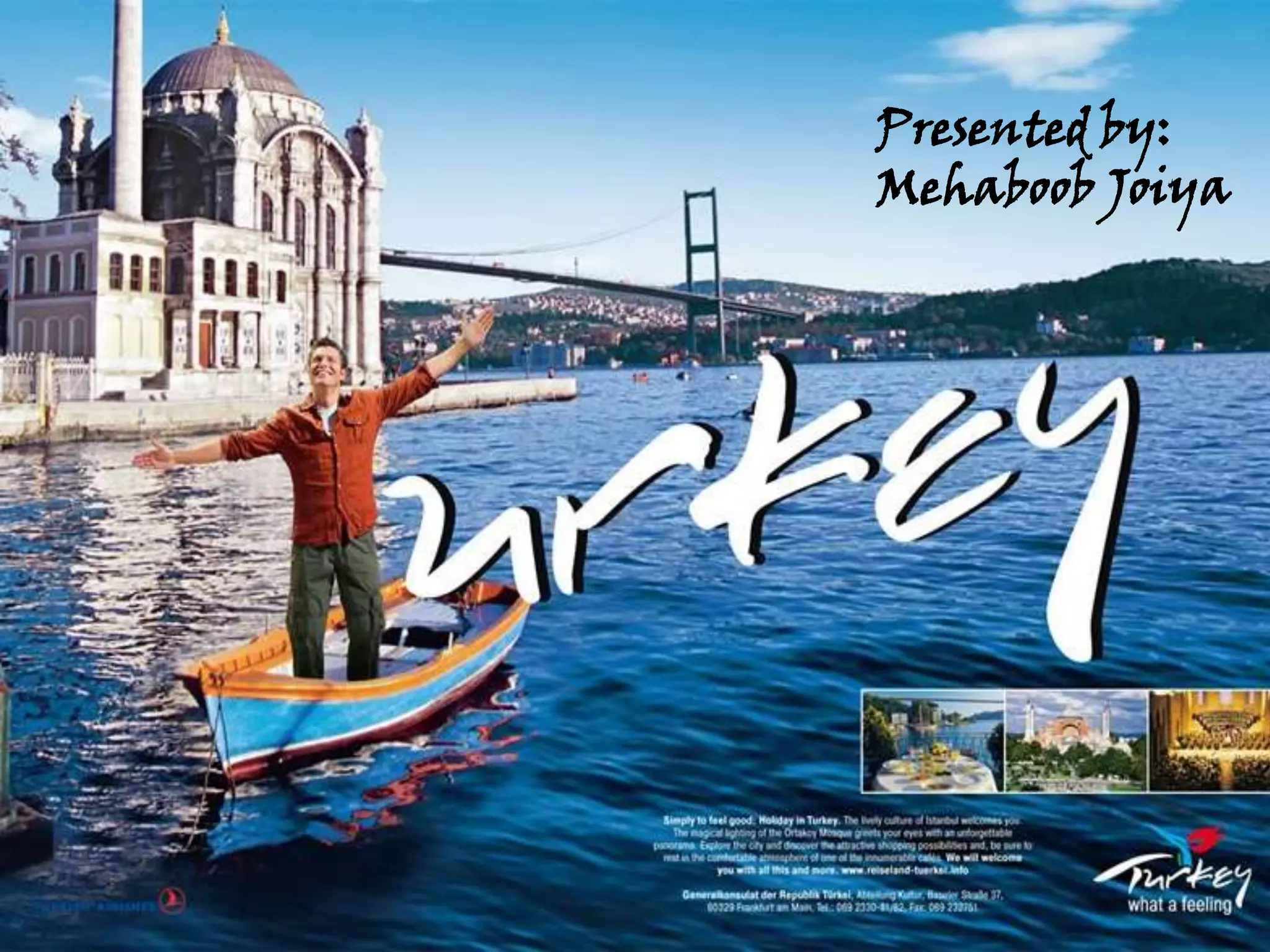
Presented by:
Mehaboob Joiya
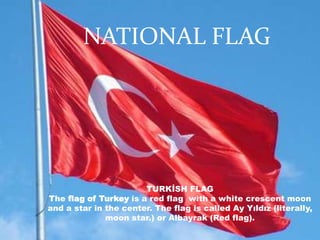
NATIONAL FLAG


                       TURKİSH FLAG
The flag of Turkey is a red flag with a white crescent moon
and a star in the center. The flag is called Ay Yıldız (literally,
              moon star.) or Albayrak (Red flag).
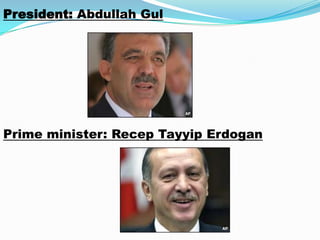
President: Abdullah Gul


Prime minister: Recep Tayyip Erdogan
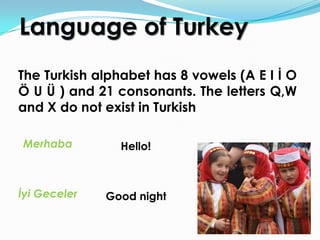
Language of Turkey
The Turkish alphabet has 8 vowels (A E I İ O
Ö U Ü ) and 21 consonants. The letters Q,W
and X do not exist in Turkish

Merhaba         Hello!


İyi Geceler   Good night
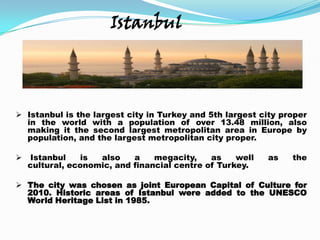
Istanbul


 Istanbul is the largest city in Turkey and 5th largest city proper
  in the world with a population of over 13.48 million, also
  making it the second largest metropolitan area in Europe by
  population, and the largest metropolitan city proper.

   Istanbul    is  also    a    megacity,    as    well   as   the
    cultural, economic, and financial centre of Turkey.

 The city was chosen as joint European Capital of Culture for
  2010. Historic areas of Istanbul were added to the UNESCO
  World Heritage List in 1985.
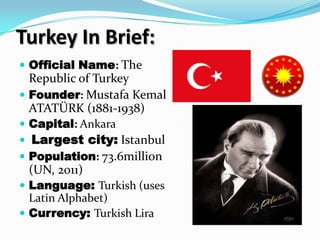
Turkey In Brief:
 Official Name: The
  Republic of Turkey
 Founder: Mustafa Kemal
  ATATÜRK (1881-1938)
 Capital: Ankara
 Largest city: Istanbul
 Population: 73.6million
 (UN, 2011)
 Language: Turkish (uses
  Latin Alphabet)
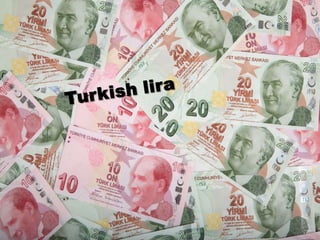
 Currency: Turkish Lira
Turkey In Brief
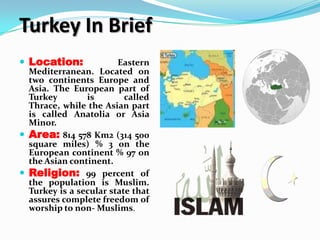
 Location:             Eastern
  Mediterranean. Located on
  two continents Europe and
  Asia. The European part of
  Turkey        is        called
  Thrace, while the Asian part
  is called Anatolia or Asia
  Minor.
 Area: 814 578 Km2 (314 500
  square miles) % 3 on the
  European continent % 97 on
  the Asian continent.
 Religion: 99 percent of
  the population is Muslim.
  Turkey is a secular state that
  assures complete freedom of
  worship to non- Muslims.
Turkey In Brief
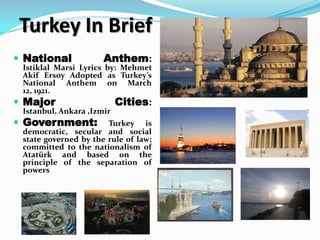
 National            Anthem:
 Istiklal Marsi Lyrics by: Mehmet
 Akif Ersoy Adopted as Turkey’s
 National Anthem on March
 12, 1921.
 Major                    Cities:
 Istanbul, Ankara ,Izmir
 Government:          Turkey is
 democratic, secular and social
 state governed by the rule of law;
 committed to the nationalism of
 Atatürk and based on the
 principle of the separation of
 powers
Turkey In Brief
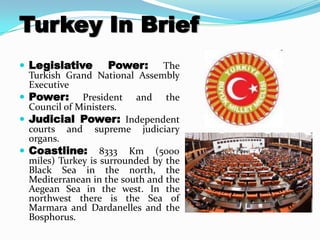
 Legislative        Power: The
  Turkish Grand National Assembly
  Executive
 Power: President and the
  Council of Ministers.
 Judicial Power: Independent
  courts and supreme judiciary
  organs.
 Coastline: 8333 Km (5000
  miles) Turkey is surrounded by the
  Black Sea in the north, the
  Mediterranean in the south and the
  Aegean Sea in the west. In the
  northwest there is the Sea of
  Marmara and Dardanelles and the
  Bosphorus.
Turkey In Brief
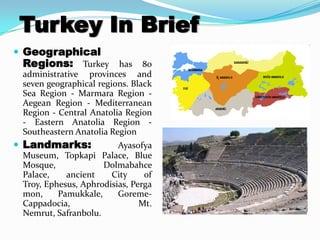
 Geographical
 Regions: Turkey has 80
 administrative provinces and
 seven geographical regions. Black
 Sea Region - Marmara Region -
 Aegean Region - Mediterranean
 Region - Central Anatolia Region
 - Eastern Anatolia Region -
 Southeastern Anatolia Region
 Landmarks:             Ayasofya
 Museum, Topkapi Palace, Blue
 Mosque,             Dolmabahce
 Palace,    ancient    City     of
 Troy, Ephesus, Aphrodisias, Perga
 mon,     Pamukkale,     Goreme-
 Cappadocia,                   Mt.
 Nemrut, Safranbolu.
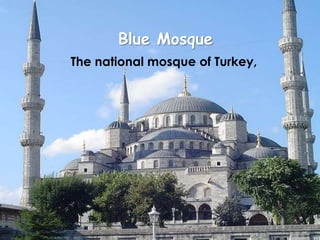
Blue Mosque
The national mosque of Turkey,
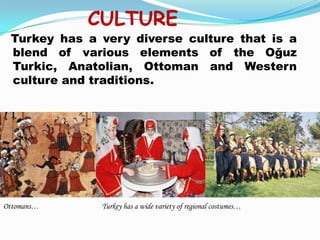
CULTURE
 Turkey has a very diverse culture that is a
 blend of various elements of the Oğuz
 Turkic, Anatolian, Ottoman and Western
 culture and traditions.


Ottomans…     Turkey has a wide variety of regional costumes…
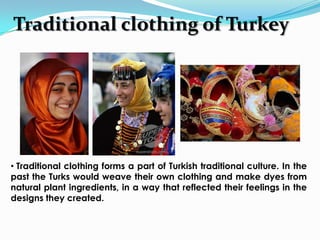
Traditional clothing of Turkey


• Traditional clothing forms a part of Turkish traditional culture. In the
past the Turks would weave their own clothing and make dyes from
natural plant ingredients, in a way that reflected their feelings in the
designs they created.
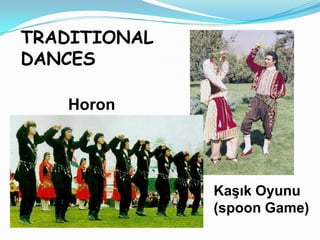
TRADITIONAL
DANCES

   Horon


              Kaşık Oyunu
              (spoon Game)
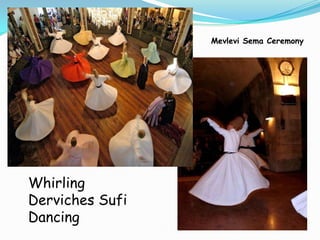
Mevlevi Sema Ceremony


Whirling
Derviches Sufi
Dancing
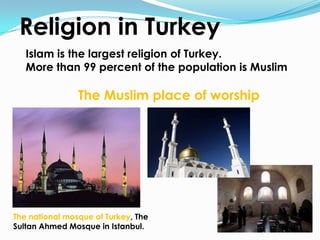
Religion in Turkey
   Islam is the largest religion of Turkey.
   More than 99 percent of the population is Muslim

                The Muslim place of worship


The national mosque of Turkey, The
Sultan Ahmed Mosque in Istanbul.
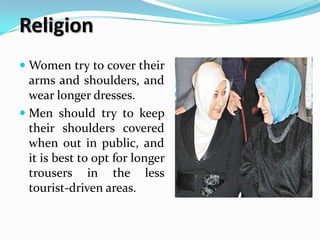
Religion
 Women try to cover their
  arms and shoulders, and
  wear longer dresses.
 Men should try to keep
  their shoulders covered
  when out in public, and
  it is best to opt for longer
  trousers in the less
  tourist-driven areas.
Business Etiquette
 Significance
 When doing business in an
  unfamiliar country, it is crucial to
  understand appropriate business
  etiquette
 Greetings
 In Turkey, new acquaintances meet
  with a firm handshake
 Relationships
 Business people in Turkey tend to prefer
  to do business with people they respect
 Considerations
 Direct communication and eye contact
  is highly valued after a relationship is
  formed
Business Etiquette
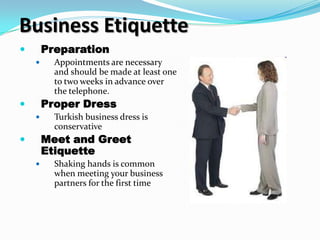
       Preparation
         Appointments are necessary
          and should be made at least one
          to two weeks in advance over
          the telephone.
       Proper Dress
         Turkish business dress is
          conservative
       Meet and Greet
        Etiquette
         Shaking hands is common
          when meeting your business
          partners for the first time
Business Etiquette
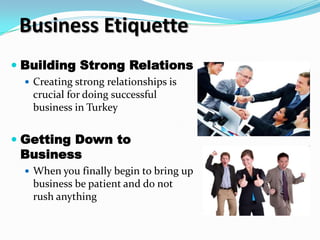
 Building Strong Relations
   Creating strong relationships is
   crucial for doing successful
   business in Turkey


 Getting Down to
  Business
   When you finally begin to bring up
   business be patient and do not
   rush anything
Social Etiquette
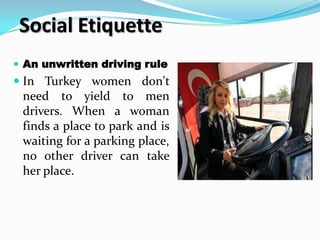
 An unwritten driving rule
 In Turkey women don't
  need to yield to men
  drivers. When a woman
  finds a place to park and is
  waiting for a parking place,
  no other driver can take
  her place.
Social Etiquette
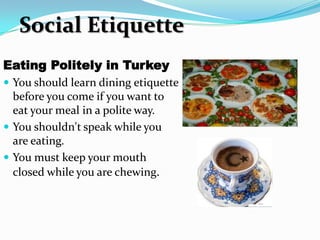
Eating Politely in Turkey
 You should learn dining etiquette
  before you come if you want to
  eat your meal in a polite way.
 You shouldn't speak while you
  are eating.
 You must keep your mouth
  closed while you are chewing.
Social Etiquette
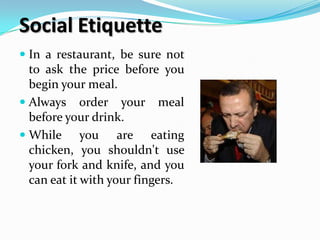
 In a restaurant, be sure not
  to ask the price before you
  begin your meal.
 Always order your      meal
  before your drink.
 While     you are eating
 chicken, you shouldn't use
 your fork and knife, and you
 can eat it with your fingers.
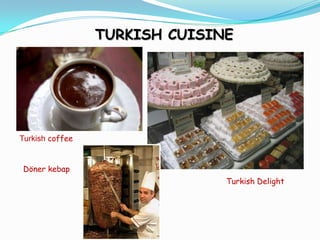
TURKISH CUISINE


Turkish coffee


Döner kebap
                               Turkish Delight
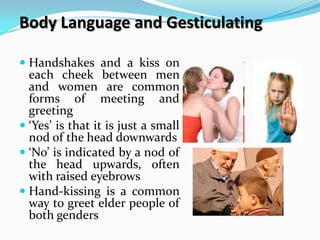
Body Language and Gesticulating

 Handshakes and a kiss on
  each cheek between men
  and women are common
  forms of meeting and
  greeting
 ‘Yes’ is that it is just a small
  nod of the head downwards
 ‘No’ is indicated by a nod of
  the head upwards, often
  with raised eyebrows
 Hand-kissing is a common
  way to greet elder people of
  both genders
Body Language and Gesticulating

 ‘OK’ sign is actually a very
  rude and provocative
  signal, as is placing your
  thumb between your
  index and middle finger.
 to bring a gift with you to
  show your humbleness
  and gratitude.
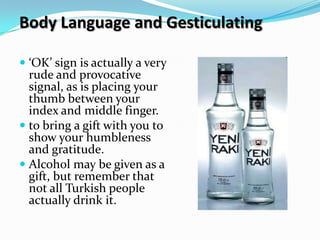
 Alcohol may be given as a
  gift, but remember that
  not all Turkish people
  actually drink it.
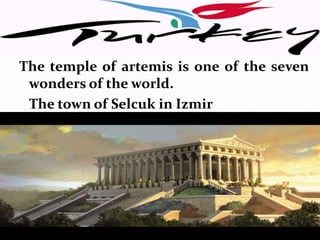
The temple of artemis is one of the seven
 wonders of the world.
 The town of Selcuk in Izmir
Thank You

Presentation on cross culture joiya

  • 1.
  • 2.
    NATIONAL FLAG TURKİSH FLAG The flag of Turkey is a red flag with a white crescent moon and a star in the center. The flag is called Ay Yıldız (literally, moon star.) or Albayrak (Red flag).
  • 4.
    President: Abdullah Gul Primeminister: Recep Tayyip Erdogan
  • 5.
    Language of Turkey TheTurkish alphabet has 8 vowels (A E I İ O Ö U Ü ) and 21 consonants. The letters Q,W and X do not exist in Turkish Merhaba Hello! İyi Geceler Good night
  • 6.
    Istanbul  Istanbul isthe largest city in Turkey and 5th largest city proper in the world with a population of over 13.48 million, also making it the second largest metropolitan area in Europe by population, and the largest metropolitan city proper.  Istanbul is also a megacity, as well as the cultural, economic, and financial centre of Turkey.  The city was chosen as joint European Capital of Culture for 2010. Historic areas of Istanbul were added to the UNESCO World Heritage List in 1985.
  • 7.
    Turkey In Brief: Official Name: The Republic of Turkey  Founder: Mustafa Kemal ATATÜRK (1881-1938)  Capital: Ankara  Largest city: Istanbul  Population: 73.6million (UN, 2011)  Language: Turkish (uses Latin Alphabet)  Currency: Turkish Lira
  • 8.
    Turkey In Brief Location: Eastern Mediterranean. Located on two continents Europe and Asia. The European part of Turkey is called Thrace, while the Asian part is called Anatolia or Asia Minor.  Area: 814 578 Km2 (314 500 square miles) % 3 on the European continent % 97 on the Asian continent.  Religion: 99 percent of the population is Muslim. Turkey is a secular state that assures complete freedom of worship to non- Muslims.
  • 9.
    Turkey In Brief National Anthem: Istiklal Marsi Lyrics by: Mehmet Akif Ersoy Adopted as Turkey’s National Anthem on March 12, 1921.  Major Cities: Istanbul, Ankara ,Izmir  Government: Turkey is democratic, secular and social state governed by the rule of law; committed to the nationalism of Atatürk and based on the principle of the separation of powers
  • 10.
    Turkey In Brief Legislative Power: The Turkish Grand National Assembly Executive  Power: President and the Council of Ministers.  Judicial Power: Independent courts and supreme judiciary organs.  Coastline: 8333 Km (5000 miles) Turkey is surrounded by the Black Sea in the north, the Mediterranean in the south and the Aegean Sea in the west. In the northwest there is the Sea of Marmara and Dardanelles and the Bosphorus.
  • 11.
    Turkey In Brief Geographical Regions: Turkey has 80 administrative provinces and seven geographical regions. Black Sea Region - Marmara Region - Aegean Region - Mediterranean Region - Central Anatolia Region - Eastern Anatolia Region - Southeastern Anatolia Region  Landmarks: Ayasofya Museum, Topkapi Palace, Blue Mosque, Dolmabahce Palace, ancient City of Troy, Ephesus, Aphrodisias, Perga mon, Pamukkale, Goreme- Cappadocia, Mt. Nemrut, Safranbolu.
  • 12.
    Blue Mosque The nationalmosque of Turkey,
  • 13.
    CULTURE Turkey hasa very diverse culture that is a blend of various elements of the Oğuz Turkic, Anatolian, Ottoman and Western culture and traditions. Ottomans… Turkey has a wide variety of regional costumes…
  • 14.
    Traditional clothing ofTurkey • Traditional clothing forms a part of Turkish traditional culture. In the past the Turks would weave their own clothing and make dyes from natural plant ingredients, in a way that reflected their feelings in the designs they created.
  • 15.
    TRADITIONAL DANCES Horon Kaşık Oyunu (spoon Game)
  • 16.
  • 17.
    Religion in Turkey Islam is the largest religion of Turkey. More than 99 percent of the population is Muslim The Muslim place of worship The national mosque of Turkey, The Sultan Ahmed Mosque in Istanbul.
  • 18.
    Religion  Women tryto cover their arms and shoulders, and wear longer dresses.  Men should try to keep their shoulders covered when out in public, and it is best to opt for longer trousers in the less tourist-driven areas.
  • 19.
    Business Etiquette  Significance When doing business in an unfamiliar country, it is crucial to understand appropriate business etiquette  Greetings  In Turkey, new acquaintances meet with a firm handshake  Relationships  Business people in Turkey tend to prefer to do business with people they respect  Considerations  Direct communication and eye contact is highly valued after a relationship is formed
  • 20.
    Business Etiquette  Preparation  Appointments are necessary and should be made at least one to two weeks in advance over the telephone.  Proper Dress  Turkish business dress is conservative  Meet and Greet Etiquette  Shaking hands is common when meeting your business partners for the first time
  • 21.
    Business Etiquette  BuildingStrong Relations  Creating strong relationships is crucial for doing successful business in Turkey  Getting Down to Business  When you finally begin to bring up business be patient and do not rush anything
  • 22.
    Social Etiquette  Anunwritten driving rule  In Turkey women don't need to yield to men drivers. When a woman finds a place to park and is waiting for a parking place, no other driver can take her place.
  • 23.
    Social Etiquette Eating Politelyin Turkey  You should learn dining etiquette before you come if you want to eat your meal in a polite way.  You shouldn't speak while you are eating.  You must keep your mouth closed while you are chewing.
  • 24.
    Social Etiquette  Ina restaurant, be sure not to ask the price before you begin your meal.  Always order your meal before your drink.  While you are eating chicken, you shouldn't use your fork and knife, and you can eat it with your fingers.
  • 25.
  • 27.
    Body Language andGesticulating  Handshakes and a kiss on each cheek between men and women are common forms of meeting and greeting  ‘Yes’ is that it is just a small nod of the head downwards  ‘No’ is indicated by a nod of the head upwards, often with raised eyebrows  Hand-kissing is a common way to greet elder people of both genders
  • 28.
    Body Language andGesticulating  ‘OK’ sign is actually a very rude and provocative signal, as is placing your thumb between your index and middle finger.  to bring a gift with you to show your humbleness and gratitude.  Alcohol may be given as a gift, but remember that not all Turkish people actually drink it.
  • 29.
    The temple ofartemis is one of the seven wonders of the world. The town of Selcuk in Izmir
  • 30.