PRESENTED BY
POUSALI MUKHERJEE
PRETAM LAHA
SOURAV TIBREWAL
PANKAJ AGARWAL
NAYAN SAHA
CASELET
MANAGEMENT
INSTITUTE
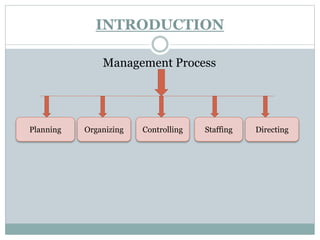
INTRODUCTION
Management Process
Planning Organizing Controlling Staffing Directing
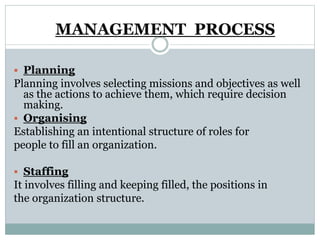
 Planning
Planning involves selecting missions and objectives as well
as the actions to achieve them, which require decision
making.
 Organising
Establishing an intentional structure of roles for
people to fill an organization.
 Staffing
It involves filling and keeping filled, the positions in
the organization structure.
MANAGEMENT PROCESS
MANAGEMENT PROCESS
 Leading
Influencing people so that they will contribute to
organizational and group goals.
 Controlling
Measuring and correcting individual and
organizational performance to ensure that events
conform to plans
MANAGEMENT INSTITUTE
 Well known Management Institute, operated under Dr. S &
also founder dean
 Dr. S is a doctor in management philosophy from Harvard
Business School,USA
 Very fast turnover of 20 odd full time faculty
 He took decisions in all academic matters regarding fixing
syllabi, deciding on teaching modes etc without concerning
other faculties
 Dr. S’s behavior was bad, indecent language & there was no
internal morale.
 Board Of Governing(BOG) members did not take any
initiative to improve internal situation.
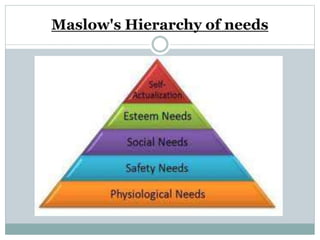
Maslow's Hierarchy of needs
 Physiological needs- In this case the faculties and
CEO’s feel the need to meet up the basic needs ( food,
shelter, comfort). So that’s why they are leaving for better
jobs.
 Safety needs- In this case faculties and CEO’s feel
insecurity as per job their jobs are concerned naturally their
dependents in family also are facing an uncertainty in social
life.
 Social needs- Constraints imposed on smooth
functioning of work in the institute make this faculties and
CEO’s to feel a pressure. So befriending attitude is lost
among them as well as with the Dean.
Maslow's Hierarchy of needs
 Esteem Needs- In this case self esteem among the
faculties and CEO’S are reduced to trickle as the
institutional head does not show respect to others
there by bringing down the confidence level of the
staffs.
 Self actualization- Morality among the CEO’S has
been shattered and as a result creativity has not
been encouraged.
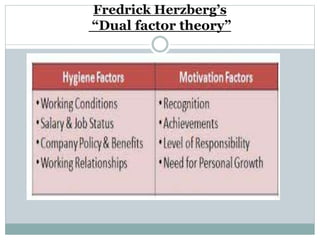
Fredrick Herzberg’s
“Dual factor theory”
Fredrick Herzberg’s
“Dual factor theory”
 In this case faculties and the CEO are not permitted
to work under congenial atmosphere because the
working conditions were always threatening.
 In this case the Dean of this Institute Mr. S was not
bothered to look after high turn over of leaving jobs
by the CEOS . And he was recruiting faculties
indiscrieminately.
 In this case the working relation is also not good.
There was hardly any team work, rapport and
individual involvement.
Fredrick Herzberg’s
“Dual factor theory”
 MOTIVATION FACTORS
 In this case he does not give any kind of recognition to
the deserving people rather he tries to promote his
flattering followers.
 Achievement has been negated . As we have seen in this
case dissertation paper submitted by Dr. M was
challenged by Mr. S.
 Level of responsibility was low among the faculties as Mr.
S always use to take all the decisions regarding academic
matters.
 In this case Mr. S does not have a cordial relationship
with the faculties . He should have maintained a good
relationship with the faculties.
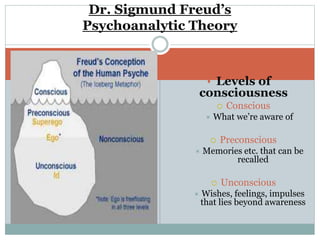
 Levels of
consciousness
 Conscious
 What we’re aware of
 Preconscious
 Memories etc. that can be
recalled
 Unconscious
 Wishes, feelings, impulses
that lies beyond awareness
Dr. Sigmund Freud’s
Psychoanalytic Theory
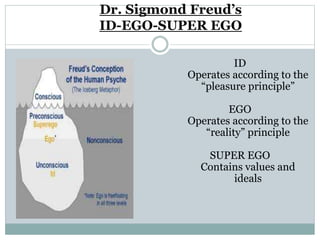
Dr. Sigmond Freud’s
ID-EGO-SUPER EGO
ID
Operates according to the
“pleasure principle”
EGO
Operates according to the
“reality” principle
SUPER EGO
Contains values and
ideals
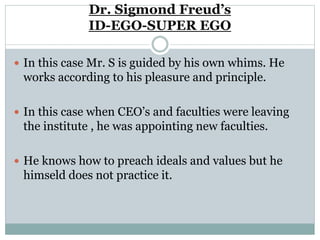
Dr. Sigmond Freud’s
ID-EGO-SUPER EGO
 In this case Mr. S is guided by his own whims. He
works according to his pleasure and principle.
 In this case when CEO’s and faculties were leaving
the institute , he was appointing new faculties.
 He knows how to preach ideals and values but he
himseld does not practice it.
STEPS OF ORGANISING
 To fix the objectives.
 To delegate authorities to the employees.
 To define the responsibilities of the employees.
 To define authority relationship between the
superiors and subordinates.
 To identify the works which are required to achieve
the objectives.
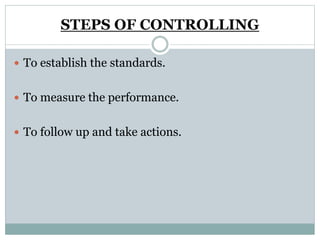
STEPS OF CONTROLLING
 To establish the standards.
 To measure the performance.
 To follow up and take actions.
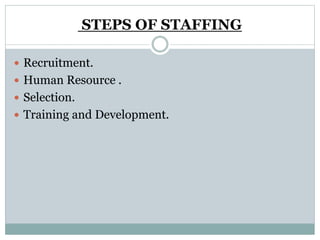
STEPS OF STAFFING
 Recruitment.
 Human Resource .
 Selection.
 Training and Development.
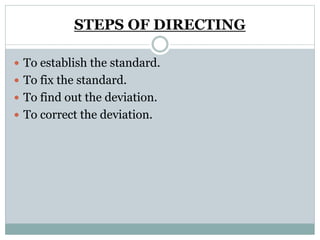
STEPS OF DIRECTING
 To establish the standard.
 To fix the standard.
 To find out the deviation.
 To correct the deviation.
THANK YOU
http://www.unitedworld.edu.in/
Campus
Ahmedabad Campus: Karnavati Knowledge
Village, A/907,Uvarsad, S.G.Highway, Gandhinagar
Kolkata Campus: Infinity Benchmark Tower 10th
Floor, Plot - G1, Block - EP& GP, Sec - V, Salt Lake,
Kolkata.
Reg. Office: 407, Zodiac Square, 4th Floor Opp.
Gurudwara, S.G. Road, Bodakdev, Ahmedabad.

Presentation on Caselet on management institute

  • 1.
    PRESENTED BY POUSALI MUKHERJEE PRETAMLAHA SOURAV TIBREWAL PANKAJ AGARWAL NAYAN SAHA CASELET MANAGEMENT INSTITUTE
  • 2.
  • 3.
     Planning Planning involvesselecting missions and objectives as well as the actions to achieve them, which require decision making.  Organising Establishing an intentional structure of roles for people to fill an organization.  Staffing It involves filling and keeping filled, the positions in the organization structure. MANAGEMENT PROCESS
  • 4.
    MANAGEMENT PROCESS  Leading Influencingpeople so that they will contribute to organizational and group goals.  Controlling Measuring and correcting individual and organizational performance to ensure that events conform to plans
  • 5.
    MANAGEMENT INSTITUTE  Wellknown Management Institute, operated under Dr. S & also founder dean  Dr. S is a doctor in management philosophy from Harvard Business School,USA  Very fast turnover of 20 odd full time faculty  He took decisions in all academic matters regarding fixing syllabi, deciding on teaching modes etc without concerning other faculties  Dr. S’s behavior was bad, indecent language & there was no internal morale.  Board Of Governing(BOG) members did not take any initiative to improve internal situation.
  • 6.
  • 7.
    Maslow's Hierarchy ofneeds  Physiological needs- In this case the faculties and CEO’s feel the need to meet up the basic needs ( food, shelter, comfort). So that’s why they are leaving for better jobs.  Safety needs- In this case faculties and CEO’s feel insecurity as per job their jobs are concerned naturally their dependents in family also are facing an uncertainty in social life.  Social needs- Constraints imposed on smooth functioning of work in the institute make this faculties and CEO’s to feel a pressure. So befriending attitude is lost among them as well as with the Dean.
  • 8.
    Maslow's Hierarchy ofneeds  Esteem Needs- In this case self esteem among the faculties and CEO’S are reduced to trickle as the institutional head does not show respect to others there by bringing down the confidence level of the staffs.  Self actualization- Morality among the CEO’S has been shattered and as a result creativity has not been encouraged.
  • 9.
  • 10.
    Fredrick Herzberg’s “Dual factortheory”  In this case faculties and the CEO are not permitted to work under congenial atmosphere because the working conditions were always threatening.  In this case the Dean of this Institute Mr. S was not bothered to look after high turn over of leaving jobs by the CEOS . And he was recruiting faculties indiscrieminately.  In this case the working relation is also not good. There was hardly any team work, rapport and individual involvement.
  • 11.
    Fredrick Herzberg’s “Dual factortheory”  MOTIVATION FACTORS  In this case he does not give any kind of recognition to the deserving people rather he tries to promote his flattering followers.  Achievement has been negated . As we have seen in this case dissertation paper submitted by Dr. M was challenged by Mr. S.  Level of responsibility was low among the faculties as Mr. S always use to take all the decisions regarding academic matters.  In this case Mr. S does not have a cordial relationship with the faculties . He should have maintained a good relationship with the faculties.
  • 12.
     Levels of consciousness Conscious  What we’re aware of  Preconscious  Memories etc. that can be recalled  Unconscious  Wishes, feelings, impulses that lies beyond awareness Dr. Sigmund Freud’s Psychoanalytic Theory
  • 13.
    Dr. Sigmond Freud’s ID-EGO-SUPEREGO ID Operates according to the “pleasure principle” EGO Operates according to the “reality” principle SUPER EGO Contains values and ideals
  • 14.
    Dr. Sigmond Freud’s ID-EGO-SUPEREGO  In this case Mr. S is guided by his own whims. He works according to his pleasure and principle.  In this case when CEO’s and faculties were leaving the institute , he was appointing new faculties.  He knows how to preach ideals and values but he himseld does not practice it.
  • 15.
    STEPS OF ORGANISING To fix the objectives.  To delegate authorities to the employees.  To define the responsibilities of the employees.  To define authority relationship between the superiors and subordinates.  To identify the works which are required to achieve the objectives.
  • 16.
    STEPS OF CONTROLLING To establish the standards.  To measure the performance.  To follow up and take actions.
  • 17.
    STEPS OF STAFFING Recruitment.  Human Resource .  Selection.  Training and Development.
  • 18.
    STEPS OF DIRECTING To establish the standard.  To fix the standard.  To find out the deviation.  To correct the deviation.
  • 19.
  • 20.
    http://www.unitedworld.edu.in/ Campus Ahmedabad Campus: KarnavatiKnowledge Village, A/907,Uvarsad, S.G.Highway, Gandhinagar Kolkata Campus: Infinity Benchmark Tower 10th Floor, Plot - G1, Block - EP& GP, Sec - V, Salt Lake, Kolkata. Reg. Office: 407, Zodiac Square, 4th Floor Opp. Gurudwara, S.G. Road, Bodakdev, Ahmedabad.