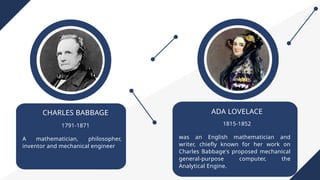
1791-1871
A mathematician, philosopher,
inventorand mechanical engineer
CHARLES BABBAGE
1815-1852
was an English mathematician and
writer, chiefly known for her work on
Charles Babbage's proposed mechanical
general-purpose computer, the
Analytical Engine.
ADA LOVELACE
4.
WhatisInternet?
• A globalsystem INTERconnected computer NETworks to
communicate between devices and other networks.
5.
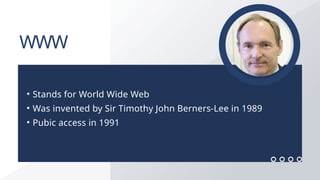
WWW
• Stands forWorld Wide Web
• Was invented by Sir Timothy John Berners-Lee in 1989
• Pubic access in 1991
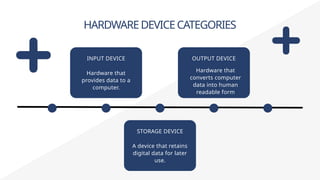
HARDWAREDEVICECATEGORIES
STORAGE DEVICE
INPUT DEVICEOUTPUT DEVICE
A device that retains
digital data for later
use.
Hardware that
provides data to a
computer.
Hardware that
converts computer
data into human
readable form
Software
•is any setof instructions that tells
the hardware what to do and how
to do it.
10.
PROGRAMMING
Programming is theprocess of
designing and building an
executable computer program to
accomplish a specific computing
result or to perform a specific task.
11.
PROGRAMMINGLANGUAGE
- is aformal language comprising
a set of strings that produce
various kinds of machine code
output.
12.
High-level vs. low-levellanguages
The biggest factor that differentiates high- and low-level
programming languages is whether the language is
meant to be easily understood by a human
programmer or a computer. Low-level languages are
machine-friendly, which makes them highly efficient in
terms of memory usage but difficult to understand
without the help of an assembler. Since they're not very
people-friendly, they're also not widely used anymore.
Examples include machine code and assembly
languages.
13.
High-level vs. low-levellanguages
High-level languages, on the other hand,
are less memory efficient but much more
human friendly. This makes them easier to
write, understand, maintain, and debug.
Most popular programming languages in use
today are considered high-level languages.
14.
Interpreted vs. compiledlanguages
The distinction between interpreted and compiled languages
has to do with how they convert high-level code and make it
readable by a computer. With interpreted languages, code
goes through a program called an interpreter, which reads
and executes the code line by line. This tends to make these
languages more flexible and platform independent.
Examples of interpreted languages include:
•Python
•JavaScript
•PHP
•Ruby
15.
Interpreted vs. compiledlanguages
Compiled languages go through a build step where the
entire program is converted into machine code. This makes it
faster to execute, but it also means that you have to compile
or "build" the program again anytime you need to make a
change.
Examples of compiled languages include:
•C, C++, and C#
•Rust
•Erlang
16.
BASIC
BASIC stands for"Beginner's All-purpose
Symbolic Instruction Code." Originally
designed as an interactive mainframe
timesharing language by John Kemeney
and Thomas Kurtz in 41963, it became widely
used on personal computers everywhere.
17.
FORTRAN
FORTRAN, in fullFormula
Translation, computer programming
language created in 1957 by John
Backus that shortened the process of
programming and made computer
programming more accessible.
18.
COBOL
stands for CommonBusiness Oriented Language.
It is imperative, procedural, and object-oriented.
A compiler is a computer program that takes
other computer programs written in a high-level
(source) language and coverts them into another
program, machine code, which the computer
can understand.
19.
MachineLanguage
Machine programming isthe process of writing
instructions for a computer in machine language.
Machine language is a low-level programming
language that is made up of binary digits (0s and
1s). E
20.
ProceduralProgrammingLanguage
A procedural languagefollows a sequence of
statements or commands in order to achieve a desired
output. Each series of steps is called a procedure, and
a program written in one of these languages will have
one or more procedures within it. Common examples
of procedural languages include:
•C and C++
•Java
•Pascal
•BASIC
21.
Object-OrientedProgrammingLanguage
This type oflanguage treats a program as a group of objects
composed of data and program elements, known as attributes
and methods. Objects can be reused within a program or in
other programs. This makes it a popular language type for
complex programs, as code is easier to reuse and scale. Some
common object-oriented programming (OOP) languages
include:
•Java
•Python
•PHP
•C++
•Ruby
22.
ScriptingLanguage
Programmers use scriptinglanguages to automate
repetitive tasks, manage dynamic web content, or
support processes in larger applications. Some common
scripting languages include:
•PHP
•Ruby
•Python
•bash
•Perl
•Node.js
23.
Front-end
• Front-end languagesare primarily concerned
with the ‘user’ aspect of the software. The
front end deals with all of the text, colors,
buttons, images, and navigation that the user
will face when navigating your website or
application. Anyone with a background in
graphic design or art may be more inspired
to begin learning one of the front-end
languages.
Back-end
• Back-end languagesdeal with storage and
manipulation of the server side of software.
This is the part of the software that the user
does not directly come into contact with but
supports their experience behind the scenes.
This includes data architecture, scripting, and
communication between applications and
underlying databases.
26.
Back-end
Some examples ofback-end programming
languages include:
•JavaScript
•PHP
•Java
•Python
•Ruby
•C#