EQAVET
overview
Piraeus 15-16 November 2012
Natassa Kazantzidou
www.bequal.info
History
 Barcelona European Council, 2002 : target to
make Europe’s education and training
systems a world quality reference by 2010.
 The Copenhagen declaration, 2002 sets the
basis for the development of a Common
Quality Assurance Framework for VET in
Europe (CQAF).
www.bequal.info
History
 May 2004, the European Council endorsed
the CQAF
 October 2005, establishment of the European
Network for Quality Assurance in VET
(ENQA-VET)
 2009, Recommendation on establishment of
a European Quality Assurance Reference
Framework for VET (EQARF)
www.bequal.info
History
 2010, European Quality Assurance in
Vocational Education and Training (EQAVET)
replaced ENQA – VET
 The Bruges Communiqué 2010 reviewed the
strategic approaches and priorities of the
Copenhagen process and set the roadmap
for VET for 2011-2020.
www.bequal.info
Quality in VET context
 Quality assurance is linked with and facilitates
adoption of European instruments and tools of
the Copenhagen process, i.e. ECVET, EQF,
validation of non-formal and informal learning
and Europass.
 All these instruments have as objective the
facilitation of mobility, through transparency of
qualifications and quality assurance is an
important factor for building mutual trust.
www.bequal.info
Quality and EQF
 The referencing of NQF to EQF has two
criteria relevant to quality assurance:
 5 “The national quality assurance system(s) for
education and training refer(s) to the NQFk or system
and are consistent with the relevant European
principles and guidelines
 6 The referencing process shall include the stated
agreement of the relevant quality assurance bodies”.
www.bequal.info
Quality and ECVET
 ECVET recommendation invites MS to apply
the common principles for quality assurance
in VET when using ECVET.
 Quality assurance is a core issue for building
mutual trust in ECVET partnerships and
quality assurance principles and criteria are
documented in ECVET documents, i.e.
Memorandum of Understanding and Learning
Agreements.
www.bequal.info
Validation of non-formal
and informal learning
 Obligation of the stakeholders to establish
appropriate quality mechanisms for the
identification and validation of non –formal and
informal learning.
 Quality assurance mechanisms should underpin
processes, procedures and criteria for validation,
in order to build confidence and trust. Member
States and European Commission are invited to
support the development of quality assurance
mechanisms.
www.bequal.info
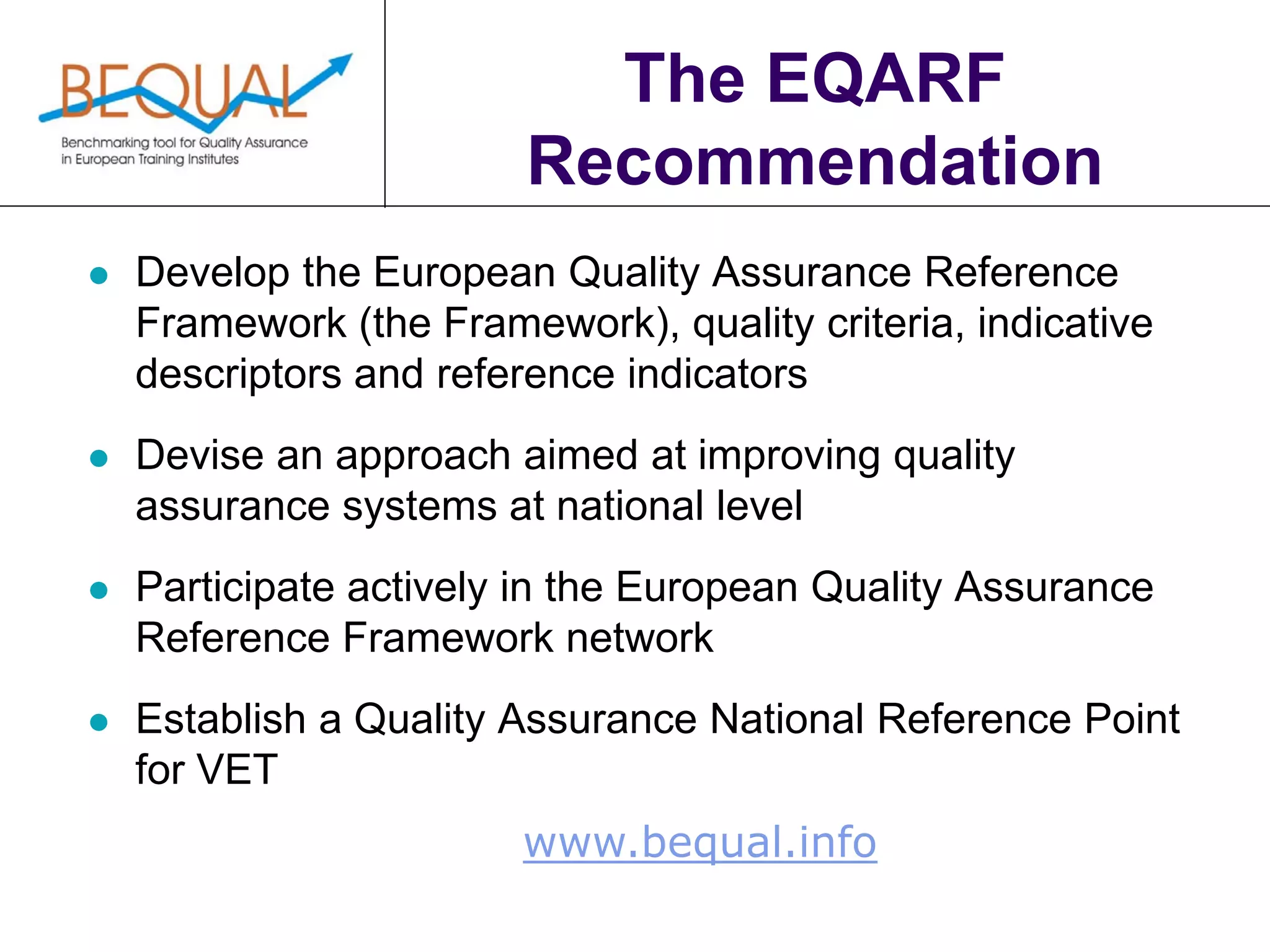
Europass
 Europass can be used as a quality assurance
framework for the identification and
documentation of learning outcomes and
transparency of qualifications.
 Quality assurance is an important factor in
the use of Europass documents, especially
Europass Mobility, in order to facilitate
understandability of qualification
www.bequal.info
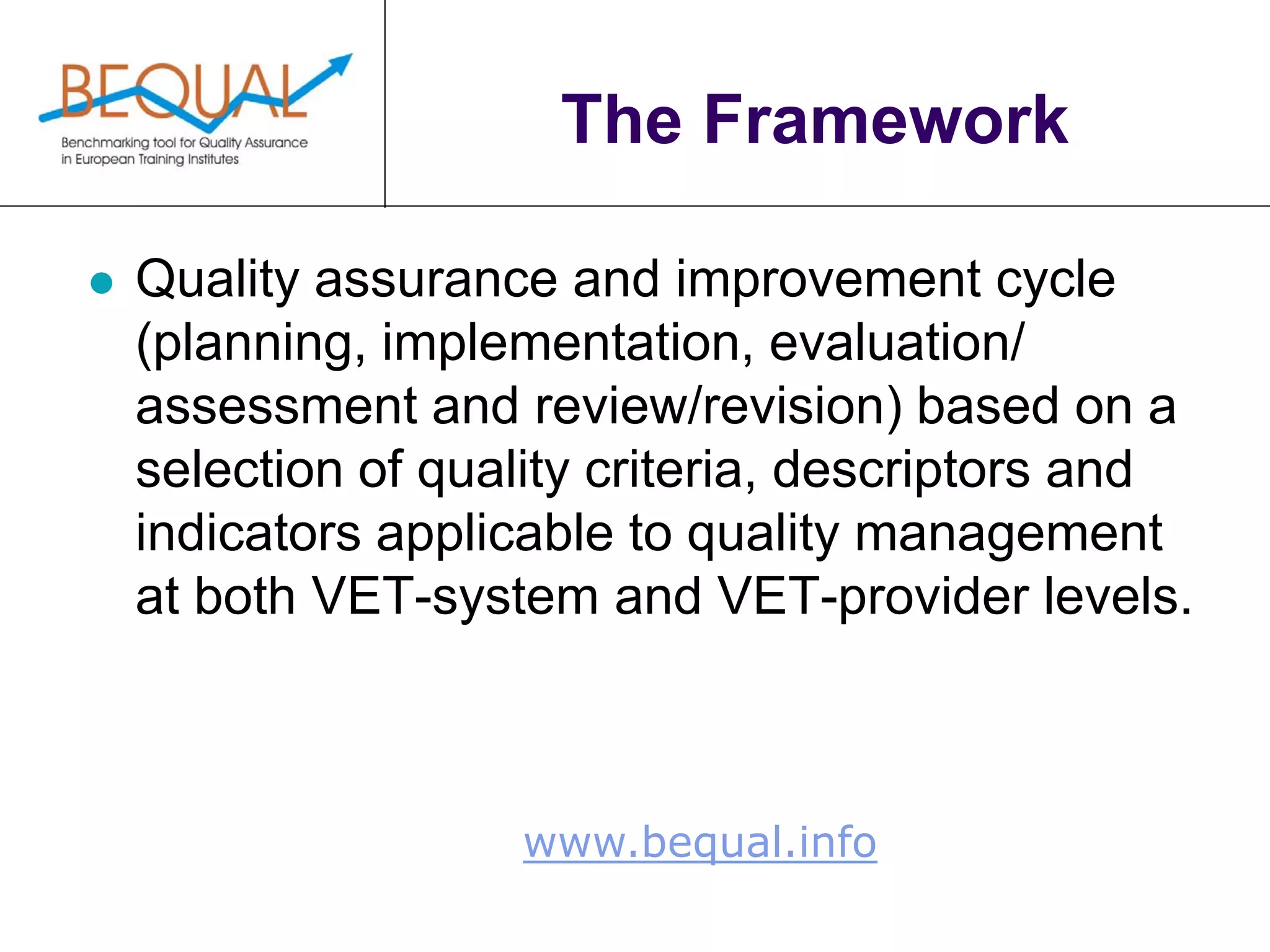
The EQARF
Recommendation
 Develop the European Quality Assurance Reference
Framework (the Framework), quality criteria, indicative
descriptors and reference indicators
 Devise an approach aimed at improving quality
assurance systems at national level
 Participate actively in the European Quality Assurance
Reference Framework network
 Establish a Quality Assurance National Reference Point
for VET
www.bequal.info
The Framework
 Quality assurance and improvement cycle
(planning, implementation, evaluation/
assessment and review/revision) based on a
selection of quality criteria, descriptors and
indicators applicable to quality management
at both VET-system and VET-provider levels.
www.bequal.info
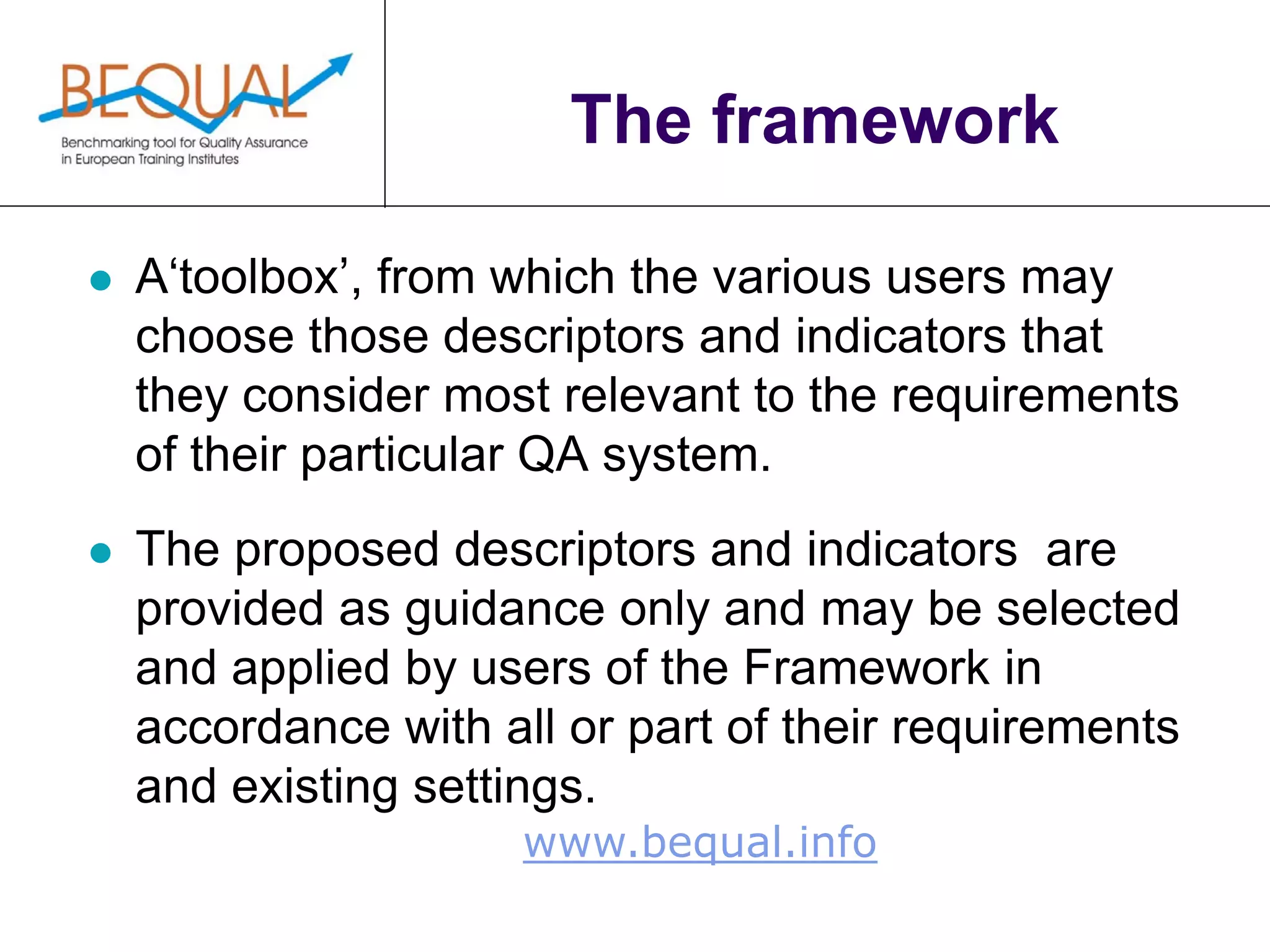
The framework
 A‘toolbox’, from which the various users may
choose those descriptors and indicators that
they consider most relevant to the requirements
of their particular QA system.
 The proposed descriptors and indicators are
provided as guidance only and may be selected
and applied by users of the Framework in
accordance with all or part of their requirements
and existing settings.
www.bequal.info
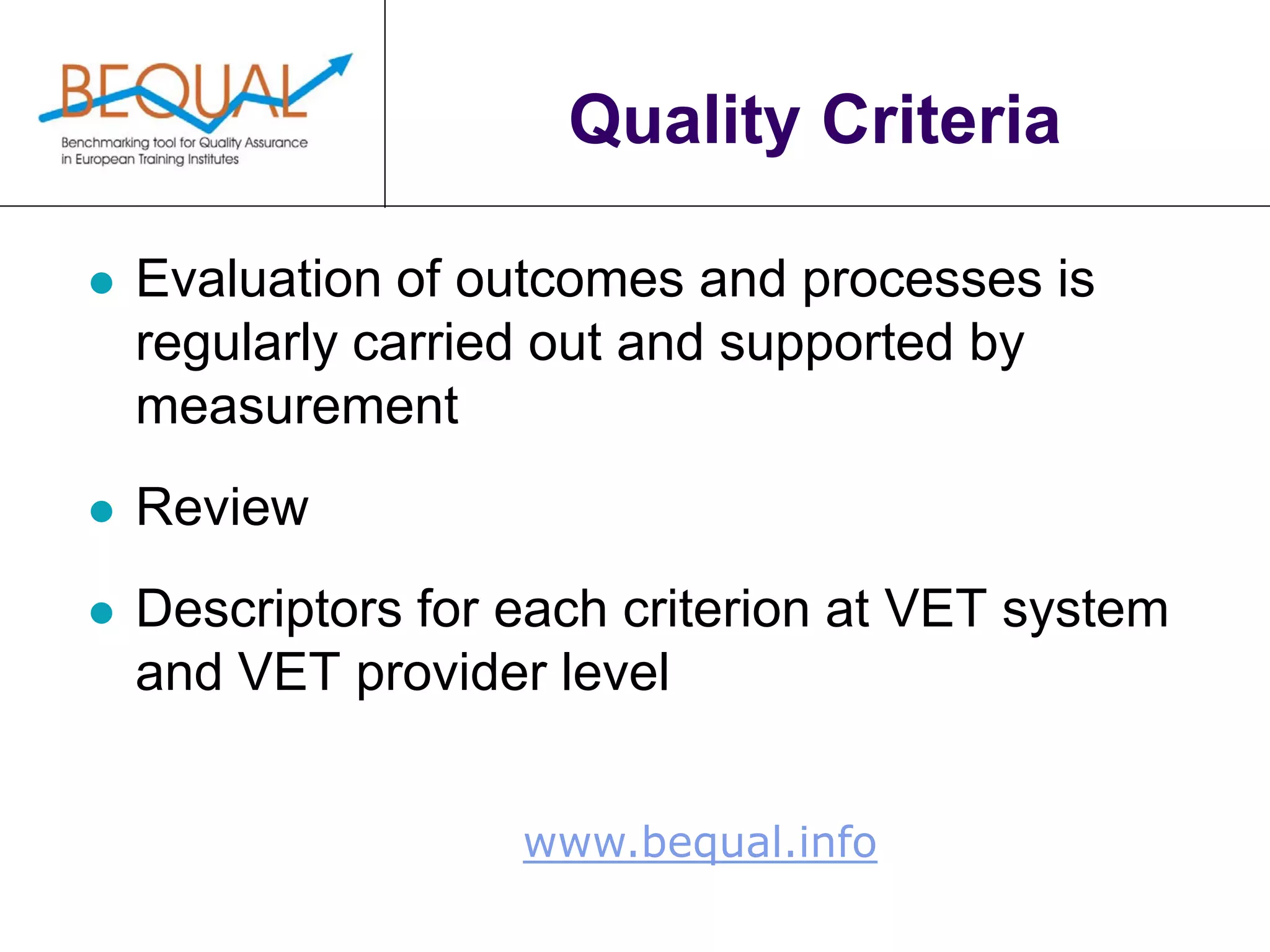
Quality Criteria
 Planning reflects a strategic vision shared by
the relevant stakeholders and includes
explicit goals/objectives, actions and
indicators
 Implementation plans are devised in
consultation with stakeholders and include
explicit principles
www.bequal.info
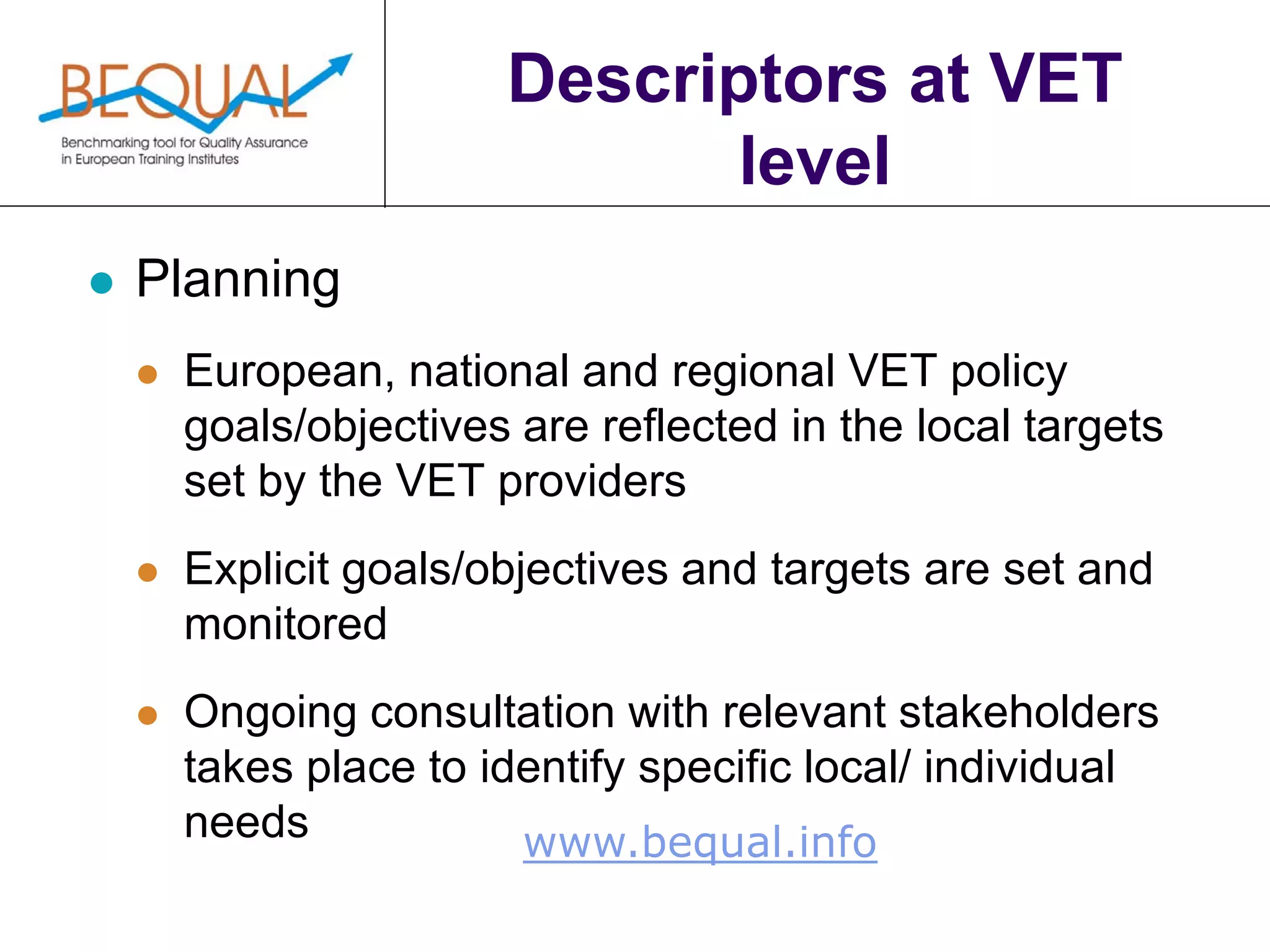
Quality Criteria
 Evaluation of outcomes and processes is
regularly carried out and supported by
measurement
 Review
 Descriptors for each criterion at VET system
and VET provider level
www.bequal.info
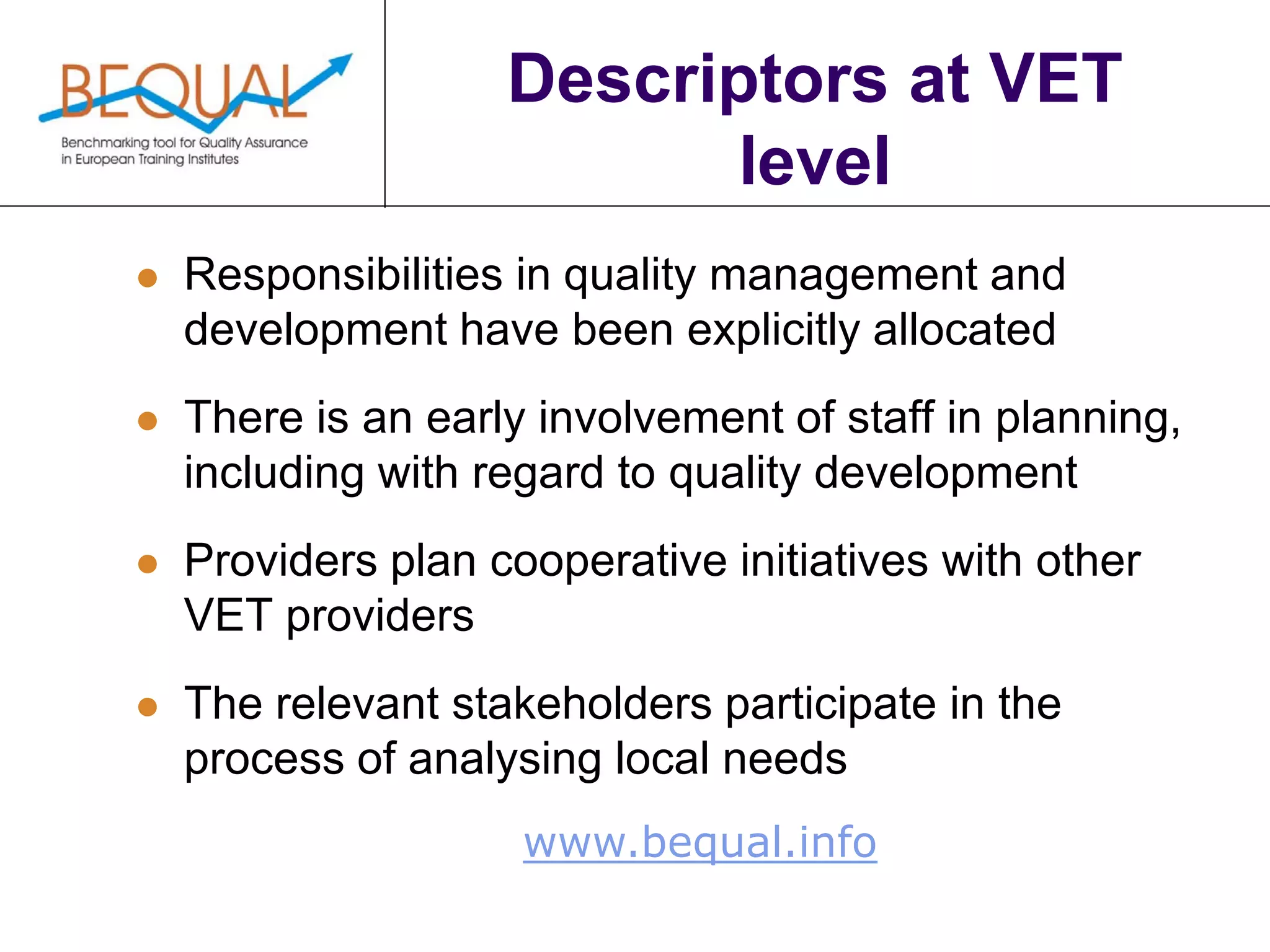
Descriptors at VET
level
 Planning
 European, national and regional VET policy
goals/objectives are reflected in the local targets
set by the VET providers
 Explicit goals/objectives and targets are set and
monitored
 Ongoing consultation with relevant stakeholders
takes place to identify specific local/ individual
needs
www.bequal.info
Descriptors at VET
level
 Responsibilities in quality management and
development have been explicitly allocated
 There is an early involvement of staff in planning,
including with regard to quality development
 Providers plan cooperative initiatives with other
VET providers
 The relevant stakeholders participate in the
process of analysing local needs
www.bequal.info
Descriptors at VET
level
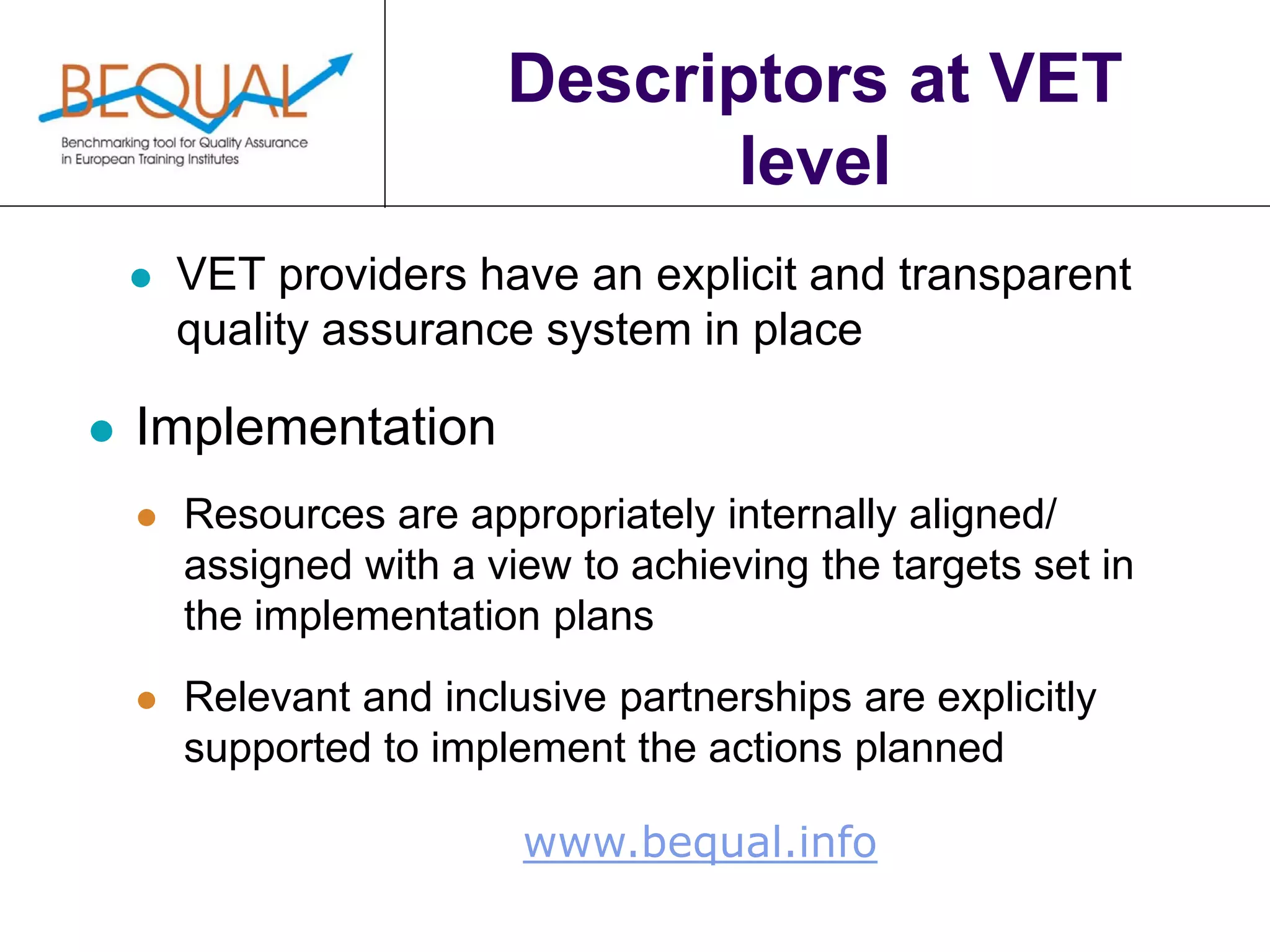
 VET providers have an explicit and transparent
quality assurance system in place
 Implementation
 Resources are appropriately internally aligned/
assigned with a view to achieving the targets set in
the implementation plans
 Relevant and inclusive partnerships are explicitly
supported to implement the actions planned
www.bequal.info
Descriptors at VET
level
 The strategic plan for staff competence development
specifies the need for training for teachers and
trainers
 Staff undertake regular training and develop
cooperation with relevant external stakeholders to
support capacity building and quality improvement,
and to enhance performance
www.bequal.info
Descriptors at VET
level
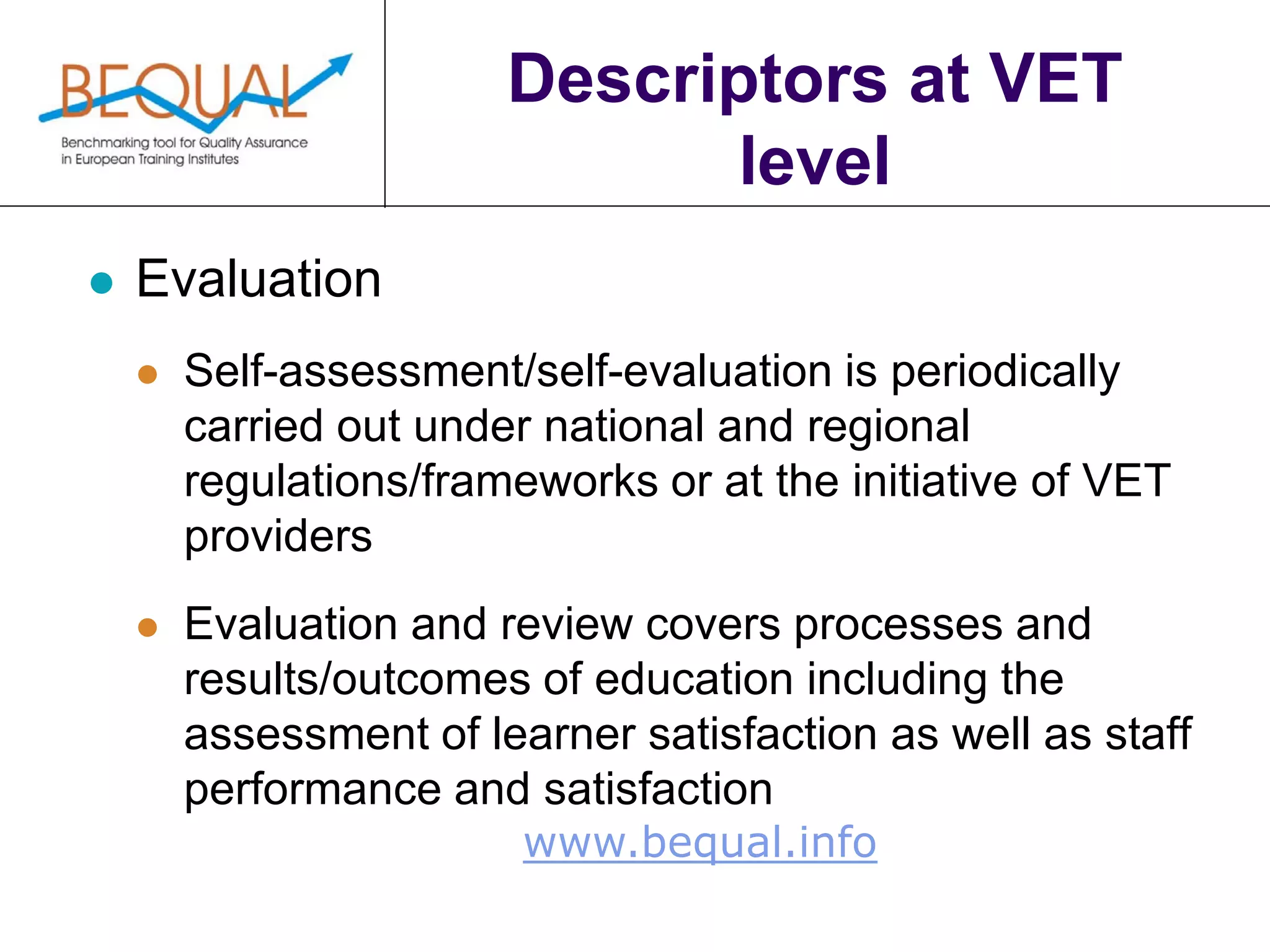
 Evaluation
 Self-assessment/self-evaluation is periodically
carried out under national and regional
regulations/frameworks or at the initiative of VET
providers
 Evaluation and review covers processes and
results/outcomes of education including the
assessment of learner satisfaction as well as staff
performance and satisfaction
www.bequal.info
Descriptors at VET
level
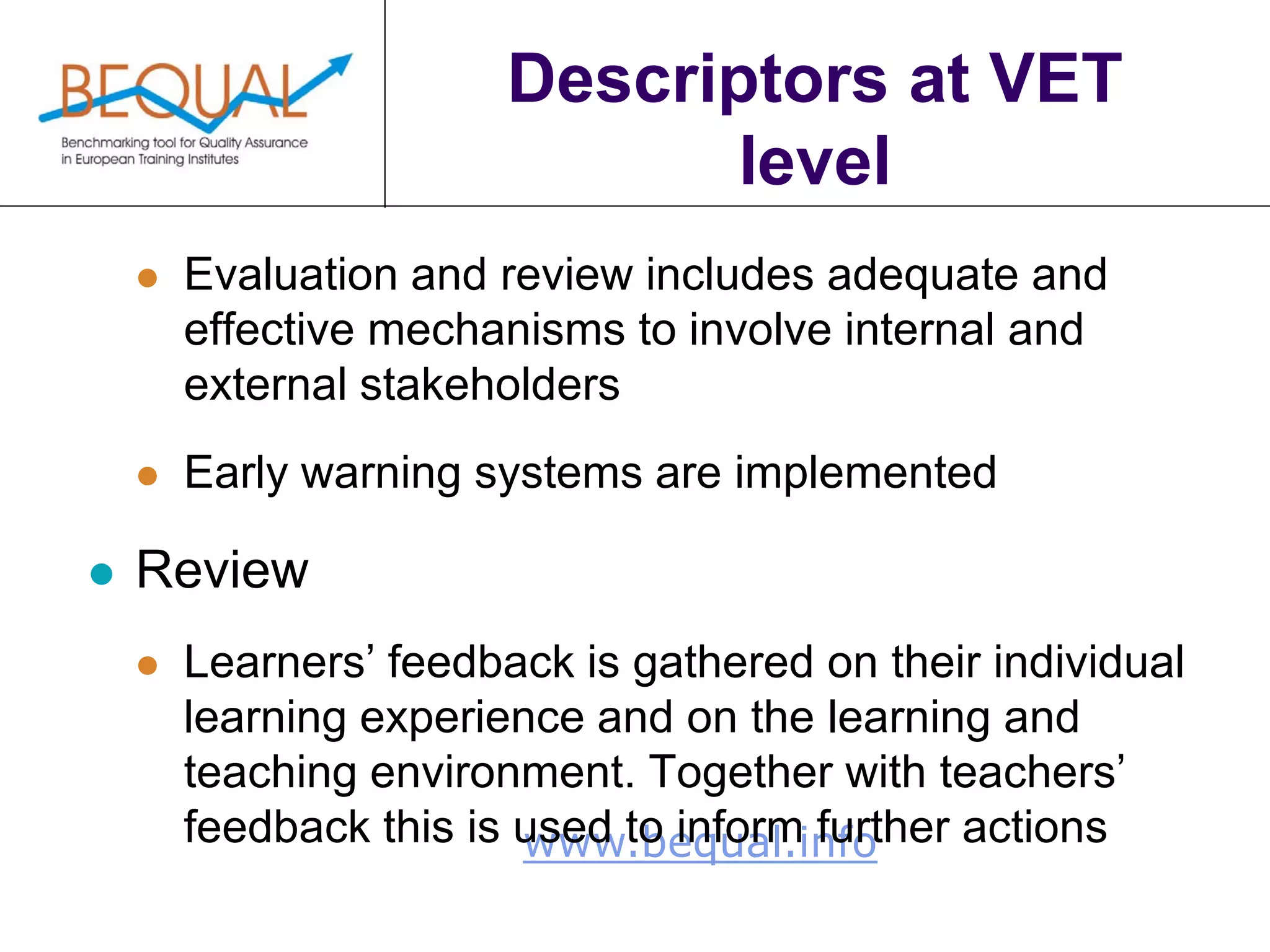
 Evaluation and review includes adequate and
effective mechanisms to involve internal and
external stakeholders
 Early warning systems are implemented
 Review
 Learners’ feedback is gathered on their individual
learning experience and on the learning and
teaching environment. Together with teachers’
feedback this is used to inform further actions
www.bequal.info
Descriptors at VET
level
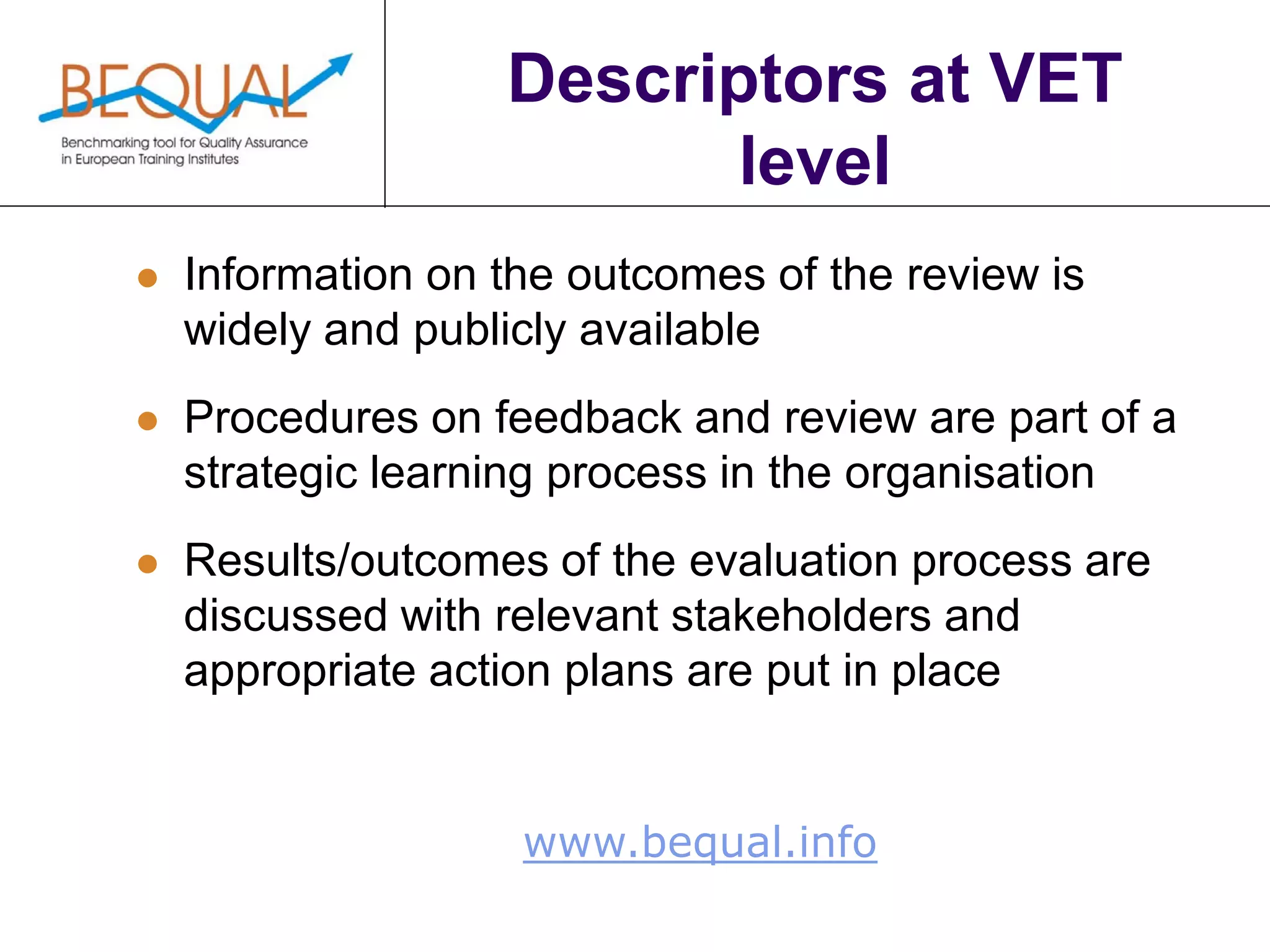
 Information on the outcomes of the review is
widely and publicly available
 Procedures on feedback and review are part of a
strategic learning process in the organisation
 Results/outcomes of the evaluation process are
discussed with relevant stakeholders and
appropriate action plans are put in place
www.bequal.info
Thank you for your attention!

Presentation of EQAVET

  • 1.
  • 2.
    www.bequal.info History  Barcelona EuropeanCouncil, 2002 : target to make Europe’s education and training systems a world quality reference by 2010.  The Copenhagen declaration, 2002 sets the basis for the development of a Common Quality Assurance Framework for VET in Europe (CQAF).
  • 3.
    www.bequal.info History  May 2004,the European Council endorsed the CQAF  October 2005, establishment of the European Network for Quality Assurance in VET (ENQA-VET)  2009, Recommendation on establishment of a European Quality Assurance Reference Framework for VET (EQARF)
  • 4.
    www.bequal.info History  2010, EuropeanQuality Assurance in Vocational Education and Training (EQAVET) replaced ENQA – VET  The Bruges Communiqué 2010 reviewed the strategic approaches and priorities of the Copenhagen process and set the roadmap for VET for 2011-2020.
  • 5.
    www.bequal.info Quality in VETcontext  Quality assurance is linked with and facilitates adoption of European instruments and tools of the Copenhagen process, i.e. ECVET, EQF, validation of non-formal and informal learning and Europass.  All these instruments have as objective the facilitation of mobility, through transparency of qualifications and quality assurance is an important factor for building mutual trust.
  • 6.
    www.bequal.info Quality and EQF The referencing of NQF to EQF has two criteria relevant to quality assurance:  5 “The national quality assurance system(s) for education and training refer(s) to the NQFk or system and are consistent with the relevant European principles and guidelines  6 The referencing process shall include the stated agreement of the relevant quality assurance bodies”.
  • 7.
    www.bequal.info Quality and ECVET ECVET recommendation invites MS to apply the common principles for quality assurance in VET when using ECVET.  Quality assurance is a core issue for building mutual trust in ECVET partnerships and quality assurance principles and criteria are documented in ECVET documents, i.e. Memorandum of Understanding and Learning Agreements.
  • 8.
    www.bequal.info Validation of non-formal andinformal learning  Obligation of the stakeholders to establish appropriate quality mechanisms for the identification and validation of non –formal and informal learning.  Quality assurance mechanisms should underpin processes, procedures and criteria for validation, in order to build confidence and trust. Member States and European Commission are invited to support the development of quality assurance mechanisms.
  • 9.
    www.bequal.info Europass  Europass canbe used as a quality assurance framework for the identification and documentation of learning outcomes and transparency of qualifications.  Quality assurance is an important factor in the use of Europass documents, especially Europass Mobility, in order to facilitate understandability of qualification
  • 10.
    www.bequal.info The EQARF Recommendation  Developthe European Quality Assurance Reference Framework (the Framework), quality criteria, indicative descriptors and reference indicators  Devise an approach aimed at improving quality assurance systems at national level  Participate actively in the European Quality Assurance Reference Framework network  Establish a Quality Assurance National Reference Point for VET
  • 11.
    www.bequal.info The Framework  Qualityassurance and improvement cycle (planning, implementation, evaluation/ assessment and review/revision) based on a selection of quality criteria, descriptors and indicators applicable to quality management at both VET-system and VET-provider levels.
  • 12.
    www.bequal.info The framework  A‘toolbox’,from which the various users may choose those descriptors and indicators that they consider most relevant to the requirements of their particular QA system.  The proposed descriptors and indicators are provided as guidance only and may be selected and applied by users of the Framework in accordance with all or part of their requirements and existing settings.
  • 13.
    www.bequal.info Quality Criteria  Planningreflects a strategic vision shared by the relevant stakeholders and includes explicit goals/objectives, actions and indicators  Implementation plans are devised in consultation with stakeholders and include explicit principles
  • 14.
    www.bequal.info Quality Criteria  Evaluationof outcomes and processes is regularly carried out and supported by measurement  Review  Descriptors for each criterion at VET system and VET provider level
  • 15.
    www.bequal.info Descriptors at VET level Planning  European, national and regional VET policy goals/objectives are reflected in the local targets set by the VET providers  Explicit goals/objectives and targets are set and monitored  Ongoing consultation with relevant stakeholders takes place to identify specific local/ individual needs
  • 16.
    www.bequal.info Descriptors at VET level Responsibilities in quality management and development have been explicitly allocated  There is an early involvement of staff in planning, including with regard to quality development  Providers plan cooperative initiatives with other VET providers  The relevant stakeholders participate in the process of analysing local needs
  • 17.
    www.bequal.info Descriptors at VET level VET providers have an explicit and transparent quality assurance system in place  Implementation  Resources are appropriately internally aligned/ assigned with a view to achieving the targets set in the implementation plans  Relevant and inclusive partnerships are explicitly supported to implement the actions planned
  • 18.
    www.bequal.info Descriptors at VET level The strategic plan for staff competence development specifies the need for training for teachers and trainers  Staff undertake regular training and develop cooperation with relevant external stakeholders to support capacity building and quality improvement, and to enhance performance
  • 19.
    www.bequal.info Descriptors at VET level Evaluation  Self-assessment/self-evaluation is periodically carried out under national and regional regulations/frameworks or at the initiative of VET providers  Evaluation and review covers processes and results/outcomes of education including the assessment of learner satisfaction as well as staff performance and satisfaction
  • 20.
    www.bequal.info Descriptors at VET level Evaluation and review includes adequate and effective mechanisms to involve internal and external stakeholders  Early warning systems are implemented  Review  Learners’ feedback is gathered on their individual learning experience and on the learning and teaching environment. Together with teachers’ feedback this is used to inform further actions
  • 21.
    www.bequal.info Descriptors at VET level Information on the outcomes of the review is widely and publicly available  Procedures on feedback and review are part of a strategic learning process in the organisation  Results/outcomes of the evaluation process are discussed with relevant stakeholders and appropriate action plans are put in place
  • 22.