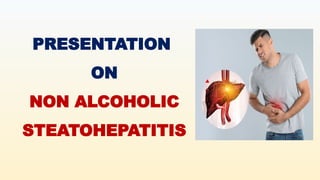
PRESENTATION
ON
NON ALCOHOLIC
STEATOHEPATITIS
INTRODUCTION
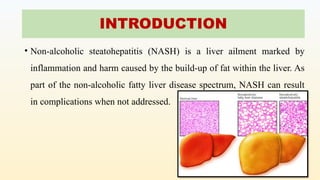
• Non-alcoholic steatohepatitis (NASH) is a liver ailment marked by
inflammation and harm caused by the build-up of fat within the liver. As
part of the non-alcoholic fatty liver disease spectrum, NASH can result
in complications when not addressed.
INTRODUCTION
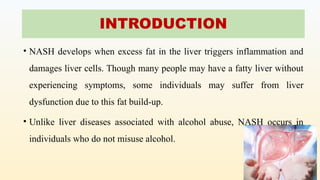
• NASH develops when excess fat in the liver triggers inflammation and
damages liver cells. Though many people may have a fatty liver without
experiencing symptoms, some individuals may suffer from liver
dysfunction due to this fat build-up.
• Unlike liver diseases associated with alcohol abuse, NASH occurs in
individuals who do not misuse alcohol.
DEFINITION
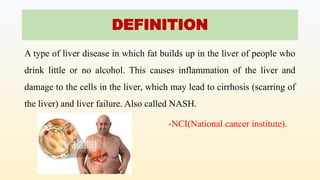
A type of liver disease in which fat builds up in the liver of people who
drink little or no alcohol. This causes inflammation of the liver and
damage to the cells in the liver, which may lead to cirrhosis (scarring of
the liver) and liver failure. Also called NASH.
-NCI(National cancer institute).
CAUSES AND RISK FACTORS
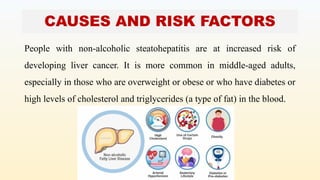
People with non-alcoholic steatohepatitis are at increased risk of
developing liver cancer. It is more common in middle-aged adults,
especially in those who are overweight or obese or who have diabetes or
high levels of cholesterol and triglycerides (a type of fat) in the blood.
CAUSES AND RISK FACTORS
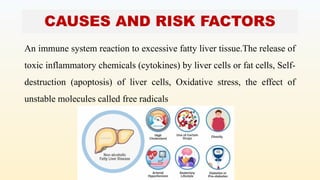
An immune system reaction to excessive fatty liver tissue.The release of
toxic inflammatory chemicals (cytokines) by liver cells or fat cells, Self-
destruction (apoptosis) of liver cells, Oxidative stress, the effect of
unstable molecules called free radicals
CAUSES AND RISK FACTORS
1. Drugs or Toxins
Metals: Antimony, Carbon disulphide, Barium salts, Thallium compounds
Antibiotics: Bleomycin, Tetracycline
Other drugs: Amiodarone, Tetracycline, Coumadin, Valproic acid, Synthetic
estrogens, Methotrexate, Glucocorticosteroids, Cocaine, Perhexilene maleate,
Didanosine, Aspirin, Fialuridine
Calcium-channel blockers: Zidovudine, Tamoxifen
CAUSES AND RISK FACTORS
2. Metabolic disorders: Abetalipoproteinemia, Glycogen storage disease,
Lipodystrophy, Weber-Christian syndrome, Dysbetalipoproteinemia,
Wilson's disease, Hyperlipidemia, Wolman's disease, Galactosemia
3. Nutritional: Obesity, Total parenteral nutrition, Diabetes and
hyperglycemia, Rapid weight loss, Intravenous glucose therapy in the week
before death, Kwashiorkor.
CAUSES AND RISK FACTORS
4. Surgical: Jejuno colic bypass, Gastroplasty, Jejunoileal bypass,
Extensive small bowel resection, Biliopancreatic diversion
5. Other disorders: Inflammatory bowel disease, Hepatotoxins:
phosphorus, Jejunal diverticulosis with bacterial overgrowth,
Petrochemicals, organic solvents, Small bowel bacterial overgrowth,
Acute starvation, Human immunodeficiencyvirus infection
NASH: Pathogenesis
• Increased delivery of fatty acids to liver
Obesity
Starvation
• Increased synthesis of fatty acids in liver
 excess carbohydrate ( TPN )
• Decreased mitochondrial beta oxidation of fatty acids
 Carnitine deficiency
 Mitochondrial dysfunction
• Decreased incorporation of triglycerides into functional VLDL
 Impaired Apo lipoprotein synthesis
NASH: Pathogenesis
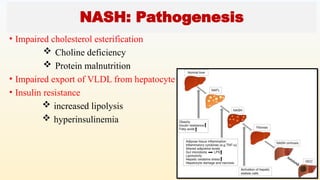
• Impaired cholesterol esterification
 Choline deficiency
 Protein malnutrition
• Impaired export of VLDL from hepatocyte
• Insulin resistance
 increased lipolysis
 hyperinsulinemia
Fibrosis Staging
• Scale ranging from FO to F4
 FO-no fibrosis
 F1-portal fibrosis without septa
 F2-portal fibrosis with few septa
 F3-bridging septa between central and portal veins
 F4 - cirrhosis
 Liver fibrosis can be expected to worsen by one class each
decade i.e. F2 will progress to cirrhosis in 20 years
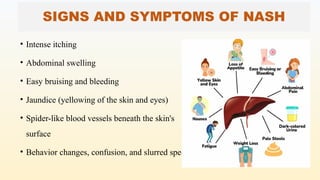
SIGNS AND SYMPTOMS OF NASH
• Intense itching
• Abdominal swelling
• Easy bruising and bleeding
• Jaundice (yellowing of the skin and eyes)
• Spider-like blood vessels beneath the skin's
surface
• Behavior changes, confusion, and slurred speech.
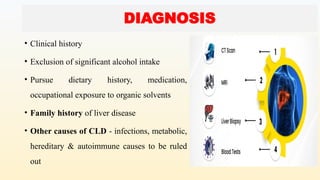
DIAGNOSIS
• Clinical history
• Exclusion of significant alcohol intake
• Pursue dietary history, medication,
occupational exposure to organic solvents
• Family history of liver disease
• Other causes of CLD - infections, metabolic,
hereditary & autoimmune causes to be ruled
out
• Magnetic resonance imaging (MRI), or ultrasound may also be used to help.
• Liver biopsy - confirm diagnosis & for prognostic information
• Fatty Liver Program also uses special MRI technology, called MR-EFF
(elastography fat fraction), to determine the percentage of fat and scarring
present. This non-invasive diagnostic tool may eliminate the need for a liver
biopsy.
DIAGNOSIS
TREATMENT
• There is no standard treatment for patients NASH
• Lifestyle changes have been shown to affect its progression. This may include
 losing weight,
 maintaining a healthy diet, or
 addressing underlying conditions such as hypothyroidism and
diabetes.
• It is important for patients with NASH to avoid consuming excessive alcohol
as this can contribute to the condition.
TREATMENT
WEIGHT REDUCTION:
• wt. loss - normalization of s.aminotransferases.
• Means of wt. loss is important not the amount of wt. loss
• Recommended wt. loss - 230 g/day or 1.6 kg/week
• Diet : 45 -100 g high quality animal protein
<100g carbohydrates
<10 g fat per day providing
600 -800 kcal
TREATMENT
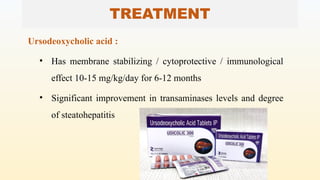
Ursodeoxycholic acid :
• Has membrane stabilizing / cytoprotective / immunological
effect 10-15 mg/kg/day for 6-12 months
• Significant improvement in transaminases levels and degree
of steatohepatitis
TREATMENT
Liver Transplantation :
• NASH - A relative contraindication
• Many of pts with NASH with CLD who underwent
• Liver Transplant - redeveloped NASH in the new donor liver
( 2/3 cases ) & 1/3rd cases - liver transplantation is unsuccessful
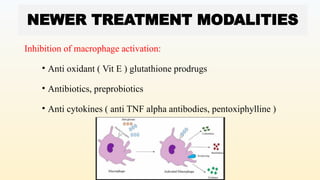
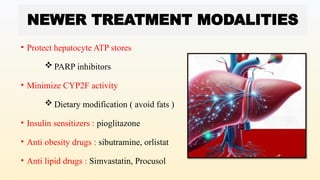
NEWER TREATMENT MODALITIES
Inhibition of macrophage activation:
• Anti oxidant ( Vit E ) glutathione prodrugs
• Antibiotics, preprobiotics
• Anti cytokines ( anti TNF alpha antibodies, pentoxiphylline )
• Protect hepatocyte ATP stores
 PARP inhibitors
• Minimize CYP2F activity
 Dietary modification ( avoid fats )
• Insulin sensitizers : pioglitazone
• Anti obesity drugs : sibutramine, orlistat
• Anti lipid drugs : Simvastatin, Procusol
NEWER TREATMENT MODALITIES
• NASH increases the risk of cirrhosis-related liver failure and liver
cancer, which could require a liver transplant.
• The average life expectancy for someone with cirrhosis of advanced
liver disease is about nine to 12 years.
• However, NAFLD greatly increases the risk of cardiovascular disease
and decreases life expectancy in adults.
NASH Complications
• Unlike inherent NASH risk factors such as genetics, age, and race,
some can be reduced through healthy diet and lifestyle choices that
can help protect the liver.
NASH PREVENTION
REFERENCES
o https://www.nejm.org/doi/full/10.1056/NEJMra1503519
 Cause, Pathogenesis, and Treatment of Nonalcoholic Steatohepatitis
 Anna M. Diehl, M.D., and Christopher Day, M.D.
 N Engl J Med 2017; 377:2063-2072 DOI: 10.1056/NEJMra1503519
o https://www.nejm.org/doi/full/10.1056/NEJMc1716786
o https://resident360.nejm.org/contentitems/nonalcoholic-steatohepatitis/
o https://www.pathpedia.com/education/eatlas/histology/liver and bile ducts/
o https://www.uptodate.com/contents/natural-history-and-management-of-nonalcoholic-fatty-liver-disease-in
adults?search=nash%20statin&source=search result&selectedTitle=1~150&usag e type=default&display
rank=1#H2027876431
PRESENTATION NASH.pptx.....................

PRESENTATION NASH.pptx.....................

  • 2.
  • 3.
    INTRODUCTION • Non-alcoholic steatohepatitis(NASH) is a liver ailment marked by inflammation and harm caused by the build-up of fat within the liver. As part of the non-alcoholic fatty liver disease spectrum, NASH can result in complications when not addressed.
  • 4.
    INTRODUCTION • NASH developswhen excess fat in the liver triggers inflammation and damages liver cells. Though many people may have a fatty liver without experiencing symptoms, some individuals may suffer from liver dysfunction due to this fat build-up. • Unlike liver diseases associated with alcohol abuse, NASH occurs in individuals who do not misuse alcohol.
  • 5.
    DEFINITION A type ofliver disease in which fat builds up in the liver of people who drink little or no alcohol. This causes inflammation of the liver and damage to the cells in the liver, which may lead to cirrhosis (scarring of the liver) and liver failure. Also called NASH. -NCI(National cancer institute).
  • 6.
    CAUSES AND RISKFACTORS People with non-alcoholic steatohepatitis are at increased risk of developing liver cancer. It is more common in middle-aged adults, especially in those who are overweight or obese or who have diabetes or high levels of cholesterol and triglycerides (a type of fat) in the blood.
  • 7.
    CAUSES AND RISKFACTORS An immune system reaction to excessive fatty liver tissue.The release of toxic inflammatory chemicals (cytokines) by liver cells or fat cells, Self- destruction (apoptosis) of liver cells, Oxidative stress, the effect of unstable molecules called free radicals
  • 8.
    CAUSES AND RISKFACTORS 1. Drugs or Toxins Metals: Antimony, Carbon disulphide, Barium salts, Thallium compounds Antibiotics: Bleomycin, Tetracycline Other drugs: Amiodarone, Tetracycline, Coumadin, Valproic acid, Synthetic estrogens, Methotrexate, Glucocorticosteroids, Cocaine, Perhexilene maleate, Didanosine, Aspirin, Fialuridine Calcium-channel blockers: Zidovudine, Tamoxifen
  • 9.
    CAUSES AND RISKFACTORS 2. Metabolic disorders: Abetalipoproteinemia, Glycogen storage disease, Lipodystrophy, Weber-Christian syndrome, Dysbetalipoproteinemia, Wilson's disease, Hyperlipidemia, Wolman's disease, Galactosemia 3. Nutritional: Obesity, Total parenteral nutrition, Diabetes and hyperglycemia, Rapid weight loss, Intravenous glucose therapy in the week before death, Kwashiorkor.
  • 10.
    CAUSES AND RISKFACTORS 4. Surgical: Jejuno colic bypass, Gastroplasty, Jejunoileal bypass, Extensive small bowel resection, Biliopancreatic diversion 5. Other disorders: Inflammatory bowel disease, Hepatotoxins: phosphorus, Jejunal diverticulosis with bacterial overgrowth, Petrochemicals, organic solvents, Small bowel bacterial overgrowth, Acute starvation, Human immunodeficiencyvirus infection
  • 11.
    NASH: Pathogenesis • Increaseddelivery of fatty acids to liver Obesity Starvation • Increased synthesis of fatty acids in liver  excess carbohydrate ( TPN ) • Decreased mitochondrial beta oxidation of fatty acids  Carnitine deficiency  Mitochondrial dysfunction • Decreased incorporation of triglycerides into functional VLDL  Impaired Apo lipoprotein synthesis
  • 12.
    NASH: Pathogenesis • Impairedcholesterol esterification  Choline deficiency  Protein malnutrition • Impaired export of VLDL from hepatocyte • Insulin resistance  increased lipolysis  hyperinsulinemia
  • 13.
    Fibrosis Staging • Scaleranging from FO to F4  FO-no fibrosis  F1-portal fibrosis without septa  F2-portal fibrosis with few septa  F3-bridging septa between central and portal veins  F4 - cirrhosis  Liver fibrosis can be expected to worsen by one class each decade i.e. F2 will progress to cirrhosis in 20 years
  • 14.
    SIGNS AND SYMPTOMSOF NASH • Intense itching • Abdominal swelling • Easy bruising and bleeding • Jaundice (yellowing of the skin and eyes) • Spider-like blood vessels beneath the skin's surface • Behavior changes, confusion, and slurred speech.
  • 15.
    DIAGNOSIS • Clinical history •Exclusion of significant alcohol intake • Pursue dietary history, medication, occupational exposure to organic solvents • Family history of liver disease • Other causes of CLD - infections, metabolic, hereditary & autoimmune causes to be ruled out
  • 16.
    • Magnetic resonanceimaging (MRI), or ultrasound may also be used to help. • Liver biopsy - confirm diagnosis & for prognostic information • Fatty Liver Program also uses special MRI technology, called MR-EFF (elastography fat fraction), to determine the percentage of fat and scarring present. This non-invasive diagnostic tool may eliminate the need for a liver biopsy. DIAGNOSIS
  • 17.
    TREATMENT • There isno standard treatment for patients NASH • Lifestyle changes have been shown to affect its progression. This may include  losing weight,  maintaining a healthy diet, or  addressing underlying conditions such as hypothyroidism and diabetes. • It is important for patients with NASH to avoid consuming excessive alcohol as this can contribute to the condition.
  • 18.
    TREATMENT WEIGHT REDUCTION: • wt.loss - normalization of s.aminotransferases. • Means of wt. loss is important not the amount of wt. loss • Recommended wt. loss - 230 g/day or 1.6 kg/week • Diet : 45 -100 g high quality animal protein <100g carbohydrates <10 g fat per day providing 600 -800 kcal
  • 19.
    TREATMENT Ursodeoxycholic acid : •Has membrane stabilizing / cytoprotective / immunological effect 10-15 mg/kg/day for 6-12 months • Significant improvement in transaminases levels and degree of steatohepatitis
  • 20.
    TREATMENT Liver Transplantation : •NASH - A relative contraindication • Many of pts with NASH with CLD who underwent • Liver Transplant - redeveloped NASH in the new donor liver ( 2/3 cases ) & 1/3rd cases - liver transplantation is unsuccessful
  • 21.
    NEWER TREATMENT MODALITIES Inhibitionof macrophage activation: • Anti oxidant ( Vit E ) glutathione prodrugs • Antibiotics, preprobiotics • Anti cytokines ( anti TNF alpha antibodies, pentoxiphylline )
  • 22.
    • Protect hepatocyteATP stores  PARP inhibitors • Minimize CYP2F activity  Dietary modification ( avoid fats ) • Insulin sensitizers : pioglitazone • Anti obesity drugs : sibutramine, orlistat • Anti lipid drugs : Simvastatin, Procusol NEWER TREATMENT MODALITIES
  • 23.
    • NASH increasesthe risk of cirrhosis-related liver failure and liver cancer, which could require a liver transplant. • The average life expectancy for someone with cirrhosis of advanced liver disease is about nine to 12 years. • However, NAFLD greatly increases the risk of cardiovascular disease and decreases life expectancy in adults. NASH Complications
  • 24.
    • Unlike inherentNASH risk factors such as genetics, age, and race, some can be reduced through healthy diet and lifestyle choices that can help protect the liver. NASH PREVENTION
  • 25.
    REFERENCES o https://www.nejm.org/doi/full/10.1056/NEJMra1503519  Cause,Pathogenesis, and Treatment of Nonalcoholic Steatohepatitis  Anna M. Diehl, M.D., and Christopher Day, M.D.  N Engl J Med 2017; 377:2063-2072 DOI: 10.1056/NEJMra1503519 o https://www.nejm.org/doi/full/10.1056/NEJMc1716786 o https://resident360.nejm.org/contentitems/nonalcoholic-steatohepatitis/ o https://www.pathpedia.com/education/eatlas/histology/liver and bile ducts/ o https://www.uptodate.com/contents/natural-history-and-management-of-nonalcoholic-fatty-liver-disease-in adults?search=nash%20statin&source=search result&selectedTitle=1~150&usag e type=default&display rank=1#H2027876431