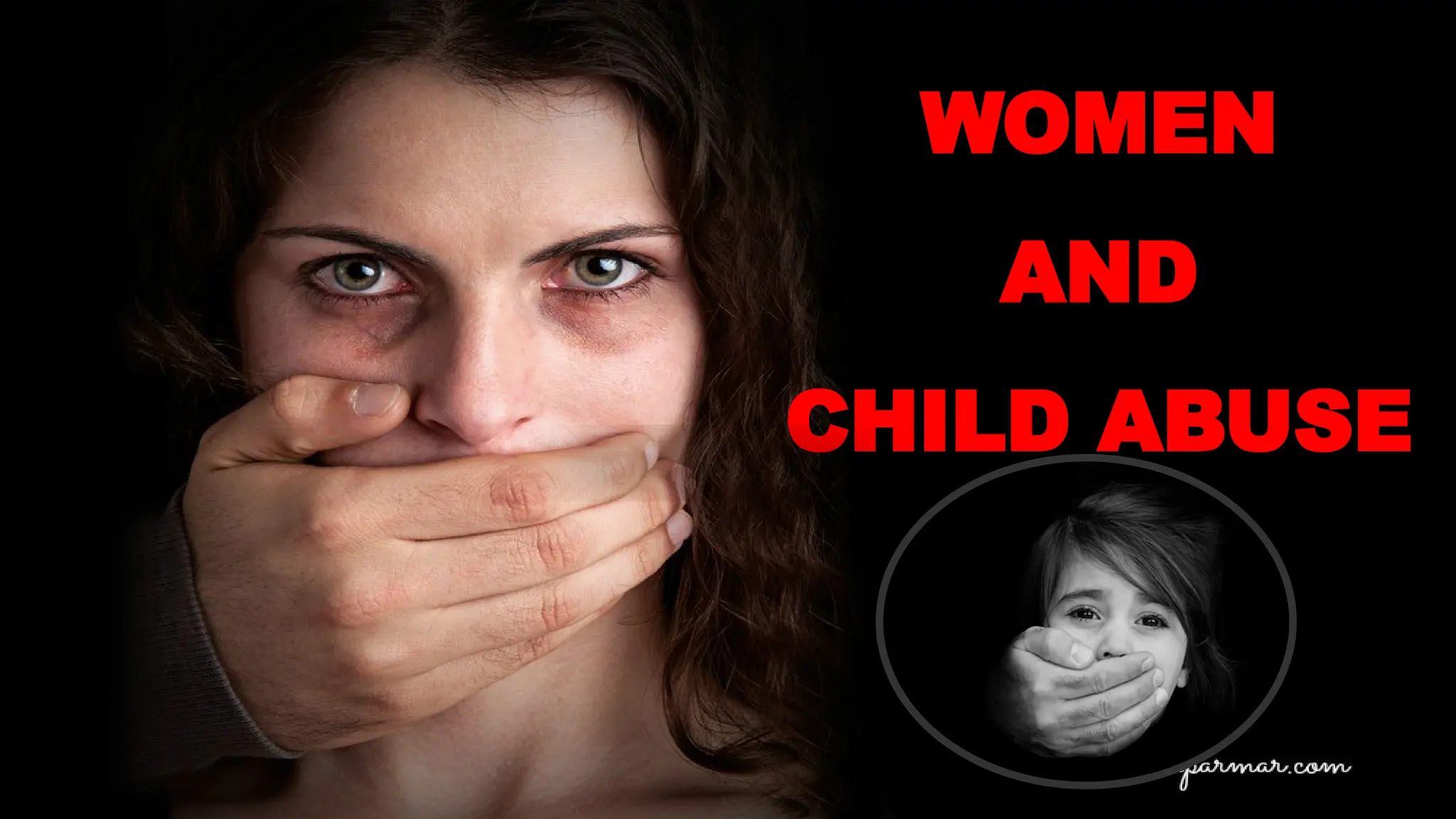
WOMEN
AND
CHILD ABUSE
ABUSE
• Abuse refers to use for bad effect or a bad purpose. It also means that
treat with cruelty or violence, or assault sexually. It addresses in an
insulting and offensive way or the improper use of something, or cruel
and violent treatment, i.e. sexual assault or insulting and use of
offensive language
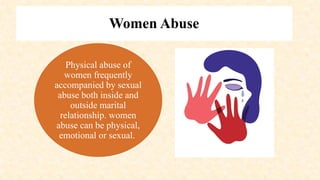
Women Abuse
Physical abuse of
women frequently
accompanied by sexual
abuse both inside and
outside marital
relationship. women
abuse can be physical,
emotional or sexual.
Signs of Women Abuse
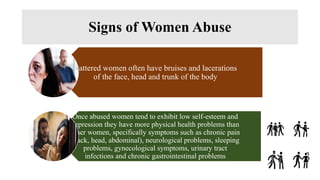
Battered women often have bruises and lacerations
of the face, head and trunk of the body
Once abused women tend to exhibit low self-esteem and
depression they have more physical health problems than
other women, specifically symptoms such as chronic pain
(back, head, abdominal), neurological problems, sleeping
problems, gynecological symptoms, urinary tract
infections and chronic gastrointestinal problems
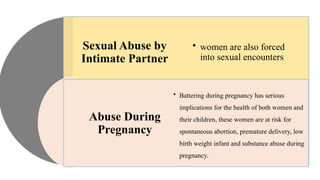
Sexual Abuse by
Intimate Partner
Abuse During
Pregnancy
• women are also forced
into sexual encounters
• Battering during pregnancy has serious
implications for the health of both women and
their children, these women are at risk for
spontaneous abortion, premature delivery, low
birth weight infant and substance abuse during
pregnancy.
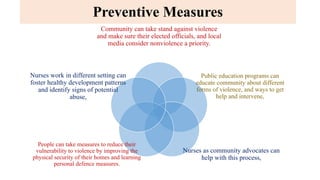
Preventive Measures
Community can take stand against violence
and make sure their elected officials, and local
media consider nonviolence a priority.
Public education programs can
educate community about different
forms of violence, and ways to get
help and intervene,
Nurses as community advocates can
help with this process,
People can take measures to reduce their
vulnerability to violence by improving the
physical security of their homes and learning
personal defence measures.
Nurses work in different setting can
foster healthy development patterns
and identify signs of potential
abuse,
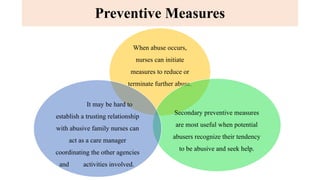
When abuse occurs,
nurses can initiate
measures to reduce or
terminate further abuse.
Secondary preventive measures
are most useful when potential
abusers recognize their tendency
to be abusive and seek help.
It may be hard to
establish a trusting relationship
with abusive family nurses can
act as a care manager
coordinating the other agencies
and activities involved.
Preventive Measures
The principles of giving care to families who are experiencing abuse
include the following:
•Intolerance for violence or abuse.
•Respect and caring for all family members.
•Safety on first priority.
•Absolute honesty.
•Empowerment.
Physical and emotional health problem of abused women are
promptly attended by all health professional.
Preventive Measures
Nursing Interventions Specific to Female
Partner Abuse
• Women in abusive relationships most often seek care for injuries in an emergency setting, a
physician's office or most often seek care for prenatal clinic.
• If battered women can be identified in those settings, perhaps effective interventions can be
provided that will prevent the kind of serious injury that later results in emergency
department visits or even a homicide.
• professional nursing organizations recommend that all women be routinely screened for
domestic violence each time they come to a healthcare setting.
Assessment
Assessment take place for all women entering the healthcare system.
The assessment should be ongoing and confidential.
A thorough assessment gathers information on physical, emotional and sexual
trauma from violence, risk for future abuse, cultural background and beliefs,
perceptions of the woman's relationships with others, and stated needs.
The assessment should be conducted in private.
Prevention
Primary prevention includes a social attitudinal change, both girls and
boys need to be taught human values of interdependence, respect for
human life
In addition, local communities must make it clear that violence against
women is not tolerated by eliminating pornography, mandating arrests
of abusers and creating a general climate of nonviolence.
Abused women need assistance in making decisions and taking
control of their lives, Community-oriented nurses, prenatal nurses,
planned parenthood, primary care
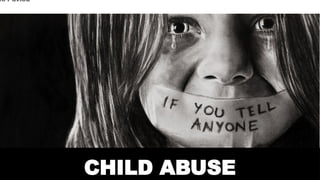
CHILD ABUSE
Child Abuse
Child abuse refers to the non-accidental use of physical force by a
parent or other custodian responsible for the care of the child. Many
children each year witness domestic violence, they may experience
post-traumatic stress(PTS).
According to WHO, it has been detailed below.
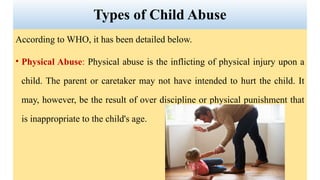
• Physical Abuse: Physical abuse is the inflicting of physical injury upon a
child. The parent or caretaker may not have intended to hurt the child. It
may, however, be the result of over discipline or physical punishment that
is inappropriate to the child's age.
Types of Child Abuse
• Sexual Abuse: Child abuse also includes sexual abuse. Approximately 1 in 4 females
and 1 in 10 male children in the United States will be subject to some form of sexual
abuse by the time they reach 18 years of age, the exact prevalence is difficult to obtain
because not all Iren have the cognitive ability to describe these experiences, this abuse
ranges from unwanted sexual touching to Intercourse, the majority childhood sexual
abuse is perpetrated by someone the child knows and trusts. Between one third and one
half of all sexual abuse involves a family member.
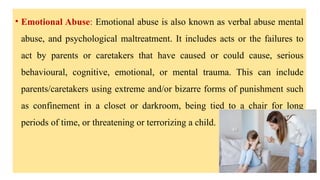
• Emotional Abuse: Emotional abuse is also known as verbal abuse mental
abuse, and psychological maltreatment. It includes acts or the failures to
act by parents or caretakers that have caused or could cause, serious
behavioural, cognitive, emotional, or mental trauma. This can include
parents/caretakers using extreme and/or bizarre forms of punishment such
as confinement in a closet or darkroom, being tied to a chair for long
periods of time, or threatening or terrorizing a child.
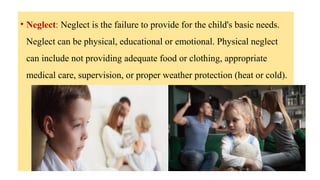
• Neglect: Neglect is the failure to provide for the child's basic needs.
Neglect can be physical, educational or emotional. Physical neglect
can include not providing adequate food or clothing, appropriate
medical care, supervision, or proper weather protection (heat or cold).
Indicators of Child Abuse
Extreme forms of punishment
Rejection
Use of derogatory terms to describe the child
Blaming the child
Making comparisons
Labelling or nicknaming.
Emotional abuse
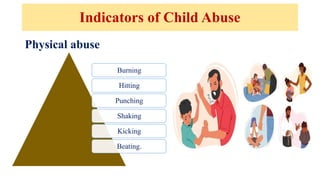
Burning
Hitting
Punching
Shaking
Kicking
Beating.
Indicators of Child Abuse
Physical abuse
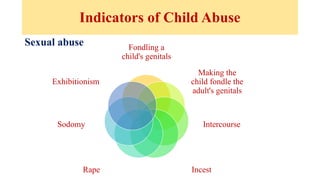
Fondling a
child's genitals
Making the
child fondle the
adult's genitals
Intercourse
Incest
Rape
Sodomy
Exhibitionism
Indicators of Child Abuse
Sexual abuse
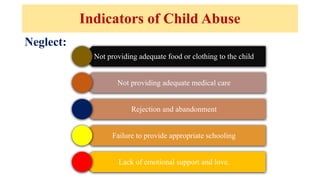
Not providing adequate food or clothing to the child
Not providing adequate medical care
Rejection and abandonment
Failure to provide appropriate schooling
Lack of emotional support and love.
Neglect:
Indicators of Child Abuse
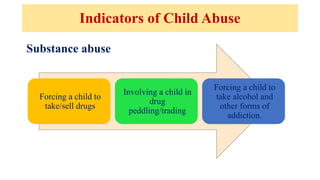
Forcing a child to
take/sell drugs
Involving a child in
drug
peddling/trading
Forcing a child to
take alcohol and
other forms of
addiction.
Indicators of Child Abuse
Substance abuse
Identify Potentially Abusive Parents
• The following characteristics in couples expecting a child constitute
warning signs of actual or potential abuse:
Denial of the reality of the pregnancy, as seen in a refusal to talk
about the impending birth or to think of a name for the child
An obvious concern or fear that the baby will not meet some
predetermined standard such as sex, hair colour, temperament or
resemblance to family members
Failure to follow through on the desire for an abortion
Family experiencing stress and numerous crises, so that the
birth of a child may be the last straw
Initial and unresolved negative feelings about having a child
An initial decision to place the child for adoption and a
change of mind
Rejection of mother by father of the baby
Identify Potentially Abusive Parents
Lack of support for the new parents
Isolation from friends, neighbours or family
Parental evidence of poor impulse control or fear of losing control
Contradictory history
Appearance of detachment
Appearance of misusing drugs or alcohol
Identify Potentially Abusive Parents
Shopping for hospitals or healthcare providers
Unrealistic expectations of the child
Verbal, physical or sexual abuse of mother by father, especially during
pregnancy
Child is not biological offspring of male stepfather of mother's current
boyfriend
Excessive talk of needing to 'discipline' children and plans to use harsh
physical punishment to enforce discipline.
Identify Potentially Abusive Parents
Foster Care
• When child abuse is discovered, the child is often placed in a foster home. It is
unfortunate that there is not enough good foster care for all abused children and
many foster care situations are also abusive. Abused children generally want to
return to their parents and the goal of most agencies is to keep natural families
together as long as it is same for the child.
Nursing Actions
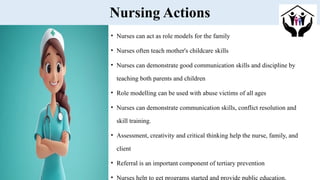
• Nurses can act as role models for the family
• Nurses often teach mother's childcare skills
• Nurses can demonstrate good communication skills and discipline by
teaching both parents and children
• Role modelling can be used with abuse victims of all ages
• Nurses can demonstrate communication skills, conflict resolution and
skill training.
• Assessment, creativity and critical thinking help the nurse, family, and
client
• Referral is an important component of tertiary prevention
• Nurses help to get programs started and provide public education.
WOMEN abuse.pptx.........................

WOMEN abuse.pptx.........................

  • 1.
  • 2.
    ABUSE • Abuse refersto use for bad effect or a bad purpose. It also means that treat with cruelty or violence, or assault sexually. It addresses in an insulting and offensive way or the improper use of something, or cruel and violent treatment, i.e. sexual assault or insulting and use of offensive language
  • 3.
    Women Abuse Physical abuseof women frequently accompanied by sexual abuse both inside and outside marital relationship. women abuse can be physical, emotional or sexual.
  • 4.
    Signs of WomenAbuse Battered women often have bruises and lacerations of the face, head and trunk of the body Once abused women tend to exhibit low self-esteem and depression they have more physical health problems than other women, specifically symptoms such as chronic pain (back, head, abdominal), neurological problems, sleeping problems, gynecological symptoms, urinary tract infections and chronic gastrointestinal problems
  • 5.
    Sexual Abuse by IntimatePartner Abuse During Pregnancy • women are also forced into sexual encounters • Battering during pregnancy has serious implications for the health of both women and their children, these women are at risk for spontaneous abortion, premature delivery, low birth weight infant and substance abuse during pregnancy.
  • 6.
    Preventive Measures Community cantake stand against violence and make sure their elected officials, and local media consider nonviolence a priority. Public education programs can educate community about different forms of violence, and ways to get help and intervene, Nurses as community advocates can help with this process, People can take measures to reduce their vulnerability to violence by improving the physical security of their homes and learning personal defence measures. Nurses work in different setting can foster healthy development patterns and identify signs of potential abuse,
  • 7.
    When abuse occurs, nursescan initiate measures to reduce or terminate further abuse. Secondary preventive measures are most useful when potential abusers recognize their tendency to be abusive and seek help. It may be hard to establish a trusting relationship with abusive family nurses can act as a care manager coordinating the other agencies and activities involved. Preventive Measures
  • 8.
    The principles ofgiving care to families who are experiencing abuse include the following: •Intolerance for violence or abuse. •Respect and caring for all family members. •Safety on first priority. •Absolute honesty. •Empowerment. Physical and emotional health problem of abused women are promptly attended by all health professional. Preventive Measures
  • 9.
    Nursing Interventions Specificto Female Partner Abuse • Women in abusive relationships most often seek care for injuries in an emergency setting, a physician's office or most often seek care for prenatal clinic. • If battered women can be identified in those settings, perhaps effective interventions can be provided that will prevent the kind of serious injury that later results in emergency department visits or even a homicide. • professional nursing organizations recommend that all women be routinely screened for domestic violence each time they come to a healthcare setting.
  • 10.
    Assessment Assessment take placefor all women entering the healthcare system. The assessment should be ongoing and confidential. A thorough assessment gathers information on physical, emotional and sexual trauma from violence, risk for future abuse, cultural background and beliefs, perceptions of the woman's relationships with others, and stated needs. The assessment should be conducted in private.
  • 11.
    Prevention Primary prevention includesa social attitudinal change, both girls and boys need to be taught human values of interdependence, respect for human life In addition, local communities must make it clear that violence against women is not tolerated by eliminating pornography, mandating arrests of abusers and creating a general climate of nonviolence. Abused women need assistance in making decisions and taking control of their lives, Community-oriented nurses, prenatal nurses, planned parenthood, primary care
  • 12.
  • 13.
    Child Abuse Child abuserefers to the non-accidental use of physical force by a parent or other custodian responsible for the care of the child. Many children each year witness domestic violence, they may experience post-traumatic stress(PTS).
  • 14.
    According to WHO,it has been detailed below. • Physical Abuse: Physical abuse is the inflicting of physical injury upon a child. The parent or caretaker may not have intended to hurt the child. It may, however, be the result of over discipline or physical punishment that is inappropriate to the child's age. Types of Child Abuse
  • 15.
    • Sexual Abuse:Child abuse also includes sexual abuse. Approximately 1 in 4 females and 1 in 10 male children in the United States will be subject to some form of sexual abuse by the time they reach 18 years of age, the exact prevalence is difficult to obtain because not all Iren have the cognitive ability to describe these experiences, this abuse ranges from unwanted sexual touching to Intercourse, the majority childhood sexual abuse is perpetrated by someone the child knows and trusts. Between one third and one half of all sexual abuse involves a family member.
  • 16.
    • Emotional Abuse:Emotional abuse is also known as verbal abuse mental abuse, and psychological maltreatment. It includes acts or the failures to act by parents or caretakers that have caused or could cause, serious behavioural, cognitive, emotional, or mental trauma. This can include parents/caretakers using extreme and/or bizarre forms of punishment such as confinement in a closet or darkroom, being tied to a chair for long periods of time, or threatening or terrorizing a child.
  • 17.
    • Neglect: Neglectis the failure to provide for the child's basic needs. Neglect can be physical, educational or emotional. Physical neglect can include not providing adequate food or clothing, appropriate medical care, supervision, or proper weather protection (heat or cold).
  • 18.
    Indicators of ChildAbuse Extreme forms of punishment Rejection Use of derogatory terms to describe the child Blaming the child Making comparisons Labelling or nicknaming. Emotional abuse
  • 19.
  • 20.
    Fondling a child's genitals Makingthe child fondle the adult's genitals Intercourse Incest Rape Sodomy Exhibitionism Indicators of Child Abuse Sexual abuse
  • 21.
    Not providing adequatefood or clothing to the child Not providing adequate medical care Rejection and abandonment Failure to provide appropriate schooling Lack of emotional support and love. Neglect: Indicators of Child Abuse
  • 22.
    Forcing a childto take/sell drugs Involving a child in drug peddling/trading Forcing a child to take alcohol and other forms of addiction. Indicators of Child Abuse Substance abuse
  • 23.
    Identify Potentially AbusiveParents • The following characteristics in couples expecting a child constitute warning signs of actual or potential abuse: Denial of the reality of the pregnancy, as seen in a refusal to talk about the impending birth or to think of a name for the child An obvious concern or fear that the baby will not meet some predetermined standard such as sex, hair colour, temperament or resemblance to family members Failure to follow through on the desire for an abortion
  • 24.
    Family experiencing stressand numerous crises, so that the birth of a child may be the last straw Initial and unresolved negative feelings about having a child An initial decision to place the child for adoption and a change of mind Rejection of mother by father of the baby Identify Potentially Abusive Parents
  • 25.
    Lack of supportfor the new parents Isolation from friends, neighbours or family Parental evidence of poor impulse control or fear of losing control Contradictory history Appearance of detachment Appearance of misusing drugs or alcohol Identify Potentially Abusive Parents
  • 26.
    Shopping for hospitalsor healthcare providers Unrealistic expectations of the child Verbal, physical or sexual abuse of mother by father, especially during pregnancy Child is not biological offspring of male stepfather of mother's current boyfriend Excessive talk of needing to 'discipline' children and plans to use harsh physical punishment to enforce discipline. Identify Potentially Abusive Parents
  • 27.
    Foster Care • Whenchild abuse is discovered, the child is often placed in a foster home. It is unfortunate that there is not enough good foster care for all abused children and many foster care situations are also abusive. Abused children generally want to return to their parents and the goal of most agencies is to keep natural families together as long as it is same for the child.
  • 28.
    Nursing Actions • Nursescan act as role models for the family • Nurses often teach mother's childcare skills • Nurses can demonstrate good communication skills and discipline by teaching both parents and children • Role modelling can be used with abuse victims of all ages • Nurses can demonstrate communication skills, conflict resolution and skill training. • Assessment, creativity and critical thinking help the nurse, family, and client • Referral is an important component of tertiary prevention • Nurses help to get programs started and provide public education.