MOSFET
Working, Types,
Applications,
Advantages &
Disadvantages
What is MOSFET?
Metal Oxide Silicon Field Effect Tra
nsistor- is abbreviated as MOSFET. It is merely a
unipolar transistor and used as an electronic switch
and to amplify electronic signals. The device has three
terminals consisting of a source, gate and drain. Apart
from these terminals there is a substrate generally
called the body which is always connected to the
source terminal for practical applications.
In recent years, its discovery has led to the dominant
usage of these devices in digital integrated circuits due
to its structure. The Silicon di-oxide (SiO2) layer acts as
an insulator and provides electrical isolation between
the gate and an active channel between the source
and the drain which provides high input impedance
which is almost infinite thus capturing all the input
signal.
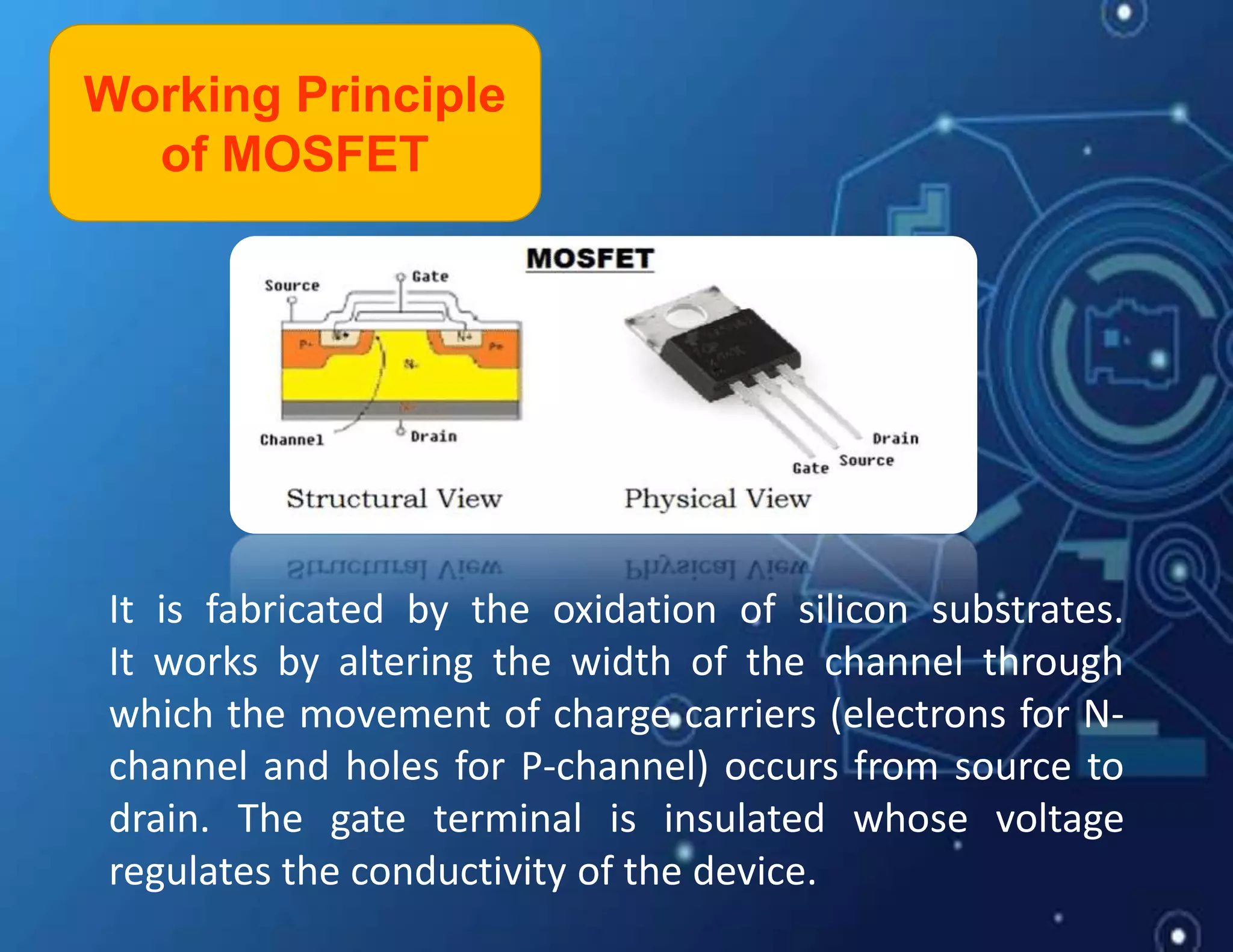
Working Principle
of MOSFET
It is fabricated by the oxidation of silicon substrates.
It works by altering the width of the channel through
which the movement of charge carriers (electrons for N-
channel and holes for P-channel) occurs from source to
drain. The gate terminal is insulated whose voltage
regulates the conductivity of the device.
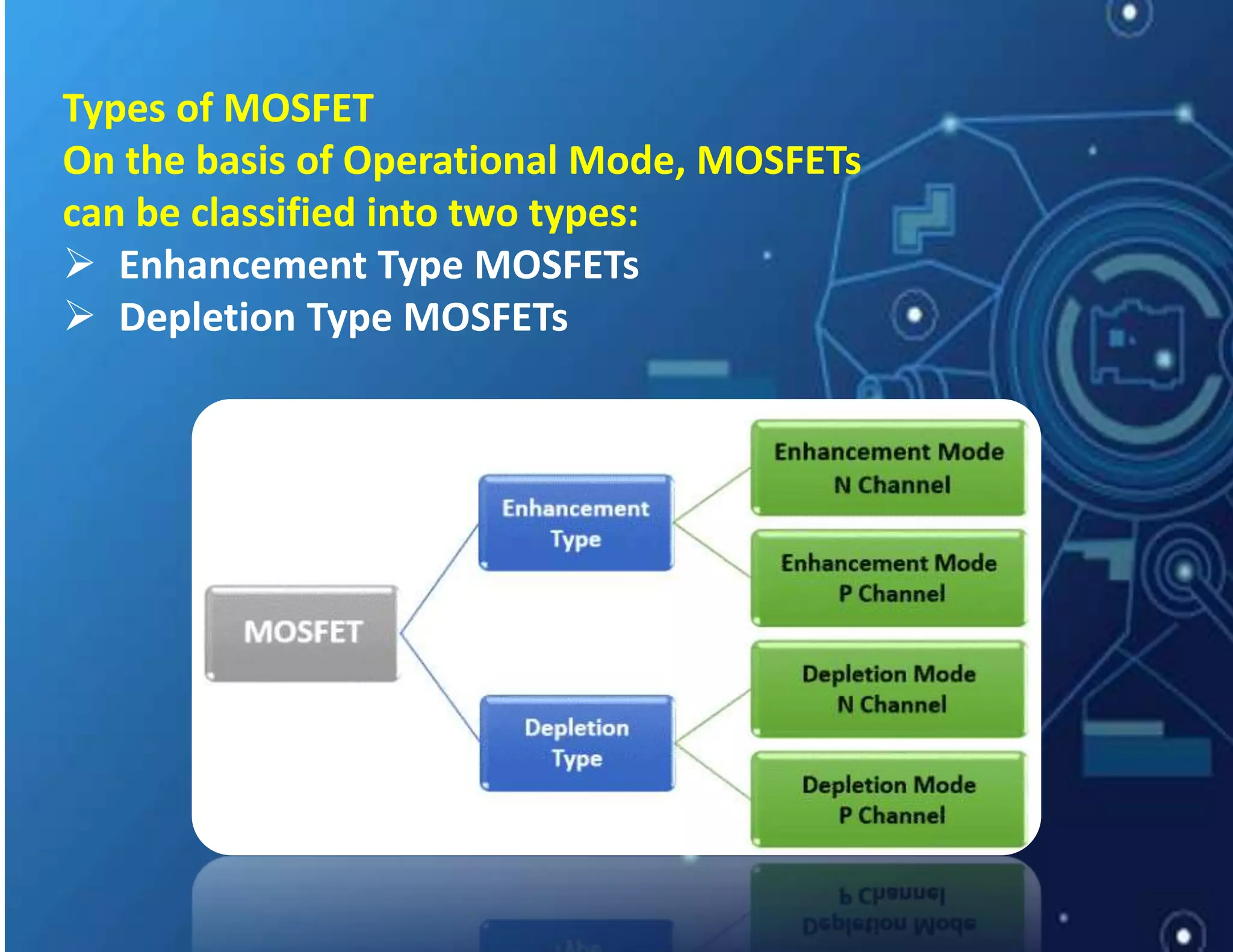
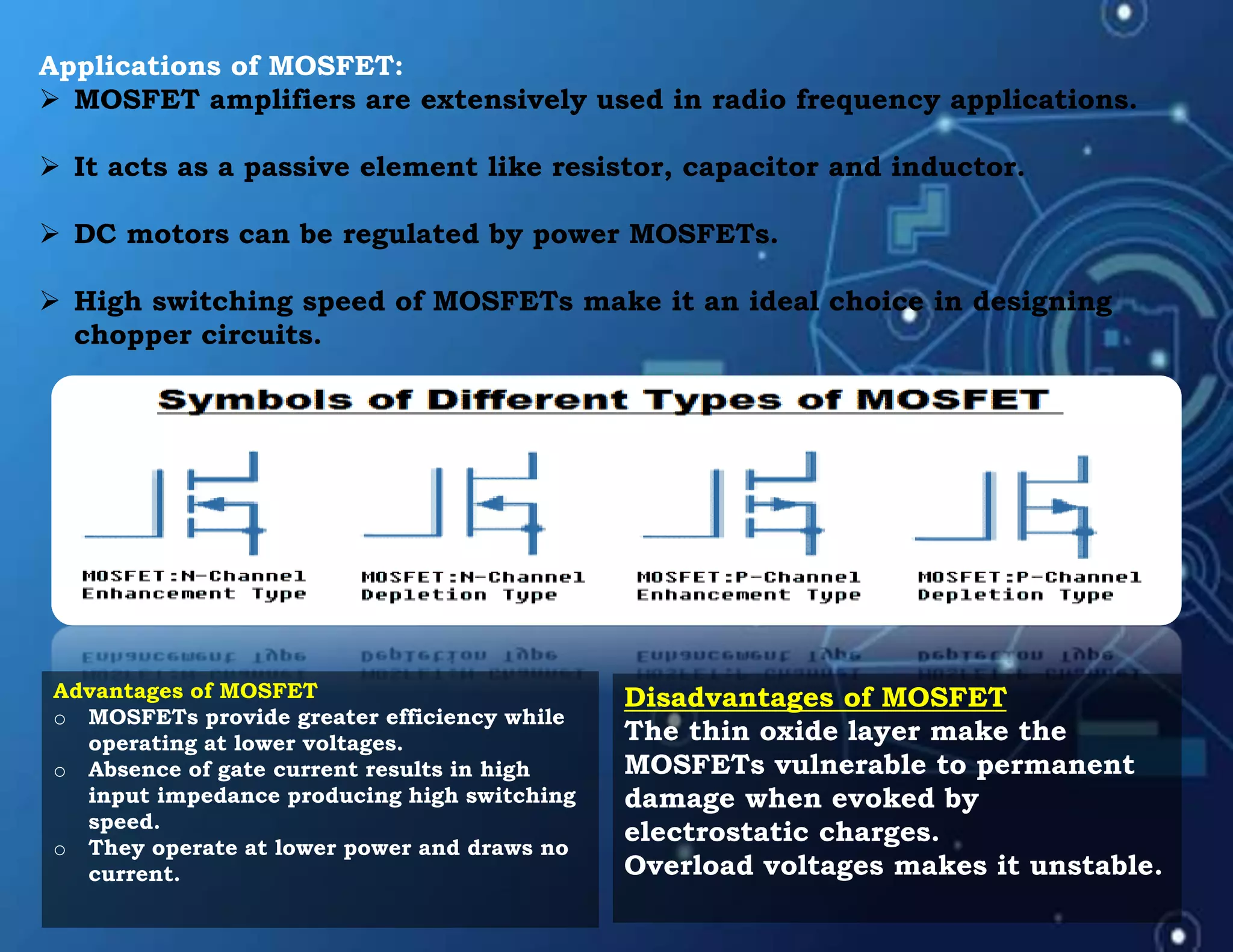
Types of MOSFET
On the basis of Operational Mode, MOSFETs
can be classified into two types:
 Enhancement Type MOSFETs
 Depletion Type MOSFETs
Enhancement Type MOSFET
In this mode, there is no conduction at zero voltage which implies it is closed or
“OFF” by default as there is no existing channel. When the gate voltage is increased
more than the source voltage, the charge carriers (holes) shifts away leaving behind
the electrons and thus a wider channel is established.
The gate voltage is directly proportional to the current i.e. as the gate voltage
increases the current increases and vice versa.
Types of Enhancement MOSFETs
The Enhancement MOSFETs can be classified into two types depending upon the
type of doped substrate (n-type or p-type) used.
N Channel Enhancement Type MOSFETs
P Channel Enhancement Type MOSFETs
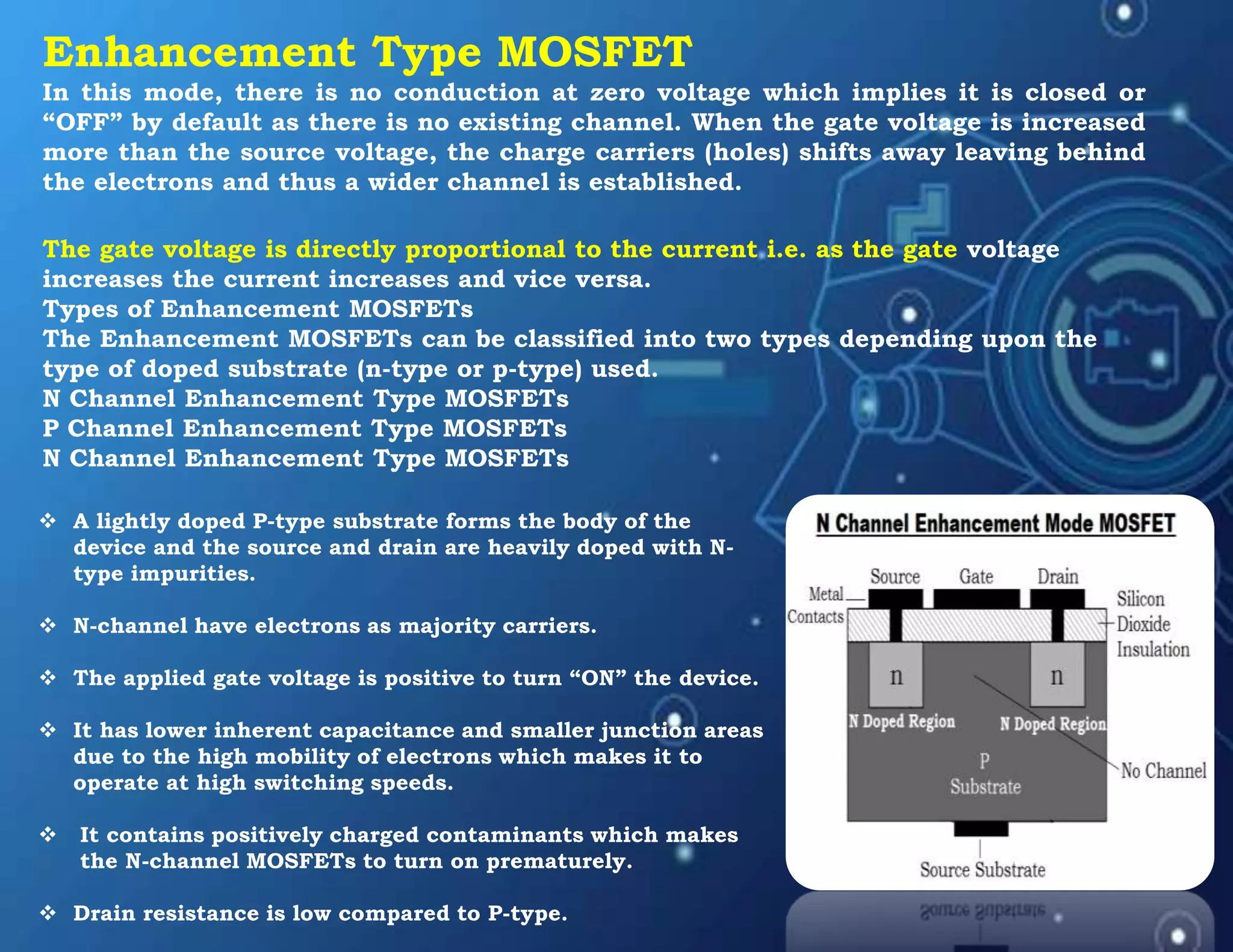
N Channel Enhancement Type MOSFETs
 A lightly doped P-type substrate forms the body of the
device and the source and drain are heavily doped with N-
type impurities.
 N-channel have electrons as majority carriers.
 The applied gate voltage is positive to turn “ON” the device.
 It has lower inherent capacitance and smaller junction areas
due to the high mobility of electrons which makes it to
operate at high switching speeds.
 It contains positively charged contaminants which makes
the N-channel MOSFETs to turn on prematurely.
 Drain resistance is low compared to P-type.
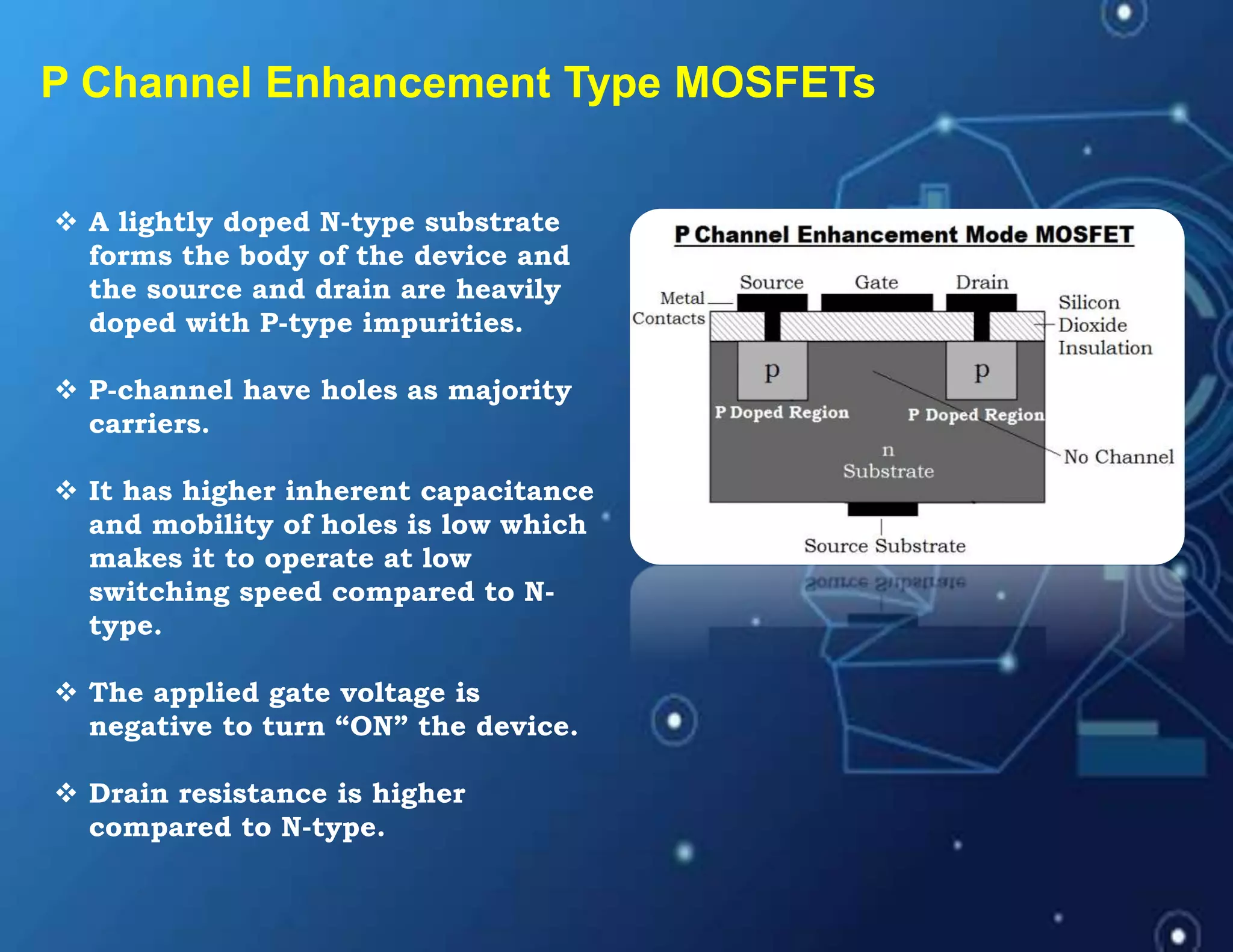
P Channel Enhancement Type MOSFETs
 A lightly doped N-type substrate
forms the body of the device and
the source and drain are heavily
doped with P-type impurities.
 P-channel have holes as majority
carriers.
 It has higher inherent capacitance
and mobility of holes is low which
makes it to operate at low
switching speed compared to N-
type.
 The applied gate voltage is
negative to turn “ON” the device.
 Drain resistance is higher
compared to N-type.
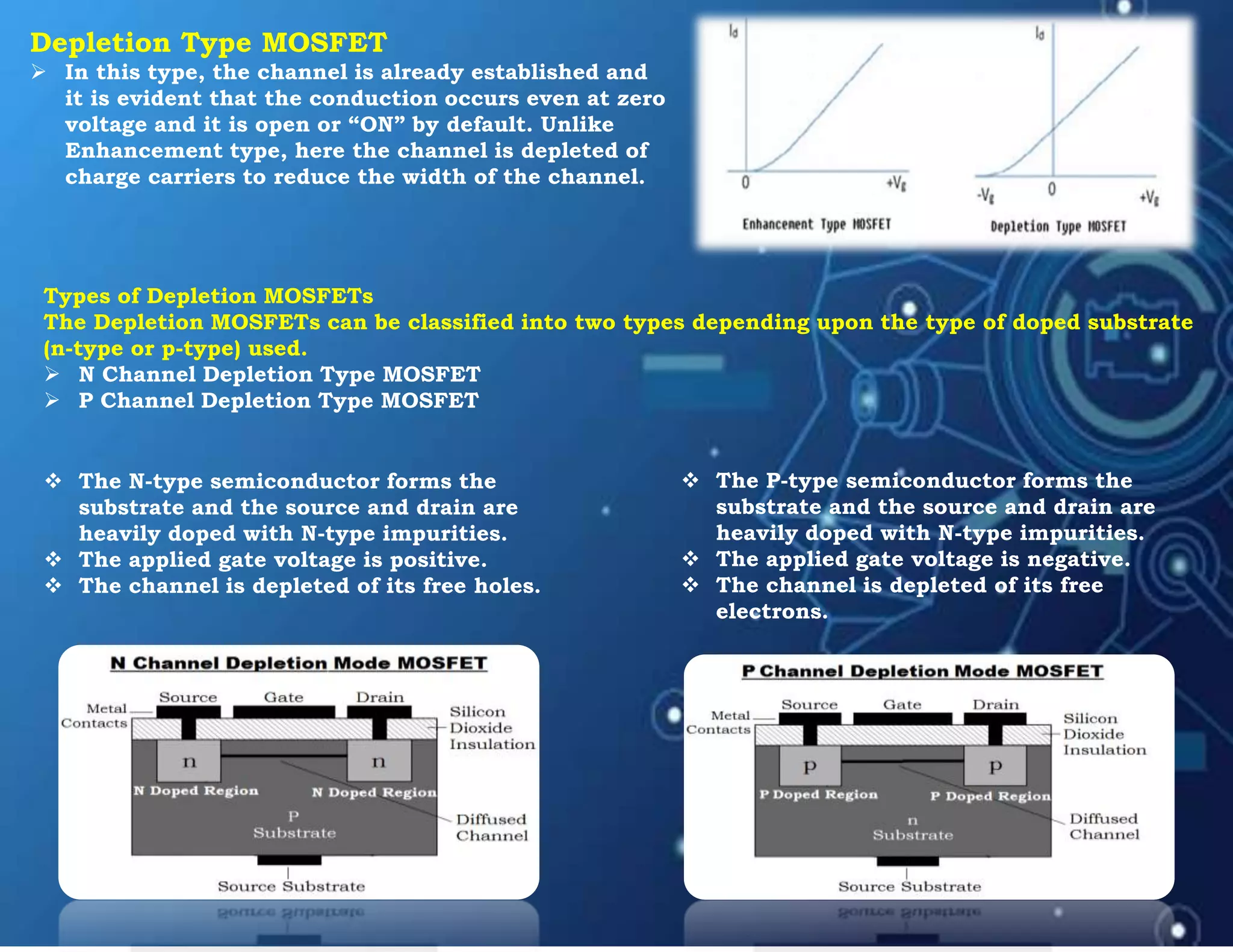
Depletion Type MOSFET
 In this type, the channel is already established and
it is evident that the conduction occurs even at zero
voltage and it is open or “ON” by default. Unlike
Enhancement type, here the channel is depleted of
charge carriers to reduce the width of the channel.
Types of Depletion MOSFETs
The Depletion MOSFETs can be classified into two types depending upon the type of doped substrate
(n-type or p-type) used.
 N Channel Depletion Type MOSFET
 P Channel Depletion Type MOSFET
 The P-type semiconductor forms the
substrate and the source and drain are
heavily doped with N-type impurities.
 The applied gate voltage is negative.
 The channel is depleted of its free
electrons.
 The N-type semiconductor forms the
substrate and the source and drain are
heavily doped with N-type impurities.
 The applied gate voltage is positive.
 The channel is depleted of its free holes.
Applications of MOSFET:
 MOSFET amplifiers are extensively used in radio frequency applications.
 It acts as a passive element like resistor, capacitor and inductor.
 DC motors can be regulated by power MOSFETs.
 High switching speed of MOSFETs make it an ideal choice in designing
chopper circuits.
Advantages of MOSFET
o MOSFETs provide greater efficiency while
operating at lower voltages.
o Absence of gate current results in high
input impedance producing high switching
speed.
o They operate at lower power and draws no
current.
Disadvantages of MOSFET
The thin oxide layer make the
MOSFETs vulnerable to permanent
damage when evoked by
electrostatic charges.
Overload voltages makes it unstable.

PRESENTATION MOSFET

  • 2.
  • 3.
    What is MOSFET? MetalOxide Silicon Field Effect Tra nsistor- is abbreviated as MOSFET. It is merely a unipolar transistor and used as an electronic switch and to amplify electronic signals. The device has three terminals consisting of a source, gate and drain. Apart from these terminals there is a substrate generally called the body which is always connected to the source terminal for practical applications. In recent years, its discovery has led to the dominant usage of these devices in digital integrated circuits due to its structure. The Silicon di-oxide (SiO2) layer acts as an insulator and provides electrical isolation between the gate and an active channel between the source and the drain which provides high input impedance which is almost infinite thus capturing all the input signal.
  • 4.
    Working Principle of MOSFET Itis fabricated by the oxidation of silicon substrates. It works by altering the width of the channel through which the movement of charge carriers (electrons for N- channel and holes for P-channel) occurs from source to drain. The gate terminal is insulated whose voltage regulates the conductivity of the device.
  • 5.
    Types of MOSFET Onthe basis of Operational Mode, MOSFETs can be classified into two types:  Enhancement Type MOSFETs  Depletion Type MOSFETs
  • 6.
    Enhancement Type MOSFET Inthis mode, there is no conduction at zero voltage which implies it is closed or “OFF” by default as there is no existing channel. When the gate voltage is increased more than the source voltage, the charge carriers (holes) shifts away leaving behind the electrons and thus a wider channel is established. The gate voltage is directly proportional to the current i.e. as the gate voltage increases the current increases and vice versa. Types of Enhancement MOSFETs The Enhancement MOSFETs can be classified into two types depending upon the type of doped substrate (n-type or p-type) used. N Channel Enhancement Type MOSFETs P Channel Enhancement Type MOSFETs N Channel Enhancement Type MOSFETs  A lightly doped P-type substrate forms the body of the device and the source and drain are heavily doped with N- type impurities.  N-channel have electrons as majority carriers.  The applied gate voltage is positive to turn “ON” the device.  It has lower inherent capacitance and smaller junction areas due to the high mobility of electrons which makes it to operate at high switching speeds.  It contains positively charged contaminants which makes the N-channel MOSFETs to turn on prematurely.  Drain resistance is low compared to P-type.
  • 7.
    P Channel EnhancementType MOSFETs  A lightly doped N-type substrate forms the body of the device and the source and drain are heavily doped with P-type impurities.  P-channel have holes as majority carriers.  It has higher inherent capacitance and mobility of holes is low which makes it to operate at low switching speed compared to N- type.  The applied gate voltage is negative to turn “ON” the device.  Drain resistance is higher compared to N-type.
  • 8.
    Depletion Type MOSFET In this type, the channel is already established and it is evident that the conduction occurs even at zero voltage and it is open or “ON” by default. Unlike Enhancement type, here the channel is depleted of charge carriers to reduce the width of the channel. Types of Depletion MOSFETs The Depletion MOSFETs can be classified into two types depending upon the type of doped substrate (n-type or p-type) used.  N Channel Depletion Type MOSFET  P Channel Depletion Type MOSFET  The P-type semiconductor forms the substrate and the source and drain are heavily doped with N-type impurities.  The applied gate voltage is negative.  The channel is depleted of its free electrons.  The N-type semiconductor forms the substrate and the source and drain are heavily doped with N-type impurities.  The applied gate voltage is positive.  The channel is depleted of its free holes.
  • 9.
    Applications of MOSFET: MOSFET amplifiers are extensively used in radio frequency applications.  It acts as a passive element like resistor, capacitor and inductor.  DC motors can be regulated by power MOSFETs.  High switching speed of MOSFETs make it an ideal choice in designing chopper circuits. Advantages of MOSFET o MOSFETs provide greater efficiency while operating at lower voltages. o Absence of gate current results in high input impedance producing high switching speed. o They operate at lower power and draws no current. Disadvantages of MOSFET The thin oxide layer make the MOSFETs vulnerable to permanent damage when evoked by electrostatic charges. Overload voltages makes it unstable.