IP ADDRASS AND
CLASSES
By : Yassen Hadhoud
AGENDA
What is IP Address?
IP structure
IP Classes
Examples
2
WHAT IS IP
ADDRESS?
WHAT IS IP ADDRESS?
• An Internet Protocol (IP) address is the unique identifying number
assigned to every device connected to the internet.
• An IP address is an address used in order to uniquely identify a
device on an IP network.
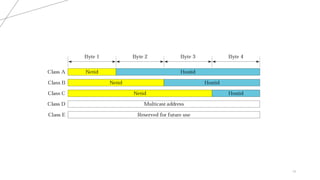
• The address is made up of 32 binary bits, which can be divisible into
a network portion and host portion with the help of a subnet mask.
• The 32 binary bits are broken into four octets (1 octet = 8 bits).
• Each octet is converted to decimal and separated by a period (dot).
• or this reason, an IP address is said to be expressed in dotted
decimal format (for example, 172.16.81.100). The value in each octet
ranges from 0 to 255 decimal, or 00000000 - 11111111 binary.
4
5
The IP addresses are unique.
An IP address is a 32-bit address.
The address space of IPv4 is
232
or 4,294,967,296.
Note:
IP STRUCTURE
IP STRUCTURE
 IP addresses consist of four sections
 Each section is 8 bits long
 Each section can range from 0 to 255
 Written, for example, 128.35.0.72
7
IP CLASSES
CLASS A
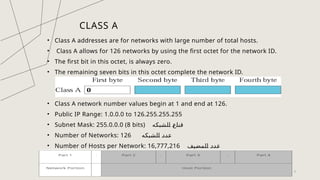
• Class A addresses are for networks with large number of total hosts.
• Class A allows for 126 networks by using the first octet for the network ID.
• The first bit in this octet, is always zero.
• The remaining seven bits in this octet complete the network ID.
• Class A network number values begin at 1 and end at 126.
• Public IP Range: 1.0.0.0 to 126.255.255.255
• Subnet Mask: 255.0.0.0 (8 bits) ‫الشبكه‬ ‫قناع‬
• Number of Networks: 126 ‫الشبكه‬ ‫عدد‬
• Number of Hosts per Network: 16,777,216 ‫المضيف‬ ‫عدد‬
9
CLASS A
• 127.0.0.0 to 127.255.255.255 >>>>>>> Loopback Address
• Used with Troubleshooting – ‫الخاصه‬ ‫األغراض‬
•
‫وكارت‬ ‫بتاعي‬ ‫الجهاز‬ ‫ان‬ ‫اختبر‬ ‫عاوز‬ ‫لو‬ ‫مثال‬
lan
‫مشكله‬ ‫مفهومش‬ ‫بالنت‬ ‫متصلين‬
10
CLASS B
• Class B addresses are for medium to large sized networks.
• The first two bits in the first octet are always 1 0
• Public IP Range: 128.0.0.0 to 191.255.255.255
• First octet value range from 128 to 191
• Subnet Mask: 255.255.0.0 (16 bits) ‫الشبكه‬ ‫قناع‬
11
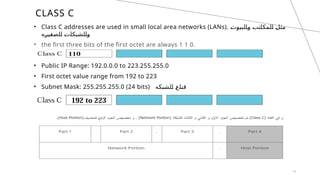
CLASS C
• Class C addresses are used in small local area networks (LANs).
• the first three bits of the first octet are always 1 1 0.
• Public IP Range: 192.0.0.0 to 223.255.255.0
• First octet value range from 192 to 223
• Subnet Mask: 255.255.255.0 (24 bits) ‫الشبكه‬ ‫قناع‬
12
CLASS C
• Class C addresses are used in small local area networks (LANs). ‫والبيوت‬ ‫المكاتب‬ ‫مثل‬
‫الصغيره‬ ‫والشبكات‬
• the first three bits of the first octet are always 1 1 0.
• Public IP Range: 192.0.0.0 to 223.255.255.0
• First octet value range from 192 to 223
• Subnet Mask: 255.255.255.0 (24 bits) ‫الشبكه‬ ‫قناع‬
13
CLASS D
• Class D IP addresses are not allocated to hosts and are used for multicasting.
• Multicasting allows a single host to send a single stream of data to thousands of
hosts across the Internet at the same time.
• Range: 224.0.0.0 to 239.255.255.255
• First octet value range from 224 to 239
14
CLASS E
• Class E IP addresses are not allocated to hosts and are not available for general
use. These are reserved for research purposes.
• Range: 240.0.0.0 to 255.255.255.255
• First octet value range from 240 to 255
15
EXAMPLE :
16
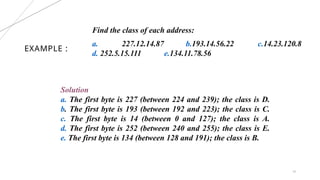
Find the class of each address:
a. 227.12.14.87 b.193.14.56.22 c.14.23.120.8
d. 252.5.15.111 e.134.11.78.56
Solution
a. The first byte is 227 (between 224 and 239); the class is D.
b. The first byte is 193 (between 192 and 223); the class is C.
c. The first byte is 14 (between 0 and 127); the class is A.
d. The first byte is 252 (between 240 and 255); the class is E.
e. The first byte is 134 (between 128 and 191); the class is B.
EXAMPLE :
17
Find the class of each address:
a. 00000001 00001011 00001011 11101111
b. 11000001 10000011 00011011 11111111
c. 10100111 11011011 10001011 01101111
d. 11110011 10011011 11111011 00001111
Solution
a. The first bit is 0. This is a class A address.
b. The first 2 bits are 1; the third bit is 0. This is a class C address.
c. The first bit is 0; the second bit is 1. This is a class B address.
d. The first 4 bits are 1s. This is a class E address..
18
19
20
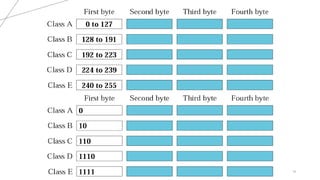
• Class A addresses begin with 0xxx, or 1 to 126 decimal.
• Class B addresses begin with 10xx, or 128 to 191 decimal.
• Class C addresses begin with 110x, or 192 to 223 decimal.
• Class D addresses begin with 1110, or 224 to 239 decimal.
• Class E addresses begin with 1111, or 240 to 254 decimal.
THANK YOU
Yassen Mohamed Hadhoud
21

IP Addrass and classes Network and security.pptx

  • 1.
    IP ADDRASS AND CLASSES By: Yassen Hadhoud
  • 2.
    AGENDA What is IPAddress? IP structure IP Classes Examples 2
  • 3.
  • 4.
    WHAT IS IPADDRESS? • An Internet Protocol (IP) address is the unique identifying number assigned to every device connected to the internet. • An IP address is an address used in order to uniquely identify a device on an IP network. • The address is made up of 32 binary bits, which can be divisible into a network portion and host portion with the help of a subnet mask. • The 32 binary bits are broken into four octets (1 octet = 8 bits). • Each octet is converted to decimal and separated by a period (dot). • or this reason, an IP address is said to be expressed in dotted decimal format (for example, 172.16.81.100). The value in each octet ranges from 0 to 255 decimal, or 00000000 - 11111111 binary. 4
  • 5.
    5 The IP addressesare unique. An IP address is a 32-bit address. The address space of IPv4 is 232 or 4,294,967,296. Note:
  • 6.
  • 7.
    IP STRUCTURE  IPaddresses consist of four sections  Each section is 8 bits long  Each section can range from 0 to 255  Written, for example, 128.35.0.72 7
  • 8.
  • 9.
    CLASS A • ClassA addresses are for networks with large number of total hosts. • Class A allows for 126 networks by using the first octet for the network ID. • The first bit in this octet, is always zero. • The remaining seven bits in this octet complete the network ID. • Class A network number values begin at 1 and end at 126. • Public IP Range: 1.0.0.0 to 126.255.255.255 • Subnet Mask: 255.0.0.0 (8 bits) ‫الشبكه‬ ‫قناع‬ • Number of Networks: 126 ‫الشبكه‬ ‫عدد‬ • Number of Hosts per Network: 16,777,216 ‫المضيف‬ ‫عدد‬ 9
  • 10.
    CLASS A • 127.0.0.0to 127.255.255.255 >>>>>>> Loopback Address • Used with Troubleshooting – ‫الخاصه‬ ‫األغراض‬ • ‫وكارت‬ ‫بتاعي‬ ‫الجهاز‬ ‫ان‬ ‫اختبر‬ ‫عاوز‬ ‫لو‬ ‫مثال‬ lan ‫مشكله‬ ‫مفهومش‬ ‫بالنت‬ ‫متصلين‬ 10
  • 11.
    CLASS B • ClassB addresses are for medium to large sized networks. • The first two bits in the first octet are always 1 0 • Public IP Range: 128.0.0.0 to 191.255.255.255 • First octet value range from 128 to 191 • Subnet Mask: 255.255.0.0 (16 bits) ‫الشبكه‬ ‫قناع‬ 11
  • 12.
    CLASS C • ClassC addresses are used in small local area networks (LANs). • the first three bits of the first octet are always 1 1 0. • Public IP Range: 192.0.0.0 to 223.255.255.0 • First octet value range from 192 to 223 • Subnet Mask: 255.255.255.0 (24 bits) ‫الشبكه‬ ‫قناع‬ 12
  • 13.
    CLASS C • ClassC addresses are used in small local area networks (LANs). ‫والبيوت‬ ‫المكاتب‬ ‫مثل‬ ‫الصغيره‬ ‫والشبكات‬ • the first three bits of the first octet are always 1 1 0. • Public IP Range: 192.0.0.0 to 223.255.255.0 • First octet value range from 192 to 223 • Subnet Mask: 255.255.255.0 (24 bits) ‫الشبكه‬ ‫قناع‬ 13
  • 14.
    CLASS D • ClassD IP addresses are not allocated to hosts and are used for multicasting. • Multicasting allows a single host to send a single stream of data to thousands of hosts across the Internet at the same time. • Range: 224.0.0.0 to 239.255.255.255 • First octet value range from 224 to 239 14
  • 15.
    CLASS E • ClassE IP addresses are not allocated to hosts and are not available for general use. These are reserved for research purposes. • Range: 240.0.0.0 to 255.255.255.255 • First octet value range from 240 to 255 15
  • 16.
    EXAMPLE : 16 Find theclass of each address: a. 227.12.14.87 b.193.14.56.22 c.14.23.120.8 d. 252.5.15.111 e.134.11.78.56 Solution a. The first byte is 227 (between 224 and 239); the class is D. b. The first byte is 193 (between 192 and 223); the class is C. c. The first byte is 14 (between 0 and 127); the class is A. d. The first byte is 252 (between 240 and 255); the class is E. e. The first byte is 134 (between 128 and 191); the class is B.
  • 17.
    EXAMPLE : 17 Find theclass of each address: a. 00000001 00001011 00001011 11101111 b. 11000001 10000011 00011011 11111111 c. 10100111 11011011 10001011 01101111 d. 11110011 10011011 11111011 00001111 Solution a. The first bit is 0. This is a class A address. b. The first 2 bits are 1; the third bit is 0. This is a class C address. c. The first bit is 0; the second bit is 1. This is a class B address. d. The first 4 bits are 1s. This is a class E address..
  • 18.
  • 19.
  • 20.
    20 • Class Aaddresses begin with 0xxx, or 1 to 126 decimal. • Class B addresses begin with 10xx, or 128 to 191 decimal. • Class C addresses begin with 110x, or 192 to 223 decimal. • Class D addresses begin with 1110, or 224 to 239 decimal. • Class E addresses begin with 1111, or 240 to 254 decimal.
  • 21.