Distributed Learningin British Columbia
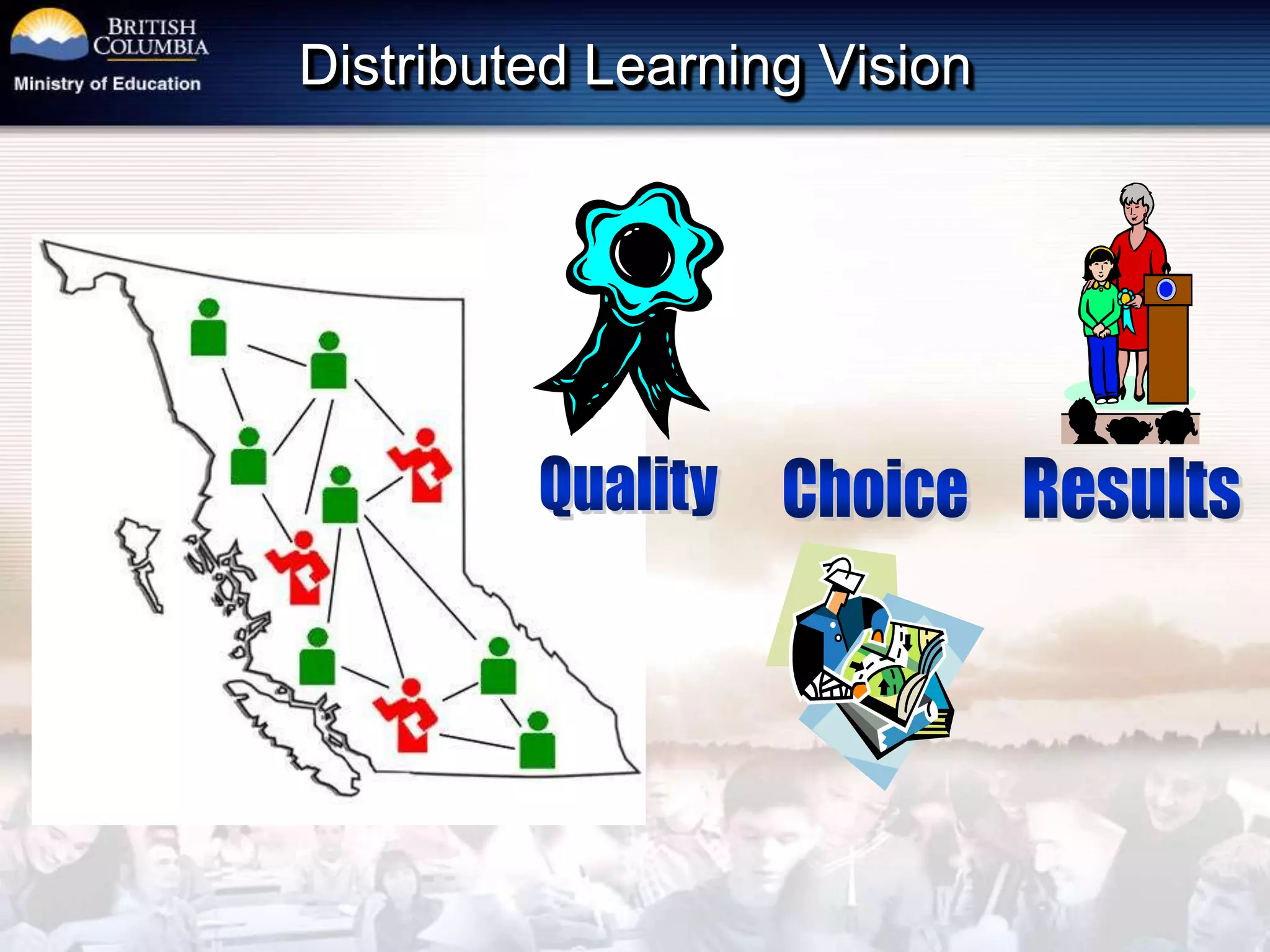
Distributed Learning VisionResultsChoiceQuality
Framework for Our ModelLegislation and policy Equitable funding modelAccountability: AuditsEvidence of student achievement: DataStudent services and coordination: LearnNow BC
Characteristics of Our ModelDL = student learning at a distance from teacherAny student can access DLAny student can enrol anytime throughout the yearChoice to take courses from anywhere: even more than one school/board/authority
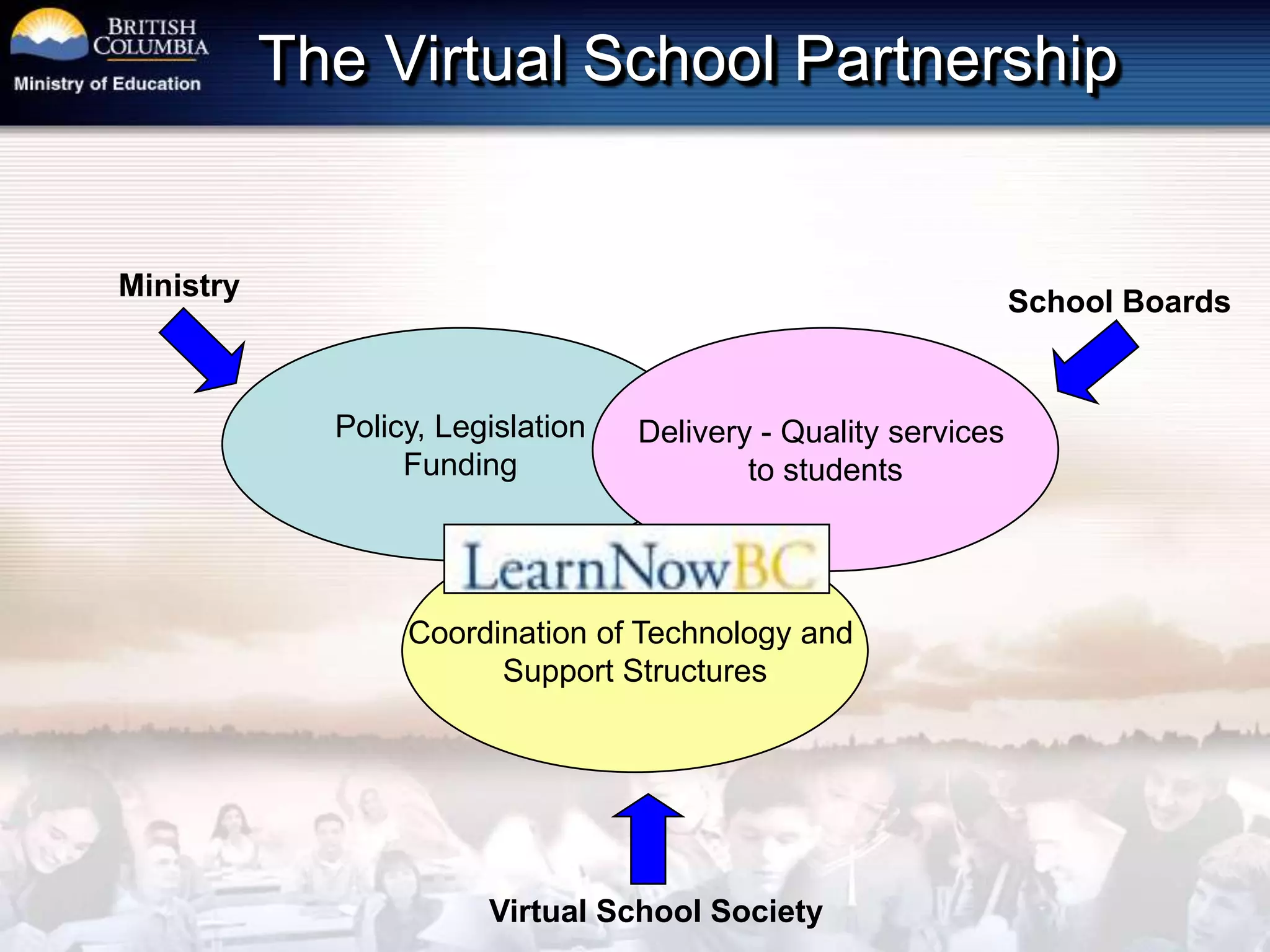
The Virtual School PartnershipMinistrySchool BoardsPolicy, LegislationFundingDelivery - Quality services to studentsCoordination of Technology and Support StructuresVirtual School Society
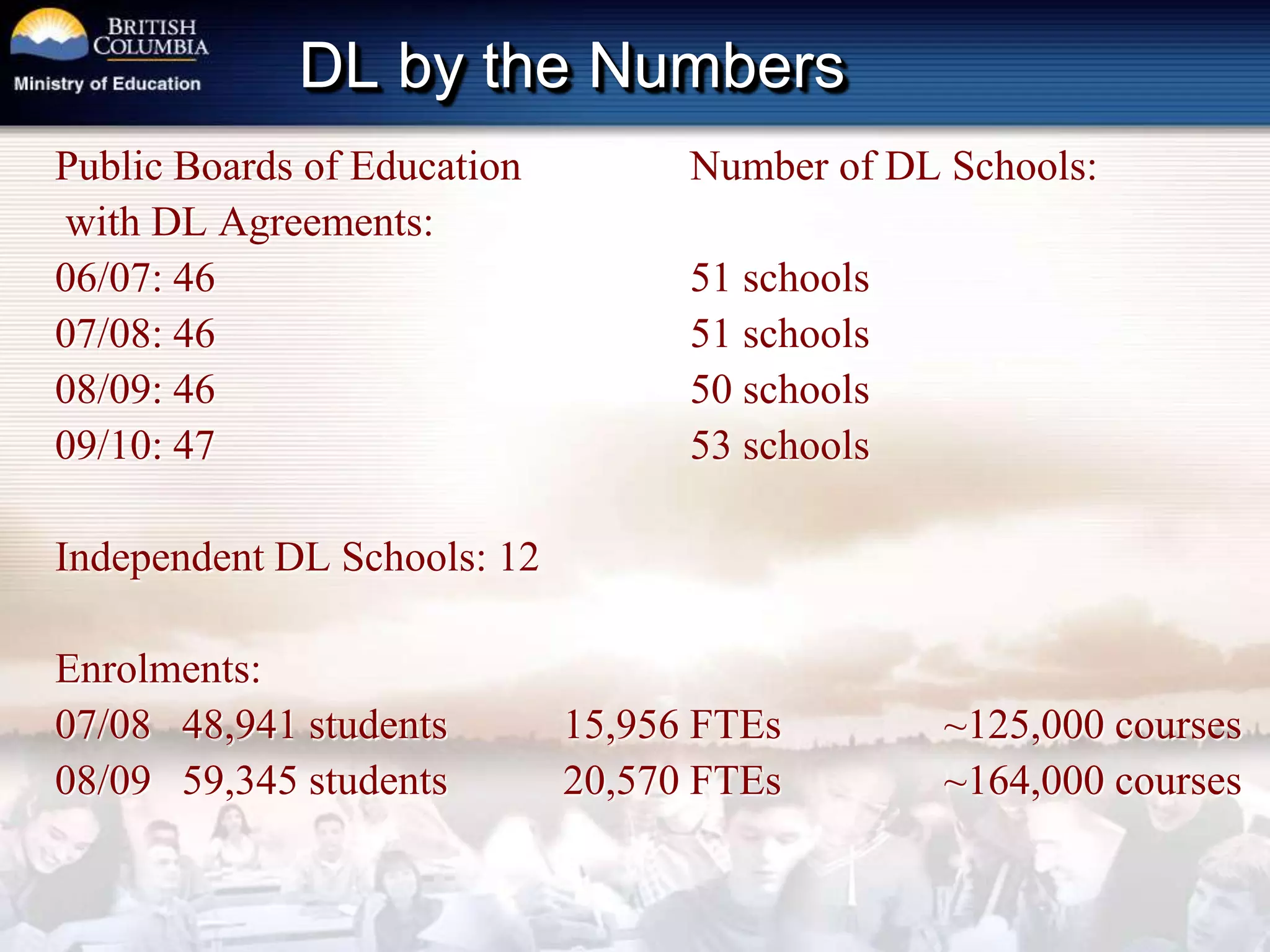
DL by the NumbersPublic Boards of Education		Number of DL Schools:with DL Agreements:06/07: 46 				51 schools07/08: 46 				51 schools08/09: 46 				50 schools09/10: 47 				53 schoolsIndependent DL Schools: 12Enrolments:07/08	48,941 students	15,956 FTEs		~125,000 courses08/09	59,345 students	20,570 FTEs		~164,000 courses
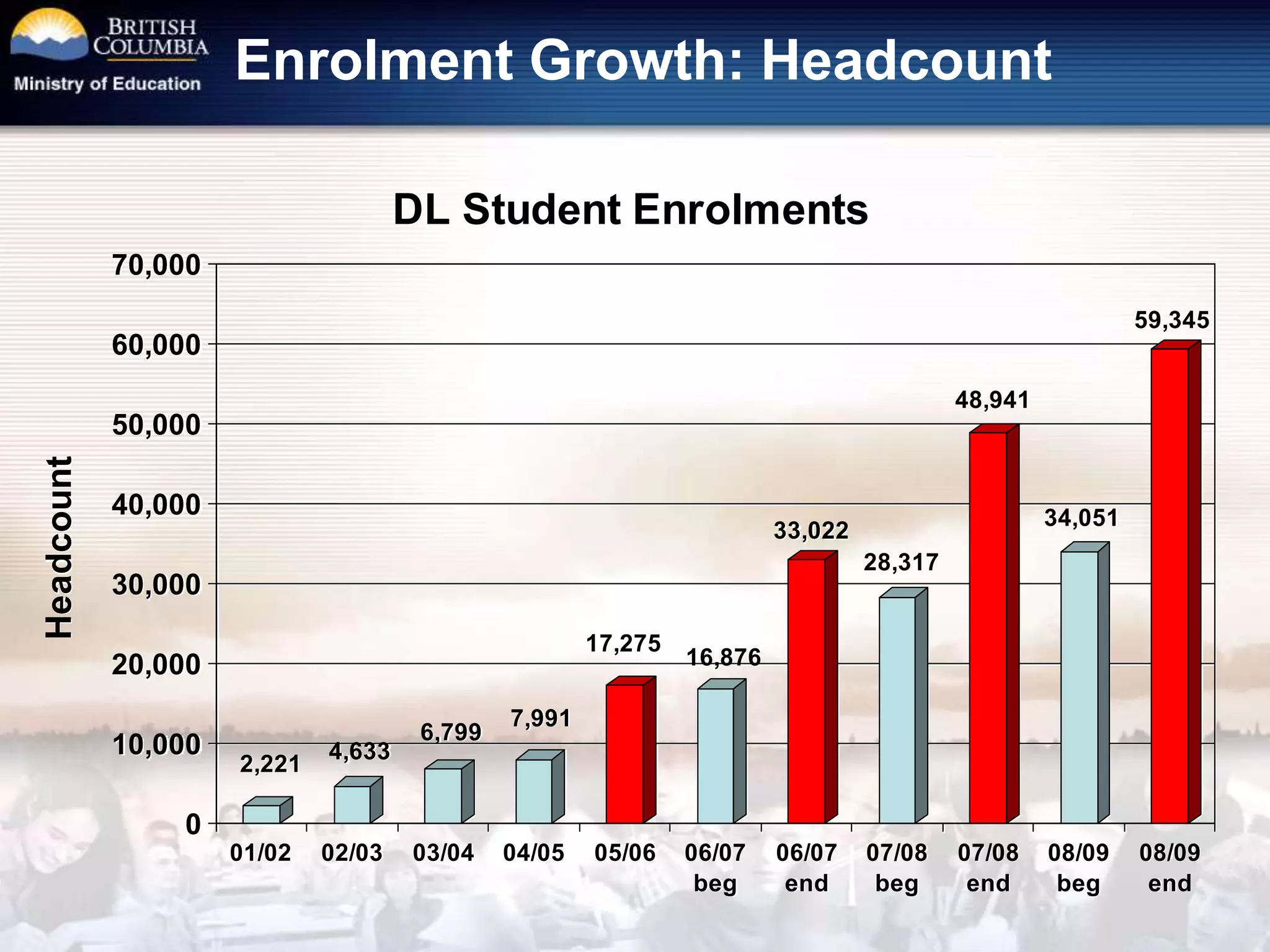
Enrolment Growth: Headcount
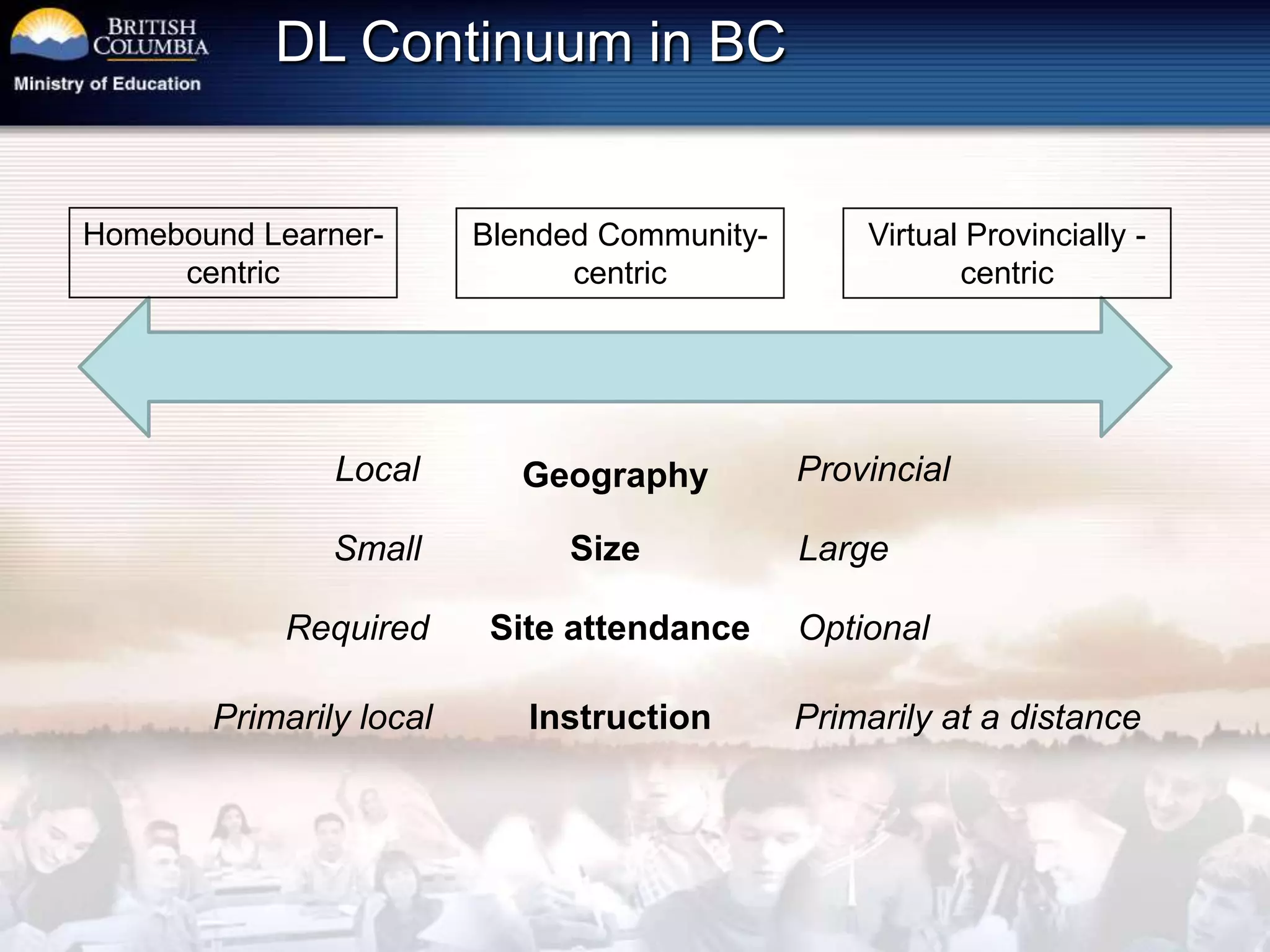
DL Continuum in BCHomebound Learner-centricBlended Community-centricVirtual Provincially -centricProvincialLocalGeographySizeSmallLargeSite attendanceRequiredOptionalPrimarily localPrimarily at a distanceInstruction
Legislation
2006 Legislation, Bill 33Recognizes DL in legislation
Only one enrolling school for K-9
Allows cross-enrolment in Grades 10-12
Each Board requires a DL Agreement with the Ministry
DL exempt from class size limitsDL Agreement5 years, renewable by MinistryCommitment to quality and standardsTransparent investmentStaffing and training for teachersCommitment to stop payments/reimbursements to parentsRegular student data submissionsParticipation in satisfaction surveys, FSAsSupport for LearnNow BC
Funding
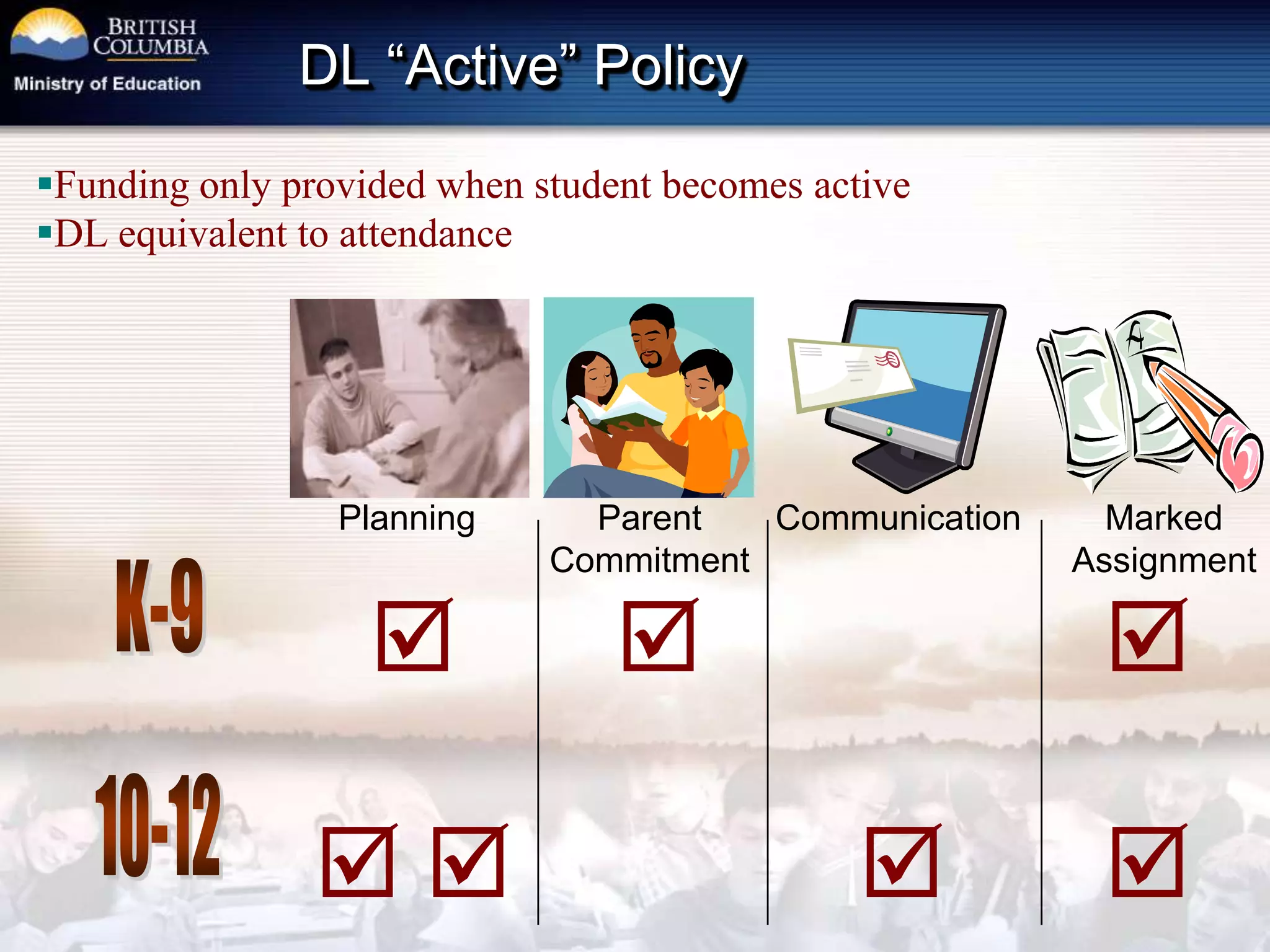
DL “Active” PolicyFunding only provided when student becomes active
DL equivalent to attendancePlanningParentCommitmentCommunicationMarkedAssignmentK-910-12
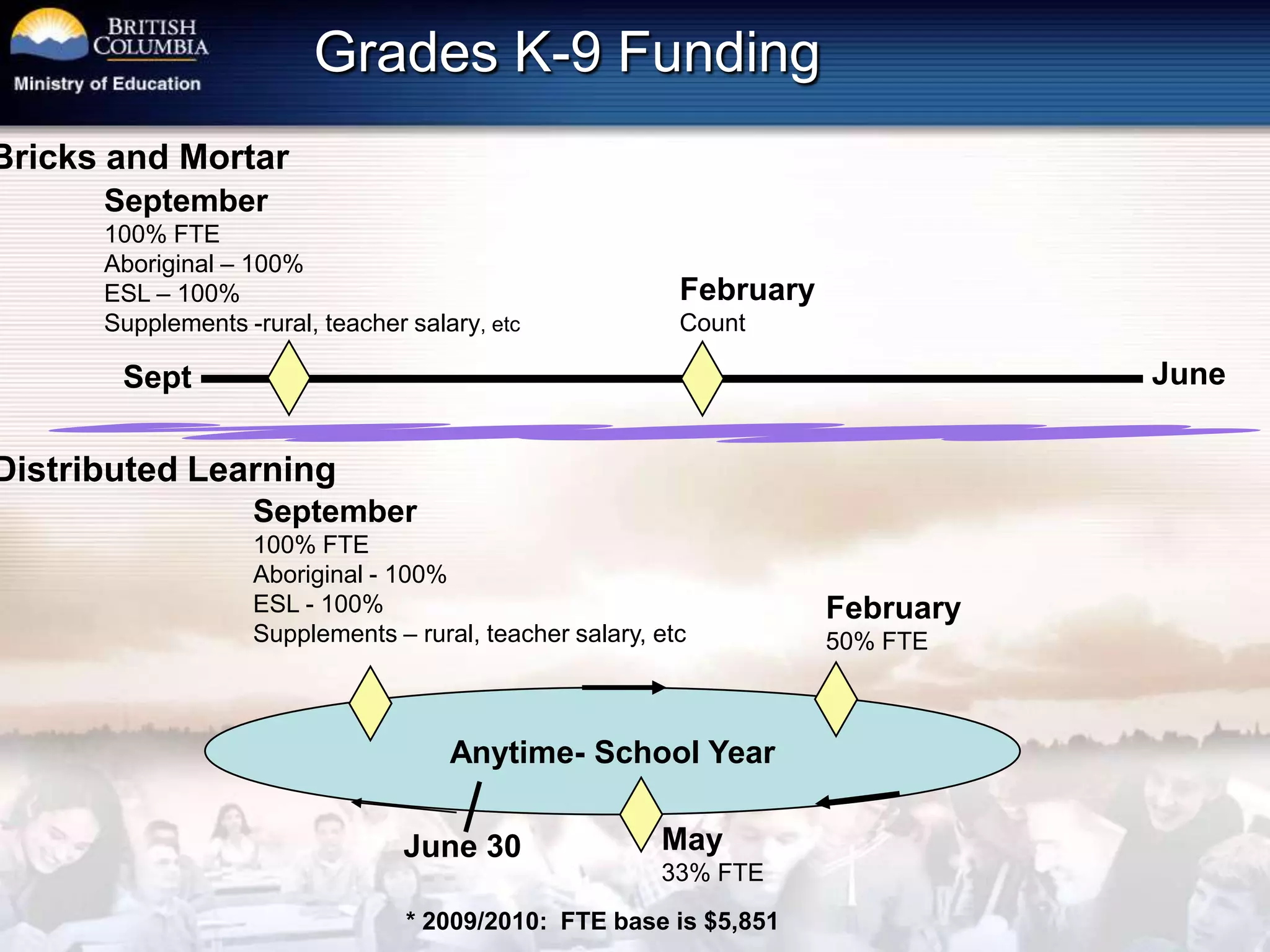
Grades K-9 FundingBricks and MortarSeptember100% FTE Aboriginal – 100%ESL – 100%Supplements -rural, teacher salary, etcFebruary Count JuneSeptDistributed LearningSeptember100% FTEAboriginal - 100%ESL - 100%Supplements – rural, teacher salary, etcFebruary50% FTEAnytime- School YearMay33% FTEJune 30* 2009/2010:  FTE base is $5,851
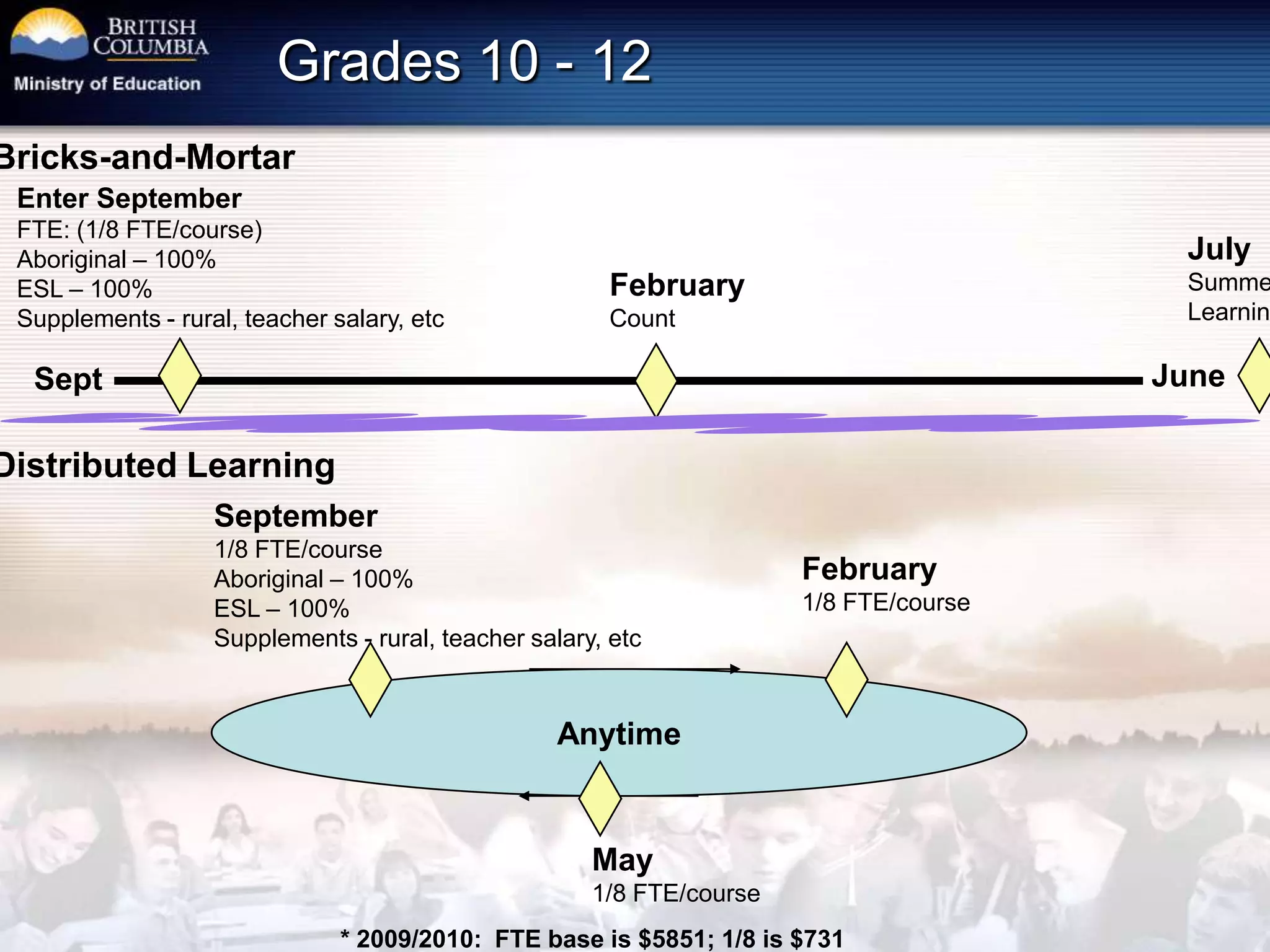
Grades 10 - 12Bricks-and-MortarEnter SeptemberFTE: (1/8 FTE/course)Aboriginal – 100%ESL – 100%Supplements - rural, teacher salary, etcJulySummerLearningFebruaryCountJuneSeptDistributed LearningSeptember1/8 FTE/courseAboriginal – 100%ESL – 100%Supplements - rural, teacher salary, etcFebruary1/8 FTE/courseAnytimeMay1/8 FTE/course* 2009/2010:  FTE base is $5851; 1/8 is $731
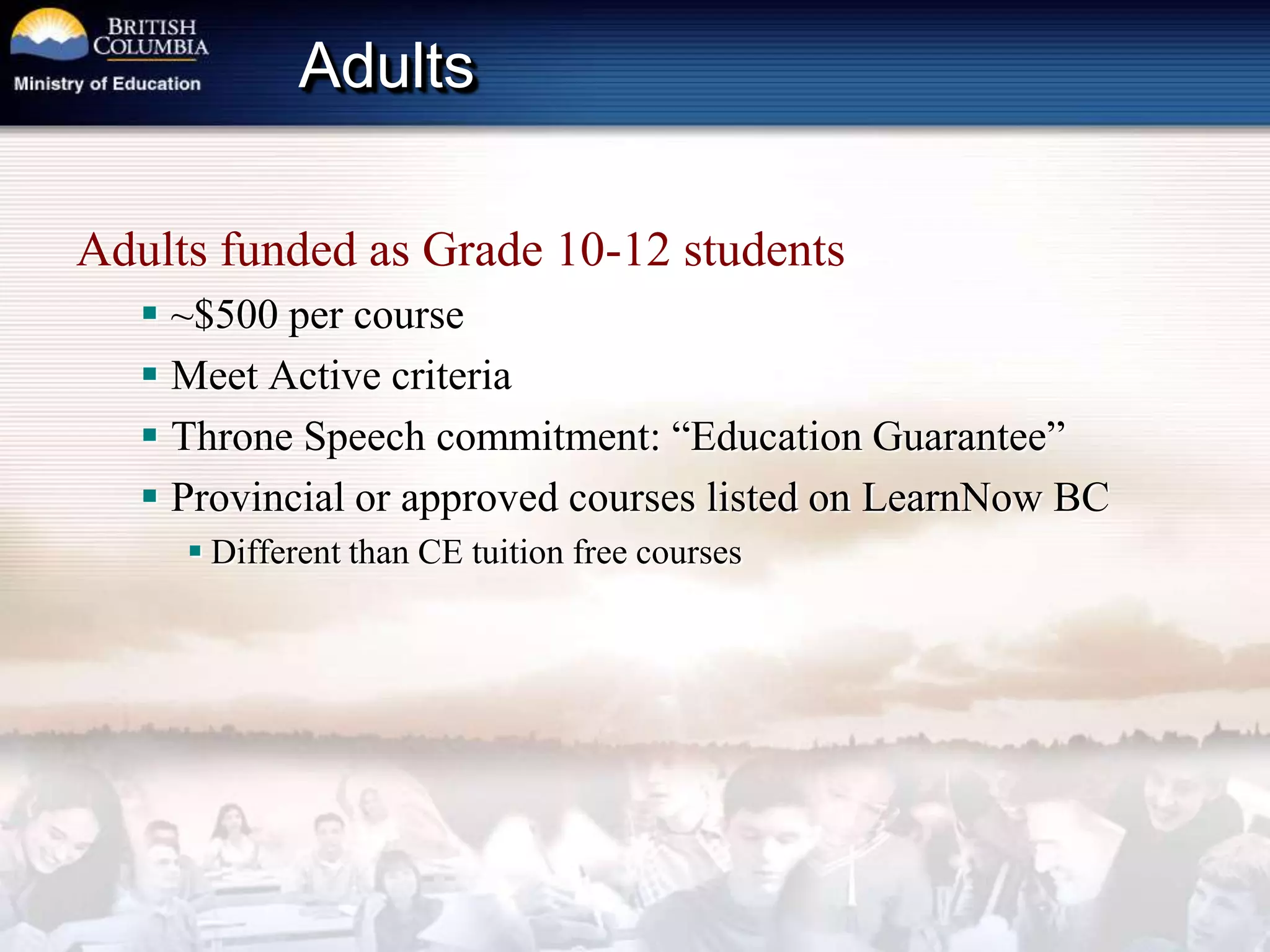
AdultsAdults funded as Grade 10-12 students~$500 per courseMeet Active criteriaThrone Speech commitment: “Education Guarantee”Provincial or approved courses listed on LearnNow BCDifferent than CE tuition free courses
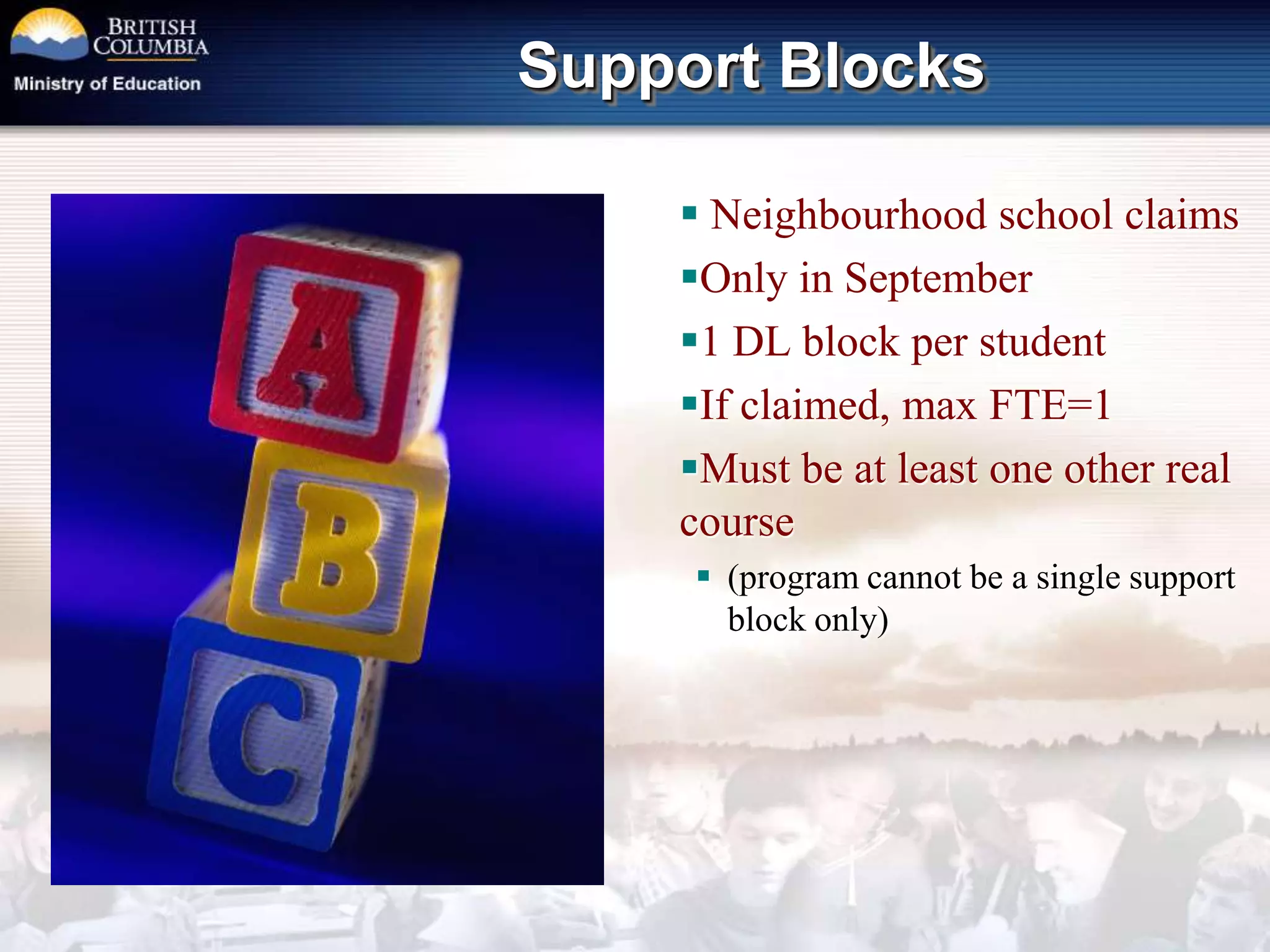
Support Blocks Neighbourhood school claims
Only in September
1 DL block per student
If claimed, max FTE=1
Must be at least one other real course (program cannot be a single support block only)
Standards
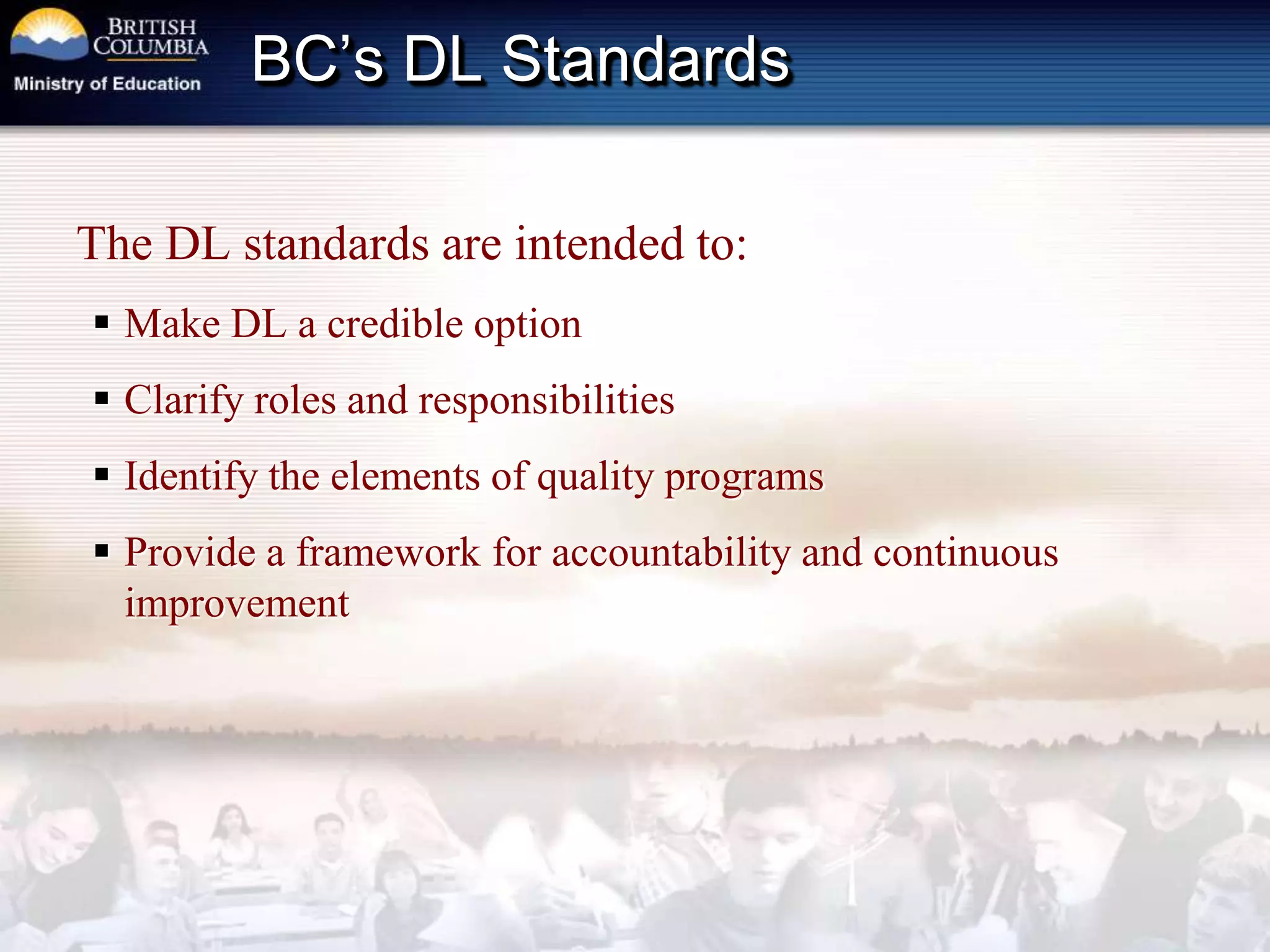
BC’s DL StandardsThe DL standards are intended to:Make DL a credible optionClarify roles and responsibilitiesIdentify the elements of quality programsProvide a framework for accountability and continuous improvement
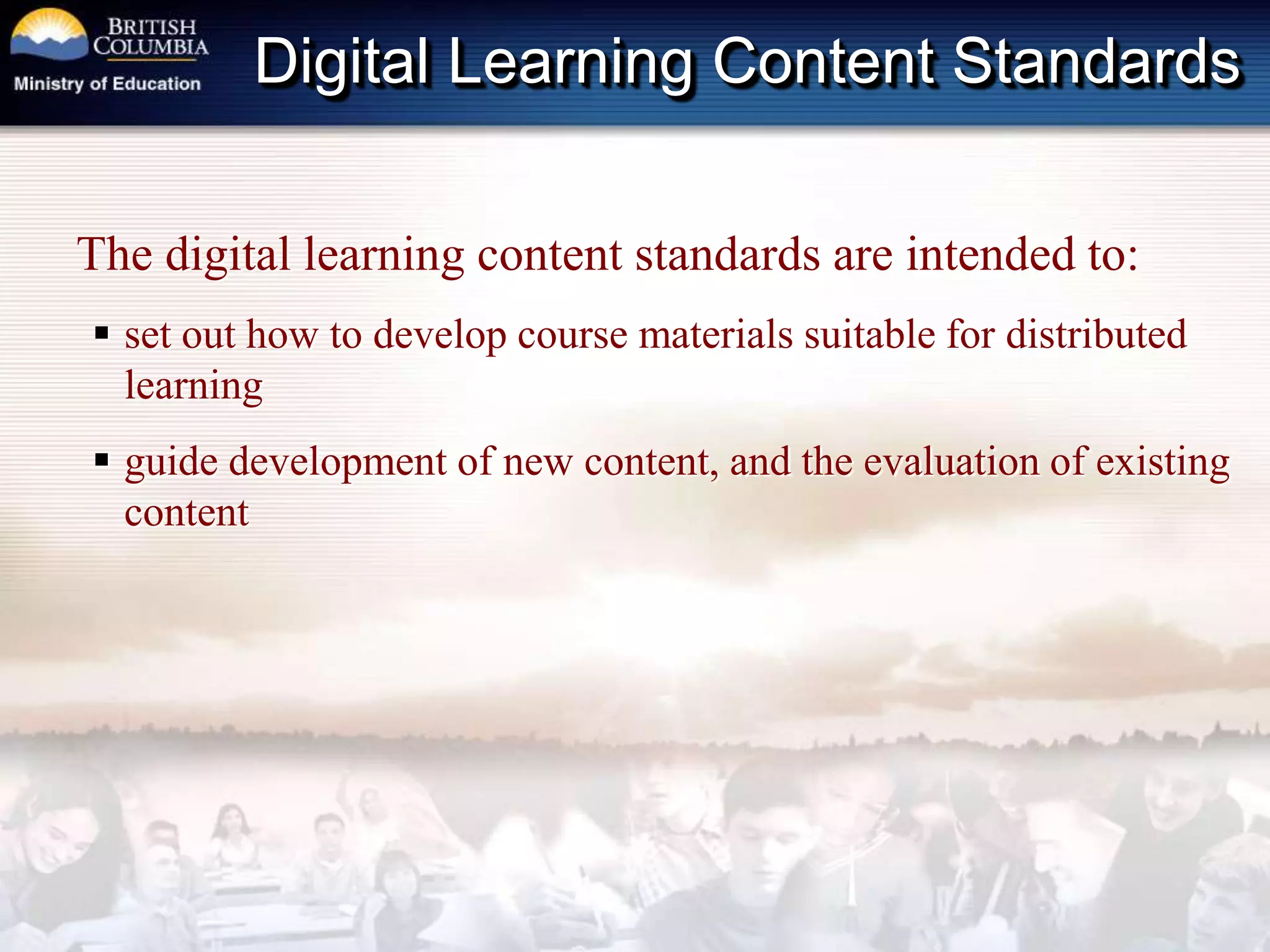
Digital Learning Content StandardsThe digital learning content standards are intended to: set out how to develop course materials suitable for distributed learningguide development of new content, and the evaluation of existing content
QualityCompliance and Quality Reviews
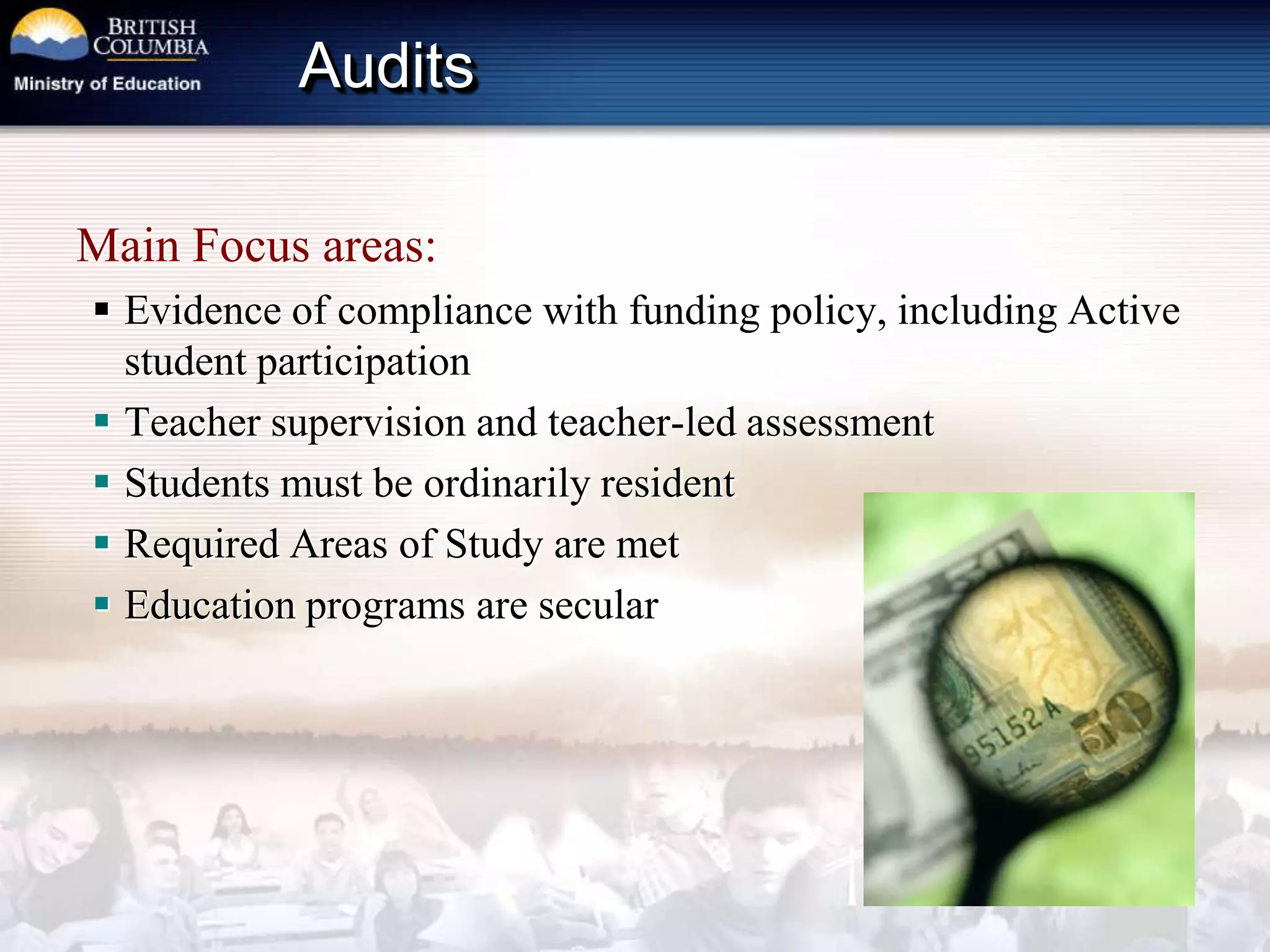
AuditsMain Focus areas:Evidence of compliance with funding policy, including Active student participationTeacher supervision and teacher-led assessmentStudents must be ordinarily residentRequired Areas of Study are metEducation programs are secular
DL Quality ReviewSeparate process from audits

Presentation for TDEA 09

  • 1.
  • 2.
  • 3.
    Framework for OurModelLegislation and policy Equitable funding modelAccountability: AuditsEvidence of student achievement: DataStudent services and coordination: LearnNow BC
  • 4.
    Characteristics of OurModelDL = student learning at a distance from teacherAny student can access DLAny student can enrol anytime throughout the yearChoice to take courses from anywhere: even more than one school/board/authority
  • 5.
    The Virtual SchoolPartnershipMinistrySchool BoardsPolicy, LegislationFundingDelivery - Quality services to studentsCoordination of Technology and Support StructuresVirtual School Society
  • 6.
    DL by theNumbersPublic Boards of Education Number of DL Schools:with DL Agreements:06/07: 46 51 schools07/08: 46 51 schools08/09: 46 50 schools09/10: 47 53 schoolsIndependent DL Schools: 12Enrolments:07/08 48,941 students 15,956 FTEs ~125,000 courses08/09 59,345 students 20,570 FTEs ~164,000 courses
  • 7.
  • 8.
    DL Continuum inBCHomebound Learner-centricBlended Community-centricVirtual Provincially -centricProvincialLocalGeographySizeSmallLargeSite attendanceRequiredOptionalPrimarily localPrimarily at a distanceInstruction
  • 9.
  • 10.
    2006 Legislation, Bill33Recognizes DL in legislation
  • 11.
    Only one enrollingschool for K-9
  • 12.
  • 13.
    Each Board requiresa DL Agreement with the Ministry
  • 14.
    DL exempt fromclass size limitsDL Agreement5 years, renewable by MinistryCommitment to quality and standardsTransparent investmentStaffing and training for teachersCommitment to stop payments/reimbursements to parentsRegular student data submissionsParticipation in satisfaction surveys, FSAsSupport for LearnNow BC
  • 15.
  • 16.
    DL “Active” PolicyFundingonly provided when student becomes active
  • 17.
    DL equivalent toattendancePlanningParentCommitmentCommunicationMarkedAssignmentK-910-12
  • 18.
    Grades K-9 FundingBricksand MortarSeptember100% FTE Aboriginal – 100%ESL – 100%Supplements -rural, teacher salary, etcFebruary Count JuneSeptDistributed LearningSeptember100% FTEAboriginal - 100%ESL - 100%Supplements – rural, teacher salary, etcFebruary50% FTEAnytime- School YearMay33% FTEJune 30* 2009/2010: FTE base is $5,851
  • 19.
    Grades 10 -12Bricks-and-MortarEnter SeptemberFTE: (1/8 FTE/course)Aboriginal – 100%ESL – 100%Supplements - rural, teacher salary, etcJulySummerLearningFebruaryCountJuneSeptDistributed LearningSeptember1/8 FTE/courseAboriginal – 100%ESL – 100%Supplements - rural, teacher salary, etcFebruary1/8 FTE/courseAnytimeMay1/8 FTE/course* 2009/2010: FTE base is $5851; 1/8 is $731
  • 20.
    AdultsAdults funded asGrade 10-12 students~$500 per courseMeet Active criteriaThrone Speech commitment: “Education Guarantee”Provincial or approved courses listed on LearnNow BCDifferent than CE tuition free courses
  • 21.
  • 22.
  • 23.
    1 DL blockper student
  • 24.
  • 25.
    Must be atleast one other real course (program cannot be a single support block only)
  • 26.
  • 27.
    BC’s DL StandardsTheDL standards are intended to:Make DL a credible optionClarify roles and responsibilitiesIdentify the elements of quality programsProvide a framework for accountability and continuous improvement
  • 28.
    Digital Learning ContentStandardsThe digital learning content standards are intended to: set out how to develop course materials suitable for distributed learningguide development of new content, and the evaluation of existing content
  • 29.
  • 30.
    AuditsMain Focus areas:Evidenceof compliance with funding policy, including Active student participationTeacher supervision and teacher-led assessmentStudents must be ordinarily residentRequired Areas of Study are metEducation programs are secular
  • 31.
    DL Quality ReviewSeparateprocess from audits
  • 32.
    Based on schooland staff self-reflection
  • 33.
    Focus on studentachievement and related data
  • 34.
    Emphasis on Qualityand StandardsAchievementEngagementProfessional DevelopmentSupport
  • 35.
    Achievement Data CollectionAbilityto monitor basic student achievement at the course/program levelContinuous collections to reflect continuous entryEvolving view versus single snapshotSADE: Student Achievement Data Exchange 4 collections/year
  • 36.
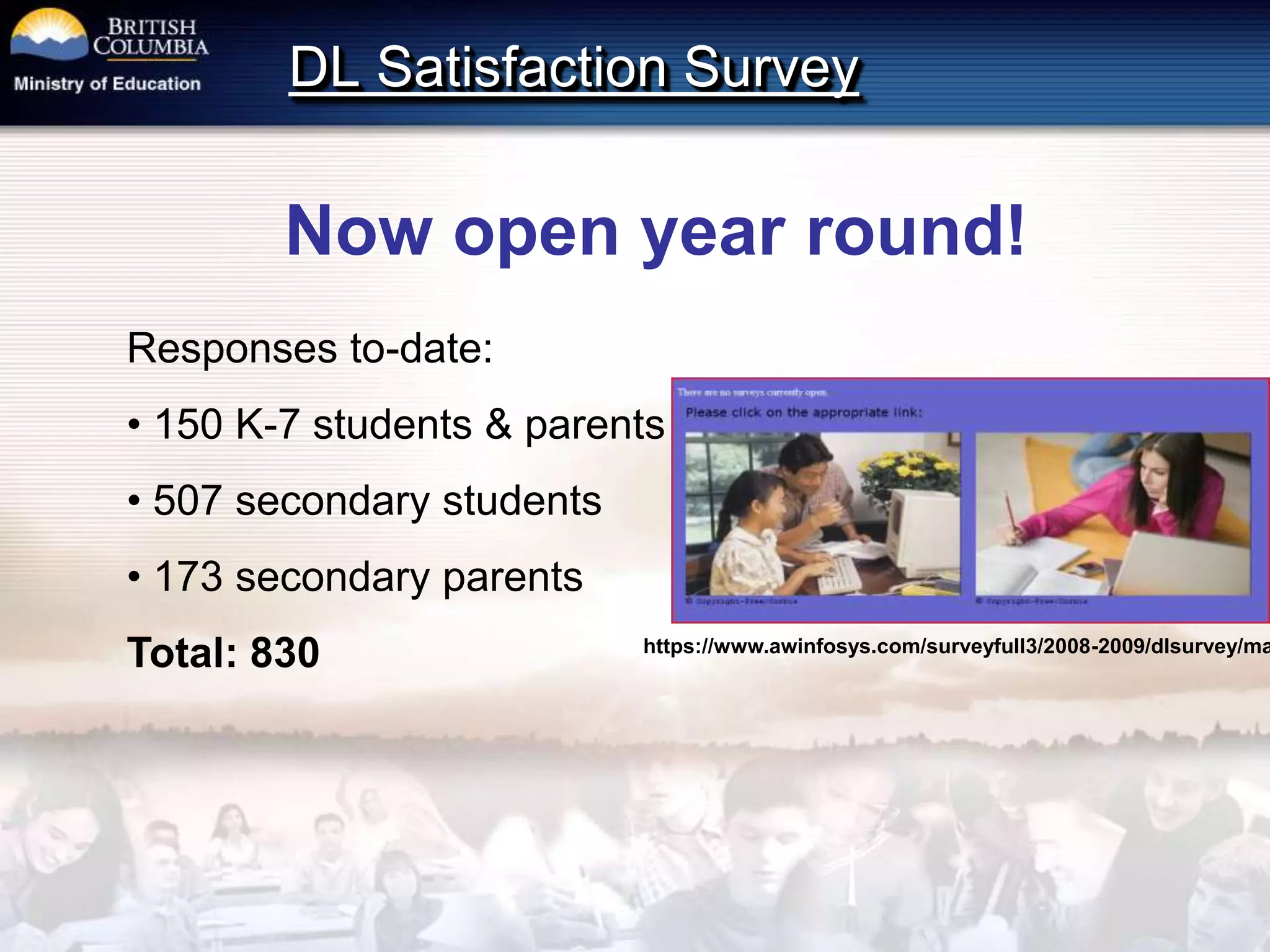
    DL Satisfaction SurveyNowopen year round!Responses to-date: 150 K-7 students & parents
  • 37.
  • 38.
    173 secondaryparentsTotal: 830https://www.awinfosys.com/surveyfull3/2008-2009/dlsurvey/main/
  • 39.
  • 40.
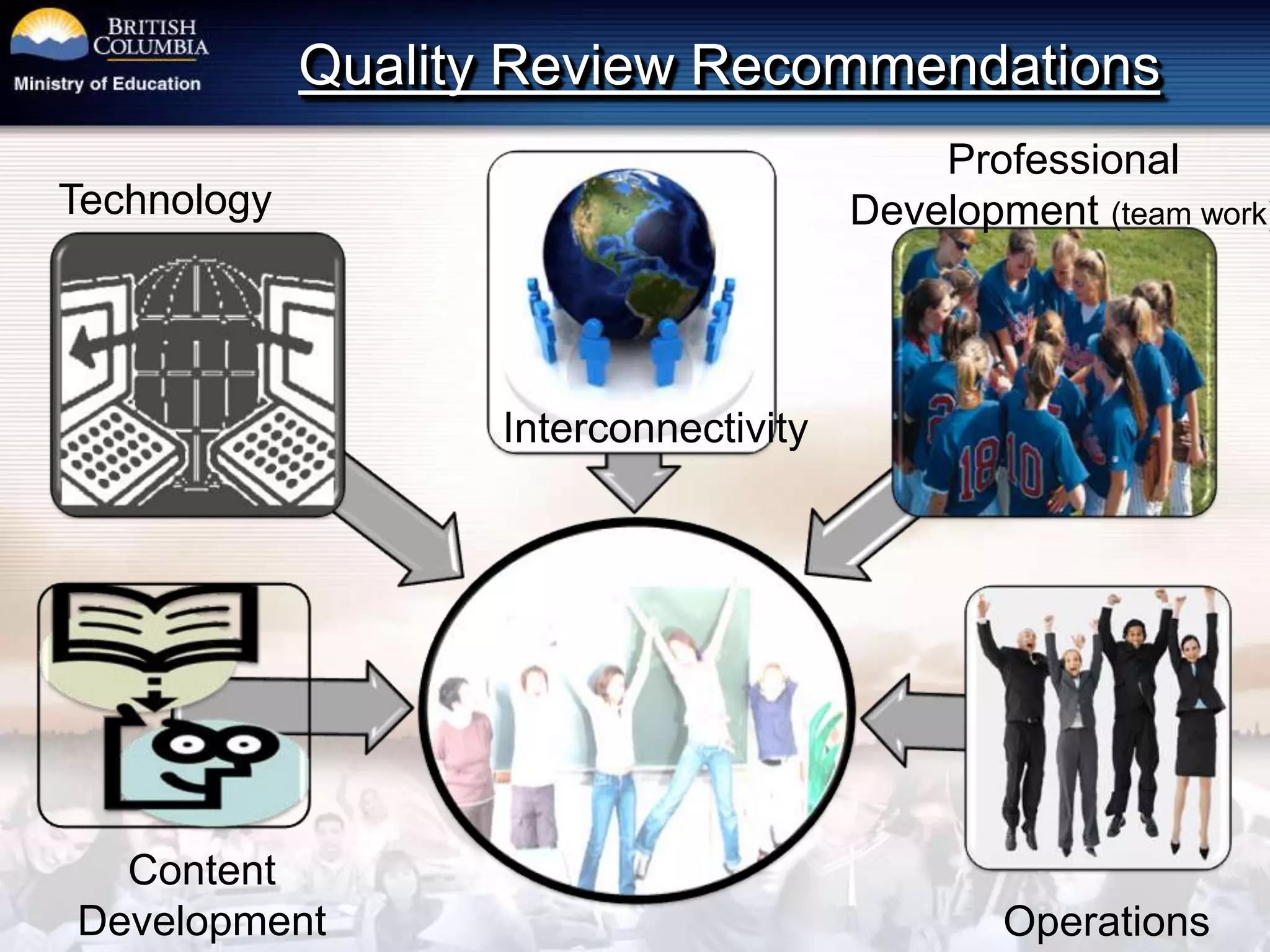
    Quality Review RecommendationsProfessionalDevelopment (team work)TechnologyInterconnectivityContent DevelopmentOperations
  • 41.
  • 42.
  • 43.
    CEETCommunity of Expertisein Educational Technology http://elgg.openschool.bc.ca/ Free professional learning
  • 44.
    Peer Mentoring(synchronous & asynchronous)
  • 45.
    Learn howto teach with Web 2.0 tools
  • 46.
    Live onlineevents & guest speakers
  • 47.
    Aggregation ofresources, links, informationLinksBC Ministry of Education Distributed Learninghttp://www.bced.gov.bc.ca/dist_learning/BC Distributed Learning Agreementhttp://www.bced.gov.bc.ca/dist_learning/documents/dist_learn_agmt.pdfBC Distributed Learning Standardshttp://www.bced.gov.bc.ca/dist_learning/documents/dl_standards.pdfLearnNow BChttp://www.learnnowbc.ca

Editor's Notes

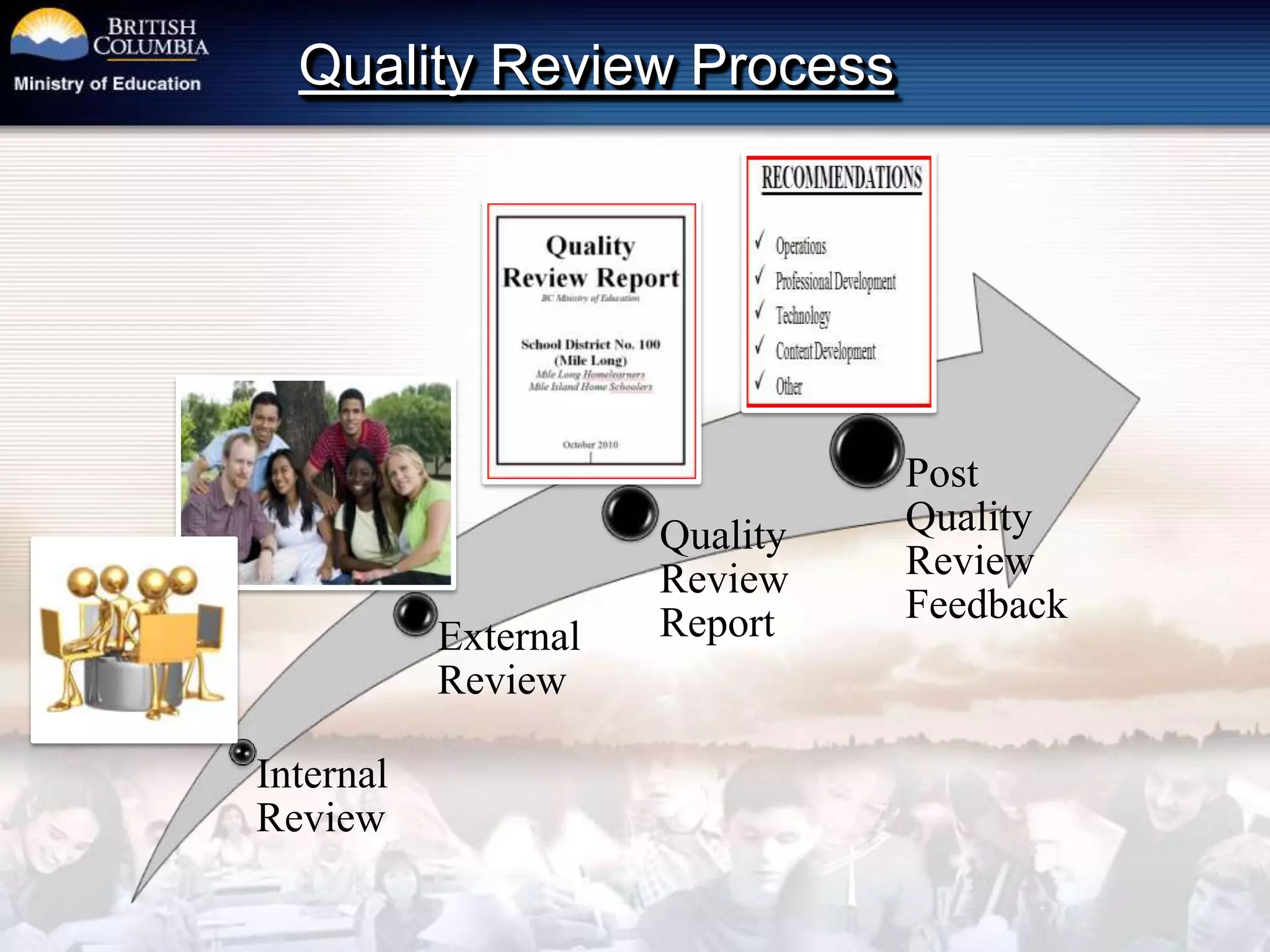
  • #27 QRs, started in 2007-2008, has three stages: Internal Review, QR Site Visit, and Post-QR. In the Internal Review, administration and staff are invited to evaluate their program and practices, and identify the strengths and challenges. The Quality Review team reviews this information prior to the site visit. The Quality Review Site Visit involves conversations by a Ministry-appointed team with the DL school’s administration, teachers and clerical staff. The goal is to identify areas of strength and challenges in all areas of the educational experience: operations, professional development, technology, content development, and other. Typically, observations by the Quality Review Team are congruent with the input by staff and administration from the Internal Review. A Quality Review Report, signed off by the Manager of the e-Learning Programs Unit, contains details about the school, observations about practices, operations and facilities, and provides recommendations. In the Post-QR, the DL school reports on the measures they have taken to address the Quality Review Team’s recommendations. Reports from the 2007-2008 Post-QRs indicate that the DL schools have taken active and significant steps to address their areas of challenge. The table below indicates the areas of recommendation by school; each school provided evidence of how they had addressed these issues.
  • #28  Professional Development:Clarifying roles, providing professional development and creating stronger linkages and supports through professional learning communities (across school and district boundaries) Technology:Implementing or increasing use of web 2.0 tools (Elluminate, video blogs, wikis, discussion boards, smart boards) in the DL classroom, and/orstandardizing the learning management system (Moodle)  Other:Creating opportunities for increased use of DL, and making connections to the wider DL communityDeveloping a community advisory report to support the distributed learning model, increasing the use of support blocks for cross-enrolled students, and creating a community of learners in a grade 10 to 12 self-paced environment. developing connections with other SDs, provinces and countries.  Content Development:Dedicating DL teacher time to developing content (in schools and across districts) lessons will be incorporating programming languages for robotics, 3-D modeling and web design.  Operations: creating extra staff positions to support their DL programs: creating a clerical/registrar position, and DL department head and administrator, coordinator, technician, video support and clerical positions.
  • #31 We have arranged for the Open School BC to continue to host CEET on their server for another year.We are upgrading to the latest and greatest version of Elgg (1.6).We are improving the look and feel of the site.Not one, but two moderators (Sandy Hirtz and Randy Labonte), will shepherd the community alongWe will provide simple tutorials to give teachers a quick sense of what a given tool is all about.A special guest-speaker will be featured in an Elluminate session re-launch of CEET in October.Subsequent special guest-speaker events will be held regularly, in addition to any that you facilitators might like to arrange.Our initial focus will be on Distributed Learning educators, but that will be broadened to include all K-12 educators in the province over time.We will use CEET as a test-bed for research into the usefulness of the Elgg community platform for educators and students.