

Lisa Amdur and Debbie Lahav Ruppin Academic Center BESIG Rome, Italy June 26, 2010 Using computer-mediated e-feedback in large classes in a business writing course
Overview The context of our business English course The course and the students  Why business English  The business English course Instructional constraints  Course components Addressing constraints: e-tasks and e-feedback Technological support – Moodle  Types of feedback  Students’ response to the feedback Thoughts for the future
Well-established college of tertiary education  Specializations: Business Administration, Marine Science, Engineering, Economics, Accountancy, Behavioral Science Rural area Students from the area and also in dorms Our  context – Ruppin Academic Center
English is studied as a foreign language in the country (compulsory subject from fourth to twelfth grade) English requirements for college entry –  Bagrut (Matriculation) English exam AND  Psychometric exam –  exemption based on a national psychometric exam OR minimum grade on psychometric exam and continues studies at college (reaching exemption level by end first year) Our  context – English requirements
Some had been exempt from English study  (based on the psychometric exam) Different entry levels of English (towards exemption) Relatively older than average college students (average age=25-27) Larger proportion of males Diverse work experience  Our students
Why Business English?  Students of Business Administration are required to: meet the academic requirements and needs as defined by the head of the Department of Business Administration function in the international business world where the knowledge of English is essential.
Why incorporate technology?  Two-fold purpose:  An end in itself Means to an end
The business English course  A compulsory, one-credit course for students in the BA program of Business Administration Offered in the first semester of the third year of studies Designed and delivered by two EFL teachers (also teach the English courses for exemption)
Main focus of the business English course Mainly writing focusing on : enhancing English proficiency studying specific text types and organization vocabulary relevant to the business world cultural awareness and appropriateness tools for self-instruction of issues related to language  These requirements have been translated into the course objectives
Course objectives: The main objective of the Business English course is to develop the skills and strategies necessary to independently create written business documents. On completion of the course you will: be able to produce various types of written business documents.  enhance your knowledge of business-related vocabulary.  be familiar with various aspects of writing, such as style (the way words are used and put together), tone (the overall impression or feeling created by words) and mechanics (grammar, spelling, layout and punctuation). have a repertoire of writing strategies as well as criteria for deciding which strategies to use in a given situation. be able to synthesize information from two or more texts on a related topic to create a written document.
Instructional approach  Approach:  Process instruction Scaffolding  Feedback
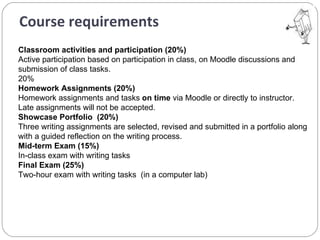
Course requirements  Classroom activities and participation (20%) Active participation based on participation in class, on Moodle discussions and  submission of class tasks. 20%  Homework Assignments (20%) Homework assignments and tasks  on time  via Moodle or directly to instructor.  Late assignments will not be accepted. Showcase Portfolio  (20%) Three writing assignments are selected, revised and submitted in a portfolio along  with a guided reflection on the writing process. Mid-term Exam (15%) In-class exam with writing tasks Final Exam (25%) Two-hour exam with writing tasks  (in a computer lab)
Our assumptions Writing development is contingent on extended writing practice accompanied by the receipt of feedback  Feedback should be responsive, customized, and on-going
Large ( n  = 38) classes (in some countries a large class is more than 10 students, ELT classes at UK universities max. 20 students.  Educational infrastructure and financial resources of the country.    Mixed-ability classes Limited time (28 academic hours) Teacher workload  Our instructional constraints
Obvious limitations include:  difficulty in getting to know each and every student very well discipline may be an issue  constraints of the physical classroom (number of desks and chairs, space, visibility, acoustics, resources)  chasing absentees  time demands  But there are advantages:  enhanced opportunity for peer learning  and peer assessment  simulation of real life situations Large classes
Components of the course  Two primary components in an EFL business English writing course: student tasks and feedback E-Tasks:  provide multiple opportunities for students to practice  composing skills in a genre-oriented approach employing scaffolded learning / instructional techniques E- Feedback:  teaches students the necessary skills and raises awareness of what is expected as writers to produce a piece of writing with minimal errors and maximum clarity Kroll 2001; Williams 2003
What is known about e-feedback in the context of developing writing skills? Tuzi, F. (2004) found that e-feedback had a greater impact on revision and allowed students to submit and retrieve their work/feedback online, and for instructors to respond and retrieve work /feedback online. Seliem  & Abdelhamid (2009) suggest that e-feedback as a pedagogic practice is generally effective in creating a positive learning environment, fostering learner responsibility, facilitating peer and teacher collaboration. In addition, they found that e-feedback was well received and helpful to the learners.
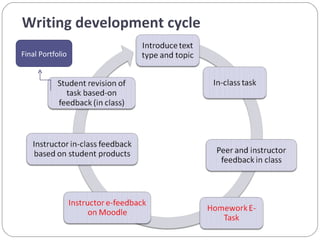
Writing development cycle Final Portfolio
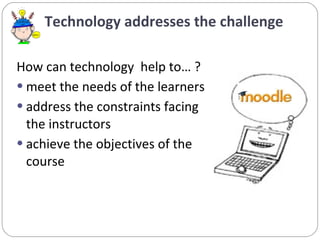
Technology addresses the challenge How can technology  help to… ? meet the needs of the learners  address the constraints facing the instructors achieve the objectives of the course
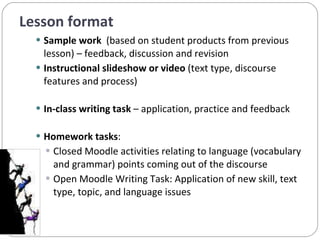
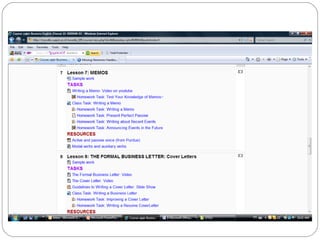
Lesson format Sample work  (based on student products from previous lesson) – feedback, discussion and revision Instructional slideshow or video  (text type, discourse features and process) In-class writing task  – application, practice and feedback Homework tasks :  Closed Moodle activities relating to language (vocabulary and grammar) points coming out of the discourse  Open Moodle Writing Task: Application of new skill, text type, topic, and language issues
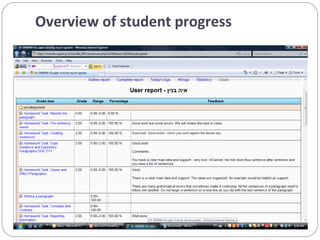
A multi-functional e-learning platform Allows open and closed activities Students can upload writing assignments  Instructors can provide feedback online Records of all assignments and feedback available to instructor and students at all times Instructor can follow progress of individual student and class
 
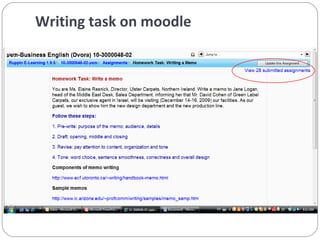
Writing task on moodle
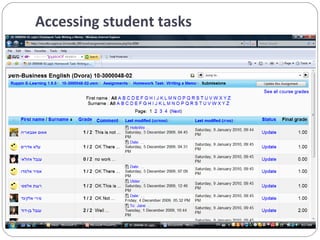
Accessing student tasks
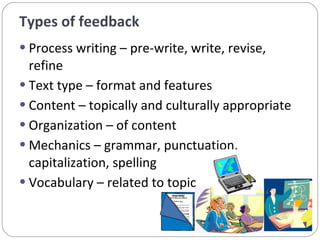
Types of feedback  Process writing – pre-write, write, revise, refine Text type – format and features  Content – topically and culturally appropriate  Organization – of content Mechanics – grammar, punctuation, capitalization, spelling Vocabulary – related to topic
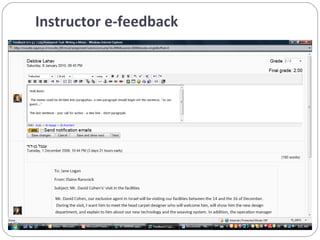
Instructor e-feedback
Sample e-feedback from instructor This does not follow the format of a memo. Review the format - heading and the body of the memo. You have one paragraph with different ideas. Each idea should be a paragraph in itself with a topic sentence and supporting ideas. A memo is not signed. It is clear from the heading who sent it. The subject is too long. It should be short and then expanded upon in the first paragraph. I do not really understand what you are trying to say here. The ideas are not organized nor expressed clearly. Good letter but organize you ideas into paragraphs - not a list of sentences
Sample e-feedback from instructor  .../contd . The email follows the form and content of an email to some extent but there are many problems: 1. Write in paragraphs - not lists of sentences. 2. Organize ideas before you write.  Paragraph – topic sentence with supporting  ideas in sentences. 3. Check grammar and spelling. There are too many errors that make this very difficult to follow. This does not follow the format of a business letter. The ideas in the letter are not organized. The second paragraph has several different ideas. Follow the steps for writing: pre-write, draft, revise and refine. There are also many errors in grammar which make your message incorrect or unclear.
Overview of student progress
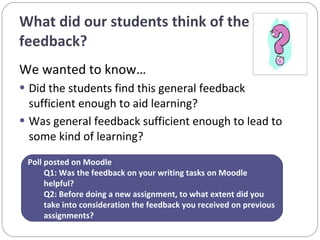
What did our students think of the feedback?  We wanted to know… Did the students find this general feedback sufficient enough to aid learning? Was general feedback sufficient enough to lead to some kind of learning? Poll posted on Moodle Q1: Was the feedback on your writing tasks on Moodle helpful? Q2: Before doing a new assignment, to what extent did you take into consideration the feedback you received on previous assignments?
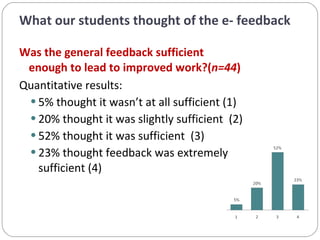
What our students thought of  the e- feedback Was the general feedback sufficient  enough to lead to improved work?( n=44 ) Quantitative results:  5% thought it wasn’t at all sufficient (1) 20% thought it was slightly sufficient  (2) 52% thought it was sufficient  (3) 23% thought feedback was extremely sufficient (4)
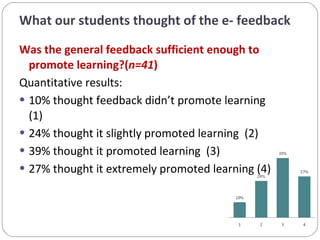
What our students thought of  the e- feedback Was the general feedback sufficient enough to promote learning?( n=41 ) Quantitative results:  10% thought feedback didn’t promote learning  (1) 24% thought it slightly promoted learning  (2) 39% thought it promoted learning  (3) 27% thought it extremely promoted learning (4)
What our students had to say about   the e- feedback “ Your feedbacks helped me to focus on my main issues in writing, and they were great assistants for me.” “ When I receive a feedback I can have some information regarding my situation and of course find mistakes and correct them. I feel that getting feedback is very important for studying.” “ It helped me to improve my writing skills, my grammar, and my vocabulary. I learned how to punctuate correctly, and even how to write in a logic way.”
What our students had to say about   the e- feedback “ In general, I feel that the feedbacks was necessary for improving my writing skills and also to prepare for the test.” “ The feedback supported the learning process, got me to focus on my weak points, and also reinforced my strong points.”  “ The best feedback I got was, when I was given clear remarks about where were my mistakes in writing. Furthermore, when I was given an explanation about why I had a mistake, it helped me to remember for the next time, not to repeat it again, Especially if it was marked.”
The advantages of e-feedback  Most students found the feedback helpful and sufficient to lead to learning. Even minimal and general feedback is deemed sufficient to lead to improved writing products. E-feedback (on Moodle) provides a convenient mode for assessing writing tasks in large mixed-ability classes. Moodle documents student / class development across the course E-feedback is available to students and instructors 24/7 on click  Enables teacher to provide on-going and customized feedback to individual students in large classes
Our thoughts for future course design  Miao, Badger & Zhen (2006) found that teacher feedback led to greater improvements in writing, but peer feedback was associated with greater degree of student autonomy, so there is a role for peer feedback. Collaboration and peer feedback using web tools such as Google docs, wikis, blogs Simulations using VoiceThread (e.g.,  presentations ) and peer feedback on them (may also upload documents and receive oral and/or written feedback from viewers) Google for educators
References Kroll, B. (2001). Considerations for teaching ESL/EFL writing course. In M. Celce-Murcia (Ed.),  Teaching English as a second or foreign language  (3 rd  ed.) (pp. 219-232).  Li, M. (2009). Adopting varied feedback modes in the EFL writing class.  US-China Foreign Language, 7 (1), 60-63. Miao, Y., Badger, R. & Zhen, Y. (2006). A comparative study of peer and teacher feedback in a Chinese EFL writing class.  Journal of Second Language Writing, 15 , 179-200. Seliem, S. & Abdelhamid, A. (March, 2009). Missing: Electronic feedback in Egyptian EFL essay writing classes. Paper presented at the Centre for Developing English Language Teaching (CDELT) Conference (Cairo). Tuzi, F. (2004). The impact of e-feedback on the revisions of L2 writers in an academic writing course.   Computers and Composition, 21(2 ), 217-235. Williams, J.G. (2003). Providing feedback on ESL students' written assignments.  The Internet TESL Journal, 9 (10). Retrieved from  http://iteslj.org/Techniques/Williams-Feedback.html Yang, Y. (2006). Feedback on college EFL students' compositions.  US-China Foreign Language, 4 (11), 93-96.
Thank you !!!!!

Presentation final(lisa)

  • 1.
    Lisa Amdur andDebbie Lahav Ruppin Academic Center BESIG Rome, Italy June 26, 2010 Using computer-mediated e-feedback in large classes in a business writing course
  • 2.
    Overview The contextof our business English course The course and the students Why business English The business English course Instructional constraints Course components Addressing constraints: e-tasks and e-feedback Technological support – Moodle Types of feedback Students’ response to the feedback Thoughts for the future
  • 3.
    Well-established college oftertiary education Specializations: Business Administration, Marine Science, Engineering, Economics, Accountancy, Behavioral Science Rural area Students from the area and also in dorms Our context – Ruppin Academic Center
  • 4.
    English is studiedas a foreign language in the country (compulsory subject from fourth to twelfth grade) English requirements for college entry – Bagrut (Matriculation) English exam AND Psychometric exam – exemption based on a national psychometric exam OR minimum grade on psychometric exam and continues studies at college (reaching exemption level by end first year) Our context – English requirements
  • 5.
    Some had beenexempt from English study (based on the psychometric exam) Different entry levels of English (towards exemption) Relatively older than average college students (average age=25-27) Larger proportion of males Diverse work experience Our students
  • 6.
    Why Business English? Students of Business Administration are required to: meet the academic requirements and needs as defined by the head of the Department of Business Administration function in the international business world where the knowledge of English is essential.
  • 7.
    Why incorporate technology? Two-fold purpose: An end in itself Means to an end
  • 8.
    The business Englishcourse A compulsory, one-credit course for students in the BA program of Business Administration Offered in the first semester of the third year of studies Designed and delivered by two EFL teachers (also teach the English courses for exemption)
  • 9.
    Main focus ofthe business English course Mainly writing focusing on : enhancing English proficiency studying specific text types and organization vocabulary relevant to the business world cultural awareness and appropriateness tools for self-instruction of issues related to language These requirements have been translated into the course objectives
  • 10.
    Course objectives: Themain objective of the Business English course is to develop the skills and strategies necessary to independently create written business documents. On completion of the course you will: be able to produce various types of written business documents. enhance your knowledge of business-related vocabulary. be familiar with various aspects of writing, such as style (the way words are used and put together), tone (the overall impression or feeling created by words) and mechanics (grammar, spelling, layout and punctuation). have a repertoire of writing strategies as well as criteria for deciding which strategies to use in a given situation. be able to synthesize information from two or more texts on a related topic to create a written document.
  • 11.
    Instructional approach Approach: Process instruction Scaffolding Feedback
  • 12.
    Course requirements Classroom activities and participation (20%) Active participation based on participation in class, on Moodle discussions and submission of class tasks. 20% Homework Assignments (20%) Homework assignments and tasks on time via Moodle or directly to instructor. Late assignments will not be accepted. Showcase Portfolio (20%) Three writing assignments are selected, revised and submitted in a portfolio along with a guided reflection on the writing process. Mid-term Exam (15%) In-class exam with writing tasks Final Exam (25%) Two-hour exam with writing tasks (in a computer lab)
  • 13.
    Our assumptions Writingdevelopment is contingent on extended writing practice accompanied by the receipt of feedback Feedback should be responsive, customized, and on-going
  • 14.
    Large ( n = 38) classes (in some countries a large class is more than 10 students, ELT classes at UK universities max. 20 students. Educational infrastructure and financial resources of the country.   Mixed-ability classes Limited time (28 academic hours) Teacher workload Our instructional constraints
  • 15.
    Obvious limitations include: difficulty in getting to know each and every student very well discipline may be an issue constraints of the physical classroom (number of desks and chairs, space, visibility, acoustics, resources) chasing absentees time demands But there are advantages: enhanced opportunity for peer learning and peer assessment simulation of real life situations Large classes
  • 16.
    Components of thecourse Two primary components in an EFL business English writing course: student tasks and feedback E-Tasks: provide multiple opportunities for students to practice composing skills in a genre-oriented approach employing scaffolded learning / instructional techniques E- Feedback: teaches students the necessary skills and raises awareness of what is expected as writers to produce a piece of writing with minimal errors and maximum clarity Kroll 2001; Williams 2003
  • 17.
    What is knownabout e-feedback in the context of developing writing skills? Tuzi, F. (2004) found that e-feedback had a greater impact on revision and allowed students to submit and retrieve their work/feedback online, and for instructors to respond and retrieve work /feedback online. Seliem & Abdelhamid (2009) suggest that e-feedback as a pedagogic practice is generally effective in creating a positive learning environment, fostering learner responsibility, facilitating peer and teacher collaboration. In addition, they found that e-feedback was well received and helpful to the learners.
  • 18.
  • 19.
    Technology addresses thechallenge How can technology help to… ? meet the needs of the learners address the constraints facing the instructors achieve the objectives of the course
  • 20.
    Lesson format Samplework (based on student products from previous lesson) – feedback, discussion and revision Instructional slideshow or video (text type, discourse features and process) In-class writing task – application, practice and feedback Homework tasks : Closed Moodle activities relating to language (vocabulary and grammar) points coming out of the discourse Open Moodle Writing Task: Application of new skill, text type, topic, and language issues
  • 21.
    A multi-functional e-learningplatform Allows open and closed activities Students can upload writing assignments Instructors can provide feedback online Records of all assignments and feedback available to instructor and students at all times Instructor can follow progress of individual student and class
  • 22.
  • 23.
  • 24.
  • 25.
    Types of feedback Process writing – pre-write, write, revise, refine Text type – format and features Content – topically and culturally appropriate Organization – of content Mechanics – grammar, punctuation, capitalization, spelling Vocabulary – related to topic
  • 26.
  • 27.
    Sample e-feedback frominstructor This does not follow the format of a memo. Review the format - heading and the body of the memo. You have one paragraph with different ideas. Each idea should be a paragraph in itself with a topic sentence and supporting ideas. A memo is not signed. It is clear from the heading who sent it. The subject is too long. It should be short and then expanded upon in the first paragraph. I do not really understand what you are trying to say here. The ideas are not organized nor expressed clearly. Good letter but organize you ideas into paragraphs - not a list of sentences
  • 28.
    Sample e-feedback frominstructor .../contd . The email follows the form and content of an email to some extent but there are many problems: 1. Write in paragraphs - not lists of sentences. 2. Organize ideas before you write. Paragraph – topic sentence with supporting ideas in sentences. 3. Check grammar and spelling. There are too many errors that make this very difficult to follow. This does not follow the format of a business letter. The ideas in the letter are not organized. The second paragraph has several different ideas. Follow the steps for writing: pre-write, draft, revise and refine. There are also many errors in grammar which make your message incorrect or unclear.
  • 29.
  • 30.
    What did ourstudents think of the feedback? We wanted to know… Did the students find this general feedback sufficient enough to aid learning? Was general feedback sufficient enough to lead to some kind of learning? Poll posted on Moodle Q1: Was the feedback on your writing tasks on Moodle helpful? Q2: Before doing a new assignment, to what extent did you take into consideration the feedback you received on previous assignments?
  • 31.
    What our studentsthought of the e- feedback Was the general feedback sufficient enough to lead to improved work?( n=44 ) Quantitative results: 5% thought it wasn’t at all sufficient (1) 20% thought it was slightly sufficient (2) 52% thought it was sufficient (3) 23% thought feedback was extremely sufficient (4)
  • 32.
    What our studentsthought of the e- feedback Was the general feedback sufficient enough to promote learning?( n=41 ) Quantitative results: 10% thought feedback didn’t promote learning (1) 24% thought it slightly promoted learning (2) 39% thought it promoted learning (3) 27% thought it extremely promoted learning (4)
  • 33.
    What our studentshad to say about the e- feedback “ Your feedbacks helped me to focus on my main issues in writing, and they were great assistants for me.” “ When I receive a feedback I can have some information regarding my situation and of course find mistakes and correct them. I feel that getting feedback is very important for studying.” “ It helped me to improve my writing skills, my grammar, and my vocabulary. I learned how to punctuate correctly, and even how to write in a logic way.”
  • 34.
    What our studentshad to say about the e- feedback “ In general, I feel that the feedbacks was necessary for improving my writing skills and also to prepare for the test.” “ The feedback supported the learning process, got me to focus on my weak points, and also reinforced my strong points.” “ The best feedback I got was, when I was given clear remarks about where were my mistakes in writing. Furthermore, when I was given an explanation about why I had a mistake, it helped me to remember for the next time, not to repeat it again, Especially if it was marked.”
  • 35.
    The advantages ofe-feedback Most students found the feedback helpful and sufficient to lead to learning. Even minimal and general feedback is deemed sufficient to lead to improved writing products. E-feedback (on Moodle) provides a convenient mode for assessing writing tasks in large mixed-ability classes. Moodle documents student / class development across the course E-feedback is available to students and instructors 24/7 on click Enables teacher to provide on-going and customized feedback to individual students in large classes
  • 36.
    Our thoughts forfuture course design Miao, Badger & Zhen (2006) found that teacher feedback led to greater improvements in writing, but peer feedback was associated with greater degree of student autonomy, so there is a role for peer feedback. Collaboration and peer feedback using web tools such as Google docs, wikis, blogs Simulations using VoiceThread (e.g., presentations ) and peer feedback on them (may also upload documents and receive oral and/or written feedback from viewers) Google for educators
  • 37.
    References Kroll, B.(2001). Considerations for teaching ESL/EFL writing course. In M. Celce-Murcia (Ed.), Teaching English as a second or foreign language (3 rd ed.) (pp. 219-232). Li, M. (2009). Adopting varied feedback modes in the EFL writing class. US-China Foreign Language, 7 (1), 60-63. Miao, Y., Badger, R. & Zhen, Y. (2006). A comparative study of peer and teacher feedback in a Chinese EFL writing class. Journal of Second Language Writing, 15 , 179-200. Seliem, S. & Abdelhamid, A. (March, 2009). Missing: Electronic feedback in Egyptian EFL essay writing classes. Paper presented at the Centre for Developing English Language Teaching (CDELT) Conference (Cairo). Tuzi, F. (2004). The impact of e-feedback on the revisions of L2 writers in an academic writing course. Computers and Composition, 21(2 ), 217-235. Williams, J.G. (2003). Providing feedback on ESL students' written assignments. The Internet TESL Journal, 9 (10). Retrieved from http://iteslj.org/Techniques/Williams-Feedback.html Yang, Y. (2006). Feedback on college EFL students' compositions. US-China Foreign Language, 4 (11), 93-96.
  • 38.