Mantra for leveraging Emerging Trends 
Ashish Sadekar 
Director 
ProThoughts 
0 Project Management in the Collaborative Age
Project Management in 
the Collaborative Age 
The Emerging Trend of Project 
Management 
Project management has travelled a long journey and in 
no uncertain terms, ready for a big leap to experience a 
new adventure and embrace a new way of managing a 
project which will reap high dividends and benefits. It will 
multiply the chances of success. To take you back, when 
project management started, the major challenges as we 
all practitioners remember has been communications and 
stakeholder management. They are going to be still there 
but with new age technology the project manager of today 
and tomorrow has a lot of ammunition to take care of 
these challenges. The new project manager and 
importantly the stakeholders will glued to their 
smartphones and will be under pressure to have all the 
project data to take important decisions in the dynamic 
environment. Tomorrow’s project management will be 
shaped by this ammunition, the tools of the project 
manager which can help the projects to succeed. These 
tools will typically be on the cloud and work with a SaaS 
(software as a Service model) and will throw real time 
analytics, such as Earned Value analysis and dashboards on 
your smartphones. There will be strong collaborative 
platform perhaps integrated with your social media 
streams such as Facebook, etc. This paper details such a 
futuristic model and platform of project management. 
Ashish Sadekar 
6/9/2014 
1 Project Management in the Collaborative Age
Table of Contents 
INTRODUCTION ........................................................................................................................................................................3 
DEFINITION OF COLLABORATIVE PROJECT MANAGEMENT............................................................................................3 
PROJECT MANAGEMENT AS WE KNOW IT .........................................................................................................................4 
THE FUTURE MODEL OF PROJECT MANAGEMENT – THE COLLABORATIVE PROJECT MANAGER...........................4 
COLLABORATIVE PROJECT MANAGEMENT TOOL – A CASE STUDY...............................................................................5 
BENEFITS OF COLLABORATIVE PROJECT MANAGEMENT ............................................................................................. 11 
THE FUTURE - COLLABORATIVE PROJECT MANAGEMENT: .......................................................................................... 12 
2 Project Management in the Collaborative Age
Introduction 
Project management has travelled a long journey and in no uncertain terms, ready for a big leap to 
experience a new adventure and embrace a new way of managing a project which will reap high 
dividends and benefits. It will multiply the chances of success. 
To take you back, when project management started, the major challenges as we all practitioners 
remember has been communications and stakeholder management. They are going to be still there 
but with new age technology the project manager of today and tomorrow has a lot of ammunition to 
take care of these challenges. 
In fact, technology advances gives newer opportunities and also throws different and unique problems 
to handle. Today’s project manager will have a diverse workforce who will be physically around in the 
globe but always connected as if you are sitting in a war room. The days are not far when video data 
would be used extensively to communicate in a project scenario and would appear as a 
commonplace item. The need for immediate data and hence, immediate decisions in this dynamic 
world of multitude of stakeholders would be demanding on the project manager. 
How will the today’s project manager react to this situation? How can he manage the project and yet 
deliver it to success. This paper will discuss the means and the only way to achieve this by working 
out a Collaborative way in project management, and introduce the innovative way - Project 
Management in Collaboration Age. This is a strong emerging trend which needs to be adopted and 
adapted fast in the project management world. 
Welcome to the collaborative world of project management. But what exactly is this collaborative 
project management? What’s this buzz word that everyone’s talking about in project management 
circles? Is this just a buzz word or do you want to suggest that the project management was not 
collaborative earlier? Let’s figure out. 
Definition of Collaborative Project Management 
Collaborative project management is based on the principle of actively involving all project members 
in the planning and control process and of networking all the project members using information, 
communication, and collaboration modules. Management is not regarded as an activity reserved 
solely for managers but as an integral part of the project work of all team members. 
Collaborative project management makes extensive use of localized control loops. Complex projects 
are broken down into smaller "more tangible" sub-systems which are then assigned to members of 
the relevant departments. Consequently, planning and control responsibility is assumed by those who 
are also responsible for project content. 
Sub-plans are networked and synchronized to tie all partners into the system of planning and control 
and to promote a common understanding of overall planning. Changes and/or delays are 
communicated directly to the relevant project members without active intervention in their areas of 
responsibility. 
The technical platform on which collaborative project management builds is a central database that 
makes current and consistent planning data available to all project participants wherever they may be 
located. 
Communication and collaboration are the basis for early identification of the impact of potential 
problems on linked sub-projects. They create a high level of transparency and a shared awareness of 
quality among team members. 
3 Project Management in the Collaborative Age
Project Management as we know it 
Isn’t the collaborative project management applicable in the earlier era of project management or 
even now? What’s so new about this project management in collaborative way? 
In our earlier times or even, I would not be wrong is stating that in our present times, project 
management as a discipline is still evolving. Project management, especially in the Indian diaspora is 
still evolving and is not being treated as a necessary function to deliver projects. The project 
management as a function and the project management knowledge is still not perceived as game 
changer or even a mere “changer” in the delivery of the projects. 
The crux is do we manage projects in the collaborative way currently? The collaborative way is some 
miles ahead, however, the right people and employers are slowly recognizing the need for project 
management. The awareness is getting built for project management as a function in the 
organization. For example, one of my clients, a large pharma client is slowly recognizing the need for 
project management and moving from the project co-ordinating kind of work with empowering the 
project manager to deliver the projects successfully. They have involved all their executive directors to 
understand the essence of project management and investing heavily to get the right talent, right 
processes and the right tools to win in their projects. It is necessary for all sectors as in pharma that 
projects are delivered within the schedule. For example, any delay of a day in pharma means a large 
revenue being lost, as the pharma company gains most of the revenue share in the early launch of 
the product. Similarly, in the telecom industry, a day’s delay in product launch or even a marketing 
gimmick would result in a heavy loss of revenue or mindshare of customer. Everyone, including the IT 
sector is waking up to the right way of doing the project management. 
To sum it up, the current project management seriously lacks collaboration and a lot of organizations 
are looking for the right way of doing the projects. It is time that it is quickly latches up the 
collaborative way of doing the projects to succeed in the projects. 
The Future Model of Project Management – The collaborative project 
manager 
As touched upon in the previous sections, tomorrow’s workforce will shift to the smartphones or video 
phones and will be a mobile diverse team. As a research suggests, the project team will be global 
workforce working in different time zones with their different culture sets and thriving in a dynamic 
environment. One common thread across the different culture set is the virtue of impatience; this 
workforce will need data on real time basis else can even be a de-motivator for the team. Can the 
current project manager survive with its own MS project desktop version running behind every team 
member for the updates. No wonder the project manager today is considered an overhead in the 
team and is seen as a non – value adding person providing statuses to the management. 
The Collaborative age of project management will provide real time status and immediate data to take 
decisions in the project, among many other things. The future of the project management is the 
Collaborative Age of Project Management. 
The collaborative project management methodology provides adequate support for the widespread 
practice of working in development teams with direct responsibility. 
 Proactive, tool-assisted communication and collaboration replace the rigid algorithms of 
conventional project management systems. 
 A central database provides current and uniform planning information for all project members 
– even between companies and across locations. 
4 Project Management in the Collaborative Age
 Clearly allocated responsibilities and interfaces promote transparency and currency of 
information, thus ensuring improved planning reliability and quality. 
 Project management sets up a top-down planning framework by defining important 
milestones and key data. Project members plan their work scopes independently, confirm that 
specified requirements have been fulfilled, and assume direct responsibility for coordination 
with other sub-projects. 
 Communication modules permit simple and intuitive networking of sub-projects and thus 
support rapid and transparent problem resolution processes. Changes are communicated 
automatically to those involved and problems are resolved by reaching mutual agreement on 
suitable measures. 
 Managing the tasks all the way through the process with a central workspace enabling the 
users the ability to have greater information at less cost/time. This is because it enables the 
team to work on what is needed and provide updates almost without thinking about it. 
 Having a collaboratively updated task list also allows automatic creation of burn-down charts, 
or other reporting; again facilitating the project manager’s role and allowing them to quickly 
understand if items are running late. Further, good knowledge management replaces the 
difficulties of file storage and hidden deposits of valuable information. Whilst a project 
manager may keep excellent documentation, the issue tends to come several months later 
when trying to find out information. Or, as we’ve all experienced, when you take over from a 
departing PM and have to try and pick up where they left off. 
 Collaboration software steps around these issues if properly managed by enabling searc h 
and by spreading the knowledge around the team as to where things are stored. 
Collaborative tools are the social media of the workplace. Generally presenting as a central 
dashboard or workspace that everyone has access to and has a reason to use, they increase the 
team’s buy-in to the project rather than just their work package. These tools tend to support three key 
areas: 
 Knowledge management: Whether this is the enterprise item like SharePoint or a centrally 
maintained wiki, it is difficult to argue that having a central location that is searchable and 
collaborative is anything other than beneficial. 
 Running a project: One of the biggest areas that has seen a range of developments is the 
area of issue management. Tools allowing each task that is required to be tracked, and effort, 
issues logged by the person responsible for delivery and then transitioned through a proper 
workflow have a significant impact of how a project can be run. 
 Reporting & Analytics: Making sense of the data captured through the knowledge 
management and giving reports suiting different stakeholders tastes and preferences, leaves 
a satisfied customer at the end of the project. The reports and analytics provide real time 
updates which helps to take decisions at the right time for the right people. 
Let’s understand a live case study of Project Management in Collaborative Age… 
Collaborative Project Management tool – A Case Study 
The collaborative way of project management can be best explained by an actual live case study 
where it was implemented and the benefits were clearly visible. The Project management in 
Collaborative age has arrived and the below case study illustrates the point well. The case study 
illustrated below is for a mid-sized Gaming IT company based out of Noida, India. 
Organization Background: 
The organization is a leading developer of high quality innovative game content and game 
development for the online, land-based, mobile and social gaming platforms. Its’ primary area of 
5 Project Management in the Collaborative Age
business is the established services sector that provides subcontracted game art and software for the 
industry. 
Regarding the projects, it is a 200 member team and grown organically over the last 6 years. This 
organization is based out of Noida, New Delhi, India. 
Some of the typical aspects of their projects were: 
 At any given moment of time, there are around of 25 -50 projects handled by 2 project 
managers and assisted by 3-4 team leaders. 
 The project team is typically of 5 member team and the duration of each of the project is 
around 4-5 month period. 
 The Project manager reports directly into the managing director and is a senior authority in 
the organization. 
 Before the collaborative way of working, the projects were managed in excel spreadsheets. 
 The communication earlier used to happen verbally or through mails, i.e., Microsoft Outlook. 
 The Configuration Management function happens with VSS and managed separately, and not 
tied up to the projects. 
Challenges: 
Some of the typical challenges the projects faced: 
 The entire effort to create, execute, track and close the project is manual which results into a 
lot of time and lot of mistakes. 
 Only a single person can track the excel sheet at any given point of time which adds to idle 
time and lack of collaborative effort, again leading to wastage of time and constrained time. 
 Excel involves a lot of macros and formulae and in case, any of the logic is modified, it takes 
a mammoth effort to correct and restore it to original. Maintenance of the project worksheets 
is quite a huge task in terms of cost and money. 
 A lot of time and energy is invested in communication the project updates; excel screenshot is 
being taken and sent to the team and the details have to be explained on 1:1 basis. 
Standardization and Collaboration is lacking in the projects. 
 Due to the lack of proper data, a lot of time in invested to get the correct data and find 
different trends and variances. In case of any issue, a good amount of time is invested to find 
the root causes and the real cause of the problem. 
 Due to lack of data, quality of reports is lacking. 
Solution Description: 
For the paucity of the technical paper, the critical aspects of the collaborative way of working in the 
projects are highlighted. These critical features along with other ancillary functionality helped 
overcome the challenges and reap high value to their projects. The customer in this case, has 
mentioned that it helped them to get repeat business and even one of their customers wants to 
implement a similar way of project management. 
A Central Repository of Data: 
Data should be stored in a single place and every element of the data should be appropriately linked 
to create a meaningful data. 
Ability to generate Data and high quality reports: 
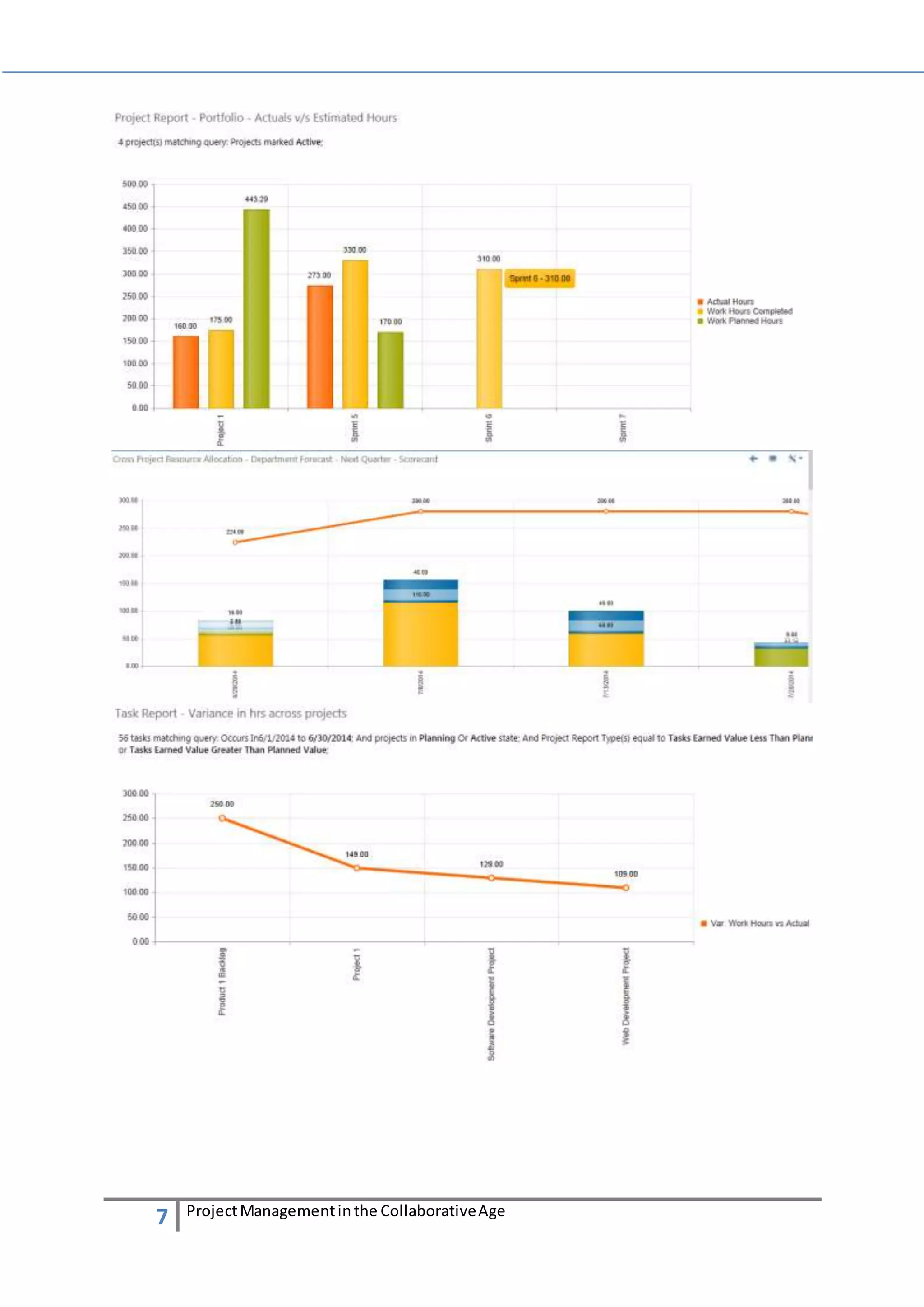
The data if mined properly should generate high quality reports and analytics for quick decision 
making. Attached are some of the snapshots of some critical reports used in various projects. 
6 Project Management in the Collaborative Age
7 Project Management in the Collaborative Age
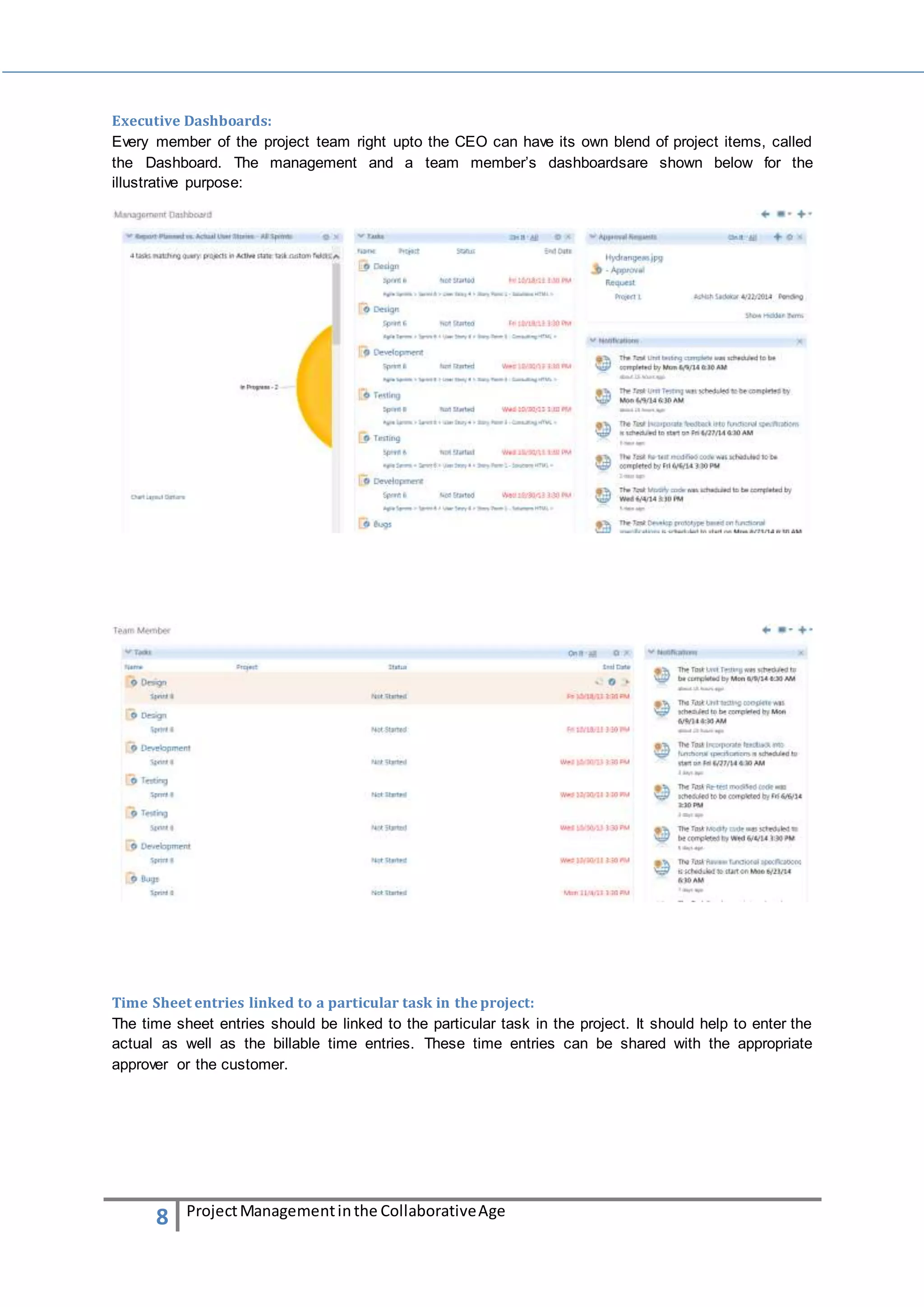
Executive Dashboards: 
Every member of the project team right upto the CEO can have its own blend of project items, called 
the Dashboard. The management and a team member’s dashboardsare shown below for the 
illustrative purpose: 
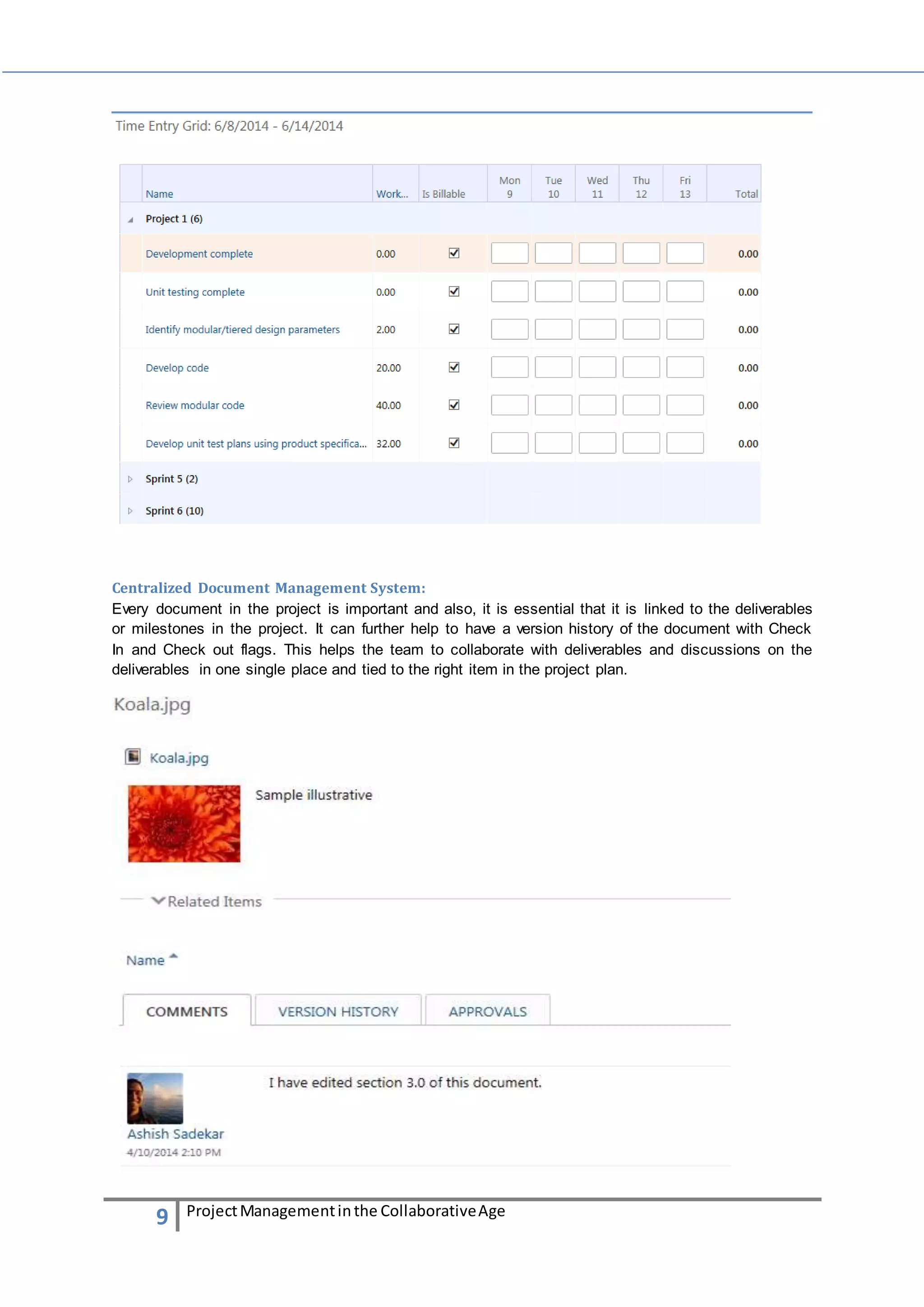
Time Sheet entries linked to a particular task in the project: 
The time sheet entries should be linked to the particular task in the project. It should help to enter the 
actual as well as the billable time entries. These time entries can be shared with the appropriate 
approver or the customer. 
8 Project Management in the Collaborative Age
Centralized Document Management System: 
Every document in the project is important and also, it is essential that it is linked to the deliverables 
or milestones in the project. It can further help to have a version history of the document with Check 
In and Check out flags. This helps the team to collaborate with deliverables and discussions on the 
deliverables in one single place and tied to the right item in the project plan. 
9 Project Management in the Collaborative Age
Discussion Threads: 
There was a need to communicate and discuss on issues, tasks or any other items in the project. This 
might help to gather the data and report as organization process asset, i.e., Lessons Learnt or 
Retrospectives. 
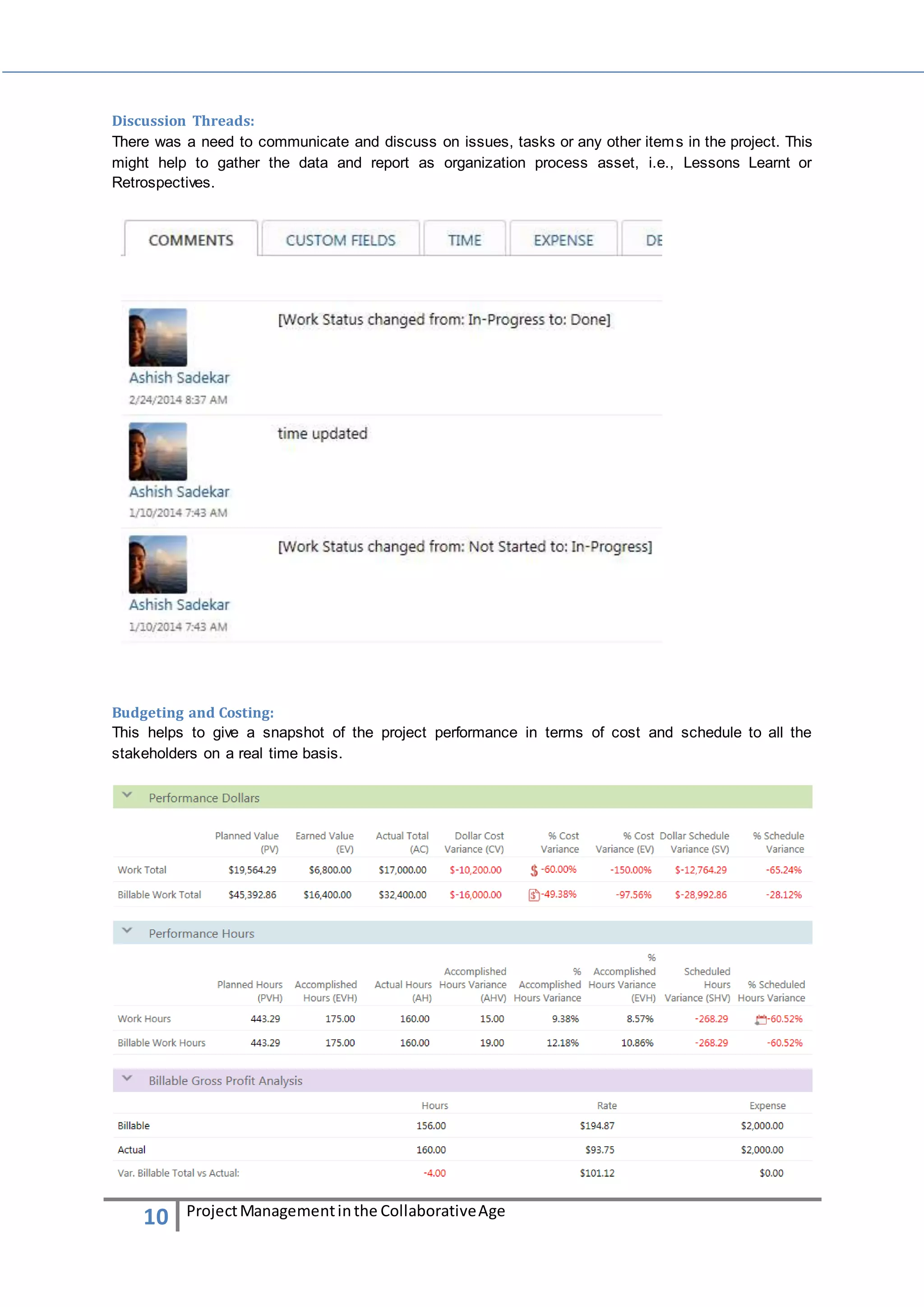
Budgeting and Costing: 
This helps to give a snapshot of the project performance in terms of cost and schedule to all the 
stakeholders on a real time basis. 
10 Project Management in the Collaborative Age
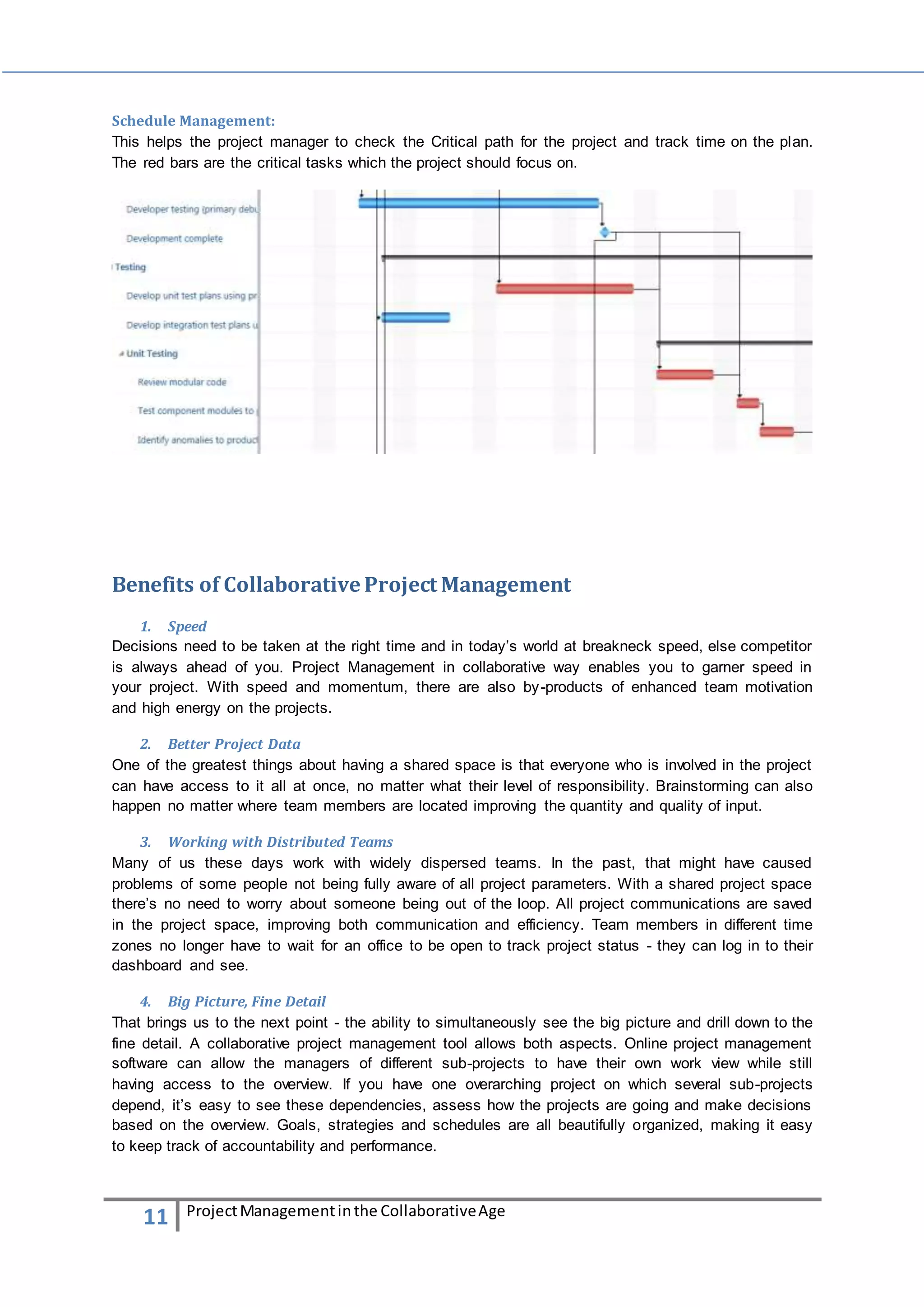
Schedule Management: 
This helps the project manager to check the Critical path for the project and track time on the plan. 
The red bars are the critical tasks which the project should focus on. 
Benefits of Collaborative Project Management 
1. Speed 
Decisions need to be taken at the right time and in today’s world at breakneck speed, else competitor 
is always ahead of you. Project Management in collaborative way enables you to garner speed in 
your project. With speed and momentum, there are also by-products of enhanced team motivation 
and high energy on the projects. 
2. Better Project Data 
One of the greatest things about having a shared space is that everyone who is involved in the project 
can have access to it all at once, no matter what their level of responsibility. Brainstorming can also 
happen no matter where team members are located improving the quantity and quality of input. 
3. Working with Distributed Teams 
Many of us these days work with widely dispersed teams. In the past, that might have caused 
problems of some people not being fully aware of all project parameters. With a shared project space 
there’s no need to worry about someone being out of the loop. All project communications are saved 
in the project space, improving both communication and efficiency. Team members in different time 
zones no longer have to wait for an office to be open to track project status - they can log in to their 
dashboard and see. 
4. Big Picture, Fine Detail 
That brings us to the next point - the ability to simultaneously see the big picture and drill down to the 
fine detail. A collaborative project management tool allows both aspects. Online project management 
software can allow the managers of different sub-projects to have their own work view while still 
having access to the overview. If you have one overarching project on which several sub-projects 
depend, it’s easy to see these dependencies, assess how the projects are going and make decisions 
based on the overview. Goals, strategies and schedules are all beautifully organized, making it easy 
to keep track of accountability and performance. 
11 Project Management in the Collaborative Age
5. Saving Money 
And let’s not forget about the financial benefits. You deliver the project well within your schedule with 
your planned effort, involving your stakeholders and increased customer satisfaction. This definitely 
augurs well for your next project, isn’t it? 
The Future - Collaborative project management: 
Project Management in the Collaborative has set in; the quicker the decision makers and project 
managers realize the better for them and their organizations. Project Management in the diverse and 
dynamic environment would be challenging and there is no other option, but to operate in a 
collaborative way to succeed in your projects. 
The idea is to quickly become aware of this fact, use the collaborative way of working together, which 
involves the people, processes and tools to win in your projects. It is the time now to do the project in 
a different way. Let’s adopt and adapt – and make a new beginning and succeed in our projects. 
Let’s embrace the Project Management in the Collaboration Age. 
References: 
http://en.wikipedia.org/wiki/Collaborative_project_management 
http://www.icoordinator.com/en/blog/collaborative-project-management 
12 Project Management in the Collaborative Age
About the Author 
Ashish Sadekar is passionate about project management and likes to call himself as an aspiring 
thought leader in this space. And he decided to devote his further career specifically for this field and 
turned an entrepreneur exclusively focussing on project management space. His company, 
ProThoughts, offers collaborative project management software, advisory & training services, and 
advanced project management concepts / theories. He is an invited speaker on PM forums and his 
papers are selected for prestigious project events (this is one among many). He is a visiting faculty to 
the city’s top 2 B-schools for Project Management. He is PfMP (one of the 1st few in Portfolio), PMP, 
Scrum Alliance certified and has trained more than 1000 project practitioners so far. 
Ashish had the privilege of working with the best minds in the top companies he has worked so far. 
He has worked with Microsoft where he bootstrapped the Consulting practice for Dynamics in India 
and he led a unit in SAS India, a leader in Business Intelligence. Earlier, he has worked with top 
Indian organizations like Infosys and TCS where he executed some of the first and complex deals. He 
is well versed with technology and especially in ERP, CRM and Business Intelligence & Analytics. 
He is an active member with PMI Mumbai chapter and participates in the certification training and 
other volunteer activities of the chapter. 
Details: 
Communication Address: E 604, OberoiSplendor, JVLR, Andheri (East) - 400060 
Email Address: ashish_sadekar@hotmail.com 
Mobile Number: +91 9820982723 
13 Project Management in the Collaborative Age

Presentation by ashish sadekar

  • 1.
    Mantra for leveragingEmerging Trends Ashish Sadekar Director ProThoughts 0 Project Management in the Collaborative Age
  • 2.
    Project Management in the Collaborative Age The Emerging Trend of Project Management Project management has travelled a long journey and in no uncertain terms, ready for a big leap to experience a new adventure and embrace a new way of managing a project which will reap high dividends and benefits. It will multiply the chances of success. To take you back, when project management started, the major challenges as we all practitioners remember has been communications and stakeholder management. They are going to be still there but with new age technology the project manager of today and tomorrow has a lot of ammunition to take care of these challenges. The new project manager and importantly the stakeholders will glued to their smartphones and will be under pressure to have all the project data to take important decisions in the dynamic environment. Tomorrow’s project management will be shaped by this ammunition, the tools of the project manager which can help the projects to succeed. These tools will typically be on the cloud and work with a SaaS (software as a Service model) and will throw real time analytics, such as Earned Value analysis and dashboards on your smartphones. There will be strong collaborative platform perhaps integrated with your social media streams such as Facebook, etc. This paper details such a futuristic model and platform of project management. Ashish Sadekar 6/9/2014 1 Project Management in the Collaborative Age
  • 3.
    Table of Contents INTRODUCTION ........................................................................................................................................................................3 DEFINITION OF COLLABORATIVE PROJECT MANAGEMENT............................................................................................3 PROJECT MANAGEMENT AS WE KNOW IT .........................................................................................................................4 THE FUTURE MODEL OF PROJECT MANAGEMENT – THE COLLABORATIVE PROJECT MANAGER...........................4 COLLABORATIVE PROJECT MANAGEMENT TOOL – A CASE STUDY...............................................................................5 BENEFITS OF COLLABORATIVE PROJECT MANAGEMENT ............................................................................................. 11 THE FUTURE - COLLABORATIVE PROJECT MANAGEMENT: .......................................................................................... 12 2 Project Management in the Collaborative Age
  • 4.
    Introduction Project managementhas travelled a long journey and in no uncertain terms, ready for a big leap to experience a new adventure and embrace a new way of managing a project which will reap high dividends and benefits. It will multiply the chances of success. To take you back, when project management started, the major challenges as we all practitioners remember has been communications and stakeholder management. They are going to be still there but with new age technology the project manager of today and tomorrow has a lot of ammunition to take care of these challenges. In fact, technology advances gives newer opportunities and also throws different and unique problems to handle. Today’s project manager will have a diverse workforce who will be physically around in the globe but always connected as if you are sitting in a war room. The days are not far when video data would be used extensively to communicate in a project scenario and would appear as a commonplace item. The need for immediate data and hence, immediate decisions in this dynamic world of multitude of stakeholders would be demanding on the project manager. How will the today’s project manager react to this situation? How can he manage the project and yet deliver it to success. This paper will discuss the means and the only way to achieve this by working out a Collaborative way in project management, and introduce the innovative way - Project Management in Collaboration Age. This is a strong emerging trend which needs to be adopted and adapted fast in the project management world. Welcome to the collaborative world of project management. But what exactly is this collaborative project management? What’s this buzz word that everyone’s talking about in project management circles? Is this just a buzz word or do you want to suggest that the project management was not collaborative earlier? Let’s figure out. Definition of Collaborative Project Management Collaborative project management is based on the principle of actively involving all project members in the planning and control process and of networking all the project members using information, communication, and collaboration modules. Management is not regarded as an activity reserved solely for managers but as an integral part of the project work of all team members. Collaborative project management makes extensive use of localized control loops. Complex projects are broken down into smaller "more tangible" sub-systems which are then assigned to members of the relevant departments. Consequently, planning and control responsibility is assumed by those who are also responsible for project content. Sub-plans are networked and synchronized to tie all partners into the system of planning and control and to promote a common understanding of overall planning. Changes and/or delays are communicated directly to the relevant project members without active intervention in their areas of responsibility. The technical platform on which collaborative project management builds is a central database that makes current and consistent planning data available to all project participants wherever they may be located. Communication and collaboration are the basis for early identification of the impact of potential problems on linked sub-projects. They create a high level of transparency and a shared awareness of quality among team members. 3 Project Management in the Collaborative Age
  • 5.
    Project Management aswe know it Isn’t the collaborative project management applicable in the earlier era of project management or even now? What’s so new about this project management in collaborative way? In our earlier times or even, I would not be wrong is stating that in our present times, project management as a discipline is still evolving. Project management, especially in the Indian diaspora is still evolving and is not being treated as a necessary function to deliver projects. The project management as a function and the project management knowledge is still not perceived as game changer or even a mere “changer” in the delivery of the projects. The crux is do we manage projects in the collaborative way currently? The collaborative way is some miles ahead, however, the right people and employers are slowly recognizing the need for project management. The awareness is getting built for project management as a function in the organization. For example, one of my clients, a large pharma client is slowly recognizing the need for project management and moving from the project co-ordinating kind of work with empowering the project manager to deliver the projects successfully. They have involved all their executive directors to understand the essence of project management and investing heavily to get the right talent, right processes and the right tools to win in their projects. It is necessary for all sectors as in pharma that projects are delivered within the schedule. For example, any delay of a day in pharma means a large revenue being lost, as the pharma company gains most of the revenue share in the early launch of the product. Similarly, in the telecom industry, a day’s delay in product launch or even a marketing gimmick would result in a heavy loss of revenue or mindshare of customer. Everyone, including the IT sector is waking up to the right way of doing the project management. To sum it up, the current project management seriously lacks collaboration and a lot of organizations are looking for the right way of doing the projects. It is time that it is quickly latches up the collaborative way of doing the projects to succeed in the projects. The Future Model of Project Management – The collaborative project manager As touched upon in the previous sections, tomorrow’s workforce will shift to the smartphones or video phones and will be a mobile diverse team. As a research suggests, the project team will be global workforce working in different time zones with their different culture sets and thriving in a dynamic environment. One common thread across the different culture set is the virtue of impatience; this workforce will need data on real time basis else can even be a de-motivator for the team. Can the current project manager survive with its own MS project desktop version running behind every team member for the updates. No wonder the project manager today is considered an overhead in the team and is seen as a non – value adding person providing statuses to the management. The Collaborative age of project management will provide real time status and immediate data to take decisions in the project, among many other things. The future of the project management is the Collaborative Age of Project Management. The collaborative project management methodology provides adequate support for the widespread practice of working in development teams with direct responsibility.  Proactive, tool-assisted communication and collaboration replace the rigid algorithms of conventional project management systems.  A central database provides current and uniform planning information for all project members – even between companies and across locations. 4 Project Management in the Collaborative Age
  • 6.
     Clearly allocatedresponsibilities and interfaces promote transparency and currency of information, thus ensuring improved planning reliability and quality.  Project management sets up a top-down planning framework by defining important milestones and key data. Project members plan their work scopes independently, confirm that specified requirements have been fulfilled, and assume direct responsibility for coordination with other sub-projects.  Communication modules permit simple and intuitive networking of sub-projects and thus support rapid and transparent problem resolution processes. Changes are communicated automatically to those involved and problems are resolved by reaching mutual agreement on suitable measures.  Managing the tasks all the way through the process with a central workspace enabling the users the ability to have greater information at less cost/time. This is because it enables the team to work on what is needed and provide updates almost without thinking about it.  Having a collaboratively updated task list also allows automatic creation of burn-down charts, or other reporting; again facilitating the project manager’s role and allowing them to quickly understand if items are running late. Further, good knowledge management replaces the difficulties of file storage and hidden deposits of valuable information. Whilst a project manager may keep excellent documentation, the issue tends to come several months later when trying to find out information. Or, as we’ve all experienced, when you take over from a departing PM and have to try and pick up where they left off.  Collaboration software steps around these issues if properly managed by enabling searc h and by spreading the knowledge around the team as to where things are stored. Collaborative tools are the social media of the workplace. Generally presenting as a central dashboard or workspace that everyone has access to and has a reason to use, they increase the team’s buy-in to the project rather than just their work package. These tools tend to support three key areas:  Knowledge management: Whether this is the enterprise item like SharePoint or a centrally maintained wiki, it is difficult to argue that having a central location that is searchable and collaborative is anything other than beneficial.  Running a project: One of the biggest areas that has seen a range of developments is the area of issue management. Tools allowing each task that is required to be tracked, and effort, issues logged by the person responsible for delivery and then transitioned through a proper workflow have a significant impact of how a project can be run.  Reporting & Analytics: Making sense of the data captured through the knowledge management and giving reports suiting different stakeholders tastes and preferences, leaves a satisfied customer at the end of the project. The reports and analytics provide real time updates which helps to take decisions at the right time for the right people. Let’s understand a live case study of Project Management in Collaborative Age… Collaborative Project Management tool – A Case Study The collaborative way of project management can be best explained by an actual live case study where it was implemented and the benefits were clearly visible. The Project management in Collaborative age has arrived and the below case study illustrates the point well. The case study illustrated below is for a mid-sized Gaming IT company based out of Noida, India. Organization Background: The organization is a leading developer of high quality innovative game content and game development for the online, land-based, mobile and social gaming platforms. Its’ primary area of 5 Project Management in the Collaborative Age
  • 7.
    business is theestablished services sector that provides subcontracted game art and software for the industry. Regarding the projects, it is a 200 member team and grown organically over the last 6 years. This organization is based out of Noida, New Delhi, India. Some of the typical aspects of their projects were:  At any given moment of time, there are around of 25 -50 projects handled by 2 project managers and assisted by 3-4 team leaders.  The project team is typically of 5 member team and the duration of each of the project is around 4-5 month period.  The Project manager reports directly into the managing director and is a senior authority in the organization.  Before the collaborative way of working, the projects were managed in excel spreadsheets.  The communication earlier used to happen verbally or through mails, i.e., Microsoft Outlook.  The Configuration Management function happens with VSS and managed separately, and not tied up to the projects. Challenges: Some of the typical challenges the projects faced:  The entire effort to create, execute, track and close the project is manual which results into a lot of time and lot of mistakes.  Only a single person can track the excel sheet at any given point of time which adds to idle time and lack of collaborative effort, again leading to wastage of time and constrained time.  Excel involves a lot of macros and formulae and in case, any of the logic is modified, it takes a mammoth effort to correct and restore it to original. Maintenance of the project worksheets is quite a huge task in terms of cost and money.  A lot of time and energy is invested in communication the project updates; excel screenshot is being taken and sent to the team and the details have to be explained on 1:1 basis. Standardization and Collaboration is lacking in the projects.  Due to the lack of proper data, a lot of time in invested to get the correct data and find different trends and variances. In case of any issue, a good amount of time is invested to find the root causes and the real cause of the problem.  Due to lack of data, quality of reports is lacking. Solution Description: For the paucity of the technical paper, the critical aspects of the collaborative way of working in the projects are highlighted. These critical features along with other ancillary functionality helped overcome the challenges and reap high value to their projects. The customer in this case, has mentioned that it helped them to get repeat business and even one of their customers wants to implement a similar way of project management. A Central Repository of Data: Data should be stored in a single place and every element of the data should be appropriately linked to create a meaningful data. Ability to generate Data and high quality reports: The data if mined properly should generate high quality reports and analytics for quick decision making. Attached are some of the snapshots of some critical reports used in various projects. 6 Project Management in the Collaborative Age
  • 8.
    7 Project Managementin the Collaborative Age
  • 9.
    Executive Dashboards: Everymember of the project team right upto the CEO can have its own blend of project items, called the Dashboard. The management and a team member’s dashboardsare shown below for the illustrative purpose: Time Sheet entries linked to a particular task in the project: The time sheet entries should be linked to the particular task in the project. It should help to enter the actual as well as the billable time entries. These time entries can be shared with the appropriate approver or the customer. 8 Project Management in the Collaborative Age
  • 10.
    Centralized Document ManagementSystem: Every document in the project is important and also, it is essential that it is linked to the deliverables or milestones in the project. It can further help to have a version history of the document with Check In and Check out flags. This helps the team to collaborate with deliverables and discussions on the deliverables in one single place and tied to the right item in the project plan. 9 Project Management in the Collaborative Age
  • 11.
    Discussion Threads: Therewas a need to communicate and discuss on issues, tasks or any other items in the project. This might help to gather the data and report as organization process asset, i.e., Lessons Learnt or Retrospectives. Budgeting and Costing: This helps to give a snapshot of the project performance in terms of cost and schedule to all the stakeholders on a real time basis. 10 Project Management in the Collaborative Age
  • 12.
    Schedule Management: Thishelps the project manager to check the Critical path for the project and track time on the plan. The red bars are the critical tasks which the project should focus on. Benefits of Collaborative Project Management 1. Speed Decisions need to be taken at the right time and in today’s world at breakneck speed, else competitor is always ahead of you. Project Management in collaborative way enables you to garner speed in your project. With speed and momentum, there are also by-products of enhanced team motivation and high energy on the projects. 2. Better Project Data One of the greatest things about having a shared space is that everyone who is involved in the project can have access to it all at once, no matter what their level of responsibility. Brainstorming can also happen no matter where team members are located improving the quantity and quality of input. 3. Working with Distributed Teams Many of us these days work with widely dispersed teams. In the past, that might have caused problems of some people not being fully aware of all project parameters. With a shared project space there’s no need to worry about someone being out of the loop. All project communications are saved in the project space, improving both communication and efficiency. Team members in different time zones no longer have to wait for an office to be open to track project status - they can log in to their dashboard and see. 4. Big Picture, Fine Detail That brings us to the next point - the ability to simultaneously see the big picture and drill down to the fine detail. A collaborative project management tool allows both aspects. Online project management software can allow the managers of different sub-projects to have their own work view while still having access to the overview. If you have one overarching project on which several sub-projects depend, it’s easy to see these dependencies, assess how the projects are going and make decisions based on the overview. Goals, strategies and schedules are all beautifully organized, making it easy to keep track of accountability and performance. 11 Project Management in the Collaborative Age
  • 13.
    5. Saving Money And let’s not forget about the financial benefits. You deliver the project well within your schedule with your planned effort, involving your stakeholders and increased customer satisfaction. This definitely augurs well for your next project, isn’t it? The Future - Collaborative project management: Project Management in the Collaborative has set in; the quicker the decision makers and project managers realize the better for them and their organizations. Project Management in the diverse and dynamic environment would be challenging and there is no other option, but to operate in a collaborative way to succeed in your projects. The idea is to quickly become aware of this fact, use the collaborative way of working together, which involves the people, processes and tools to win in your projects. It is the time now to do the project in a different way. Let’s adopt and adapt – and make a new beginning and succeed in our projects. Let’s embrace the Project Management in the Collaboration Age. References: http://en.wikipedia.org/wiki/Collaborative_project_management http://www.icoordinator.com/en/blog/collaborative-project-management 12 Project Management in the Collaborative Age
  • 14.
    About the Author Ashish Sadekar is passionate about project management and likes to call himself as an aspiring thought leader in this space. And he decided to devote his further career specifically for this field and turned an entrepreneur exclusively focussing on project management space. His company, ProThoughts, offers collaborative project management software, advisory & training services, and advanced project management concepts / theories. He is an invited speaker on PM forums and his papers are selected for prestigious project events (this is one among many). He is a visiting faculty to the city’s top 2 B-schools for Project Management. He is PfMP (one of the 1st few in Portfolio), PMP, Scrum Alliance certified and has trained more than 1000 project practitioners so far. Ashish had the privilege of working with the best minds in the top companies he has worked so far. He has worked with Microsoft where he bootstrapped the Consulting practice for Dynamics in India and he led a unit in SAS India, a leader in Business Intelligence. Earlier, he has worked with top Indian organizations like Infosys and TCS where he executed some of the first and complex deals. He is well versed with technology and especially in ERP, CRM and Business Intelligence & Analytics. He is an active member with PMI Mumbai chapter and participates in the certification training and other volunteer activities of the chapter. Details: Communication Address: E 604, OberoiSplendor, JVLR, Andheri (East) - 400060 Email Address: ashish_sadekar@hotmail.com Mobile Number: +91 9820982723 13 Project Management in the Collaborative Age