Security Challenges
        in the
  Current World Order


        Sebastian Kautz
Security Challenges
                           in the
          Current World Order


          Security, Politics, the International Community...

                   … what are we talking about?

             How did we get to the current world order?

Is it possible to create a logically coherent theoretical framework for

                       International Security?
Security Studies and
        Critical Analysis


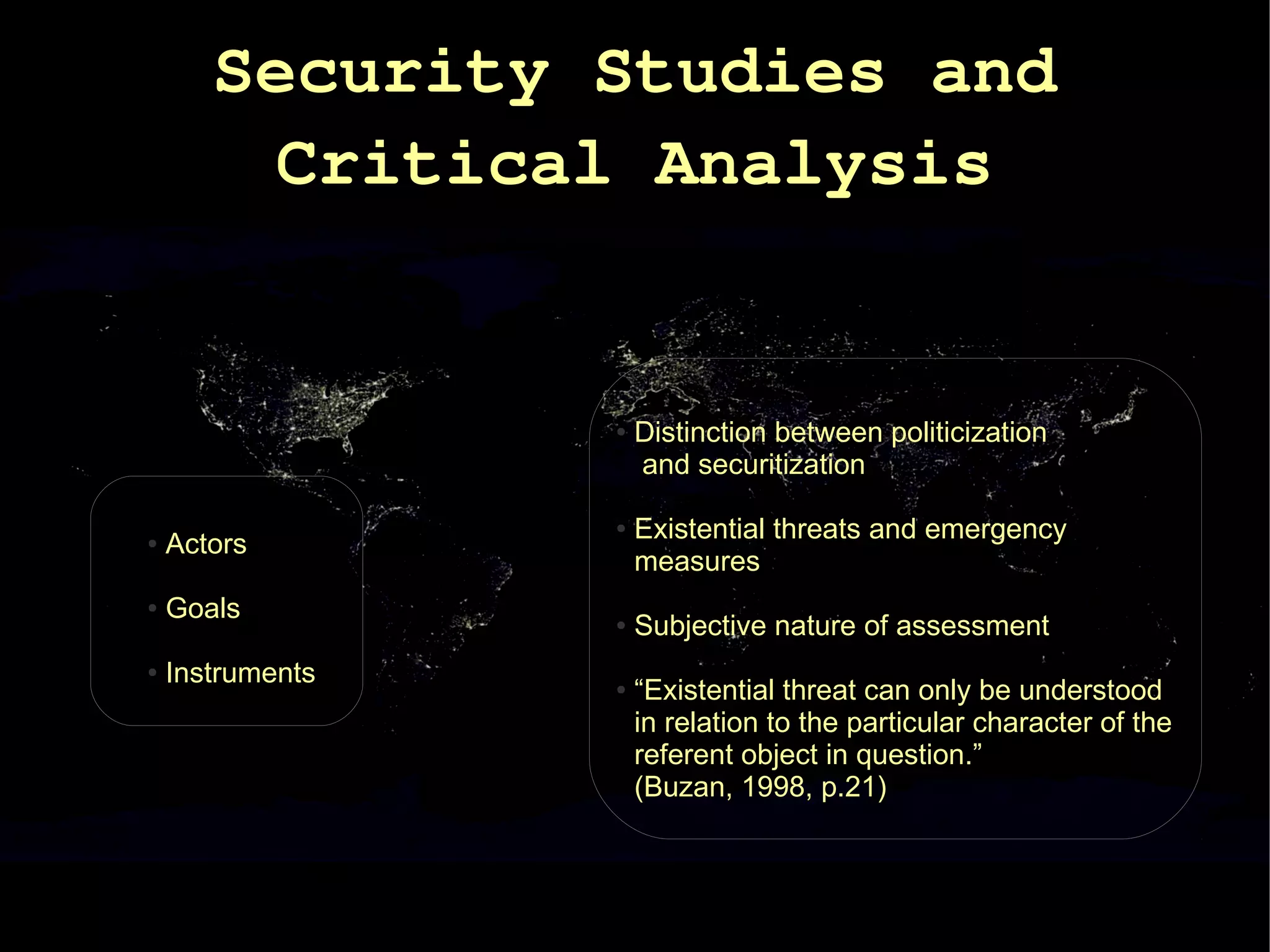
                  ●   Distinction between politicization
                      and securitization

                  ●   Existential threats and emergency
●   Actors
                      measures
●   Goals         ●   Subjective nature of assessment
●   Instruments   ●   “Existential threat can only be understood
                      in relation to the particular character of the
                      referent object in question.”
                      (Buzan, 1998, p.21)
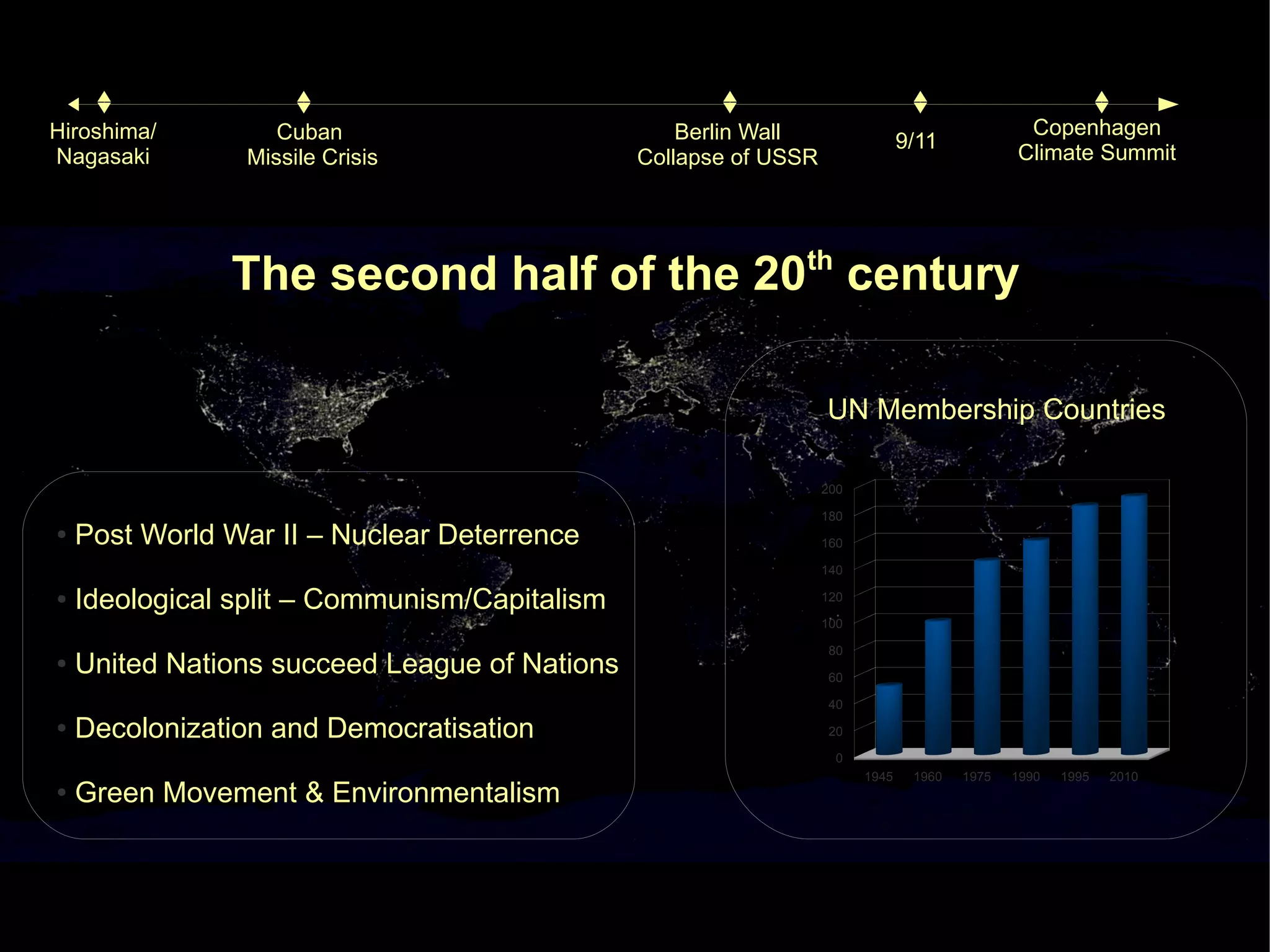
Hiroshima/         Cuban                           Berlin Wall                                 Copenhagen
                                                                               9/11
Nagasaki        Missile Crisis                 Collapse of USSR                               Climate Summit


               The second half of the 20th century

                                                                  UN Membership Countries

                                                                  200

                                                                  180
●   Post World War II – Nuclear Deterrence                        160

                                                                  140

●   Ideological split – Communism/Capitalism                      120

                                                                  100

                                                                   80
●   United Nations succeed League of Nations                       60

                                                                   40
●   Decolonization and Democratisation                             20

                                                                    0
                                                                        1945    1960   1975   1990   1995   2010
●   Green Movement & Environmentalism
Hiroshima/                          Cuban                                                      Berlin Wall                               Copenhagen
                                                                                                                         9/11
  Nagasaki                         Missile Crisis                                            Collapse of USSR                             Climate Summit


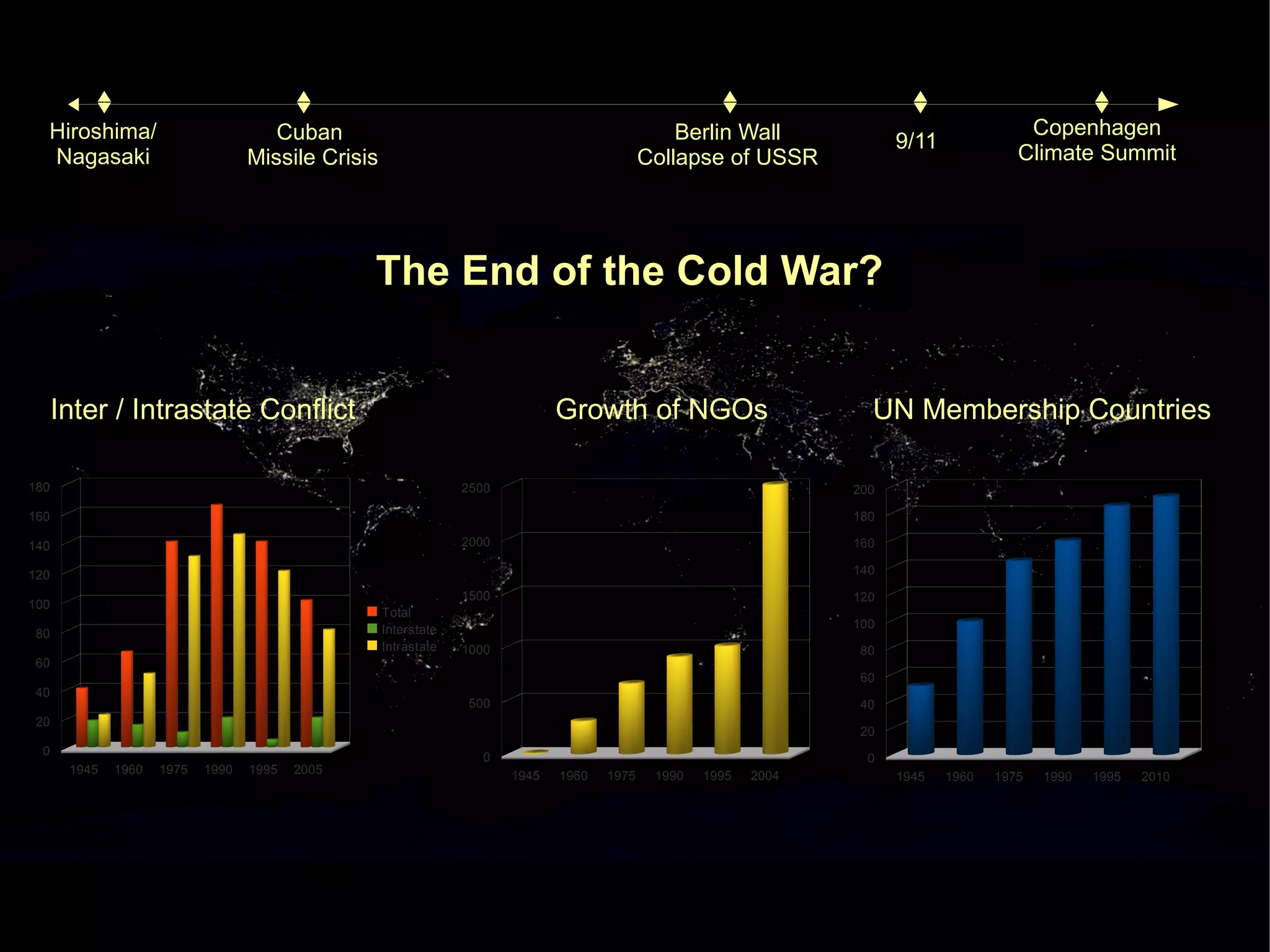
                                                 The End of the Cold War?


      Inter / Intrastate Conflict                                              Growth of NGOs                        UN Membership Countries

180                                                              2500                                              200

160                                                                                                                180

140                                                              2000                                              160

120                                                                                                                140

                                                                 1500                                              120
100
                                                    Total
                                                    Interstate                                                     100
 80
                                                    Intrastate   1000                                               80
 60
                                                                                                                    60
 40
                                                                  500                                               40
 20
                                                                                                                    20
  0                                                                 0                                                0
       1945   1960   1975   1990   1995   2005                          1945   1960   1975    1990   1995   2004         1945   1960   1975   1990   1995   2010
Hiroshima/            Cuban                      Berlin Wall                   Copenhagen
                                                                    9/11
Nagasaki           Missile Crisis            Collapse of USSR                 Climate Summit


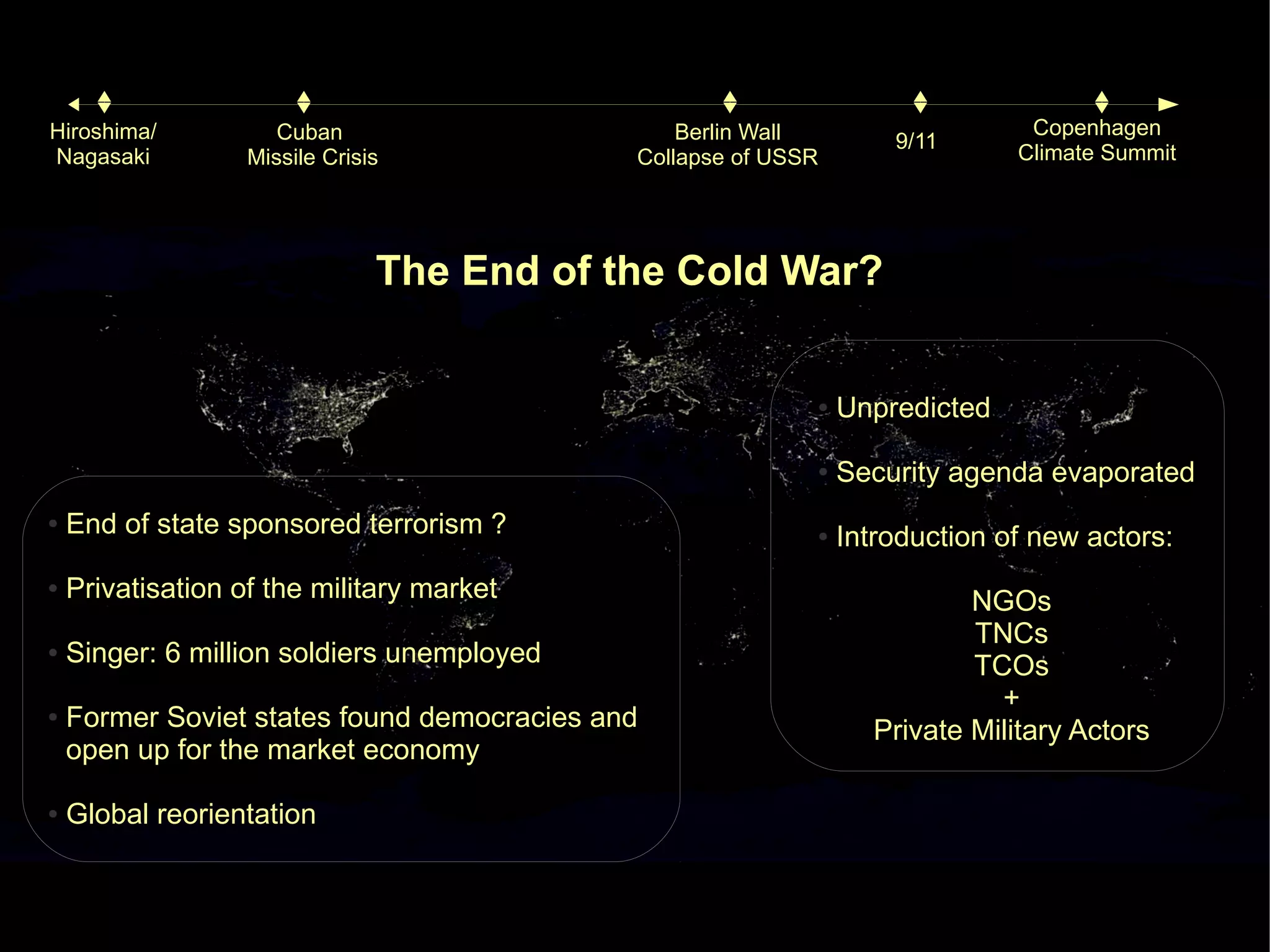
                                The End of the Cold War?


                                                            ●   Unpredicted

                                                            ●   Security agenda evaporated
●   End of state sponsored terrorism ?                      ●   Introduction of new actors:
●   Privatisation of the military market                                  NGOs
                                                                          TNCs
●   Singer: 6 million soldiers unemployed                                 TCOs
                                                                            +
●   Former Soviet states found democracies and                    Private Military Actors
    open up for the market economy

●   Global reorientation
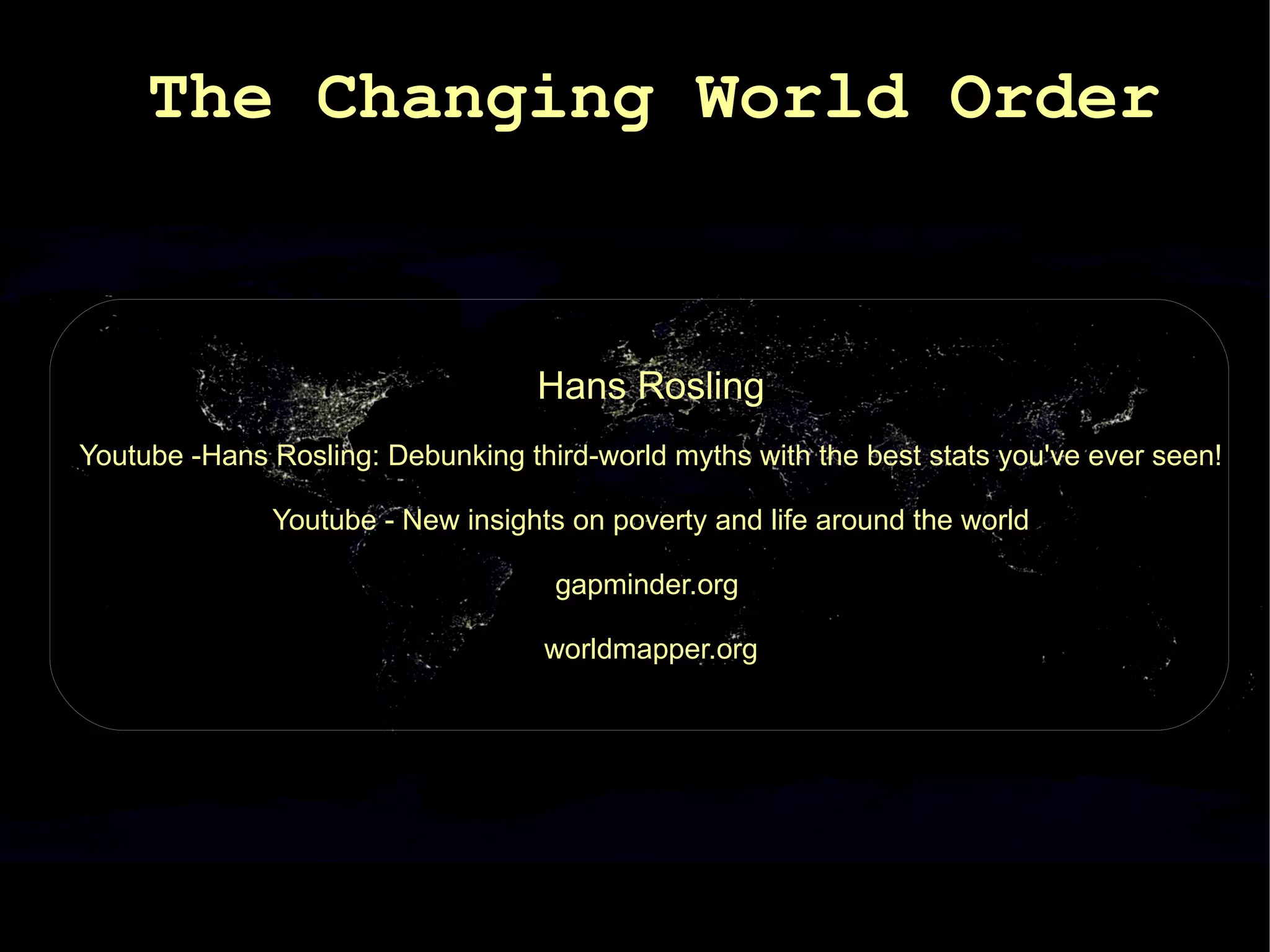
The Changing World Order


                                   Hans Rosling
Youtube -Hans Rosling: Debunking third-world myths with the best stats you've ever seen!

              Youtube - New insights on poverty and life around the world

                                    gapminder.org

                                   worldmapper.org
Hiroshima/      Cuban             Berlin Wall            Copenhagen
                                                  9/11
 Nagasaki     Missile Crisis   Collapse of USSR          Climate Summit


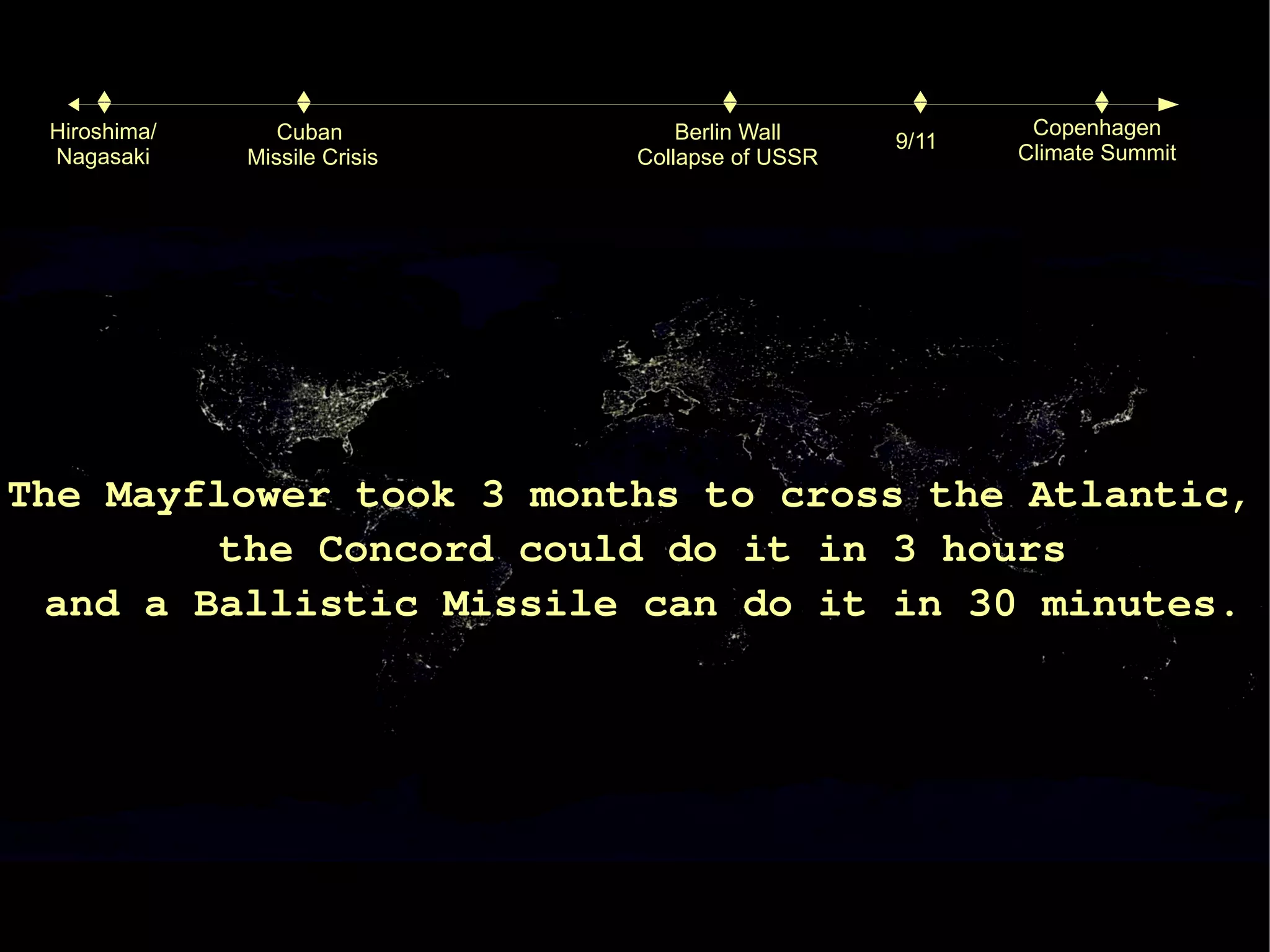
The Mayflower took 3 months to cross the Atlantic,
         the Concord could do it in 3 hours
  and a Ballistic Missile can do it in 30 minutes.
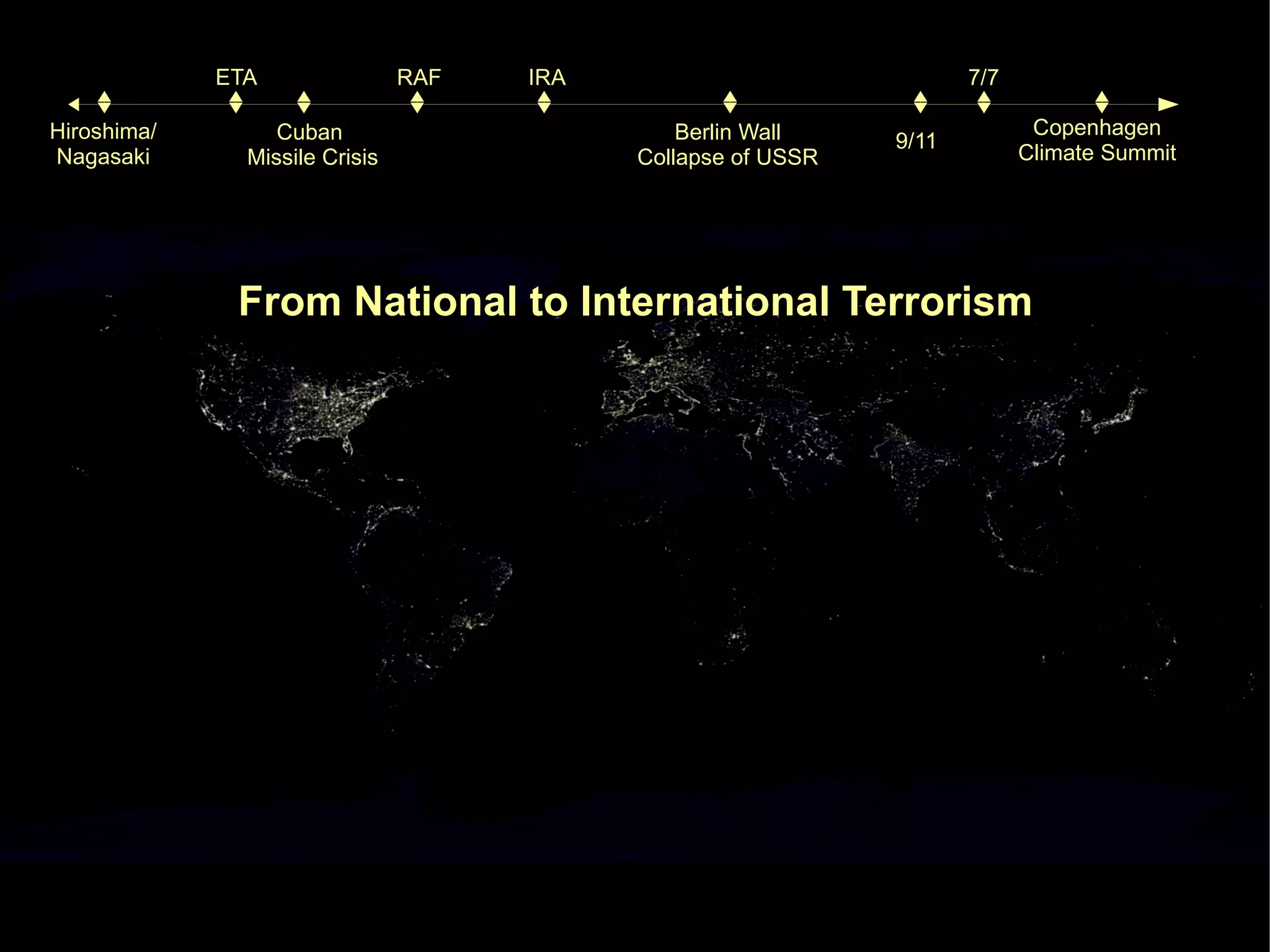
ETA                RAF   IRA                             7/7

Hiroshima/        Cuban                         Berlin Wall                  Copenhagen
                                                               9/11
Nagasaki       Missile Crisis               Collapse of USSR                Climate Summit


              From National to International Terrorism
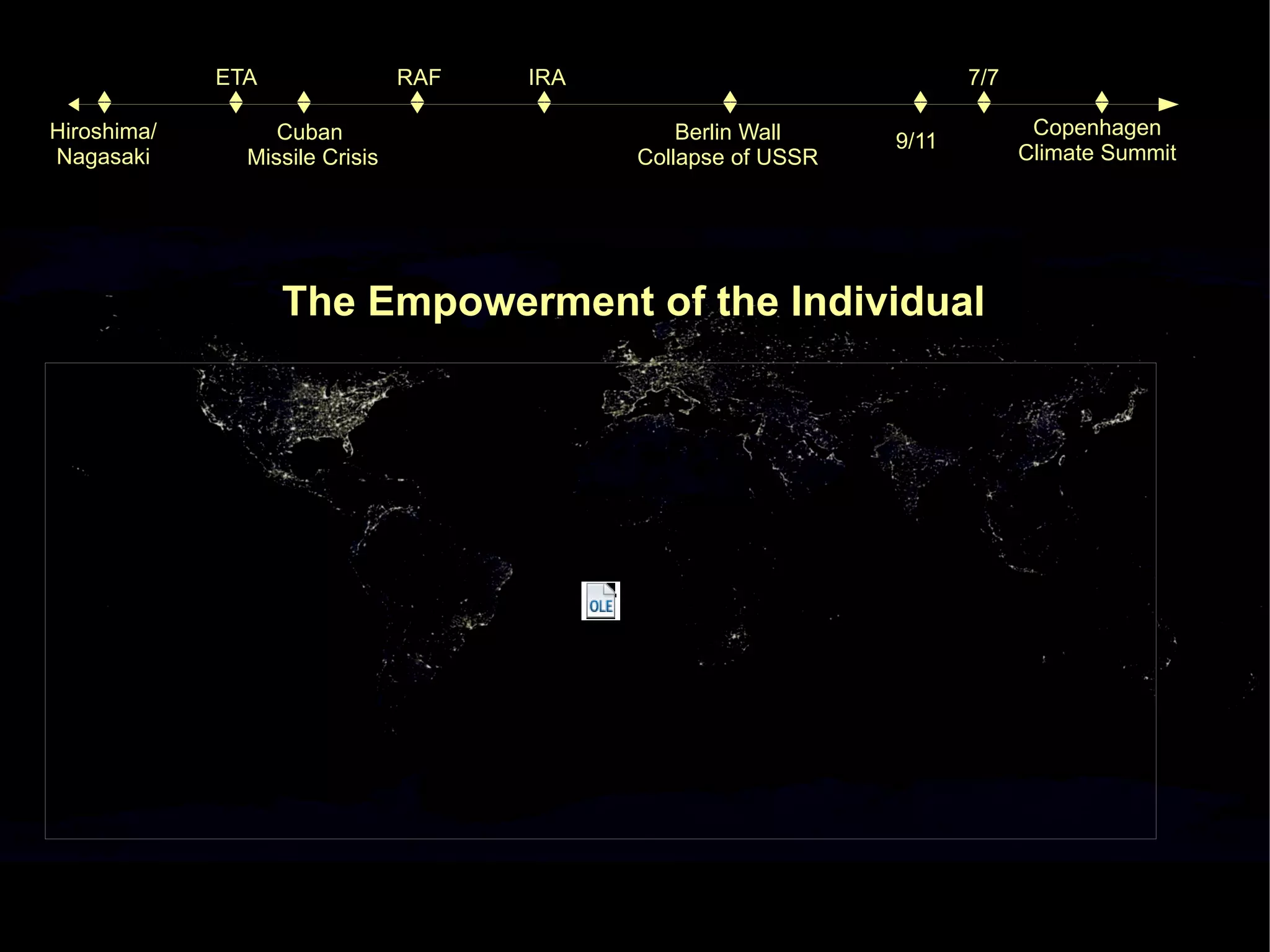
ETA                RAF   IRA                             7/7

Hiroshima/        Cuban                         Berlin Wall                  Copenhagen
                                                               9/11
Nagasaki       Missile Crisis               Collapse of USSR                Climate Summit


                   The Empowerment of the Individual
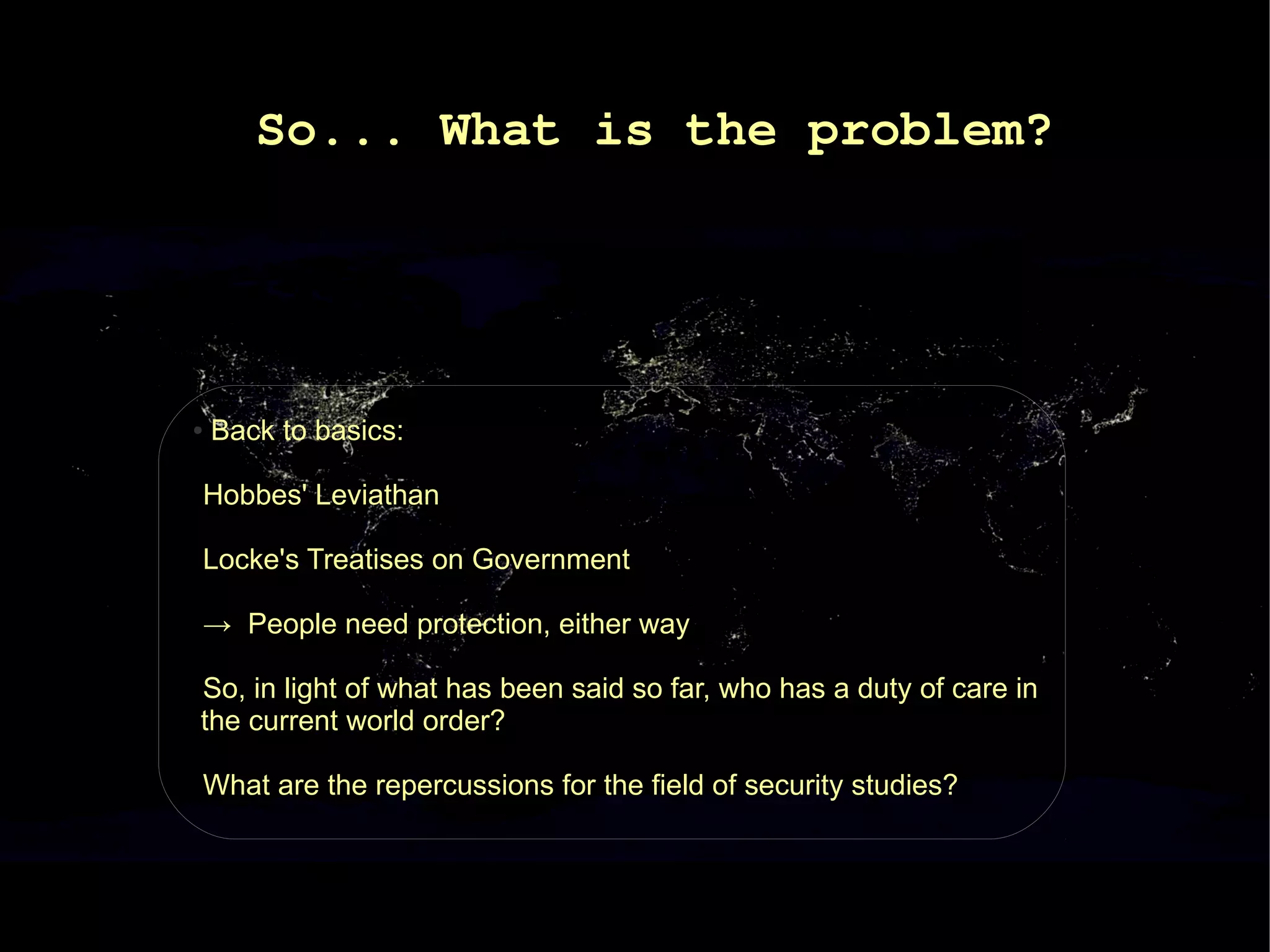
So... What is the problem?


●   Back to basics:

Hobbes' Leviathan

Locke's Treatises on Government

→ People need protection, either way

So, in light of what has been said so far, who has a duty of care in
the current world order?

What are the repercussions for the field of security studies?
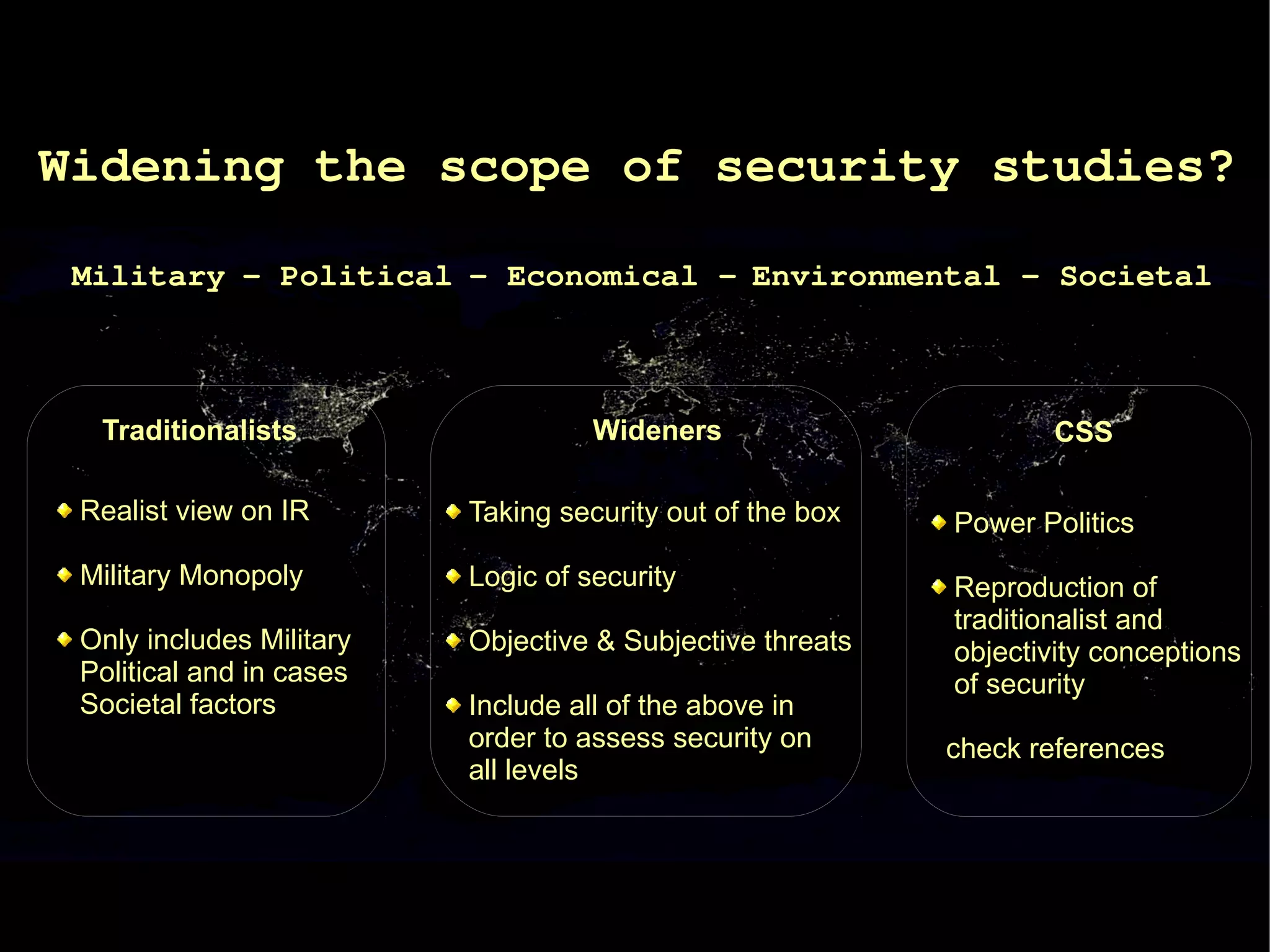
Widening the scope of security studies?

 Military - Political - Economical - Environmental - Societal


  Traditionalists                   Wideners                       CSS

 Realist view on IR       Taking security out of the box   Power Politics
 Military Monopoly        Logic of security                Reproduction of
                                                           traditionalist and
 Only includes Military   Objective & Subjective threats   objectivity conceptions
 Political and in cases                                    of security
 Societal factors         Include all of the above in
                          order to assess security on      check references
                          all levels
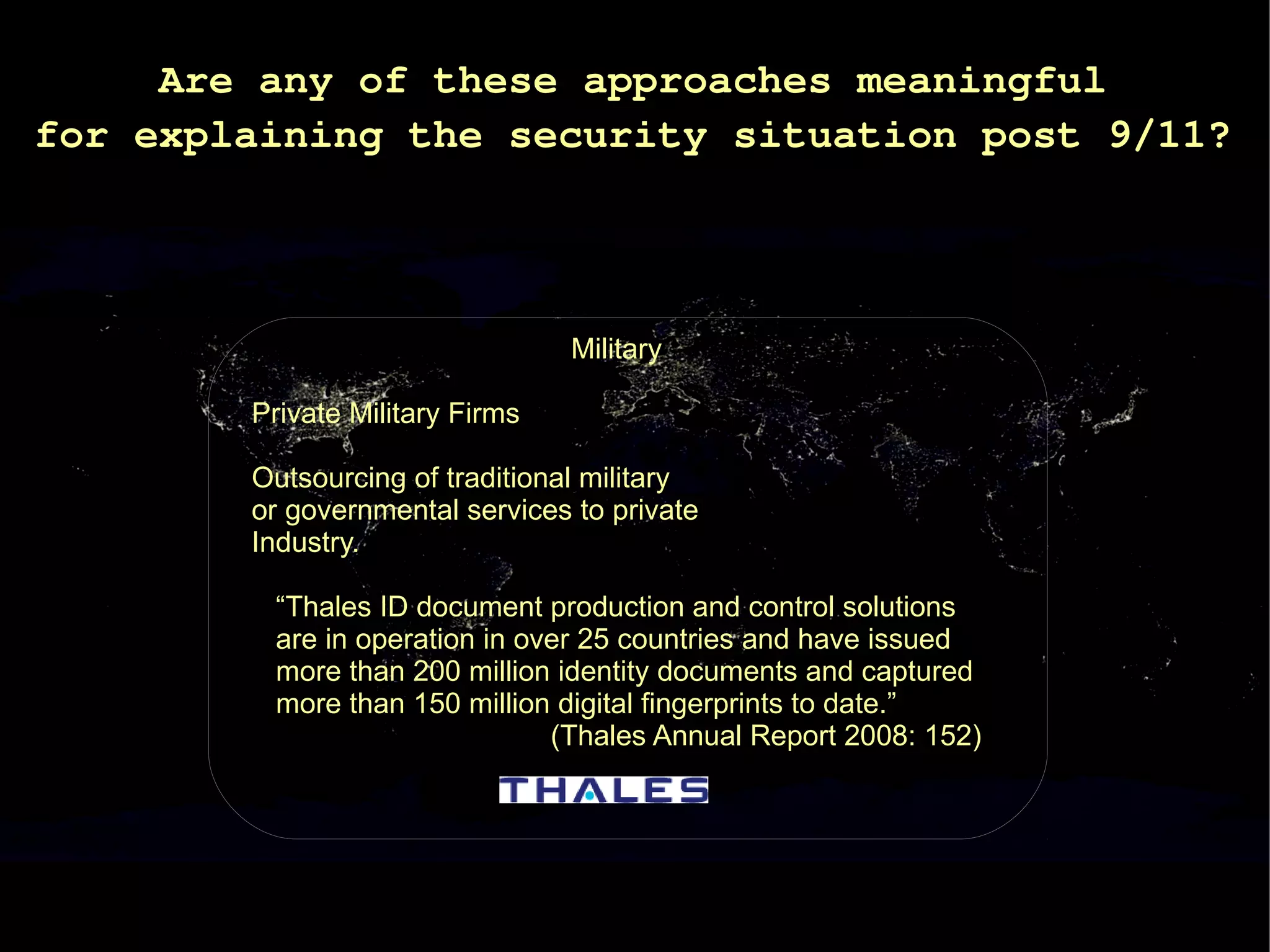
Are any of these approaches meaningful
for explaining the security situation post 9/11?


                                 Military

        Private Military Firms

        Outsourcing of traditional military
        or governmental services to private
        Industry.

         “Thales ID document production and control solutions
         are in operation in over 25 countries and have issued
         more than 200 million identity documents and captured
         more than 150 million digital fingerprints to date.”
                               (Thales Annual Report 2008: 152)
Are any of these approaches meaningful
for explaining the security situation post 9/11?


                                    Criminal

         Traditionally operating without boarders

         Exploitation of niches and adoption to new “business models”

         Cyberspace
Is Cyberspace
the battlefield of the 21st century?


                          Meet Stuxnet


 ●   New form of computer virus targeting industrial mainframes

 ●   Not only programmed to spy on systems but also to reprogram

 ●   Unprecedented level of sophistication

 → Zombie machines and unsuspecting users
Instruments & Goals


                                  Are they adequate given the nature of new
                                  Threats?
National and International Law
                                  Do they allow a global response?
United Nations Security Council

EU Battle group
                                  How are we going to define global goals?
Sanctions
                                  What did the Climate Summit 2009 tell us?
In conclusion...


 … a holistic approach to Security Studies seems to be more
 striking than the outdated Traditionalist view and CSS

However, the Copenhagen School has been heavily criticised
for being to swift, and too 'broad' in their approach... one central
criticism is that any theoretical framework needs a real world
problem that can not be solved by existing theories.

A new framework for analysis lacks purpose and adequacy 12
years after it was initially published.

Still, the Copenhagen School contributed to the field of SS in
that they created a pro pluralist theory, which is also concerned
with the language of security.
References


  Baylis, J., Smith, S., 2001 (2006), The globalisation of World Politics,
                      Oxford: Oxford University Press.

    Buxton, J., 2006, The Political Economy of Narcotics: Production,
          Consumption & Global Markets, London: Zedbooks.

Dorling, D., Newmann, M., Badford, A., 2008, The Atlas of the Real World:
         Mapping the way we live, London: Thames and Hudson.

    Nye, J. S., Welch, D. A., 2011, Understanding Global Conflict and
                  Cooperation, London: Pearson/Longman.

     Walzer, M., 1977, Just and Unjust Wars, New York: Basic Books.
References


          Skidmore, D., 1999, Reviewed work(s): Security: A New Framework for Analysis
        by Barry Buzan; Ole Weaver; Jaap de Wilde The American Politiacal Science Review
                           Vol. 93, No. 4 (Dec., 1999), pp. 1010-1011.

    Barry Buzan et al. Security: A New Framework for Analysis (1998, Lynne Rienner Publishers)

          Barry Buzan, “Rethinking Security After the Cold War” Cooperation and Conflict
                                  (March 1997): 32:1, pp. 5-28.

     R.T. Naylor, “From Cold War to Crime War” Transnational Organised Crime (Winter 1995).

Xavier Raufer, “New World Disorder, New Terrorism: New Threats for Europe and the Western World”
                  Terrorism and Political Violence (Winter 1999), 11:4, pp. 30-51.

Security Challenges Presentation (2010)

  • 1.
    Security Challenges in the Current World Order Sebastian Kautz
  • 2.
    Security Challenges in the Current World Order Security, Politics, the International Community... … what are we talking about? How did we get to the current world order? Is it possible to create a logically coherent theoretical framework for International Security?
  • 3.
    Security Studies and Critical Analysis ● Distinction between politicization and securitization ● Existential threats and emergency ● Actors measures ● Goals ● Subjective nature of assessment ● Instruments ● “Existential threat can only be understood in relation to the particular character of the referent object in question.” (Buzan, 1998, p.21)
  • 4.
    Hiroshima/ Cuban Berlin Wall Copenhagen 9/11 Nagasaki Missile Crisis Collapse of USSR Climate Summit The second half of the 20th century UN Membership Countries 200 180 ● Post World War II – Nuclear Deterrence 160 140 ● Ideological split – Communism/Capitalism 120 100 80 ● United Nations succeed League of Nations 60 40 ● Decolonization and Democratisation 20 0 1945 1960 1975 1990 1995 2010 ● Green Movement & Environmentalism
  • 5.
    Hiroshima/ Cuban Berlin Wall Copenhagen 9/11 Nagasaki Missile Crisis Collapse of USSR Climate Summit The End of the Cold War? Inter / Intrastate Conflict Growth of NGOs UN Membership Countries 180 2500 200 160 180 140 2000 160 120 140 1500 120 100 Total Interstate 100 80 Intrastate 1000 80 60 60 40 500 40 20 20 0 0 0 1945 1960 1975 1990 1995 2005 1945 1960 1975 1990 1995 2004 1945 1960 1975 1990 1995 2010
  • 6.
    Hiroshima/ Cuban Berlin Wall Copenhagen 9/11 Nagasaki Missile Crisis Collapse of USSR Climate Summit The End of the Cold War? ● Unpredicted ● Security agenda evaporated ● End of state sponsored terrorism ? ● Introduction of new actors: ● Privatisation of the military market NGOs TNCs ● Singer: 6 million soldiers unemployed TCOs + ● Former Soviet states found democracies and Private Military Actors open up for the market economy ● Global reorientation
  • 7.
    The Changing WorldOrder Hans Rosling Youtube -Hans Rosling: Debunking third-world myths with the best stats you've ever seen! Youtube - New insights on poverty and life around the world gapminder.org worldmapper.org
  • 8.
    Hiroshima/ Cuban Berlin Wall Copenhagen 9/11 Nagasaki Missile Crisis Collapse of USSR Climate Summit The Mayflower took 3 months to cross the Atlantic, the Concord could do it in 3 hours and a Ballistic Missile can do it in 30 minutes.
  • 9.
    ETA RAF IRA 7/7 Hiroshima/ Cuban Berlin Wall Copenhagen 9/11 Nagasaki Missile Crisis Collapse of USSR Climate Summit From National to International Terrorism
  • 10.
    ETA RAF IRA 7/7 Hiroshima/ Cuban Berlin Wall Copenhagen 9/11 Nagasaki Missile Crisis Collapse of USSR Climate Summit The Empowerment of the Individual
  • 11.
    So... What isthe problem? ● Back to basics: Hobbes' Leviathan Locke's Treatises on Government → People need protection, either way So, in light of what has been said so far, who has a duty of care in the current world order? What are the repercussions for the field of security studies?
  • 12.
    Widening the scopeof security studies? Military - Political - Economical - Environmental - Societal Traditionalists Wideners CSS Realist view on IR Taking security out of the box Power Politics Military Monopoly Logic of security Reproduction of traditionalist and Only includes Military Objective & Subjective threats objectivity conceptions Political and in cases of security Societal factors Include all of the above in order to assess security on check references all levels
  • 13.
    Are any ofthese approaches meaningful for explaining the security situation post 9/11? Military Private Military Firms Outsourcing of traditional military or governmental services to private Industry. “Thales ID document production and control solutions are in operation in over 25 countries and have issued more than 200 million identity documents and captured more than 150 million digital fingerprints to date.” (Thales Annual Report 2008: 152)
  • 14.
    Are any ofthese approaches meaningful for explaining the security situation post 9/11? Criminal Traditionally operating without boarders Exploitation of niches and adoption to new “business models” Cyberspace
  • 15.
    Is Cyberspace the battlefieldof the 21st century? Meet Stuxnet ● New form of computer virus targeting industrial mainframes ● Not only programmed to spy on systems but also to reprogram ● Unprecedented level of sophistication → Zombie machines and unsuspecting users
  • 16.
    Instruments & Goals Are they adequate given the nature of new Threats? National and International Law Do they allow a global response? United Nations Security Council EU Battle group How are we going to define global goals? Sanctions What did the Climate Summit 2009 tell us?
  • 17.
    In conclusion... …a holistic approach to Security Studies seems to be more striking than the outdated Traditionalist view and CSS However, the Copenhagen School has been heavily criticised for being to swift, and too 'broad' in their approach... one central criticism is that any theoretical framework needs a real world problem that can not be solved by existing theories. A new framework for analysis lacks purpose and adequacy 12 years after it was initially published. Still, the Copenhagen School contributed to the field of SS in that they created a pro pluralist theory, which is also concerned with the language of security.
  • 18.
    References Baylis,J., Smith, S., 2001 (2006), The globalisation of World Politics, Oxford: Oxford University Press. Buxton, J., 2006, The Political Economy of Narcotics: Production, Consumption & Global Markets, London: Zedbooks. Dorling, D., Newmann, M., Badford, A., 2008, The Atlas of the Real World: Mapping the way we live, London: Thames and Hudson. Nye, J. S., Welch, D. A., 2011, Understanding Global Conflict and Cooperation, London: Pearson/Longman. Walzer, M., 1977, Just and Unjust Wars, New York: Basic Books.
  • 19.
    References Skidmore, D., 1999, Reviewed work(s): Security: A New Framework for Analysis by Barry Buzan; Ole Weaver; Jaap de Wilde The American Politiacal Science Review Vol. 93, No. 4 (Dec., 1999), pp. 1010-1011. Barry Buzan et al. Security: A New Framework for Analysis (1998, Lynne Rienner Publishers) Barry Buzan, “Rethinking Security After the Cold War” Cooperation and Conflict (March 1997): 32:1, pp. 5-28. R.T. Naylor, “From Cold War to Crime War” Transnational Organised Crime (Winter 1995). Xavier Raufer, “New World Disorder, New Terrorism: New Threats for Europe and the Western World” Terrorism and Political Violence (Winter 1999), 11:4, pp. 30-51.