PRESENTATIO
 N
      on
CARL JUNG &
CONTENTS
History
Carl Jung and his theory
MBTI
Balance of personalities
HISTORY
•Carl Jung was a Swiss psychiatrist .

•His theory was built on a notion that
people are fundamentally different but also
alike.

•Acc to him the whole population is divided in
two basic types- extrovert and introvert

•His theory is a part of psychodynamic theory.
3 Levels of
      Consciousness:
Ego: conscious level; carries out daily
activities;
Personal Unconscious:         individual’s
thoughts, memories, wishes, impulses; like
Collective Unconscious: storehouse of
memories inherited from the common
ancestors of the whole human race;
Extraversion/Introversion
                 Characteristics
 An Extravert…                 An Introvert…
Expresses Thoughts          Keeps Thoughts and
and Emotions Freely         Emotions Private
Needs Relationships         (May be at Risk of
                            Saying too little)
Gives Breadth to
Life                        Needs Privacy
E’s may Seem                Gives Depth to Life
Shallow to I’s              I’s may Seem
Is Often Friendly,          Withdrawn to E’s
Talkative, Easy to          Is Often Reserved,
Know                        Quiet, Hard to Know
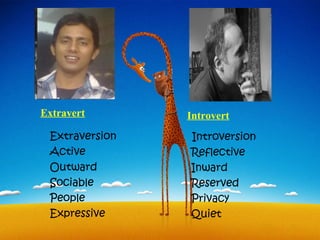
Extravert       Introvert
 Extraversion   Introversion
 Active         Reflective
 Outward        Inward
 Sociable       Reserved
 People         Privacy
 Expressive     Quiet
Why Do We Care about our Type?
The daughter-mother ,Isabel and Catherine
briggs , developed CJ theory into usable
methodology & system for understanding and
interpreting personality in 1942.
Set up Dichotomies to reflect Carl Jung’s theory of
Psychological Types
Dichotomies E/I; S/N; T/F; J/P
 The MBTI is a powerful personality profile that
gives you insight into your own and other
preferences for how you learn, how you make
decisions, for how you communicate, and for
managing time and energy. This effects every
aspect of your life.
Thinking: naming and interpreting
experience.
Feeling: evaluating an experience for its
emotional worth to us.
Sensing: experiencing the world through
the senses without interpreting or
evaluating it.
Intuiting: relating directly to the world
without physical sensation, reasoning, or
interpretation.
Sensing/Intuition
A Sensor…                  An Intuitor…
Sees Specific Parts      Sees Patterns and
And Pieces               Relationships
Lives in the Present     Lives Toward the
Enjoying What’s There.   Future, Anticipating
Prefers Handling         What Might Be
Practical Matters        Prefers Imaging
Likes Things That Are    Possibilities
Definite, Measureable    Likes Opportunities for
S’s may seem             Being Inventive
Materialistic and        N’s May Seem Fickle,
Literal Minded to Ns     Impractical Dreamers
                         to S’s
Thinking/Feeling
 Thinking             Feeling
Thinking             Feeling
Head                 Heart
Objective            Subjective
Justice              Harmony
Cool
                     Caring
Impersonal
                     Personal
Critique
Analyze              Appreciates
Precise              Empathize
Principles           Persuasive
                     Values
Judging/Perception
 Judging              Perceiving
Judgment             Perception
Organized            Flexible
Structure            Flow
Control              Experience
Decisive             Curious
Deliberate           Spontaneous
Closure              Openness
Plan                 Wait
Deadlines            Discoveries
Productive           Receptive
Balance
Judgment Needs Perception for Balance.
Judging Types use Both J and P But they
Prefer J
Perception Needs Judgment for Balance.
Perceiving Types use Both J and P But they
Prefer P
Thinking Needs Feeling for Balance. Thinking
Types use Both T and F But they Prefer T.
Feeling Needs Thinking for Balance. Feeling
Types use Both T and F But they Prefer F.
Sensing Types use Both S and N But they
Prefer S. Sensing Needs Intuition for Balance
Intuition Needs Sensing for Balance. Intuitive
Types use Both S and N But they Prefer N
PRESENTATION BY

ASHISH SHARMA
  PARUL SHANKER
Presentation

Presentation

  • 1.
    PRESENTATIO N on CARL JUNG &
  • 2.
    CONTENTS History Carl Jung andhis theory MBTI Balance of personalities
  • 3.
    HISTORY •Carl Jung wasa Swiss psychiatrist . •His theory was built on a notion that people are fundamentally different but also alike. •Acc to him the whole population is divided in two basic types- extrovert and introvert •His theory is a part of psychodynamic theory.
  • 4.
    3 Levels of Consciousness: Ego: conscious level; carries out daily activities; Personal Unconscious: individual’s thoughts, memories, wishes, impulses; like Collective Unconscious: storehouse of memories inherited from the common ancestors of the whole human race;
  • 5.
    Extraversion/Introversion Characteristics An Extravert… An Introvert… Expresses Thoughts Keeps Thoughts and and Emotions Freely Emotions Private Needs Relationships (May be at Risk of Saying too little) Gives Breadth to Life Needs Privacy E’s may Seem Gives Depth to Life Shallow to I’s I’s may Seem Is Often Friendly, Withdrawn to E’s Talkative, Easy to Is Often Reserved, Know Quiet, Hard to Know
  • 6.
    Extravert Introvert Extraversion Introversion Active Reflective Outward Inward Sociable Reserved People Privacy Expressive Quiet
  • 7.
    Why Do WeCare about our Type? The daughter-mother ,Isabel and Catherine briggs , developed CJ theory into usable methodology & system for understanding and interpreting personality in 1942. Set up Dichotomies to reflect Carl Jung’s theory of Psychological Types Dichotomies E/I; S/N; T/F; J/P The MBTI is a powerful personality profile that gives you insight into your own and other preferences for how you learn, how you make decisions, for how you communicate, and for managing time and energy. This effects every aspect of your life.
  • 8.
    Thinking: naming andinterpreting experience. Feeling: evaluating an experience for its emotional worth to us. Sensing: experiencing the world through the senses without interpreting or evaluating it. Intuiting: relating directly to the world without physical sensation, reasoning, or interpretation.
  • 9.
    Sensing/Intuition A Sensor… An Intuitor… Sees Specific Parts Sees Patterns and And Pieces Relationships Lives in the Present Lives Toward the Enjoying What’s There. Future, Anticipating Prefers Handling What Might Be Practical Matters Prefers Imaging Likes Things That Are Possibilities Definite, Measureable Likes Opportunities for S’s may seem Being Inventive Materialistic and N’s May Seem Fickle, Literal Minded to Ns Impractical Dreamers to S’s
  • 10.
    Thinking/Feeling Thinking Feeling Thinking Feeling Head Heart Objective Subjective Justice Harmony Cool Caring Impersonal Personal Critique Analyze Appreciates Precise Empathize Principles Persuasive Values
  • 11.
    Judging/Perception Judging Perceiving Judgment Perception Organized Flexible Structure Flow Control Experience Decisive Curious Deliberate Spontaneous Closure Openness Plan Wait Deadlines Discoveries Productive Receptive
  • 12.
    Balance Judgment Needs Perceptionfor Balance. Judging Types use Both J and P But they Prefer J Perception Needs Judgment for Balance. Perceiving Types use Both J and P But they Prefer P Thinking Needs Feeling for Balance. Thinking Types use Both T and F But they Prefer T. Feeling Needs Thinking for Balance. Feeling Types use Both T and F But they Prefer F. Sensing Types use Both S and N But they Prefer S. Sensing Needs Intuition for Balance Intuition Needs Sensing for Balance. Intuitive Types use Both S and N But they Prefer N
  • 13.