Luke, Sanita, Danny, Becki, Joel
Initial questions in relation to the brief…

• Shall we specifically link the game to an artists
  work directly, or shall we make it more
  universal by including the works of several
  works within the contemporary collection?
• What are different age ranges? And how will
  the levels differ?
• What will the rewards be for the players if
  they participate?
Inspiration
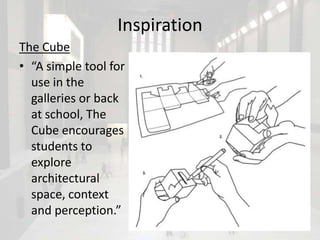
The Cube
• “A simple tool for
  use in the
  galleries or back
  at school, The
  Cube encourages
  students to
  explore
  architectural
  space, context
  and perception.”
Inspiration
• Tate Modern's Multimedia Guide is a unique
  way for visitors to find out more about the
  Collections Displays. Holding a small computer
  as you walk through the galleries, you can see
  videos and still images that provide additional
  context for the art, take part in interactive
  games, listen to commentaries, and play art-
  related music.
What is AR?
Augmented reality is considered an extension of virtual reality. AR
mixes virtual characters with the natural world.
•   History
•   1975 Myron Krueger creates Videoplace to allow users to interact with virtual objects for the first time.

•   1989 Jaron Lanier coins the phrase Virtual Reality and creates the first commercial business around virtual worlds.

•   1992 L.B Rosenberg develops one of the first function AR systems, called Virtual Fixtures.

•   1998 Spatial Augmented Reality introduced at Univeristy of North Carolina.

•   1999 Hirokazu Kato creates ART ToolKit: a computer tracking library, allowing for the creation of augmented reality
    applications that overlay virtual imagery on the real world.

•   2000 Bruce H. Thomas develops ARQuake, the first outdoor mobile AR game. Using the classic computer game
    Quake.

•   2008 Wikitude AR travel guide launches on the G1 Android Phone.

•   2009 AR Toolkit is ported to Adobe Flash (FLARToolkit) bringing AR to a web browser.
Hardware
• The main aspects of AR are a processor, display,
  sensors and input devices.
• Smartphones are seen as a prospective AR platform
  due to the fact they have GPS an accelerometer and
  display and a camera.
• 3 types of displays can be used in AR:
• head mounted display - optical see through or video
  see through.
• handheld display - all opt for video see through
• spatial display - uses digital projectors to display
  graphics onto physical objects allowing for several
  users to take part at the same time.
AR CAN BE USED IN A NUMBER OF DIFFERENT
    FEILDS WITH ENDLESS POSSIBILITIES....

Current Uses of AR
• Advertising
• Navigation
• Military and Emergency services
• Art
• Archietecture
• Sightseeing
• Time: historical reinactments
• Entertainment, Education and Performance
• Translation.

Potential Applications
• X Ray Vision
• Automotive: navigation arrows on roadways
• Public Displays: window dressings, traffic signs, Christmas decorations
Example of AR use
• http://www.youtube.com/watch?v=T4Nuje_Y
  CoM
Idea
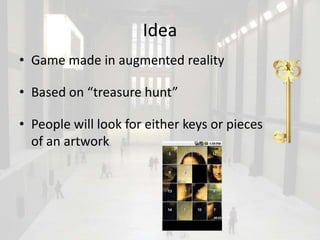
• Game made in augmented reality

• Based on “treasure hunt”

• People will look for either keys or pieces
  of an artwork
Idea


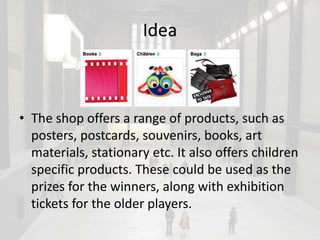
• The shop offers a range of products, such as
  posters, postcards, souvenirs, books, art
  materials, stationary etc. It also offers children
  specific products. These could be used as the
  prizes for the winners, along with exhibition
  tickets for the older players.
• Look through the sculptures
• twist the art work or sculpture in their phones
• Go really close to the art work squat to look at
  it from really low angle or to stand on toes or
  jump to see from higher angle and at that
  moment press on the key
• move two art works together to see the key
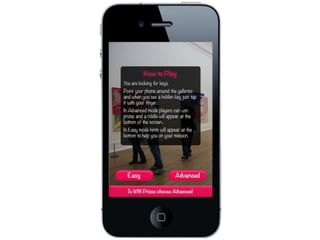
• Every key has a riddle for example "sculpture
  is the eye" or "twist and you shall see”;
• Game also offers hints which are more direct;
• First hint turn the wall person has to look at
  green;
• Second hint show the area of the specific
  object;
• To collect all the necessary keys player needs
  to go through all four collection rooms;
• There is a time that needs to be beaten to get
  a prize.
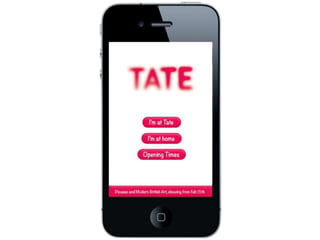
In the Gallery
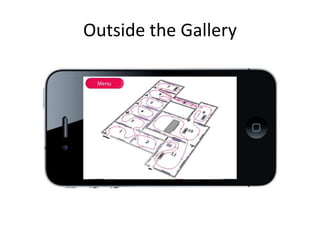
Outside the Gallery
Hidden                   Hints for finding
artworks                      the keys


                   Easy


 Chance to post
you score online                 No time
                                  limit
Collect pieces
                               of artwork


 More similar to
in gallery version

                         Advanced
                                                  Put together
                                                  puzzle out of
                                                     pieces


  Visit gallery to get
         prizes                Few best of the
                               month win prizes
Any questions? 

Presentation

  • 1.
  • 2.
    Initial questions inrelation to the brief… • Shall we specifically link the game to an artists work directly, or shall we make it more universal by including the works of several works within the contemporary collection? • What are different age ranges? And how will the levels differ? • What will the rewards be for the players if they participate?
  • 3.
    Inspiration The Cube • “Asimple tool for use in the galleries or back at school, The Cube encourages students to explore architectural space, context and perception.”
  • 4.
    Inspiration • Tate Modern'sMultimedia Guide is a unique way for visitors to find out more about the Collections Displays. Holding a small computer as you walk through the galleries, you can see videos and still images that provide additional context for the art, take part in interactive games, listen to commentaries, and play art- related music.
  • 5.
    What is AR? Augmentedreality is considered an extension of virtual reality. AR mixes virtual characters with the natural world. • History • 1975 Myron Krueger creates Videoplace to allow users to interact with virtual objects for the first time. • 1989 Jaron Lanier coins the phrase Virtual Reality and creates the first commercial business around virtual worlds. • 1992 L.B Rosenberg develops one of the first function AR systems, called Virtual Fixtures. • 1998 Spatial Augmented Reality introduced at Univeristy of North Carolina. • 1999 Hirokazu Kato creates ART ToolKit: a computer tracking library, allowing for the creation of augmented reality applications that overlay virtual imagery on the real world. • 2000 Bruce H. Thomas develops ARQuake, the first outdoor mobile AR game. Using the classic computer game Quake. • 2008 Wikitude AR travel guide launches on the G1 Android Phone. • 2009 AR Toolkit is ported to Adobe Flash (FLARToolkit) bringing AR to a web browser.
  • 6.
    Hardware • The mainaspects of AR are a processor, display, sensors and input devices. • Smartphones are seen as a prospective AR platform due to the fact they have GPS an accelerometer and display and a camera. • 3 types of displays can be used in AR: • head mounted display - optical see through or video see through. • handheld display - all opt for video see through • spatial display - uses digital projectors to display graphics onto physical objects allowing for several users to take part at the same time.
  • 7.
    AR CAN BEUSED IN A NUMBER OF DIFFERENT FEILDS WITH ENDLESS POSSIBILITIES.... Current Uses of AR • Advertising • Navigation • Military and Emergency services • Art • Archietecture • Sightseeing • Time: historical reinactments • Entertainment, Education and Performance • Translation. Potential Applications • X Ray Vision • Automotive: navigation arrows on roadways • Public Displays: window dressings, traffic signs, Christmas decorations
  • 8.
    Example of ARuse • http://www.youtube.com/watch?v=T4Nuje_Y CoM
  • 9.
    Idea • Game madein augmented reality • Based on “treasure hunt” • People will look for either keys or pieces of an artwork
  • 10.
    Idea • The shopoffers a range of products, such as posters, postcards, souvenirs, books, art materials, stationary etc. It also offers children specific products. These could be used as the prizes for the winners, along with exhibition tickets for the older players.
  • 16.
    • Look throughthe sculptures • twist the art work or sculpture in their phones • Go really close to the art work squat to look at it from really low angle or to stand on toes or jump to see from higher angle and at that moment press on the key • move two art works together to see the key
  • 17.
    • Every keyhas a riddle for example "sculpture is the eye" or "twist and you shall see”; • Game also offers hints which are more direct; • First hint turn the wall person has to look at green; • Second hint show the area of the specific object; • To collect all the necessary keys player needs to go through all four collection rooms; • There is a time that needs to be beaten to get a prize.
  • 18.
  • 19.
  • 20.
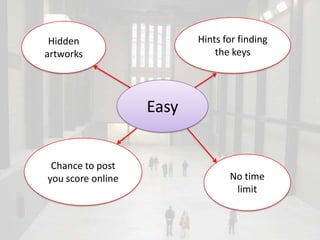
    Hidden Hints for finding artworks the keys Easy Chance to post you score online No time limit
  • 21.
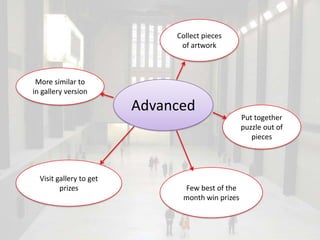
    Collect pieces of artwork More similar to in gallery version Advanced Put together puzzle out of pieces Visit gallery to get prizes Few best of the month win prizes
  • 22.

Editor's Notes

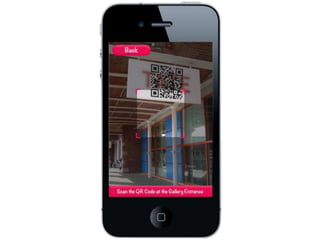
  • #14 When going in to gallery they have to register for the game by scanning QR code. For each collection room there is a different code! In that way detecting in which room player is.
  • #17 go really close to the art work squat to look at it from really low angle or to stand on toes or jump to  see from higher angle and at that moment press on the key;
  • #18 Every key has a riddle (which player can access by clicking this button?)for example "sculpture is the eye" or "twist and you shall see"Game also offers hints which are more direct, but if the player use a hint he looses a chance to win the prizes. First hint turn the wall person has to look at green, second hint show the area of the specific object To collect all the necessary keys person needs to go through all four collection roomsThere is a time that needs to be beaten to get a prize, which are showed when player scans the QR code. Game becomes
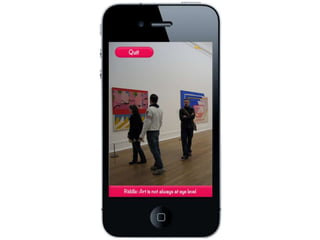
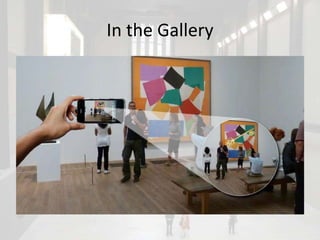
  • #19 This mock up how the augmented reality could look in galleryDuring the game playershave to find keys which are hidden in art works. To see the keys they have to look from a specific and rather precise angles.
  • #20 This mock up how the augmented reality could look in galleryDuring the game playershave to find keys which are hidden in art works. To see the keys they have to look from a specific and rather precise angles.
  • #21 The easy one is designed for children. Some of the artwork are hidden and they have to be unlocked by keys. This version doesn't have riddles, but just provides player with hints which helps to find the keys and unlock each of the hidden artworks. There is no time limit, but you can set your best time and register it online. The app has a score board as well as the score can show up in your Bebo account and show in which place you are among you friends.
  • #22 The hard version is thought from around age of twelve and up. It is similar to the mode of game played in gallery, but here player has to find and collect pieces of an artwork, in the same way as in the gallery, and in the end put them together like pieces of puzzle in the end. Some few fastest players of the month could be rewarded with greeting cards which are generally small reproductions of artwork or discounts for exhibition tickets and of course to get to these prizes the person has to visit the gallery.