Fallopian Tubes, Gestation and the Three Stages of Labor By: Carmen Ortiz
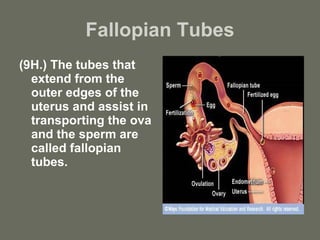
Fallopian Tubes (9H.) The tubes that extend from the outer edges of the uterus and assist in transporting the ova and the sperm are called fallopian tubes.
Fallopian Tubes  (Oviducts or Uterine Tubes) Are a pair of tubes found in every female mammal. Are found in the pelvic cavity, running between the uterus and the ovaries. They are approximately 3 to 4 inches long. Are not attached to the ovaries, but open up into the peritonial cavity very close to the ovaries. They play an vital role in ovulation and conception. Once the egg is released from the ovary (ovulation) the fallopian tube’s fimbriae grabs hold of the egg. The fimbriae catch the ovum and direct it into the tube. The fallopian tube then propels the ovum to the uterus. The meeting of the egg and sperm  (conception) takes place within the upper half of the fallopian tubes.
Fallopian Tubes They are a vital part of the female reproductive system. Without them the egg cannot become fertilized and the embryo cannot reach the uterus for implantation. It can be very difficult to become pregnant if they are not working properly. Problems that can arise in fallopian tubes: 1.)Tubal blockage - one or both tubes can become narrow and blocked. Thereby preventing eggs from traveling to the uterus. 2.)Tubal scarring - caused by endometriosis, pelvic inflammatory disease (PID), surgery and ectopic pregnancy.
Treatment. Invitro Fertilization (IVF) It involves fertilizing the egg outside the fallopian tubes and implanting the embryo inside the uterus. Fallopian Tube Surgery Surgery to remove adhesions, scar tissue, and fallopian tube is available.
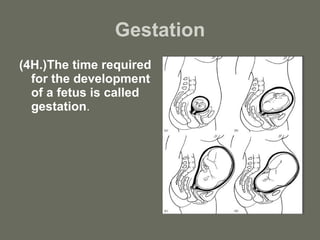
Gestation (4H.)The time required for the development of a fetus is called gestation .
Gestation The normal length of time for a human pregnancy (gestation) is about 40 weeks (the normal range is 37-42 weeks). Before 37 weeks gestation is considered preterm and after 42 weeks it is considered postterm. Gestational age begins being measured based on the time that has passed since the last menstruation. It generally happens 2 weeks prior to actual fertilization. It is divided between the embryonic stage and the fetal stage
Embryonic Stage Week 1-3 5-7 days after fertilization. The blastula attaches to the wall of the uterus. When it comes in contact with the endometrium it performs implantation. Implantation connection between the mother and the embryo begin to form, including the umbilical cord. The embryo‘s growth centers around an axis, which will become the spine and the spinal cord. The brain, spinal cord, heart, and gastrointestinal tract begin to form. Week 4-5 Chemicals produced by embryo stop the mother’s menstrual cycle. Neurogenesis (brain activity at about 6 th  week). Heart begins to beat and blood starts to flow. Limb buds appear that will eventually develop into arms and legs. Organogenesis begins. At this time the head is more than half of the embryo’s mass. Brain develops in five areas. Tissue formation forms that will develop into vertebra and bones.
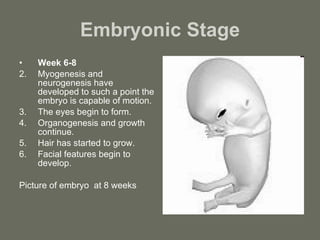
Embryonic Stage Week 6-8 Myogenesis and neurogenesis have developed to such a point the embryo is capable of motion. The eyes begin to form. Organogenesis and growth continue. Hair has started to grow. Facial features begin to develop. Picture of embryo  at 8 weeks
Fetal Stage Week 9-15 In week nine the fetus is about 30 mm in length and weighs 8 grams. The head makes up half the size of the fetus. Lung development. The heart, hands, feet, brain and other organs are at the beginning of development and have minimal operation. The fetus is not capable of feeling pain in the beginning of fetal stage. Uncontrolled movement and twitches occur in muscles. Brain and pathways begin to develop. Week 16-25 Fetus continues to develop. A women pregnant for the first time feels movement at about week 21, while a women who has given birth before feels movement in week 20. By the end on the fifth month the fetus is about 20 cm.
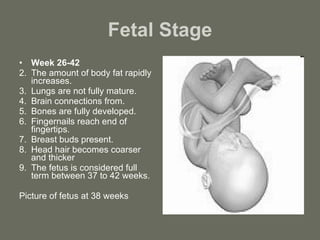
Fetal Stage Week 26-42 The amount of body fat rapidly increases. Lungs are not fully mature. Brain connections from. Bones are fully developed. Fingernails reach end of fingertips. Breast buds present. Head hair becomes coarser and thicker The fetus is considered full term between 37 to 42 weeks. Picture of fetus at 38 weeks
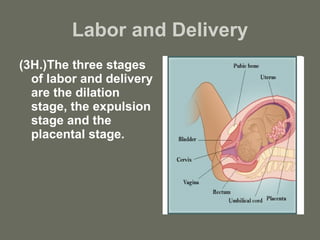
Labor and Delivery (3H.)The three stages of labor and delivery are the dilation stage, the expulsion stage and the placental stage.
The First Stage of Labor (Dilation Stage) It is the longest part of labor and can last up to 20 hours. It begins when the cervix start to dilate and ends when it is completely dilated (10 cm). The latent stage When the cervix dilates 0-4 centimeters, contractions get stronger as time progresses. Mild contractions begin at 15-20 minutes apart and last 60-90 seconds. The active phase Contractions get stronger, are about 3 minutes apart and last 45 sec. Backache and bleeding in vagina. If the amniotic membrane ruptures the contractions may get much stronger. The transition phase The cervix dilated from 8-10 centimeters its called the transition phase. Contractions are 2-3 minutes apart and last 1 minute. Pressure felt on rectum, stronger backache and heavier vaginal bleeding. During this phase go to hospital.
The Second Stage of Labor (Expulsion Stage) Begins when cervix is fully dilated at 10 centimeters. This stage continues until you baby passes through the birth canal, vagina, and is born. It may last two hours or longer. Contractions feel different they slow to 2-5 minutes apart and last 60 -90 sec.  A strong urge to push with contractions is felt. Pain relive medication may be administered. Generally the head of the baby appears first (crowning). In some cases the buttocks come first (breech presentation).
The Third Stage of Labor (Placental Stage) Begins after the baby is born. Ends when the placenta separates from the wall of the uterus and is passed through the vagina. It last about 20 minutes. Contractions are felt, but are less painful.
Shared Journey. 2010.  http://www.sharedjourney.com/define/fall.html Wikipedia. 19 March 2010.  http://en.wikipedia.org/wiki/Fetus#9_weeks_of_gestation:_condition_at_start_of_fetal_stage Wikipedia. 22 March 2020.  http://en.wikipedia.org/wiki/Embryo Web MD. 20 Dec. 2009.  http://www.webmd.com/baby/guide/pregnancy-stages-labor Medical Terminology “A living Language”. Works Cited

Presentation #10

  • 1.
    Fallopian Tubes, Gestationand the Three Stages of Labor By: Carmen Ortiz
  • 2.
    Fallopian Tubes (9H.)The tubes that extend from the outer edges of the uterus and assist in transporting the ova and the sperm are called fallopian tubes.
  • 3.
    Fallopian Tubes (Oviducts or Uterine Tubes) Are a pair of tubes found in every female mammal. Are found in the pelvic cavity, running between the uterus and the ovaries. They are approximately 3 to 4 inches long. Are not attached to the ovaries, but open up into the peritonial cavity very close to the ovaries. They play an vital role in ovulation and conception. Once the egg is released from the ovary (ovulation) the fallopian tube’s fimbriae grabs hold of the egg. The fimbriae catch the ovum and direct it into the tube. The fallopian tube then propels the ovum to the uterus. The meeting of the egg and sperm (conception) takes place within the upper half of the fallopian tubes.
  • 4.
    Fallopian Tubes Theyare a vital part of the female reproductive system. Without them the egg cannot become fertilized and the embryo cannot reach the uterus for implantation. It can be very difficult to become pregnant if they are not working properly. Problems that can arise in fallopian tubes: 1.)Tubal blockage - one or both tubes can become narrow and blocked. Thereby preventing eggs from traveling to the uterus. 2.)Tubal scarring - caused by endometriosis, pelvic inflammatory disease (PID), surgery and ectopic pregnancy.
  • 5.
    Treatment. Invitro Fertilization(IVF) It involves fertilizing the egg outside the fallopian tubes and implanting the embryo inside the uterus. Fallopian Tube Surgery Surgery to remove adhesions, scar tissue, and fallopian tube is available.
  • 6.
    Gestation (4H.)The timerequired for the development of a fetus is called gestation .
  • 7.
    Gestation The normallength of time for a human pregnancy (gestation) is about 40 weeks (the normal range is 37-42 weeks). Before 37 weeks gestation is considered preterm and after 42 weeks it is considered postterm. Gestational age begins being measured based on the time that has passed since the last menstruation. It generally happens 2 weeks prior to actual fertilization. It is divided between the embryonic stage and the fetal stage
  • 8.
    Embryonic Stage Week1-3 5-7 days after fertilization. The blastula attaches to the wall of the uterus. When it comes in contact with the endometrium it performs implantation. Implantation connection between the mother and the embryo begin to form, including the umbilical cord. The embryo‘s growth centers around an axis, which will become the spine and the spinal cord. The brain, spinal cord, heart, and gastrointestinal tract begin to form. Week 4-5 Chemicals produced by embryo stop the mother’s menstrual cycle. Neurogenesis (brain activity at about 6 th week). Heart begins to beat and blood starts to flow. Limb buds appear that will eventually develop into arms and legs. Organogenesis begins. At this time the head is more than half of the embryo’s mass. Brain develops in five areas. Tissue formation forms that will develop into vertebra and bones.
  • 9.
    Embryonic Stage Week6-8 Myogenesis and neurogenesis have developed to such a point the embryo is capable of motion. The eyes begin to form. Organogenesis and growth continue. Hair has started to grow. Facial features begin to develop. Picture of embryo at 8 weeks
  • 10.
    Fetal Stage Week9-15 In week nine the fetus is about 30 mm in length and weighs 8 grams. The head makes up half the size of the fetus. Lung development. The heart, hands, feet, brain and other organs are at the beginning of development and have minimal operation. The fetus is not capable of feeling pain in the beginning of fetal stage. Uncontrolled movement and twitches occur in muscles. Brain and pathways begin to develop. Week 16-25 Fetus continues to develop. A women pregnant for the first time feels movement at about week 21, while a women who has given birth before feels movement in week 20. By the end on the fifth month the fetus is about 20 cm.
  • 11.
    Fetal Stage Week26-42 The amount of body fat rapidly increases. Lungs are not fully mature. Brain connections from. Bones are fully developed. Fingernails reach end of fingertips. Breast buds present. Head hair becomes coarser and thicker The fetus is considered full term between 37 to 42 weeks. Picture of fetus at 38 weeks
  • 12.
    Labor and Delivery(3H.)The three stages of labor and delivery are the dilation stage, the expulsion stage and the placental stage.
  • 13.
    The First Stageof Labor (Dilation Stage) It is the longest part of labor and can last up to 20 hours. It begins when the cervix start to dilate and ends when it is completely dilated (10 cm). The latent stage When the cervix dilates 0-4 centimeters, contractions get stronger as time progresses. Mild contractions begin at 15-20 minutes apart and last 60-90 seconds. The active phase Contractions get stronger, are about 3 minutes apart and last 45 sec. Backache and bleeding in vagina. If the amniotic membrane ruptures the contractions may get much stronger. The transition phase The cervix dilated from 8-10 centimeters its called the transition phase. Contractions are 2-3 minutes apart and last 1 minute. Pressure felt on rectum, stronger backache and heavier vaginal bleeding. During this phase go to hospital.
  • 14.
    The Second Stageof Labor (Expulsion Stage) Begins when cervix is fully dilated at 10 centimeters. This stage continues until you baby passes through the birth canal, vagina, and is born. It may last two hours or longer. Contractions feel different they slow to 2-5 minutes apart and last 60 -90 sec. A strong urge to push with contractions is felt. Pain relive medication may be administered. Generally the head of the baby appears first (crowning). In some cases the buttocks come first (breech presentation).
  • 15.
    The Third Stageof Labor (Placental Stage) Begins after the baby is born. Ends when the placenta separates from the wall of the uterus and is passed through the vagina. It last about 20 minutes. Contractions are felt, but are less painful.
  • 16.
    Shared Journey. 2010. http://www.sharedjourney.com/define/fall.html Wikipedia. 19 March 2010. http://en.wikipedia.org/wiki/Fetus#9_weeks_of_gestation:_condition_at_start_of_fetal_stage Wikipedia. 22 March 2020. http://en.wikipedia.org/wiki/Embryo Web MD. 20 Dec. 2009. http://www.webmd.com/baby/guide/pregnancy-stages-labor Medical Terminology “A living Language”. Works Cited