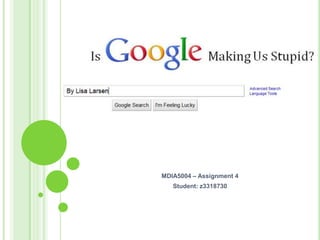
MDIA5004 – Assignment 4Student: z3318730
Reading:Carr, Nicholas (2008). “Is Google Making us Stupid?”, Atlantic.com. Washington D.C: The Atlantic	http://www.theatlantic.com/magazine/archive/2008/07/is-google-making-us-stupid/6868/2
WhyGoogle Is Making Us Stupid Carr (2008) argues that he has concentration problems when it comes to reading long texts and bookInternet has become the universal medium	Immediate access to information	Shape the process of thought (McLuhan)The mind obtain information in the same way the Internet distributes it3
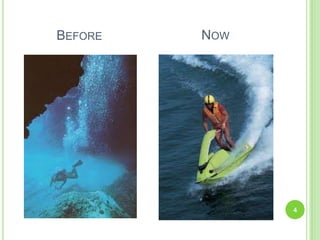
Now4Before
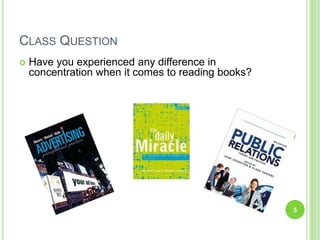
ClassQuestionHave you experienced any difference in concentration when it comes to reading books? 5
Lack Of Scientific EvidenceThere is not sufficient research to back up Carr’s claimsOne study of online research habits done by University College LondonStudy over 5 yearsTwo popular research sites for journal articles and e booksSkimming“Power browse”6
Class ExperimentRaise you hand when your mind drift off http://www.news.com.au/features/federal-election/kevin-rudd-denies-latest-leak-accusing-julia-gillard-of-opposing-paid-parental-leave/story-e6frfllr-1225897807744http://www.smh.com.au/federal-election/abbott-pledges-to-cut-company-tax-rate-20100728-10v34.html7
Read More, But DifferentInternet texts and SMS         read more?Different kind of reading and different kind of thinkingWolf: “We are how we read”Reading is not an instinctive skillWhat we read shape our brains8
New Tools, New Ways - Old School9
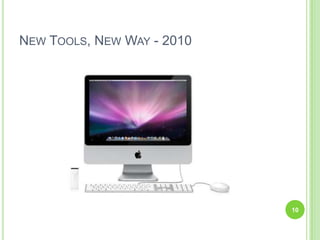
New Tools, New Way - 201010
Internet = The Almighty Internet as map, clock, printing press, typewriter, calculator, telephone, radio and TVTraditional media has to adapt to new expectationsThe absorbed medium re created in the Net’s imageCommunication system with multi rolesReprogramming? 11
Algorithm & GoogleGoogle’s search engine Definitions (provided by Google)a preciserule (or setofrules) specifyinghow to solvesome problemwordnetweb.princeton.edu/perl/webwnalgorithmic - of or relating to or havingthecharacteristicsof an algorithmwordnetweb.princeton.edu/perl/webwnthe set of simple instructions that combine to accomplish a task. Computer codes are algorithms.rredc.nrel.gov/solar/glossary/An established and well-defined step-by-step method used to achieve a desired mathematical result. Example: The addition algorithm for the sum of two two-digit numbers where carrying is required. -- The procedure used in long division.www.numbernut.com/glossary/index.shtml12
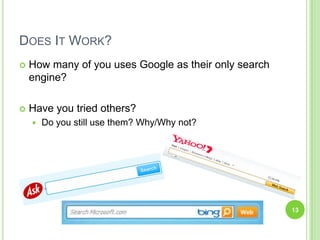
Does It Work?How many of you uses Google as their only search engine?Have you tried others?Do you still use them? Why/Why not?13
Why It WorksBrin and Page: “For us, working on search is a way to work on artificial intelligence”Desire to use technology as motivation Our surfing provides information to Google and advertising companies 14
Class DiscussionDo you agree with Carr (2008)? Is Google making us stupid? How often do you use the other Google pages (e.g. Translate, Scholars, Map, News, Satellite, Books, Images, Gmail).15
Online ResourcesJohn Battelle’s search blogJohn Battelle is a journalist as well as founder and chairman of Federated Media Publishing. He has been a visiting professor of journalism at UC Berkeley and also maintains Searchblog. The blog covers search, technology, and media. http://battellemedia.comSearch Engine WatchSearch Engine Watch works as a guide for web search. Moreover, they also provide analysis and can assist site owners to improve their sites to make them easier to be found in search engines. http://searchenginewatch.com16
Online Resources Search Engine LandSearch Engine Land  led by Danny Sullivan and Chris Sherman and is one of the leading online publication for news regarding search. They also provide research, anaylsis, commentary and expert advice. http://searchengineland.com/MashableMashableis a source for news in social and digital media, technology and web culture. They report breaking web news in addition to trend analysis, web site review and offers social media resources and guides. Their uses range from entrepreneurs, marketing, PR and bloggers and social media users.  http://mashable.com 17
Relevant ReadingsBattelle, John (September 2005). “The Search: How Google and Its Rivals Rewrote the Rules of Business and Transformed Our Culture”. New York: PortfolioBrabazon, T. (2006).”The Google Effect: Googling, Blogging, Wikis and the Flattening of Expertise”In Libri(2006, vol.56, pp. 157-167). Germany Caufield, J. (2005)“Where Did Google Get Its Value?”. In Libraries and the Academy (Number 4, October 2005, pp. 555-572).The Johns Hopkins University PressConti, G. (2006). “Googling considered harmful” in New Security Paradigms Workshop archive (2006, pp. 67-76) New York: ACMDel Corso, G. M. Gulli, A. Romani, F. (2005) ”Ranking a Stream of News” in International World Wide Web Conference archive (2005, pp. 97-106). New York: ACMEvans, M. P. (2007) “Analysing Google rankings through search engine optimization data” in Internet Research No. 1 (2007, pp. 21-37). Bingley: Emerald Group Publishing LimitedFinkelstein, L. et al. (2001). “Placing search in context: the concept revisited” in International World Wide Web Conference archive (2001, pp. 406-414). New York: ACMGoldberg, M. A. (2005) “Googling of Online Privacy: Gmail, Search-Engine Histories and the New Frontier of Protecting Private Information on the Web”. In 9 Lewis & Clark Law Review (2005, pp. 249-262)Goldman E. (2008)“Search Engine Bias and the Demise of Search Engine Utopianis”, In Spink, A. and Zimmer, M. (2008) Web Search . Berlin: SpringerKilgarriff, A. (2007) “Googleology is Bad Science” in Computational Lingustics No. 1 (pp. 147-151)Liu, Y. et al (2008) ”BrowseRank: letting web users vote for page importance” in Annual ACM Conference on Research and Development in Information Retrieval archive (2008, pp. 451-458) New York: ACM18

Presentasjon

  • 1.
    MDIA5004 – Assignment4Student: z3318730
  • 2.
    Reading:Carr, Nicholas (2008).“Is Google Making us Stupid?”, Atlantic.com. Washington D.C: The Atlantic http://www.theatlantic.com/magazine/archive/2008/07/is-google-making-us-stupid/6868/2
  • 3.
    WhyGoogle Is MakingUs Stupid Carr (2008) argues that he has concentration problems when it comes to reading long texts and bookInternet has become the universal medium Immediate access to information Shape the process of thought (McLuhan)The mind obtain information in the same way the Internet distributes it3
  • 4.
  • 5.
    ClassQuestionHave you experiencedany difference in concentration when it comes to reading books? 5
  • 6.
    Lack Of ScientificEvidenceThere is not sufficient research to back up Carr’s claimsOne study of online research habits done by University College LondonStudy over 5 yearsTwo popular research sites for journal articles and e booksSkimming“Power browse”6
  • 7.
    Class ExperimentRaise youhand when your mind drift off http://www.news.com.au/features/federal-election/kevin-rudd-denies-latest-leak-accusing-julia-gillard-of-opposing-paid-parental-leave/story-e6frfllr-1225897807744http://www.smh.com.au/federal-election/abbott-pledges-to-cut-company-tax-rate-20100728-10v34.html7
  • 8.
    Read More, ButDifferentInternet texts and SMS read more?Different kind of reading and different kind of thinkingWolf: “We are how we read”Reading is not an instinctive skillWhat we read shape our brains8
  • 9.
    New Tools, NewWays - Old School9
  • 10.
    New Tools, NewWay - 201010
  • 11.
    Internet = TheAlmighty Internet as map, clock, printing press, typewriter, calculator, telephone, radio and TVTraditional media has to adapt to new expectationsThe absorbed medium re created in the Net’s imageCommunication system with multi rolesReprogramming? 11
  • 12.
    Algorithm & GoogleGoogle’ssearch engine Definitions (provided by Google)a preciserule (or setofrules) specifyinghow to solvesome problemwordnetweb.princeton.edu/perl/webwnalgorithmic - of or relating to or havingthecharacteristicsof an algorithmwordnetweb.princeton.edu/perl/webwnthe set of simple instructions that combine to accomplish a task. Computer codes are algorithms.rredc.nrel.gov/solar/glossary/An established and well-defined step-by-step method used to achieve a desired mathematical result. Example: The addition algorithm for the sum of two two-digit numbers where carrying is required. -- The procedure used in long division.www.numbernut.com/glossary/index.shtml12
  • 13.
    Does It Work?Howmany of you uses Google as their only search engine?Have you tried others?Do you still use them? Why/Why not?13
  • 14.
    Why It WorksBrinand Page: “For us, working on search is a way to work on artificial intelligence”Desire to use technology as motivation Our surfing provides information to Google and advertising companies 14
  • 15.
    Class DiscussionDo youagree with Carr (2008)? Is Google making us stupid? How often do you use the other Google pages (e.g. Translate, Scholars, Map, News, Satellite, Books, Images, Gmail).15
  • 16.
    Online ResourcesJohn Battelle’ssearch blogJohn Battelle is a journalist as well as founder and chairman of Federated Media Publishing. He has been a visiting professor of journalism at UC Berkeley and also maintains Searchblog. The blog covers search, technology, and media. http://battellemedia.comSearch Engine WatchSearch Engine Watch works as a guide for web search. Moreover, they also provide analysis and can assist site owners to improve their sites to make them easier to be found in search engines. http://searchenginewatch.com16
  • 17.
    Online Resources SearchEngine LandSearch Engine Land led by Danny Sullivan and Chris Sherman and is one of the leading online publication for news regarding search. They also provide research, anaylsis, commentary and expert advice. http://searchengineland.com/MashableMashableis a source for news in social and digital media, technology and web culture. They report breaking web news in addition to trend analysis, web site review and offers social media resources and guides. Their uses range from entrepreneurs, marketing, PR and bloggers and social media users. http://mashable.com 17
  • 18.
    Relevant ReadingsBattelle, John(September 2005). “The Search: How Google and Its Rivals Rewrote the Rules of Business and Transformed Our Culture”. New York: PortfolioBrabazon, T. (2006).”The Google Effect: Googling, Blogging, Wikis and the Flattening of Expertise”In Libri(2006, vol.56, pp. 157-167). Germany Caufield, J. (2005)“Where Did Google Get Its Value?”. In Libraries and the Academy (Number 4, October 2005, pp. 555-572).The Johns Hopkins University PressConti, G. (2006). “Googling considered harmful” in New Security Paradigms Workshop archive (2006, pp. 67-76) New York: ACMDel Corso, G. M. Gulli, A. Romani, F. (2005) ”Ranking a Stream of News” in International World Wide Web Conference archive (2005, pp. 97-106). New York: ACMEvans, M. P. (2007) “Analysing Google rankings through search engine optimization data” in Internet Research No. 1 (2007, pp. 21-37). Bingley: Emerald Group Publishing LimitedFinkelstein, L. et al. (2001). “Placing search in context: the concept revisited” in International World Wide Web Conference archive (2001, pp. 406-414). New York: ACMGoldberg, M. A. (2005) “Googling of Online Privacy: Gmail, Search-Engine Histories and the New Frontier of Protecting Private Information on the Web”. In 9 Lewis & Clark Law Review (2005, pp. 249-262)Goldman E. (2008)“Search Engine Bias and the Demise of Search Engine Utopianis”, In Spink, A. and Zimmer, M. (2008) Web Search . Berlin: SpringerKilgarriff, A. (2007) “Googleology is Bad Science” in Computational Lingustics No. 1 (pp. 147-151)Liu, Y. et al (2008) ”BrowseRank: letting web users vote for page importance” in Annual ACM Conference on Research and Development in Information Retrieval archive (2008, pp. 451-458) New York: ACM18