ReadingsCarr, Nicholas. (2008). “Is Google Making us Stupid?”, Atlantic.com. Washington D.C: The Atlantic.Stross, Randall. (2008). “The Algorithm”. In Planet Google: how one company is transforming our lives (pp. 63-88). London: Atlantic Books.
AlgorithmsAn algorithm is a set of rules for solving a particular problem; it’s the essential building block used in constructing complex computer software (Stross, R. 2008). Read more definitionsonWikipediahttp://en.wikipedia.org/wiki/Algorithm
ClassquestionsHow many of you use Google as your first choice? How many of you use any of the competitors, such as Microsoft’s Bing, Yahoo or Ask?
ClassquestionsWhy do you use the preferred search engine? Are you conscious about it, or do you just use it because everyone else does? Do you use the word search engine or do you say googling?
Google has infiltratedourlangageGoogling is defined as a transitive verb according to the dictionary and thesaurus Merriam Webster. Link: http://www.merriam-webster.com/dictionary/googling
Is Googlestupidifying?Is Google making us stupid?Carrarguesthatourbrain has adapted to thewayGoogle present information to us. Insteadofreading in depthbooks and articles, wenowscanliteraturequickly to findwhatwearelooking for.
WhatdoesGoogle offer?
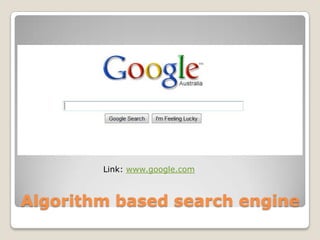
AlgorithmbasedsearchengineLink: www.google.com
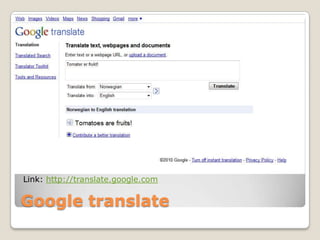
GoogletranslateLink: http://translate.google.com
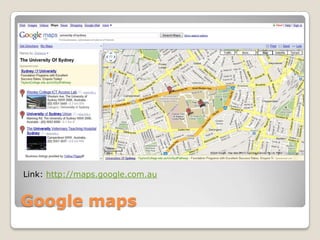
GooglemapsLink: http://maps.google.com.au
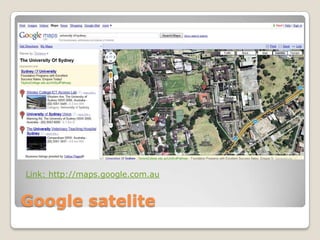
GooglesateliteLink: http://maps.google.com.au
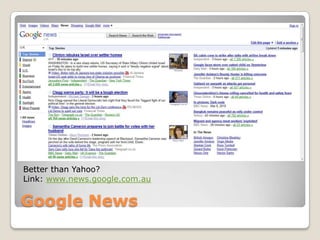
Google NewsBetter than Yahoo?Link: www.news.google.com.au
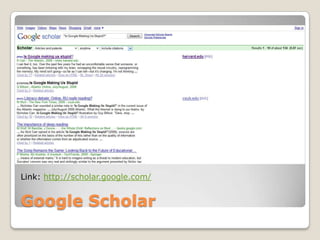
GoogleScholarLink: http://scholar.google.com/
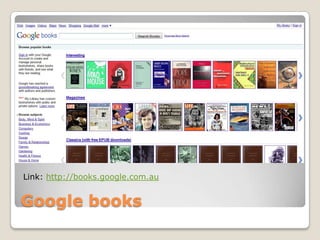
GooglebooksLink: http://books.google.com.au
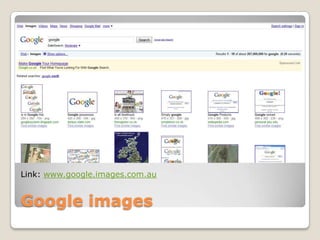
Google imagesLink: www.google.images.com.au
Link: https://www.google.com/accountsGmail
ClassquestionsDo you agree with Carr? Or do you think it’s the other way around?By having all sorts of information accessible, we get to it easier; hence, we learn more?Can the accessible information indeed wipe out some of the differences between those with a university degree, scholars and so on and people with no higher education?
Otheruseful online resourcesJohn Battelle’s searchblogJohn Battelle is a journalist as well as founder and chairman of Federated Media Publishing. He has been a visiting professor of journalism at UC Berkeley and also maintains Searchblog. The blog covers search, technology, and media.Battelle is one of the original founders of Wired magazinehttp://battellemedia.com
Otheruseful online resourcesSearchEngineWatch http://searchenginewatch.comSearchEngine Land http://searchengineland.com/SearchEngine Journal http://www.searchenginejournal.com/Mashable, The social Media Guide http://mashable.com
Relevant readings Battelle, John (September 2005). “The Search: How Google and Its Rivals Rewrote the Rules of Business and Transformed Our Culture”. New York: PortfolioBauerlein, M. (2008). “The Dumbest Generation: How the Digital Age Stupefies Young Americans and Jeopardizes Our Future (Or, Don’t Trust Anyone Under 30)”. New York: Jeremy P. Tarcher/PenguinBrabazon, T. (2006).”The Google Effect: Googling, Blogging, Wikis and the Flattening of Expertise”In Libri(2006, vol.56, pp. 157-167). Germany Caufield, J. (2005)“Where Did Google Get Its Value?”. In Libraries and the Academy (Number 4, October 2005, pp. 555-572).The Johns Hopkins University PressConti, G. (2006). “Googling considered harmful” in New Security Paradigms Workshop archive (2006, pp. 67-76) New York: ACMDel Corso, G. M. Gulli, A. Romani, F. (2005) ”Ranking a Stream of News” in International World Wide Web Conference archive (2005, pp. 97-106). New York: ACMEvans, M. P. (2007) “Analysing Google rankings through search engine optimization data” in Internet Research No. 1 (2007, pp. 21-37). Bingley: Emerald Group Publishing LimitedFinkelstein, L. et al. (2001). “Placing search in context: the concept revisited” in International World Wide Web Conference archive (2001, pp. 406-414). New York: ACMGoldberg, M. A. (2005) “Googling of Online Privacy: Gmail, Search-Engine Histories and the New Frontier of Protecting Private Information on the Web”. In 9 Lewis & Clark Law Review (2005, pp. 249-262)Goldman E. (2008)“Search Engine Bias and the Demise of Search Engine Utopianis”, In Spink, A. and Zimmer, M. (2008) Web Search . Berlin: SpringerKilgarriff, A. (2007) “Googleology is Bad Science” in Computational Lingustics No. 1 (pp. 147-151)Ling, X. et al. (2008) “Can Chinese Web Pages Be Classified with English Data Source?” in International World Wide Web Conference archive (2008, pp. 969-978). New York: ACMLiu, Y. et al (2008) ”BrowseRank: letting web users vote for page importance” in Annual ACM Conference on Research and Development in Information Retrieval archive (2008, pp. 451-458) New York: ACMYen J.Y.  et al. (2007) “The Comorbid Psychiatric Symptoms of InternetAddiction: Attention Deficit and Hyperactivity Disorder (ADHD)”, in Depression, Social Phobia, and Hostility. Journal of AdolescentHealth, 41. Yoo, H.J. et al. (2004). “Attention Deficit Hyperactivity Symptoms andInternet Addiction”. Psychiatry and Clinical Neuroscience, 58.

I’ll Google It

  • 2.
    ReadingsCarr, Nicholas. (2008).“Is Google Making us Stupid?”, Atlantic.com. Washington D.C: The Atlantic.Stross, Randall. (2008). “The Algorithm”. In Planet Google: how one company is transforming our lives (pp. 63-88). London: Atlantic Books.
  • 3.
    AlgorithmsAn algorithm isa set of rules for solving a particular problem; it’s the essential building block used in constructing complex computer software (Stross, R. 2008). Read more definitionsonWikipediahttp://en.wikipedia.org/wiki/Algorithm
  • 4.
    ClassquestionsHow many ofyou use Google as your first choice? How many of you use any of the competitors, such as Microsoft’s Bing, Yahoo or Ask?
  • 5.
    ClassquestionsWhy do youuse the preferred search engine? Are you conscious about it, or do you just use it because everyone else does? Do you use the word search engine or do you say googling?
  • 6.
    Google has infiltratedourlangageGooglingis defined as a transitive verb according to the dictionary and thesaurus Merriam Webster. Link: http://www.merriam-webster.com/dictionary/googling
  • 7.
    Is Googlestupidifying?Is Googlemaking us stupid?Carrarguesthatourbrain has adapted to thewayGoogle present information to us. Insteadofreading in depthbooks and articles, wenowscanliteraturequickly to findwhatwearelooking for.
  • 8.
  • 9.
  • 10.
  • 11.
  • 12.
  • 13.
    Google NewsBetter thanYahoo?Link: www.news.google.com.au
  • 14.
  • 15.
  • 16.
  • 17.
  • 18.
    ClassquestionsDo you agreewith Carr? Or do you think it’s the other way around?By having all sorts of information accessible, we get to it easier; hence, we learn more?Can the accessible information indeed wipe out some of the differences between those with a university degree, scholars and so on and people with no higher education?
  • 19.
    Otheruseful online resourcesJohnBattelle’s searchblogJohn Battelle is a journalist as well as founder and chairman of Federated Media Publishing. He has been a visiting professor of journalism at UC Berkeley and also maintains Searchblog. The blog covers search, technology, and media.Battelle is one of the original founders of Wired magazinehttp://battellemedia.com
  • 20.
    Otheruseful online resourcesSearchEngineWatchhttp://searchenginewatch.comSearchEngine Land http://searchengineland.com/SearchEngine Journal http://www.searchenginejournal.com/Mashable, The social Media Guide http://mashable.com
  • 21.
    Relevant readings Battelle, John(September 2005). “The Search: How Google and Its Rivals Rewrote the Rules of Business and Transformed Our Culture”. New York: PortfolioBauerlein, M. (2008). “The Dumbest Generation: How the Digital Age Stupefies Young Americans and Jeopardizes Our Future (Or, Don’t Trust Anyone Under 30)”. New York: Jeremy P. Tarcher/PenguinBrabazon, T. (2006).”The Google Effect: Googling, Blogging, Wikis and the Flattening of Expertise”In Libri(2006, vol.56, pp. 157-167). Germany Caufield, J. (2005)“Where Did Google Get Its Value?”. In Libraries and the Academy (Number 4, October 2005, pp. 555-572).The Johns Hopkins University PressConti, G. (2006). “Googling considered harmful” in New Security Paradigms Workshop archive (2006, pp. 67-76) New York: ACMDel Corso, G. M. Gulli, A. Romani, F. (2005) ”Ranking a Stream of News” in International World Wide Web Conference archive (2005, pp. 97-106). New York: ACMEvans, M. P. (2007) “Analysing Google rankings through search engine optimization data” in Internet Research No. 1 (2007, pp. 21-37). Bingley: Emerald Group Publishing LimitedFinkelstein, L. et al. (2001). “Placing search in context: the concept revisited” in International World Wide Web Conference archive (2001, pp. 406-414). New York: ACMGoldberg, M. A. (2005) “Googling of Online Privacy: Gmail, Search-Engine Histories and the New Frontier of Protecting Private Information on the Web”. In 9 Lewis & Clark Law Review (2005, pp. 249-262)Goldman E. (2008)“Search Engine Bias and the Demise of Search Engine Utopianis”, In Spink, A. and Zimmer, M. (2008) Web Search . Berlin: SpringerKilgarriff, A. (2007) “Googleology is Bad Science” in Computational Lingustics No. 1 (pp. 147-151)Ling, X. et al. (2008) “Can Chinese Web Pages Be Classified with English Data Source?” in International World Wide Web Conference archive (2008, pp. 969-978). New York: ACMLiu, Y. et al (2008) ”BrowseRank: letting web users vote for page importance” in Annual ACM Conference on Research and Development in Information Retrieval archive (2008, pp. 451-458) New York: ACMYen J.Y. et al. (2007) “The Comorbid Psychiatric Symptoms of InternetAddiction: Attention Deficit and Hyperactivity Disorder (ADHD)”, in Depression, Social Phobia, and Hostility. Journal of AdolescentHealth, 41. Yoo, H.J. et al. (2004). “Attention Deficit Hyperactivity Symptoms andInternet Addiction”. Psychiatry and Clinical Neuroscience, 58.