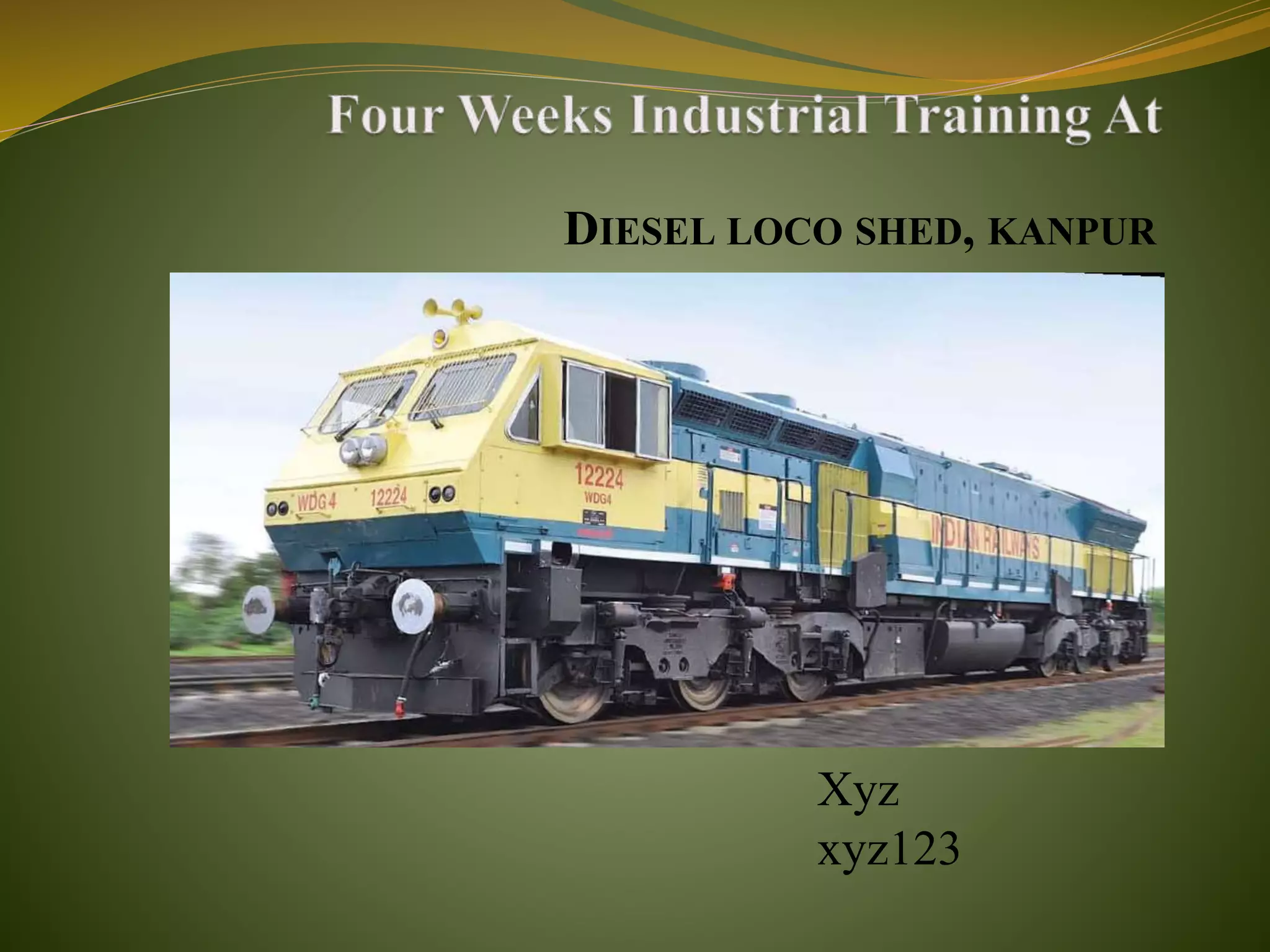
DIESEL LOCO SHED, KANPUR
Xyz
xyz123
Locomotive
A locomotive or engine is a railway vehicle that provides
the motive power for a train. The word originates from
the Latin loco – "from a place", ablative of locus, "place"
+ Medieval Latin motivus, "causing motion", and is a
shortened form of the term locomotive engine.
The first successful locomotives were built
by Cornish inventor Richard Trevithick in 1804.
Diesel Locomotive
A diesel locomotive is a type of railway locomotive in
which the prime mover is a diesel engine.
Several types of diesel locomotive have been developed,
differing mainly in the means by which mechanical power
is conveyed to the driving wheels (drivers).
Dhakkan
Interview
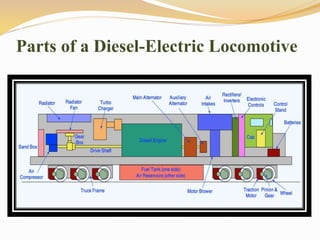
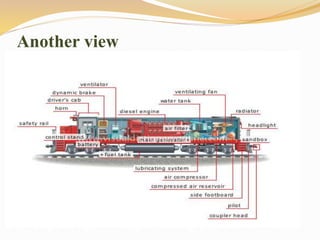
Parts of a Diesel-Electric Locomotive
Another view
Diesel Engine
This is the main power source for the locomotive.
 A diesel engine (also known as a compression-ignition
engine) is an internal combustion engine that uses the heat
of compression to initiate ignition to burn the fuel that has
been injected into the combustion chamber.
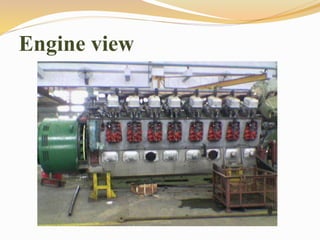
 It comprises a large cylinder block, with the cylinders
arranged in a straight line or in a V.
Engine view
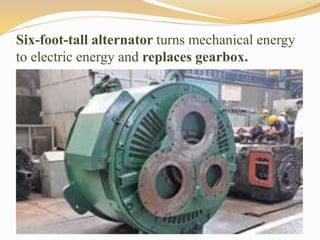
Main Alternator
The diesel engine drives the main alternator which
provides the power to move the train.
The alternator generates AC electricity which is used to
provide power for the traction motors mounted on the
trucks (bogies).
In older locomotives, the alternator was a DC machine,
called a generator. .
Six-foot-tall alternator turns mechanical energy
to electric energy and replaces gearbox.
Auxiliary Alternator
Locomotives used to operate passenger trains are
equipped with an auxiliary alternator.
This provides AC power for lighting, heating, air
conditioning, dining facilities etc. on the train.
The output is transmitted along the train through an
auxiliary power line.
Automobile
interview questions
Part 2
For more login to Youtube
(dhakkan interview)
Dhakkan Interview
Motor Blower
The diesel engine also drives a motor blower.
As its name suggests, the motor blower provides air which
is blown over the traction motors to keep them cool during
periods of heavy work.
 The blower is mounted inside the locomotive body but
the motors are on the trucks, so the blower output is
connected to each of the motors through flexible ducting.
 The blower output also cools the alternators.
Traction Motor
Since the diesel-electric locomotive uses electric
transmission, traction motors are provided on the axles to
give the final drive.
These motors were traditionally DC but the development
of modern power and control electronics has led to the
introduction of 3-phase AC motors.
Pinion/Gear
 The traction motor drives the axle through a reduction
gear of a range between 3 to 1 (freight) and 4 to 1
(passenger).
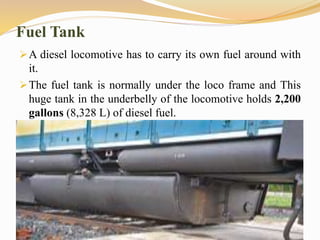
Fuel Tank
A diesel locomotive has to carry its own fuel around with
it.
The fuel tank is normally under the loco frame and This
huge tank in the underbelly of the locomotive holds 2,200
gallons (8,328 L) of diesel fuel.
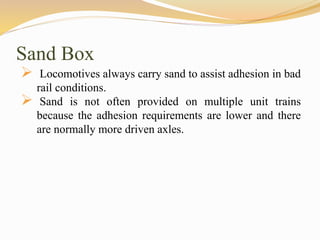
Sand Box
 Locomotives always carry sand to assist adhesion in bad
rail conditions.
 Sand is not often provided on multiple unit trains
because the adhesion requirements are lower and there
are normally more driven axles.
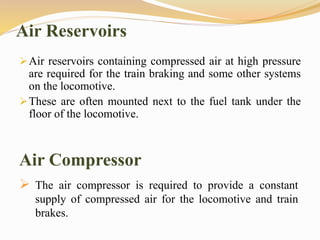
Air Reservoirs
Air reservoirs containing compressed air at high pressure
are required for the train braking and some other systems
on the locomotive.
These are often mounted next to the fuel tank under the
floor of the locomotive.
Air Compressor
 The air compressor is required to provide a constant
supply of compressed air for the locomotive and train
brakes.
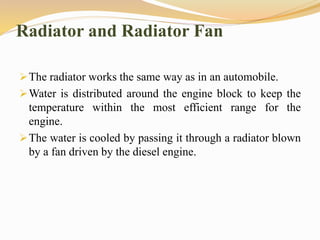
Radiator and Radiator Fan
The radiator works the same way as in an automobile.
Water is distributed around the engine block to keep the
temperature within the most efficient range for the
engine.
The water is cooled by passing it through a radiator blown
by a fan driven by the diesel engine.
Turbo Charging
The amount of power obtained from a cylinder in a diesel
engine depends on how much fuel can be burnt in it.
The amount of fuel which can be burnt depends on the
amount of air available in the cylinder. So, if you can get
more air into the cylinder, more fuel will be burnt and you
will get more power out of your ignition.
Turbo charging is used to increase the amount of air
pushed into each cylinder.
Turbocharging gives a 50% increase in engine power.
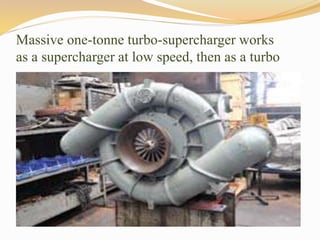
Massive one-tonne turbo-supercharger works
as a supercharger at low speed, then as a turbo
Locomotive Data
General Data Of Locomotive:-
 Model No. : WDM2
 Specification : 16 cylinder V-type 4 stroke
Diesel Engine
 Type : Co-Co
 Power : 700hp, 1400hp, 2400hp
 Maximum Speed : 120 kph
 Gear Ratio : 68/18
 Compression Ratio : 16:1
 Cylinder Bore : 230mm
 Cylinder Stroke : 279mm
Wheel Base:-
 Wheel Dia : 1092mm
 Wheel Base : 12834mm
 Traction Motor : Bhel 165
 Track Gauge : 1676mm
 Brake Equipment : Vaccun/Air
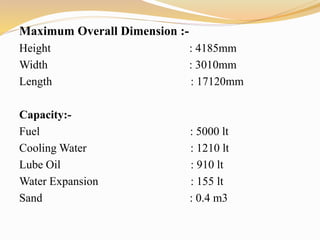
Maximum Overall Dimension :-
Height : 4185mm
Width : 3010mm
Length : 17120mm
Capacity:-
Fuel : 5000 lt
Cooling Water : 1210 lt
Lube Oil : 910 lt
Water Expansion : 155 lt
Sand : 0.4 m3
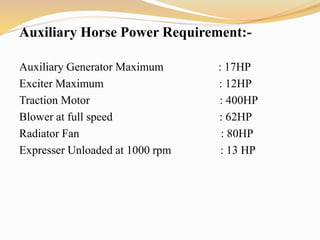
Auxiliary Horse Power Requirement:-
Auxiliary Generator Maximum : 17HP
Exciter Maximum : 12HP
Traction Motor : 400HP
Blower at full speed : 62HP
Radiator Fan : 80HP
Expresser Unloaded at 1000 rpm : 13 HP
Dhakkan
Interview
THANKS

Presentaion on Diesel Loco WDG4

  • 1.
    DIESEL LOCO SHED,KANPUR Xyz xyz123
  • 2.
    Locomotive A locomotive orengine is a railway vehicle that provides the motive power for a train. The word originates from the Latin loco – "from a place", ablative of locus, "place" + Medieval Latin motivus, "causing motion", and is a shortened form of the term locomotive engine. The first successful locomotives were built by Cornish inventor Richard Trevithick in 1804.
  • 3.
    Diesel Locomotive A diesellocomotive is a type of railway locomotive in which the prime mover is a diesel engine. Several types of diesel locomotive have been developed, differing mainly in the means by which mechanical power is conveyed to the driving wheels (drivers).
  • 4.
  • 5.
    Parts of aDiesel-Electric Locomotive
  • 6.
  • 7.
    Diesel Engine This isthe main power source for the locomotive.  A diesel engine (also known as a compression-ignition engine) is an internal combustion engine that uses the heat of compression to initiate ignition to burn the fuel that has been injected into the combustion chamber.  It comprises a large cylinder block, with the cylinders arranged in a straight line or in a V.
  • 8.
  • 9.
    Main Alternator The dieselengine drives the main alternator which provides the power to move the train. The alternator generates AC electricity which is used to provide power for the traction motors mounted on the trucks (bogies). In older locomotives, the alternator was a DC machine, called a generator. .
  • 10.
    Six-foot-tall alternator turnsmechanical energy to electric energy and replaces gearbox.
  • 11.
    Auxiliary Alternator Locomotives usedto operate passenger trains are equipped with an auxiliary alternator. This provides AC power for lighting, heating, air conditioning, dining facilities etc. on the train. The output is transmitted along the train through an auxiliary power line.
  • 12.
    Automobile interview questions Part 2 Formore login to Youtube (dhakkan interview) Dhakkan Interview
  • 13.
    Motor Blower The dieselengine also drives a motor blower. As its name suggests, the motor blower provides air which is blown over the traction motors to keep them cool during periods of heavy work.  The blower is mounted inside the locomotive body but the motors are on the trucks, so the blower output is connected to each of the motors through flexible ducting.  The blower output also cools the alternators.
  • 14.
    Traction Motor Since thediesel-electric locomotive uses electric transmission, traction motors are provided on the axles to give the final drive. These motors were traditionally DC but the development of modern power and control electronics has led to the introduction of 3-phase AC motors. Pinion/Gear  The traction motor drives the axle through a reduction gear of a range between 3 to 1 (freight) and 4 to 1 (passenger).
  • 15.
    Fuel Tank A diesellocomotive has to carry its own fuel around with it. The fuel tank is normally under the loco frame and This huge tank in the underbelly of the locomotive holds 2,200 gallons (8,328 L) of diesel fuel.
  • 16.
    Sand Box  Locomotivesalways carry sand to assist adhesion in bad rail conditions.  Sand is not often provided on multiple unit trains because the adhesion requirements are lower and there are normally more driven axles.
  • 17.
    Air Reservoirs Air reservoirscontaining compressed air at high pressure are required for the train braking and some other systems on the locomotive. These are often mounted next to the fuel tank under the floor of the locomotive. Air Compressor  The air compressor is required to provide a constant supply of compressed air for the locomotive and train brakes.
  • 18.
    Radiator and RadiatorFan The radiator works the same way as in an automobile. Water is distributed around the engine block to keep the temperature within the most efficient range for the engine. The water is cooled by passing it through a radiator blown by a fan driven by the diesel engine.
  • 19.
    Turbo Charging The amountof power obtained from a cylinder in a diesel engine depends on how much fuel can be burnt in it. The amount of fuel which can be burnt depends on the amount of air available in the cylinder. So, if you can get more air into the cylinder, more fuel will be burnt and you will get more power out of your ignition. Turbo charging is used to increase the amount of air pushed into each cylinder. Turbocharging gives a 50% increase in engine power.
  • 20.
    Massive one-tonne turbo-superchargerworks as a supercharger at low speed, then as a turbo
  • 21.
    Locomotive Data General DataOf Locomotive:-  Model No. : WDM2  Specification : 16 cylinder V-type 4 stroke Diesel Engine  Type : Co-Co  Power : 700hp, 1400hp, 2400hp  Maximum Speed : 120 kph  Gear Ratio : 68/18  Compression Ratio : 16:1  Cylinder Bore : 230mm  Cylinder Stroke : 279mm
  • 22.
    Wheel Base:-  WheelDia : 1092mm  Wheel Base : 12834mm  Traction Motor : Bhel 165  Track Gauge : 1676mm  Brake Equipment : Vaccun/Air
  • 23.
    Maximum Overall Dimension:- Height : 4185mm Width : 3010mm Length : 17120mm Capacity:- Fuel : 5000 lt Cooling Water : 1210 lt Lube Oil : 910 lt Water Expansion : 155 lt Sand : 0.4 m3
  • 24.
    Auxiliary Horse PowerRequirement:- Auxiliary Generator Maximum : 17HP Exciter Maximum : 12HP Traction Motor : 400HP Blower at full speed : 62HP Radiator Fan : 80HP Expresser Unloaded at 1000 rpm : 13 HP
  • 25.
  • 26.