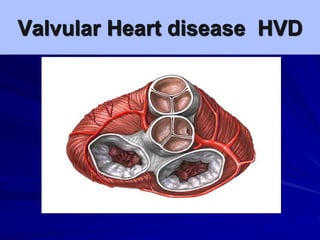
Valvular Heart disease HVD
VHD- Objectives
By the end of this session, the student
should be able to:
1. Define and classify valvular heart disease.
2. Enlist the causes of acquired heart valve diseases.
3. Identify the clinical consequences of valve
dysfunction and complications.
4. Describe different morphological features of valve
dysfunction.
Valvular Heart Disease(HVD)
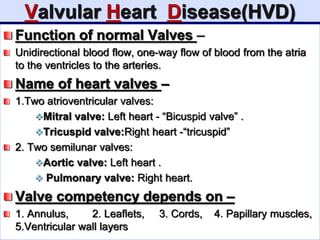
Function of normal Valves –
Unidirectional blood flow, one-way flow of blood from the atria
to the ventricles to the arteries.
Name of heart valves –
1.Two atrioventricular valves:
Mitral valve: Left heart - “Bicuspid valve” .
Tricuspid valve:Right heart -“tricuspid”
2. Two semilunar valves:
Aortic valve: Left heart .
 Pulmonary valve: Right heart.
Valve competency depends on –
1. Annulus, 2. Leaflets, 3. Cords, 4. Papillary muscles,
5.Ventricular wall layers
The aortic valve
Bicuspid valve-thin delicate& leaflets Three thin and delicate cusps
The mitral valve
Define HVD, and explain why its draw the
clinical attention?
HVD is groups of critical clinical conditions involve heart valves,
leading to different pattern of dysfunction.
HVD come to clinical attention – because impose:
1. Hemodynamic instability.
2. Increase susceptibility to infection (infective endocarditis).
Why hemodynamic burden precipitated?
1. Stenosis (Obstruction)
2. Insufficiency (Regurgitation or incompetence).
3. Both
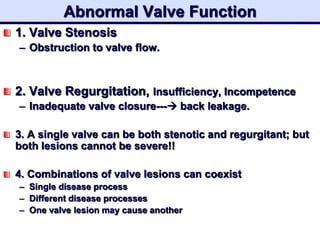
Abnormal Valve Function
1. Valve Stenosis
– Obstruction to valve flow.
2. Valve Regurgitation, Insufficiency, Incompetence
– Inadequate valve closure--- back leakage.
3. A single valve can be both stenotic and regurgitant; but
both lesions cannot be severe!!
4. Combinations of valve lesions can coexist
– Single disease process
– Different disease processes
– One valve lesion may cause another
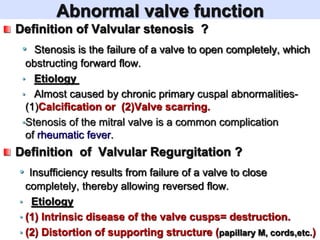
Abnormal valve function
Definition of Valvular stenosis ?
• Stenosis is the failure of a valve to open completely, which
obstructing forward flow.
• Etiology
• Almost caused by chronic primary cuspal abnormalities-
(1)Calcification or (2)Valve scarring.
•Stenosis of the mitral valve is a common complication
of rheumatic fever.
Definition of Valvular Regurgitation ?
• Insufficiency results from failure of a valve to close
completely, thereby allowing reversed flow.
• Etiology
• (1) Intrinsic disease of the valve cusps= destruction.
• (2) Distortion of supporting structure (papillary M, cords,etc.)
Classification
Based on etiology can be classified into:
 1. Congenital heart disease
 2. Acquired heart disease.
Heart Valvular Disease- Etiology
1.Congenital heart valve disease -
e.g. Septal defect, Atresia, mal-position.
to be discussed in separate session.
_______________________________________________
2. Acquired heart valve disease :- (most frequent)
A. Endocarditis– (MR & AR) most common is mitral valve.
B. Post-inflammatory healed scar (Rheumatic heart disease)
MS+MR & AS+AR
C. Senile calcific aortic stenosis- AS
D. Myxomatous - Mitral valve Prolapse- MR
E. Abnormalities of Leaflets and Commissures
F. Abnormalities of Tensor Apparatus.
G. Abnormalities of Left Ventricular Cavity and/or Annulus-
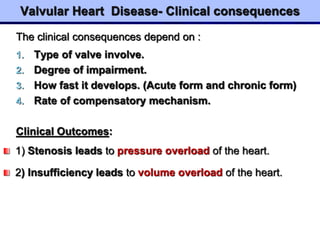
Valvular Heart Disease- Clinical consequences
The clinical consequences depend on :
1. Type of valve involve.
2. Degree of impairment.
3. How fast it develops. (Acute form and chronic form)
4. Rate of compensatory mechanism.
Clinical Outcomes:
1) Stenosis leads to pressure overload of the heart.
2) Insufficiency leads to volume overload of the heart.
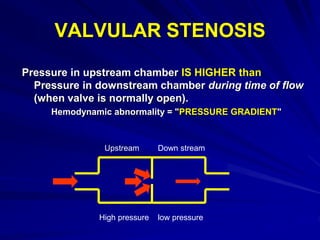
VALVULAR STENOSIS
Pressure in upstream chamber IS HIGHER than
Pressure in downstream chamber during time of flow
(when valve is normally open).
Hemodynamic abnormality = "PRESSURE GRADIENT"
Upstream Down stream
High pressure low pressure
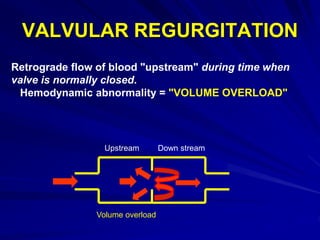
VALVULAR REGURGITATION
Upstream Down stream
Volume overload
Retrograde flow of blood "upstream" during time when
valve is normally closed.
Hemodynamic abnormality = "VOLUME OVERLOAD"
Assessment for Valve Dysfunction
– Murmurs
– General malaise
– Dyspnea on exertion
– Dizziness
– Chest pain or discomfort
– Prior history of rheumatic
heart disease
– Orthopnea
– Dyspnea, rales
– Pink-tinged sputum
Complications:
– Hemodynamic instability
– Heart failure
– Angina
– Syncope
– Death
Diagnosis:
ECG
Chest x-ray
Cardiac cath
Echocardiogram
Heart Valvular Disease- Clinical Outcomes
Example:
(1) Mitral stenosis: (comments type)
Complication of Rheumatic heart disease fibroticscarring
Chronic - Well tolerated over years.
Mitral stenosis “fish mouth”
show diffuse fibrous thickening
&distortion, commissural fusion
Calcific aortic disease
Most common acquired aortic stenosis in elderly.
Consequence of age-associated “wear and tear” 
degeneration , fibrosis and calcification.
Occasions: (1) Normal valves. (2) Congenitally bicuspid valves
Pathological processes for calcification
(1) Disorder of elderly (2) Unknown.
The major clinical features of Stenosis :
(1) Left ventricular hypertrophy and (CHF) failure...
(2) Angina.
(3) Syncope (abrupt episodes of faintness) (hypoperfusion)
Calcified aortic valve of old age
Macroscopic
1) Heaped-up protruded
calcified masses.
2) the cusps become fibrosed
and thickened.
3) The free edges of the cusps
are not involved.
Microscopic:
large nodular calcific
deposits.
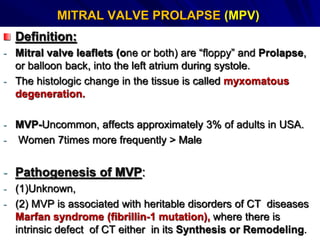
MITRAL VALVE PROLAPSE (MPV)
Definition:
- Mitral valve leaflets (one or both) are “floppy” and Prolapse,
or balloon back, into the left atrium during systole.
- The histologic change in the tissue is called myxomatous
degeneration.
- MVP-Uncommon, affects approximately 3% of adults in USA.
- Women 7times more frequently > Male
- Pathogenesis of MVP:
- (1)Unknown,
- (2) MVP is associated with heritable disorders of CT diseases
Marfan syndrome (fibrillin-1 mutation), where there is
intrinsic defect of CT either in its Synthesis or Remodeling.
MPV-MORPHOLOGY
Macroscopic appearance
1. The Leaflets: Enlarged,
redundant, thick, rubbery,
Ballooning .
2. The Tendinous : cords
may be elongated, thinned,
or even ruptured.
3. The annulus: may be
dilated.
4. The tricuspid, aortic, or
pulmonary valves may also
be affected.
Left ventricle demonstrating prolapse of
the posterior mitral leaflet into the left
atrium
Mitral valve
Pronounced hooding of MV with thrombotic plaques
Microscopy:
* Thinning fibrosa layer of the valve.
* Marked expansion of the spongiosa layer with
deposition of mucoid (myxomatous) material.
Valvular Heart Disease
The end
?
1. Stenosis is the failure of a valve to close completely.
(T) OR (F)
2. Insufficiency is the failure of a valve to close completely.
(T) OR (F)

Valvular disease.ppt

  • 1.
  • 2.
    VHD- Objectives By theend of this session, the student should be able to: 1. Define and classify valvular heart disease. 2. Enlist the causes of acquired heart valve diseases. 3. Identify the clinical consequences of valve dysfunction and complications. 4. Describe different morphological features of valve dysfunction.
  • 3.
    Valvular Heart Disease(HVD) Functionof normal Valves – Unidirectional blood flow, one-way flow of blood from the atria to the ventricles to the arteries. Name of heart valves – 1.Two atrioventricular valves: Mitral valve: Left heart - “Bicuspid valve” . Tricuspid valve:Right heart -“tricuspid” 2. Two semilunar valves: Aortic valve: Left heart .  Pulmonary valve: Right heart. Valve competency depends on – 1. Annulus, 2. Leaflets, 3. Cords, 4. Papillary muscles, 5.Ventricular wall layers
  • 5.
    The aortic valve Bicuspidvalve-thin delicate& leaflets Three thin and delicate cusps The mitral valve
  • 6.
    Define HVD, andexplain why its draw the clinical attention? HVD is groups of critical clinical conditions involve heart valves, leading to different pattern of dysfunction. HVD come to clinical attention – because impose: 1. Hemodynamic instability. 2. Increase susceptibility to infection (infective endocarditis). Why hemodynamic burden precipitated? 1. Stenosis (Obstruction) 2. Insufficiency (Regurgitation or incompetence). 3. Both
  • 7.
    Abnormal Valve Function 1.Valve Stenosis – Obstruction to valve flow. 2. Valve Regurgitation, Insufficiency, Incompetence – Inadequate valve closure--- back leakage. 3. A single valve can be both stenotic and regurgitant; but both lesions cannot be severe!! 4. Combinations of valve lesions can coexist – Single disease process – Different disease processes – One valve lesion may cause another
  • 8.
    Abnormal valve function Definitionof Valvular stenosis ? • Stenosis is the failure of a valve to open completely, which obstructing forward flow. • Etiology • Almost caused by chronic primary cuspal abnormalities- (1)Calcification or (2)Valve scarring. •Stenosis of the mitral valve is a common complication of rheumatic fever. Definition of Valvular Regurgitation ? • Insufficiency results from failure of a valve to close completely, thereby allowing reversed flow. • Etiology • (1) Intrinsic disease of the valve cusps= destruction. • (2) Distortion of supporting structure (papillary M, cords,etc.)
  • 9.
    Classification Based on etiologycan be classified into:  1. Congenital heart disease  2. Acquired heart disease.
  • 10.
    Heart Valvular Disease-Etiology 1.Congenital heart valve disease - e.g. Septal defect, Atresia, mal-position. to be discussed in separate session. _______________________________________________ 2. Acquired heart valve disease :- (most frequent) A. Endocarditis– (MR & AR) most common is mitral valve. B. Post-inflammatory healed scar (Rheumatic heart disease) MS+MR & AS+AR C. Senile calcific aortic stenosis- AS D. Myxomatous - Mitral valve Prolapse- MR E. Abnormalities of Leaflets and Commissures F. Abnormalities of Tensor Apparatus. G. Abnormalities of Left Ventricular Cavity and/or Annulus-
  • 11.
    Valvular Heart Disease-Clinical consequences The clinical consequences depend on : 1. Type of valve involve. 2. Degree of impairment. 3. How fast it develops. (Acute form and chronic form) 4. Rate of compensatory mechanism. Clinical Outcomes: 1) Stenosis leads to pressure overload of the heart. 2) Insufficiency leads to volume overload of the heart.
  • 12.
    VALVULAR STENOSIS Pressure inupstream chamber IS HIGHER than Pressure in downstream chamber during time of flow (when valve is normally open). Hemodynamic abnormality = "PRESSURE GRADIENT" Upstream Down stream High pressure low pressure
  • 13.
    VALVULAR REGURGITATION Upstream Downstream Volume overload Retrograde flow of blood "upstream" during time when valve is normally closed. Hemodynamic abnormality = "VOLUME OVERLOAD"
  • 14.
    Assessment for ValveDysfunction – Murmurs – General malaise – Dyspnea on exertion – Dizziness – Chest pain or discomfort – Prior history of rheumatic heart disease – Orthopnea – Dyspnea, rales – Pink-tinged sputum Complications: – Hemodynamic instability – Heart failure – Angina – Syncope – Death Diagnosis: ECG Chest x-ray Cardiac cath Echocardiogram
  • 15.
    Heart Valvular Disease-Clinical Outcomes Example: (1) Mitral stenosis: (comments type) Complication of Rheumatic heart disease fibroticscarring Chronic - Well tolerated over years. Mitral stenosis “fish mouth” show diffuse fibrous thickening &distortion, commissural fusion
  • 16.
    Calcific aortic disease Mostcommon acquired aortic stenosis in elderly. Consequence of age-associated “wear and tear”  degeneration , fibrosis and calcification. Occasions: (1) Normal valves. (2) Congenitally bicuspid valves Pathological processes for calcification (1) Disorder of elderly (2) Unknown. The major clinical features of Stenosis : (1) Left ventricular hypertrophy and (CHF) failure... (2) Angina. (3) Syncope (abrupt episodes of faintness) (hypoperfusion)
  • 17.
    Calcified aortic valveof old age Macroscopic 1) Heaped-up protruded calcified masses. 2) the cusps become fibrosed and thickened. 3) The free edges of the cusps are not involved. Microscopic: large nodular calcific deposits.
  • 18.
    MITRAL VALVE PROLAPSE(MPV) Definition: - Mitral valve leaflets (one or both) are “floppy” and Prolapse, or balloon back, into the left atrium during systole. - The histologic change in the tissue is called myxomatous degeneration. - MVP-Uncommon, affects approximately 3% of adults in USA. - Women 7times more frequently > Male - Pathogenesis of MVP: - (1)Unknown, - (2) MVP is associated with heritable disorders of CT diseases Marfan syndrome (fibrillin-1 mutation), where there is intrinsic defect of CT either in its Synthesis or Remodeling.
  • 19.
    MPV-MORPHOLOGY Macroscopic appearance 1. TheLeaflets: Enlarged, redundant, thick, rubbery, Ballooning . 2. The Tendinous : cords may be elongated, thinned, or even ruptured. 3. The annulus: may be dilated. 4. The tricuspid, aortic, or pulmonary valves may also be affected. Left ventricle demonstrating prolapse of the posterior mitral leaflet into the left atrium
  • 20.
    Mitral valve Pronounced hoodingof MV with thrombotic plaques
  • 21.
    Microscopy: * Thinning fibrosalayer of the valve. * Marked expansion of the spongiosa layer with deposition of mucoid (myxomatous) material.
  • 22.
  • 23.
    1. Stenosis isthe failure of a valve to close completely. (T) OR (F) 2. Insufficiency is the failure of a valve to close completely. (T) OR (F)