Managing Value-added Services in Today's Academic Library  By John Michael Potter 10.31.07
Value-Added Services = “Library 2.0” “ The new element that Library 2.0 brings to our libraries is a shift in power balance—between us, our users, suppliers, software vendors, non-users”. -Kathryn Greenhill (2007)
More about Library 2.0 Web 2.0 characteristics allow users to produce content, share ideas, employ collaborative tools Web 2.0 has empowered both librarians and patrons.  However, the academic library can no longer become accustomed to having a captive audience Library 2.0 alludes to the term 2.0 in an attempt to associate libraries more directly with the characteristics and technology of web 2.0 (Participatory, barrier-free, ubiquitous) Generational changes play a part. Current generation has little desire to navigate OPACs.  Beware Library 2.0 hype vs reality.  The trend argues for evolution rather than revolution.
What this means: Changing the way we view libraries Inviting user participation  to share ideas, contribute content, access collaborative tools Consistently evaluating services  to reach new users, better serve current users Higher expectations, aspirations
Value-Added Reference  Virtual reference isn’t just about the question but is tied to the full range of the user experience—an environment in which all of the Library 2.0 tools are served up in an integrated way in the service of the end user…
Wiki as a Knowledge Base External Wiki:  Employ as reference question repository For dynamic, up-to-date information Internal Wiki Technology updates News about new resources Confer about student assignments
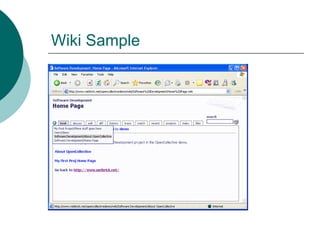
Wiki Sample
Other considerations Wikis  can be used to foster collaboration between libraries The Desk vs Roving Reference Virtual Reference/Google Answers Facebook  participation to create personal connections (quality not quantity)
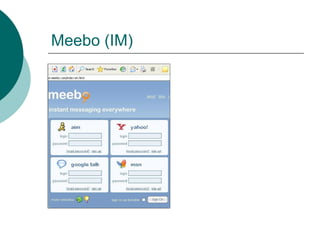
Other L2 tools IM (Meebo):  Necessary Device restrictions Disproportionate attention? Voice of Internet Protocol Skype’s new handheld device (10/23) Blogs Connect, engage with users  promote library services, demonstrate librarian’s skills
Meebo (IM)
Value-Added Instruction  by treating patrons as peers and interacting with them on their turf, librarians can be perceived as genuine allies
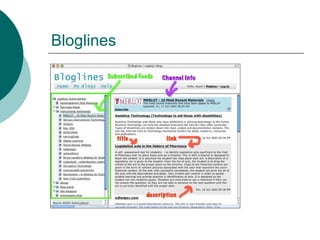
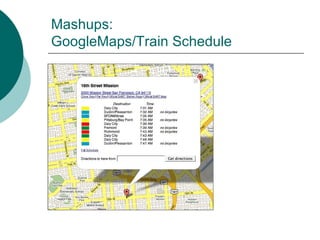
“Customer Facing Environments” Facebook, MySpace:  ” Learn by Doing”  Bloglines:  Accumulate updated research material using RSS Podcasts:  Adding value, convenience Mashups:  Tools for innovative Research
Bloglines
Mashups:  GoogleMaps/Train Schedule
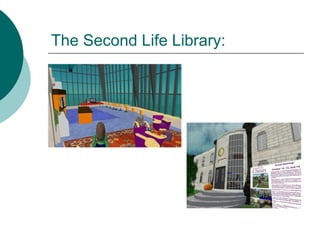
“Customer Facing Environments” Wikis:  Really dynamic research guides  Second Life:  A distance learning tool Game Design:  unwarranted skepticism (?)
The Second Life Library:
Information Literacy Evaluate materials (IL) using Wikis Review legal issues using Facebook Discover new ideas using tagging Discern research trends using Del.icio.us Create IL Podcasts for user convenience (customized via RSS)
Value-Added Access  “ Libraries must disconnect services from being locked away in proprietary silos…  Otherwise, students will bypass processes and institutions they perceive to be slow, unresponsive, and irrelevant...”   -Jenny Levine (2006)
Unhappiness with OPACs First mistake:  made to serve librarians rather than users Disconnected:  analogous to a proprietary silo- no data mobility Closed system:  limited ability to add features Demand change from vendors  or build your own (OPAC plug-in for Wordpress).
OPAC Solutions In short, become like Amazon (personalized, participatory) Requires radical trust  open up systems, create pilot project A New OPAC should have:  open standards, APIs, and web services modular, reusable systems- separate the data, application, & interface Hire Programmers  Deciding factor between haves and have-nots
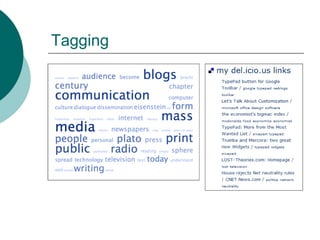
Tagging Delicious/Flickr-  “ facilitate shared discovery of new ways of understanding same content” University of Pennsylvania  RSS feed for tags to promote discovery Allow users to tag within online catalog Tag Clouds?????? Geotagging????????
Tagging
Tagging Advantages More scalable, current/reflective,  Flat, non-hierarchical,  A discovery system– unlike blog, can be used for long-term interests Disadvantages No synonym control, lack of precision, fuzziness in linguistic boundaries (no broader vs. narrower)
Implementation “ Currently libraries have a tendency to plan, implement, and forget.” -Michael Casey (2006)
Staff Issues Resistance Rethinking Training  Staff Wiki
Risks/Problems High expectations from users Implemented and forgotten? Vague interest from management  Any misstep may affect general progress
Planning Ahead Envisioning the ideal Library 2.0 But what do users want?  Judiciously select priorities Don’t reinvent the wheel Document success and failures Prepare to convince the IT Dept  Well-thought out plans taken seriously
Evaluation & Assessment Create vehicle for regular student & faculty input Employ benchmarks  Do not throw out the baby with the bathwater Solicit feedback
Marketing “ ..telling people to come to the library is different from telling them to consult a well-educated librarian”     -J.K.Shokane (2002)
Still Relevant Ideas Technologies vs. Attitude Student Outreach Relationship Marketing Self-Branding
Promotional Web Tools Google Scholar Blogs Podcasting Flickr Facebook
Conclusion What is the alternative to learning new skills and changing? That would be marginalization and obsolescence.
Conclusion What will become of the Library? Institutional Repositories & Trust D2C2 at Purdue University

Managing Value-Added Services...

  • 1.
    Managing Value-added Servicesin Today's Academic Library By John Michael Potter 10.31.07
  • 2.
    Value-Added Services =“Library 2.0” “ The new element that Library 2.0 brings to our libraries is a shift in power balance—between us, our users, suppliers, software vendors, non-users”. -Kathryn Greenhill (2007)
  • 3.
    More about Library2.0 Web 2.0 characteristics allow users to produce content, share ideas, employ collaborative tools Web 2.0 has empowered both librarians and patrons. However, the academic library can no longer become accustomed to having a captive audience Library 2.0 alludes to the term 2.0 in an attempt to associate libraries more directly with the characteristics and technology of web 2.0 (Participatory, barrier-free, ubiquitous) Generational changes play a part. Current generation has little desire to navigate OPACs. Beware Library 2.0 hype vs reality. The trend argues for evolution rather than revolution.
  • 4.
    What this means:Changing the way we view libraries Inviting user participation to share ideas, contribute content, access collaborative tools Consistently evaluating services to reach new users, better serve current users Higher expectations, aspirations
  • 5.
    Value-Added Reference Virtual reference isn’t just about the question but is tied to the full range of the user experience—an environment in which all of the Library 2.0 tools are served up in an integrated way in the service of the end user…
  • 6.
    Wiki as aKnowledge Base External Wiki: Employ as reference question repository For dynamic, up-to-date information Internal Wiki Technology updates News about new resources Confer about student assignments
  • 7.
  • 8.
    Other considerations Wikis can be used to foster collaboration between libraries The Desk vs Roving Reference Virtual Reference/Google Answers Facebook participation to create personal connections (quality not quantity)
  • 9.
    Other L2 toolsIM (Meebo): Necessary Device restrictions Disproportionate attention? Voice of Internet Protocol Skype’s new handheld device (10/23) Blogs Connect, engage with users promote library services, demonstrate librarian’s skills
  • 10.
  • 11.
    Value-Added Instruction by treating patrons as peers and interacting with them on their turf, librarians can be perceived as genuine allies
  • 12.
    “Customer Facing Environments”Facebook, MySpace: ” Learn by Doing” Bloglines: Accumulate updated research material using RSS Podcasts: Adding value, convenience Mashups: Tools for innovative Research
  • 13.
  • 14.
  • 15.
    “Customer Facing Environments”Wikis: Really dynamic research guides Second Life: A distance learning tool Game Design: unwarranted skepticism (?)
  • 16.
  • 17.
    Information Literacy Evaluatematerials (IL) using Wikis Review legal issues using Facebook Discover new ideas using tagging Discern research trends using Del.icio.us Create IL Podcasts for user convenience (customized via RSS)
  • 18.
    Value-Added Access “ Libraries must disconnect services from being locked away in proprietary silos… Otherwise, students will bypass processes and institutions they perceive to be slow, unresponsive, and irrelevant...” -Jenny Levine (2006)
  • 19.
    Unhappiness with OPACsFirst mistake: made to serve librarians rather than users Disconnected: analogous to a proprietary silo- no data mobility Closed system: limited ability to add features Demand change from vendors or build your own (OPAC plug-in for Wordpress).
  • 20.
    OPAC Solutions Inshort, become like Amazon (personalized, participatory) Requires radical trust open up systems, create pilot project A New OPAC should have: open standards, APIs, and web services modular, reusable systems- separate the data, application, & interface Hire Programmers Deciding factor between haves and have-nots
  • 21.
    Tagging Delicious/Flickr- “ facilitate shared discovery of new ways of understanding same content” University of Pennsylvania RSS feed for tags to promote discovery Allow users to tag within online catalog Tag Clouds?????? Geotagging????????
  • 22.
  • 23.
    Tagging Advantages Morescalable, current/reflective, Flat, non-hierarchical, A discovery system– unlike blog, can be used for long-term interests Disadvantages No synonym control, lack of precision, fuzziness in linguistic boundaries (no broader vs. narrower)
  • 24.
    Implementation “ Currentlylibraries have a tendency to plan, implement, and forget.” -Michael Casey (2006)
  • 25.
    Staff Issues ResistanceRethinking Training Staff Wiki
  • 26.
    Risks/Problems High expectationsfrom users Implemented and forgotten? Vague interest from management Any misstep may affect general progress
  • 27.
    Planning Ahead Envisioningthe ideal Library 2.0 But what do users want? Judiciously select priorities Don’t reinvent the wheel Document success and failures Prepare to convince the IT Dept Well-thought out plans taken seriously
  • 28.
    Evaluation & AssessmentCreate vehicle for regular student & faculty input Employ benchmarks Do not throw out the baby with the bathwater Solicit feedback
  • 29.
    Marketing “ ..tellingpeople to come to the library is different from telling them to consult a well-educated librarian” -J.K.Shokane (2002)
  • 30.
    Still Relevant IdeasTechnologies vs. Attitude Student Outreach Relationship Marketing Self-Branding
  • 31.
    Promotional Web ToolsGoogle Scholar Blogs Podcasting Flickr Facebook
  • 32.
    Conclusion What isthe alternative to learning new skills and changing? That would be marginalization and obsolescence.
  • 33.
    Conclusion What willbecome of the Library? Institutional Repositories & Trust D2C2 at Purdue University