PRESENT
PROGRESSIVE
Elaborado por:
Sandrine Lafontant Diaz
Educación a Distancia
1
HOW TO STRUCTURE THE “PRESENT
PROGRESSIVE”?
The present progressive is formed by two main verbs:
Verb BE (in present simple) + gerund form
In the following slides we Will see how to conjuate both verbs in a
present progressive form.
Verb BE
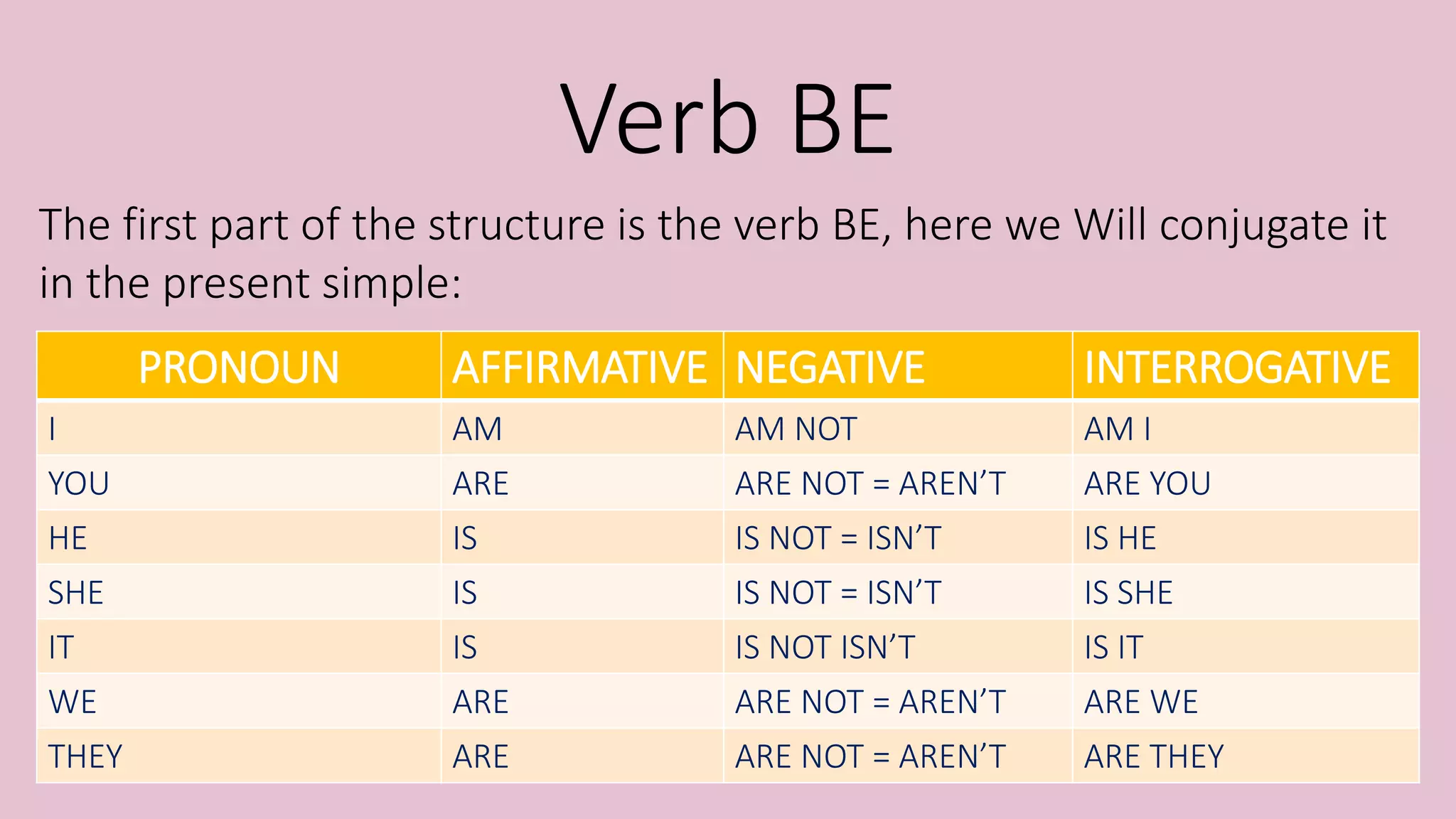
The first part of the structure is the verb BE, here we Will conjugate it
in the present simple:
PRONOUN AFFIRMATIVE NEGATIVE INTERROGATIVE
I AM AM NOT AM I
YOU ARE ARE NOT = AREN’T ARE YOU
HE IS IS NOT = ISN’T IS HE
SHE IS IS NOT = ISN’T IS SHE
IT IS IS NOT ISN’T IS IT
WE ARE ARE NOT = AREN’T ARE WE
THEY ARE ARE NOT = AREN’T ARE THEY
GERUND FORM
In the second part of the structure we Will put the main verb in the
gerund form:
----- we only have to add “ing” at the end of the main verb ------
PRONOUN AFFIRMATIVE Gerund form
I AM Talking
YOU ARE Playing
HE IS Dancing
SHE IS Singing
IT IS Swimming
WE ARE Running
THEY ARE walking
EXAMPLES
SENTENCES
Affirmative I am walking to work.
Negative She isn’t eating pizza.
Interrogative Are you drinking some coffee?
Affirmative We are dancing salsa on the dance floor.
Negative They aren’t writing a letter.
Affirmative He is watching a movie.
Interrogative Is it biting the bone?
USES OF THE PRESENT PROGRESSIVE
The present progressive is used to:
- describe an action that is happening in the moment.
For example: You are using the Internet.
- Describe an action that is happening nowadays.
For example: Are you still working for the same company?
- Describe an future action or evento which is already planned.
For example: We are going to visit our grandparents this weekend.
EXCEPTIONS TO THE RULES
Some verbs cannot be conjugated in the present progressive because
they refer to a state not an action:
- Sensation : to feel, to hear, to see, to smell, to taste
- Opinion: to asume, to believe, to consider, to suppose
- Mental state: to forget, to imagina, to know, to understand
- Emotions: to fear, to love, to hate, to envy
- Measurements: to hold, to measure, to weight
- Other verbs: to look, to be, to seem
Créditos
Tecnológico nacional de México
Tecnológico de Estudios Superiores de
Cuautitlán Izcalli
Coordinación del Área de
Educación a Distancia

Present progressive

  • 1.
  • 2.
    HOW TO STRUCTURETHE “PRESENT PROGRESSIVE”? The present progressive is formed by two main verbs: Verb BE (in present simple) + gerund form In the following slides we Will see how to conjuate both verbs in a present progressive form.
  • 3.
    Verb BE The firstpart of the structure is the verb BE, here we Will conjugate it in the present simple: PRONOUN AFFIRMATIVE NEGATIVE INTERROGATIVE I AM AM NOT AM I YOU ARE ARE NOT = AREN’T ARE YOU HE IS IS NOT = ISN’T IS HE SHE IS IS NOT = ISN’T IS SHE IT IS IS NOT ISN’T IS IT WE ARE ARE NOT = AREN’T ARE WE THEY ARE ARE NOT = AREN’T ARE THEY
  • 4.
    GERUND FORM In thesecond part of the structure we Will put the main verb in the gerund form: ----- we only have to add “ing” at the end of the main verb ------ PRONOUN AFFIRMATIVE Gerund form I AM Talking YOU ARE Playing HE IS Dancing SHE IS Singing IT IS Swimming WE ARE Running THEY ARE walking
  • 5.
    EXAMPLES SENTENCES Affirmative I amwalking to work. Negative She isn’t eating pizza. Interrogative Are you drinking some coffee? Affirmative We are dancing salsa on the dance floor. Negative They aren’t writing a letter. Affirmative He is watching a movie. Interrogative Is it biting the bone?
  • 6.
    USES OF THEPRESENT PROGRESSIVE The present progressive is used to: - describe an action that is happening in the moment. For example: You are using the Internet. - Describe an action that is happening nowadays. For example: Are you still working for the same company? - Describe an future action or evento which is already planned. For example: We are going to visit our grandparents this weekend.
  • 7.
    EXCEPTIONS TO THERULES Some verbs cannot be conjugated in the present progressive because they refer to a state not an action: - Sensation : to feel, to hear, to see, to smell, to taste - Opinion: to asume, to believe, to consider, to suppose - Mental state: to forget, to imagina, to know, to understand - Emotions: to fear, to love, to hate, to envy - Measurements: to hold, to measure, to weight - Other verbs: to look, to be, to seem
  • 8.
    Créditos Tecnológico nacional deMéxico Tecnológico de Estudios Superiores de Cuautitlán Izcalli Coordinación del Área de Educación a Distancia