Present Continuous
Tense
I  am singing

By Salome Monge Cruz
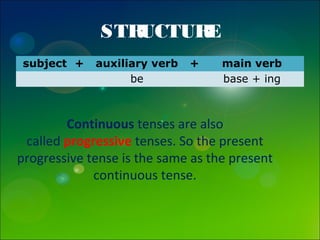
STR
UCTUR
E
subject +


auxiliary verb
be

+
 

main verb
base + ing

Continuous tenses are also 
called progressive tenses. So the present 
progressive tense is the same as the present 
continuous tense.
Look at these examples:
 

subject

+
+
?

I

auxiliary 
verb
am

You

are

She

is

We

are

Is

he


main verb


speaking

to you.

reading

this.

not

staying

in London.

not

playing

football.

watching

TV?

We use the present continuous tense to talk about:
•Action happening now
•Action in the future
a) For action happening exactly now
past

I am eating my lunch.
present

future

    _____________                                            
The action is happening now.
b) For action happening around now
John is going out with Mary.
past
____

_

present
______________

______________ __

future
_____ _____

___

The action is happening around now.

The action may not be happening exactly now, but it is happening just
before and just after now, and it is not permanent or habitual.
Basic rule

Spelling the Present
Continuous Tense
Just add -ing to the base verb:
work

>

working

play
>
playing
assist
>
assisting
see
>
seeing
be
>
being
Exception 1
If the base verb ends in consonant + stressed vowel + consonant, double the last
letter:
s
t
o
consonant
Stressed vowel
stop
>
stopping
run
>
running
begin
>
beginning
Note that this exception does not apply when the last syllable of the base verb is
not stressed:
open
>
opening
Exception 2

Exception 3

Basic rule

If the base verb ends in ie, change the ie to y:
lie
>
lying
die
>
dying
If the base verb ends in vowel + consonant + e, omit the e:
come
>
coming
mistake
>
mistaking
Just add -ing to the base verb:
work
>
working
Examples
•
•
•
•
•
•
•
•
•
•

You are learning English now.
You are not swimming now.
Are you sleeping?
I am sitting.
I am not standing.
Is he sitting or standing?
They are reading their books.
They are not watching television.
What are you doing?
Why aren't you doing your homework?

Present continuous tense

  • 1.
    Present Continuous Tense I  amsinging By Salome Monge Cruz
  • 2.
    STR UCTUR E subject +     auxiliary verb be +   mainverb base + ing Continuous tenses are also  called progressive tenses. So the present  progressive tense is the same as the present  continuous tense.
  • 3.
    Look at theseexamples:   subject + + ? I auxiliary  verb am You are She is We are Is he   main verb   speaking to you. reading this. not staying in London. not playing football. watching TV? We use the present continuous tense to talk about: •Action happening now •Action in the future
  • 4.
    a) For actionhappening exactly now past I am eating my lunch. present future     _____________                                             The action is happening now.
  • 5.
    b) For actionhappening around now John is going out with Mary. past ____ _ present ______________ ______________ __ future _____ _____ ___ The action is happening around now. The action may not be happening exactly now, but it is happening just before and just after now, and it is not permanent or habitual.
  • 6.
    Basic rule Spelling thePresent Continuous Tense Just add -ing to the base verb: work > working play > playing assist > assisting see > seeing be > being Exception 1 If the base verb ends in consonant + stressed vowel + consonant, double the last letter: s t o consonant Stressed vowel stop > stopping run > running begin > beginning Note that this exception does not apply when the last syllable of the base verb is not stressed: open > opening Exception 2 Exception 3 Basic rule If the base verb ends in ie, change the ie to y: lie > lying die > dying If the base verb ends in vowel + consonant + e, omit the e: come > coming mistake > mistaking Just add -ing to the base verb: work > working
  • 7.
    Examples • • • • • • • • • • You are learning English now. You are notswimming now. Are you sleeping? I am sitting. I am not standing. Is he sitting or standing? They are reading their books. They are not watching television. What are you doing? Why aren't you doing your homework?