Preparing to Teach...
A Model for Training Faculty
5 Underlying Principles Guiding our Approach
Mike Meloy and Jennifer Lewis
Madison College Flexible Learning Conference
October 18, 2013
Who are we?

• CETL Fellows, facilitators of PTTH/O
classes
• Classes result of VP of Learner Success
request to develop “something” in 2007
• Courses focus:
o Skills for success
o Quality course development/facilitation
Madison College Definitions:
Online courses deliver education using the Internet for self-motivated students who wish to learn in their own
environments, rather than on campus, using a computer to connect with the instructor and other course
participants. Although these classes have a specific schedule, and have specific start and end dates, they do not
require participants to meet on campus. They may require supervised or proctored exams, labs, and
activities, depending on the subject matter and instructor’s design. Online courses are demanding; students must
manage time well and be self motivated to be successful.

Hybrid courses at Madison College combine the best of traditional face-to-face teaching with innovative online
learning methods. Students will be expected to attend scheduled face-to-face class sessions, but the number
and/or length of the classroom time will vary depending on the nature of the course and the instructor. As little as
1/3 or as much as 3/4 of the traditional classroom instruction will be replaced with the online instructional methods.
The online instruction component will promote student engagement through enhanced interaction with course
material.

http://madisoncollege.edu/definitions
What is PTTO?
TOPICS:

END PRODUCTS:

•Defining the Online Classroom

•Online Syllabus

•Designing the Online Learning
Experience

•Welcome Letter

•Course Organization

•Self-defined Final Project

•Instructor's Presence

•Experience with Web 2.0
tools

•Copyright and Academic Integrity Issues
•Managing the Online Classroom
•Online Learning Activities

•Online Teaching Philosophy
What is PTTH?
TOPICS:

End Products:

•Defining Hybrid Learning at
Madison College

•Hybrid Syllabus

•Analyzing the Hybrid Learning
Environment

•Hybrid Learning Activity

•Adapting Learning Activities for
Hybrid Learners

•Facilitation Methods and Logistics
•Academic Integrity Issues
•Curriculum Construction and
Creating Hybrid Learning Activities

•Hybrid Teaching Philosophy
•Experience with Web 2.0
Tools
1) Follow and Model Best Practices

• Teaching methods
• Facilitation, interaction and
communication

• Course design and assessment

http://intranet.madisoncollege.edu/forms-db/forms/Course_Quality_Standards.pdf
Modeling Best Practices: PTTH
Our Approach:
Course Navigation
Bridge F2F and Online
Three types of activities

•
•
•

Image: http://commons.wikimedia.org/wiki/File:Stanley_compass_1.jpg
Modeling Best Practices PTTO
Our Approach:
Overall Course Design
Creating Online Community
Instructor Presence and Role
Three types of activities

•
•
•
•

Image: http://commons.wikimedia.org/wiki/File:Cairn_3.jpg
2) Create Student/Instructor
Centered, Relevant Courses

• Making an “in demand” course
• Aid in course creation
• Relevant deliverables
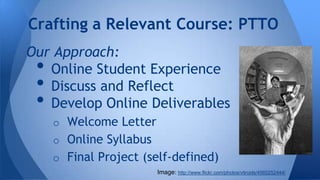
Crafting a Relevant Course: PTTO
Our Approach:
Online Student Experience
Discuss and Reflect
Develop Online Deliverables

•
•
•

o Welcome Letter
o Online Syllabus
o Final Project (self-defined)
Image: http://www.flickr.com/photos/vitroids/4560252444/
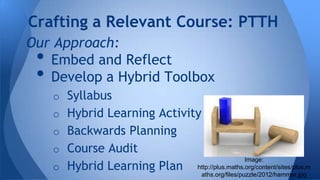
Crafting a Relevant Course: PTTH
Our Approach:
Embed and Reflect
Develop a Hybrid Toolbox

•
•

o Syllabus

o Hybrid Learning Activity
o Backwards Planning

o Course Audit
o Hybrid Learning Plan

Image:
http://plus.maths.org/content/sites/plus.m
aths.org/files/puzzle/2012/hammer.jpg
3) Emphasize Process, Engagement,
and Interactivity

• Web 2.0 tools used to enhance, not
drive the classroom

• Shift focus away from content and
delivery (shoveling content online)
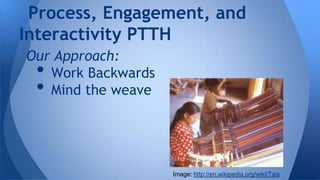
Process, Engagement, and
Interactivity PTTH
Our Approach:
Work Backwards
Mind the weave

•
•

Image: http://en.wikipedia.org/wiki/Tais
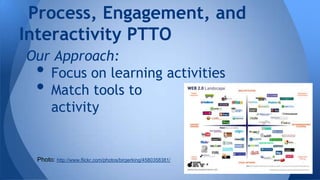
Process, Engagement, and
Interactivity PTTO
Our Approach:
Focus on learning activities
Match tools to
activity

•
•

Photo: http://www.flickr.com/photos/birgerking/4580358381/
4) Diversify Assessment Strategies
and Activities

• Addressing different Learning Styles
• Aids in increased engagement
Diversifying Assessment in PTTO
Our Approach:
Universal Design:

•

o Content representation
o Action and Expression
 knowledge
o Engagement - easiest in PTTO
 recruit interest, sustain effort

o

http://www.udlcenter.org/aboutudl
Photo: http://www.flickr.com/photos/katerha/5241746230/
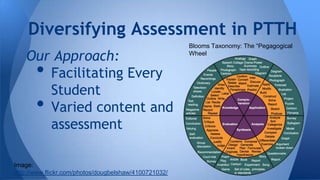
Diversifying Assessment in PTTH
Our Approach:
Facilitating Every
Student
Varied content and
assessment

•
•

Image:
http://www.flickr.com/photos/dougbelshaw/4100721032/

Blooms Taxonomy: The “Pegagogical
Wheel
5) Promote Active, Engaged Learning

• Focus on the student’s learning needs
• Applied learning and critical thinking
• Knowledge retention
http://madisoncollege.edu/in/about-active-learning
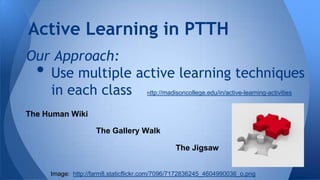
Active Learning in PTTH
Our Approach:
Use multiple active learning techniques
in each class ttp://madisoncollege.edu/in/active-learning-activities

•

h

The Human Wiki
The Gallery Walk
The Jigsaw
Image: http://farm8.staticflickr.com/7096/7172836245_4604990036_o.png
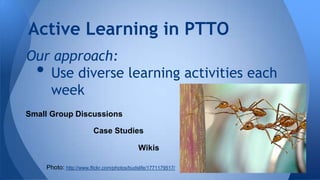
Active Learning in PTTO
Our approach:
Use diverse learning activities each
week

•

Small Group Discussions
Case Studies
Wikis
Photo: http://www.flickr.com/photos/budslife/1771179517/
For More Information on Flexible
Learning at Madison College

• Flexible and Online Learning Website:

http://madisoncollege.edu/in/flexible
-online-learning

• To register for PTTH/PTTO:

http://madisoncollege.edu/in/cetl

Preparing to Teach... a Model for Training Faculty

  • 1.
    Preparing to Teach... AModel for Training Faculty 5 Underlying Principles Guiding our Approach Mike Meloy and Jennifer Lewis Madison College Flexible Learning Conference October 18, 2013
  • 2.
    Who are we? •CETL Fellows, facilitators of PTTH/O classes • Classes result of VP of Learner Success request to develop “something” in 2007 • Courses focus: o Skills for success o Quality course development/facilitation
  • 3.
    Madison College Definitions: Onlinecourses deliver education using the Internet for self-motivated students who wish to learn in their own environments, rather than on campus, using a computer to connect with the instructor and other course participants. Although these classes have a specific schedule, and have specific start and end dates, they do not require participants to meet on campus. They may require supervised or proctored exams, labs, and activities, depending on the subject matter and instructor’s design. Online courses are demanding; students must manage time well and be self motivated to be successful. Hybrid courses at Madison College combine the best of traditional face-to-face teaching with innovative online learning methods. Students will be expected to attend scheduled face-to-face class sessions, but the number and/or length of the classroom time will vary depending on the nature of the course and the instructor. As little as 1/3 or as much as 3/4 of the traditional classroom instruction will be replaced with the online instructional methods. The online instruction component will promote student engagement through enhanced interaction with course material. http://madisoncollege.edu/definitions
  • 4.
    What is PTTO? TOPICS: ENDPRODUCTS: •Defining the Online Classroom •Online Syllabus •Designing the Online Learning Experience •Welcome Letter •Course Organization •Self-defined Final Project •Instructor's Presence •Experience with Web 2.0 tools •Copyright and Academic Integrity Issues •Managing the Online Classroom •Online Learning Activities •Online Teaching Philosophy
  • 5.
    What is PTTH? TOPICS: EndProducts: •Defining Hybrid Learning at Madison College •Hybrid Syllabus •Analyzing the Hybrid Learning Environment •Hybrid Learning Activity •Adapting Learning Activities for Hybrid Learners •Facilitation Methods and Logistics •Academic Integrity Issues •Curriculum Construction and Creating Hybrid Learning Activities •Hybrid Teaching Philosophy •Experience with Web 2.0 Tools
  • 6.
    1) Follow andModel Best Practices • Teaching methods • Facilitation, interaction and communication • Course design and assessment http://intranet.madisoncollege.edu/forms-db/forms/Course_Quality_Standards.pdf
  • 7.
    Modeling Best Practices:PTTH Our Approach: Course Navigation Bridge F2F and Online Three types of activities • • • Image: http://commons.wikimedia.org/wiki/File:Stanley_compass_1.jpg
  • 8.
    Modeling Best PracticesPTTO Our Approach: Overall Course Design Creating Online Community Instructor Presence and Role Three types of activities • • • • Image: http://commons.wikimedia.org/wiki/File:Cairn_3.jpg
  • 9.
    2) Create Student/Instructor Centered,Relevant Courses • Making an “in demand” course • Aid in course creation • Relevant deliverables
  • 10.
    Crafting a RelevantCourse: PTTO Our Approach: Online Student Experience Discuss and Reflect Develop Online Deliverables • • • o Welcome Letter o Online Syllabus o Final Project (self-defined) Image: http://www.flickr.com/photos/vitroids/4560252444/
  • 11.
    Crafting a RelevantCourse: PTTH Our Approach: Embed and Reflect Develop a Hybrid Toolbox • • o Syllabus o Hybrid Learning Activity o Backwards Planning o Course Audit o Hybrid Learning Plan Image: http://plus.maths.org/content/sites/plus.m aths.org/files/puzzle/2012/hammer.jpg
  • 12.
    3) Emphasize Process,Engagement, and Interactivity • Web 2.0 tools used to enhance, not drive the classroom • Shift focus away from content and delivery (shoveling content online)
  • 13.
    Process, Engagement, and InteractivityPTTH Our Approach: Work Backwards Mind the weave • • Image: http://en.wikipedia.org/wiki/Tais
  • 14.
    Process, Engagement, and InteractivityPTTO Our Approach: Focus on learning activities Match tools to activity • • Photo: http://www.flickr.com/photos/birgerking/4580358381/
  • 15.
    4) Diversify AssessmentStrategies and Activities • Addressing different Learning Styles • Aids in increased engagement
  • 16.
    Diversifying Assessment inPTTO Our Approach: Universal Design: • o Content representation o Action and Expression  knowledge o Engagement - easiest in PTTO  recruit interest, sustain effort o http://www.udlcenter.org/aboutudl Photo: http://www.flickr.com/photos/katerha/5241746230/
  • 17.
    Diversifying Assessment inPTTH Our Approach: Facilitating Every Student Varied content and assessment • • Image: http://www.flickr.com/photos/dougbelshaw/4100721032/ Blooms Taxonomy: The “Pegagogical Wheel
  • 18.
    5) Promote Active,Engaged Learning • Focus on the student’s learning needs • Applied learning and critical thinking • Knowledge retention http://madisoncollege.edu/in/about-active-learning
  • 19.
    Active Learning inPTTH Our Approach: Use multiple active learning techniques in each class ttp://madisoncollege.edu/in/active-learning-activities • h The Human Wiki The Gallery Walk The Jigsaw Image: http://farm8.staticflickr.com/7096/7172836245_4604990036_o.png
  • 20.
    Active Learning inPTTO Our approach: Use diverse learning activities each week • Small Group Discussions Case Studies Wikis Photo: http://www.flickr.com/photos/budslife/1771179517/
  • 21.
    For More Informationon Flexible Learning at Madison College • Flexible and Online Learning Website: http://madisoncollege.edu/in/flexible -online-learning • To register for PTTH/PTTO: http://madisoncollege.edu/in/cetl