Preparing to Be Unprepared:Preparing to Be Unprepared:
Human ResourcesHuman Resources
Susanne Jul, PhD
Pacific Disaster Center
sjul@pdc.org
Presented by:
Canadian Centre for
Emergency Preparedness
© SJul 2007 2 WCDM 2007
Disclaimer
• Work done, in part, at the Pacific Disaster
Center under a National Research Council
postdoctoral fellowship
• However, not directly related to PDC operations
– PDC operations focused on geographic information
analysis (primarily for mitigation efforts)
• Research supplemented with personal
experience with American Red Cross Disaster
Services
© SJul 2007 3 WCDM 2007
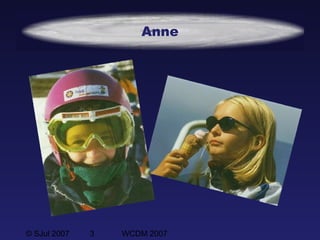
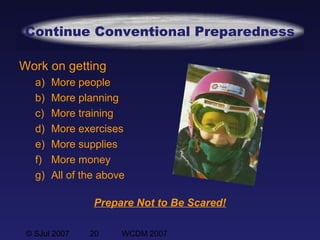
Anne
© SJul 2007 4 WCDM 2007
To Be Prepared
We need to have
a) More people
b) More planning
c) More training
d) More exercises
e) More supplies
f) More money
g) All of the above
© SJul 2007 5 WCDM 2007
But, What About When
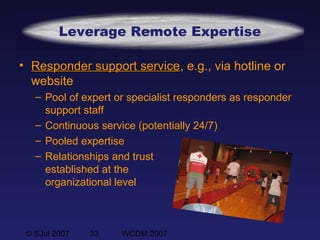
We don’t havehave
a) More people?
b) More planning?
c) More training?
d) More exercises?
e) More supplies?
f) More money?
g) All of the above?
© SJul 2007 6 WCDM 2007
Claim
• Preparedness is an illusion
– It is impossible to prepare for all possible events
• Responders and response organizations need to
function in situations and under circumstances
for which they are unprepared
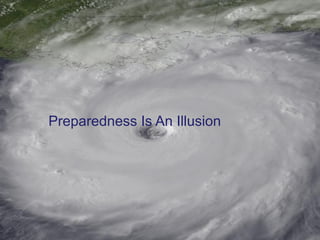
Preparedness Is An Illusion
© SJul 2007 8 WCDM 2007
Sociological Evidence
• Disaster sociology has been a field of systematic
study since ~1950
• Literature predominantly reflects responses to
natural disastersnatural disasters in North AmericaNorth America
• Three dimensions of events correlated with
response characteristics
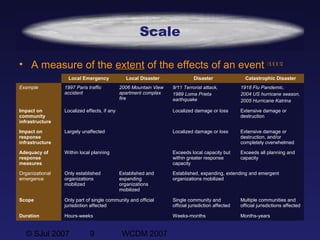
– Scale
– Kind
– “Anticipability”
© SJul 2007 9 WCDM 2007
Local Emergency Local Disaster Disaster Catastrophic Disaster
Example 1997 Paris traffic
accident
2006 Mountain View
apartment complex
fire
9/11 Terrorist attack,
1989 Loma Prieta
earthquake
1918 Flu Pandemic,
2004 US hurricane season,
2005 Hurricane Katrina
Impact on
community
infrastructure
Localized effects, if any Localized damage or loss Extensive damage or
destruction
Impact on
response
infrastructure
Largely unaffected Localized damage or loss Extensive damage or
destruction, and/or
completely overwhelmed
Adequacy of
response
measures
Within local planning Exceeds local capacity but
within greater response
capacity
Exceeds all planning and
capacity
Organizational
emergence
Only established
organizations
mobilized
Established and
expanding
organizations
mobilized
Established, expanding, extending and emergent
organizations mobilized
Scope Only part of single community and official
jurisdiction affected
Single community and
official jurisdiction affected
Multiple communities and
official jurisdictions affected
Duration Hours-weeks Weeks-months Months-years
Scale
• A measure of the extentextent of the effects of an event  5, 6, 9, 12
© SJul 2007 10 WCDM 2007
“DRC typology”  6
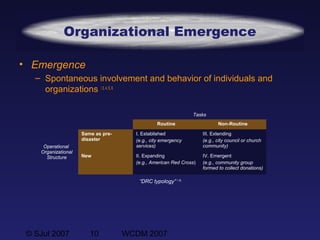
Organizational Emergence
• Emergence
– Spontaneous involvement and behavior of individuals and
organizations  3, 4, 5, 6
Tasks
Routine Non-Routine
Operational
Organizational
Structure
Same as pre-
disaster
I. Established
(e.g., city emergency
services)
III. Extending
(e.g., city council or church
community)
New II. Expanding
(e.g., American Red Cross)
IV. Emergent
(e.g., community group
formed to collect donations)
© SJul 2007 11 WCDM 2007
Local Emergency Local Disaster Disaster Catastrophic Disaster
Example 1997 Paris traffic
accident
2006 Mountain View
apartment complex
fire
9/11 Terrorist attack,
1989 Loma Prieta
earthquake
1918 Flu Pandemic,
2004 US hurricane season,
2005 Hurricane Katrina
Impact on
community
infrastructure
Localized effects, if any Localized damage or loss Extensive damage or
destruction
Impact on
response
infrastructure
Largely unaffected Localized damage or loss Extensive damage or
destruction, and/or
completely overwhelmed
Adequacy of
response
measures
Within local planning Exceeds local capacity but
within greater response
capacity
Exceeds all planning and
capacity
Organizational
emergence
Only established
organizations
mobilized
Established and
expanding
organizations
mobilized
Established, expanding, extending and emergent
organizations mobilized
Scope Only part of single community and official
jurisdiction affected
Single community and
official jurisdiction affected
Multiple communities and
official jurisdictions affected
Duration Hours-weeks Weeks-months Months-years
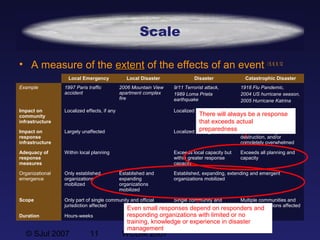
Scale
There will always be a response
that exceeds actual
preparedness
Even small responses depend on responders and
responding organizations with limited or no
training, knowledge or experience in disaster
management
• A measure of the extentextent of the effects of an event  5, 6, 9, 12
© SJul 2007 12 WCDM 2007
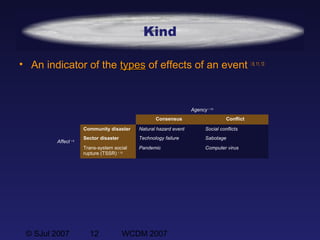
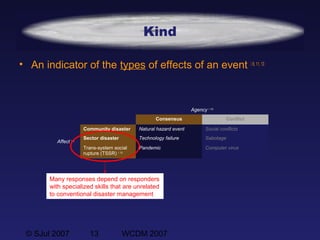
Kind
• An indicator of the typestypes of effects of an event  6, 11, 13
Agency  10
Consensus Conflict
Affect  6
Community disaster Natural hazard event Social conflicts
Sector disaster Technology failure Sabotage
Trans-system social
rupture (TSSR)  12
Pandemic Computer virus
© SJul 2007 13 WCDM 2007
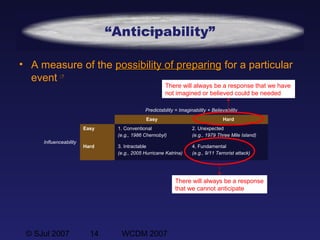
Kind
• An indicator of the types of effects of an event  6, 11, 13
Agency  10
Consensus Conflict
Affect  6
Community disaster Natural hazard event Social conflicts
Sector disaster Technology failure Sabotage
Trans-system social
rupture (TSSR)  12
Pandemic Computer virus
Many responses depend on responders
with specialized skills that are unrelated
to conventional disaster management
© SJul 2007 14 WCDM 2007
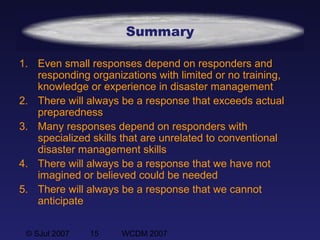
“Anticipability”
• A measure of the possibility of preparingpossibility of preparing for a particular
event  7
Predictability = Imaginability + Believability
Easy Hard
Influenceability
Easy 1. Conventional
(e.g., 1986 Chernobyl)
2. Unexpected
(e.g., 1979 Three Mile Island)
Hard 3. Intractable
(e.g., 2005 Hurricane Katrina)
4. Fundamental
(e.g., 9/11 Terrorist attack)
There will always be a response that we have
not imagined or believed could be needed
There will always be a response
that we cannot anticipate
© SJul 2007 15 WCDM 2007
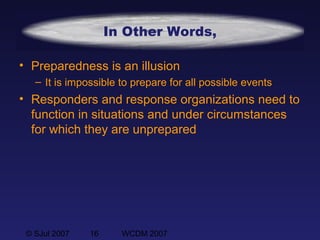
Summary
1. Even small responses depend on responders and
responding organizations with limited or no training,
knowledge or experience in disaster management
2. There will always be a response that exceeds actual
preparedness
3. Many responses depend on responders with
specialized skills that are unrelated to conventional
disaster management skills
4. There will always be a response that we have not
imagined or believed could be needed
5. There will always be a response that we cannot
anticipate
© SJul 2007 16 WCDM 2007
In Other Words,
• Preparedness is an illusion
– It is impossible to prepare for all possible events
• Responders and response organizations need to
function in situations and under circumstances
for which they are unprepared
© SJul 2007 17 WCDM 2007
But Wait!
• Even if it were possible to prepare for all
possible events, resource limitations make it
impossible
• In fact, resource limitations make it impossible to
prepare for those events for which it isis possible
to prepare
© SJul 2007 18 WCDM 2007
Resource Limitations
• Planners generally not resource controllers  1, 10
– Public vs. private sector
– Staff vs. line management
• Given the reality of limited resources, resource
controllers must prioritize certain, near-certain
and immediate threats (i.e., routine events)  10
– Perceived low-probability and distant threats (i.e.,
disasters) lose out
© SJul 2007 19 WCDM 2007
Scared?
• Can’t prepare for all possible events
• Even if we could, we don’t have the necessary
resources
• Yet everyone expects (and needs) us to be
prepared for any event!
What to do?What to do?
© SJul 2007 20 WCDM 2007
Continue Conventional Preparedness
Prepare Not to Be Scared!
Work on getting
a) More people
b) More planning
c) More training
d) More exercises
e) More supplies
f) More money
g) All of the above
© SJul 2007 21 WCDM 2007
• Augment conventional preparedness
• Prepare responders and response organizations
to leverage available resourcesleverage available resources
– People
– Supplies
Prepare to Be Scared!Prepare to Be Scared!
Prepare to Be Unprepared
Preparing to Be Unprepared
(PUp):
Human Resources
© SJul 2007 23 WCDM 2007
Problem
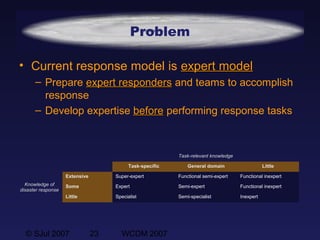
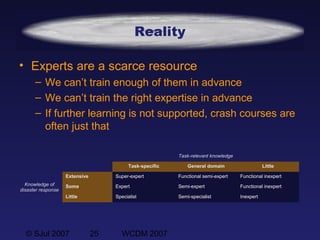
• Current response model is expert modelexpert model
– Prepare expert respondersexpert responders and teams to accomplish
response
– Develop expertise beforebefore performing response tasks
Task-relevant knowledge
Task-specific General domain Little
Knowledge of
disaster response
Extensive Super-expert Functional semi-expert Functional inexpert
Some Expert Semi-expert Functional inexpert
Little Specialist Semi-specialist Inexpert
© SJul 2007 24 WCDM 2007
Problem
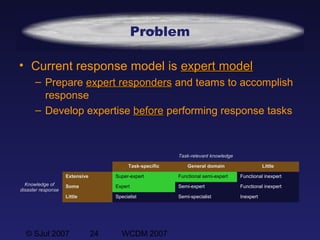
• Current response model is expert modelexpert model
– Prepare expert respondersexpert responders and teams to accomplish
response
– Develop expertise beforebefore performing response tasks
Task-relevant knowledge
Task-specific General domain Little
Knowledge of
disaster response
Extensive Super-expert Functional semi-expert Functional inexpert
Some Expert Semi-expert Functional inexpert
Little Specialist Semi-specialist Inexpert
© SJul 2007 25 WCDM 2007
Reality
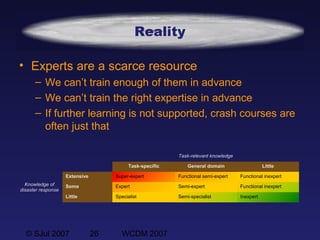
• Experts are a scarce resource
– We can’t train enough of them in advance
– We can’t train the right expertise in advance
– If further learning is not supported, crash courses are
often just that
Task-relevant knowledge
Task-specific General domain Little
Knowledge of
disaster response
Extensive Super-expert Functional semi-expert Functional inexpert
Some Expert Semi-expert Functional inexpert
Little Specialist Semi-specialist Inexpert
© SJul 2007 26 WCDM 2007
Reality
• Experts are a scarce resource
– We can’t train enough of them in advance
– We can’t train the right expertise in advance
– If further learning is not supported, crash courses are
often just that
Task-relevant knowledge
Task-specific General domain Little
Knowledge of
disaster response
Extensive Super-expert Functional semi-expert Functional inexpert
Some Expert Semi-expert Functional inexpert
Little Specialist Semi-specialist Inexpert
© SJul 2007 27 WCDM 2007
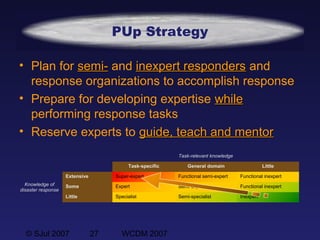
PUp Strategy
• Plan for semi-semi- and inexpert respondersinexpert responders and
response organizations to accomplish response
• Prepare for developing expertise whilewhile
performing response tasks
• Reserve experts to guide, teach and mentorguide, teach and mentor
Task-relevant knowledge
Task-specific General domain Little
Knowledge of
disaster response
Extensive Super-expert Functional semi-expert Functional inexpert
Some Expert Semi-expert Functional inexpert
Little Specialist Semi-specialist Inexpert
© SJul 2007 28 WCDM 2007
PUp Techniques
• Prepare tools and matériel for inexpertsinexperts
• Train coachcoach respondersresponders
• Leverage remote expertiseremote expertise
• Plan and train to co-source quotidian tasksco-source quotidian tasks
• Get ready to catch the wavecatch the wave
© SJul 2007 29 WCDM 2007
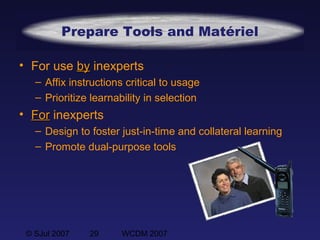
Prepare Tools and Matériel
• For use byby inexperts
– Affix instructions critical to usage
– Prioritize learnability in selection
• ForFor inexperts
– Design to foster just-in-time and collateral learning
– Promote dual-purpose tools
© SJul 2007 30 WCDM 2007
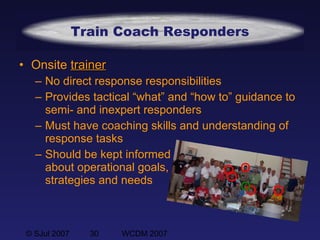
Train Coach Responders
• Onsite trainertrainer
– No direct response responsibilities
– Provides tactical “what” and “how to” guidance to
semi- and inexpert responders
– Must have coaching skills and understanding of
response tasks
– Should be kept informed
about operational goals,
strategies and needs
© SJul 2007 31 WCDM 2007
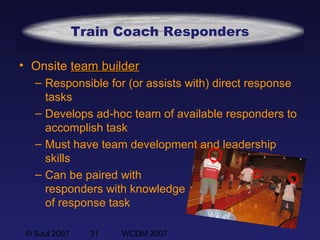
Train Coach Responders
• Onsite team builderteam builder
– Responsible for (or assists with) direct response
tasks
– Develops ad-hoc team of available responders to
accomplish task
– Must have team development and leadership
skills
– Can be paired with
responders with knowledge
of response task
© SJul 2007 32 WCDM 2007
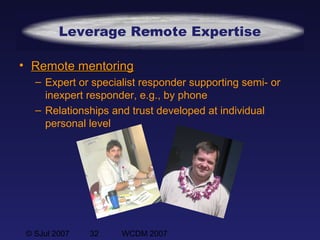
Leverage Remote Expertise
• Remote mentoringRemote mentoring
– Expert or specialist responder supporting semi- or
inexpert responder, e.g., by phone
– Relationships and trust developed at individual
personal level
© SJul 2007 33 WCDM 2007
Leverage Remote Expertise
• Responder support serviceResponder support service, e.g., via hotline or
website
– Pool of expert or specialist responders as responder
support staff
– Continuous service (potentially 24/7)
– Pooled expertise
– Relationships and trust
established at the
organizational level
© SJul 2007 34 WCDM 2007
Co-source Quotidian Tasks
• Quotidian
– Daily, ordinary, common-place
• Quotidian task
– Specialized, outsourceable, non-response-specific
• Dual-purpose organization  2
– Primary purpose not disaster-related, but
capabilities are response-relevant
© SJul 2007 35 WCDM 2007
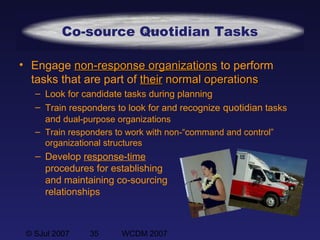
• Engage non-response organizationsnon-response organizations to perform
tasks that are part of theirtheir normal operationsnormal operations
– Look for candidate tasks during planning
– Train responders to look for and recognize quotidian tasks
and dual-purpose organizations
– Train responders to work with non-“command and control”
organizational structures
– Develop response-time
procedures for establishing
and maintaining co-sourcing
relationships
Co-source Quotidian Tasks
© SJul 2007 36 WCDM 2007
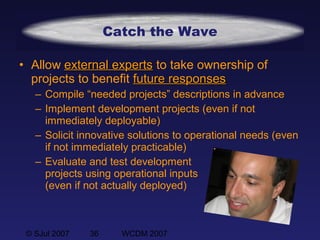
Catch the Wave
• Allow external expertsexternal experts to take ownership of
projects to benefit future responsesfuture responses
– Compile “needed projects” descriptions in advance
– Implement development projects (even if not
immediately deployable)
– Solicit innovative solutions to operational needs (even
if not immediately practicable)
– Evaluate and test development
projects using operational inputs
(even if not actually deployed)
Summary
© SJul 2007 38 WCDM 2007
Summary
• Three dimensions of disaster correlated with qualitative
differences in ensuing responses 
– Scale
– Kind
– Anticipability
• Preparedness is an illusion
– It is impossible to prepare for all possible events
– Even if it were possible to prepare for all possible events,
resource limitations make it impossible
• Must prepare responders and response organizations to
leverage available resourcesleverage available resources
 Jul, S. (2007). Who’s Really on First? A Domain-Level User, Task and
Context Analysis for Response Technology. Proceedings of the 4th
International ISCRAM Conference.
© SJul 2007 39 WCDM 2007
Summary
• Techniques for preparing to leverage available
human resources
– Prepare tools and matériel for inexpertsinexperts
– Train coachcoach respondersresponders
– Leverage remote expertiseremote expertise
– Plan and train to co-source quotidian tasksco-source quotidian tasks
– Get ready to catch the wavecatch the wave
© SJul 2007 40 WCDM 2007
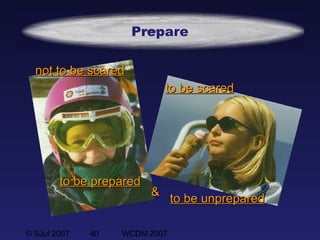
Prepare
to be scaredto be scared
to be unpreparedto be unprepared
not to be scarednot to be scared
&&
to be preparedto be prepared
© SJul 2007 41 WCDM 2007
Thanks to
• The Pacific Disaster CenterPacific Disaster Center and the US NationalUS National
Research CouncilResearch Council for financial support
• Steve HaileySteve Hailey, American Red Cross, for leading
by example
© SJul 2007 42 WCDM 2007
References
1. Auf der Heide, E. (1989). Disaster Response: Principles of Preparation and Coordination. St. Louis, MO: C.V. Mosby
Company.
2. Bankoff, G. (2002). Cultures of Disaster: Society and Natural Hazards in the Philippines. Routledge.
3. Drabek, T.E., McEntire, D.A. (2002). Emergent Phenomena and Multiorganizational Coordination in Disasters: Lessons
from the Research Literature. International Journal of Mass Emergencies and Disasters, 20(2):197-224.
4. Drabek, T.E., McEntire, D.A. (2003). Emergent Phenomena and the Sociology of Disaster: Lessons, Trends and
Opportunties from the Research Literature. Disaster Prevention and Management, 12(2):97-113.
5. Dynes, R. R. (1970). Organized Behavior in Disaster. Lexington, MA: Heath Lexington Books.
6. Dynes, R. R. (1998). Coming to Terms with Community Disaster. In Quarantelli, E.L., What Is a Disaster? Perspectives
on the Question. Routledge:109-126.
7. Gundel, S. (2005). Towards a New Typology of Crises. Journal of Contingencies & Crisis Management, 13(3):106-115.
8. Jul, S. (2007). Who’s Really on First? A Domain-Level User, Task and Context Analysis for Response Technology.
Proceedings of the 4th International ISCRAM Conference. Delft, the Netherlands, May 2007.
9. Kreps, G.A. (1998). Disaster as Systemic and Social Event. In Quarantelli, E.L., What Is a Disaster? Perspectives on the
Question. Routledge: 31-55.
10. McConnell, A., Drennan, L. (2006). Mission Impossible? Planning and Preparing for Crisis. Journal of Contingencies &
Crisis Management, Jun, Vol. 14 Issue 2, p59-70.
11. Quarantelli, E.L. (1993). Community Crises: An Exploratory Comparison of the Characteristics of and Consequences of
Disasters and Riots. Journal of Contingencies & Crisis Management, 1(2):67-78.
12. Quarantelli, E.L. (2005/9/26). “Catastrophes are Different from Disasters: Some Implications for Crisis Planning and
Managing Drawn from Katrina.” Online posting. The Social Science Research Council forum: Understanding Katrina:
Perspectives from the Social Sciences. 2006/12/14.
<http://understandingkatrina.ssrc.org/Quarantelli/>.
13. Quarantelli, E.L. (2006). The Disasters of the 21st Century: A Mixture of New, Old, and Mixed Types. Online
proceedings. The Third Annual MaGrann Research Conference.
<http://geography.rutgers.edu/events/magrann_conference/2006/papers/quarantelli.pdf>.

Preparing to Be Unprepared: Human Resources

  • 1.
    Preparing to BeUnprepared:Preparing to Be Unprepared: Human ResourcesHuman Resources Susanne Jul, PhD Pacific Disaster Center sjul@pdc.org Presented by: Canadian Centre for Emergency Preparedness
  • 2.
    © SJul 20072 WCDM 2007 Disclaimer • Work done, in part, at the Pacific Disaster Center under a National Research Council postdoctoral fellowship • However, not directly related to PDC operations – PDC operations focused on geographic information analysis (primarily for mitigation efforts) • Research supplemented with personal experience with American Red Cross Disaster Services
  • 3.
    © SJul 20073 WCDM 2007 Anne
  • 4.
    © SJul 20074 WCDM 2007 To Be Prepared We need to have a) More people b) More planning c) More training d) More exercises e) More supplies f) More money g) All of the above
  • 5.
    © SJul 20075 WCDM 2007 But, What About When We don’t havehave a) More people? b) More planning? c) More training? d) More exercises? e) More supplies? f) More money? g) All of the above?
  • 6.
    © SJul 20076 WCDM 2007 Claim • Preparedness is an illusion – It is impossible to prepare for all possible events • Responders and response organizations need to function in situations and under circumstances for which they are unprepared
  • 7.
  • 8.
    © SJul 20078 WCDM 2007 Sociological Evidence • Disaster sociology has been a field of systematic study since ~1950 • Literature predominantly reflects responses to natural disastersnatural disasters in North AmericaNorth America • Three dimensions of events correlated with response characteristics – Scale – Kind – “Anticipability”
  • 9.
    © SJul 20079 WCDM 2007 Local Emergency Local Disaster Disaster Catastrophic Disaster Example 1997 Paris traffic accident 2006 Mountain View apartment complex fire 9/11 Terrorist attack, 1989 Loma Prieta earthquake 1918 Flu Pandemic, 2004 US hurricane season, 2005 Hurricane Katrina Impact on community infrastructure Localized effects, if any Localized damage or loss Extensive damage or destruction Impact on response infrastructure Largely unaffected Localized damage or loss Extensive damage or destruction, and/or completely overwhelmed Adequacy of response measures Within local planning Exceeds local capacity but within greater response capacity Exceeds all planning and capacity Organizational emergence Only established organizations mobilized Established and expanding organizations mobilized Established, expanding, extending and emergent organizations mobilized Scope Only part of single community and official jurisdiction affected Single community and official jurisdiction affected Multiple communities and official jurisdictions affected Duration Hours-weeks Weeks-months Months-years Scale • A measure of the extentextent of the effects of an event  5, 6, 9, 12
  • 10.
    © SJul 200710 WCDM 2007 “DRC typology”  6 Organizational Emergence • Emergence – Spontaneous involvement and behavior of individuals and organizations  3, 4, 5, 6 Tasks Routine Non-Routine Operational Organizational Structure Same as pre- disaster I. Established (e.g., city emergency services) III. Extending (e.g., city council or church community) New II. Expanding (e.g., American Red Cross) IV. Emergent (e.g., community group formed to collect donations)
  • 11.
    © SJul 200711 WCDM 2007 Local Emergency Local Disaster Disaster Catastrophic Disaster Example 1997 Paris traffic accident 2006 Mountain View apartment complex fire 9/11 Terrorist attack, 1989 Loma Prieta earthquake 1918 Flu Pandemic, 2004 US hurricane season, 2005 Hurricane Katrina Impact on community infrastructure Localized effects, if any Localized damage or loss Extensive damage or destruction Impact on response infrastructure Largely unaffected Localized damage or loss Extensive damage or destruction, and/or completely overwhelmed Adequacy of response measures Within local planning Exceeds local capacity but within greater response capacity Exceeds all planning and capacity Organizational emergence Only established organizations mobilized Established and expanding organizations mobilized Established, expanding, extending and emergent organizations mobilized Scope Only part of single community and official jurisdiction affected Single community and official jurisdiction affected Multiple communities and official jurisdictions affected Duration Hours-weeks Weeks-months Months-years Scale There will always be a response that exceeds actual preparedness Even small responses depend on responders and responding organizations with limited or no training, knowledge or experience in disaster management • A measure of the extentextent of the effects of an event  5, 6, 9, 12
  • 12.
    © SJul 200712 WCDM 2007 Kind • An indicator of the typestypes of effects of an event  6, 11, 13 Agency  10 Consensus Conflict Affect  6 Community disaster Natural hazard event Social conflicts Sector disaster Technology failure Sabotage Trans-system social rupture (TSSR)  12 Pandemic Computer virus
  • 13.
    © SJul 200713 WCDM 2007 Kind • An indicator of the types of effects of an event  6, 11, 13 Agency  10 Consensus Conflict Affect  6 Community disaster Natural hazard event Social conflicts Sector disaster Technology failure Sabotage Trans-system social rupture (TSSR)  12 Pandemic Computer virus Many responses depend on responders with specialized skills that are unrelated to conventional disaster management
  • 14.
    © SJul 200714 WCDM 2007 “Anticipability” • A measure of the possibility of preparingpossibility of preparing for a particular event  7 Predictability = Imaginability + Believability Easy Hard Influenceability Easy 1. Conventional (e.g., 1986 Chernobyl) 2. Unexpected (e.g., 1979 Three Mile Island) Hard 3. Intractable (e.g., 2005 Hurricane Katrina) 4. Fundamental (e.g., 9/11 Terrorist attack) There will always be a response that we have not imagined or believed could be needed There will always be a response that we cannot anticipate
  • 15.
    © SJul 200715 WCDM 2007 Summary 1. Even small responses depend on responders and responding organizations with limited or no training, knowledge or experience in disaster management 2. There will always be a response that exceeds actual preparedness 3. Many responses depend on responders with specialized skills that are unrelated to conventional disaster management skills 4. There will always be a response that we have not imagined or believed could be needed 5. There will always be a response that we cannot anticipate
  • 16.
    © SJul 200716 WCDM 2007 In Other Words, • Preparedness is an illusion – It is impossible to prepare for all possible events • Responders and response organizations need to function in situations and under circumstances for which they are unprepared
  • 17.
    © SJul 200717 WCDM 2007 But Wait! • Even if it were possible to prepare for all possible events, resource limitations make it impossible • In fact, resource limitations make it impossible to prepare for those events for which it isis possible to prepare
  • 18.
    © SJul 200718 WCDM 2007 Resource Limitations • Planners generally not resource controllers  1, 10 – Public vs. private sector – Staff vs. line management • Given the reality of limited resources, resource controllers must prioritize certain, near-certain and immediate threats (i.e., routine events)  10 – Perceived low-probability and distant threats (i.e., disasters) lose out
  • 19.
    © SJul 200719 WCDM 2007 Scared? • Can’t prepare for all possible events • Even if we could, we don’t have the necessary resources • Yet everyone expects (and needs) us to be prepared for any event! What to do?What to do?
  • 20.
    © SJul 200720 WCDM 2007 Continue Conventional Preparedness Prepare Not to Be Scared! Work on getting a) More people b) More planning c) More training d) More exercises e) More supplies f) More money g) All of the above
  • 21.
    © SJul 200721 WCDM 2007 • Augment conventional preparedness • Prepare responders and response organizations to leverage available resourcesleverage available resources – People – Supplies Prepare to Be Scared!Prepare to Be Scared! Prepare to Be Unprepared
  • 22.
    Preparing to BeUnprepared (PUp): Human Resources
  • 23.
    © SJul 200723 WCDM 2007 Problem • Current response model is expert modelexpert model – Prepare expert respondersexpert responders and teams to accomplish response – Develop expertise beforebefore performing response tasks Task-relevant knowledge Task-specific General domain Little Knowledge of disaster response Extensive Super-expert Functional semi-expert Functional inexpert Some Expert Semi-expert Functional inexpert Little Specialist Semi-specialist Inexpert
  • 24.
    © SJul 200724 WCDM 2007 Problem • Current response model is expert modelexpert model – Prepare expert respondersexpert responders and teams to accomplish response – Develop expertise beforebefore performing response tasks Task-relevant knowledge Task-specific General domain Little Knowledge of disaster response Extensive Super-expert Functional semi-expert Functional inexpert Some Expert Semi-expert Functional inexpert Little Specialist Semi-specialist Inexpert
  • 25.
    © SJul 200725 WCDM 2007 Reality • Experts are a scarce resource – We can’t train enough of them in advance – We can’t train the right expertise in advance – If further learning is not supported, crash courses are often just that Task-relevant knowledge Task-specific General domain Little Knowledge of disaster response Extensive Super-expert Functional semi-expert Functional inexpert Some Expert Semi-expert Functional inexpert Little Specialist Semi-specialist Inexpert
  • 26.
    © SJul 200726 WCDM 2007 Reality • Experts are a scarce resource – We can’t train enough of them in advance – We can’t train the right expertise in advance – If further learning is not supported, crash courses are often just that Task-relevant knowledge Task-specific General domain Little Knowledge of disaster response Extensive Super-expert Functional semi-expert Functional inexpert Some Expert Semi-expert Functional inexpert Little Specialist Semi-specialist Inexpert
  • 27.
    © SJul 200727 WCDM 2007 PUp Strategy • Plan for semi-semi- and inexpert respondersinexpert responders and response organizations to accomplish response • Prepare for developing expertise whilewhile performing response tasks • Reserve experts to guide, teach and mentorguide, teach and mentor Task-relevant knowledge Task-specific General domain Little Knowledge of disaster response Extensive Super-expert Functional semi-expert Functional inexpert Some Expert Semi-expert Functional inexpert Little Specialist Semi-specialist Inexpert
  • 28.
    © SJul 200728 WCDM 2007 PUp Techniques • Prepare tools and matériel for inexpertsinexperts • Train coachcoach respondersresponders • Leverage remote expertiseremote expertise • Plan and train to co-source quotidian tasksco-source quotidian tasks • Get ready to catch the wavecatch the wave
  • 29.
    © SJul 200729 WCDM 2007 Prepare Tools and Matériel • For use byby inexperts – Affix instructions critical to usage – Prioritize learnability in selection • ForFor inexperts – Design to foster just-in-time and collateral learning – Promote dual-purpose tools
  • 30.
    © SJul 200730 WCDM 2007 Train Coach Responders • Onsite trainertrainer – No direct response responsibilities – Provides tactical “what” and “how to” guidance to semi- and inexpert responders – Must have coaching skills and understanding of response tasks – Should be kept informed about operational goals, strategies and needs
  • 31.
    © SJul 200731 WCDM 2007 Train Coach Responders • Onsite team builderteam builder – Responsible for (or assists with) direct response tasks – Develops ad-hoc team of available responders to accomplish task – Must have team development and leadership skills – Can be paired with responders with knowledge of response task
  • 32.
    © SJul 200732 WCDM 2007 Leverage Remote Expertise • Remote mentoringRemote mentoring – Expert or specialist responder supporting semi- or inexpert responder, e.g., by phone – Relationships and trust developed at individual personal level
  • 33.
    © SJul 200733 WCDM 2007 Leverage Remote Expertise • Responder support serviceResponder support service, e.g., via hotline or website – Pool of expert or specialist responders as responder support staff – Continuous service (potentially 24/7) – Pooled expertise – Relationships and trust established at the organizational level
  • 34.
    © SJul 200734 WCDM 2007 Co-source Quotidian Tasks • Quotidian – Daily, ordinary, common-place • Quotidian task – Specialized, outsourceable, non-response-specific • Dual-purpose organization  2 – Primary purpose not disaster-related, but capabilities are response-relevant
  • 35.
    © SJul 200735 WCDM 2007 • Engage non-response organizationsnon-response organizations to perform tasks that are part of theirtheir normal operationsnormal operations – Look for candidate tasks during planning – Train responders to look for and recognize quotidian tasks and dual-purpose organizations – Train responders to work with non-“command and control” organizational structures – Develop response-time procedures for establishing and maintaining co-sourcing relationships Co-source Quotidian Tasks
  • 36.
    © SJul 200736 WCDM 2007 Catch the Wave • Allow external expertsexternal experts to take ownership of projects to benefit future responsesfuture responses – Compile “needed projects” descriptions in advance – Implement development projects (even if not immediately deployable) – Solicit innovative solutions to operational needs (even if not immediately practicable) – Evaluate and test development projects using operational inputs (even if not actually deployed)
  • 37.
  • 38.
    © SJul 200738 WCDM 2007 Summary • Three dimensions of disaster correlated with qualitative differences in ensuing responses  – Scale – Kind – Anticipability • Preparedness is an illusion – It is impossible to prepare for all possible events – Even if it were possible to prepare for all possible events, resource limitations make it impossible • Must prepare responders and response organizations to leverage available resourcesleverage available resources  Jul, S. (2007). Who’s Really on First? A Domain-Level User, Task and Context Analysis for Response Technology. Proceedings of the 4th International ISCRAM Conference.
  • 39.
    © SJul 200739 WCDM 2007 Summary • Techniques for preparing to leverage available human resources – Prepare tools and matériel for inexpertsinexperts – Train coachcoach respondersresponders – Leverage remote expertiseremote expertise – Plan and train to co-source quotidian tasksco-source quotidian tasks – Get ready to catch the wavecatch the wave
  • 40.
    © SJul 200740 WCDM 2007 Prepare to be scaredto be scared to be unpreparedto be unprepared not to be scarednot to be scared && to be preparedto be prepared
  • 41.
    © SJul 200741 WCDM 2007 Thanks to • The Pacific Disaster CenterPacific Disaster Center and the US NationalUS National Research CouncilResearch Council for financial support • Steve HaileySteve Hailey, American Red Cross, for leading by example
  • 42.
    © SJul 200742 WCDM 2007 References 1. Auf der Heide, E. (1989). Disaster Response: Principles of Preparation and Coordination. St. Louis, MO: C.V. Mosby Company. 2. Bankoff, G. (2002). Cultures of Disaster: Society and Natural Hazards in the Philippines. Routledge. 3. Drabek, T.E., McEntire, D.A. (2002). Emergent Phenomena and Multiorganizational Coordination in Disasters: Lessons from the Research Literature. International Journal of Mass Emergencies and Disasters, 20(2):197-224. 4. Drabek, T.E., McEntire, D.A. (2003). Emergent Phenomena and the Sociology of Disaster: Lessons, Trends and Opportunties from the Research Literature. Disaster Prevention and Management, 12(2):97-113. 5. Dynes, R. R. (1970). Organized Behavior in Disaster. Lexington, MA: Heath Lexington Books. 6. Dynes, R. R. (1998). Coming to Terms with Community Disaster. In Quarantelli, E.L., What Is a Disaster? Perspectives on the Question. Routledge:109-126. 7. Gundel, S. (2005). Towards a New Typology of Crises. Journal of Contingencies & Crisis Management, 13(3):106-115. 8. Jul, S. (2007). Who’s Really on First? A Domain-Level User, Task and Context Analysis for Response Technology. Proceedings of the 4th International ISCRAM Conference. Delft, the Netherlands, May 2007. 9. Kreps, G.A. (1998). Disaster as Systemic and Social Event. In Quarantelli, E.L., What Is a Disaster? Perspectives on the Question. Routledge: 31-55. 10. McConnell, A., Drennan, L. (2006). Mission Impossible? Planning and Preparing for Crisis. Journal of Contingencies & Crisis Management, Jun, Vol. 14 Issue 2, p59-70. 11. Quarantelli, E.L. (1993). Community Crises: An Exploratory Comparison of the Characteristics of and Consequences of Disasters and Riots. Journal of Contingencies & Crisis Management, 1(2):67-78. 12. Quarantelli, E.L. (2005/9/26). “Catastrophes are Different from Disasters: Some Implications for Crisis Planning and Managing Drawn from Katrina.” Online posting. The Social Science Research Council forum: Understanding Katrina: Perspectives from the Social Sciences. 2006/12/14. <http://understandingkatrina.ssrc.org/Quarantelli/>. 13. Quarantelli, E.L. (2006). The Disasters of the 21st Century: A Mixture of New, Old, and Mixed Types. Online proceedings. The Third Annual MaGrann Research Conference. <http://geography.rutgers.edu/events/magrann_conference/2006/papers/quarantelli.pdf>.

Editor's Notes

  • #2 The title of this talk is “Preparing to Be Unprepared: Human Resources.” My name is Susanne Jul. I am a visiting researcher at the Pacific Disaster Center in Kihei Hawaii.
  • #3 The work I’m going to be talking about today is an extension of the work I’ve done while at the PDC. However, the application of my research to preparedness takes it outside the scope of PDC operations. PDC operations are focused primarily on analysis of geographic information for mitigation purposes. I am also a volunteer with the American Red Cross and this application of my research draws heavily on my experiences with Red Cross Disaster Services.
  • #4 This is my niece, Anne. When Anne was little, she had to do everything that her older brother Claus did. One time, when she was about five, she absolutely had to into the haunted house at the local amusement park. “But Claus did!” The problem was that Anne was quite timid and easily frightened. So my brother did his best to prepare her, “Now, there’s going to be a ghost popping out, but it’s just a sheet, so don’t be scared. And when the ghost is gone, it’s suddenly going to get dark. But you just keep holding my hand. And, while it’s dark, someone’s going to scream. But that’s just a recording, it’s just like on tv, ok?” And, so on… Of course, when they came out, Anne was sobbing uncontrollably. “But you didn’t tell me about the spider!” Now my brother can be very insightful, and his comment later was, “Yeah, I tried to make sure she wouldn’t be scared. I didn’t tell her what to do when she got scared.”
  • #5 If you have ever attended an exercise hot-wash or an after-action-review, I’m willing to bet that most, if not all, of the recommendations that came out of it were variants on one or more of the following: … I am also willing to bet that you have rarely, if ever, heard anyone talk about,
  • #6 “what do we do when…”
  • #7 I going to claim that preparedness is an illusion. That you cannot possibly be prepared enough. And that you must prepare responders and response organizations to function in situations and under circumstances for which you have not prepared.
  • #8 First, let’s look at the claim that preparedness is an illusion.
  • #9 Your honor, I’d like to call to the stand an extensive literature on the sociology of disaster. As you may know, sociologists have studied disaster since about 1920, and disaster sociology became a systematic field of study in the early 1950s. This has resulted in a large body of literature on disaster and disaster response, mostly based on studies of responses to natural hazard events in the United States. Sociologists have identified three dimensions of disaster events that correlate with characteristics of their ensuing responses: Scale of event, kind of event and anticipability of event. I’m going to try to convince you that there are events and responses with characteristics that make preparedness impossible. Samuel Prince’s 1920 dissertation on the 1917 Halifax harbor tragedy,
  • #10 First, scale. Scale is something we all talk about, but rarely define. Mostly what we’re referring to, though, is the extent of the effects of an event. On the left here, is a set indicators of that sociologists have found to be useful measures of scale. Impact on community infrastructure: food, water, businesses, critical infrastructure, human resources – are your key decision-makers unavailable because they are at home digging out from under the rubble? Impact on response infrastructure: hospitals, transportation, communication networks, human resources, all the things we’re talking about at this conference. Adequacy of response measures: Was this what you prepared for? How well did your plans hold up? I want to come back to organizational emergence. Scope: How many socio-political units are affected? Duration: For what period of time do new effects continue to be introduced? Across the top, there’s a set of categories of scale, ranging from a local emergency (such as a common traffic accident), through local disaster (such as an apartment building fire), to regional disaster (such as flooding or wildfires), to catastrophic disaster (such as Hurricane Katrina or the 2006 typhoons in the Philippines). Now, I’m not going to walk through this entire chart, but what’s important here is that sociologists have found that responses to events of different scales differ qualitatively. Now, that’s really important, so I’m going to say it again: Responses to events of different scales differ qualitatively. In other words, it’s not just a question of the numbers getting bigger, but the nature of the response changes in fundamental ways. One of the ways in which responses change is in organizational emergence.
  • #11 When sociologists and psychologists talk about emergence, they’re talking about spontaneous behaviors of individuals and groups in response to situational factors, that is, something that emerges because of the situation or the circumstances. This is the so-called DRC typology of organizations that participate in disaster responses. As you can see, they are characterized by two aspects: The relationship between pre-disaster and response operational organizational structures: Do the people or the org chart differ? The relationship between pre-disaster and response tasks: Are the response tasks routine tasks for the organization? This results in four organizational types: …
  • #12 Now, going back to our chart, you see that a characteristic of local emergencies is that … Now if you think about it, members of extending and emerging organizations are unlikely to know much about disaster management, many members of expanding organizations won’t have much training or experience, and even some members of established organizations will have little experience. That means that even in small responses you’re going to be depending on responders and responding organizations with limited or no training, knowledge or experience in disaster management. Another difference in responses stems from the fact that disaster is a relative term. Whether something becomes a disaster depends on whether we are prepared for it. So, a disaster or catastrophe, is by definition, for which we are not prepared at some level. What this means is that there will always be a response that goes beyond what you have prepared for. There are lots of other things to talk about around scale, but our time is limited, so let’s move on to kind.
  • #13 Kind of event is an indicator of the types of effects that an event has. It has two aspects: Affect is a measure of how diverse the effects are, in other words, how many social functions are affected. Here, we distinguish between community disasters – events that cut across many social functions, for instance, natural hazard events – and sector disasters – events that affect very specific segments of society, for instance, a human or computer virus. A TSSR is a special case… Agency results from the causal agent or the circumstances surrounding the event and is an indicator of response coherency. In consensus situations, everyone pretty much agrees on what the agenda is and what needs to be done. So, for instance, after Hurricane Katrina, everyone agreed that “we need to get these people food, water, shelter and help so that they can rebuild their homes.” In conflict situations, in contrast, you have factions with different agendas. For instance, in urban riots, you typically have one faction whose agenda is to restore peace and order, and another that’s saying, “No, we don’t want to restore peace and order, because restoring peace and order means a return to a status quo that we find unacceptable.” Now, earlier, I said that the dimensions I’m talking about are based primarily on studies of responses to natural hazard events, so I want to be clear that we don’t know whether or how these conclusions apply to conflict situations.
  • #14 If we look at the implication of differences in affect, we see that, in community disaster, you need responders with conventional disaster response and management skills, however, in sector disasters, you need responders with sector-specific skills. For example, in a pandemic, you need infectious disease specialists rather than emergency medicine personnel. In a cascading network failure, you need computer professionals. That means that in some responses you’re going to depend on responders that have specialized skills that are unrelated to conventional disaster management skills.
  • #15 Finally, anticipability. This is a measure of how possible it is to prepare for a particular event. Anticipability has two aspects. Predictability is a measure of how difficult it is to foresee that an event might occur. Now, for us to predict an event, we have to do two things: We have to imagine it, and we have to believe that it might really happen. So, for instance, the events at the Three Mile Island nuclear facility in 1979 were difficult to predict because they resulted from a cascading series of coincidences that we just couldn’t imagine, whereas the 9/11 terrorist attack was difficult to predict, not because we couldn’t imagine it, but because our prevailing sense of humanity did not allow us to believe that someone would use commercial airliners as bombs against civilian targets. The second aspect, influenceability, is a measure of how much we can do about an event, if we can predict it. The Chernobyl nuclear disaster, for instance, was primarily due to disregard of standard safety procedures and was entirely preventable. Hurricane Katrina, on the other hand, had been predicted for years, and many preventative and mitigative measures had been proposed, but the socio-political climate of the time and place made it impossible to carry many of them out. The implications of this is that Well, first, if there are events that we cannot predict, there will always be a response that we have not imagined or believed could be needed. And, second, if we can neither predict nor influence a particular event, there will always be a response that we cannot anticipate.
  • #16 So, no matter what you do to prepare, You will always …
  • #17 In other words: Preparedness is an illusion. You cannot possibly prepare for all possible events. And, responders and response organizations must be prepared to function in situations and under circumstances for which you have not prepared.
  • #18 But wait. It gets worse! Even if preparedness for all events were possible, realistically, we don’t have the resources to do so. If fact, realistically, we don’t even have the resources to prepare for those events for which preparedness is possible.
  • #19 And, here are some of the reasons why: … Erik Auf der Heide, Disaster Response: Principles of Preparation and Coordination, from 1989, but recently made available as online book
  • #20 Did I scare you? Huh? Huh? Did I? Well, I’ve scared me. You can’t prepare for all possible events, and, even if you could, you are unlikely to have the resources needed. Yet everyone expects and needs you to be prepared for any event! So what do you do?
  • #21 Well, first of all, continue conventional preparedness. Get ready for the ghost, the dark, the screaming… Prepare not to be scared.
  • #22 But, at the same time, get ready for spiders and other surprises. Prepare to be scared, or, in the words of the prophet: Prepare to Be Unprepared. I want to stress that preparing to be unprepared augments conventional preparedness. The basic concept is to get responders and response organizations ready to leverage whatever resources are available in the event. That is, making use of whatever people and supplies are there.
  • #23 I’m now going to talk about some techniques for preparing to leverage the people, the human resources, that are likely to be available.
  • #24 Let’s first look at what we’re doing now and consider what we can improve. At present, we – at least in the US – think of disaster management as an expert activity. What we try to do in preparedness is to train expert responders and teams that will go out and do the job. That is, we’re geared toward developing expertise in advance. So, for instance, Red Cross (and note, that when I say Red Cross, I am referring to the American Red Cross; just because that happens to be my parent organization), when Red Cross gets people in who want to help with a major response, what do we do? We give them a day or two of crash courses, and then ship them out, with a “Congratulations, you’re now trained. Good luck. Let us know how things go.” So let’s consider what we mean by “expertise.” There are two dimensions we need to be concerned about: Knowledge of disaster response and management, and knowledge of a given task. So, for example, if you’re in a feeding operation, you need to know about kitchen requirements and logistics of food distribution – disaster response knowledge, but you also need to know about cooking and food safety – task-specific knowledge.
  • #25 Conventional preparedness is aimed at making sure that we will have plenty of experts – people who know about disaster management and typical response tasks.
  • #26 But the truth is that experts are a scarce resource … If we send people out after a crash course, with no further support for learning, we probably did just that: Trained them to go out and crash.
  • #27 Here’s what reality looks like: In responses larger than for a local emergency, we have scads of inexperts, but few experts. And the larger the event, the fewer experts we have, relatively speaking.
  • #28 So the PUp strategy – preparing to be unprepared -- is to take get ready to make use of those inexpert resources. So, we’re going to rely on semi- and inexpert responders to accomplish the response, get ready to help them develop expertise while they are doing so, and multiply our limited expert resources by reserving some of them to guide, teach and mentor. If you think about it for a bit: all our preparedness strategies are about shifting people from here upwards. The difference between conventional preparedness and preparing to be unprepared is that conventional preparedness aims to do so in advance, while the PUp strategy is to do it dynamically; in the course of accomplishing the response.
  • #29 Now, let’s talk about five specific techniques for preparing to be unprepared.
  • #30 Does anyone know what this is? On Hurricane Ivan, I was in charge of field support for Red Cross response technology. One day, one of the couriers came to me… When I got home, I found out that Don &amp; Miriam DeJongh from my chapter had been the shelter managers for that shelter… The point is that you need to think about how you get your tools and materiel ready to be used by people who aren’t familiar with them and who don’t quite know what it is they need to be doing with them. You need to think about preparing them to…
  • #31 This was the Red Cross response technology team for Hurricane Katrina in Baton Rouge, or at least those that were in headquarters in mid-September. This is Matt, he was RT manager. Red Cross RT is organized into four activities: networking, computer operations, communications and customer support/resource management. Each of these areas has a supervisor; everyone else is a service associate. Of these five people, only these two had prior experience. These three were on their first assignment, as were most of the others in the picture. I mean half of these people learned to spell “Red Cross” on the plane out. When I came on the job, all the supervisory positions were filled, which was a good thing as it left me free to be a training resource for both supervisors and service associates. I would check in with each supervisor every two hours, answering questions and providing guidance and information about standard operating procedures and resources, and doing the same for service associates in between. This worked really well. The concept behind coach responders is to use some of your expert resources that are on the scene to coach and support semi- and inexperts in doing the job. That is coaching and mentoring are their primary job responsibility. Coach responders come in two flavors (at least): Onsite trainers. …
  • #32 When Hurricane Rita came through, I went out to run an evacuation shelter. These three people cam with me to help. They had literally gotten off the plane a few hours earlier, and had, pretty much, learned to spell “Red Cross” on that plane. So I was functioning as an onsite team builder, that is, developing and accomplishing the task with an ad hoc team. An onsite team builder … Note that a good supervisory responder will do both coaching and team building. The point here is that we typically don’t make it an explicit primary responsibility and training for it is all too limited. We tend to assume that responders will learn coaching and team building skills by example, on the job.
  • #33 These are two of my favorite people in the world ... The point is that this is my personal remote mentoring network. The concept behind leveraging remote expertise is to take advantage of modern communication technologies to capitalize on experts that are not on the scene. That could be because they are unable to deploy, because they have skills that are needed elsewhere, or because this is the best use of their skills to you. In remote mentoring ...
  • #34 This woman back here was Brenda. She was the county clerk of Iberville parish. She had opened this shelter at 6 am and had no idea of what she was doing. When we got there at 10 pm, she was dead on her feet, kids were running around yelling and screaming, and parents and seniors were looking frazzled and exhausted. As a moderately experienced shelter manager, my immediate reaction was “We have to get these people to bed.” so I declared, “quiet time in 20 minutes, lights out in 30.” (Of course, we lost power 5 minutes later, so that wasn’t a problem.) But all Brenda really needed was to have had some basic instructions and support. She could really have used a number where she could call and say, “I’m out here opening a shelter, what do I do?” She had good organizational shills and would probably have done just fine. So we can think about setting up a responder support service … Both training coach responders and leveraging remote expertise are ways of multiplying the effectiveness of your expert responders. And I can guarantee you that these techniques are going to become increasingly critical as we have more catastrophic events, see more trans-system social ruptures [remember those?] and as security concerns increase on all operations [think 9/11 5-day ground stop].
  • #35 Definitions…
  • #36 These are Red Cross emergency response vehicles – ERVs. They are used for delivering food and supplies and for mobile feeding. There’s a window on the side here that opens so you can hand out meals and drinks. We have a large fleet of them; I’m sure many of you have seen them. This is Anna Faust, of the Maui Red Cross branch. She deployed on Katrina for her first national assignment, and spent two weeks scheduling and routing ERVs. And that was just for Southern Mississippi. Now scheduling and routing delivery vehicles is not a specialized response task: who does this on a daily basis? ... Anna’s time and skills could well have been used elsewhere. So, the idea behind co-sourcing quotidian tasks is to ... Delegate whatever tasks you can to others who already know how to do them better than you. That is, reduce the strain on job resources from actually doing the task to managing the co-sourcing relationship.
  • #37 This is Greg. He is a very talented networking engineer from Cisco. He came out on his first Red Cross assignment in Katrina and was doing network support. Of course, he had a lot of really good ideas about how things could be improved, but I kept having to tell him, “Yes, you know and I know that that is a much better technical solution, but I can’t put it in place right now. I have to have solutions that are robust and tested. You’re going to be gone in a week or two and someone who probably doesn’t have your skills and knowledge will have to maintain it.” Not surprisingly, he got increasingly frustrated, because he really did have good insights and solutions, and we weren’t listening. Eventually, he transferred to disaster assessment. I doubt that Red Cross will be seeing him again, much to our loss. Now, “catching the wave” is a surfing concept. Living in Hawaii, I’ve taken up surfing: The hard part isn’t standing on the board, it’s seeing and catching the wave. The trick is that you have to spot the wave coming in, so you can start paddling, because you need to be moving at the speed of the wave when it comes up under you, or it’s going to roll right past you. (Or bowl you over, if you’re at a bad angle.) In disaster, particularly in catastrophic disaster, you will have people and organizations with specialized expertise who see ways in which they can make the response much more effective and offer you their assistance. Often, you will not be able to implement or deploy their ideas in the current response, but, if you don’t engage them now, you will lose them. So, the idea behind catching the wave is to get ready to harvest the energy and ideas of these external experts not for this response, but to benefit the next one. …
  • #39 … And, if you’re interested in more detail, the synthesis of this literature that I’m about to give you is written up in a paper that I presented last month at the 2007 Conference on Information Systems for Crisis Response and Management. I have a few copies with me and it is also available on the web.
  • #41 … These are complementary approaches: Preparing to be prepared is about hardening, preparing to be unprepared is about developing agility and increasing resilience. By shifting some of your preparedness efforts to getting ready to leverage available resources, you will get a much more effective response for the same investment in preparedness.