Preparing for
Emergencies
Kristin Botzer
Emergency Preparedness
Emergency preparedness is the “comprehensive skills, abilities, knowledge, and
actions that are needed to respond and prepare for a threat, actual or suspected,
chemical, radiological, nuclear, biological, or explosive in nature” (Slepski as
cited in Baack & Alfred, 2013, p. 282).
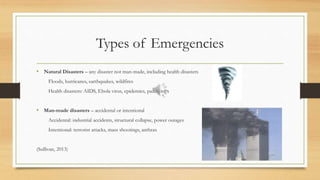
Types of Emergencies
• Natural Disasters – any disaster not man-made, including health disasters
Floods, hurricanes, earthquakes, wildfires
Health disasters: AIDS, Ebola virus, epidemics, pandemics
• Man-made disasters – accidental or intentional
Accidental: industrial accidents, structural collapse, power outages
Intentional: terrorist attacks, mass shootings, anthrax
(Sullivan, 2013)
Levels of Disaster
• Level I – Local response
• Level II – Regional response
• Level III – Statewide or National response
(Sullivan, 2013)
Where does healthcare fit in?
“The healthcare system is now viewed as a foundation of national security
that must provide care anytime, anywhere, without fail and in an ever-
expanding role” (Cagliuso, 2014/2015, p. 160).
Popular Disasters
• September 11, 2001
• Indian Ocean Earthquake and Tsunami 2004
• Hurricane Katrina 2005
• Haiti Earthquake 2010
• Sandy Hook Elementary School 2012
• Ebola 2014
The Role of Nursing During Disaster
• Caring for the sick and injured
• Infection control
• Planning to prevent further damage
• Triage
• Mass immunizations
• Mass evacuations
• Treatment for mass casualties
( Baack & Alfred, 2013, p. 282)
Challenges for Nurses
• Lack of preparation
• Lack of education in school
• Lack of understanding disaster communication methods
• Lack of understanding the formal disaster plan
• Perception of what constitutes disaster preparedness
( Baack & Alfred, 2013, p. 282)
Disasters can affect nurses in all areas of care: Community Health
Centers, Schools, Hospitals, Nursing Homes, Home Care, Management
and Administration
Challenges to Institutions
• Lack of performance metrics
• Lack of funding
• Limited surge capacity
• Unclear federal guidelines and requirements for accreditation
• Lack of Coordination
(Cagliuso, 2014/2015, p. 156)
Ways to Prepare
• Develop and maintain a current disaster plan
(American College of Healthcare Executives,
2014).
• Focus the plan to address “likely” events (ACHE,
2014).
• Develop a command system (ACHE, 2014).
• Assess available resources (ACHE, 2014).
• Plan for operations (ACHE, 2014).
• Develop resource protocols (ACHE, 2014).
• Assess safety of employees, patients, and families
(ACHE, 2014).
• Enhance communication protocols (ACHE,
2014).
• Control and report disease (ACHE, 2014).
• Staff education and training (Sullivan, 2013).
• Practice EOP biannually (Sullivan, 2013).
Emergency Operations Plan Components
• Activation response
• Communication plan
• Patient care and coordination plan
• Security plan
• Traffic flow plan
• Data management strategy
• Resource availability
(Sullivan, 2013)
National Preparedness Goal
• Prevention.
• Protection.
• Mitigation.
• Response.
• Recovery.
(Federal Emergency Management Agency [FEMA], 2015, para. 7)
Factors Affecting Nurses
• Exhaustion and fatigue
• Personal safety concerns
• Illness
• Leaving families to care for others
• Professional accountability
• Grief counseling
(Sullivan, 2013)
Disaster Nursing Video
Additional Resources
• American Nurses Association Disaster Preparedness and Response: http://www.nursingworld.org/
MainMenuCategories/WorkplaceSafety/DPR
• Federal Emergency Management Agency, U.S. Government: http://www.fema.gov/ International Council
of Nurses Disaster Response Network: http://www.icn.ch/networks/disaster-response-network/
• International Nursing Coalition for Mass Casualty Education Educational Competencies for Registered
Nurses Responding to Mass Casualty Incidents: http://www.aacn.nche.edu/ leading-initiatives/education-
resources/INCMCECompetencies.pdf
• The Joint Commission: www.jointcommission.org/ standards
• National Center for Emergency Preparedness: http://www.ncep.vanderbilt.edu/index.html
• World Association for Disaster and Emergency Medicine Nursing Section:
http://www.wadem.org/nursing.html
References
• American College of Healthcare Executives. (2014). Healthcare executives’ role in emergency
preparedness. Healthcare Executive, 29(4), 90-91. Retrieved from http://www.ebscohost.com/
• Baack, S., & Alfred, D. (2013). Nurses’ preparedness and perceived competence in managing disasters.
Journal of Nursing Scholarship, 45(3), 281-287. http://dx.doi.org/10.1111/jnu.12029
• Cagliuso, N. (2014/2015). Stakeholders’ experiences with US hospital emergency preparedness: Part 1.
Journal of Business Continuity & Emergency Planning, 8(2), 156-168. Retrieved from
http://www.ebscohost.com/
• Federal Emergency Management Agency. (2015). National preparedness goal. Retrieved from
http://www.fema.gov/
• Feuerstein, C. (2012, November 6). Disaster nursing [Video file]. Retrieved from https://youtu.be/W-
S2BXTPKHs
• Sullivan, E. J. (2013). Effective leadership and management in nursing (8th ed.). Boston, MA: Pearson.

Preparing for emergencies

  • 1.
  • 2.
    Emergency Preparedness Emergency preparednessis the “comprehensive skills, abilities, knowledge, and actions that are needed to respond and prepare for a threat, actual or suspected, chemical, radiological, nuclear, biological, or explosive in nature” (Slepski as cited in Baack & Alfred, 2013, p. 282).
  • 3.
    Types of Emergencies •Natural Disasters – any disaster not man-made, including health disasters Floods, hurricanes, earthquakes, wildfires Health disasters: AIDS, Ebola virus, epidemics, pandemics • Man-made disasters – accidental or intentional Accidental: industrial accidents, structural collapse, power outages Intentional: terrorist attacks, mass shootings, anthrax (Sullivan, 2013)
  • 4.
    Levels of Disaster •Level I – Local response • Level II – Regional response • Level III – Statewide or National response (Sullivan, 2013) Where does healthcare fit in? “The healthcare system is now viewed as a foundation of national security that must provide care anytime, anywhere, without fail and in an ever- expanding role” (Cagliuso, 2014/2015, p. 160).
  • 5.
    Popular Disasters • September11, 2001 • Indian Ocean Earthquake and Tsunami 2004 • Hurricane Katrina 2005 • Haiti Earthquake 2010 • Sandy Hook Elementary School 2012 • Ebola 2014
  • 6.
    The Role ofNursing During Disaster • Caring for the sick and injured • Infection control • Planning to prevent further damage • Triage • Mass immunizations • Mass evacuations • Treatment for mass casualties ( Baack & Alfred, 2013, p. 282)
  • 7.
    Challenges for Nurses •Lack of preparation • Lack of education in school • Lack of understanding disaster communication methods • Lack of understanding the formal disaster plan • Perception of what constitutes disaster preparedness ( Baack & Alfred, 2013, p. 282) Disasters can affect nurses in all areas of care: Community Health Centers, Schools, Hospitals, Nursing Homes, Home Care, Management and Administration
  • 8.
    Challenges to Institutions •Lack of performance metrics • Lack of funding • Limited surge capacity • Unclear federal guidelines and requirements for accreditation • Lack of Coordination (Cagliuso, 2014/2015, p. 156)
  • 9.
    Ways to Prepare •Develop and maintain a current disaster plan (American College of Healthcare Executives, 2014). • Focus the plan to address “likely” events (ACHE, 2014). • Develop a command system (ACHE, 2014). • Assess available resources (ACHE, 2014). • Plan for operations (ACHE, 2014). • Develop resource protocols (ACHE, 2014). • Assess safety of employees, patients, and families (ACHE, 2014). • Enhance communication protocols (ACHE, 2014). • Control and report disease (ACHE, 2014). • Staff education and training (Sullivan, 2013). • Practice EOP biannually (Sullivan, 2013).
  • 10.
    Emergency Operations PlanComponents • Activation response • Communication plan • Patient care and coordination plan • Security plan • Traffic flow plan • Data management strategy • Resource availability (Sullivan, 2013)
  • 11.
    National Preparedness Goal •Prevention. • Protection. • Mitigation. • Response. • Recovery. (Federal Emergency Management Agency [FEMA], 2015, para. 7)
  • 12.
    Factors Affecting Nurses •Exhaustion and fatigue • Personal safety concerns • Illness • Leaving families to care for others • Professional accountability • Grief counseling (Sullivan, 2013)
  • 13.
  • 14.
    Additional Resources • AmericanNurses Association Disaster Preparedness and Response: http://www.nursingworld.org/ MainMenuCategories/WorkplaceSafety/DPR • Federal Emergency Management Agency, U.S. Government: http://www.fema.gov/ International Council of Nurses Disaster Response Network: http://www.icn.ch/networks/disaster-response-network/ • International Nursing Coalition for Mass Casualty Education Educational Competencies for Registered Nurses Responding to Mass Casualty Incidents: http://www.aacn.nche.edu/ leading-initiatives/education- resources/INCMCECompetencies.pdf • The Joint Commission: www.jointcommission.org/ standards • National Center for Emergency Preparedness: http://www.ncep.vanderbilt.edu/index.html • World Association for Disaster and Emergency Medicine Nursing Section: http://www.wadem.org/nursing.html
  • 15.
    References • American Collegeof Healthcare Executives. (2014). Healthcare executives’ role in emergency preparedness. Healthcare Executive, 29(4), 90-91. Retrieved from http://www.ebscohost.com/ • Baack, S., & Alfred, D. (2013). Nurses’ preparedness and perceived competence in managing disasters. Journal of Nursing Scholarship, 45(3), 281-287. http://dx.doi.org/10.1111/jnu.12029 • Cagliuso, N. (2014/2015). Stakeholders’ experiences with US hospital emergency preparedness: Part 1. Journal of Business Continuity & Emergency Planning, 8(2), 156-168. Retrieved from http://www.ebscohost.com/ • Federal Emergency Management Agency. (2015). National preparedness goal. Retrieved from http://www.fema.gov/ • Feuerstein, C. (2012, November 6). Disaster nursing [Video file]. Retrieved from https://youtu.be/W- S2BXTPKHs • Sullivan, E. J. (2013). Effective leadership and management in nursing (8th ed.). Boston, MA: Pearson.