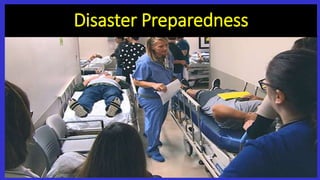
Disaster Preparedness
Disaster
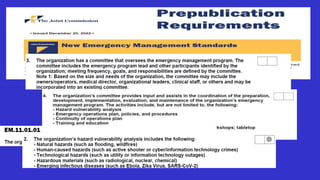
Disruption to a community that exceeds its capacity to cope with it
Mass casualty incidents (MCIs)
The number and severity of casualties overwhelm the abilities of the local
health-care system
• Abrupt/Gradual onset
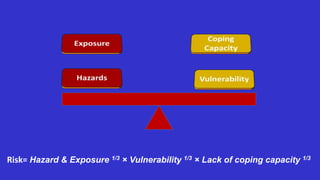
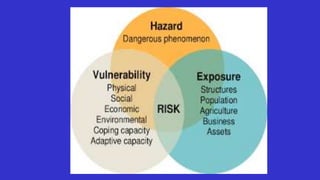
Risk= Hazard & Exposure 1/3 × Vulnerability 1/3 × Lack of coping capacity 1/3
• Community’s responsibility to protect lives of affected populations
• Uninterrupted health services
Major responders to disasters/emergencies
Receiving end of victims
Direct life saving roles
Symbol of social progress & stability
• Disaster Risk Reduction 2015-2030, that was adopted by 187 Member States
at the 3rd World Conference for Disaster Risk Reduction
• structural, non-structural and functional disaster resilient institutions by 2030
• “Promote the goal of ‘hospitals safe from disasters’
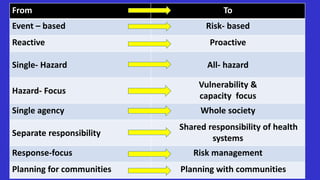
From To
Event – based Risk- based
Reactive Proactive
Single- Hazard All- hazard
Hazard- Focus
Vulnerability &
capacity focus
Single agency Whole society
Separate responsibility
Shared responsibility of health
systems
Response-focus Risk management
Planning for communities Planning with communities
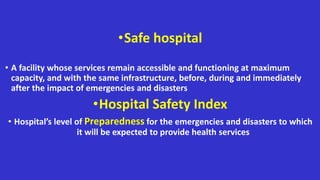
•Safe hospital
• A facility whose services remain accessible and functioning at maximum
capacity, and with the same infrastructure, before, during and immediately
after the impact of emergencies and disasters
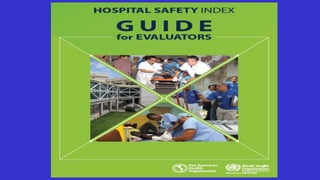
•Hospital Safety Index
• Hospital’s level of Preparedness for the emergencies and disasters to which
it will be expected to provide health services
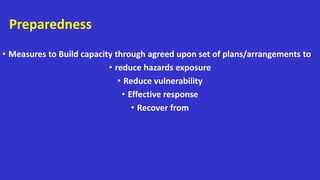
Preparedness
• Measures to Build capacity through agreed upon set of plans/arrangements to
• reduce hazards exposure
• Reduce vulnerability
• Effective response
• Recover from
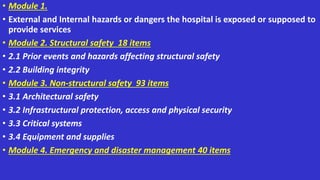
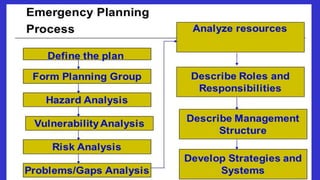
• Module 1.
• External and Internal hazards or dangers the hospital is exposed or supposed to
provide services
• Module 2. Structural safety 18 items
• 2.1 Prior events and hazards affecting structural safety
• 2.2 Building integrity
• Module 3. Non-structural safety 93 items
• 3.1 Architectural safety
• 3.2 Infrastructural protection, access and physical security
• 3.3 Critical systems
• 3.4 Equipment and supplies
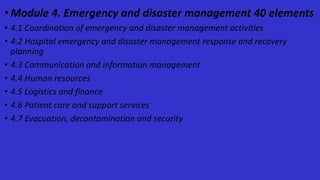
• Module 4. Emergency and disaster management 40 items
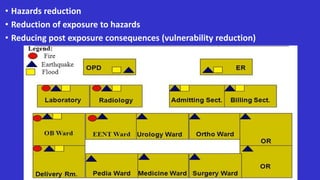
• Hazards reduction
• Reduction of exposure to hazards
• Reducing post exposure consequences (vulnerability reduction)
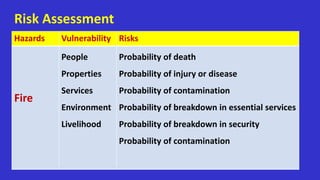
Hazards Vulnerability Risks
Fire
People
Properties
Services
Environment
Livelihood
Probability of death
Probability of injury or disease
Probability of contamination
Probability of breakdown in essential services
Probability of breakdown in security
Probability of contamination
Risk Assessment
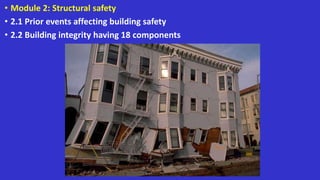
• Module 2: Structural safety
• 2.1 Prior events affecting building safety
• 2.2 Building integrity having 18 components
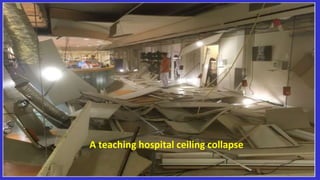
A teaching hospital ceiling collapse
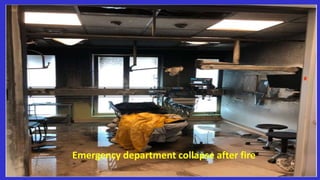
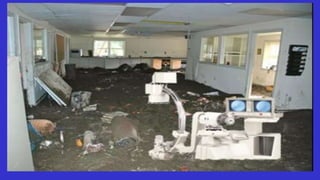
Emergency department collapse after fire
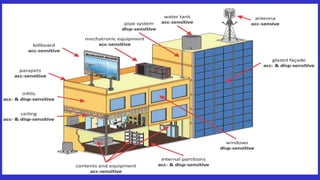
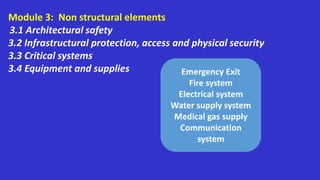
Module 3: Non structural elements
3.1 Architectural safety
3.2 Infrastructural protection, access and physical security
3.3 Critical systems
3.4 Equipment and supplies Emergency Exit
Fire system
Electrical system
Water supply system
Medical gas supply
Communication
system
Module 4. Emergency and disaster management
7 Submodules
40 items checklist
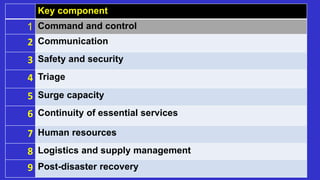
Key component
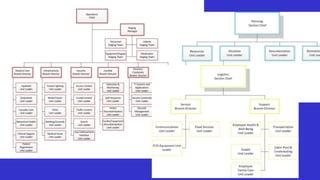
1 Command and control
2 Communication
3 Safety and security
4 Triage
5 Surge capacity
6 Continuity of essential services
7 Human resources
8 Logistics and supply management
9 Post-disaster recovery
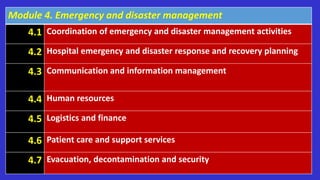
Module 4. Emergency and disaster management
4.1 Coordination of emergency and disaster management activities
4.2 Hospital emergency and disaster response and recovery planning
4.3 Communication and information management
4.4 Human resources
4.5 Logistics and finance
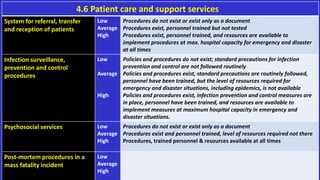
4.6 Patient care and support services
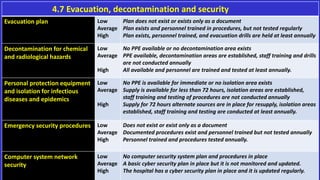
4.7 Evacuation, decontamination and security
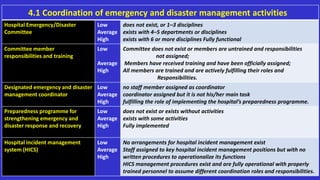
4.1 Coordination of emergency and disaster management activities
Hospital Emergency/Disaster
Committee
Low
Average
High
does not exist, or 1–3 disciplines
exists with 4–5 departments or disciplines
exists with 6 or more disciplines Fully functional
Committee member
responsibilities and training
Low
Average
High
Committee does not exist or members are untrained and responsibilities
not assigned;
Members have received training and have been officially assigned;
All members are trained and are actively fulfilling their roles and
Responsibilities.
Designated emergency and disaster
management coordinator
Low
Average
High
no staff member assigned as coordinator
coordinator assigned but it is not his/her main task
fulfilling the role of implementing the hospital’s preparedness programme.
Preparedness programme for
strengthening emergency and
disaster response and recovery
Low
Average
High
does not exist or exists without activities
exists with some activities
Fully implemented
Hospital incident management
system (HICS)
Low
Average
High
No arrangements for hospital incident management exist
Staff assigned to key hospital incident management positions but with no
written procedures to operationalize its functions
HICS management procedures exist and are fully operational with properly
trained personnel to assume different coordination roles and responsibilities.
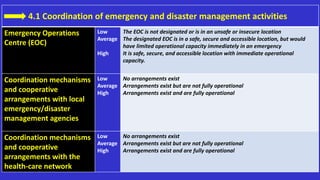
4.1 Coordination of emergency and disaster management activities
Emergency Operations
Centre (EOC)
Low
Average
High
The EOC is not designated or is in an unsafe or insecure location
The designated EOC is in a safe, secure and accessible location, but would
have limited operational capacity immediately in an emergency
It is safe, secure, and accessible location with immediate operational
capacity.
Coordination mechanisms
and cooperative
arrangements with local
emergency/disaster
management agencies
Low
Average
High
No arrangements exist
Arrangements exist but are not fully operational
Arrangements exist and are fully operational
Coordination mechanisms
and cooperative
arrangements with the
health-care network
Low
Average
High
No arrangements exist
Arrangements exist but are not fully operational
Arrangements exist and are fully operational
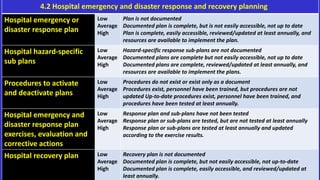
4.2 Hospital emergency and disaster response and recovery planning
Hospital emergency or
disaster response plan
Low
Average
High
Plan is not documented
Documented plan is complete, but is not easily accessible, not up to date
Plan is complete, easily accessible, reviewed/updated at least annually, and
resources are available to implement the plan.
Hospital hazard-specific
sub plans
Low
Average
High
Hazard-specific response sub-plans are not documented
Documented plans are complete but not easily accessible, not up to date
Documented plans are complete, reviewed/updated at least annually, and
resources are available to implement the plans.
Procedures to activate
and deactivate plans
Low
Average
High
Procedures do not exist or exist only as a document
Procedures exist, personnel have been trained, but procedures are not
updated Up-to-date procedures exist, personnel have been trained, and
procedures have been tested at least annually.
Hospital emergency and
disaster response plan
exercises, evaluation and
corrective actions
Low
Average
High
Response plan and sub-plans have not been tested
Response plan or sub-plans are tested, but are not tested at least annually
Response plan or sub-plans are tested at least annually and updated
according to the exercise results.
Hospital recovery plan Low
Average
High
Recovery plan is not documented
Documented plan is complete, but not easily accessible, not up-to-date
Documented plan is complete, easily accessible, and reviewed/updated at
least annually.
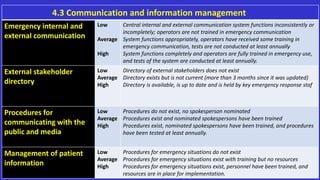
4.3 Communication and information management
Emergency internal and
external communication
Low
Average
High
Central internal and external communication system functions inconsistently or
incompletely; operators are not trained in emergency communication
System functions appropriately, operators have received some training in
emergency communication, tests are not conducted at least annually
System functions completely and operators are fully trained in emergency use,
and tests of the system are conducted at least annually.
External stakeholder
directory
Low
Average
High
Directory of external stakeholders does not exist
Directory exists but is not current (more than 3 months since it was updated)
Directory is available, is up to date and is held by key emergency response staf
Procedures for
communicating with the
public and media
Low
Average
High
Procedures do not exist, no spokesperson nominated
Procedures exist and nominated spokespersons have been trained
Procedures exist, nominated spokespersons have been trained, and procedures
have been tested at least annually.
Management of patient
information
Low
Average
High
Procedures for emergency situations do not exist
Procedures for emergency situations exist with training but no resources
Procedures for emergency situations exist, personnel have been trained, and
resources are in place for implementation.
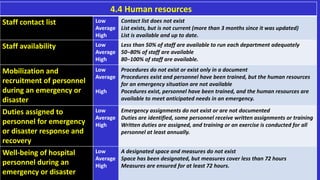
4.4 Human resources
Staff contact list Low
Average
High
Contact list does not exist
List exists, but is not current (more than 3 months since it was updated)
List is available and up to date.
Staff availability Low
Average
High
Less than 50% of staff are available to run each department adequately
50−80% of staff are available
80−100% of staff are available.
Mobilization and
recruitment of personnel
during an emergency or
disaster
Low
Average
High
Procedures do not exist or exist only in a document
Procedures exist and personnel have been trained, but the human resources
for an emergency situation are not available
Pocedures exist, personnel have been trained, and the human resources are
available to meet anticipated needs in an emergency.
Duties assigned to
personnel for emergency
or disaster response and
recovery
Low
Average
High
Emergency assignments do not exist or are not documented
Duties are identified, some personnel receive written assignments or training
Written duties are assigned, and training or an exercise is conducted for all
personnel at least annually.
Well-being of hospital
personnel during an
emergency or disaster
Low
Average
High
A designated space and measures do not exist
Space has been designated, but measures cover less than 72 hours
Measures are ensured for at least 72 hours.
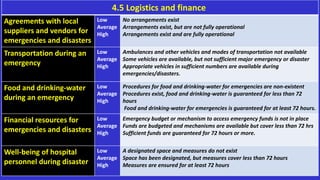
4.5 Logistics and finance
Agreements with local
suppliers and vendors for
emergencies and disasters
Low
Average
High
No arrangements exist
Arrangements exist, but are not fully operational
Arrangements exist and are fully operational
Transportation during an
emergency
Low
Average
High
Ambulances and other vehicles and modes of transportation not available
Some vehicles are available, but not sufficient major emergency or disaster
Appropriate vehicles in sufficient numbers are available during
emergencies/disasters.
Food and drinking-water
during an emergency
Low
Average
High
Procedures for food and drinking-water for emergencies are non-existent
Procedures exist, food and drinking-water is guaranteed for less than 72
hours
Food and drinking-water for emergencies is guaranteed for at least 72 hours.
Financial resources for
emergencies and disasters
Low
Average
High
Emergency budget or mechanism to access emergency funds is not in place
Funds are budgeted and mechanisms are available but cover less than 72 hrs
Sufficient funds are guaranteed for 72 hours or more.
Well-being of hospital
personnel during disaster
Low
Average
High
A designated space and measures do not exist
Space has been designated, but measures cover less than 72 hours
Measures are ensured for at least 72 hours
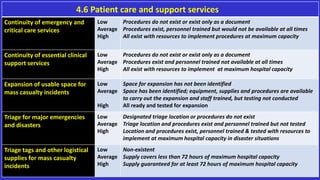
4.6 Patient care and support services
Continuity of emergency and
critical care services
Low
Average
High
Procedures do not exist or exist only as a document
Procedures exist, personnel trained but would not be available at all times
All exist with resources to implement procedures at maximum capacity
Continuity of essential clinical
support services
Low
Average
High
Procedures do not exist or exist only as a document
Procedures exist and personnel trained not available at all times
All exist with resources to implement at maximum hospital capacity
Expansion of usable space for
mass casualty incidents
Low
Average
High
Space for expansion has not been identified
Space has been identified; equipment, supplies and procedures are available
to carry out the expansion and staff trained, but testing not conducted
All ready and tested for expansion
Triage for major emergencies
and disasters
Low
Average
High
Designated triage location or procedures do not exist
Triage location and procedures exist and personnel trained but not tested
Location and procedures exist, personnel trained & tested with resources to
implement at maximum hospital capacity in disaster situations
Triage tags and other logistical
supplies for mass casualty
incidents
Low
Average
High
Non-existent
Supply covers less than 72 hours of maximum hospital capacity
Supply guaranteed for at least 72 hours of maximum hospital capacity
4.6 Patient care and support services
System for referral, transfer
and reception of patients
Low
Average
High
Procedures do not exist or exist only as a document
Procedures exist, personnel trained but not tested
Procedures exist, personnel trained, and resources are available to
implement procedures at max. hospital capacity for emergency and disaster
at all times
Infection surveillance,
prevention and control
procedures
Low
Average
High
Policies and procedures do not exist; standard precautions for infection
prevention and control are not followed routinely
Policies and procedures exist, standard precautions are routinely followed,
personnel have been trained, but the level of resources required for
emergency and disaster situations, including epidemics, is not available
Policies and procedures exist, infection prevention and control measures are
in place, personnel have been trained, and resources are available to
implement measures at maximum hospital capacity in emergency and
disaster situations.
Psychosocial services Low
Average
High
Procedures do not exist or exist only as a document
Procedures exist and personnel trained, level of resources required not there
Procedures, trained personnel & resources available at all times
Post-mortem procedures in a
mass fatality incident
Low
Average
High
4.7 Evacuation, decontamination and security
Evacuation plan Low
Average
High
Plan does not exist or exists only as a document
Plan exists and personnel trained in procedures, but not tested regularly
Plan exists, personnel trained, and evacuation drills are held at least annually
Decontamination for chemical
and radiological hazards
Low
Average
High
No PPE available or no decontamination area exists
PPE available, decontamination areas are established, staff training and drills
are not conducted annually
All available and personnel are trained and tested at least annually.
Personal protection equipment
and isolation for infectious
diseases and epidemics
Low
Average
High
No PPE is available for immediate or no isolation area exists
Supply is available for less than 72 hours, isolation areas are established,
staff training and testing of procedures are not conducted annually
Supply for 72 hours alternate sources are in place for resupply, isolation areas
established, staff training and testing are conducted at least annually.
Emergency security procedures Low
Average
High
Does not exist or exist only as a document
Documented procedures exist and personnel trained but not tested annually
Personnel trained and procedures tested annually.
Computer system network
security
Low
Average
High
No computer security system plan and procedures in place
A basic cyber security plan in place but it is not monitored and updated.
The hospital has a cyber security plan in place and it is updated regularly.
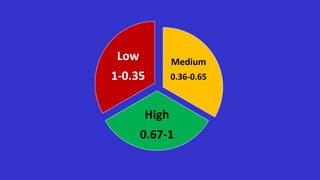
Medium
0.36-0.65
High
0.67-1
Low
1-0.35
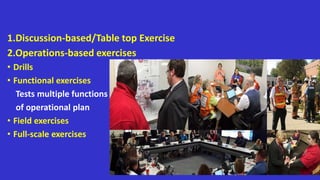
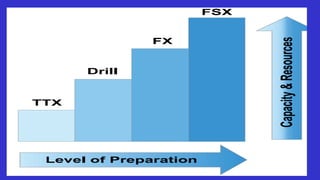
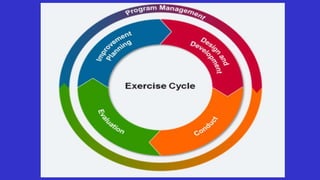
1.Discussion-based/Table top Exercise
2.Operations-based exercises
• Drills
• Functional exercises
Tests multiple functions
of operational plan
• Field exercises
• Full-scale exercises
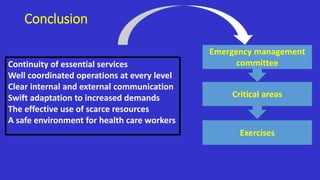
Conclusion
Exercises
Continuity of essential services
Well coordinated operations at every level
Clear internal and external communication
Swift adaptation to increased demands
The effective use of scarce resources
A safe environment for health care workers
Emergency management
committee
Critical areas
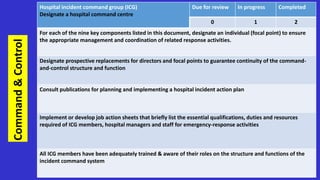
Command
&
Control
Hospital incident command group (ICG)
Designate a hospital command centre
Due for review In progress Completed
0 1 2
For each of the nine key components listed in this document, designate an individual (focal point) to ensure
the appropriate management and coordination of related response activities.
Designate prospective replacements for directors and focal points to guarantee continuity of the command-
and-control structure and function
Consult publications for planning and implementing a hospital incident action plan
Implement or develop job action sheets that briefly list the essential qualifications, duties and resources
required of ICG members, hospital managers and staff for emergency-response activities
All ICG members have been adequately trained & aware of their roles on the structure and functions of the
incident command system
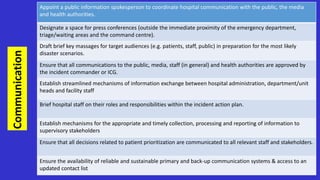
Appoint a public information spokesperson to coordinate hospital communication with the public, the media
and health authorities.
Designate a space for press conferences (outside the immediate proximity of the emergency department,
triage/waiting areas and the command centre).
Draft brief key massages for target audiences (e.g. patients, staff, public) in preparation for the most likely
disaster scenarios.
Ensure that all communications to the public, media, staff (in general) and health authorities are approved by
the incident commander or ICG.
Establish streamlined mechanisms of information exchange between hospital administration, department/unit
heads and facility staff
Brief hospital staff on their roles and responsibilities within the incident action plan.
Establish mechanisms for the appropriate and timely collection, processing and reporting of information to
supervisory stakeholders
Ensure that all decisions related to patient prioritization are communicated to all relevant staff and stakeholders.
Ensure the availability of reliable and sustainable primary and back-up communication systems & access to an
updated contact list
Communication
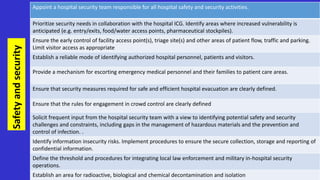
Safety
and
security
Appoint a hospital security team responsible for all hospital safety and security activities.
Prioritize security needs in collaboration with the hospital ICG. Identify areas where increased vulnerability is
anticipated (e.g. entry/exits, food/water access points, pharmaceutical stockpiles).
Ensure the early control of facility access point(s), triage site(s) and other areas of patient flow, traffic and parking.
Limit visitor access as appropriate
Establish a reliable mode of identifying authorized hospital personnel, patients and visitors.
Provide a mechanism for escorting emergency medical personnel and their families to patient care areas.
Ensure that security measures required for safe and efficient hospital evacuation are clearly defined.
Ensure that the rules for engagement in crowd control are clearly defined
Solicit frequent input from the hospital security team with a view to identifying potential safety and security
challenges and constraints, including gaps in the management of hazardous materials and the prevention and
control of infection. .
Identify information insecurity risks. Implement procedures to ensure the secure collection, storage and reporting of
confidential information.
Define the threshold and procedures for integrating local law enforcement and military in-hospital security
operations.
Establish an area for radioactive, biological and chemical decontamination and isolation
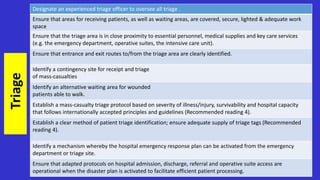
Designate an experienced triage officer to oversee all triage .
Ensure that areas for receiving patients, as well as waiting areas, are covered, secure, lighted & adequate work
space
Ensure that the triage area is in close proximity to essential personnel, medical supplies and key care services
(e.g. the emergency department, operative suites, the intensive care unit).
Ensure that entrance and exit routes to/from the triage area are clearly identified.
Identify a contingency site for receipt and triage
of mass-casualties
Identify an alternative waiting area for wounded
patients able to walk.
Establish a mass-casualty triage protocol based on severity of illness/injury, survivability and hospital capacity
that follows internationally accepted principles and guidelines (Recommended reading 4).
Establish a clear method of patient triage identification; ensure adequate supply of triage tags (Recommended
reading 4).
Identify a mechanism whereby the hospital emergency response plan can be activated from the emergency
department or triage site.
Ensure that adapted protocols on hospital admission, discharge, referral and operative suite access are
operational when the disaster plan is activated to facilitate efficient patient processing.
Triage
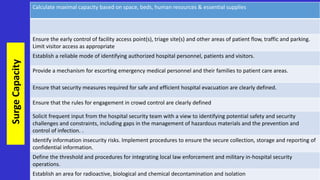
Calculate maximal capacity based on space, beds, human resources & essential supplies
Ensure the early control of facility access point(s), triage site(s) and other areas of patient flow, traffic and parking.
Limit visitor access as appropriate
Establish a reliable mode of identifying authorized hospital personnel, patients and visitors.
Provide a mechanism for escorting emergency medical personnel and their families to patient care areas.
Ensure that security measures required for safe and efficient hospital evacuation are clearly defined.
Ensure that the rules for engagement in crowd control are clearly defined
Solicit frequent input from the hospital security team with a view to identifying potential safety and security
challenges and constraints, including gaps in the management of hazardous materials and the prevention and
control of infection. .
Identify information insecurity risks. Implement procedures to ensure the secure collection, storage and reporting of
confidential information.
Define the threshold and procedures for integrating local law enforcement and military in-hospital security
operations.
Establish an area for radioactive, biological and chemical decontamination and isolation
Surge
Capacity
•Module 4. Emergency and disaster management 40 elements
• 4.1 Coordination of emergency and disaster management activities
• 4.2 Hospital emergency and disaster management response and recovery
planning
• 4.3 Communication and information management
• 4.4 Human resources
• 4.5 Logistics and finance
• 4.6 Patient care and support services
• 4.7 Evacuation, decontamination and security
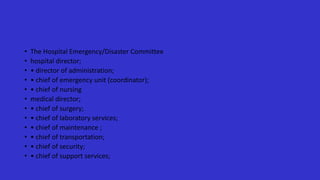
• The Hospital Emergency/Disaster Committee
• hospital director;
• • director of administration;
• • chief of emergency unit (coordinator);
• • chief of nursing
• medical director;
• • chief of surgery;
• • chief of laboratory services;
• • chief of maintenance ;
• • chief of transportation;
• • chief of security;
• • chief of support services;
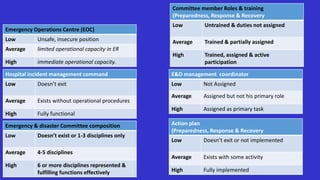
response, recovery)
Emergency & disaster Committee composition
Low Doesn’t exist or 1-3 disciplines only
Average 4-5 disciplines
High 6 or more disciplines represented &
fulfilling functions effectively
Committee member Roles & training
(Preparedness, Response & Recovery
Low Untrained & duties not assigned
Average Trained & partially assigned
High Trained, assigned & active
participation
E&D management coordinator
Low Not Assigned
Average Assigned but not his primary role
High Assigned as primary task
Action plan
(Preparedness, Response & Recovery
Low Doesn’t exit or not implemented
Average Exists with some activity
High Fully implemented
Hospital incident management command
Low Doesn’t exit
Average Exists without operational procedures
High Fully functional
Emergency Operations Centre (EOC)
Low Unsafe, insecure position
Average limited operational capacity in ER
High immediate operational capacity.
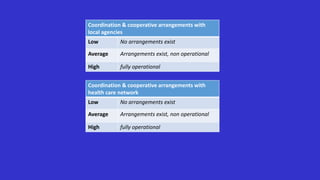
Coordination & cooperative arrangements with
local agencies
Low No arrangements exist
Average Arrangements exist, non operational
High fully operational
Coordination & cooperative arrangements with
health care network
Low No arrangements exist
Average Arrangements exist, non operational
High fully operational
• electricity, water supply, waste management, fire protection),
medical, laboratory and office equipment (whether fixed or mobile),
supplies used for analysis and treatment, and so forth
• Hazards
• Vulnerability
• Preparedness
• Impact
• Disaster
• Response
• The ability of health services to function without interruption in these
situations is a matter of life and death
• Pan American Health Organization (PAHO) and WHO released the first
version of the Hospital Safety Index in 2008
• Module 4: Emergency and disaster management
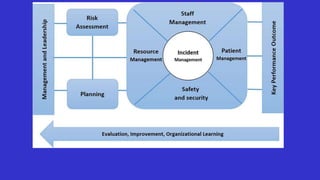
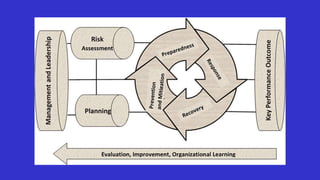
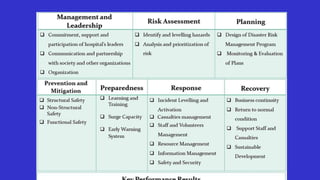
• The tool is structured according to nine key components, each with a
list of priority action to support hospital managers and emergency
planners in achieving: (1) continuity of essential services; (2) well-
coordinated implementation of hospital operations at every level; (3)
clear and accurate internal and external communication; (4) swift
adaptation to increased demands; (5) the effective use of scarce
resources; and (6) a safe environment for health-care workers
challenges of a disaster
• Limited resources, a surge in demand for medical services, and the
disruption of communication and supply lines create a significant
barrier to the provision of health care
Key component 1
Command and control
Disaster preparedeness.pptx

Disaster preparedeness.pptx

  • 1.
  • 2.
    Disaster Disruption to acommunity that exceeds its capacity to cope with it Mass casualty incidents (MCIs) The number and severity of casualties overwhelm the abilities of the local health-care system • Abrupt/Gradual onset
  • 3.
    Risk= Hazard &Exposure 1/3 × Vulnerability 1/3 × Lack of coping capacity 1/3
  • 4.
    • Community’s responsibilityto protect lives of affected populations • Uninterrupted health services Major responders to disasters/emergencies Receiving end of victims Direct life saving roles Symbol of social progress & stability • Disaster Risk Reduction 2015-2030, that was adopted by 187 Member States at the 3rd World Conference for Disaster Risk Reduction • structural, non-structural and functional disaster resilient institutions by 2030 • “Promote the goal of ‘hospitals safe from disasters’
  • 5.
    From To Event –based Risk- based Reactive Proactive Single- Hazard All- hazard Hazard- Focus Vulnerability & capacity focus Single agency Whole society Separate responsibility Shared responsibility of health systems Response-focus Risk management Planning for communities Planning with communities
  • 6.
    •Safe hospital • Afacility whose services remain accessible and functioning at maximum capacity, and with the same infrastructure, before, during and immediately after the impact of emergencies and disasters •Hospital Safety Index • Hospital’s level of Preparedness for the emergencies and disasters to which it will be expected to provide health services
  • 7.
    Preparedness • Measures toBuild capacity through agreed upon set of plans/arrangements to • reduce hazards exposure • Reduce vulnerability • Effective response • Recover from
  • 13.
    • Module 1. •External and Internal hazards or dangers the hospital is exposed or supposed to provide services • Module 2. Structural safety 18 items • 2.1 Prior events and hazards affecting structural safety • 2.2 Building integrity • Module 3. Non-structural safety 93 items • 3.1 Architectural safety • 3.2 Infrastructural protection, access and physical security • 3.3 Critical systems • 3.4 Equipment and supplies • Module 4. Emergency and disaster management 40 items
  • 15.
    • Hazards reduction •Reduction of exposure to hazards • Reducing post exposure consequences (vulnerability reduction)
  • 16.
    Hazards Vulnerability Risks Fire People Properties Services Environment Livelihood Probabilityof death Probability of injury or disease Probability of contamination Probability of breakdown in essential services Probability of breakdown in security Probability of contamination Risk Assessment
  • 18.
    • Module 2:Structural safety • 2.1 Prior events affecting building safety • 2.2 Building integrity having 18 components
  • 19.
    A teaching hospitalceiling collapse
  • 20.
  • 23.
    Module 3: Nonstructural elements 3.1 Architectural safety 3.2 Infrastructural protection, access and physical security 3.3 Critical systems 3.4 Equipment and supplies Emergency Exit Fire system Electrical system Water supply system Medical gas supply Communication system
  • 24.
    Module 4. Emergencyand disaster management 7 Submodules 40 items checklist
  • 26.
    Key component 1 Commandand control 2 Communication 3 Safety and security 4 Triage 5 Surge capacity 6 Continuity of essential services 7 Human resources 8 Logistics and supply management 9 Post-disaster recovery
  • 28.
    Module 4. Emergencyand disaster management 4.1 Coordination of emergency and disaster management activities 4.2 Hospital emergency and disaster response and recovery planning 4.3 Communication and information management 4.4 Human resources 4.5 Logistics and finance 4.6 Patient care and support services 4.7 Evacuation, decontamination and security
  • 29.
    4.1 Coordination ofemergency and disaster management activities Hospital Emergency/Disaster Committee Low Average High does not exist, or 1–3 disciplines exists with 4–5 departments or disciplines exists with 6 or more disciplines Fully functional Committee member responsibilities and training Low Average High Committee does not exist or members are untrained and responsibilities not assigned; Members have received training and have been officially assigned; All members are trained and are actively fulfilling their roles and Responsibilities. Designated emergency and disaster management coordinator Low Average High no staff member assigned as coordinator coordinator assigned but it is not his/her main task fulfilling the role of implementing the hospital’s preparedness programme. Preparedness programme for strengthening emergency and disaster response and recovery Low Average High does not exist or exists without activities exists with some activities Fully implemented Hospital incident management system (HICS) Low Average High No arrangements for hospital incident management exist Staff assigned to key hospital incident management positions but with no written procedures to operationalize its functions HICS management procedures exist and are fully operational with properly trained personnel to assume different coordination roles and responsibilities.
  • 30.
    4.1 Coordination ofemergency and disaster management activities Emergency Operations Centre (EOC) Low Average High The EOC is not designated or is in an unsafe or insecure location The designated EOC is in a safe, secure and accessible location, but would have limited operational capacity immediately in an emergency It is safe, secure, and accessible location with immediate operational capacity. Coordination mechanisms and cooperative arrangements with local emergency/disaster management agencies Low Average High No arrangements exist Arrangements exist but are not fully operational Arrangements exist and are fully operational Coordination mechanisms and cooperative arrangements with the health-care network Low Average High No arrangements exist Arrangements exist but are not fully operational Arrangements exist and are fully operational
  • 31.
    4.2 Hospital emergencyand disaster response and recovery planning Hospital emergency or disaster response plan Low Average High Plan is not documented Documented plan is complete, but is not easily accessible, not up to date Plan is complete, easily accessible, reviewed/updated at least annually, and resources are available to implement the plan. Hospital hazard-specific sub plans Low Average High Hazard-specific response sub-plans are not documented Documented plans are complete but not easily accessible, not up to date Documented plans are complete, reviewed/updated at least annually, and resources are available to implement the plans. Procedures to activate and deactivate plans Low Average High Procedures do not exist or exist only as a document Procedures exist, personnel have been trained, but procedures are not updated Up-to-date procedures exist, personnel have been trained, and procedures have been tested at least annually. Hospital emergency and disaster response plan exercises, evaluation and corrective actions Low Average High Response plan and sub-plans have not been tested Response plan or sub-plans are tested, but are not tested at least annually Response plan or sub-plans are tested at least annually and updated according to the exercise results. Hospital recovery plan Low Average High Recovery plan is not documented Documented plan is complete, but not easily accessible, not up-to-date Documented plan is complete, easily accessible, and reviewed/updated at least annually.
  • 32.
    4.3 Communication andinformation management Emergency internal and external communication Low Average High Central internal and external communication system functions inconsistently or incompletely; operators are not trained in emergency communication System functions appropriately, operators have received some training in emergency communication, tests are not conducted at least annually System functions completely and operators are fully trained in emergency use, and tests of the system are conducted at least annually. External stakeholder directory Low Average High Directory of external stakeholders does not exist Directory exists but is not current (more than 3 months since it was updated) Directory is available, is up to date and is held by key emergency response staf Procedures for communicating with the public and media Low Average High Procedures do not exist, no spokesperson nominated Procedures exist and nominated spokespersons have been trained Procedures exist, nominated spokespersons have been trained, and procedures have been tested at least annually. Management of patient information Low Average High Procedures for emergency situations do not exist Procedures for emergency situations exist with training but no resources Procedures for emergency situations exist, personnel have been trained, and resources are in place for implementation.
  • 33.
    4.4 Human resources Staffcontact list Low Average High Contact list does not exist List exists, but is not current (more than 3 months since it was updated) List is available and up to date. Staff availability Low Average High Less than 50% of staff are available to run each department adequately 50−80% of staff are available 80−100% of staff are available. Mobilization and recruitment of personnel during an emergency or disaster Low Average High Procedures do not exist or exist only in a document Procedures exist and personnel have been trained, but the human resources for an emergency situation are not available Pocedures exist, personnel have been trained, and the human resources are available to meet anticipated needs in an emergency. Duties assigned to personnel for emergency or disaster response and recovery Low Average High Emergency assignments do not exist or are not documented Duties are identified, some personnel receive written assignments or training Written duties are assigned, and training or an exercise is conducted for all personnel at least annually. Well-being of hospital personnel during an emergency or disaster Low Average High A designated space and measures do not exist Space has been designated, but measures cover less than 72 hours Measures are ensured for at least 72 hours.
  • 34.
    4.5 Logistics andfinance Agreements with local suppliers and vendors for emergencies and disasters Low Average High No arrangements exist Arrangements exist, but are not fully operational Arrangements exist and are fully operational Transportation during an emergency Low Average High Ambulances and other vehicles and modes of transportation not available Some vehicles are available, but not sufficient major emergency or disaster Appropriate vehicles in sufficient numbers are available during emergencies/disasters. Food and drinking-water during an emergency Low Average High Procedures for food and drinking-water for emergencies are non-existent Procedures exist, food and drinking-water is guaranteed for less than 72 hours Food and drinking-water for emergencies is guaranteed for at least 72 hours. Financial resources for emergencies and disasters Low Average High Emergency budget or mechanism to access emergency funds is not in place Funds are budgeted and mechanisms are available but cover less than 72 hrs Sufficient funds are guaranteed for 72 hours or more. Well-being of hospital personnel during disaster Low Average High A designated space and measures do not exist Space has been designated, but measures cover less than 72 hours Measures are ensured for at least 72 hours
  • 35.
    4.6 Patient careand support services Continuity of emergency and critical care services Low Average High Procedures do not exist or exist only as a document Procedures exist, personnel trained but would not be available at all times All exist with resources to implement procedures at maximum capacity Continuity of essential clinical support services Low Average High Procedures do not exist or exist only as a document Procedures exist and personnel trained not available at all times All exist with resources to implement at maximum hospital capacity Expansion of usable space for mass casualty incidents Low Average High Space for expansion has not been identified Space has been identified; equipment, supplies and procedures are available to carry out the expansion and staff trained, but testing not conducted All ready and tested for expansion Triage for major emergencies and disasters Low Average High Designated triage location or procedures do not exist Triage location and procedures exist and personnel trained but not tested Location and procedures exist, personnel trained & tested with resources to implement at maximum hospital capacity in disaster situations Triage tags and other logistical supplies for mass casualty incidents Low Average High Non-existent Supply covers less than 72 hours of maximum hospital capacity Supply guaranteed for at least 72 hours of maximum hospital capacity
  • 36.
    4.6 Patient careand support services System for referral, transfer and reception of patients Low Average High Procedures do not exist or exist only as a document Procedures exist, personnel trained but not tested Procedures exist, personnel trained, and resources are available to implement procedures at max. hospital capacity for emergency and disaster at all times Infection surveillance, prevention and control procedures Low Average High Policies and procedures do not exist; standard precautions for infection prevention and control are not followed routinely Policies and procedures exist, standard precautions are routinely followed, personnel have been trained, but the level of resources required for emergency and disaster situations, including epidemics, is not available Policies and procedures exist, infection prevention and control measures are in place, personnel have been trained, and resources are available to implement measures at maximum hospital capacity in emergency and disaster situations. Psychosocial services Low Average High Procedures do not exist or exist only as a document Procedures exist and personnel trained, level of resources required not there Procedures, trained personnel & resources available at all times Post-mortem procedures in a mass fatality incident Low Average High
  • 37.
    4.7 Evacuation, decontaminationand security Evacuation plan Low Average High Plan does not exist or exists only as a document Plan exists and personnel trained in procedures, but not tested regularly Plan exists, personnel trained, and evacuation drills are held at least annually Decontamination for chemical and radiological hazards Low Average High No PPE available or no decontamination area exists PPE available, decontamination areas are established, staff training and drills are not conducted annually All available and personnel are trained and tested at least annually. Personal protection equipment and isolation for infectious diseases and epidemics Low Average High No PPE is available for immediate or no isolation area exists Supply is available for less than 72 hours, isolation areas are established, staff training and testing of procedures are not conducted annually Supply for 72 hours alternate sources are in place for resupply, isolation areas established, staff training and testing are conducted at least annually. Emergency security procedures Low Average High Does not exist or exist only as a document Documented procedures exist and personnel trained but not tested annually Personnel trained and procedures tested annually. Computer system network security Low Average High No computer security system plan and procedures in place A basic cyber security plan in place but it is not monitored and updated. The hospital has a cyber security plan in place and it is updated regularly.
  • 38.
  • 40.
    1.Discussion-based/Table top Exercise 2.Operations-basedexercises • Drills • Functional exercises Tests multiple functions of operational plan • Field exercises • Full-scale exercises
  • 44.
    Conclusion Exercises Continuity of essentialservices Well coordinated operations at every level Clear internal and external communication Swift adaptation to increased demands The effective use of scarce resources A safe environment for health care workers Emergency management committee Critical areas
  • 46.
    Command & Control Hospital incident commandgroup (ICG) Designate a hospital command centre Due for review In progress Completed 0 1 2 For each of the nine key components listed in this document, designate an individual (focal point) to ensure the appropriate management and coordination of related response activities. Designate prospective replacements for directors and focal points to guarantee continuity of the command- and-control structure and function Consult publications for planning and implementing a hospital incident action plan Implement or develop job action sheets that briefly list the essential qualifications, duties and resources required of ICG members, hospital managers and staff for emergency-response activities All ICG members have been adequately trained & aware of their roles on the structure and functions of the incident command system
  • 47.
    Appoint a publicinformation spokesperson to coordinate hospital communication with the public, the media and health authorities. Designate a space for press conferences (outside the immediate proximity of the emergency department, triage/waiting areas and the command centre). Draft brief key massages for target audiences (e.g. patients, staff, public) in preparation for the most likely disaster scenarios. Ensure that all communications to the public, media, staff (in general) and health authorities are approved by the incident commander or ICG. Establish streamlined mechanisms of information exchange between hospital administration, department/unit heads and facility staff Brief hospital staff on their roles and responsibilities within the incident action plan. Establish mechanisms for the appropriate and timely collection, processing and reporting of information to supervisory stakeholders Ensure that all decisions related to patient prioritization are communicated to all relevant staff and stakeholders. Ensure the availability of reliable and sustainable primary and back-up communication systems & access to an updated contact list Communication
  • 48.
    Safety and security Appoint a hospitalsecurity team responsible for all hospital safety and security activities. Prioritize security needs in collaboration with the hospital ICG. Identify areas where increased vulnerability is anticipated (e.g. entry/exits, food/water access points, pharmaceutical stockpiles). Ensure the early control of facility access point(s), triage site(s) and other areas of patient flow, traffic and parking. Limit visitor access as appropriate Establish a reliable mode of identifying authorized hospital personnel, patients and visitors. Provide a mechanism for escorting emergency medical personnel and their families to patient care areas. Ensure that security measures required for safe and efficient hospital evacuation are clearly defined. Ensure that the rules for engagement in crowd control are clearly defined Solicit frequent input from the hospital security team with a view to identifying potential safety and security challenges and constraints, including gaps in the management of hazardous materials and the prevention and control of infection. . Identify information insecurity risks. Implement procedures to ensure the secure collection, storage and reporting of confidential information. Define the threshold and procedures for integrating local law enforcement and military in-hospital security operations. Establish an area for radioactive, biological and chemical decontamination and isolation
  • 49.
    Designate an experiencedtriage officer to oversee all triage . Ensure that areas for receiving patients, as well as waiting areas, are covered, secure, lighted & adequate work space Ensure that the triage area is in close proximity to essential personnel, medical supplies and key care services (e.g. the emergency department, operative suites, the intensive care unit). Ensure that entrance and exit routes to/from the triage area are clearly identified. Identify a contingency site for receipt and triage of mass-casualties Identify an alternative waiting area for wounded patients able to walk. Establish a mass-casualty triage protocol based on severity of illness/injury, survivability and hospital capacity that follows internationally accepted principles and guidelines (Recommended reading 4). Establish a clear method of patient triage identification; ensure adequate supply of triage tags (Recommended reading 4). Identify a mechanism whereby the hospital emergency response plan can be activated from the emergency department or triage site. Ensure that adapted protocols on hospital admission, discharge, referral and operative suite access are operational when the disaster plan is activated to facilitate efficient patient processing. Triage
  • 50.
    Calculate maximal capacitybased on space, beds, human resources & essential supplies Ensure the early control of facility access point(s), triage site(s) and other areas of patient flow, traffic and parking. Limit visitor access as appropriate Establish a reliable mode of identifying authorized hospital personnel, patients and visitors. Provide a mechanism for escorting emergency medical personnel and their families to patient care areas. Ensure that security measures required for safe and efficient hospital evacuation are clearly defined. Ensure that the rules for engagement in crowd control are clearly defined Solicit frequent input from the hospital security team with a view to identifying potential safety and security challenges and constraints, including gaps in the management of hazardous materials and the prevention and control of infection. . Identify information insecurity risks. Implement procedures to ensure the secure collection, storage and reporting of confidential information. Define the threshold and procedures for integrating local law enforcement and military in-hospital security operations. Establish an area for radioactive, biological and chemical decontamination and isolation Surge Capacity
  • 51.
    •Module 4. Emergencyand disaster management 40 elements • 4.1 Coordination of emergency and disaster management activities • 4.2 Hospital emergency and disaster management response and recovery planning • 4.3 Communication and information management • 4.4 Human resources • 4.5 Logistics and finance • 4.6 Patient care and support services • 4.7 Evacuation, decontamination and security
  • 52.
    • The HospitalEmergency/Disaster Committee • hospital director; • • director of administration; • • chief of emergency unit (coordinator); • • chief of nursing • medical director; • • chief of surgery; • • chief of laboratory services; • • chief of maintenance ; • • chief of transportation; • • chief of security; • • chief of support services;
  • 53.
    response, recovery) Emergency &disaster Committee composition Low Doesn’t exist or 1-3 disciplines only Average 4-5 disciplines High 6 or more disciplines represented & fulfilling functions effectively Committee member Roles & training (Preparedness, Response & Recovery Low Untrained & duties not assigned Average Trained & partially assigned High Trained, assigned & active participation E&D management coordinator Low Not Assigned Average Assigned but not his primary role High Assigned as primary task Action plan (Preparedness, Response & Recovery Low Doesn’t exit or not implemented Average Exists with some activity High Fully implemented Hospital incident management command Low Doesn’t exit Average Exists without operational procedures High Fully functional Emergency Operations Centre (EOC) Low Unsafe, insecure position Average limited operational capacity in ER High immediate operational capacity.
  • 54.
    Coordination & cooperativearrangements with local agencies Low No arrangements exist Average Arrangements exist, non operational High fully operational Coordination & cooperative arrangements with health care network Low No arrangements exist Average Arrangements exist, non operational High fully operational
  • 55.
    • electricity, watersupply, waste management, fire protection), medical, laboratory and office equipment (whether fixed or mobile), supplies used for analysis and treatment, and so forth
  • 57.
    • Hazards • Vulnerability •Preparedness • Impact • Disaster • Response
  • 58.
    • The abilityof health services to function without interruption in these situations is a matter of life and death • Pan American Health Organization (PAHO) and WHO released the first version of the Hospital Safety Index in 2008
  • 59.
    • Module 4:Emergency and disaster management
  • 69.
    • The toolis structured according to nine key components, each with a list of priority action to support hospital managers and emergency planners in achieving: (1) continuity of essential services; (2) well- coordinated implementation of hospital operations at every level; (3) clear and accurate internal and external communication; (4) swift adaptation to increased demands; (5) the effective use of scarce resources; and (6) a safe environment for health-care workers
  • 70.
    challenges of adisaster • Limited resources, a surge in demand for medical services, and the disruption of communication and supply lines create a significant barrier to the provision of health care
  • 71.