1 June 2018
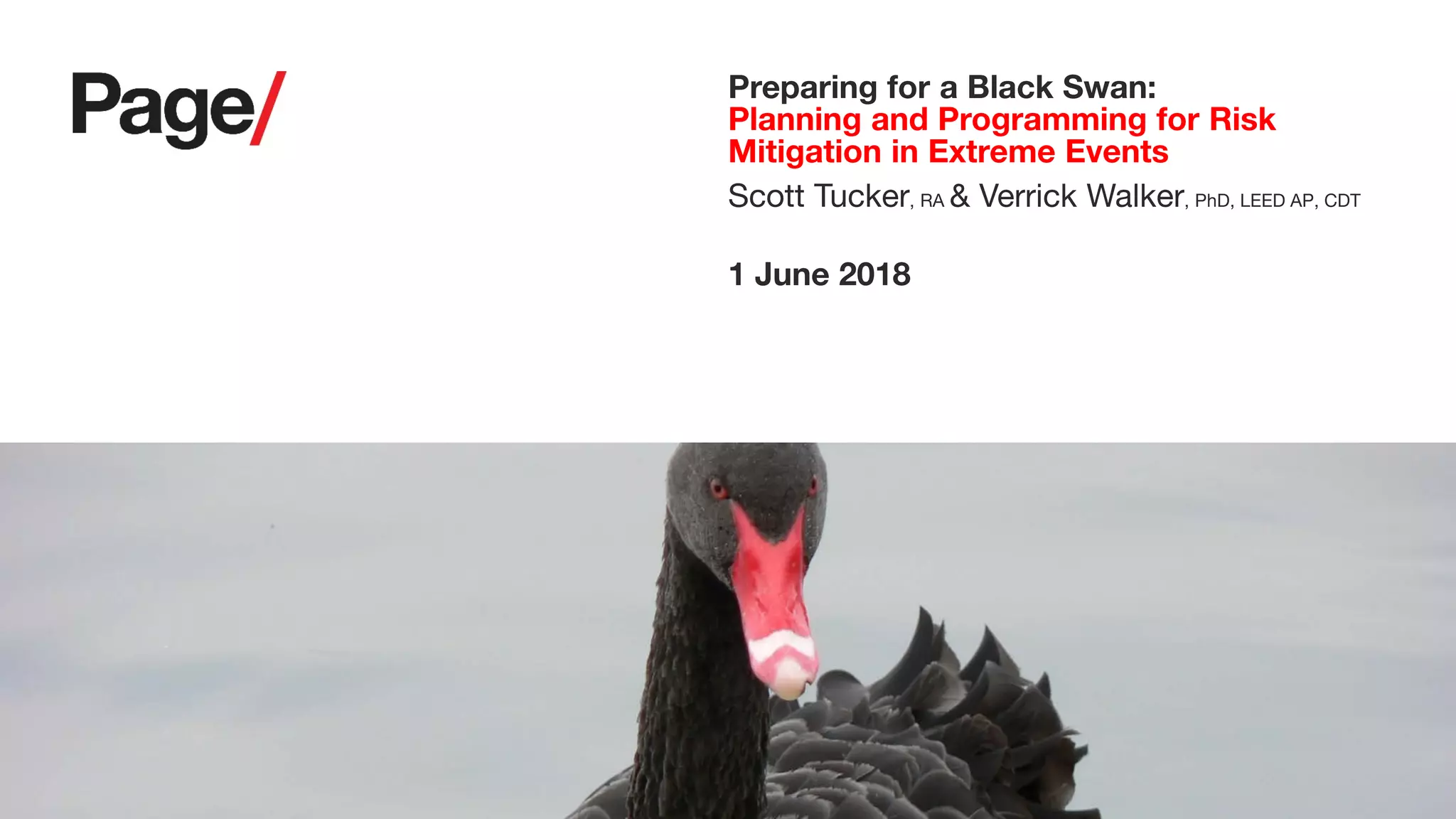
Preparing for a Black Swan:
Planning and Programming for Risk
Mitigation in Extreme Events
Scott Tucker, RA & Verrick Walker, PhD, LEED AP, CDT
Contents/
i. How to think about resilient
design
ii. Method for organizing and
prioritizing
iii. Illustrations
conceptual framework
how to think bout resilient design
what is resilience?
Deliver Us From Failure: How the Astros Endured Futility to
Become World Series Champions
LeBron James’ Cavaliers face elimination once again
A/E Industry and Governmental Perspectives
What is resilience?
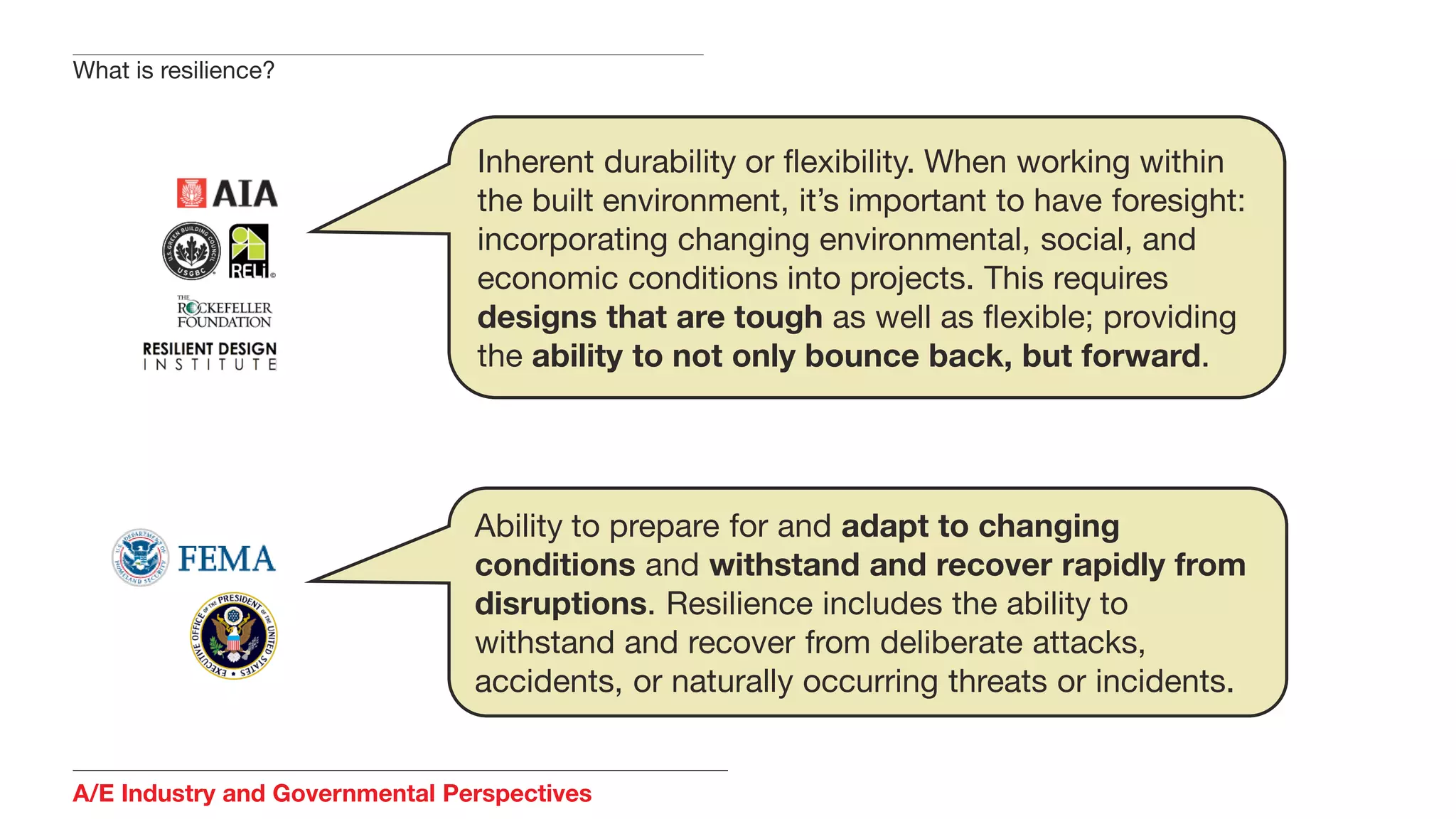
Inherent durability or flexibility. When working within
the built environment, it’s important to have foresight:
incorporating changing environmental, social, and
economic conditions into projects. This requires
designs that are tough as well as flexible; providing
the ability to not only bounce back, but forward.
Ability to prepare for and adapt to changing
conditions and withstand and recover rapidly from
disruptions. Resilience includes the ability to
withstand and recover from deliberate attacks,
accidents, or naturally occurring threats or incidents.
Disaster Mitigation and Risk Reduction Perspectives
What is resilience?
Center for Research on the Epidemiology of Disasters
Disaster Mitigation and Risk Reduction Perspectives
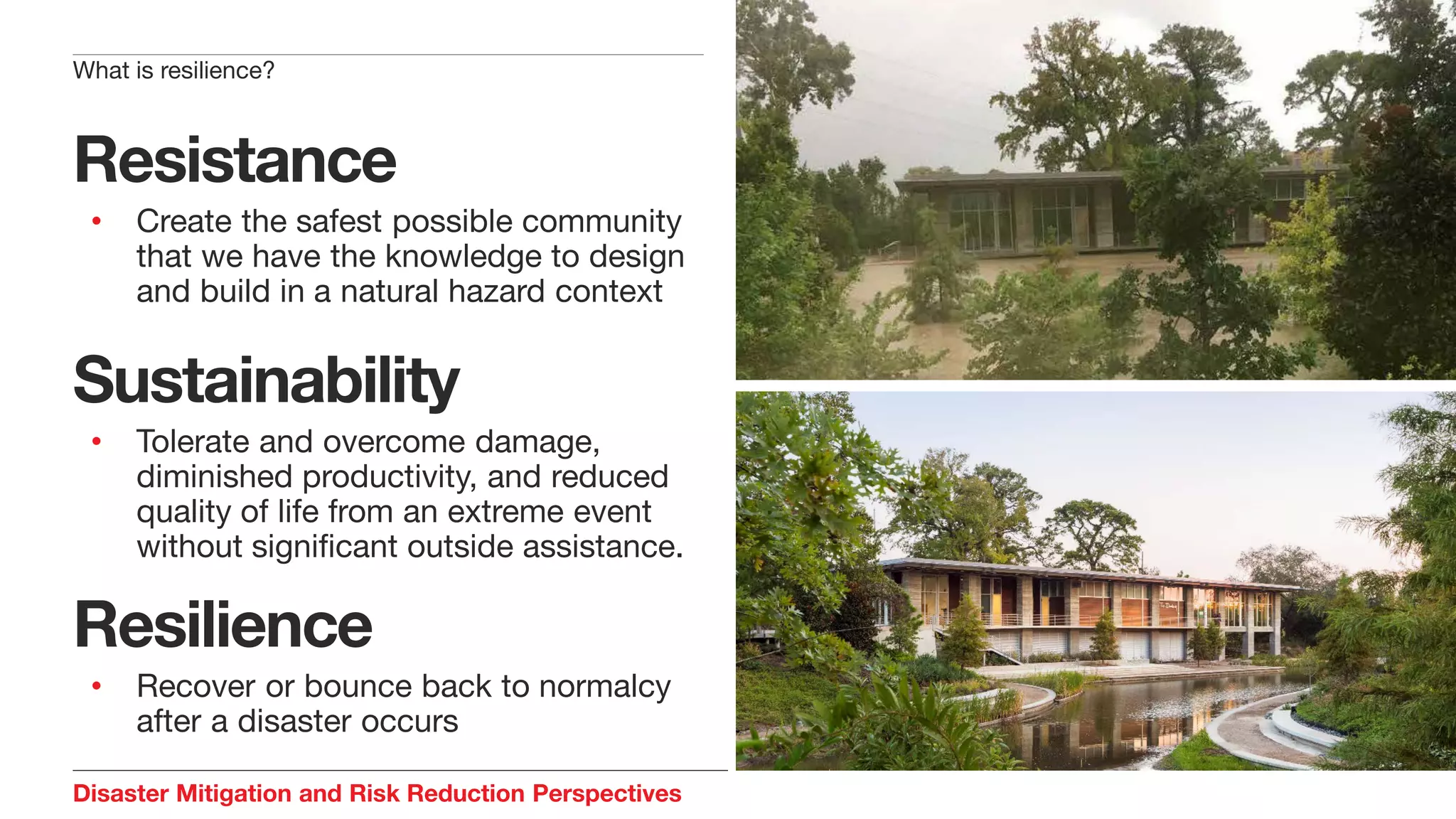
Resistance
• Create the safest possible community
that we have the knowledge to design
and build in a natural hazard context
Sustainability
• Tolerate and overcome damage,
diminished productivity, and reduced
quality of life from an extreme event
without significant outside assistance.
Resilience
• Recover or bounce back to normalcy
after a disaster occurs
What is resilience?
Mamoudou Gassama “Mali Spiderman”
Disaster Mitigation and Risk Reduction Perspectives
What is resilience?
Center for Research on the Epidemiology of Disasters
Shift focus from
Post-Disaster
Improvisation
towards
Pre-Disaster
Preparedness
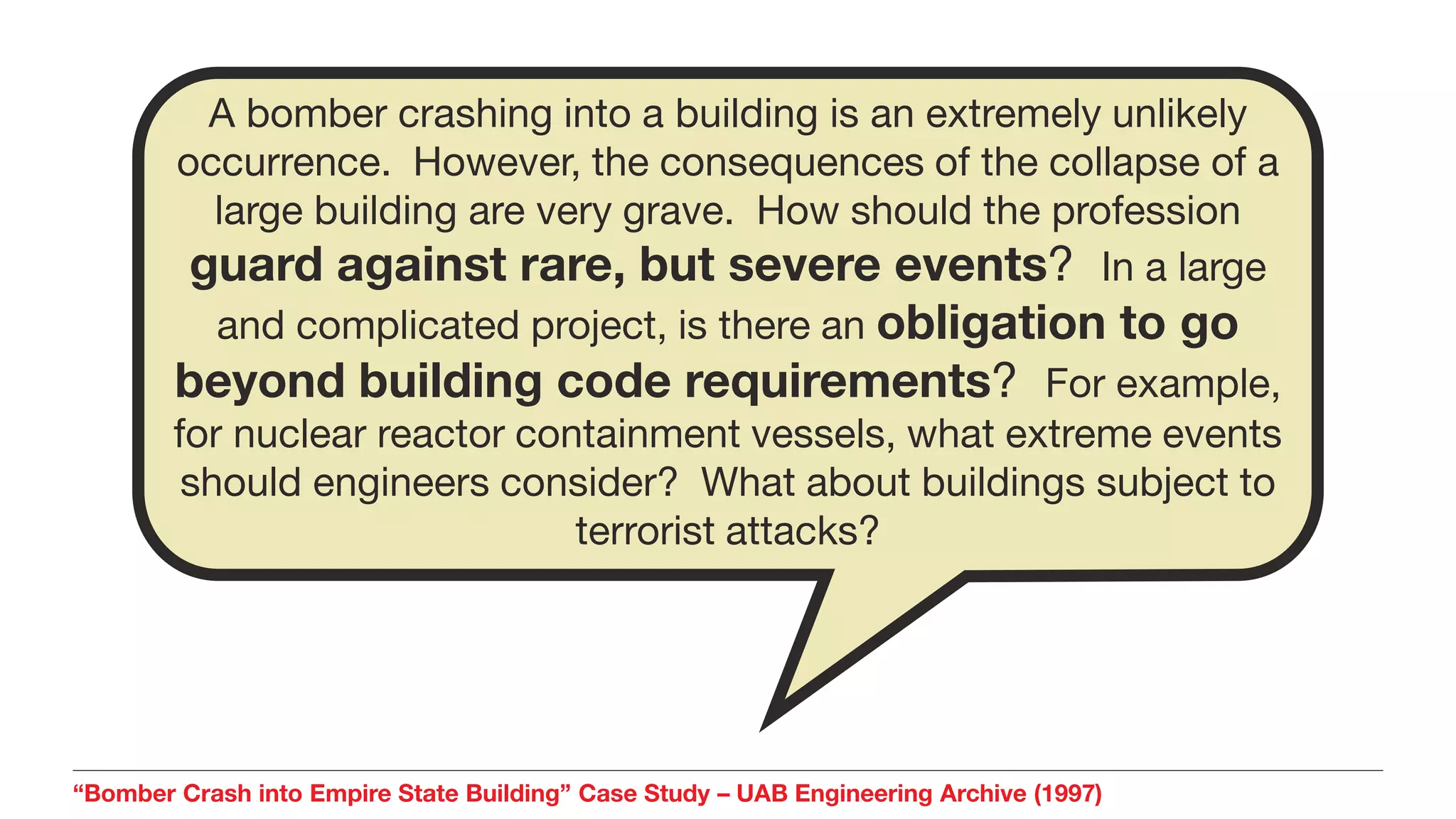
“Bomber Crash into Empire State Building” Case Study – UAB Engineering Archive (1997)
A bomber crashing into a building is an extremely unlikely
occurrence. However, the consequences of the collapse of a
large building are very grave. How should the profession
guard against rare, but severe events? In a large
and complicated project, is there an obligation to go
beyond building code requirements? For example,
for nuclear reactor containment vessels, what extreme events
should engineers consider? What about buildings subject to
terrorist attacks?
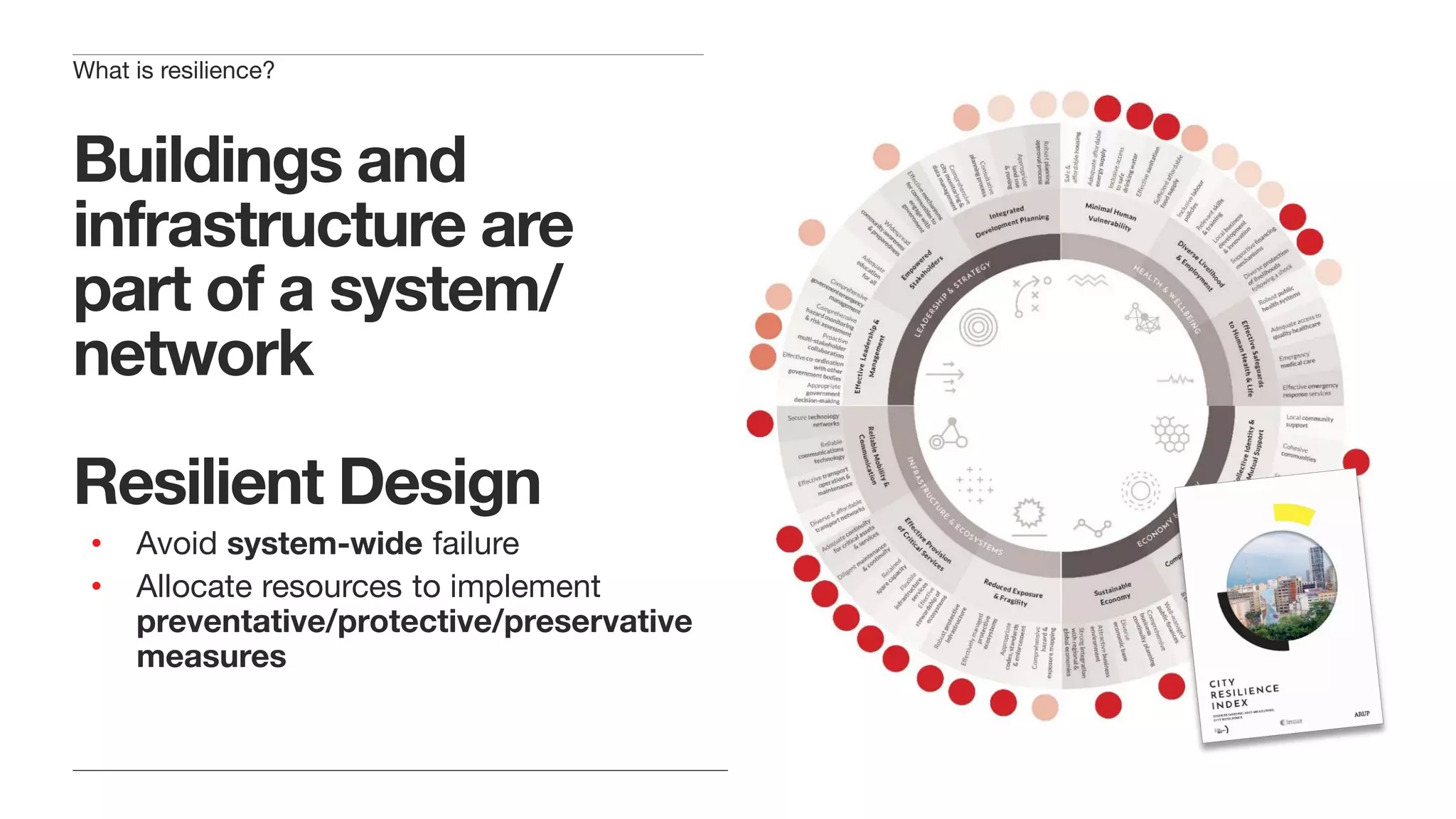
Buildings and
infrastructure are
part of a system/
network
Resilient Design
• Avoid system-wide failure
• Allocate resources to implement
preventative/protective/preservative
measures
What is resilience?
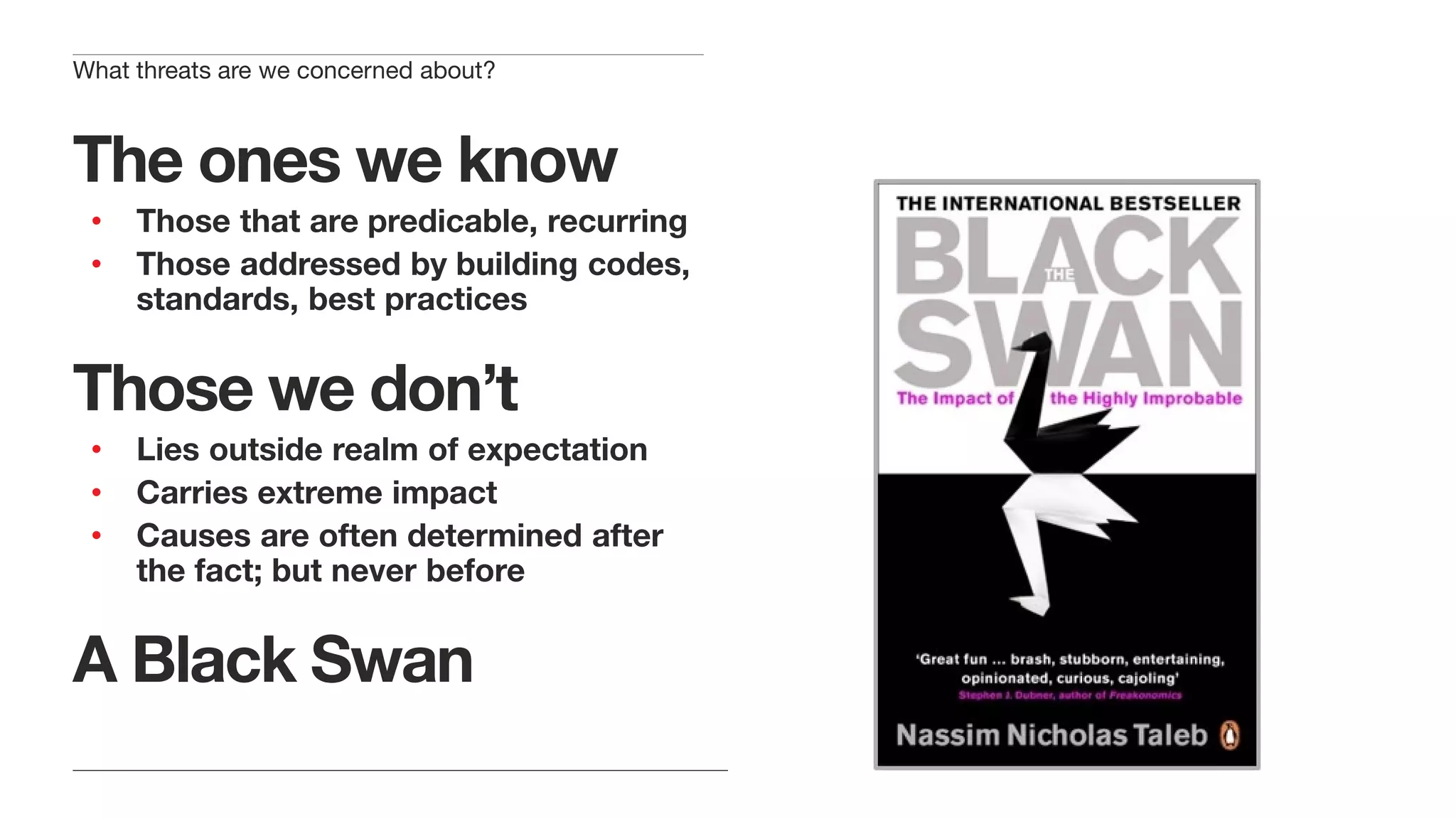
The ones we know
• Those that are predicable, recurring
• Those addressed by building codes,
standards, best practices
Those we don’t
• Lies outside realm of expectation
• Carries extreme impact
• Causes are often determined after
the fact; but never before
A Black Swan
What threats are we concerned about?
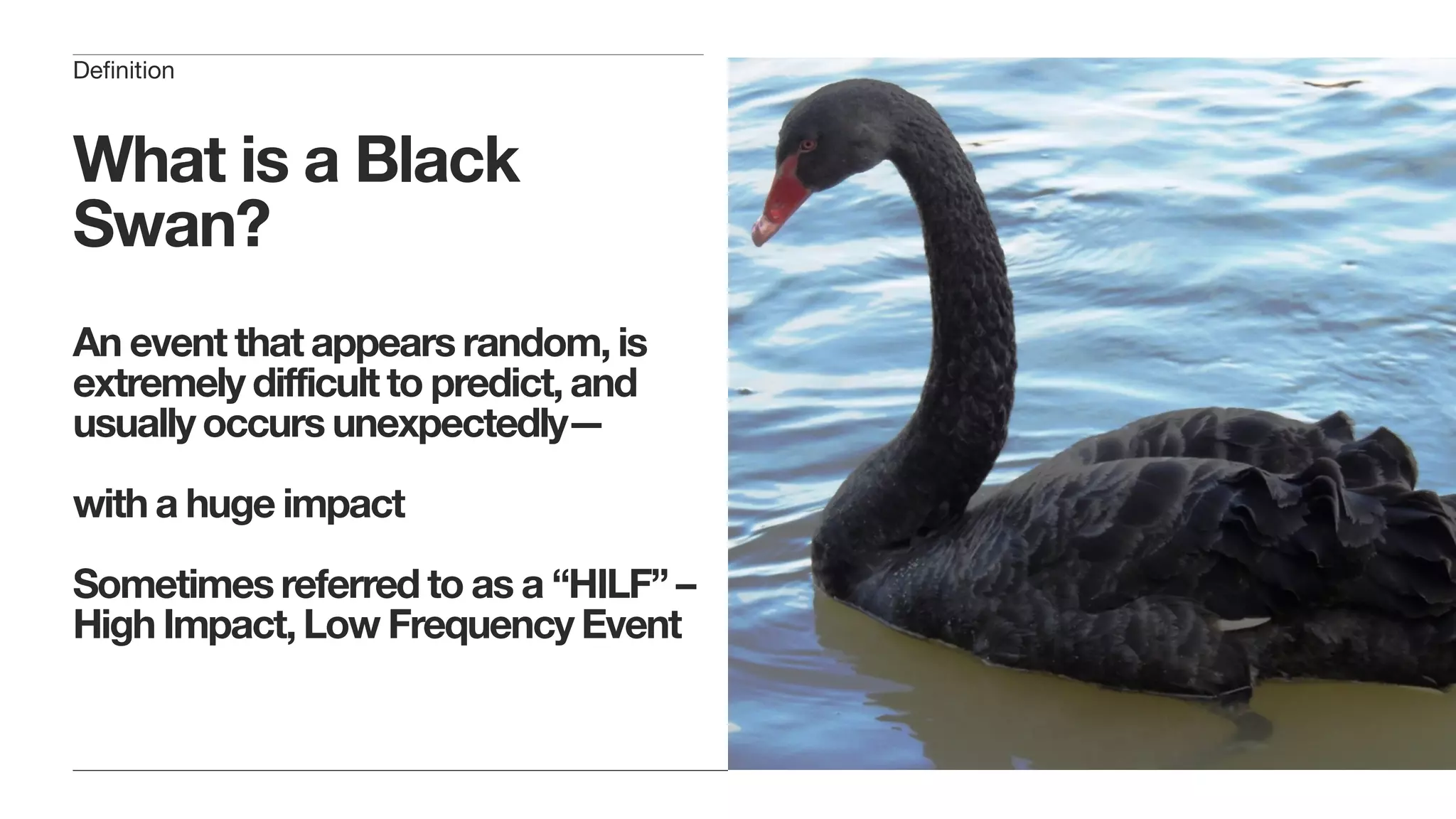
What is a Black
Swan?
An event that appears random, is
extremely difficult to predict, and
usually occurs unexpectedly—
with a huge impact
Sometimes referred to as a “HILF” –
High Impact, Low Frequency Event
Definition
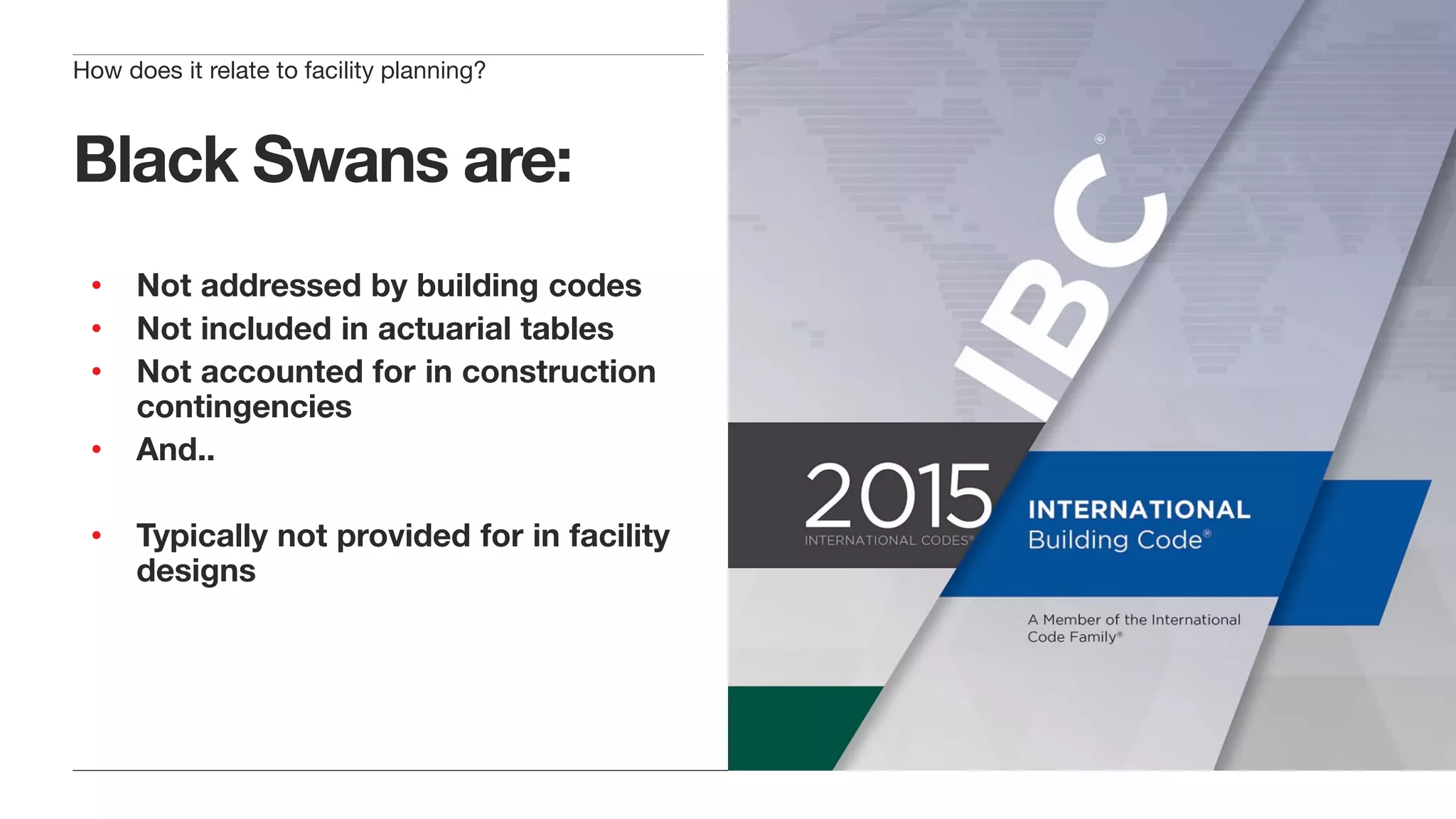
Black Swans are:
• Not addressed by building codes
• Not included in actuarial tables
• Not accounted for in construction
contingencies
• And..
• Typically not provided for in facility
designs
How does it relate to facility planning?
HIGH
NATURAL
MAN-MADE
RISK MATRIX
FOR
INFRASTRUCTURE
EXISTENTIAL
THREAT
LOW
HIGHLOW
FREQUENCY/LIKELIHOOD
SEVERE HURRICANE
WIND/FLOOD
NATIONWIDE
DISASTER
LOCALIZED
DISASTER
ORDINARY
HAZARDS
LIGHTNING STRIKE
POTENTIALIMPACT
BLACK
SWAN
EARTHQUAKE
VOLCANO
ISOLATED
TERRORISM
CYBER ATTACK
PROPERTY
CRIMES
PROLONGED NUCLEAR
CONFLICT
ASTEROID
STRIKE
CARRINGTON
SCALE SOLAR STORM
COORDINATED
TERRORIST ATTACK
YELLOWSTONE SUPERVOLCANO
ERUPTION ROGUE STATE
EMP ATTACK
BUILDING
FIRES
FOREST/REGIONAL
FIRES
AIRLINER
CRASH
METEOR STRIKE
MAJOR
STRUCTURAL FAILURE
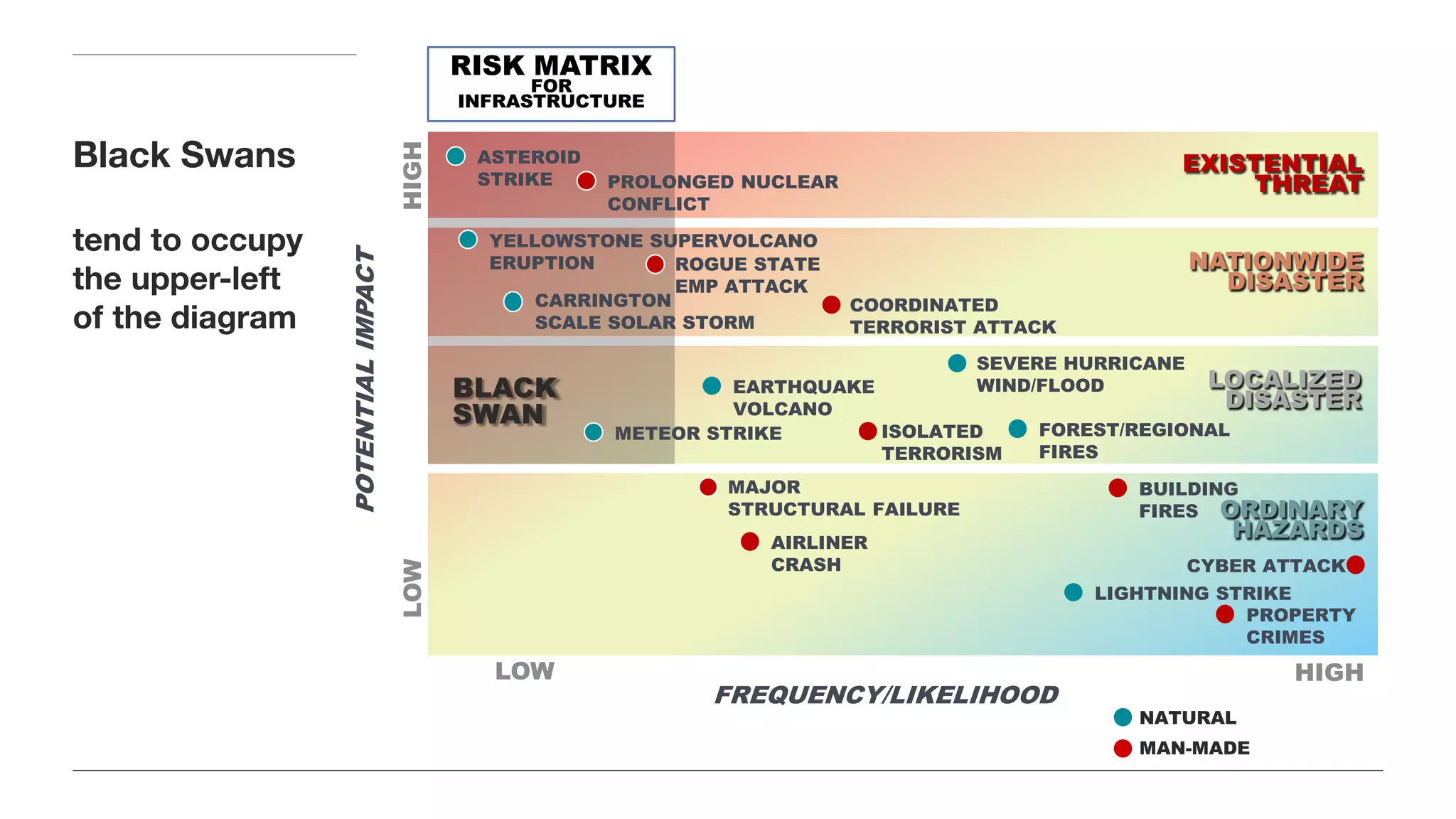
Black Swans
tend to occupy
the upper-left
of the diagram
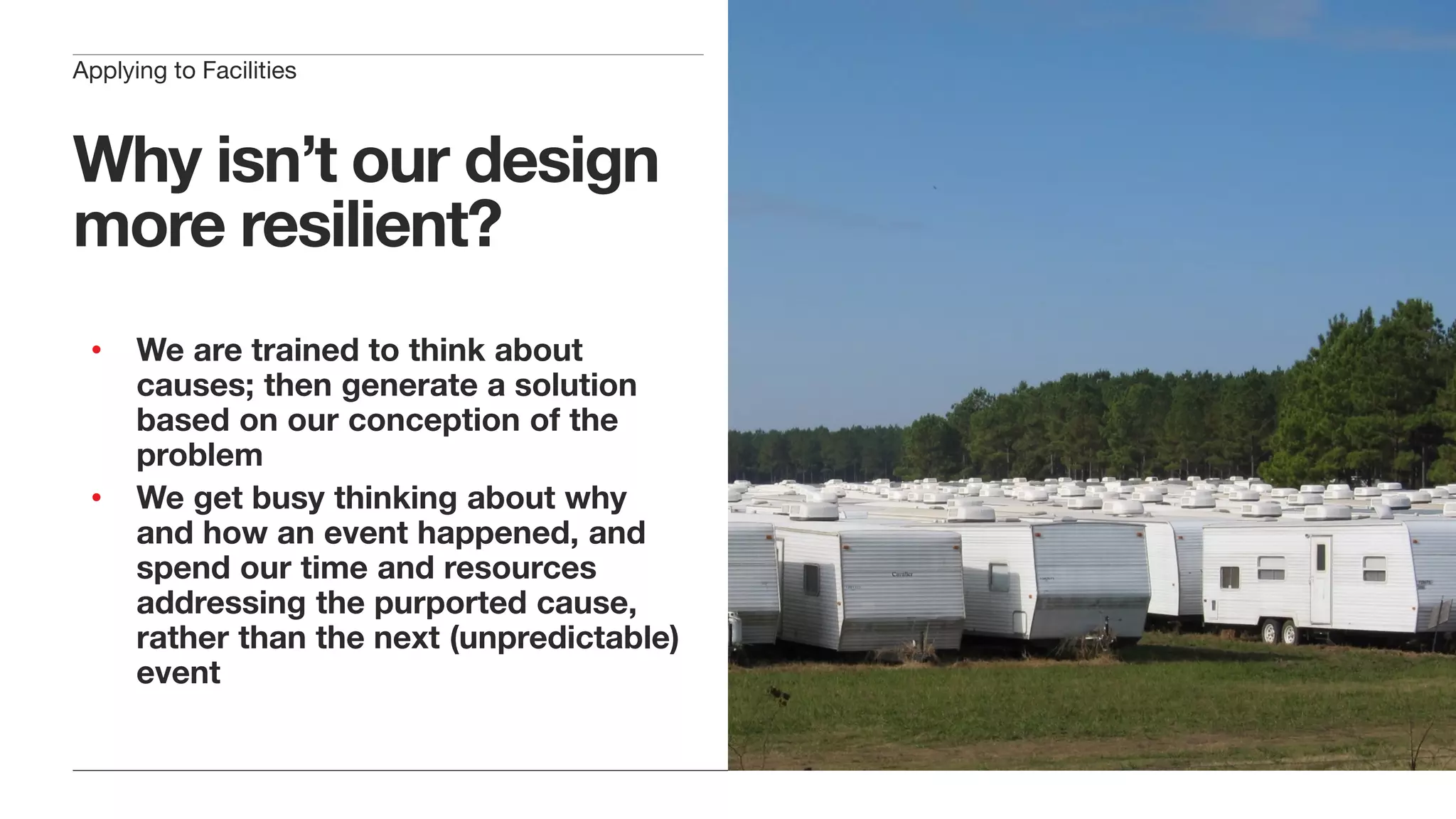
Why isn’t our design
more resilient?
• We are trained to think about
causes; then generate a solution
based on our conception of the
problem
• We get busy thinking about why
and how an event happened, and
spend our time and resources
addressing the purported cause,
rather than the next (unpredictable)
event
Applying to Facilities
The Solution: General Robustness
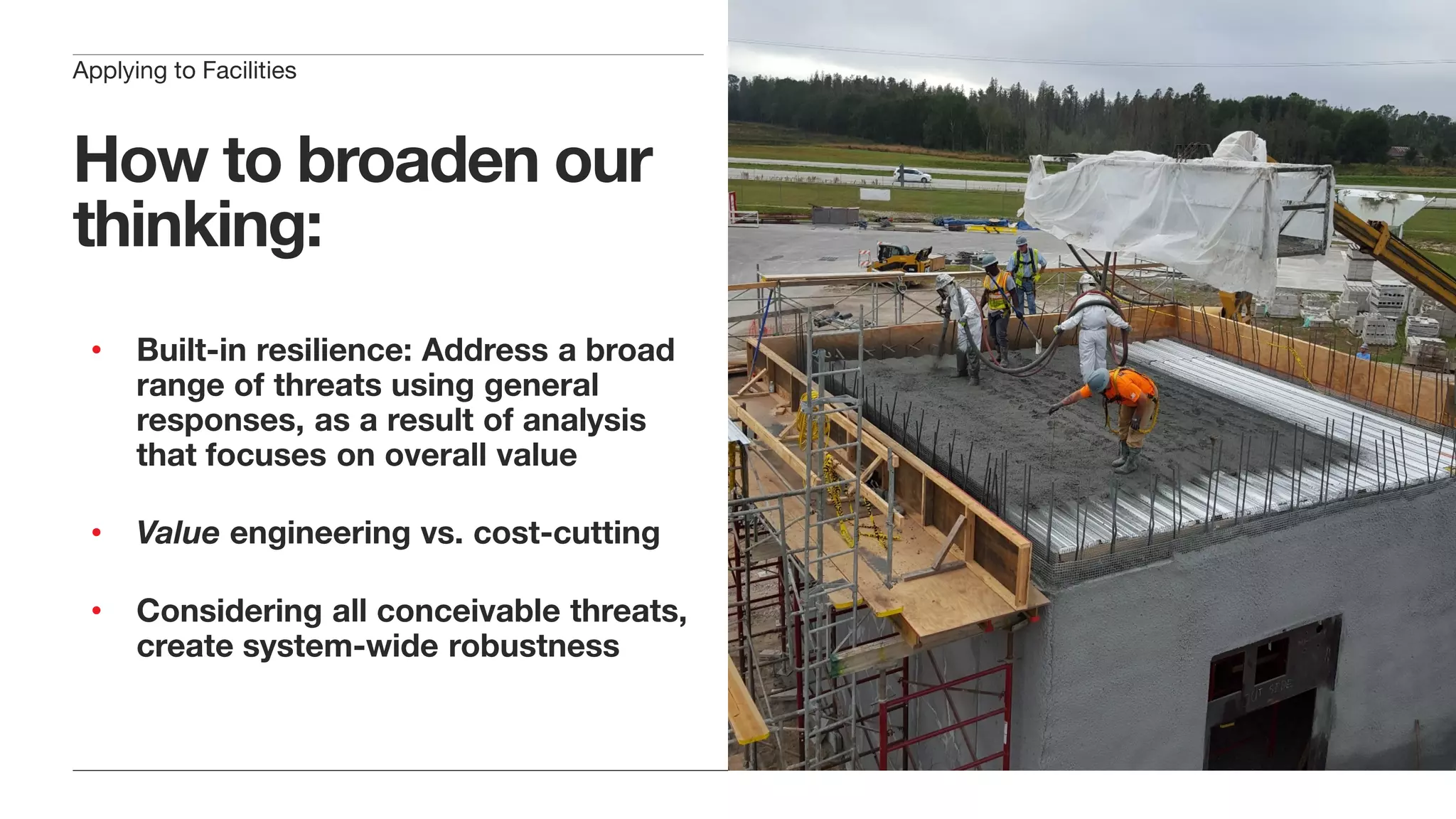
How to broaden our
thinking:
• Built-in resilience: Address a broad
range of threats using general
responses, as a result of analysis
that focuses on overall value
• Value engineering vs. cost-cutting
• Considering all conceivable threats,
create system-wide robustness
Applying to Facilities
approach
method for organizing and prioritizing
how do we define the
problem?
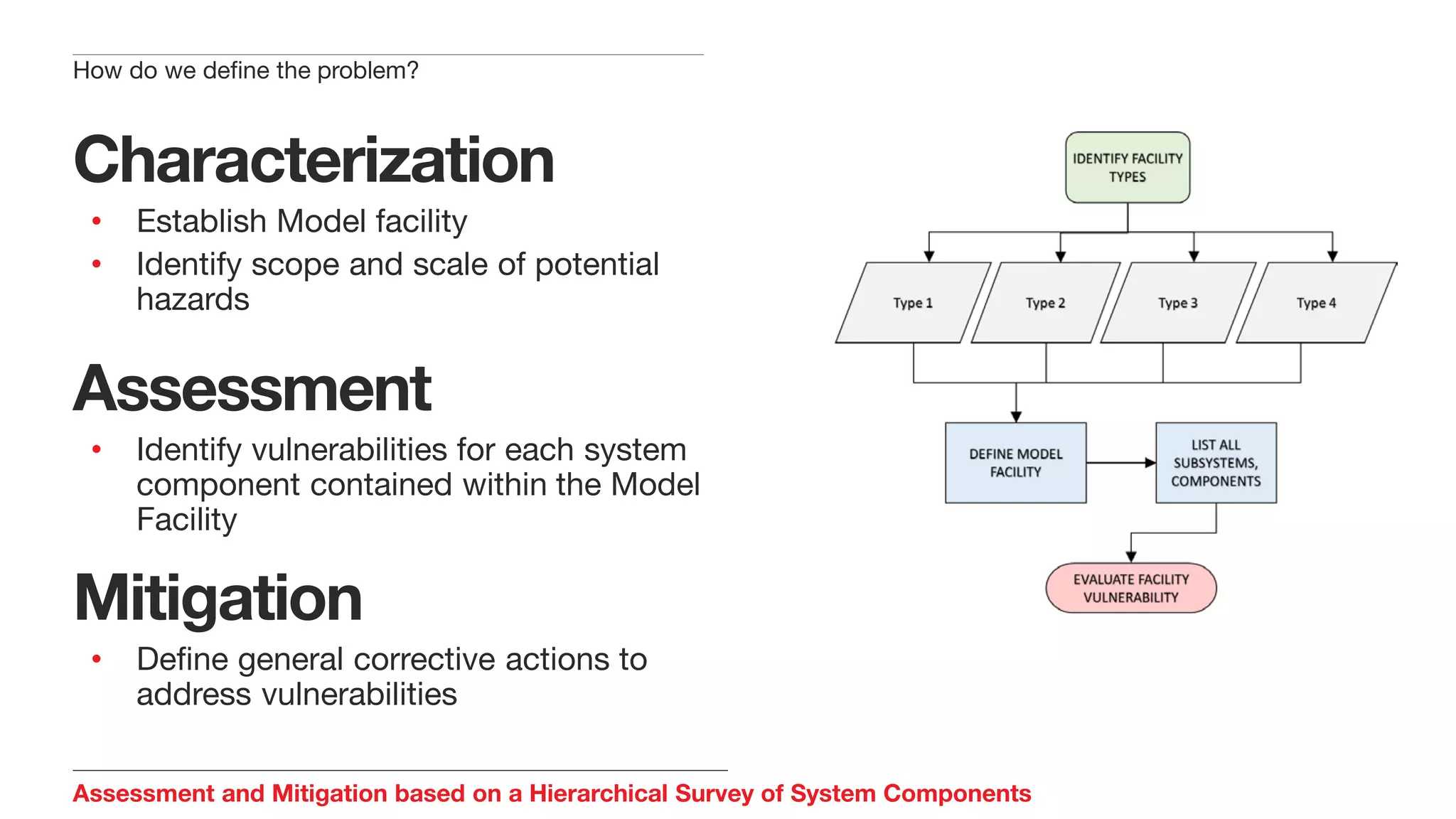
Assessment and Mitigation based on a Hierarchical Survey of System Components
Characterization
• Establish Model facility
• Identify scope and scale of potential
hazards
Assessment
• Identify vulnerabilities for each system
component contained within the Model
Facility
Mitigation
• Define general corrective actions to
address vulnerabilities
How do we define the problem?
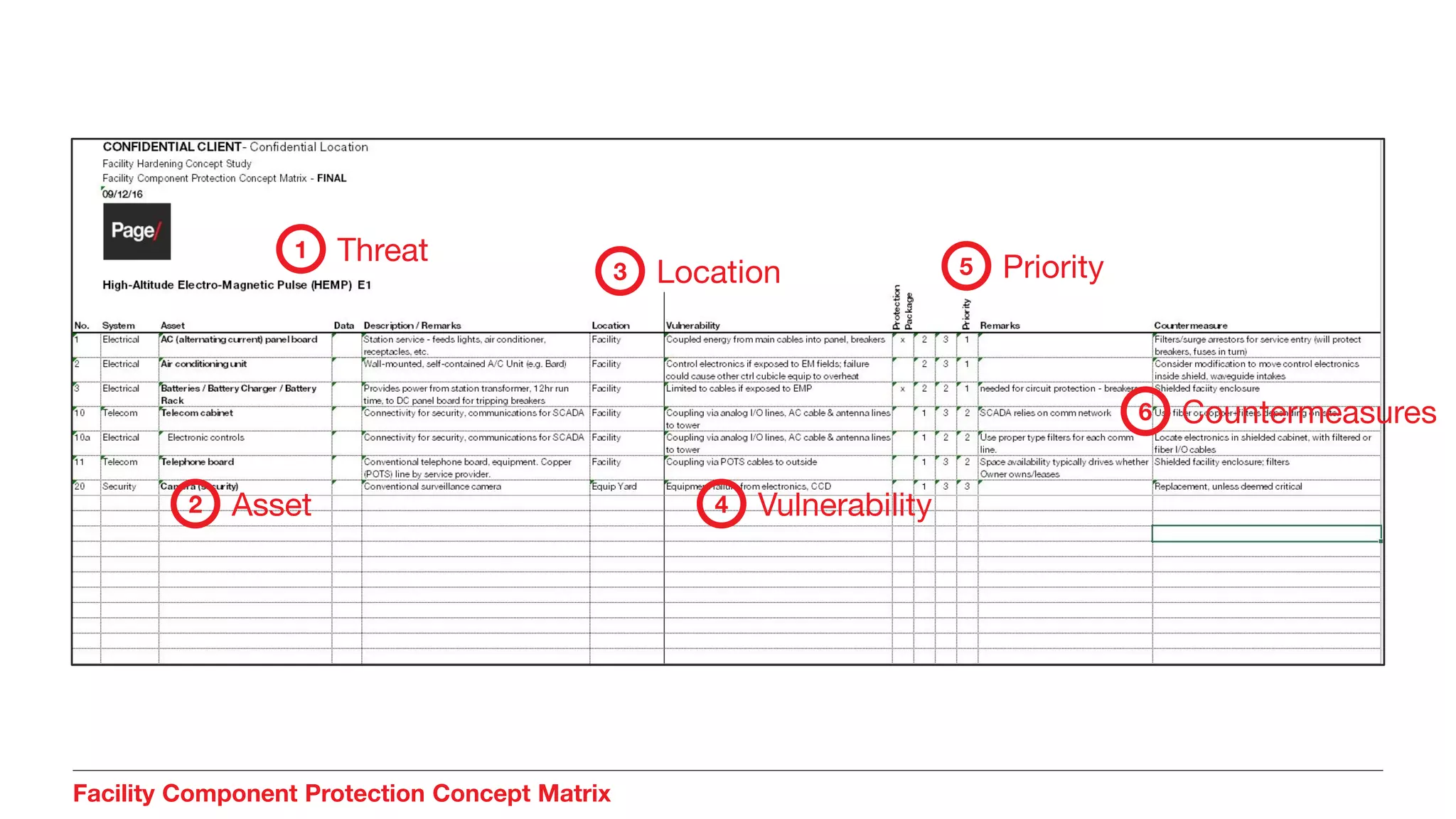
Facility Component Protection Concept Matrix
Threat1
Location3
Vulnerability4
Priority5
Countermeasures6
Asset2
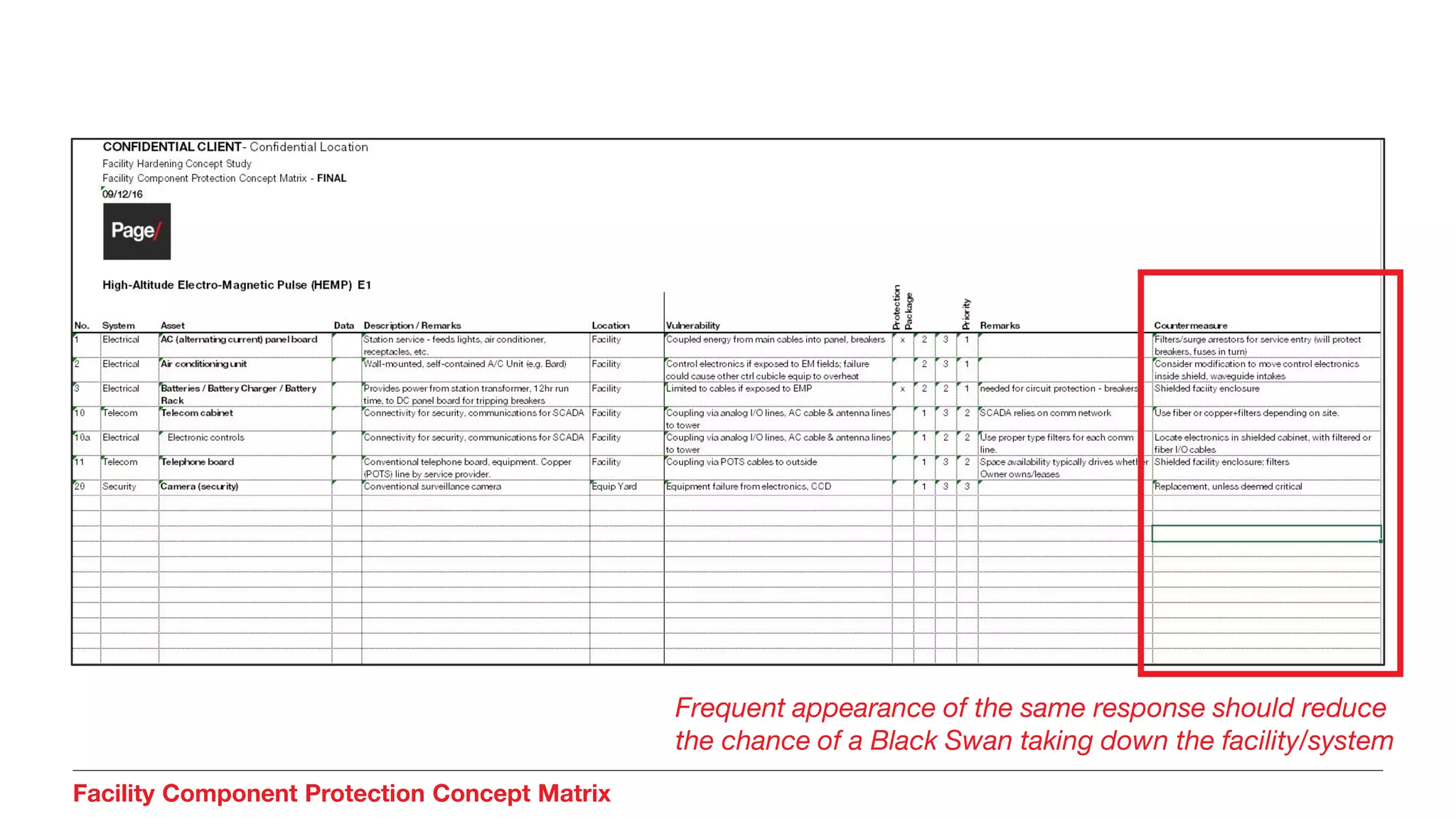
Facility Component Protection Concept Matrix
Frequent appearance of the same response should reduce
the chance of a Black Swan taking down the facility/system
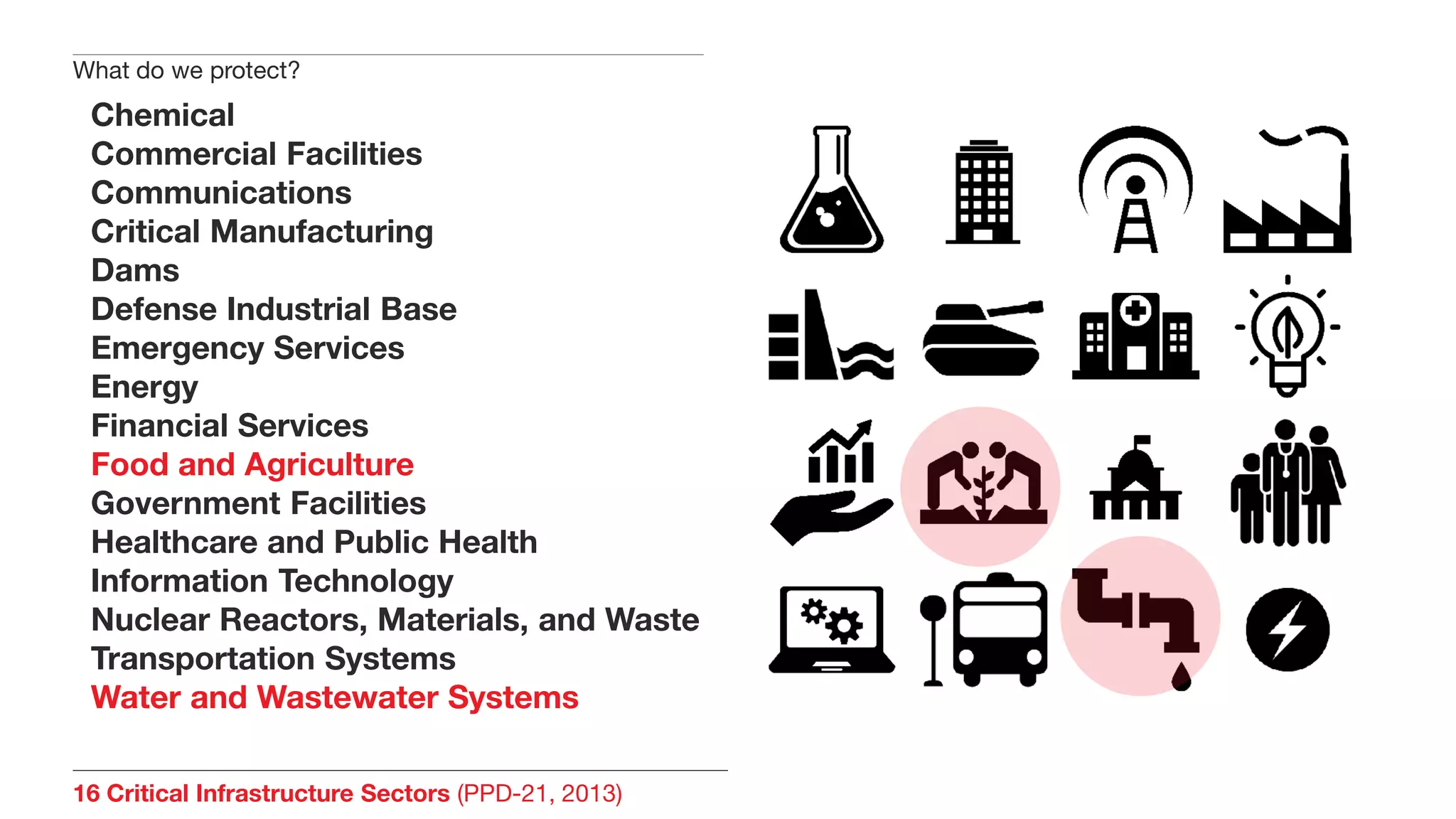
what do we protect?
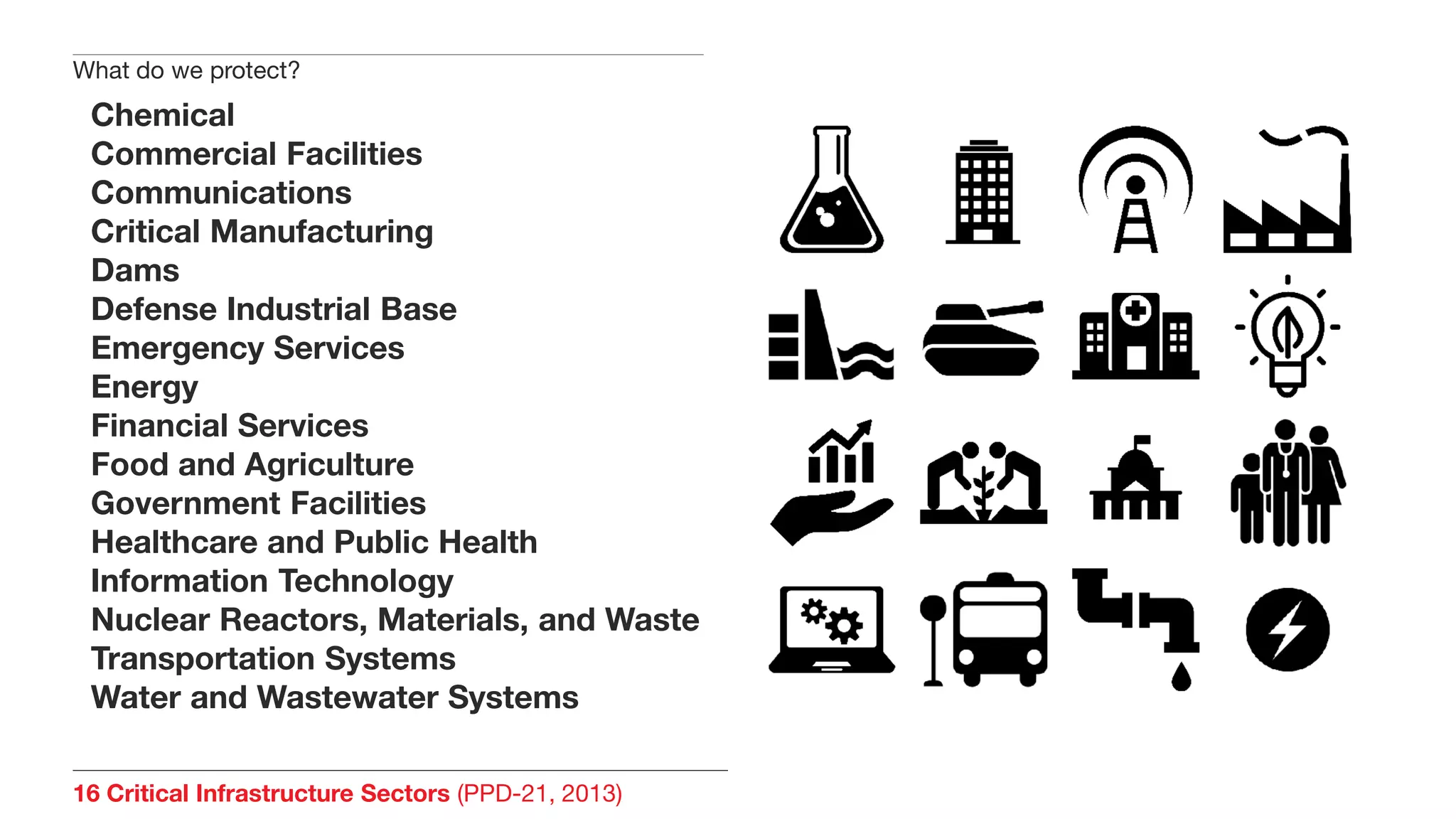
16 Critical Infrastructure Sectors (PPD-21, 2013)
Chemical
Commercial Facilities
Communications
Critical Manufacturing
Dams
Defense Industrial Base
Emergency Services
Energy
Financial Services
Food and Agriculture
Government Facilities
Healthcare and Public Health
Information Technology
Nuclear Reactors, Materials, and Waste
Transportation Systems
Water and Wastewater Systems
What do we protect?
16 Critical Infrastructure Sectors (PPD-21, 2013)
Chemical
Commercial Facilities
Communications
Critical Manufacturing
Dams
Defense Industrial Base
Emergency Services
Energy
Financial Services
Food and Agriculture
Government Facilities
Healthcare and Public Health
Information Technology
Nuclear Reactors, Materials, and Waste
Transportation Systems
Water and Wastewater Systems
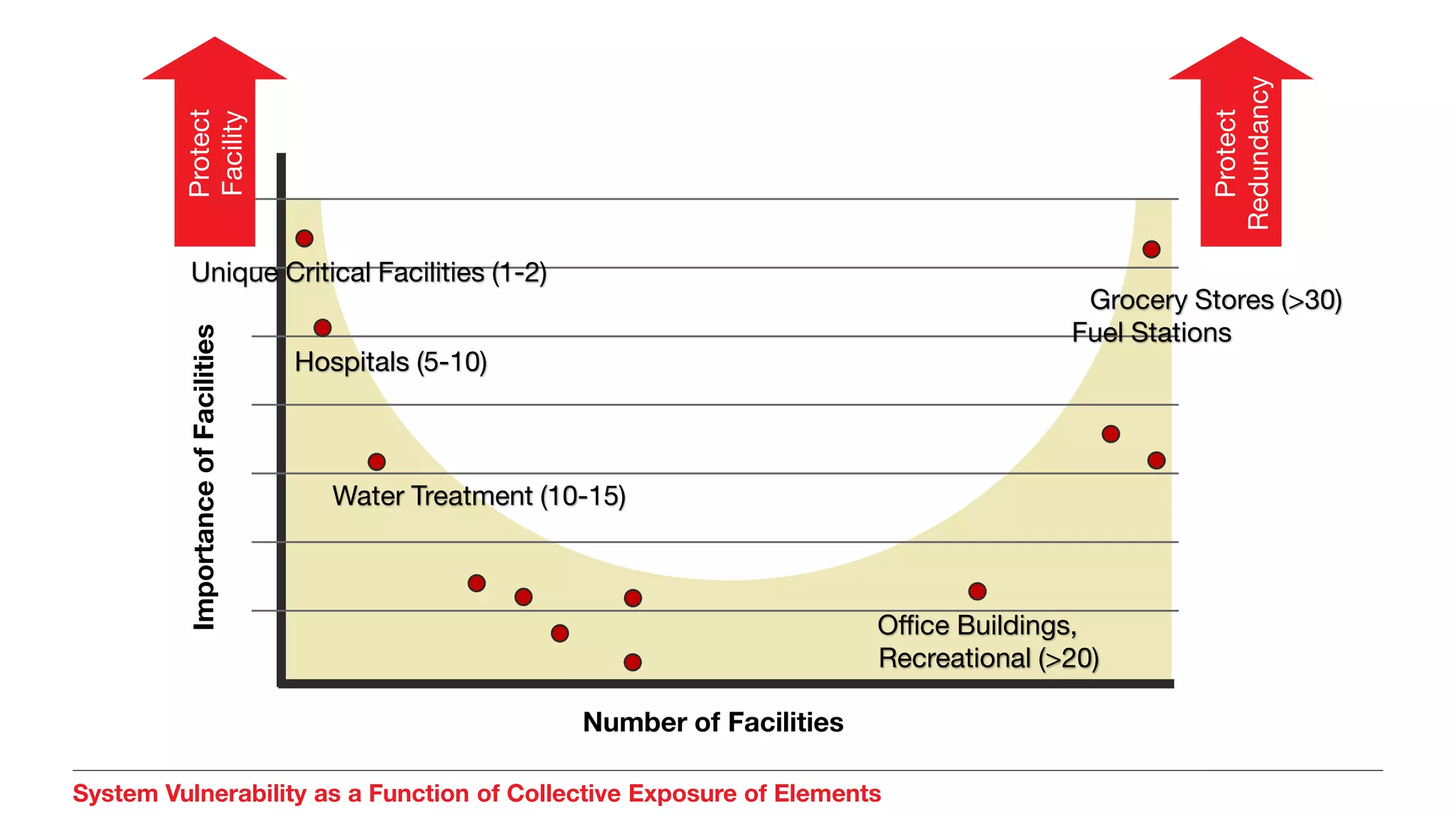
What do we protect?
Unique Critical Facilities (1-2)
Hospitals (5-10)
Water Treatment (10-15)
Office Buildings,
Recreational (>20)
Grocery Stores (>30)
Fuel Stations
Number of Facilities
ImportanceofFacilities
Protect
Redundancy
Protect
Facility
System Vulnerability as a Function of Collective Exposure of Elements
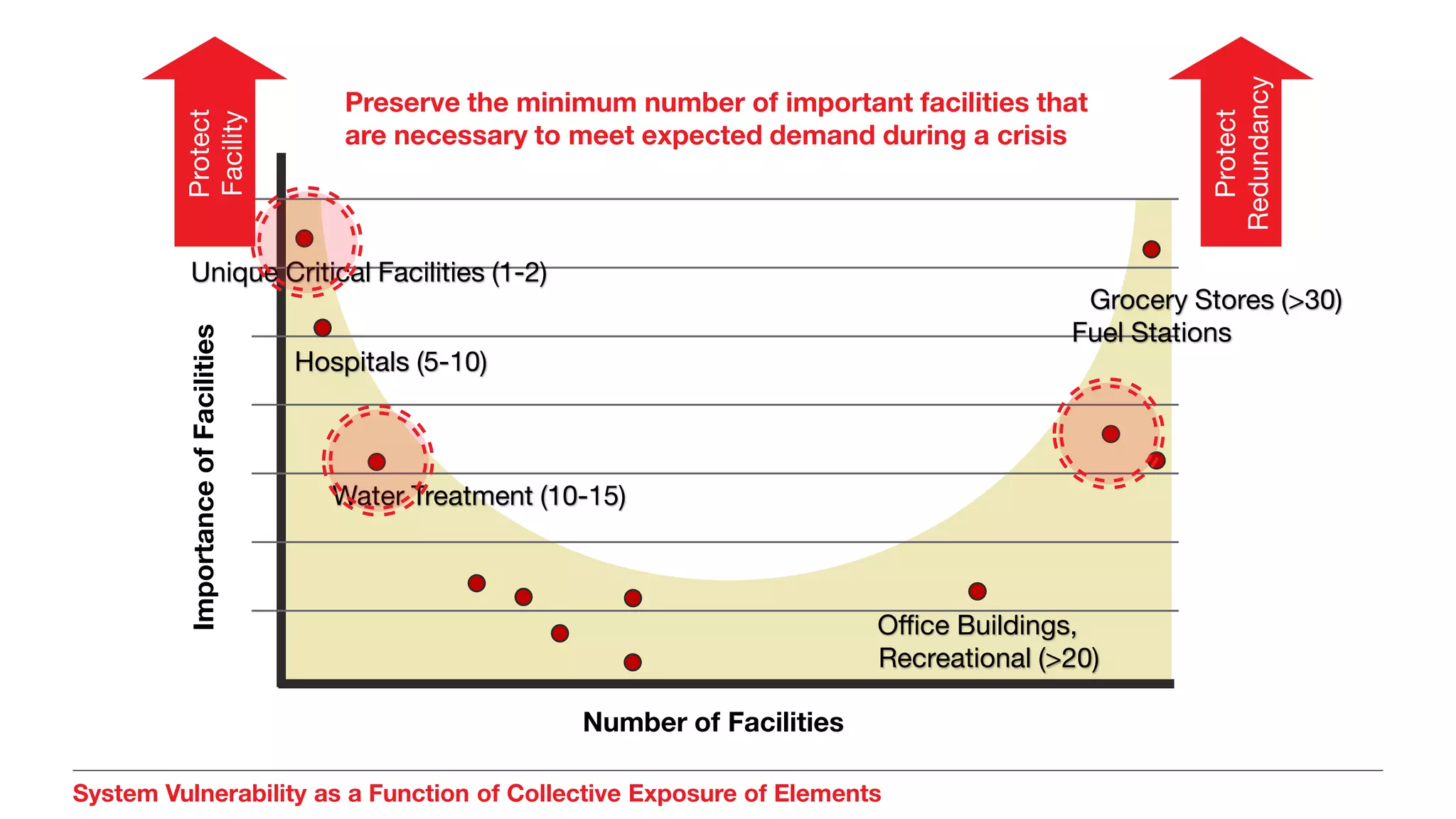
Unique Critical Facilities (1-2)
Hospitals (5-10)
Water Treatment (10-15)
Office Buildings,
Recreational (>20)
Grocery Stores (>30)
Fuel Stations
Number of Facilities
ImportanceofFacilities
Preserve the minimum number of important facilities that
are necessary to meet expected demand during a crisis
Protect
Redundancy
Protect
Facility
System Vulnerability as a Function of Collective Exposure of Elements
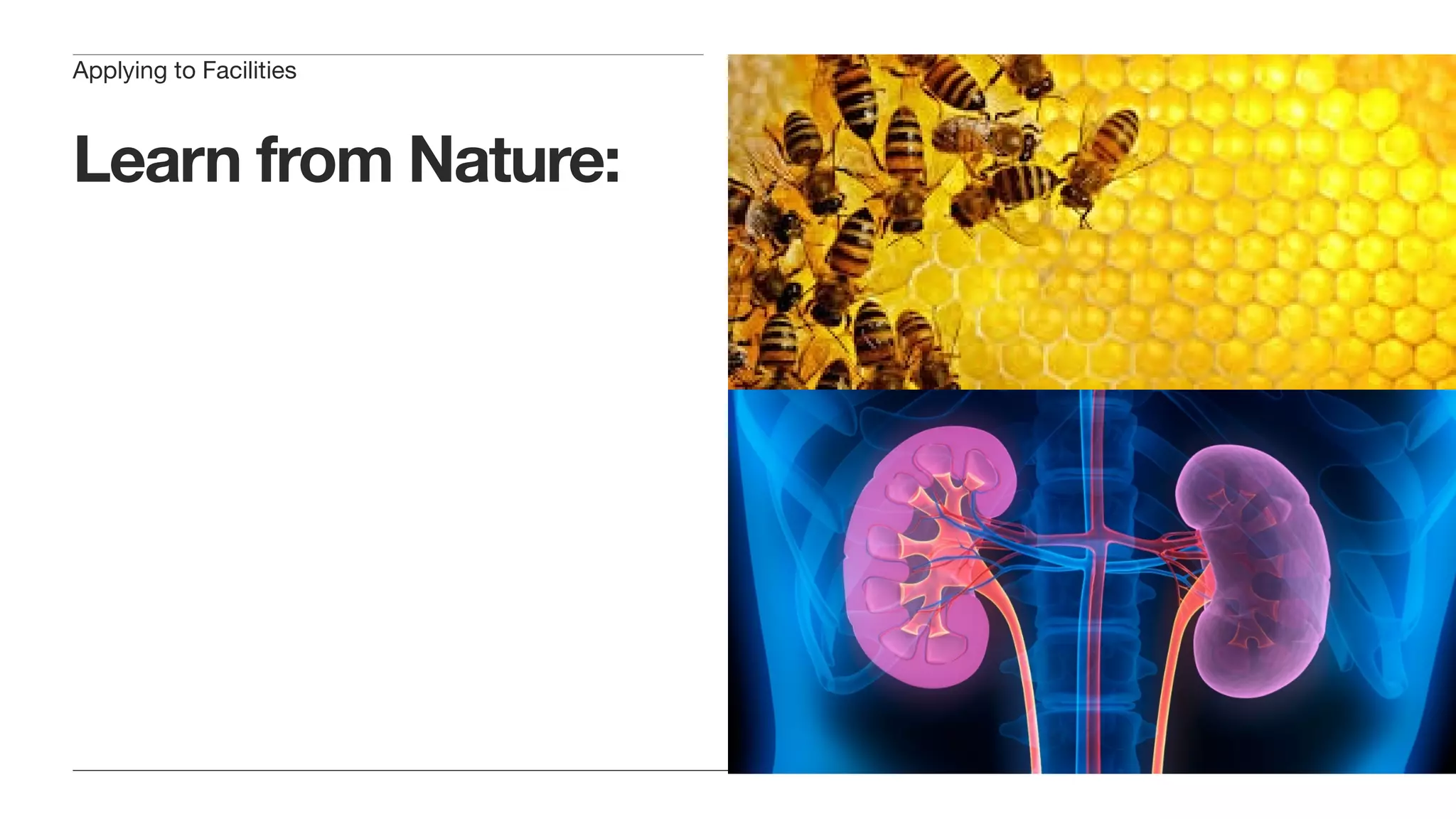
Learn from Nature:
Redundancy = Insurance
Big is Ugly, and Fragile
The other Redundancy: Functional
Redundancy; Multiple-Use
Applying to Facilities
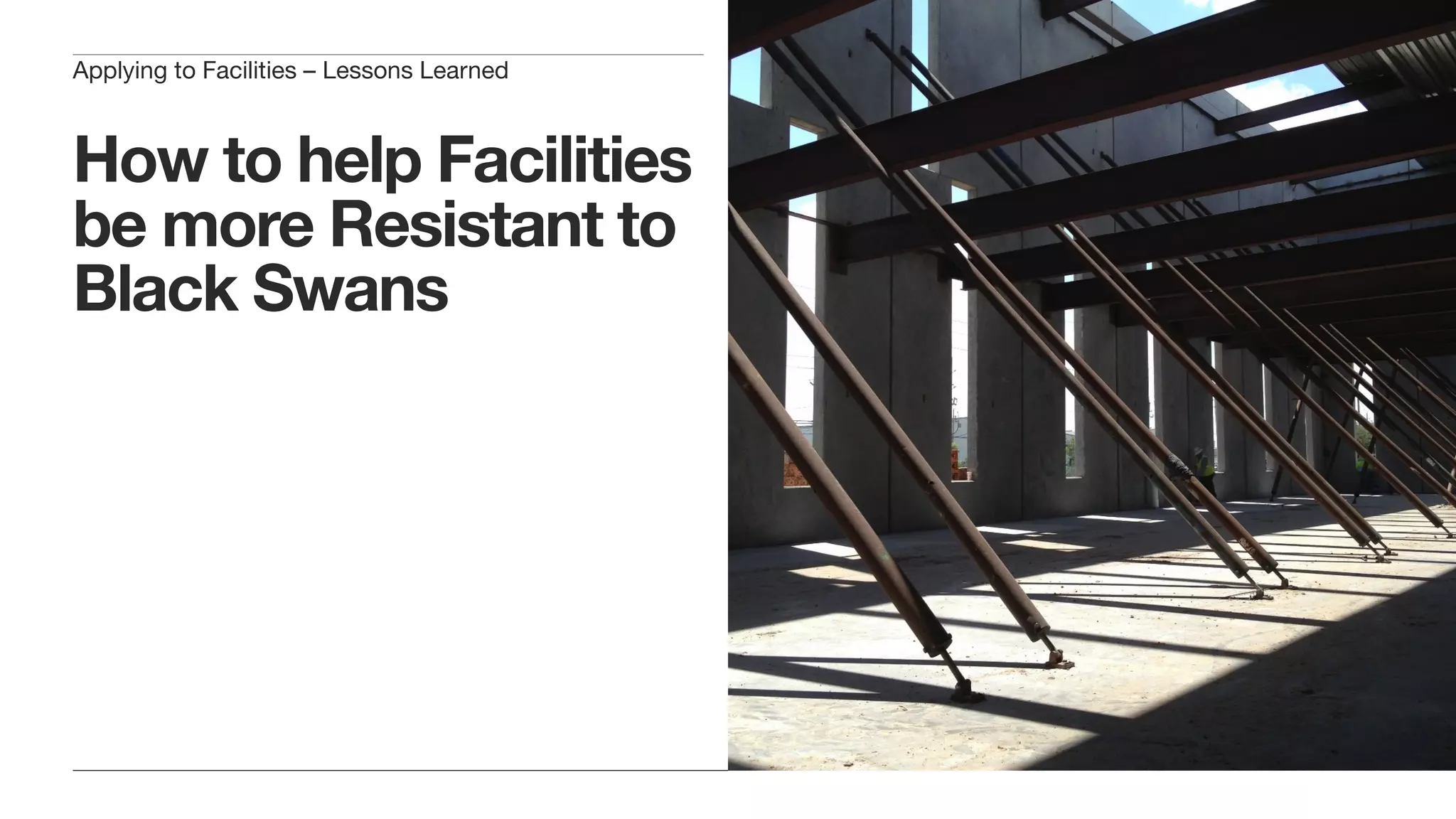
How to help Facilities
be more Resistant to
Black Swans
Why we should overbuild: There are
benefits from overbuilding that can
ultimately increase resiliency
Cumulative effect of many small
improvements
Scale matters
Applying to Facilities – Lessons Learned
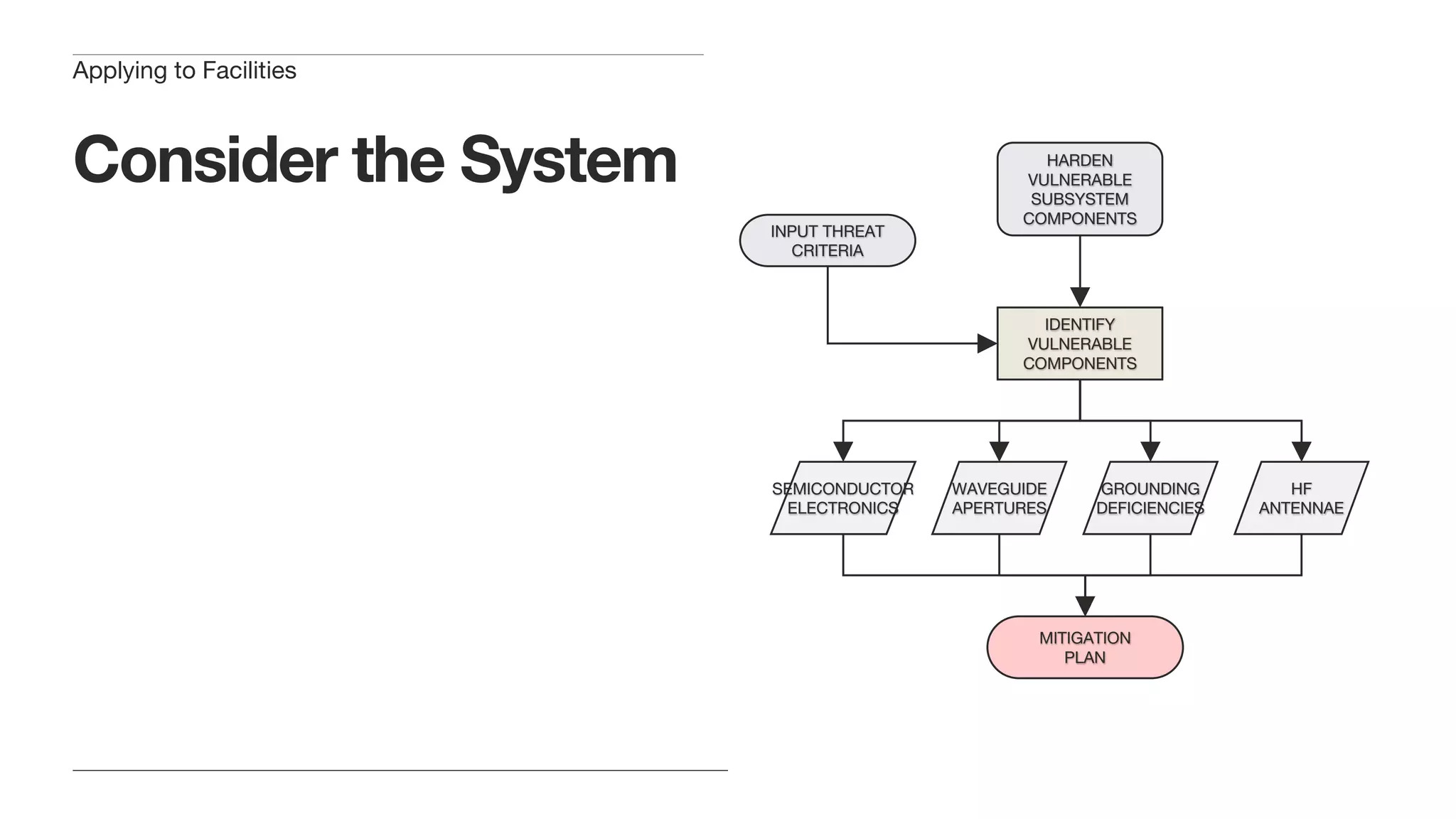
Consider the System
Focus on general vulnerabilities
(system resilience) rather than
specific causes & effects
Provide redundancy in components,
especially dependent components
(redundancy)
“Harden” individual components for
many kinds of threats (functional
redundancy)
Find common solutions for various
threats (resilience)
Applying to Facilities
HARDEN
VULNERABLE
SUBSYSTEM
COMPONENTS
MITIGATION
PLAN
SEMICONDUCTOR
ELECTRONICS
IDENTIFY
VULNERABLE
COMPONENTS
HF
ANTENNAE
GROUNDING
DEFICIENCIES
WAVEGUIDE
APERTURES
INPUT THREAT
CRITERIA
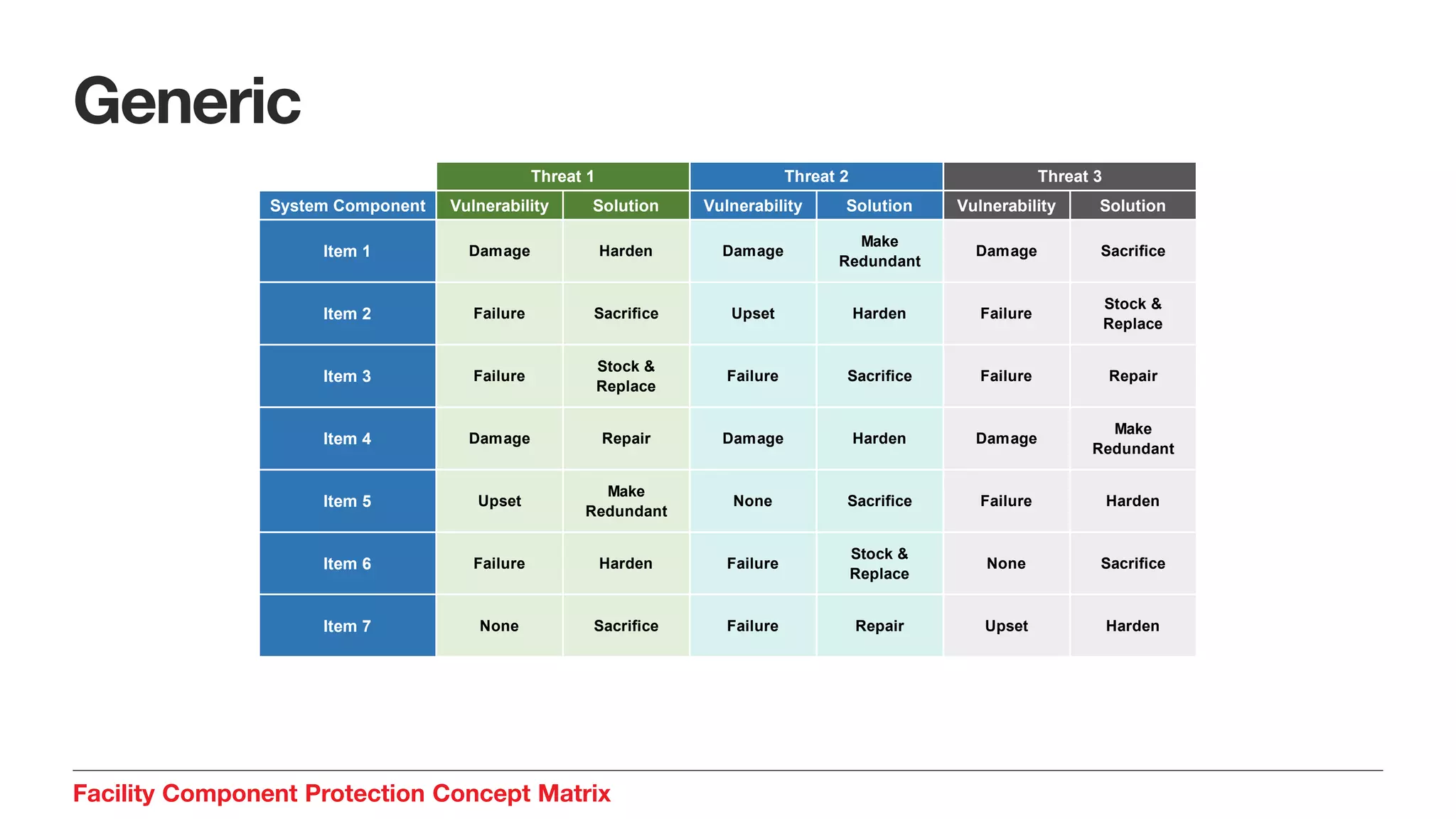
Generic
Facility Component Protection Concept Matrix
System Component Vulnerability Solution Vulnerability Solution Vulnerability Solution
Item 1 Damage Harden Damage
Make
Redundant
Damage Sacrifice
Item 2 Failure Sacrifice Upset Harden Failure
Stock &
Replace
Item 3 Failure
Stock &
Replace
Failure Sacrifice Failure Repair
Item 4 Damage Repair Damage Harden Damage
Make
Redundant
Item 5 Upset
Make
Redundant
None Sacrifice Failure Harden
Item 6 Failure Harden Failure
Stock &
Replace
None Sacrifice
Item 7 None Sacrifice Failure Repair Upset Harden
Threat 1 Threat 2 Threat 3
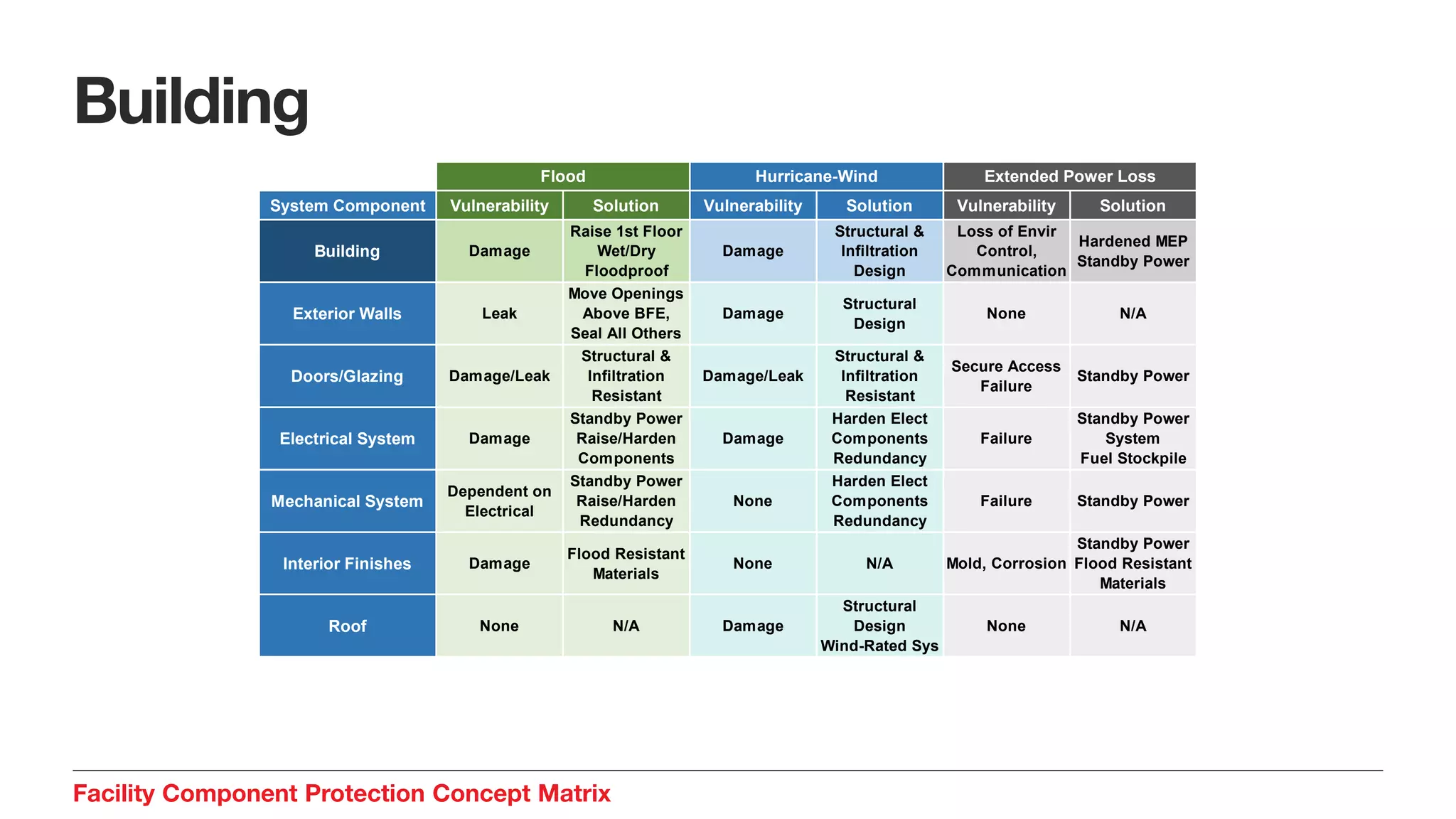
Building
Facility Component Protection Concept Matrix
System Component Vulnerability Solution Vulnerability Solution Vulnerability Solution
Building Damage
Raise 1st Floor
Wet/Dry
Floodproof
Damage
Structural &
Infiltration
Design
Loss of Envir
Control,
Communication
Hardened MEP
Standby Power
Exterior Walls Leak
Move Openings
Above BFE,
Seal All Others
Damage
Structural
Design
None N/A
Doors/Glazing Damage/Leak
Structural &
Infiltration
Resistant
Damage/Leak
Structural &
Infiltration
Resistant
Secure Access
Failure
Standby Power
Electrical System Damage
Standby Power
Raise/Harden
Components
Damage
Harden Elect
Components
Redundancy
Failure
Standby Power
System
Fuel Stockpile
Mechanical System
Dependent on
Electrical
Standby Power
Raise/Harden
Redundancy
None
Harden Elect
Components
Redundancy
Failure Standby Power
Interior Finishes Damage
Flood Resistant
Materials
None N/A Mold, Corrosion
Standby Power
Flood Resistant
Materials
Roof None N/A Damage
Structural
Design
Wind-Rated Sys
None N/A
Flood Hurricane-Wind Extended Power Loss
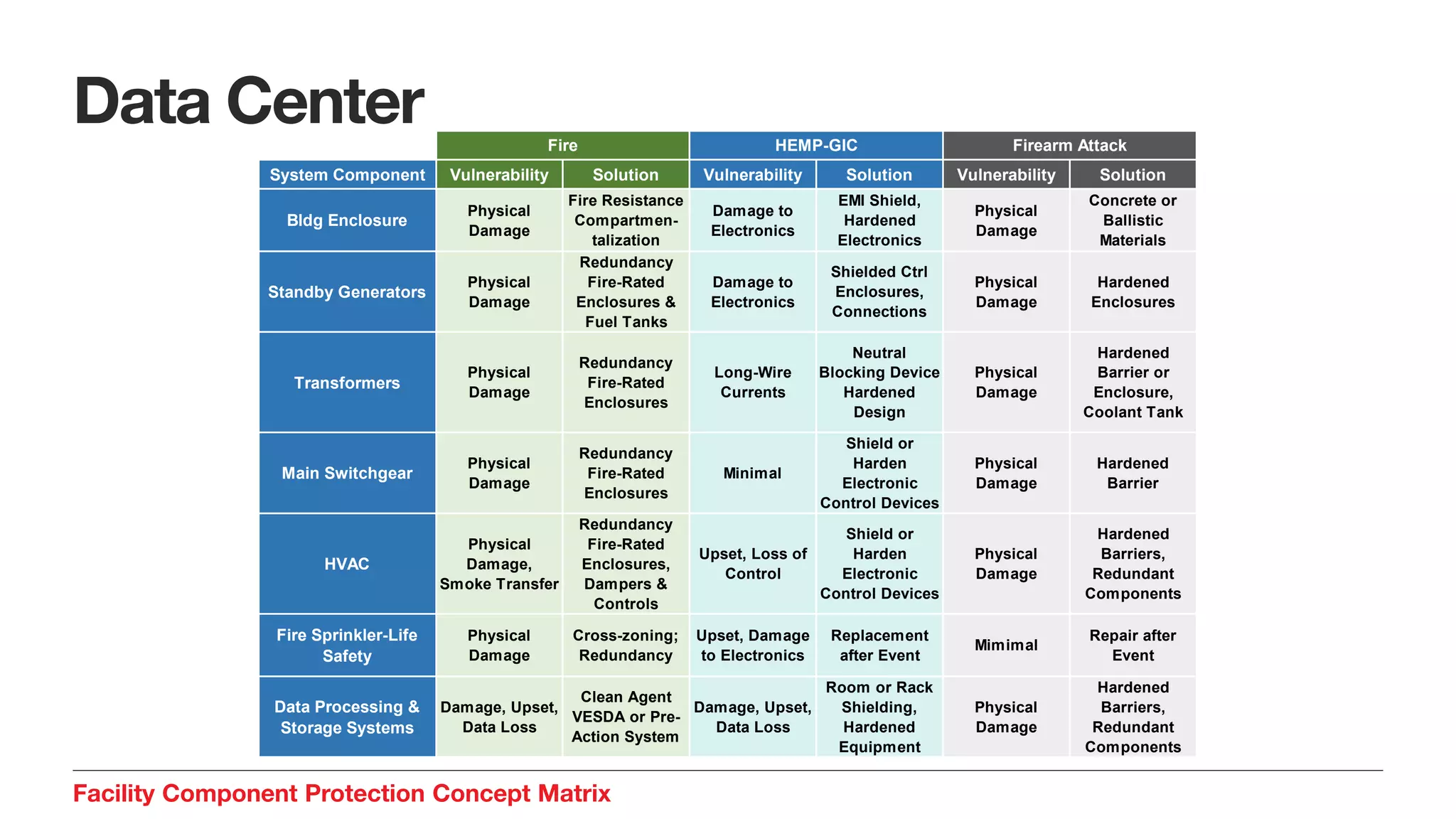
Data Center
Facility Component Protection Concept Matrix
System Component Vulnerability Solution Vulnerability Solution Vulnerability Solution
Bldg Enclosure
Physical
Damage
Fire Resistance
Compartmen-
talization
Damage to
Electronics
EMI Shield,
Hardened
Electronics
Physical
Damage
Concrete or
Ballistic
Materials
Standby Generators
Physical
Damage
Redundancy
Fire-Rated
Enclosures &
Fuel Tanks
Damage to
Electronics
Shielded Ctrl
Enclosures,
Connections
Physical
Damage
Hardened
Enclosures
Transformers
Physical
Damage
Redundancy
Fire-Rated
Enclosures
Long-Wire
Currents
Neutral
Blocking Device
Hardened
Design
Physical
Damage
Hardened
Barrier or
Enclosure,
Coolant Tank
Main Switchgear
Physical
Damage
Redundancy
Fire-Rated
Enclosures
Minimal
Shield or
Harden
Electronic
Control Devices
Physical
Damage
Hardened
Barrier
HVAC
Physical
Damage,
Smoke Transfer
Redundancy
Fire-Rated
Enclosures,
Dampers &
Controls
Upset, Loss of
Control
Shield or
Harden
Electronic
Control Devices
Physical
Damage
Hardened
Barriers,
Redundant
Components
Fire Sprinkler-Life
Safety
Physical
Damage
Cross-zoning;
Redundancy
Upset, Damage
to Electronics
Replacement
after Event
Mimimal
Repair after
Event
Data Processing &
Storage Systems
Damage, Upset,
Data Loss
Clean Agent
VESDA or Pre-
Action System
Damage, Upset,
Data Loss
Room or Rack
Shielding,
Hardened
Equipment
Physical
Damage
Hardened
Barriers,
Redundant
Components
Fire HEMP-GIC Firearm Attack
illustrations
general robustness
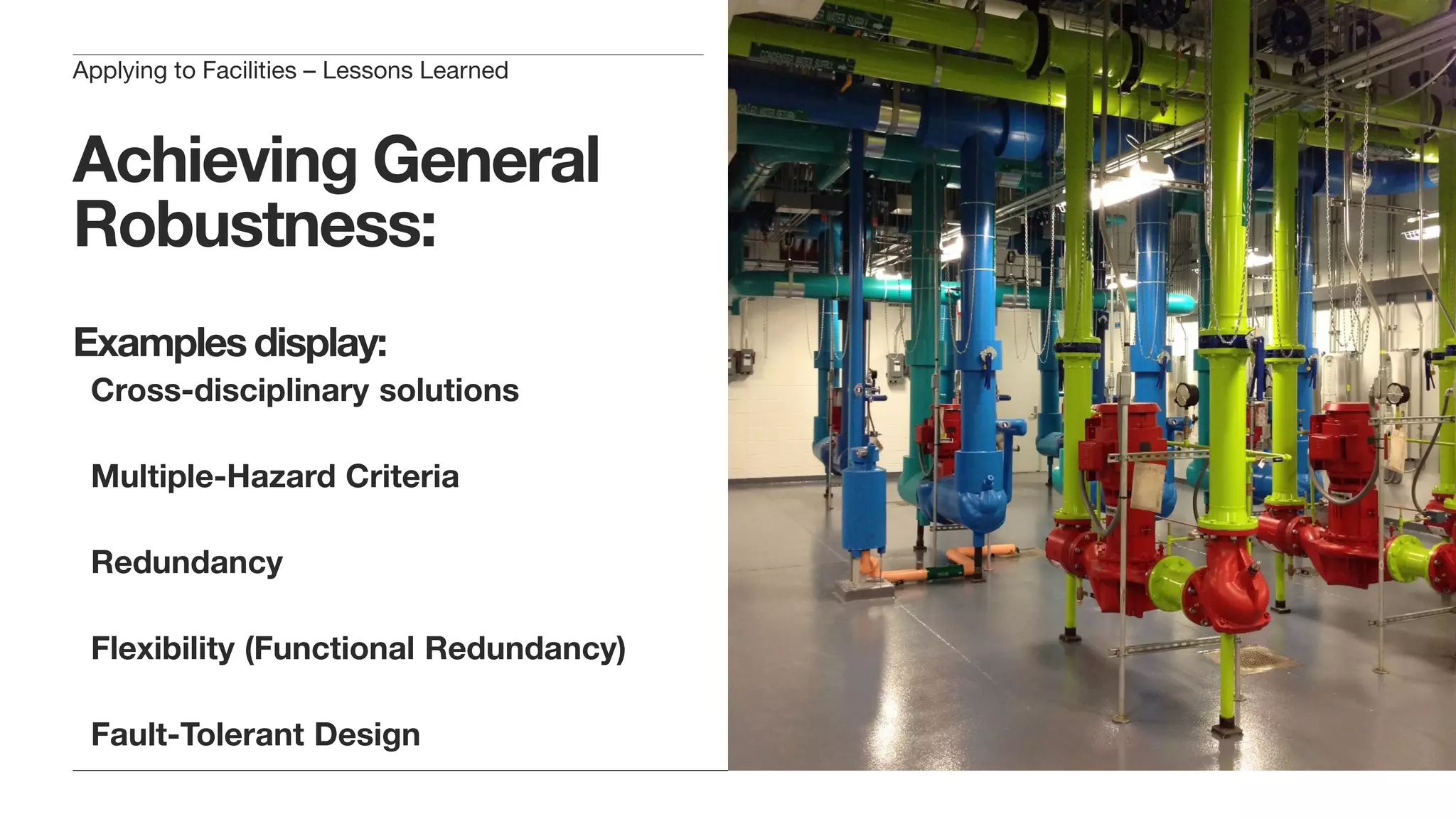
Achieving General
Robustness:
Examples display:
Cross-disciplinary solutions
Multiple-Hazard Criteria
Redundancy
Flexibility (Functional Redundancy)
Fault-Tolerant Design
Applying to Facilities – Lessons Learned
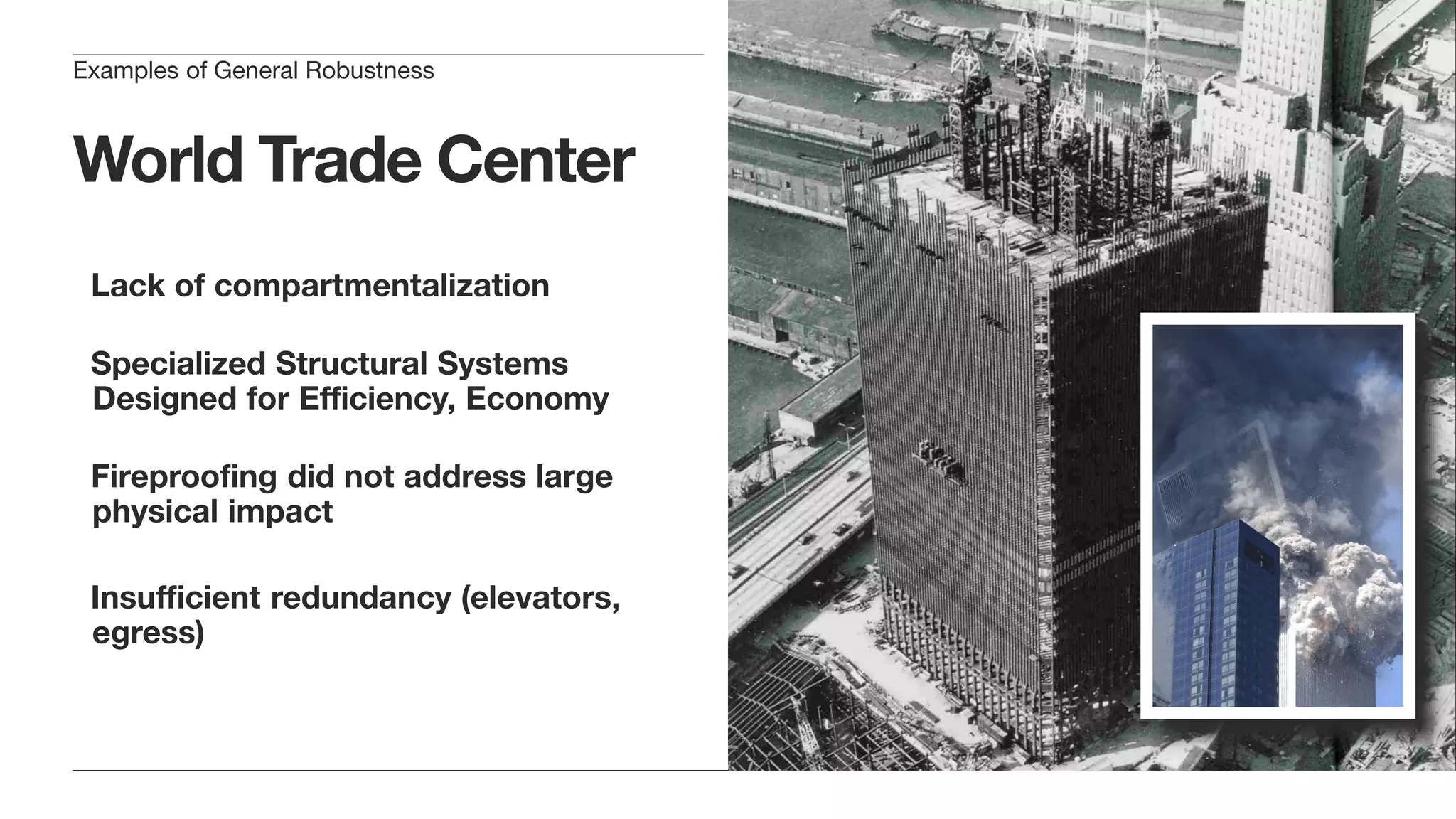
World Trade Center
Lack of compartmentalization
Specialized Structural Systems
Designed for Efficiency, Economy
Fireproofing did not address large
physical impact
Insufficient redundancy (elevators,
egress)
Examples of General Robustness
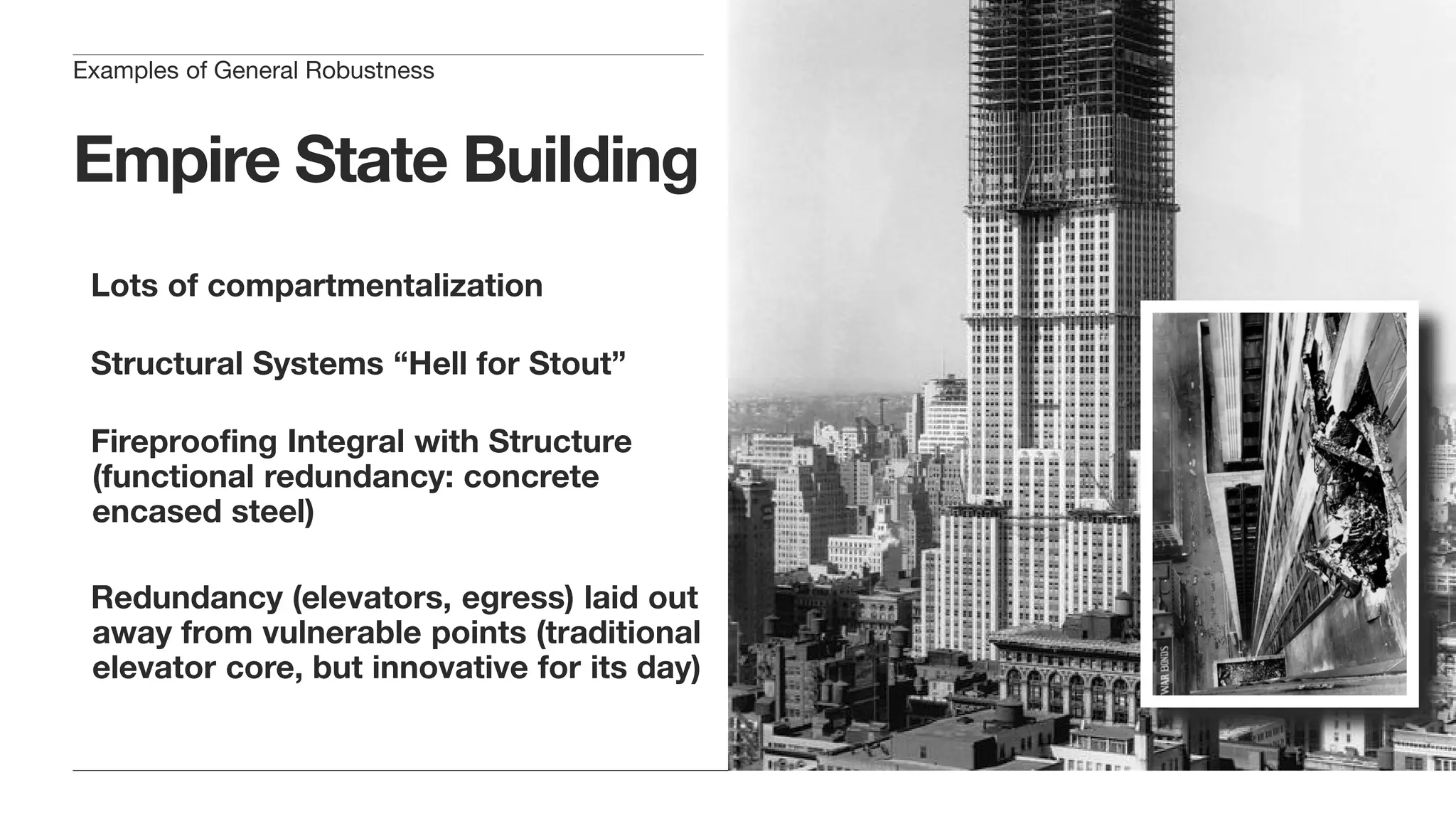
Empire State Building
Lots of compartmentalization
Structural Systems “Hell for Stout”
Fireproofing Integral with Structure
(functional redundancy: concrete
encased steel)
Redundancy (elevators, egress) laid out
away from vulnerable points (traditional
elevator core, but innovative for its day)
Examples of General Robustness
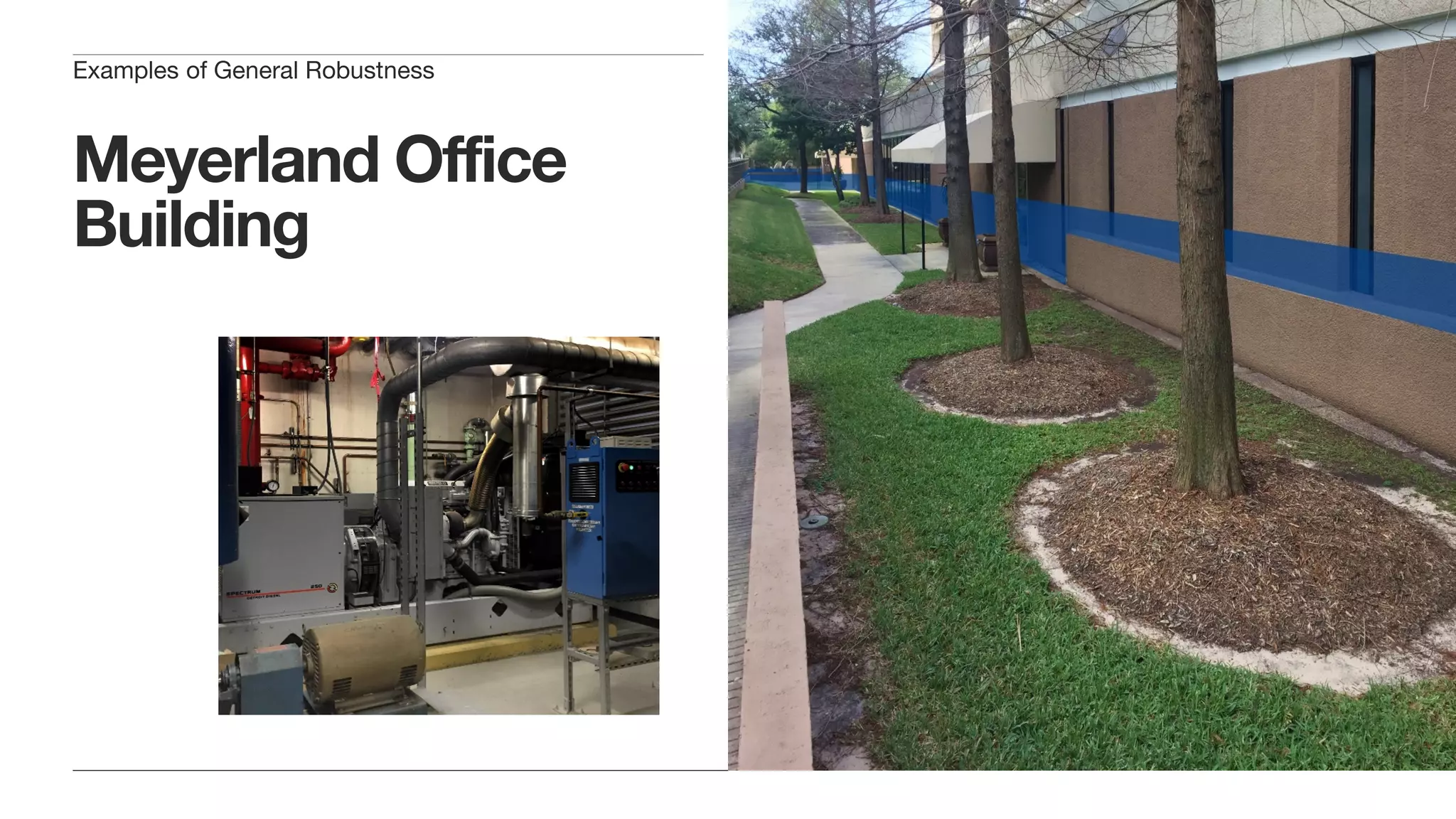
Meyerland Office
Building
Examples of General Robustness
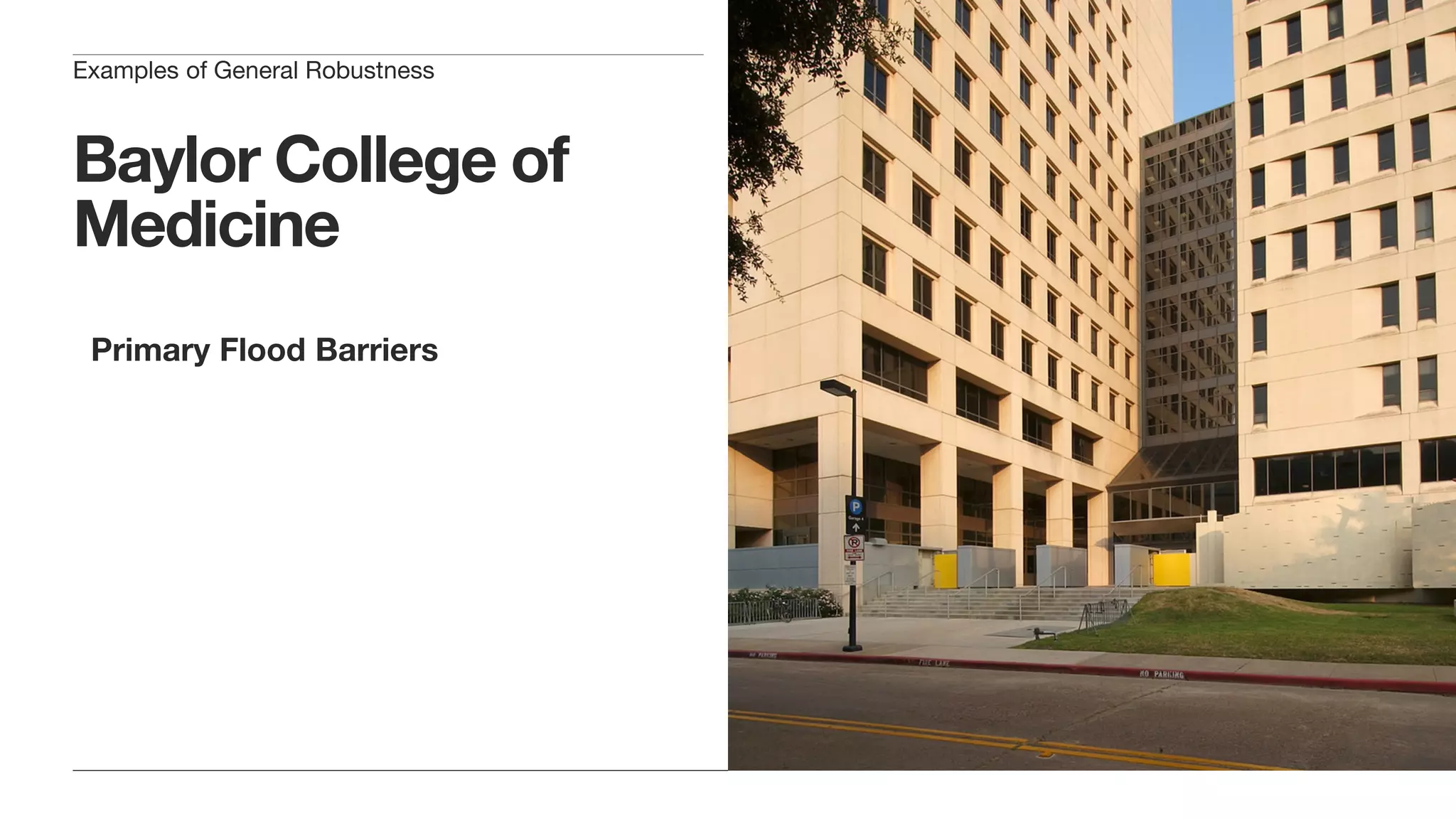
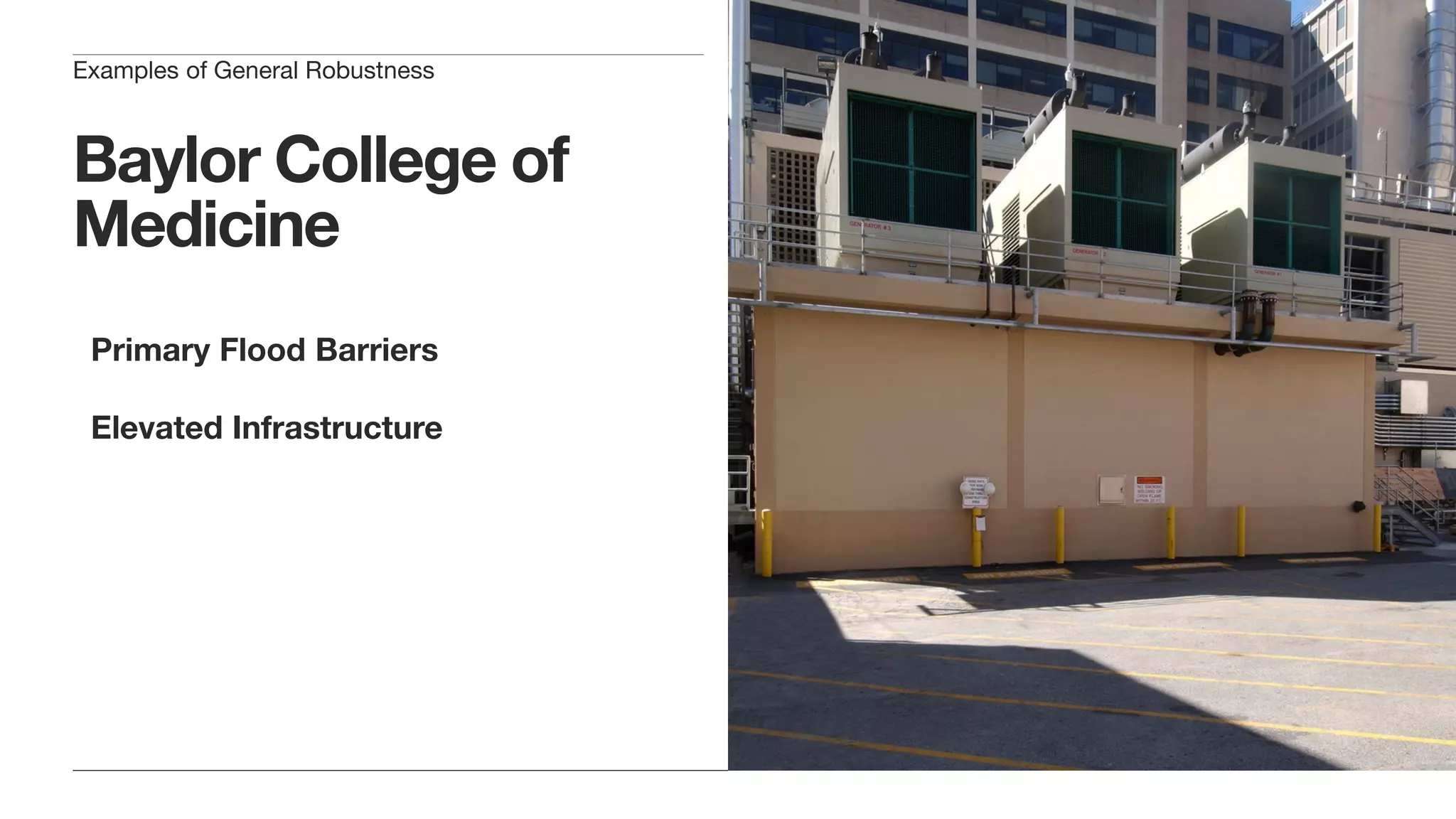
Baylor College of
Medicine
Primary Flood Barriers
Examples of General Robustness
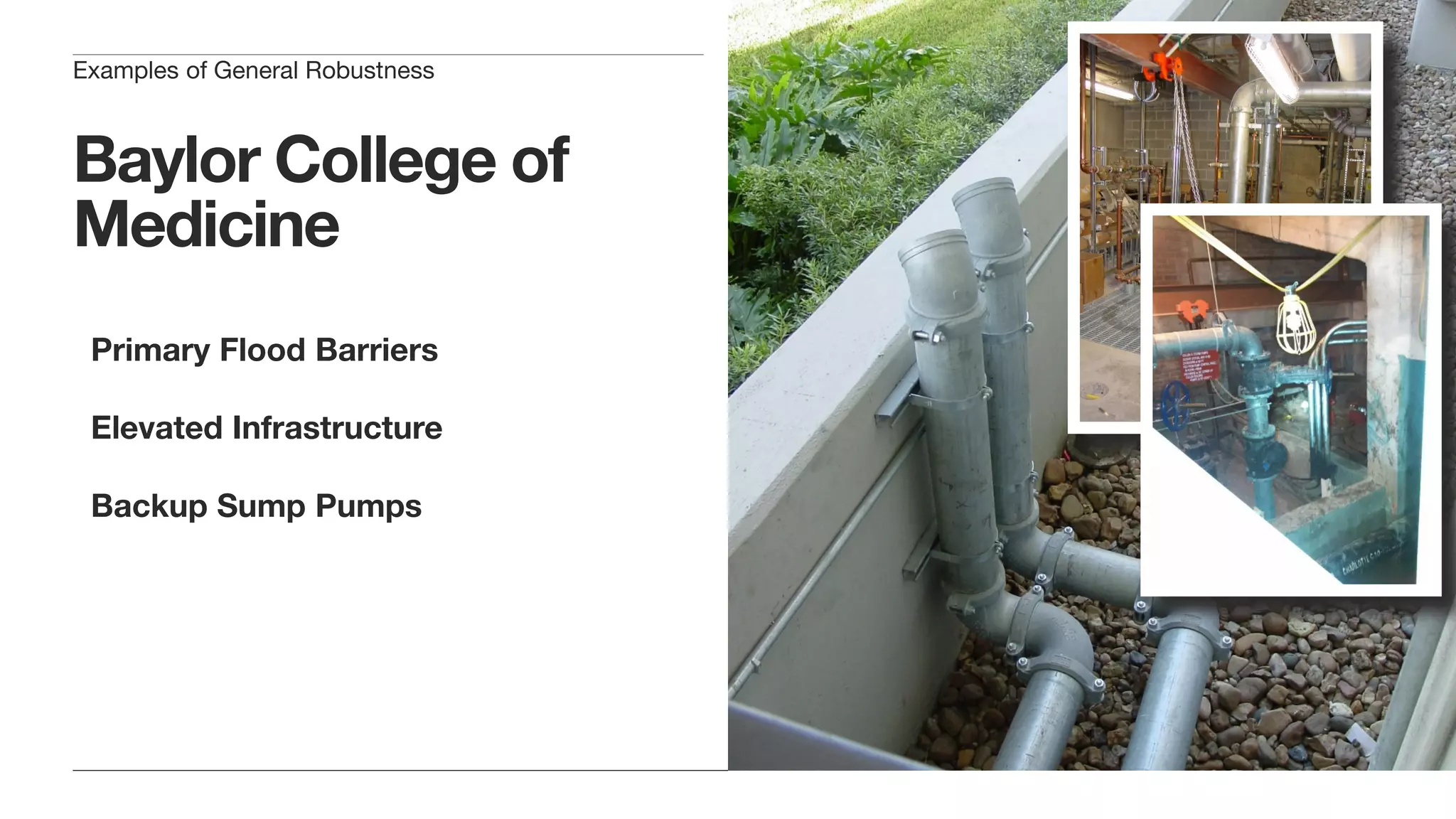
Baylor College of
Medicine
Primary Flood Barriers
Elevated Infrastructure
Examples of General Robustness
Baylor College of
Medicine
Primary Flood Barriers
Elevated Infrastructure
Backup Sump Pumps
Examples of General Robustness
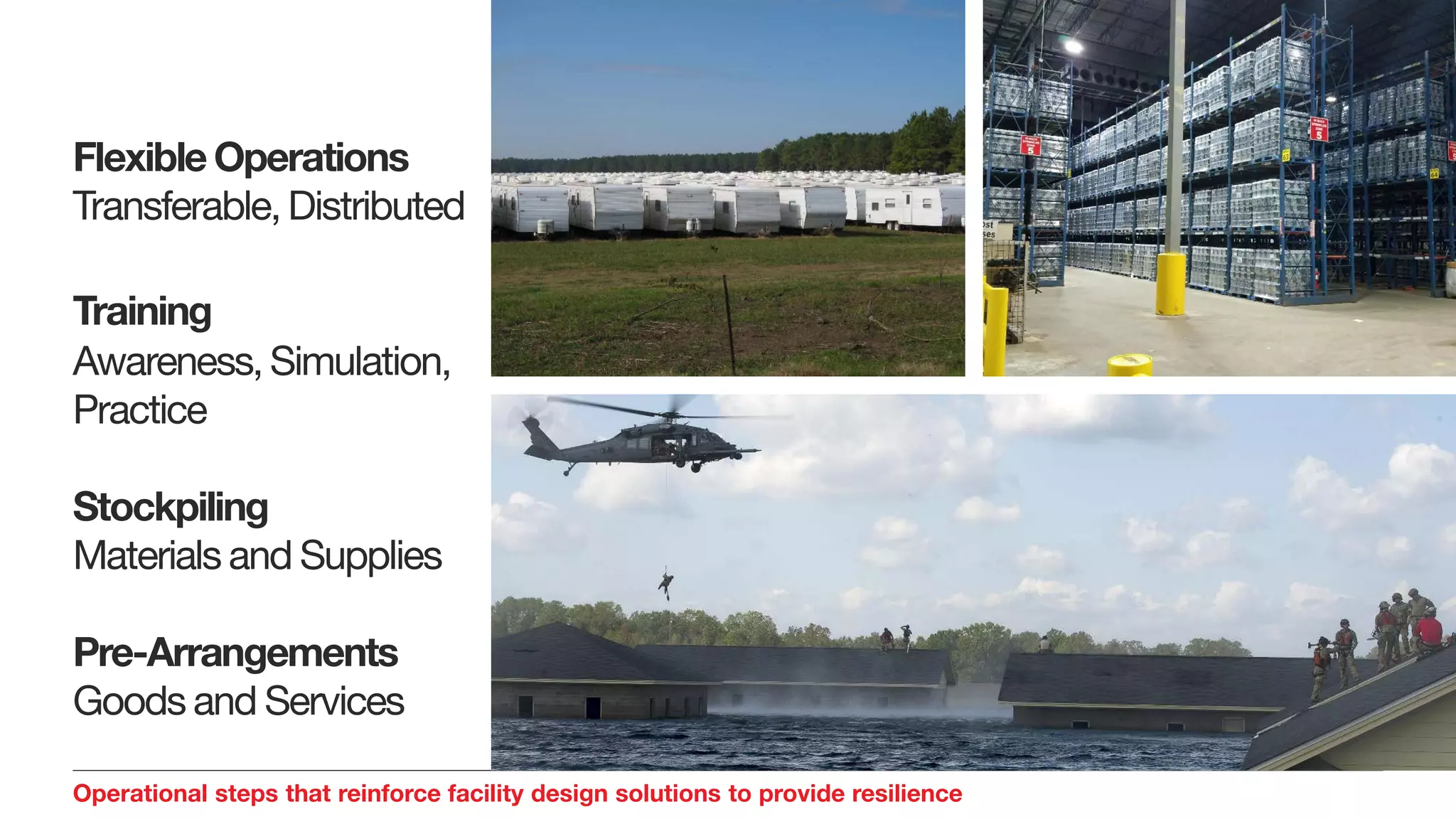
Operational steps that reinforce facility design solutions to provide resilience
Flexible Operations
Transferable, Distributed
Training
Awareness, Simulation,
Practice
Stockpiling
Materials and Supplies
Pre-Arrangements
Goods and Services
Preparing for a Black Swan: Planning and Programming for Risk Mitigation in Extreme Events

Preparing for a Black Swan: Planning and Programming for Risk Mitigation in Extreme Events

  • 1.
    1 June 2018 Preparingfor a Black Swan: Planning and Programming for Risk Mitigation in Extreme Events Scott Tucker, RA & Verrick Walker, PhD, LEED AP, CDT
  • 2.
    Contents/ i. How tothink about resilient design ii. Method for organizing and prioritizing iii. Illustrations
  • 3.
    conceptual framework how tothink bout resilient design
  • 4.
  • 5.
    Deliver Us FromFailure: How the Astros Endured Futility to Become World Series Champions LeBron James’ Cavaliers face elimination once again
  • 6.
    A/E Industry andGovernmental Perspectives What is resilience? Inherent durability or flexibility. When working within the built environment, it’s important to have foresight: incorporating changing environmental, social, and economic conditions into projects. This requires designs that are tough as well as flexible; providing the ability to not only bounce back, but forward. Ability to prepare for and adapt to changing conditions and withstand and recover rapidly from disruptions. Resilience includes the ability to withstand and recover from deliberate attacks, accidents, or naturally occurring threats or incidents.

  • 7.
    Disaster Mitigation andRisk Reduction Perspectives What is resilience? Center for Research on the Epidemiology of Disasters
  • 8.
    Disaster Mitigation andRisk Reduction Perspectives Resistance • Create the safest possible community that we have the knowledge to design and build in a natural hazard context Sustainability • Tolerate and overcome damage, diminished productivity, and reduced quality of life from an extreme event without significant outside assistance. Resilience • Recover or bounce back to normalcy after a disaster occurs What is resilience?
  • 9.
  • 10.
    Disaster Mitigation andRisk Reduction Perspectives What is resilience? Center for Research on the Epidemiology of Disasters Shift focus from Post-Disaster Improvisation towards Pre-Disaster Preparedness
  • 11.
    “Bomber Crash intoEmpire State Building” Case Study – UAB Engineering Archive (1997) A bomber crashing into a building is an extremely unlikely occurrence. However, the consequences of the collapse of a large building are very grave. How should the profession guard against rare, but severe events? In a large and complicated project, is there an obligation to go beyond building code requirements? For example, for nuclear reactor containment vessels, what extreme events should engineers consider? What about buildings subject to terrorist attacks?
  • 12.
    Buildings and infrastructure are partof a system/ network Resilient Design • Avoid system-wide failure • Allocate resources to implement preventative/protective/preservative measures What is resilience?
  • 13.
    The ones weknow • Those that are predicable, recurring • Those addressed by building codes, standards, best practices Those we don’t • Lies outside realm of expectation • Carries extreme impact • Causes are often determined after the fact; but never before A Black Swan What threats are we concerned about?
  • 14.
    What is aBlack Swan? An event that appears random, is extremely difficult to predict, and usually occurs unexpectedly— with a huge impact Sometimes referred to as a “HILF” – High Impact, Low Frequency Event Definition
  • 15.
    Black Swans are: •Not addressed by building codes • Not included in actuarial tables • Not accounted for in construction contingencies • And.. • Typically not provided for in facility designs How does it relate to facility planning?
  • 16.
    HIGH NATURAL MAN-MADE RISK MATRIX FOR INFRASTRUCTURE EXISTENTIAL THREAT LOW HIGHLOW FREQUENCY/LIKELIHOOD SEVERE HURRICANE WIND/FLOOD NATIONWIDE DISASTER LOCALIZED DISASTER ORDINARY HAZARDS LIGHTNINGSTRIKE POTENTIALIMPACT BLACK SWAN EARTHQUAKE VOLCANO ISOLATED TERRORISM CYBER ATTACK PROPERTY CRIMES PROLONGED NUCLEAR CONFLICT ASTEROID STRIKE CARRINGTON SCALE SOLAR STORM COORDINATED TERRORIST ATTACK YELLOWSTONE SUPERVOLCANO ERUPTION ROGUE STATE EMP ATTACK BUILDING FIRES FOREST/REGIONAL FIRES AIRLINER CRASH METEOR STRIKE MAJOR STRUCTURAL FAILURE Black Swans tend to occupy the upper-left of the diagram
  • 17.
    Why isn’t ourdesign more resilient? • We are trained to think about causes; then generate a solution based on our conception of the problem • We get busy thinking about why and how an event happened, and spend our time and resources addressing the purported cause, rather than the next (unpredictable) event Applying to Facilities
  • 18.
  • 19.
    How to broadenour thinking: • Built-in resilience: Address a broad range of threats using general responses, as a result of analysis that focuses on overall value • Value engineering vs. cost-cutting • Considering all conceivable threats, create system-wide robustness Applying to Facilities
  • 20.
  • 21.
    how do wedefine the problem?
  • 22.
    Assessment and Mitigationbased on a Hierarchical Survey of System Components Characterization • Establish Model facility • Identify scope and scale of potential hazards Assessment • Identify vulnerabilities for each system component contained within the Model Facility Mitigation • Define general corrective actions to address vulnerabilities How do we define the problem?
  • 23.
    Facility Component ProtectionConcept Matrix Threat1 Location3 Vulnerability4 Priority5 Countermeasures6 Asset2
  • 24.
    Facility Component ProtectionConcept Matrix Frequent appearance of the same response should reduce the chance of a Black Swan taking down the facility/system
  • 25.
    what do weprotect?
  • 26.
    16 Critical InfrastructureSectors (PPD-21, 2013) Chemical Commercial Facilities Communications Critical Manufacturing Dams Defense Industrial Base Emergency Services Energy Financial Services Food and Agriculture Government Facilities Healthcare and Public Health Information Technology Nuclear Reactors, Materials, and Waste Transportation Systems Water and Wastewater Systems What do we protect?
  • 27.
    16 Critical InfrastructureSectors (PPD-21, 2013) Chemical Commercial Facilities Communications Critical Manufacturing Dams Defense Industrial Base Emergency Services Energy Financial Services Food and Agriculture Government Facilities Healthcare and Public Health Information Technology Nuclear Reactors, Materials, and Waste Transportation Systems Water and Wastewater Systems What do we protect?
  • 28.
    Unique Critical Facilities(1-2) Hospitals (5-10) Water Treatment (10-15) Office Buildings, Recreational (>20) Grocery Stores (>30) Fuel Stations Number of Facilities ImportanceofFacilities Protect Redundancy Protect Facility System Vulnerability as a Function of Collective Exposure of Elements
  • 29.
    Unique Critical Facilities(1-2) Hospitals (5-10) Water Treatment (10-15) Office Buildings, Recreational (>20) Grocery Stores (>30) Fuel Stations Number of Facilities ImportanceofFacilities Preserve the minimum number of important facilities that are necessary to meet expected demand during a crisis Protect Redundancy Protect Facility System Vulnerability as a Function of Collective Exposure of Elements
  • 30.
    Learn from Nature: Redundancy= Insurance Big is Ugly, and Fragile The other Redundancy: Functional Redundancy; Multiple-Use Applying to Facilities
  • 31.
    How to helpFacilities be more Resistant to Black Swans Why we should overbuild: There are benefits from overbuilding that can ultimately increase resiliency Cumulative effect of many small improvements Scale matters Applying to Facilities – Lessons Learned
  • 32.
    Consider the System Focuson general vulnerabilities (system resilience) rather than specific causes & effects Provide redundancy in components, especially dependent components (redundancy) “Harden” individual components for many kinds of threats (functional redundancy) Find common solutions for various threats (resilience) Applying to Facilities HARDEN VULNERABLE SUBSYSTEM COMPONENTS MITIGATION PLAN SEMICONDUCTOR ELECTRONICS IDENTIFY VULNERABLE COMPONENTS HF ANTENNAE GROUNDING DEFICIENCIES WAVEGUIDE APERTURES INPUT THREAT CRITERIA
  • 33.
    Generic Facility Component ProtectionConcept Matrix System Component Vulnerability Solution Vulnerability Solution Vulnerability Solution Item 1 Damage Harden Damage Make Redundant Damage Sacrifice Item 2 Failure Sacrifice Upset Harden Failure Stock & Replace Item 3 Failure Stock & Replace Failure Sacrifice Failure Repair Item 4 Damage Repair Damage Harden Damage Make Redundant Item 5 Upset Make Redundant None Sacrifice Failure Harden Item 6 Failure Harden Failure Stock & Replace None Sacrifice Item 7 None Sacrifice Failure Repair Upset Harden Threat 1 Threat 2 Threat 3
  • 34.
    Building Facility Component ProtectionConcept Matrix System Component Vulnerability Solution Vulnerability Solution Vulnerability Solution Building Damage Raise 1st Floor Wet/Dry Floodproof Damage Structural & Infiltration Design Loss of Envir Control, Communication Hardened MEP Standby Power Exterior Walls Leak Move Openings Above BFE, Seal All Others Damage Structural Design None N/A Doors/Glazing Damage/Leak Structural & Infiltration Resistant Damage/Leak Structural & Infiltration Resistant Secure Access Failure Standby Power Electrical System Damage Standby Power Raise/Harden Components Damage Harden Elect Components Redundancy Failure Standby Power System Fuel Stockpile Mechanical System Dependent on Electrical Standby Power Raise/Harden Redundancy None Harden Elect Components Redundancy Failure Standby Power Interior Finishes Damage Flood Resistant Materials None N/A Mold, Corrosion Standby Power Flood Resistant Materials Roof None N/A Damage Structural Design Wind-Rated Sys None N/A Flood Hurricane-Wind Extended Power Loss
  • 35.
    Data Center Facility ComponentProtection Concept Matrix System Component Vulnerability Solution Vulnerability Solution Vulnerability Solution Bldg Enclosure Physical Damage Fire Resistance Compartmen- talization Damage to Electronics EMI Shield, Hardened Electronics Physical Damage Concrete or Ballistic Materials Standby Generators Physical Damage Redundancy Fire-Rated Enclosures & Fuel Tanks Damage to Electronics Shielded Ctrl Enclosures, Connections Physical Damage Hardened Enclosures Transformers Physical Damage Redundancy Fire-Rated Enclosures Long-Wire Currents Neutral Blocking Device Hardened Design Physical Damage Hardened Barrier or Enclosure, Coolant Tank Main Switchgear Physical Damage Redundancy Fire-Rated Enclosures Minimal Shield or Harden Electronic Control Devices Physical Damage Hardened Barrier HVAC Physical Damage, Smoke Transfer Redundancy Fire-Rated Enclosures, Dampers & Controls Upset, Loss of Control Shield or Harden Electronic Control Devices Physical Damage Hardened Barriers, Redundant Components Fire Sprinkler-Life Safety Physical Damage Cross-zoning; Redundancy Upset, Damage to Electronics Replacement after Event Mimimal Repair after Event Data Processing & Storage Systems Damage, Upset, Data Loss Clean Agent VESDA or Pre- Action System Damage, Upset, Data Loss Room or Rack Shielding, Hardened Equipment Physical Damage Hardened Barriers, Redundant Components Fire HEMP-GIC Firearm Attack
  • 36.
  • 37.
    Achieving General Robustness: Examples display: Cross-disciplinarysolutions Multiple-Hazard Criteria Redundancy Flexibility (Functional Redundancy) Fault-Tolerant Design Applying to Facilities – Lessons Learned
  • 38.
    World Trade Center Lackof compartmentalization Specialized Structural Systems Designed for Efficiency, Economy Fireproofing did not address large physical impact Insufficient redundancy (elevators, egress) Examples of General Robustness
  • 39.
    Empire State Building Lotsof compartmentalization Structural Systems “Hell for Stout” Fireproofing Integral with Structure (functional redundancy: concrete encased steel) Redundancy (elevators, egress) laid out away from vulnerable points (traditional elevator core, but innovative for its day) Examples of General Robustness
  • 40.
  • 41.
    Baylor College of Medicine PrimaryFlood Barriers Examples of General Robustness
  • 42.
    Baylor College of Medicine PrimaryFlood Barriers Elevated Infrastructure Examples of General Robustness
  • 43.
    Baylor College of Medicine PrimaryFlood Barriers Elevated Infrastructure Backup Sump Pumps Examples of General Robustness
  • 44.
    Operational steps thatreinforce facility design solutions to provide resilience Flexible Operations Transferable, Distributed Training Awareness, Simulation, Practice Stockpiling Materials and Supplies Pre-Arrangements Goods and Services