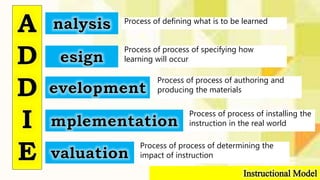
Process of defining what is to be learned
Process of process of specifying how
learning will occur
Process of process of authoring and
producing the materials
Process of process of installing the
instruction in the real world
Process of process of determining the
impact of instruction
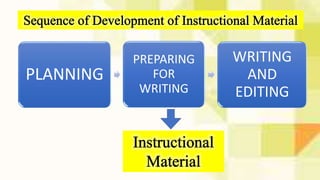
PLANNING
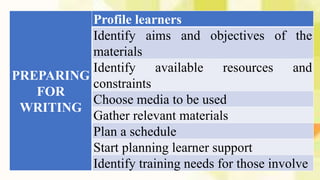
PREPARING
FOR
WRITING
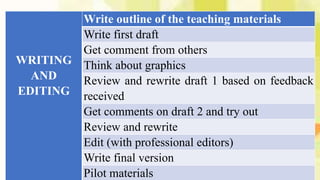
WRITING
AND
EDITING
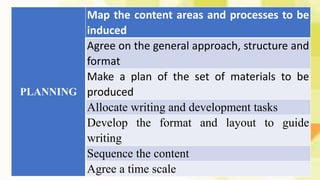
PLANNING
Map the content areas and processes to be
induced
Agree on the general approach, structure and
format
Make a plan of the set of materials to be
produced
Allocate writing and development tasks
Develop the format and layout to guide
writing
Sequence the content
Agree a time scale
PREPARING
FOR
WRITING
Profile learners
Identify aims and objectives of the
materials
Identify available resources and
constraints
Choose media to be used
Gather relevant materials
Plan a schedule
Start planning learner support
Identify training needs for those involve
WRITING
AND
EDITING
Write outline of the teaching materials
Write first draft
Get comment from others
Think about graphics
Review and rewrite draft 1 based on feedback
received
Get comments on draft 2 and try out
Review and rewrite
Edit (with professional editors)
Write final version
Pilot materials
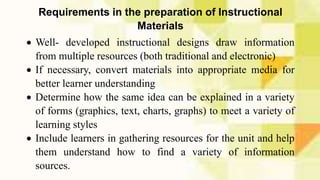
Requirements in the preparation of Instructional
Materials
ď‚· Well- developed instructional designs draw information
from multiple resources (both traditional and electronic)
ď‚· If necessary, convert materials into appropriate media for
better learner understanding
ď‚· Determine how the same idea can be explained in a variety
of forms (graphics, text, charts, graphs) to meet a variety of
learning styles
ď‚· Include learners in gathering resources for the unit and help
them understand how to find a variety of information
sources.
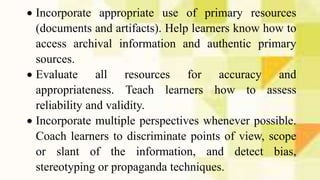
ď‚· Incorporate appropriate use of primary resources
(documents and artifacts). Help learners know how to
access archival information and authentic primary
sources.
ď‚· Evaluate all resources for accuracy and
appropriateness. Teach learners how to assess
reliability and validity.
ď‚· Incorporate multiple perspectives whenever possible.
Coach learners to discriminate points of view, scope
or slant of the information, and detect bias,
stereotyping or propaganda techniques.
In preparing instructional materials, one need to have
the expertise in the following:
ď‚· Knowing and understanding the elements of a subject field: the
concepts, terminology, definitions, methods and theories and
models.
ď‚· Learning to use the methods and techniques that are specific to
the subject
ď‚· Mastering the process of acquisition and presentation of
scientific knowledge
ď‚· Acquiring a critical mind
ď‚· Learning to research and use specialized literature as well as all
other documentary sources
THANK YOU FOR LISTENING!!!

Preparation and Development of IMS

  • 5.
    Process of definingwhat is to be learned Process of process of specifying how learning will occur Process of process of authoring and producing the materials Process of process of installing the instruction in the real world Process of process of determining the impact of instruction
  • 6.
  • 7.
    PLANNING Map the contentareas and processes to be induced Agree on the general approach, structure and format Make a plan of the set of materials to be produced Allocate writing and development tasks Develop the format and layout to guide writing Sequence the content Agree a time scale
  • 8.
    PREPARING FOR WRITING Profile learners Identify aimsand objectives of the materials Identify available resources and constraints Choose media to be used Gather relevant materials Plan a schedule Start planning learner support Identify training needs for those involve
  • 9.
    WRITING AND EDITING Write outline ofthe teaching materials Write first draft Get comment from others Think about graphics Review and rewrite draft 1 based on feedback received Get comments on draft 2 and try out Review and rewrite Edit (with professional editors) Write final version Pilot materials
  • 10.
    Requirements in thepreparation of Instructional Materials ď‚· Well- developed instructional designs draw information from multiple resources (both traditional and electronic) ď‚· If necessary, convert materials into appropriate media for better learner understanding ď‚· Determine how the same idea can be explained in a variety of forms (graphics, text, charts, graphs) to meet a variety of learning styles ď‚· Include learners in gathering resources for the unit and help them understand how to find a variety of information sources.
  • 11.
    ď‚· Incorporate appropriateuse of primary resources (documents and artifacts). Help learners know how to access archival information and authentic primary sources. ď‚· Evaluate all resources for accuracy and appropriateness. Teach learners how to assess reliability and validity. ď‚· Incorporate multiple perspectives whenever possible. Coach learners to discriminate points of view, scope or slant of the information, and detect bias, stereotyping or propaganda techniques.
  • 12.
    In preparing instructionalmaterials, one need to have the expertise in the following: ď‚· Knowing and understanding the elements of a subject field: the concepts, terminology, definitions, methods and theories and models. ď‚· Learning to use the methods and techniques that are specific to the subject ď‚· Mastering the process of acquisition and presentation of scientific knowledge ď‚· Acquiring a critical mind ď‚· Learning to research and use specialized literature as well as all other documentary sources
  • 13.
    THANK YOU FORLISTENING!!!